Calculus 1 Lecture 0.1
Lines, Angle of Inclination, and the Distance Formula
Introduction
- [0:01]
Introduction
- Review of Math 2 concepts and basic algebra needed for Calculus.
- Topics to cover:
- Basic lines.
- Families of curves.
- Trigonometric functions.
- Introduction to Calculus.
Lines
-
[0:34]
Lines –
[image]
- What is special about a line?
- You need at least two points to define a line.
- Lines do not curve.
- Lines do not end.
- Lines have slope.
- [1:03] What
do we need to graph a line?
- Two points or . . .
- . . . One point and the slope
- [1:10]
Slope of a Line
- The slope describes how a line rises or falls.
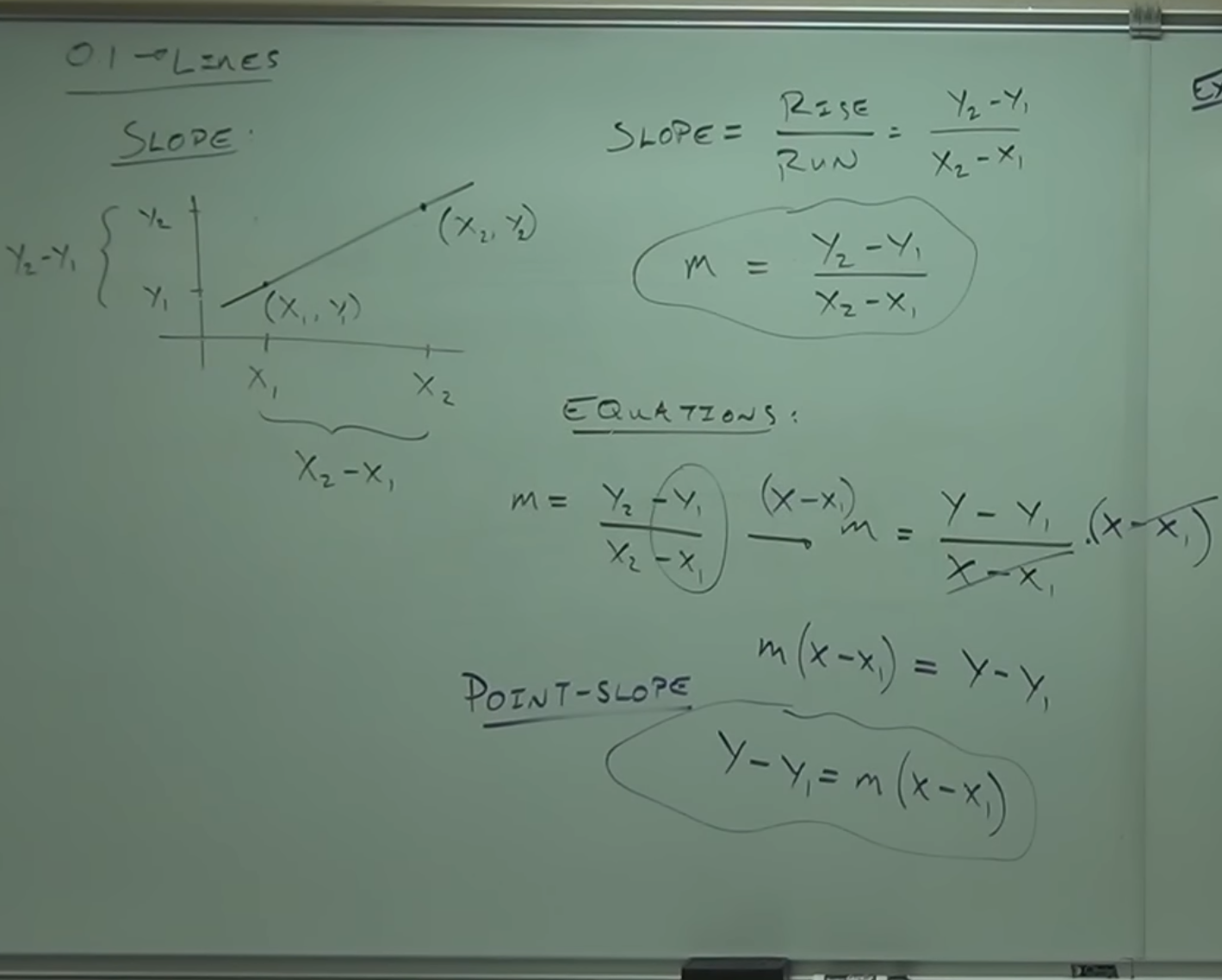
- Deriving the slope formula:
- Take two generic points on a line: $(𝒙_1,𝒚_1)$ and $(𝒙_2,𝒚_2)$.
- Coordinates of a point $(𝒙,𝒚)$.
- Distinguishing two points using subscripts.
- Calculating the “run” (change in 𝒙): $𝒙_2-𝒙_1$.
- Calculating the “rise” (change in 𝒚): $𝒚_2-𝒚_1$.
- [3:30] Defining the slope $(𝒎)$ as rise over run:
- $\boxed{\Large 𝒎=\dfrac{𝒚_2-𝒚_1}{𝒙_2-𝒙_1}}$
- The formula works for any pair of points on the line.
- [5:39]
Equation of a Line from the Slope Formula
- Manipulating the slope formula to get the equation of a line.
- Fix one point $(𝒙_1,𝒚_1)$ and let the other point be variable $(𝒙,𝒚)$.
- Substituting into the slope formula:
- $\boxed{\Large 𝒎=\dfrac{𝒚-𝒚_1}{𝒙-𝒙_1}}$
- The resulting equation allows solving for 𝒚 when a value for 𝒙 is provided.
- Isolating $(𝒚-𝒚_1)$
- $\boxed{\Large 𝒚-𝒚_1=𝒎(𝒙-𝒙_1)}$
- Called point-slope form because you need one point $(𝒙_1,𝒚_1)$ and the slope
$(𝒎)$ to define it.
-
[9:40]
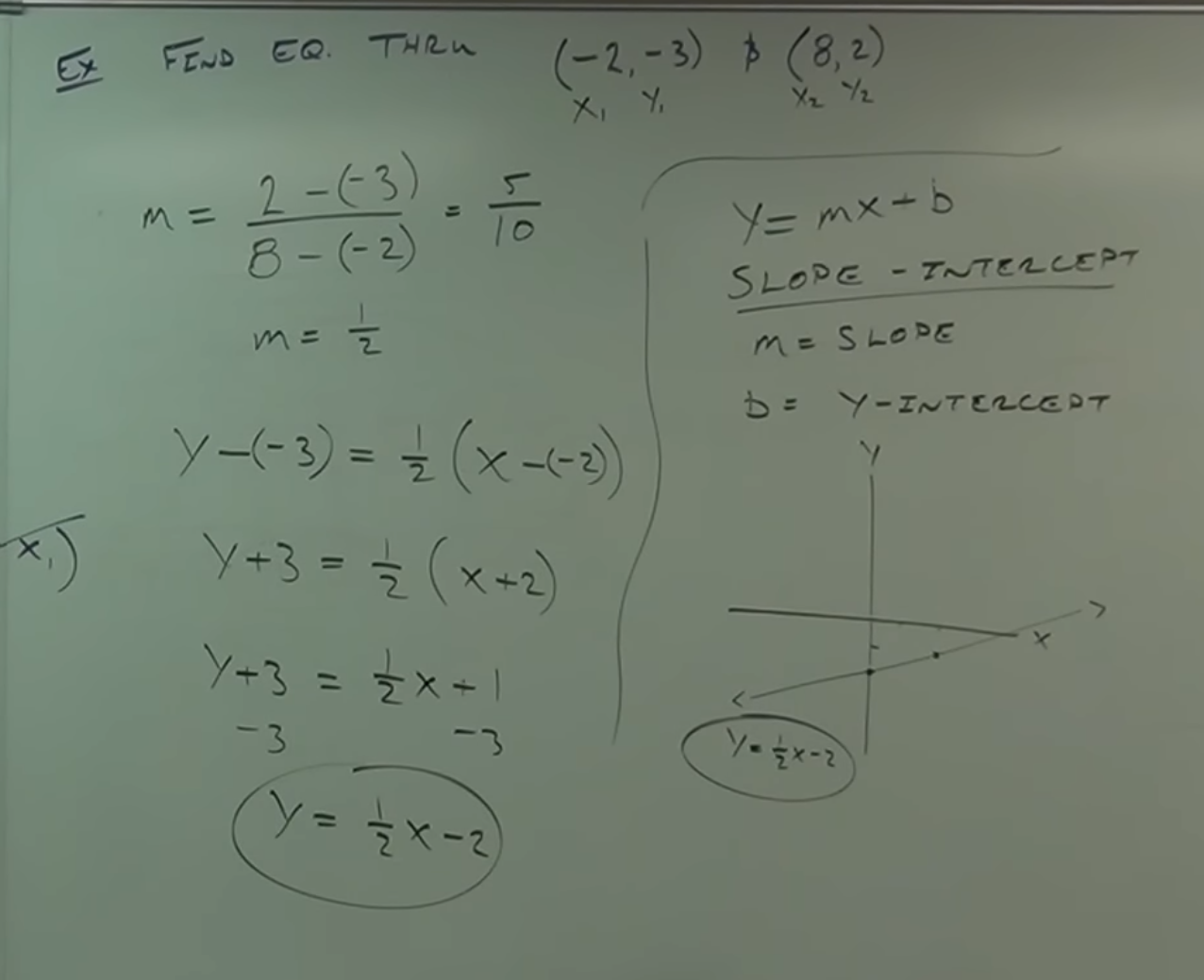
🧩 Example – Finding a Line’s Equation Given Two Points: $(-2,-3)$ and $(8,2)$ –
[image]
- Necessary steps:
- We need one point (we have two).
- We need the slope (we must calculate it).
- Calculating the slope using the two given points:
- $𝒎=\dfrac{2-(-3)}{8-(-2)}=\dfrac{5}{10}=\dfrac{1}{2}$
- Using the point-slope form to find the equation:
- $𝒚-(-3)=\dfrac{1}{2}(𝒙-(-2))$
- $𝒚+3=\dfrac{1}{2}(𝒙+2)$
- $𝒚+3=\dfrac{1}{2}𝒙+1$
- $𝒚=\dfrac{1}{2}𝒙-2$
- [15:10]
Slope-Intercept Form of a Line’s Equation
- Transforming the point-slope form to slope-intercept form
- $\displaystyle \boxed{\Large 𝒚=𝒎𝒙+𝒃}$
- Identifying the slope $(𝒎)$ and the 𝒚-intercept $(𝒃)$.
- 🧩 Example – Graphing using slope-intercept form.
- Interpretation of positive or negative slope.
- Two points define a unique line.
- $𝒚=\dfrac{1}{2}𝒙-2$
- $𝒃=-2$ point $(0,-2)$
- $𝒎=\dfrac{1}{2}$; from $(0,2)$ one unit up (rise) ⇡ and two units to the
right ⇢ (run)
- $(-1,2)$ is the second point
-
[17:24]
Special Types of Lines –
[image]

-
[17:46]
Horizontal lines: $𝒚=𝒄$ (where 𝒄 is a constant).
- Intersects the 𝒚-axis at 𝒄.
- Slope is zero.
- [18:45]
Vertical lines: $𝒙=𝒄$ (where 𝒄 is a constant).
- Intersects the 𝒙-axis at 𝒄.
- Slope is undefined.
-
[19:50]
Standard Form of a Line’s Equation –
[image]
- [21:52]
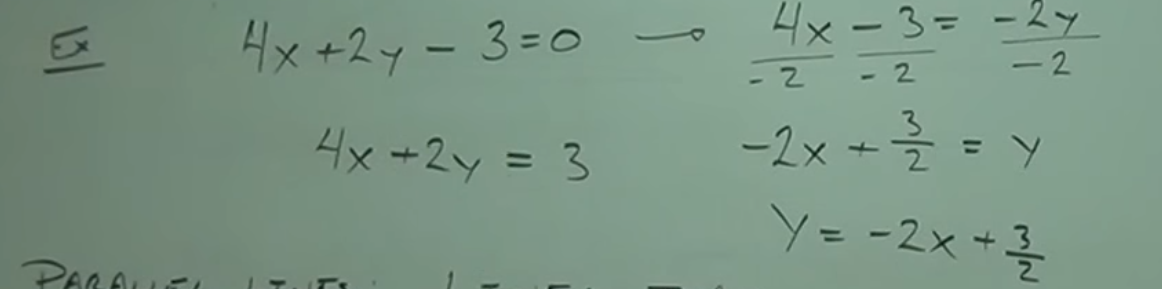
🧩 Example – Converting from standard form to slope-intercept form by isolating 𝒚: $4𝒙+2𝒚-3=0 \;\to\;
𝒚=𝒎𝒙+𝒃$
- Start from the standard form:
- Move the constant term to the other side:
- Divide each term to isolate 𝒚:
- $\dfrac{4𝒙-3}{-2}=-2𝒙+\dfrac{3}{2}=𝒚$
- Final slope–intercept form:
- $𝒚=-2𝒙+\dfrac{3}{2}$
- Here, slope $𝒎=-2$ and intercept $𝒃=\dfrac{3}{2}$
- [22:02]
Cover-Up Method for Graphing from Standard Form
- To find the 𝒙-intercept, cover the term with 𝒚.
- To find the 𝒚-intercept, cover the term with 𝒙.
- 🧩 Example – $3𝒙+4𝒚=4$ ($𝒙$-intercept at $\dfrac{4}{3}$, $𝒚$-intercept at $1$).
- [23:02]
Parallel Lines
- Have the same slope.
- Stair analogy: both rise or fall at the same rate, never intersecting.
- Algebraic condition for parallelism:
- Two lines $𝑦=𝒎_1𝑥+𝒃_1$ and $𝑦=𝒎_2𝑥+𝒃_2$ are parallel iff $𝒎_1=𝒎_2$ but
$𝒃_1\neq𝒃_2$.
- Different intercepts $(𝒃_1,𝒃_2)$ shift the lines vertically without changing slope.
- Geometric interpretation: equal slope ⇒ same inclination angle with respect to the
𝒙-axis.
- [23:39]
Perpendicular Lines
- Intersect at a right angle (90°).
- If one slope is positive, the other is negative.
- Their slopes are negative reciprocals:
- $\displaystyle \boxed{\Large 𝒎_1\cdot𝒎_2=-1}$
- Example: if $𝒎_1=2$, then $𝒎_2=-\dfrac{1}{2}$
- Special case (vertical and horizontal lines):
- A vertical line (undefined slope) and a horizontal line (slope $=0$) are perpendicular
even though $𝒎_1\cdot𝒎_2\neq-1$ (since one slope is undefined).
- Visual cue: perpendicular lines form a “T” or “L” shape where they intersect.
-
[25:24]
🧩 Example – Parallel to $2𝒙+3𝒚=12$ through $(6,7)$ –
[image]
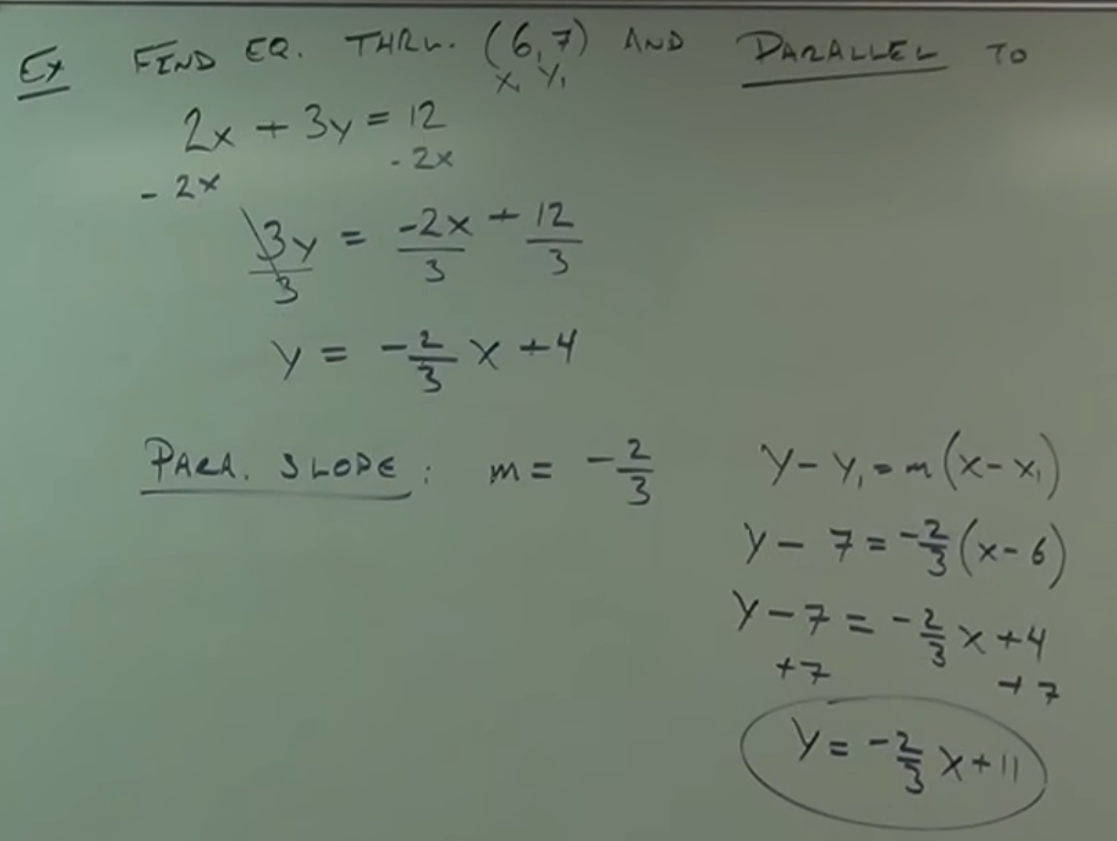
- Identify the slope of the given line (in slope-intercept form):
- $2𝒙+3𝒚=12$
- $3𝒚=-2𝒙+12$
- $𝒚=-\dfrac{2}{3}𝒙+4$
- The slope of the parallel line is the same: $𝒎=-\dfrac{2}{3}$
- Use the point-slope form with the point $(6,7)$ and the parallel slope:
- $𝒚-𝒚_1=𝒎(𝒙-𝒙_1)$
- $𝒚-7=-\dfrac{2}{3}(𝒙-6)$
- $𝒚-7=-\dfrac{2}{3}𝒙+4$
- $𝒚=-\dfrac{2}{3}𝒙+11$
-
[29:50]
🧩 Example – Perpendicular to $2𝒙+3𝒚=12$ through $(6,7)$ –
[image]
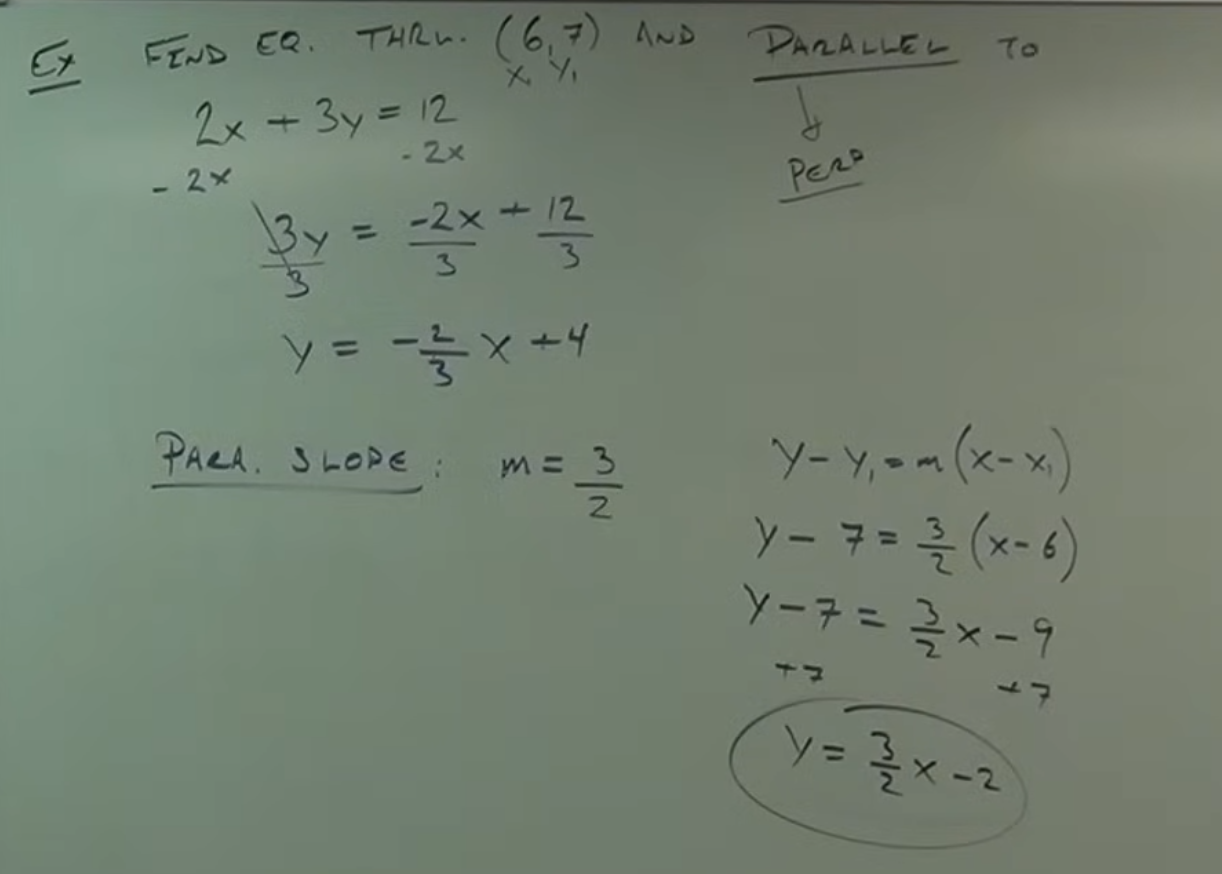
- $𝒎=-\dfrac{2}{3} \;\to\; 𝒎=\dfrac{3}{2}$ (negative reciprocals)
- Use the point-slope form:
- $𝒚-𝒚_1=𝒎(𝒙-𝒙_1)$
- $𝒚-7=\dfrac{3}{2}(𝒙-6)$
- $𝒚-7=\dfrac{3}{2}𝒙-9$
- $𝒚=\dfrac{3}{2}𝒙-2$
Angle of Inclination
-
[32:10]
Angle of Inclination –
[image]
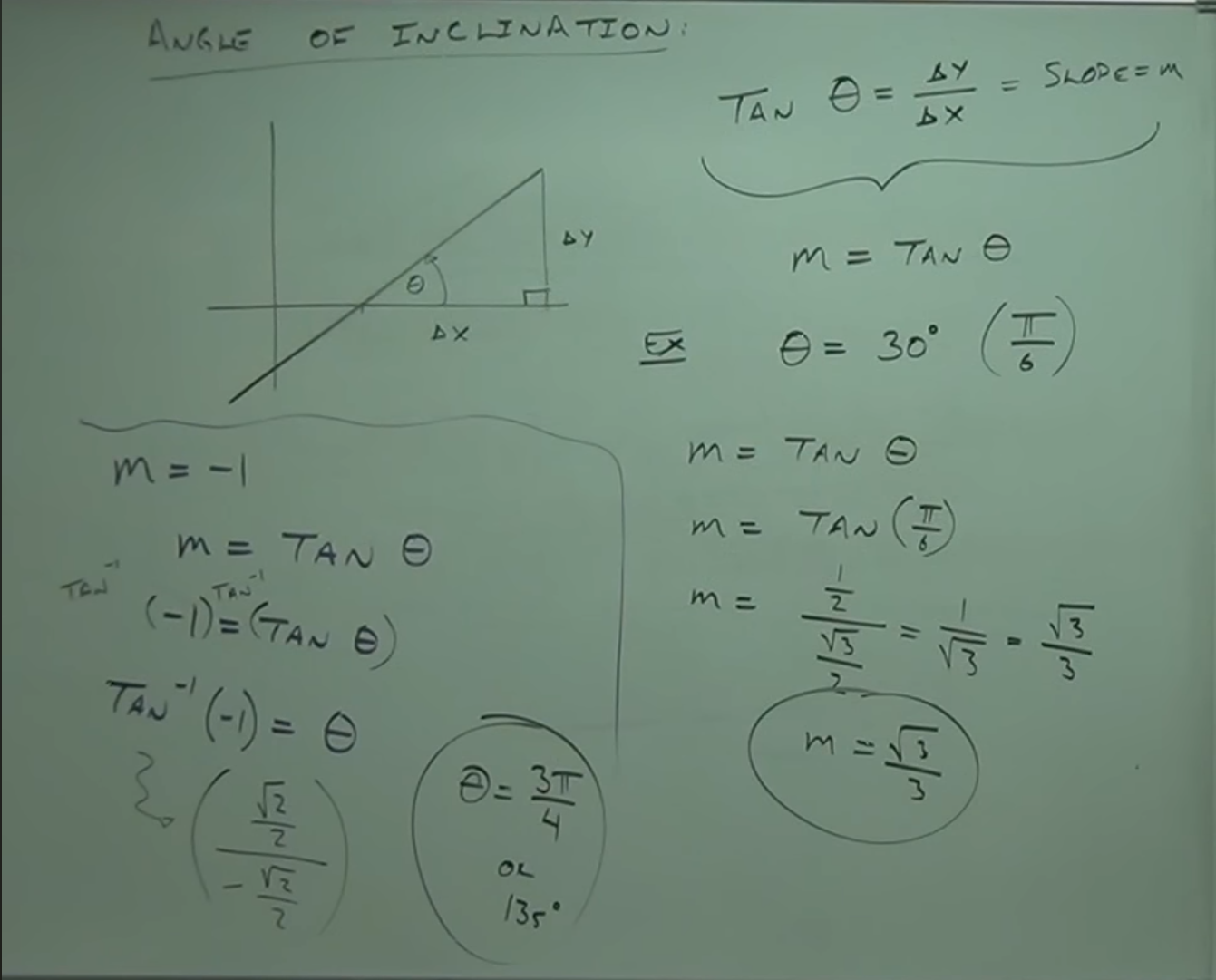
- Definition: The angle a line forms with the positive 𝒙-axis.
- Relationship with change in 𝒙 $(\Delta 𝒙)$ and change in 𝒚 $(\Delta 𝒚)$.
- Using basic trigonometry on a right triangle formed by the line, $\Delta 𝒙$, and $\Delta
𝒚$.
- The tangent of the angle of inclination $(𝜃)$ equals the slope $(𝒎)$:
- $\displaystyle \boxed{\Large \tan(𝜃)=\dfrac{\Delta 𝒚}{\Delta 𝒙}=𝒎}$
- If the angle is known, the slope can be found; if the slope is known, the angle can be
found.
- [35:50]
🧩 Example – Given the Angle of Inclination: $30^\circ$ or $\dfrac{\pi}{6}$
- Using the formula $𝒎=\tan(𝜃)$.
-
$\tan\!\big(\dfrac{\pi}{6}\big)=\dfrac{\sin(\pi/6)}{\cos(\pi/6)}=\dfrac{1/2}{\sqrt{3}/2}=\dfrac{1}{\sqrt{3}}=\dfrac{\sqrt{3}}{3}$
-
[39:00]
🧩 Example – Given the Slope: $𝒎=-1$
- Using $\tan(𝜃)=𝒎 \;\to\; -1=\tan(𝜃)$
- Applying the inverse tangent: $𝜃=\tan^{-1}(-1)$
- Interpreting the inverse tangent: finding the angle whose tangent is $-1$.
- Using the unit circle to find angles where sine and cosine have equal magnitudes but
opposite signs:
- $135^\circ$ → Second quadrant
- $315^\circ$ → Fourth quadrant
- Importance of practicing these trigonometric concepts.
- Trigonometry will be used extensively in Calculus.
Distance Formula
-
[44:20]
Distance Formula –
[image]
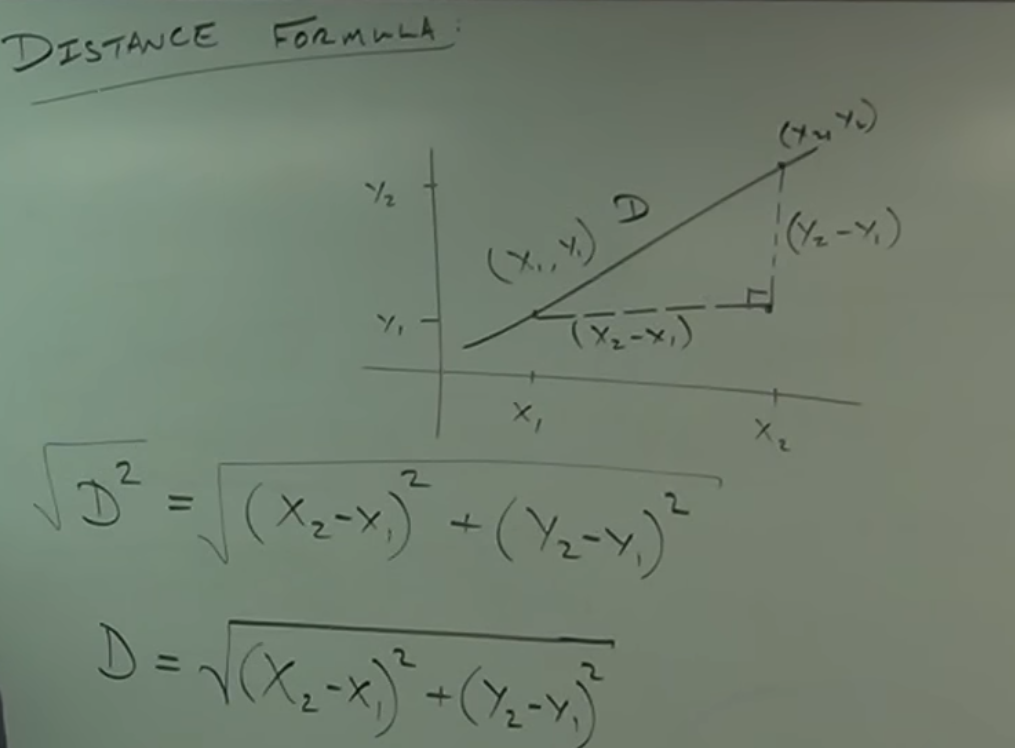
- Derived using two random points $(𝒙_1,𝒚_1)$ and $(𝒙_2,𝒚_2)$.
- Forming a right triangle with sides $|𝒙_2-𝒙_1|$ and $|𝒚_2-𝒚_1|$.
- Applying the Pythagorean Theorem: $𝒅^2=(𝒙_2-𝒙_1)^2+(𝒚_2-𝒚_1)^2$
- Solving for distance 𝒅:
- $\displaystyle \boxed{\Large 𝒅=\sqrt{(𝒙_2-𝒙_1)^2+(𝒚_2-𝒚_1)^2}}$
- We omit the negative root because distance cannot be negative.