Calculus 1 Lecture 0.2
Introduction to Functions
Introduction
-
[00:01]
Introduction
– [📷image]
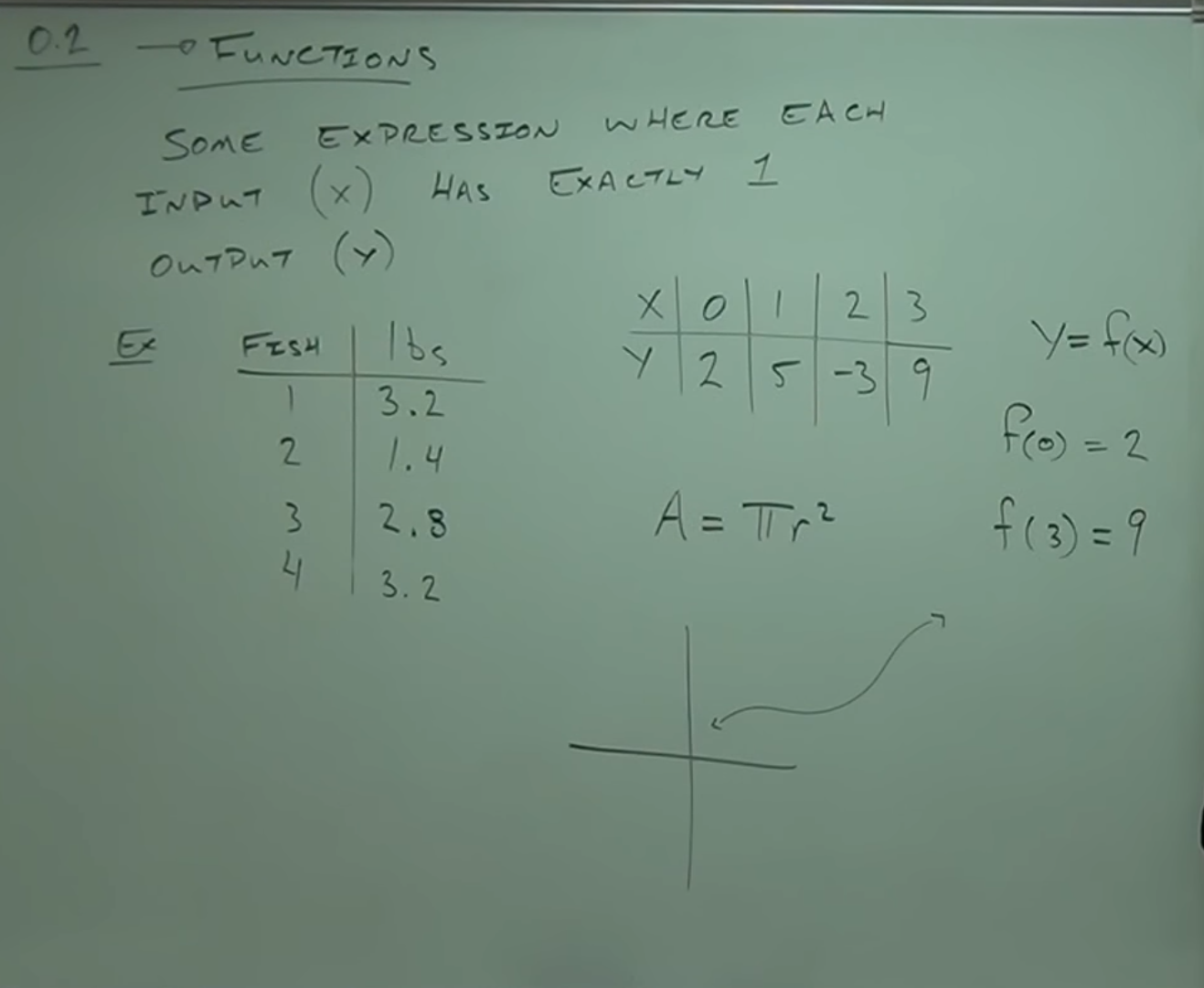
- Presentation of the topic: Functions (Section 0.2)
- Initial definition of a function: one variable depends on another (e.g., $𝒚$ depends on
$𝒙$)
- Fundamental condition for a function: each input has exactly one output
- If one input had multiple outputs, it would not be a function
- Common notation for inputs ($𝒙$) and outputs ($𝒚$ or $𝒇(𝒙)$)
- Ways to represent functions
- Tables
-
[02:00]
🧩 Example – Function table: Fish caught and their weight
- Clarification about having specific outputs for each input
- It is allowed for different inputs to share the same output
-
[05:25]
Reference table for a function:
- $\displaystyle
\begin{array}{c|cccc}
x & 0 & 1 & 2 & 3 \\ \hline
y & 2 & 5 & -3 & 9
\end{array}$
-
[05:50]
Reference table for not a function.
- $\displaystyle
\begin{array}{c|cccc}
x & 0 & 1 & 2 & 3 & 2\\ \hline
y & 2 & 5 & -3 & 9 & 7
\end{array}$
-
[07:05]
🧩 Example – if $𝒚=𝒇(𝒙)$, find $𝒇(0)$
- Reference table for examples:
- $\displaystyle
\begin{array}{c|cccc}
x & 0 & 1 & 2 & 3 \\ \hline
y & 2 & 5 & -3 & 9
\end{array}$
- Interpreting $𝒇(0)$ as the output when the input is 0
- Another example: find $𝒇(3)$
- Formulas
- Graphs
Function notation
-
[07:05]
Typical application with equations (e.g., $𝒚=3𝒙^{2}-4𝒙+2$)
– [📷image]
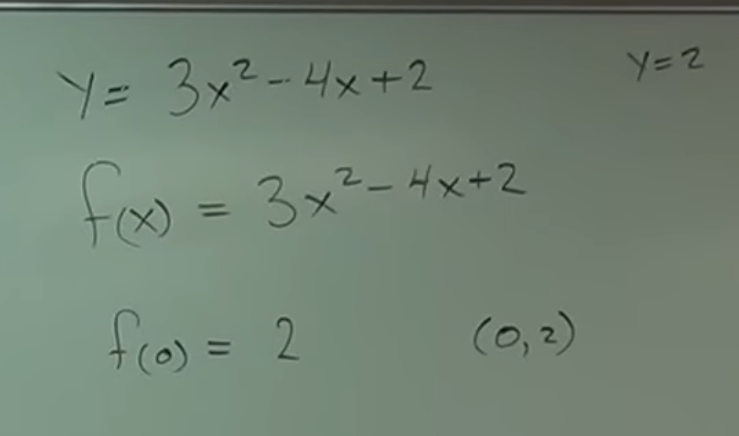
- Isn't the best way to represent a function because when we are looking at two different
functions at once, we are not going to distinguish between them.
-
[08:24]
Advantages of using $𝒇(𝒙)$, $𝓰(𝒙)$, $𝒉(𝒙)$
- Helps distinguish between multiple functions
- 🧩 Example – Find $𝒇(0)$ for $𝒇(𝒙)=3𝒙^{2}-4𝒙+2$
- Contrast $𝒇(0)=2$ with $𝒚=2$
- $𝒇(0)$ inherently shows the value of the input
- We obtain also a coordinate point $(0,2)$
- Coordinate points expressed as $(𝒙,𝒇(𝒙))$
Identifying functions from graphs
-
[09:40]
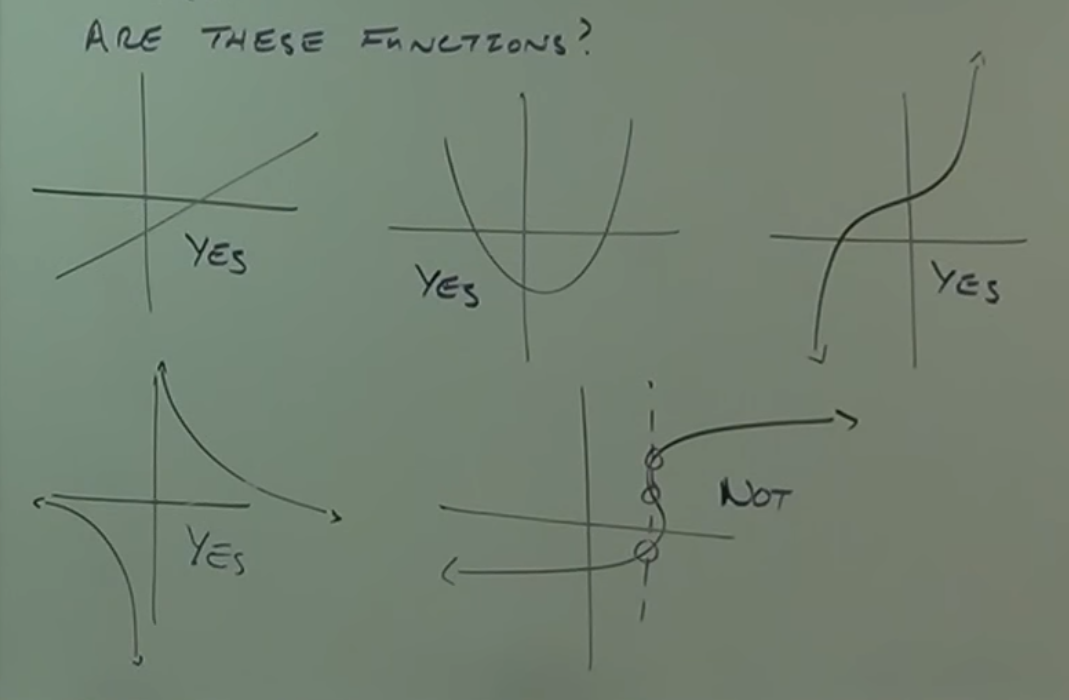
The Vertical Line Test
– [📷image]
- Reminder: in tables, repeated inputs with different outputs mean it is not a function
- Explanation of the Vertical Line Test
- A graph is a function if and only if every vertical line intersects it at most once
- Graphic examples
- A diagonal line: it is a function
- A parabola: it is a function (though not one-to-one)
- A graph that passes the test even if it has an empty section (e.g., $1/𝒙$)
- Not every input must have an output, but if it does, it must be unique
- A graph that fails the Vertical Line Test (one input with multiple outputs) is not a
function
-
[13:20]
🧩 Example – Equation that does not represent a function: the circle
– [📷image]
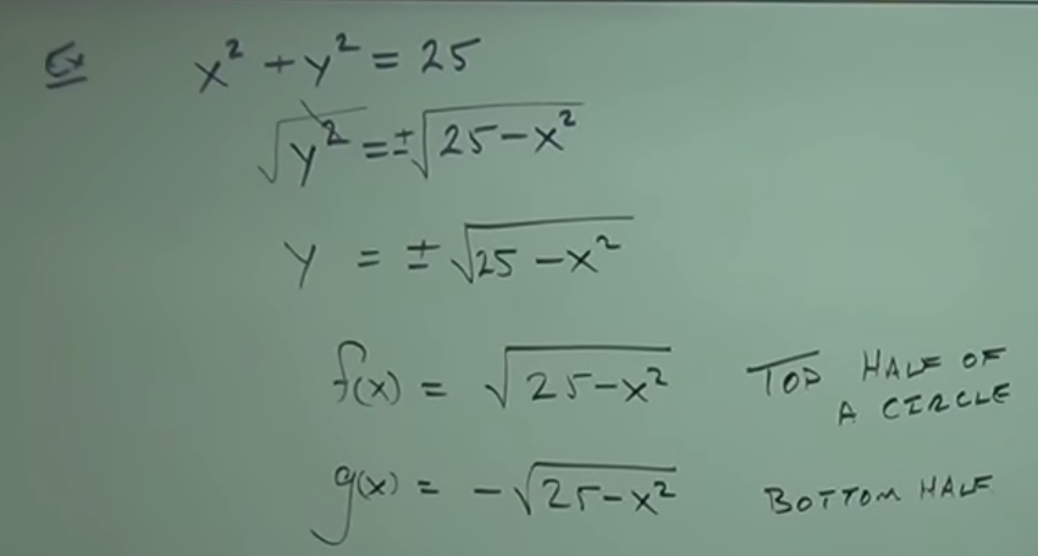
- Equation of a circle centered at the origin: $𝒙^{2}+𝒚^{2}=25$
- When trying to solve for $𝒚$, we get $𝒚=\pm\sqrt{25-𝒙^{2}}$
- The $\pm$ indicates one input ($𝒙$) can have two different outputs ($𝒚$), so it is not a
function
- However, parts of the circle can be functions if defined separately
- $𝒇(𝒙)=\sqrt{25-𝒙^{2}}$ (the upper half)
- $𝓰(𝒙)=-\sqrt{25-𝒙^{2}}$ (the lower half)
Piecewise Functions
-
[17:40]
General idea
– [📷image]
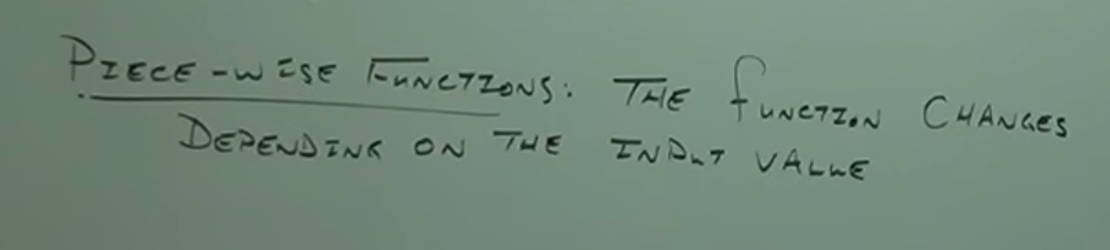
- The function’s formula depends on the value of $𝒙$
- The function changes depending on the input value
-
[19:10]
Defining absolute value as an example of a piecewise function
– [📷image]
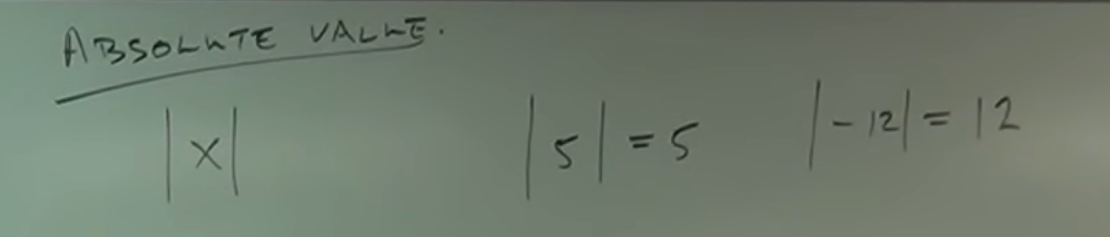
- The absolute value symbol: $|𝒙|$
- Intuitive definition: distance from zero
- More specific two-part definition:
- If $𝒙\ge 0$, $|𝒙|=𝒙$
- If $𝒙<0$, $|𝒙|=-𝒙$ (the sign is flipped)
- 🧩 Example – $|5|=5$; $|-12|=12$
-
[20:45]
Formal notation for a piecewise function
– [📷image]
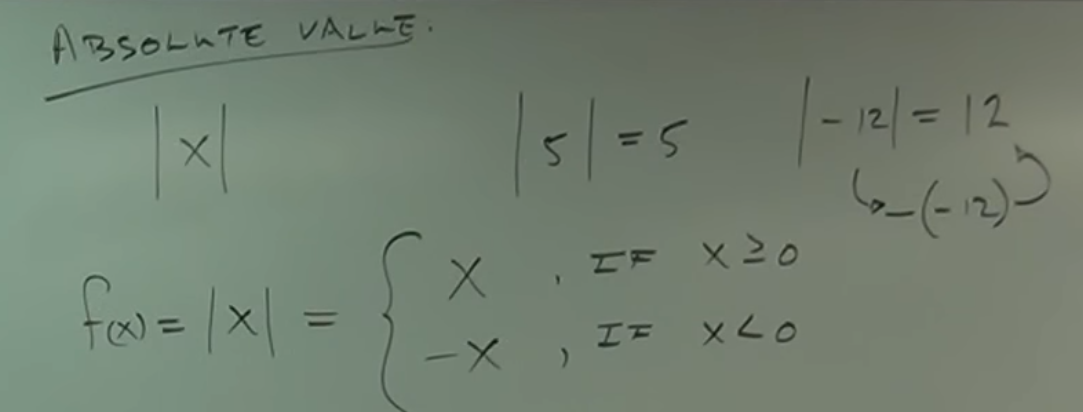
- Use of braces to group the different definitions and their $𝒙$-ranges
- 🧩 Example of the piecewise definition for absolute value
-
[23:50]
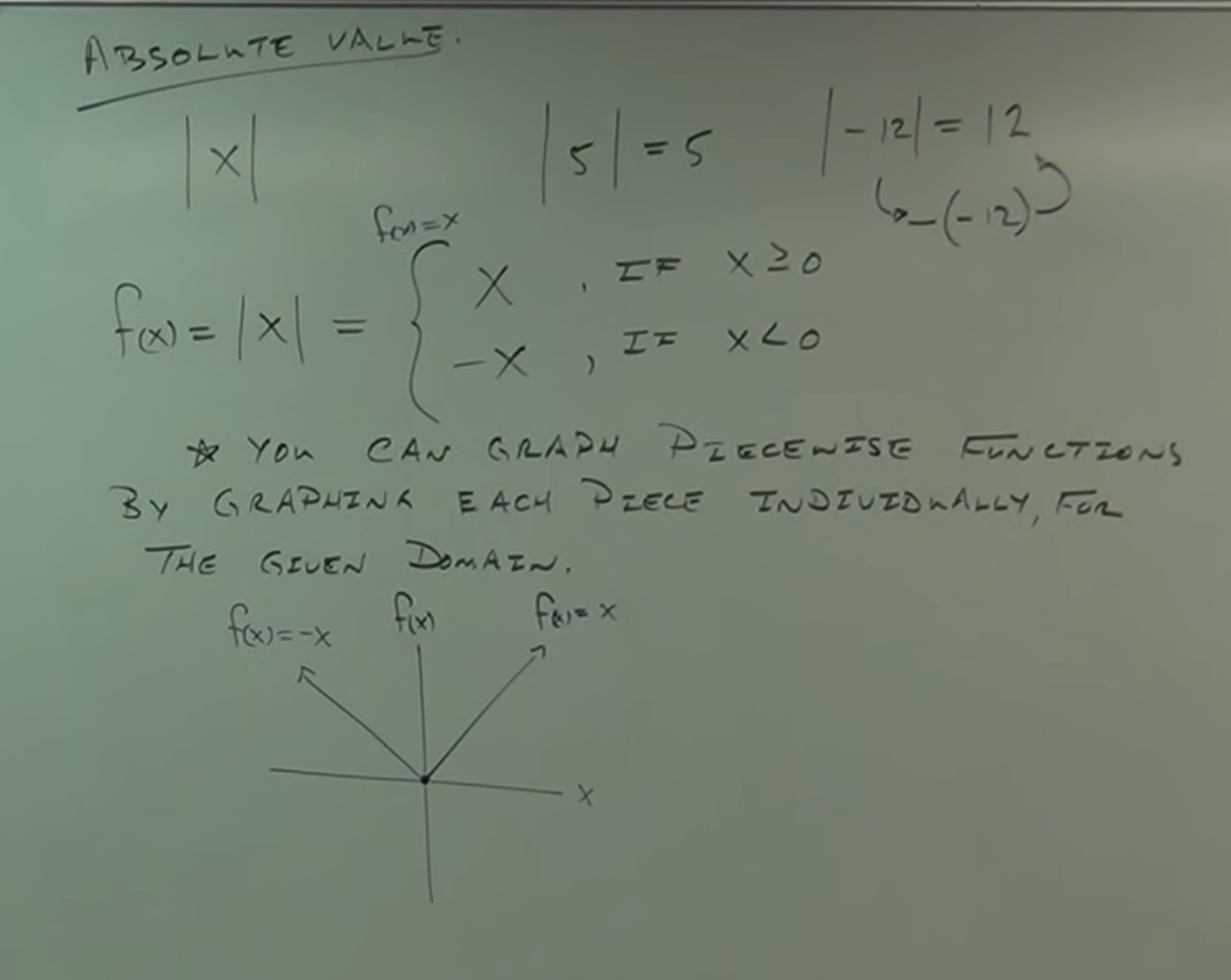
Graphing piecewise functions
- Each “piece” is graphed individually
- The correct domain interval must be applied to each piece
-
[25:00]
Graphing absolute value function
– [📷image]
-
[27:35]
🧩 Example – Graphing a piecewise function
– [📷image]
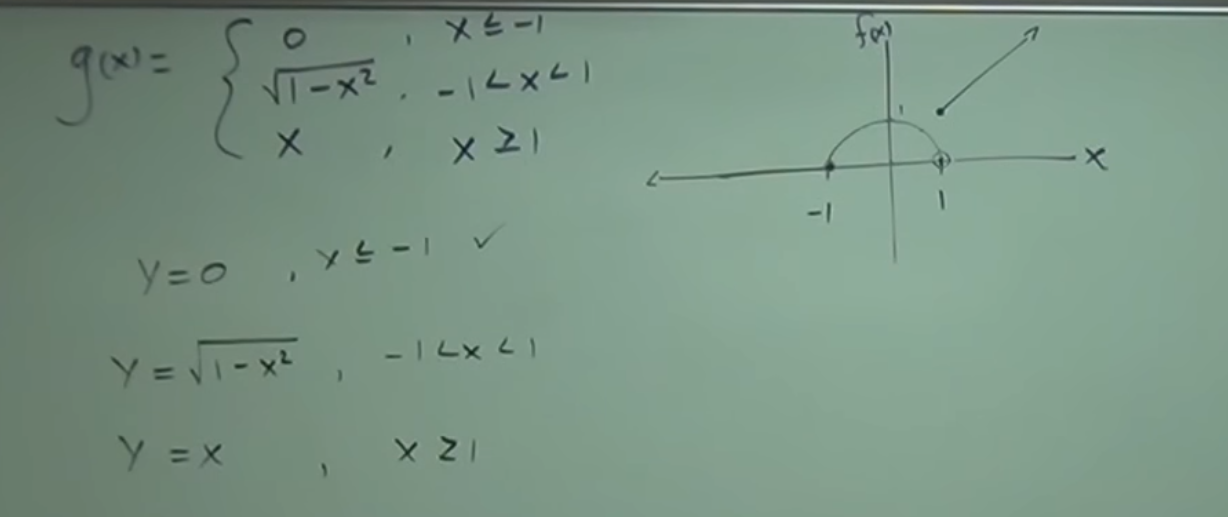
- $\displaystyle 𝒇(𝒙)=\begin{cases}0,& \text{if } 𝒙\le -1,\\\sqrt{1-𝒙^{2}},& -1
<𝒙<1,\\𝒙,& \text{if } 𝒙\ge 1\end{cases}$
- Identifying key intervals where the function’s definition changes
- $𝒇(𝒙)=0$ for $𝒙\le−1$
- Graph of $𝒚=0$ (the x-axis) for $𝒙\le−1$
- Closed circle at $𝒙=−1$ because of “≤”
- $𝒇(𝒙)=\sqrt{1−𝒙^{2}}$ for $−1<𝒙<1$
- Rewriting as $𝒚=\sqrt{1−𝒙^{2}}$
- Recognizing the related circle equation ($𝒙^{2}+𝒚^{2}=1$)
- Identifying it as the upper semicircle of radius 1, centered at (0, 0)
- Open circles because of the strict inequality “<”
- At $𝒙=−1$
- Connection to the closed circle from the previous piece at $𝒙=−1$
- At $𝒙=1$
- $𝒇(𝒙)=𝒙$ for $𝒙\ge 1$
- Graph of $𝒚=𝒙$ (a straight line through the origin with slope 1)
- Only consider the portion for $𝒙\ge 1$
- Closed circle at $𝒙=1$ due to “≥”
Domain & Range
-
[35:25]. Domain and Range of a
function
– [📷image]
- Definition of Domain
- All values that can be “input” into a function
- Typically 𝒙-values, but can vary depending on the problem’s variables
- Definition of Range
- All possible values that are “output” by a function
- Typically 𝒚-values or 𝒇(𝒙)
- Restrictions on the Domain
- Real-world constraints (problem context)
-
[36:40]. 🧩 Example
– The area of a square (side 𝓼): $𝓼^{2}$
- The domain (𝓼) cannot be negative
- The side can be zero (trivial area)
-
[38:06]. Formula-based
restrictions
- Division by zero: the denominator cannot be zero (e.g., $𝒚=\dfrac{1}{𝒙}$)
- Even-index roots: the radicand cannot be negative in real numbers (e.g.,
$𝒇(𝒙)=\sqrt{𝒙}$)
- The square root of zero is defined
- In complex numbers, roots of negative numbers do exist (using $i$)
-
[39:30]. Natural Domain
- Definition for this course: all values that work in the formula, including natural and
formula-based restrictions
- When we find the natural domain, we must consider (include) any restrictions that
naturally arise from the formula — these restrictions define which values must be excluded.
- In short: all values for which the formula makes sense
-
[40:54]. How to find the
Natural Domain
- 🧩 Example – 1 Natural Domain: $𝒇(𝒙)=𝒙^{3}$
– [📷image]
- Is there any number you cannot plug in? No
- Domain: all real numbers ($𝓡$ or $𝒙\in 𝓡$)
-
[42:21]. 🧩 Example – 2
Natural Domain: $𝒇(𝒙)=\dfrac{2𝒙+1}{(𝒙-1)(𝒙-3)}$
– [📷image]
- Some numbers make the denominator zero; these are excluded
- Set the denominator $(𝒙-1)(𝒙-3)=0
- Solutions: $𝒙=1$ and $𝒙=3$
- Domain:
- Sets: $𝒙\in 𝓡\setminus\{1,3\}$
- Set-Builder Notation: $\{\, 𝓍\in 𝓡 : 𝓍\neq \mathbf{1}\ \text{and}\ 𝓍\neq
\mathbf{3}\,\}$
- Union of Intervals: $(-\infty,1)\cup(1,3)\cup(3,\infty)$
-
[45:15]. 🧩 Example – 3
Natural Domain: $𝓰(𝒙)=\tan(𝒙)$
– [📷image]
- Definition of tangent: $\tan(𝒙)=\dfrac{\sin(𝒙)}{\cos(𝒙)}$
- Tangent is undefined where cosine is zero
- Cosine is zero at $𝒙=\dfrac{\pi}{2},\ \dfrac{3\pi}{2},\ -\dfrac{\pi}{2},\ \dots$
- Domain: all real numbers except $𝒙=\dfrac{\pi}{2}+n\pi$, where $n$ is an integer
-
[48:10]. 🧩 Example – 4
Natural Domain: $𝒇(𝒙)=\sqrt{6-5𝒙+𝒙^{2}}$
– [📷image]
- Potential problem: the square root of a negative number
- The radicand must be $\ge 0$: $6-5𝒙+𝒙^{2}\ge 0$
- Factorization of the quadratic: $(𝒙-2)(𝒙-3)\ge 0$
- Sign analysis test to find intervals satisfying this inequality
- Critical points: $𝒙=2$ and $𝒙=3$
- Draw a number line with critical points
- Test values in each interval
- For $𝒙<2$ (e.g., $0$), the product is positive
- For $2<𝒙<3$ (e.g., $2.5$), the product is negative
- For $𝒙>3$ (e.g., $4$), the product is positive
- Intervals where the expression is nonnegative form the domain
- Domain in interval notation: $(-\infty,2]\cup[3,\infty)$
-
[58:50]. 🧩 Example – 5
Natural Domain: $𝒇(𝒙)=\dfrac{𝒙^{2}-4}{𝒙-2}$
– [📷image]
- Potential problem: denominator is zero if $𝒙=2$
- Domain: $𝒙\in 𝓡\setminus\{2\}$
- Simplification: $𝒇(𝒙)=\dfrac{(𝒙+2)(𝒙-2)}{𝒙-2}=𝒙+2$ (for $𝒙\neq 2$)
- Even if the function simplifies, the original domain restriction remains
- The discontinuity at $𝒙=2$ is called a “hole” or removable discontinuity
- Occurs when the problematic factor can be canceled
- In polynomials, this happens when substitution yields $0/0$
-
[01:03:14]. Graph
- If the problematic factor cannot be canceled, we get a vertical asymptote
- Typically a number/zero form upon substitution
-
[01:06:00].
Removable discontinuity
vs.
Vertical asymptote
– [📷image]
- $𝒇(𝒙)=\dfrac{𝒙^{2}-4}{𝒙-2}$
- Has a “domain problem” at $𝒙=2$
- But it can be removed, problematic factor can be canceled (this is a removable
discontinuity — it creates a "hole")
- $𝓰(𝒙)=\dfrac{3𝒙}{𝒙-4}$
- Also has a “domain issue” at $𝒙=4$
- But it cannot be removed, problematic factor cannot be canceled — it's a
vertical asymptote
-
[01:10:20]. 🧩 Example – 6:
$𝒇(𝒙)=2+\sqrt{𝒙-1}$
– [📷image]
- Potential problem: negative radicand
- Inequality: $𝒙-1\ge 0$
- Solution: $𝒙\ge 1$
- Domain in interval notation: $[1,\infty)$
-
[01:13:00]. 🧩 Example – 7:
with a root in the denominator: $𝒇(𝒙)=\dfrac{1}{\sqrt{𝒙-1}}$
– [📷image]
- Restrictions: the radicand cannot be negative and the denominator cannot be zero
- Inequality: $𝒙-1>0$
- Solution: $𝒙>1$
-
[01:13:35]. How to find the
Range
- The set of all possible outputs (𝒚-values)
- 𝓕𝓲𝓻𝓼𝓽 𝓶𝓮𝓽𝓱𝓸𝓭: substitute domain values into the function and observe the
results
-
[01:15:55]. 🧩 Example
– : $𝒇(𝒙)=2+\sqrt{𝒙-1}$ with domain $[1,\infty)$
- If $𝒙=1$, $𝒇(1)=2$
- As $𝒙$ decreases, $𝒇(𝒙)$ increases toward $+\infty$
- Range: $[2,\infty)$
- 𝓢𝓮𝓬𝓸𝓷𝓭 𝓶𝓮𝓽𝓱𝓸𝓭 (not always easy): solve for $𝒙$ in terms of $𝒚$ and find that
domain of $𝒚$
- This makes the outputs act like “inputs”
-
[01:16:15]. 🧩 Example – :
$𝒇(𝒙)=\dfrac{𝒙+1}{𝒙-1}$
– [📷image]
- Domain: $𝒙\neq 1$, vertical asymptote (problematic factor cannot be canceled)
- Solve for $𝒙$: $𝒚(𝒙-1)=𝒙+1 \;\Rightarrow\; 𝒚𝒙-𝒚=𝒙+1 \;\Rightarrow\;
𝒚𝒙-𝒙=𝒚+1 \;\Rightarrow\; 𝒙(𝒚-1)=𝒚+1 \;\Rightarrow\; 𝒙=\dfrac{𝒚+1}{𝒚-1}$
- The condition $𝒚\neq 1$ indicates the range excludes $𝒚=1$ (the domain of $𝒚$ is
the range of the function)
- That exclusion ($𝒚\neq 1$) corresponds to a horizontal asymptote
- Warning: this method is not always straightforward
Application
-
[01:21:25]
🧩 Example – Application problem: Cardboard box
– [📷image]
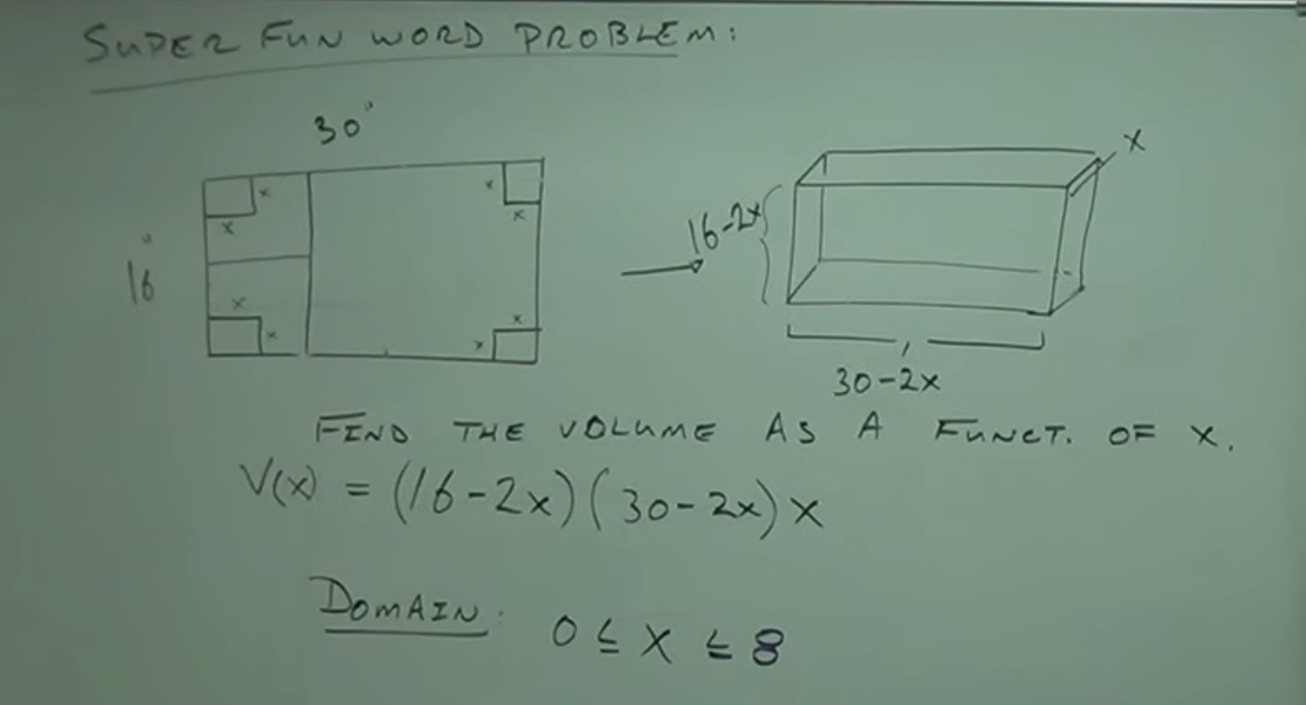
- Problem description: cutting squares out of the corners of a piece of cardboard to form a
box
- Cardboard dimensions: 16 inches by 30 inches
- The cut squares must have the same side length ($𝒙$) on each corner
- Formula for the volume of the box as a function of $𝒙$
- Length of the base: $30-2𝒙$
- Width of the base: $16-2𝒙$
- Height of the box: $𝒙$
- Volume $𝓥(𝒙)=𝒙(16-2𝒙)(30-2𝒙)$
-
[01:27:05]
Realistic domain for the volume function
- There are no denominators or roots in the volume formula
- Real-world restriction: the length of the cuts ($𝒙$) must be positive ($𝒙>0$)
- The cut cannot be so large that a side is fully removed
- The maximum cut is less than half of the shorter dimension (16 inches), so $𝒙<8$<
/li>
- Realistic domain: $0<𝒙<8$< /li>
Even and Odd functions
-
[01:30:50]
Brief review
– [📷image]
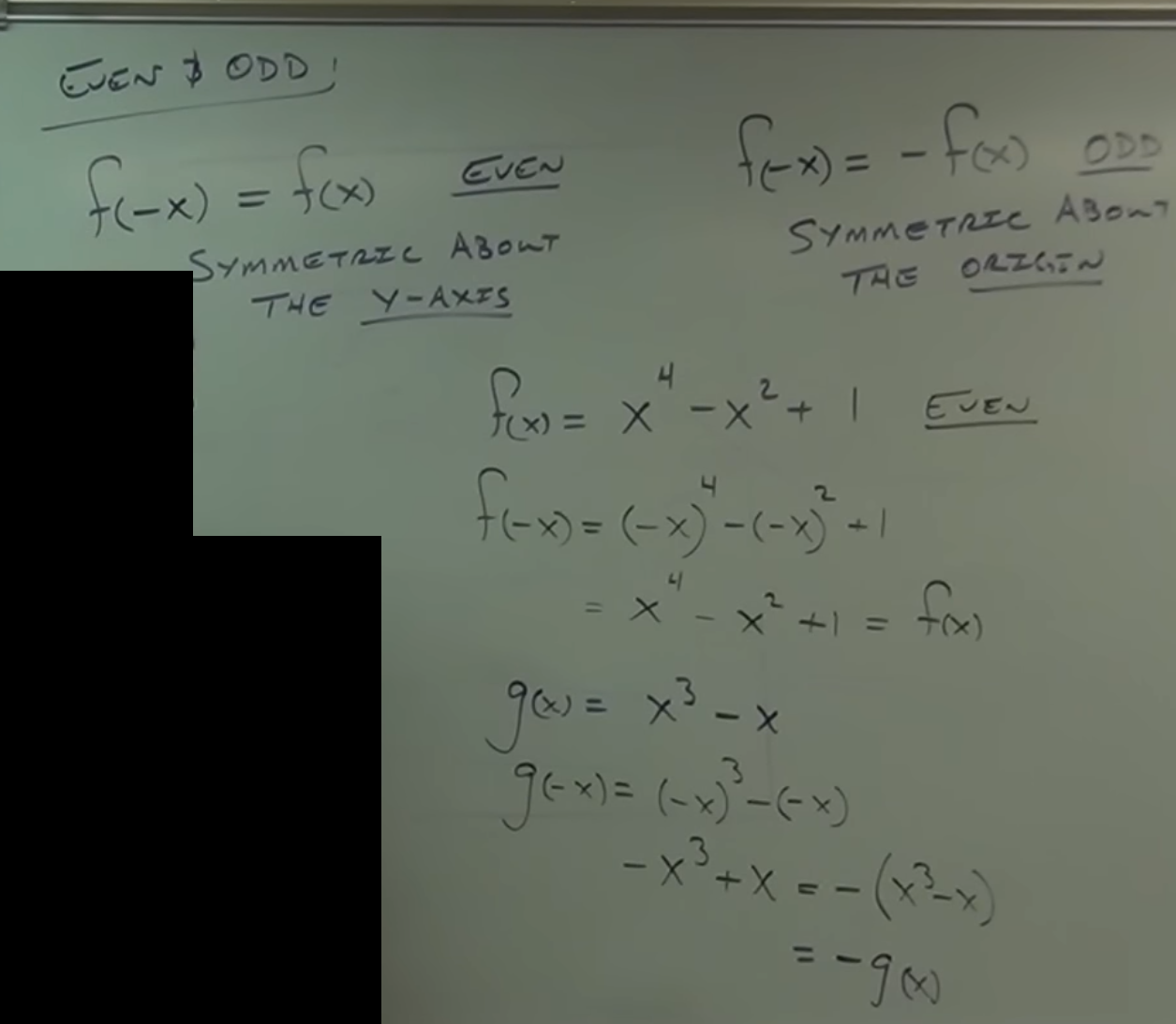
- Even function
- Algebraic definition: $𝒇(-𝒙)=𝒇(𝒙)$
- Symmetry about the y-axis
- Example: $𝒇(𝒙)=𝒙^{4}-𝒙^{2}+1$
- Odd function
- Algebraic definition: $𝓰(-𝒙)=-𝓰(𝒙)$
- Symmetry about the origin (180° rotation)
- Example: $𝓰(𝒙)=𝒙^{3}-𝒙$
- Method to check if a function is even or odd: substitute $-𝒙$ and simplify