Calculus 1 Lecture 0.3
Review of Trigonometry and Graphing Trigonometric Functions
Angles
- [0:30]. Initial Side and Terminal Side of an Angle
– [📷image]
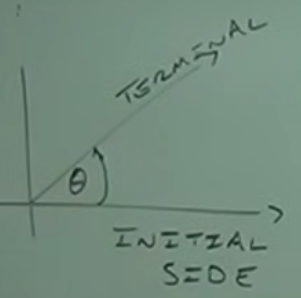
- Initial Side: This is the starting position of the angle before any rotation occurs. It is typically aligned with the positive x-axis in a standard position.
- Terminal Side: After rotating by the given angle measure (in degrees or radians), this is the final position where the side ends up.
- [1:02]. Positive and Negative Angles
– [📷image]
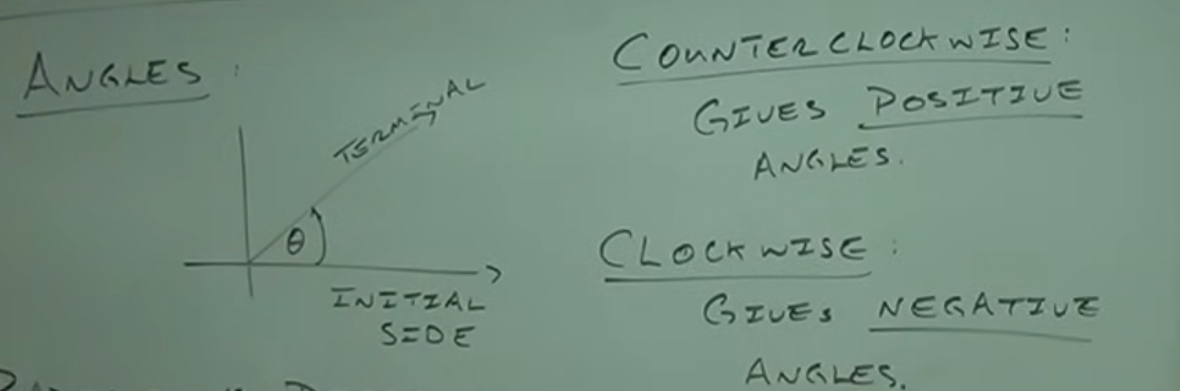
- Counterclockwise: This direction follows the standard mathematical convention for positive angles.
- Clockwise: Rotations in this direction are considered negative in standard mathematical terms.
- [2:08]. Angle Measurement Systems: Degrees and Radians
– [📷image]
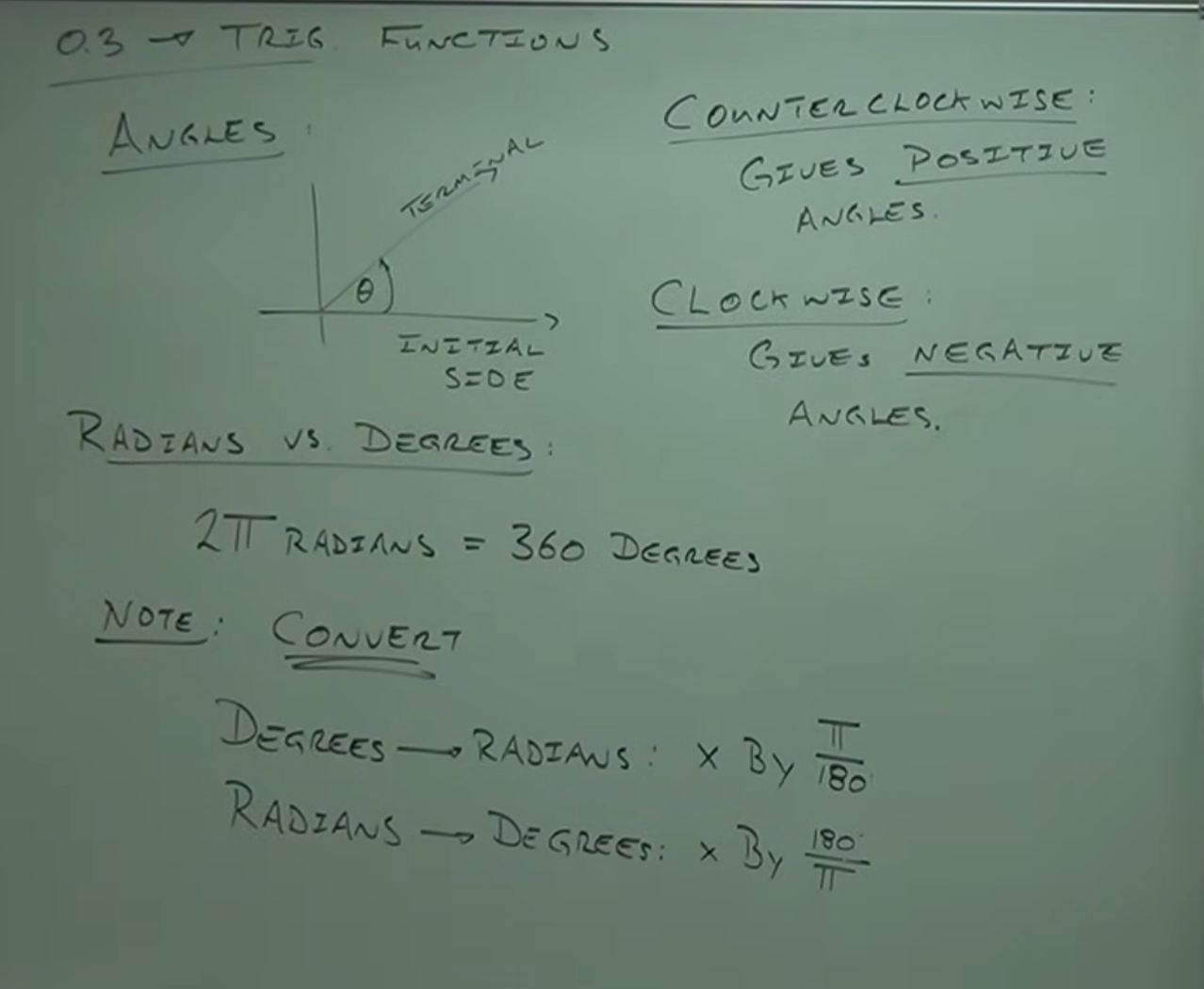
- Equivalence between Radians and Degrees: $\displaystyle 2\pi$ radians = $\displaystyle 360$ degrees
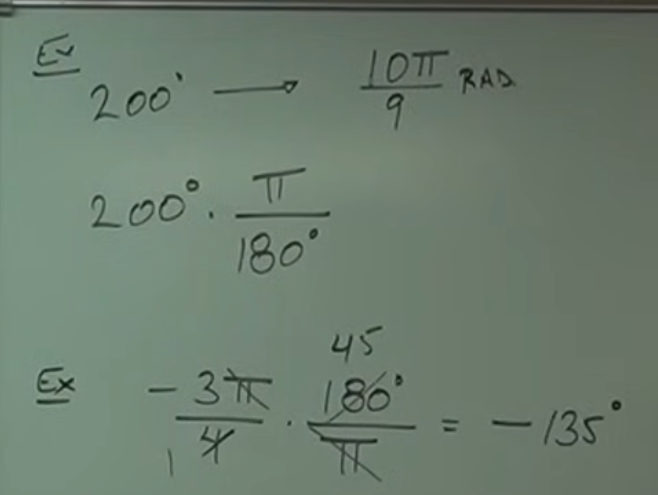
- To convert between degrees and radians, we use the relationship that $\displaystyle 180$ degrees is equal to $\displaystyle \pi$ radians
- Examples of Converting Degrees to Radians:
– [📷image]
- [8:38]. Coterminal Angles
- Coterminal angles are angles that share the same terminal side when drawn in standard position. They differ by multiples of $\displaystyle 360^\circ$ (or $\displaystyle 2\pi$ or $\displaystyle -2\pi$ radians). To find a coterminal angle within a specific range, adjust the given angle by adding or subtracting these multiples.
- 🧩 Examples:
- Find two positive and two negative coterminal angles for $\displaystyle 60^\circ$:
- Positive: $\displaystyle 420^\circ$, $\displaystyle 780^\circ$
- Negative: $\displaystyle -300^\circ$, $\displaystyle -660^\circ$
- Find two positive and two negative coterminal angles for $\displaystyle 60^\circ$:
- [9:10]. Graphs of Angles
– [📷image]
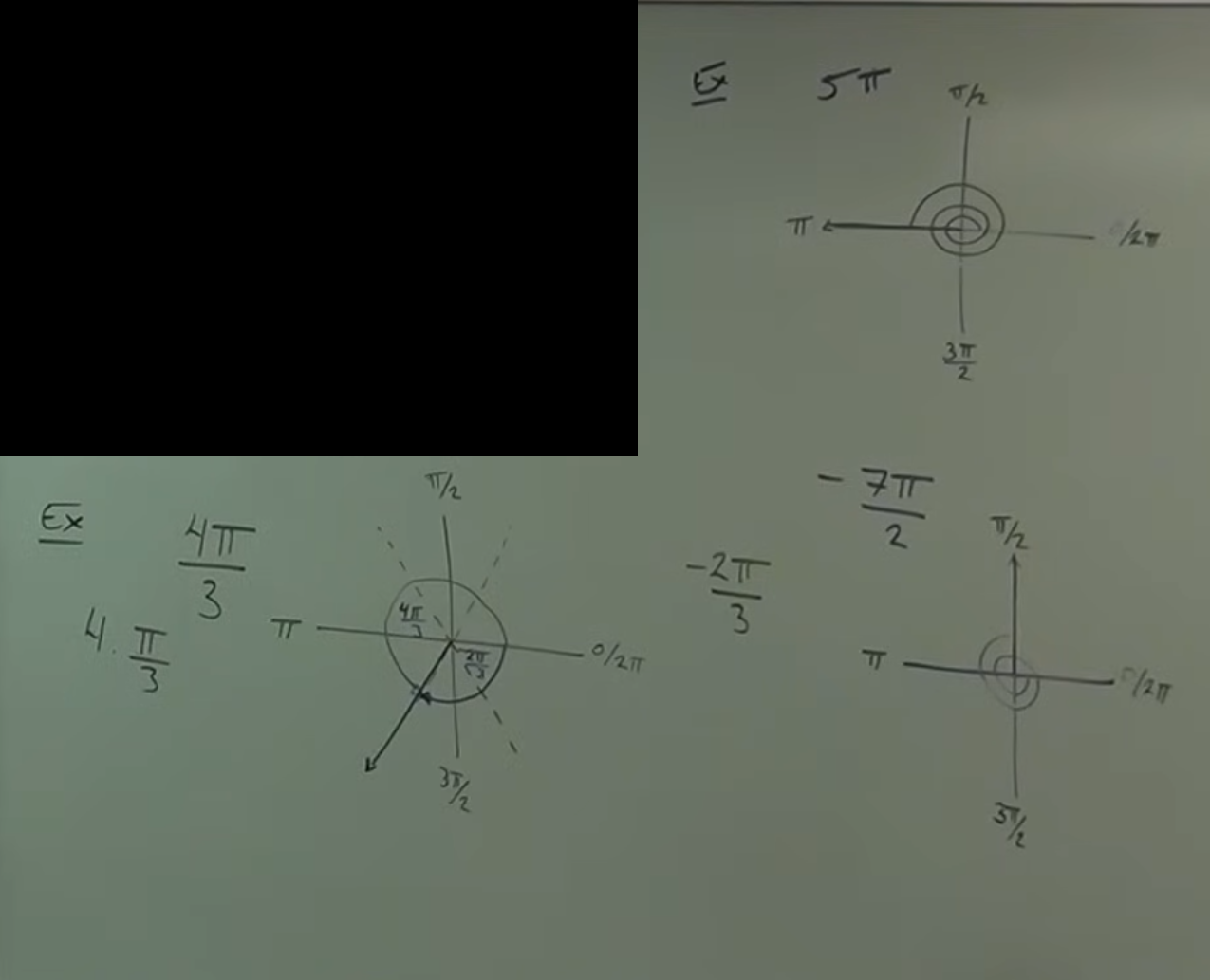
Trigonometric Functions
- [16:17]. Relationship between the Sides of a Right Triangle and the Unit Circle
– [📷image]
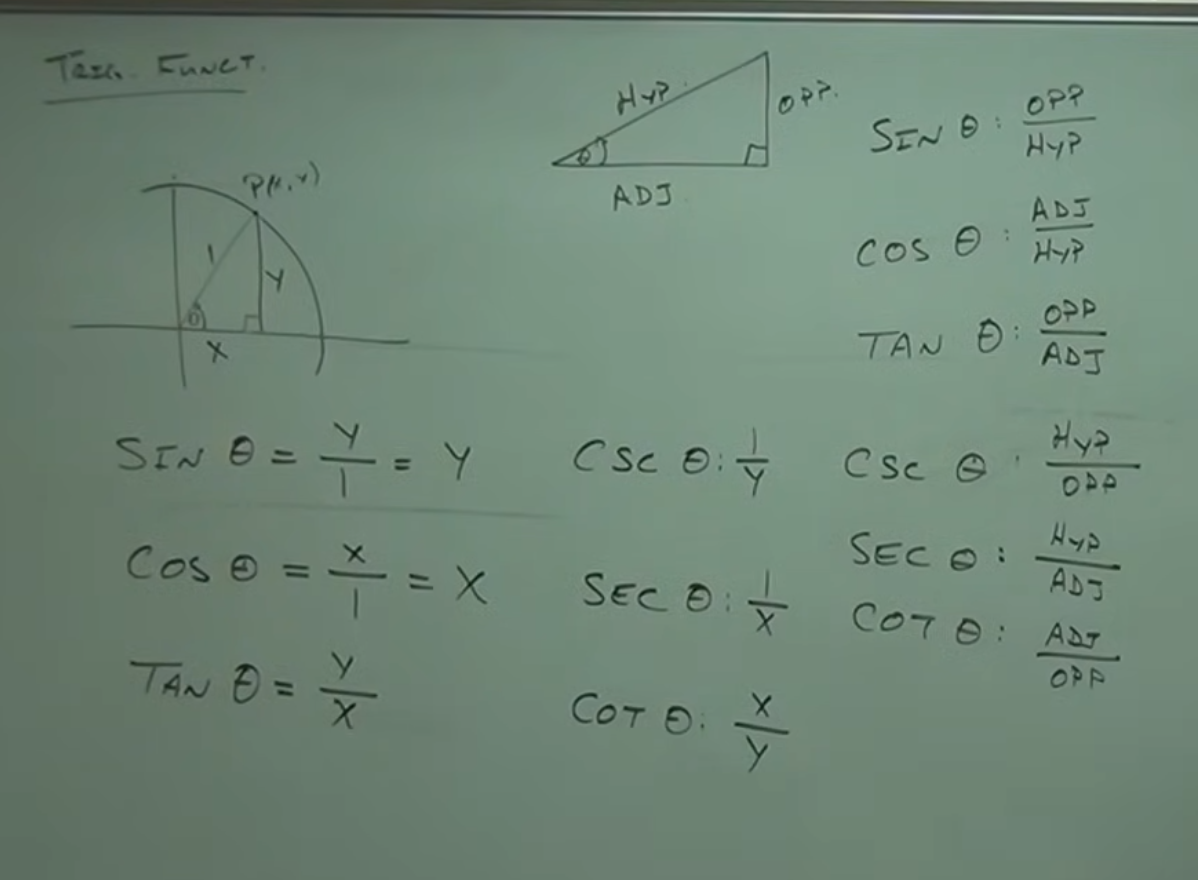
- [17:15]. A right triangle has one 90-degree angle and two shorter sides called legs.
- The side opposite the angle you're looking at is called the opposite side (OPP).
- The side next to the angle (but not the hypotenuse) is the adjacent side (ADJ).
- The longest side, opposite the right angle, is the hypotenuse (HYP).
- [17:15]. A right triangle has one 90-degree angle and two shorter sides called legs.
- [17:36]. Definition of Sine, Cosine, and Tangent
– [📷image]
- $\displaystyle \sin(\theta)=\dfrac{\text{OPP}}{\text{HYP}}$
- $\displaystyle \cos(\theta)=\dfrac{\text{ADJ}}{\text{HYP}}$
- $\displaystyle \tan(\theta)=\dfrac{\text{OPP}}{\text{ADJ}}$
- [19:35]. Definition of Cosecant, Secant, and Cotangent
– [📷image]
- $\displaystyle \csc(\theta)=\dfrac{\text{HYP}}{\text{OPP}}$
- $\displaystyle \sec(\theta)=\dfrac{\text{HYP}}{\text{ADJ}}$
- $\displaystyle \cot(\theta)=\dfrac{\text{ADJ}}{\text{OPP}}$
- [20:28]. Relationship between the Coordinates of a Point on the Unit Circle and the
Trigonometric Functions of the Angle
– [📷image]
- $\displaystyle \sin(\theta)=\dfrac{y}{1}=y$, $\displaystyle \csc(\theta)=\dfrac{1}{y}$
- $\displaystyle \cos(\theta)=\dfrac{x}{1}=x$, $\displaystyle \sec(\theta)=\dfrac{1}{x}$
- $\displaystyle \tan(\theta)=\dfrac{y}{x}$, $\displaystyle \cot(\theta)=\dfrac{x}{y}$
- [23:34]. Review of Common Angles on the Unit Circle
$\boxed{\displaystyle\begin{array}{c|ccccccccccc}\theta & 0 & \dfrac{\pi}{6} & \dfrac{\pi}{4} & \dfrac{\pi}{3} & \dfrac{\pi}{2} & \dfrac{2\pi}{3} & \dfrac{3\pi}{4} & \dfrac{5\pi}{6} & \pi & \dfrac{3\pi}{2} & 2\pi \\[12pt]\hline\sin(\theta) & 0 & \dfrac{1}{2} & \dfrac{1}{\sqrt{2}} & \dfrac{\sqrt{3}}{2} & 1 & \dfrac{\sqrt{3}}{2} & \dfrac{1}{\sqrt{2}} & \dfrac{1}{2} & 0 & -1 & 0 \\[12pt]\cos(\theta) & 1 & \dfrac{\sqrt{3}}{2} & \dfrac{1}{\sqrt{2}} & \dfrac{1}{2} & 0 & -\dfrac{1}{2} & -\dfrac{1}{\sqrt{2}} & -\dfrac{\sqrt{3}}{2} & -1 & 0 & 1 \\\end{array}}$
Signs of Trigonometric Functions
- [24:36]. Review of Quadrants in the Cartesian Plane
– [📷image]
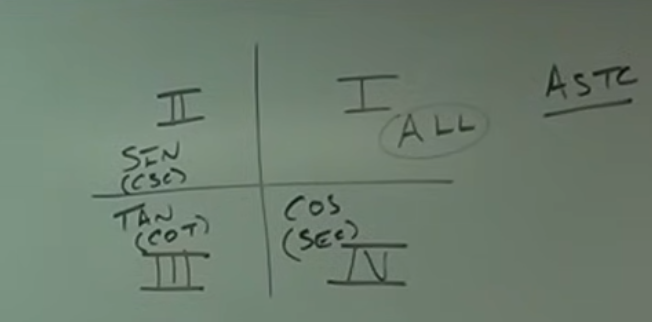
- A̳S̳T̳C̳: The signs of the trigonometric functions for angles in each of the four
quadrants can
be remembered by means of the rule “A̳ll S̳tudents T̳ake C̳alculus”.
- Quadrant I: (A̳) All trigonometric functions are positive.
- Quadrant II: (S̳) $\displaystyle \sin(\theta)>0$
- Quadrant III: (T̳) $\displaystyle \tan(\theta)>0$
- Quadrant IV: (C̳) $\displaystyle \cos(\theta)>0$
- A̳S̳T̳C̳: The signs of the trigonometric functions for angles in each of the four
quadrants can
be remembered by means of the rule “A̳ll S̳tudents T̳ake C̳alculus”.
- [27:35]. Reference Angles
– [📷image]
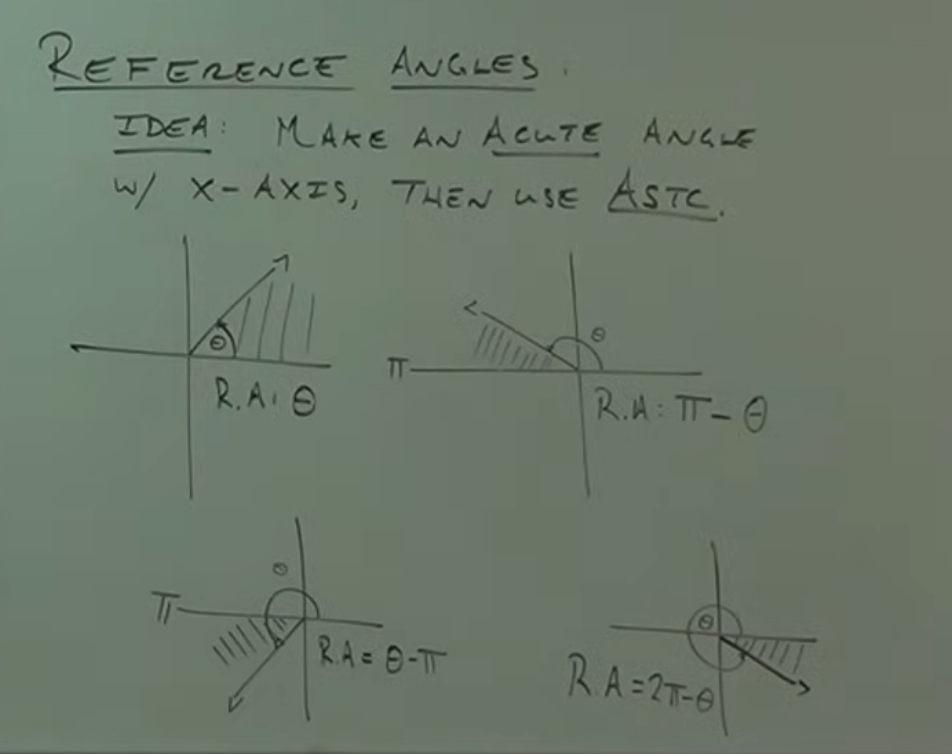
- Reference angles make it possible to evaluate trigonometric functions for angles outside the first quadrant. They can also be used to find $(x,y)$ coordinates for those angles. We will use the reference angle of the angle of rotation combined with the quadrant in which the terminal side of the angle lies.
- Measure the angle between the terminal side of the given angle and the horizontal axis. That is the reference angle (acute angle).
- [28:55]. Case 1: Angle in the First Quadrant: $\displaystyle \theta$
- [29:20]. Case 2: Angle in the Second Quadrant: $\displaystyle \pi-\theta$
- [30:40]. Case 3: Angle in the Third Quadrant: $\displaystyle \theta-\pi$
- [31:54]. Case 4: Angle in the Fourth Quadrant: $\displaystyle 2\pi-\theta$
- [33:06]. Use of Reference Angles to Find Trigonometric Functions
– [📷image]
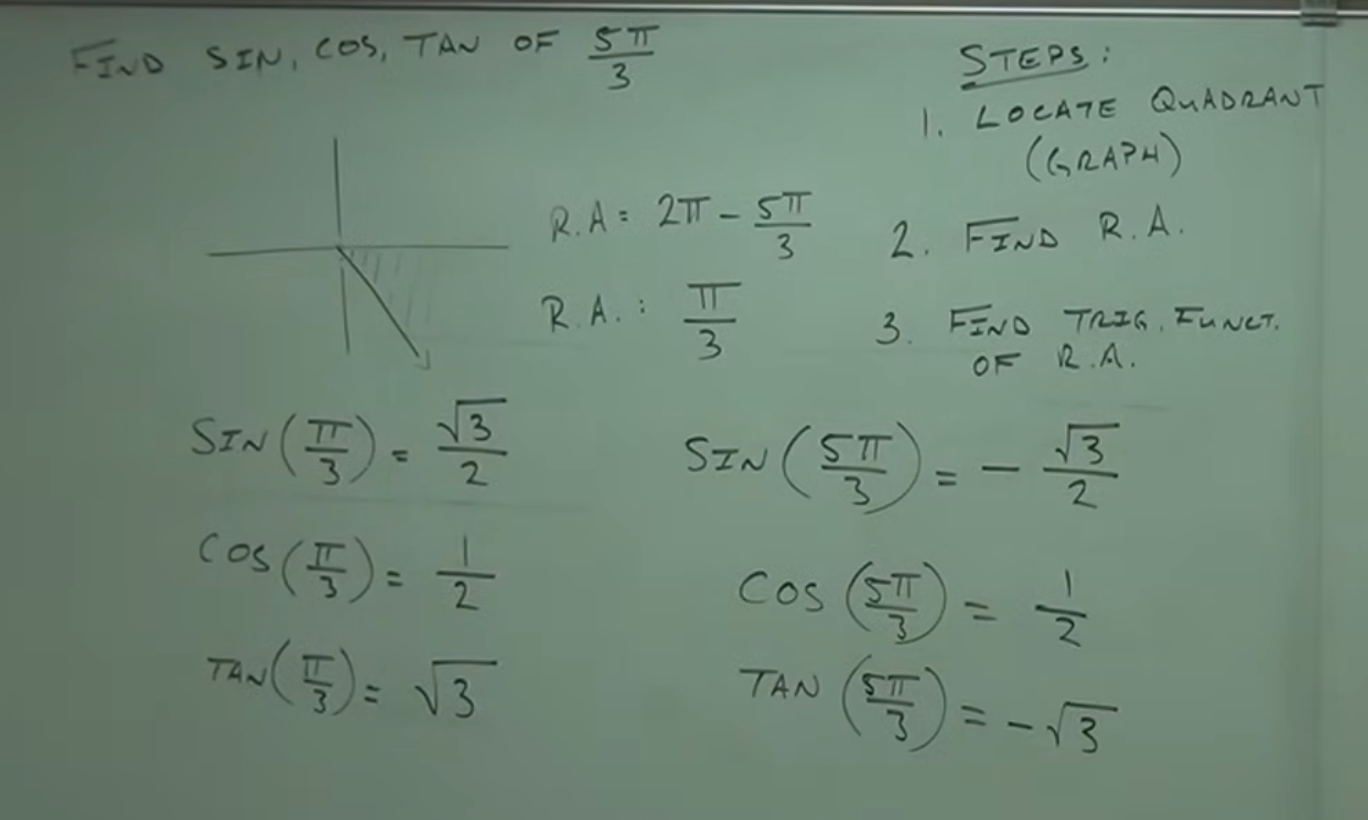
- [33:40]. 🧩 Example – Find $\displaystyle \sin(5\pi/3)$, $\displaystyle \cos(5\pi/3)$,
and $\displaystyle \tan(5\pi/3)$ Using Reference Angles
- Step 1: Locate the Quadrant of the Angle: Fourth Quadrant
- Step 2: Graph the Angle: Terminal Side and Initial Side
- Step 3: Find the Reference Angle: $\displaystyle 2\pi - \dfrac{5\pi}{3} = \dfrac{\pi}{3}$
- Step 4: Find the Trigonometric Functions of the Reference Angle
- $\displaystyle \sin\!\left(\dfrac{\pi}{3}\right)=\dfrac{\sqrt{3}}{2}$
- $\displaystyle \cos\!\left(\dfrac{\pi}{3}\right)=\dfrac{1}{2}$
- $\displaystyle \tan\!\left(\dfrac{\pi}{3}\right)=\sqrt{3}$
- Step 5: Use the Mnemonic "All Students Take Calculus" to Determine the Sign of the
Trigonometric
Functions of the Original Angle
- $\displaystyle \sin\!\left(\dfrac{5\pi}{3}\right)=-\dfrac{\sqrt{3}}{2}$
- $\displaystyle \cos\!\left(\dfrac{5\pi}{3}\right)=\dfrac{1}{2}$
- $\displaystyle \tan\!\left(\dfrac{5\pi}{3}\right)=-\sqrt{3}$
- [33:40]. 🧩 Example – Find $\displaystyle \sin(5\pi/3)$, $\displaystyle \cos(5\pi/3)$,
and $\displaystyle \tan(5\pi/3)$ Using Reference Angles
Graphs of Trigonometric Functions
- [44:17]. Concepts
– [📷image]
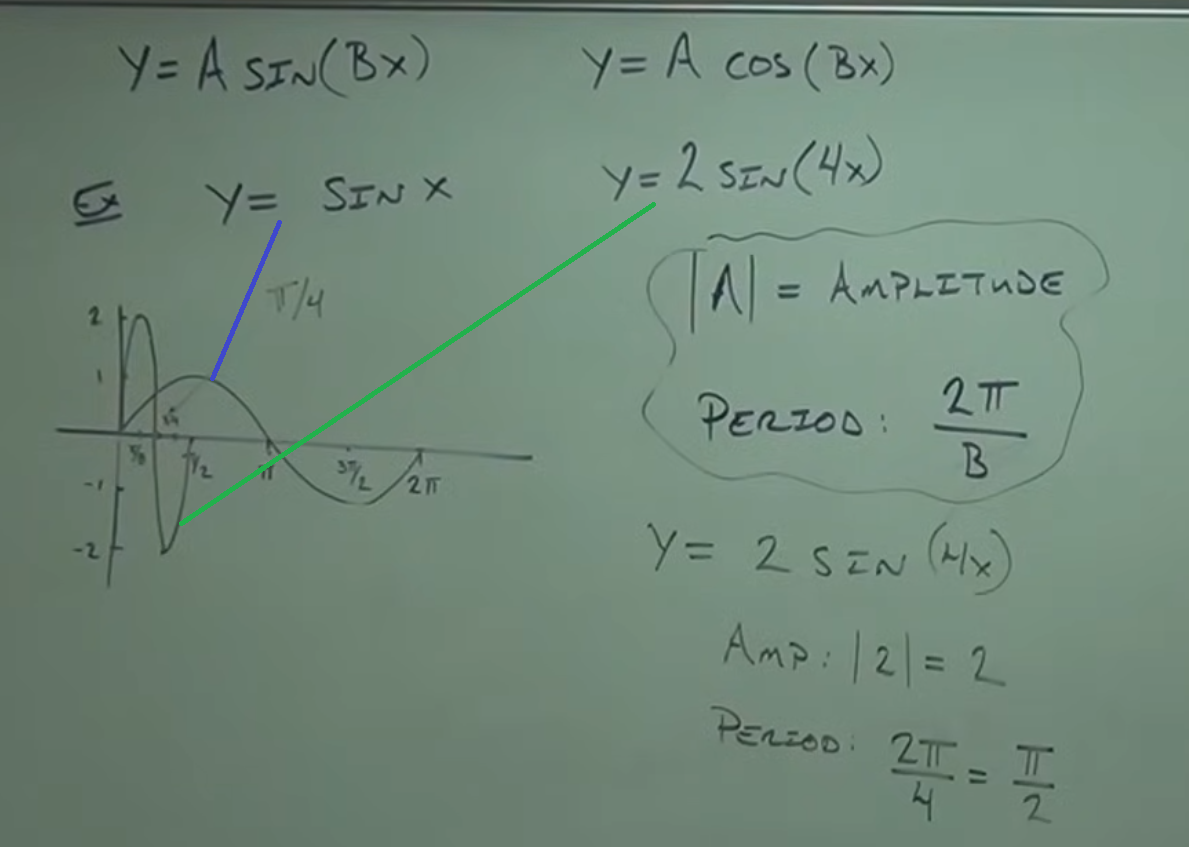
- Importance of Knowing the Basic Graphs of Sine, Cosine, and Tangent
- Graphs of Functions in the Form $\displaystyle y=a\cdot\sin(bx)$ or $\displaystyle y=a\cdot\cos(bx)$
- Definition of Amplitude and Period
- Amplitude: $\displaystyle |a|$
- Period: $\displaystyle \dfrac{2\pi}{b}$
- [49:41]. Example: $\displaystyle y=2\cdot\sin(4x)$
- Amplitude: $\displaystyle 2$
- Period: $\displaystyle \dfrac{\pi}{2}$
- [55:40]. Example: $\displaystyle y=-3\cdot\cos\!\left(\dfrac{1}{2}x\right)$
– [📷image]
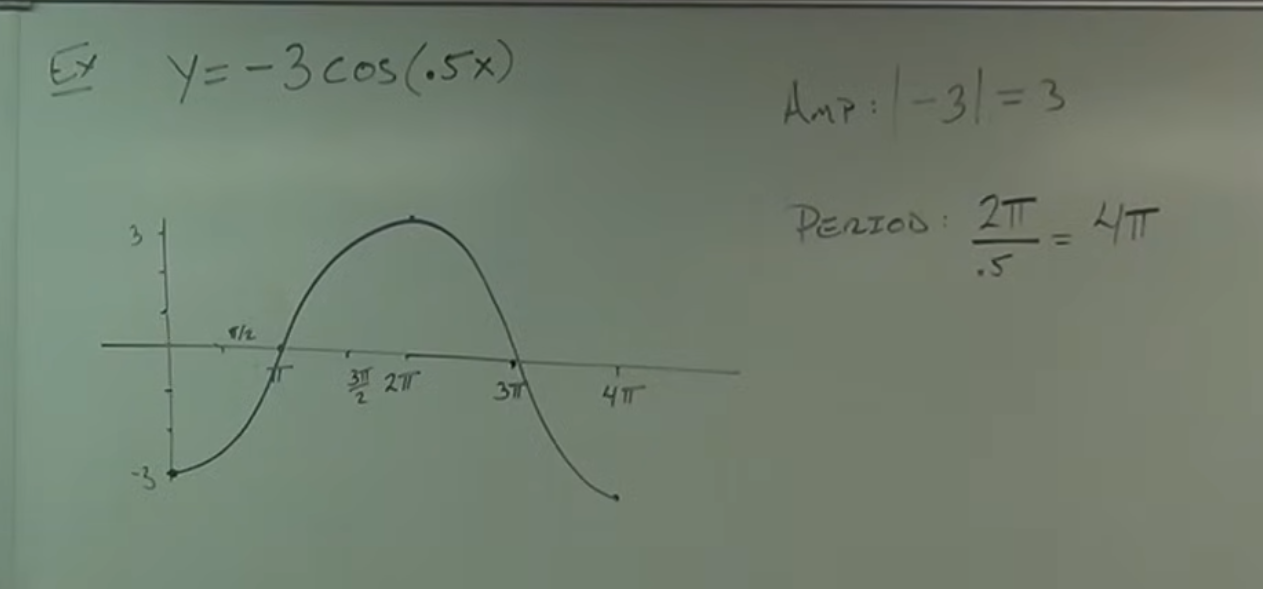
- Amplitude: $\displaystyle 3$
- Period: $\displaystyle 4\pi$
- [1:05:00]. Translations of Trigonometric Functions
– [📷image]
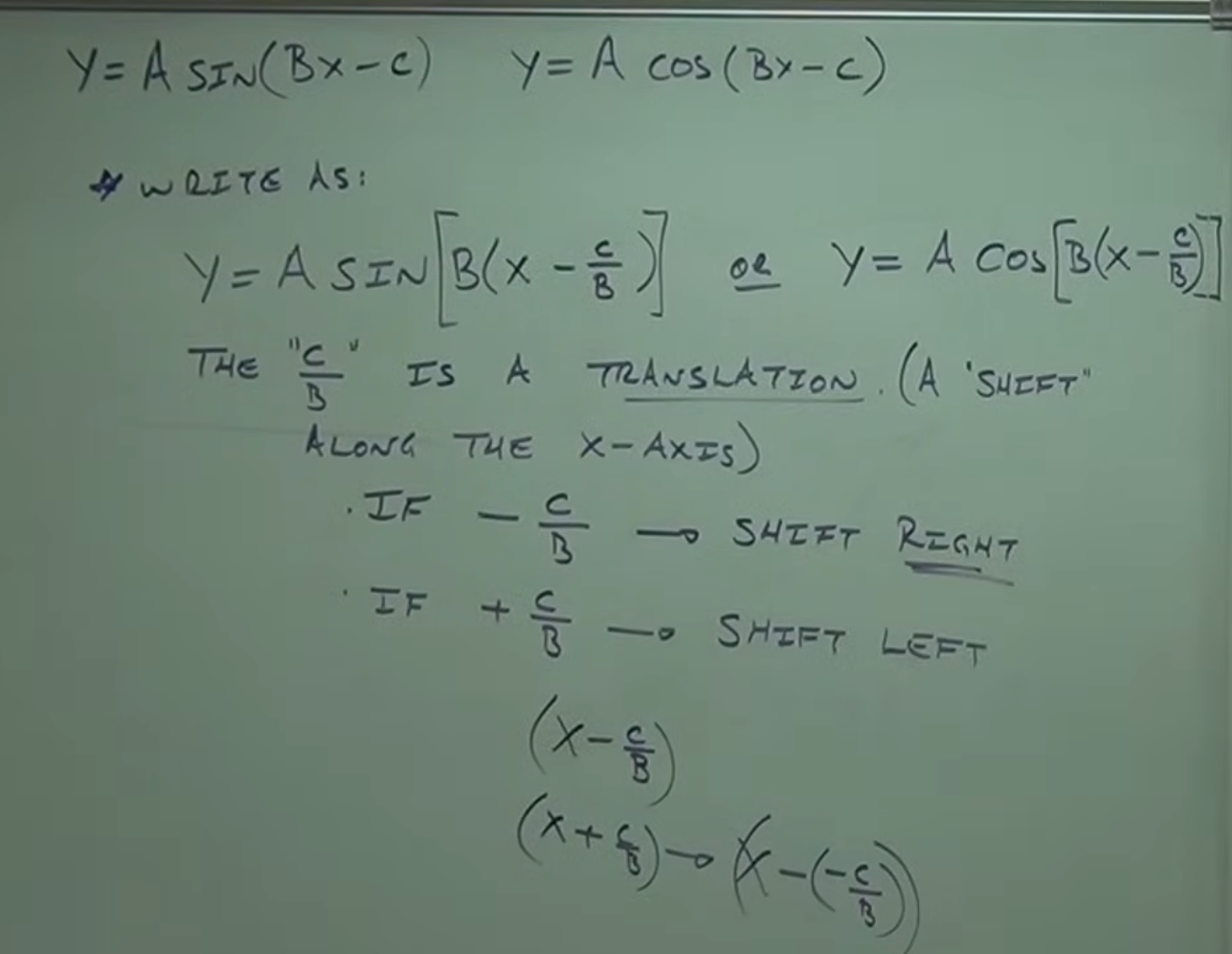
- Graphs of Functions in the Form $\displaystyle y=a\cdot\sin(bx-c)$ or $\displaystyle y=a\cdot\cos(bx-c)$
- Find the Horizontal Translation: Factor out $b$ and observe $\displaystyle \dfrac{c}{b}$
- $\displaystyle y=a\cdot\sin\!\big[b(x-\dfrac{c}{b})\big]$ or $\displaystyle y=a\cdot\cos\!\big[b(x-\dfrac{c}{b})\big]$
- Horizontal Translation:
- If it is $\displaystyle -\dfrac{c}{b}$, the translation is to the right
- If it is $\displaystyle +\dfrac{c}{b}$, the translation is to the left
- $\displaystyle x+\dfrac{c}{b}=x-(-\dfrac{c}{b})$
- [1:10:13]. 🧩 Example – $\displaystyle y=3\cdot\cos(2x+\dfrac{\pi}{2})$
- Amplitude: $\displaystyle 3$
- Period: $\displaystyle \pi$
- Horizontal Translation: $\displaystyle \dfrac{\pi}{4}$ to the left
– [📷image]
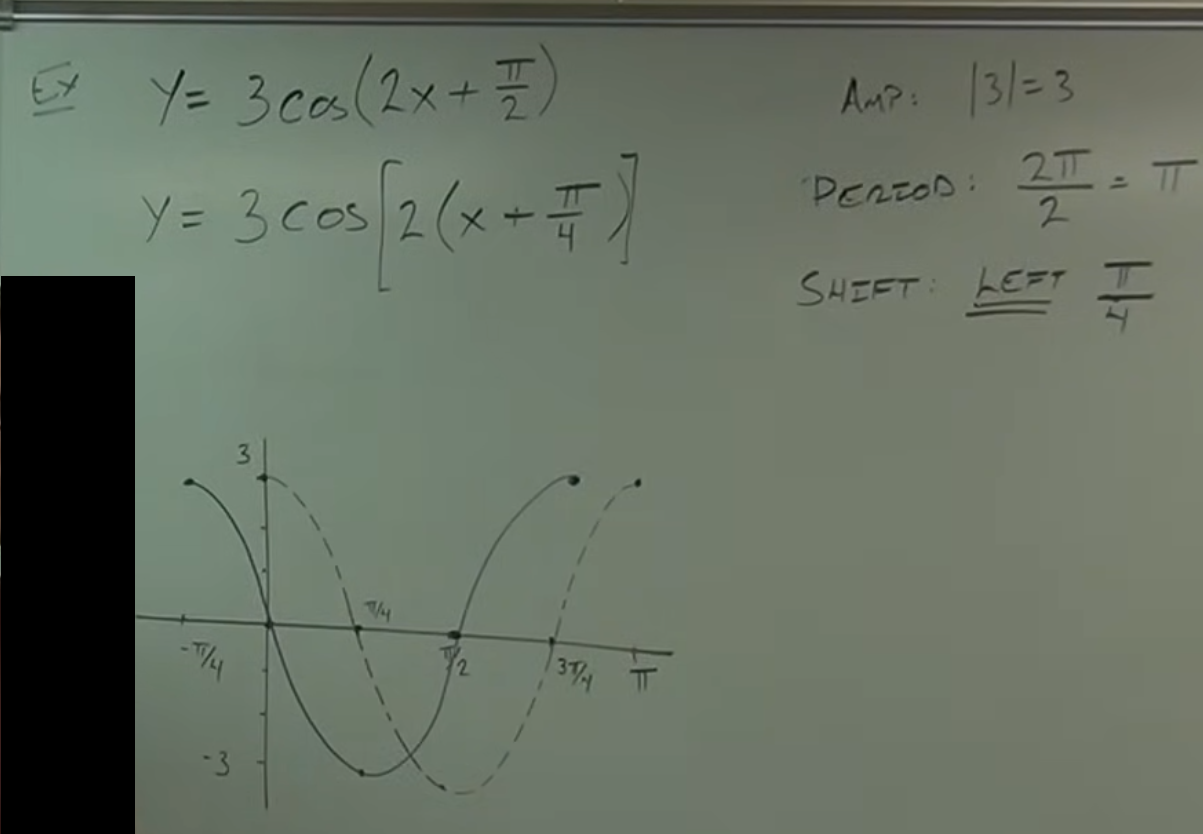
- $\displaystyle y=3\cdot\cos\!\Big[2\big(x+\dfrac{\pi}{4}\big)\Big]$