Calculus 1 lecture 0.4
Combining and composition of functions
Combining Functions
- [0:44].
Introduction to Combining Functions: addition, subtraction, multiplication, division.
– [📷image]
- [0:57].
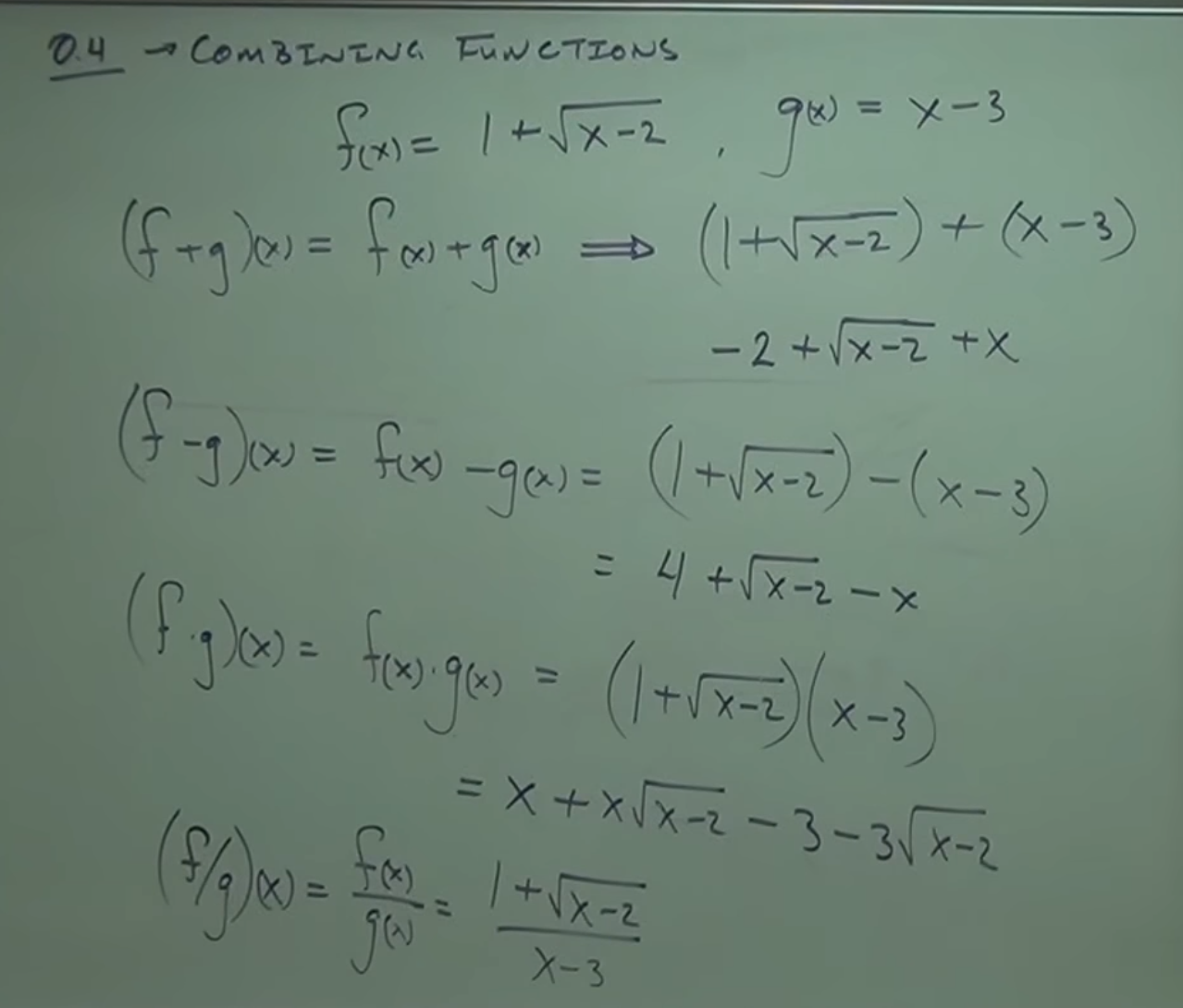
🧩 Example – with functions: $\displaystyle \mathcal{f}(x)=1+\sqrt{x-2}$ and $\displaystyle
\mathcal{g}(x)=x-3$
- Addition of functions: $\displaystyle (\mathcal{f}+\mathcal{g})(x)$
- $\displaystyle
(\mathcal{f}+\mathcal{g})(x)=\mathcal{f}(x)+\mathcal{g}(x)=(1+\sqrt{x-2})+(x-3)=-2+\sqrt{x-2}+x$
- Subtraction of functions: $\displaystyle (\mathcal{f}-\mathcal{g})(x)$
- $\displaystyle
(\mathcal{f}-\mathcal{g})(x)=\mathcal{f}(x)-\mathcal{g}(x)=(1+\sqrt{x-2})-(x-3)=4+\sqrt{x-2}-x$
- Multiplication of functions: $\displaystyle (\mathcal{f}\cdot\mathcal{g})(x)$
- $\displaystyle
(\mathcal{f}\cdot\mathcal{g})(x)=\mathcal{f}(x)\cdot\mathcal{g}(x)=(1+\sqrt{x-2})\cdot(x-3)=x+x\sqrt{x-2}-3-3\sqrt{x-2}$
- Division of functions: $\displaystyle (\mathcal{f}/\mathcal{g})(x)$
- $\displaystyle
(\mathcal{f}/\mathcal{g})(x)=\dfrac{\mathcal{f}(x)}{\mathcal{g}(x)}=\dfrac{1+\sqrt{x-2}}{x-3}$
- [3:58].
Domain of Combined Functions
- The domain is the i͟n͟t͟e͟r͟s͟e͟c͟t͟i͟o͟n͟ of the domains of the o͟r͟i͟g͟i͟n͟a͟l͟
functions.
- [4:30]. 🧩 Example – illustrate domain restriction:
– [📷image]
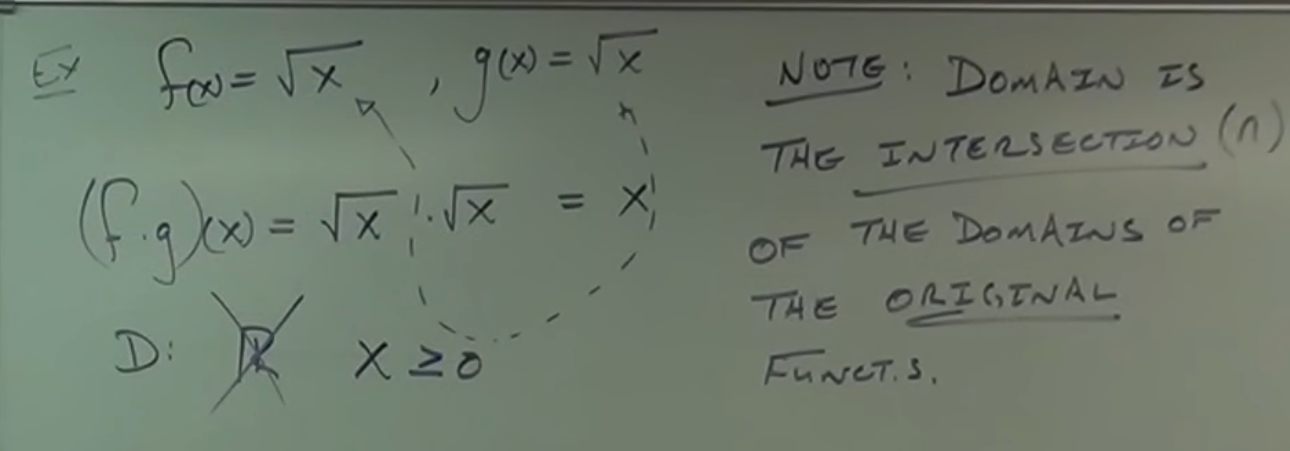
- $\displaystyle \sqrt{x}\cdot\sqrt{x}=x$. The domain is not all real numbers.
- The domain of $\displaystyle \sqrt{x}\cdot\sqrt{x}$ is numbers greater than or
equal to $\displaystyle 0$.
- Domain restrictions cannot be removed; when functions are combined, they accumulate rather
than cancel out.
- 🧩 Example –:
- Conclusion: domain issues do not cancel out — they accumulate.
Composition of Functions
- [7:37].
Introduction by examples to Composition of Functions
– [📷image]
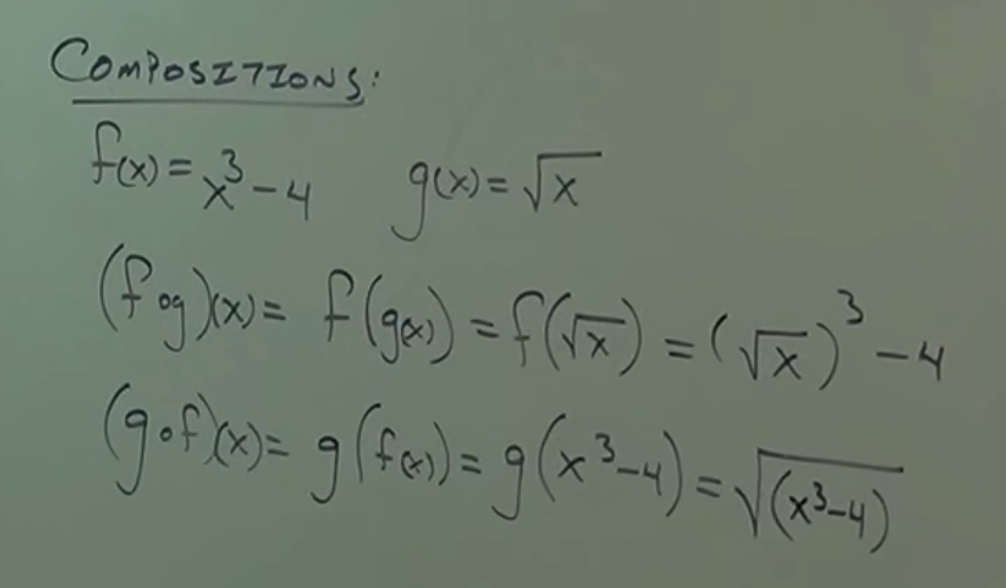
- [7:56]. 🧩 Example –: $\displaystyle \mathcal{f}(x)=x^{3}-4$ and $\displaystyle
\mathcal{g}(x)=\sqrt{x}$
- [8:29]. Composition $\displaystyle
(\mathcal{f}\circ\mathcal{g})(x)=\mathcal{f}(\mathcal{g}(x))$
- $\displaystyle
(\mathcal{f}\circ\mathcal{g})(x)=\mathcal{f}(\mathcal{g}(x))=\mathcal{f}(\sqrt{x})=(\sqrt{x})^{3}-4$
- [10:15]. Composition $\displaystyle
(\mathcal{g}\circ\mathcal{f})(x)=\mathcal{g}(\mathcal{f}(x))$
- $\displaystyle
(\mathcal{g}\circ\mathcal{f})(x)=\mathcal{g}(\mathcal{f}(x))=\mathcal{g}(x^{3}-4)=\sqrt{x^{3}-4}$
- [11:07].
Multiple Composition of Functions by example
– [📷image]
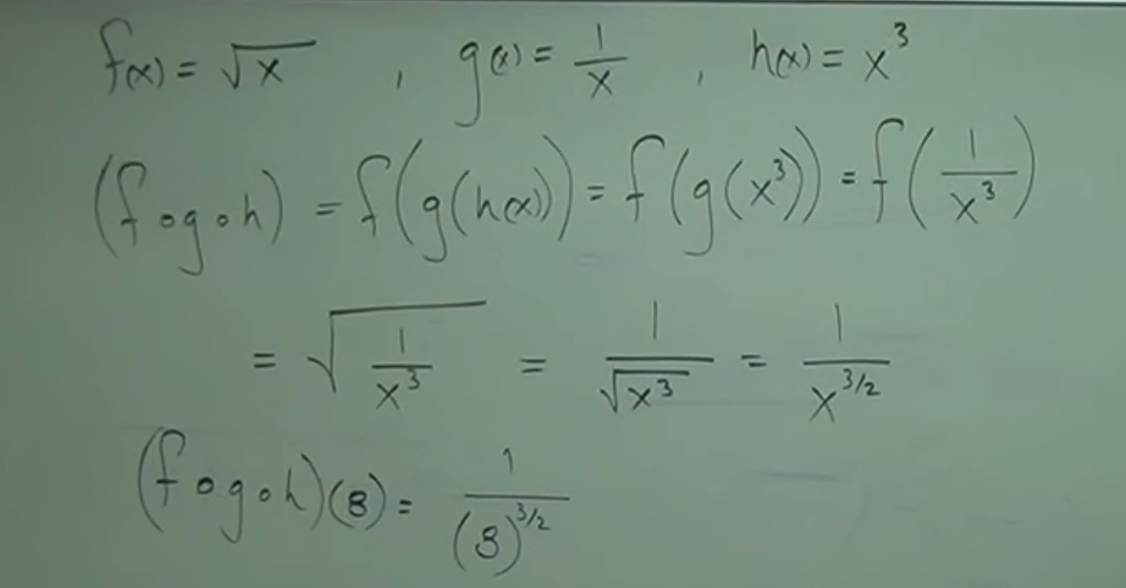
- [11:26]. 🧩 Example –: $\displaystyle \mathcal{f}(x)=\sqrt{x}$, $\displaystyle
\mathcal{g}(x)=\dfrac{1}{x}$, and $\displaystyle \mathcal{h}(x)=x^{3}$
- [11:51]. $\displaystyle (\mathcal{f}\circ\mathcal{g}\circ\mathcal{h})(x)$
- $\displaystyle
(\mathcal{f}\circ\mathcal{g}\circ\mathcal{h})(x)=\mathcal{f}(\mathcal{g}(\mathcal{h}(x)))=\mathcal{f}(\mathcal{g}(x^{3}))=\mathcal{f}\!\left(\dfrac{1}{x^{3}}\right)=\sqrt{\dfrac{1}{x^{3}}}=\dfrac{1}{\sqrt{x^{3}}}=\dfrac{1}{x^{3/2}}$
- [13:30]. $\displaystyle (\mathcal{f}\circ\mathcal{g}\circ\mathcal{h})(8)$
- $\displaystyle
(\mathcal{f}\circ\mathcal{g}\circ\mathcal{h})(8)=\dfrac{1}{8^{3/2}}$
- [14:44].
Decomposing a Function into a Composition of Functions by example
– [📷image]
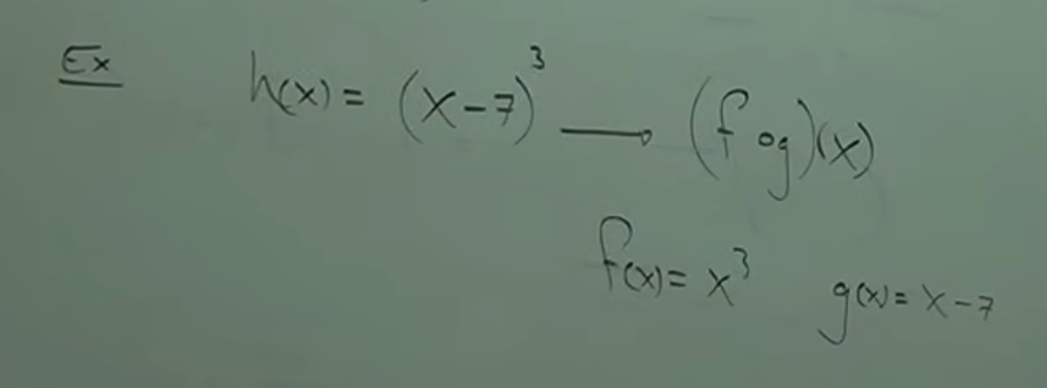
- 🧩 Example –: $\displaystyle \mathcal{h}(x)=(x-7)^{3}$ can be written as a composition
$\displaystyle \mathcal{f}(\mathcal{g}(x))$
- $\displaystyle (\mathcal{f}\circ\mathcal{g})(x)$; $\displaystyle
\mathcal{f}(x)=x^{3}$; $\displaystyle \mathcal{g}(x)=x-7$
Additional resources