Calculus 1 lecture 1.2
Properties Of Limits. Techniques Of Limit Computation
Introduction to the Properties of Limits
-
0:50. The Limit of a
Constant:
– [📷image]
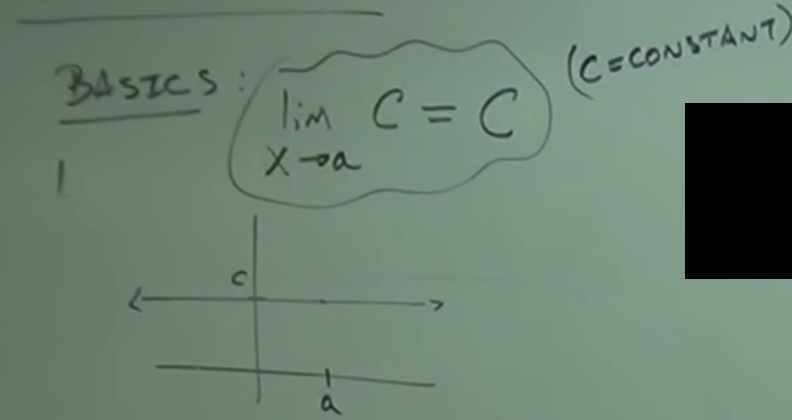
- The limit of a constant is defined as: $\displaystyle \lim_{x\to a} 𝓒=𝓒$, where $𝓒$ is
a constant.
- If a function always has the same value, it doesn’t matter what value $x$ approaches — the
result does not change.
-
2:53. The Limit of a Simple
Variable:
– [📷image]
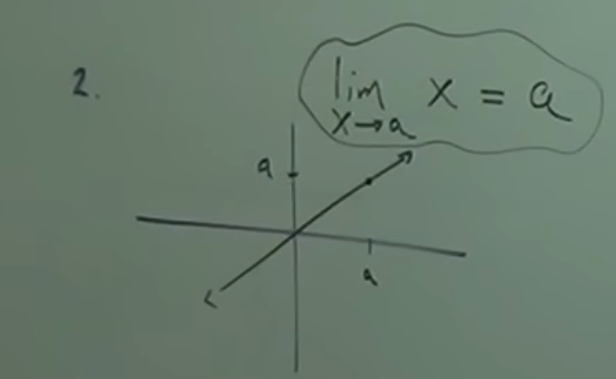
- The limit of a simple variable is defined as: $\displaystyle \lim_{x\to a} 𝒙=𝒂$.
- If the function is just $𝒙$ itself, then as $𝒙$ gets closer to $a$, the function gets
closer to $a$ — so the limit is the value it approaches.
-
5:10. The Importance of
Equality of One-sided Limits:
– [📷image]
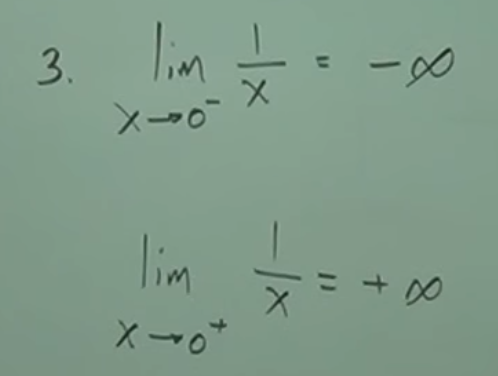
- The importance that the one-sided limits are equal for the general limit to e𝒙ist is
emphasized.
-
Examples of one-sided limits that are not equal are provided, resulting in the non-e𝒙istence of the general
limit.
- $\displaystyle \lim_{x\to 0^-}\dfrac{1}{x}=-\infty$ and $\displaystyle \lim_{x\to
0^+}\dfrac{1}{𝒙}=+\infty$
Properties of Limits
-
6:25. Properties of Limits:
– [📷image]
-
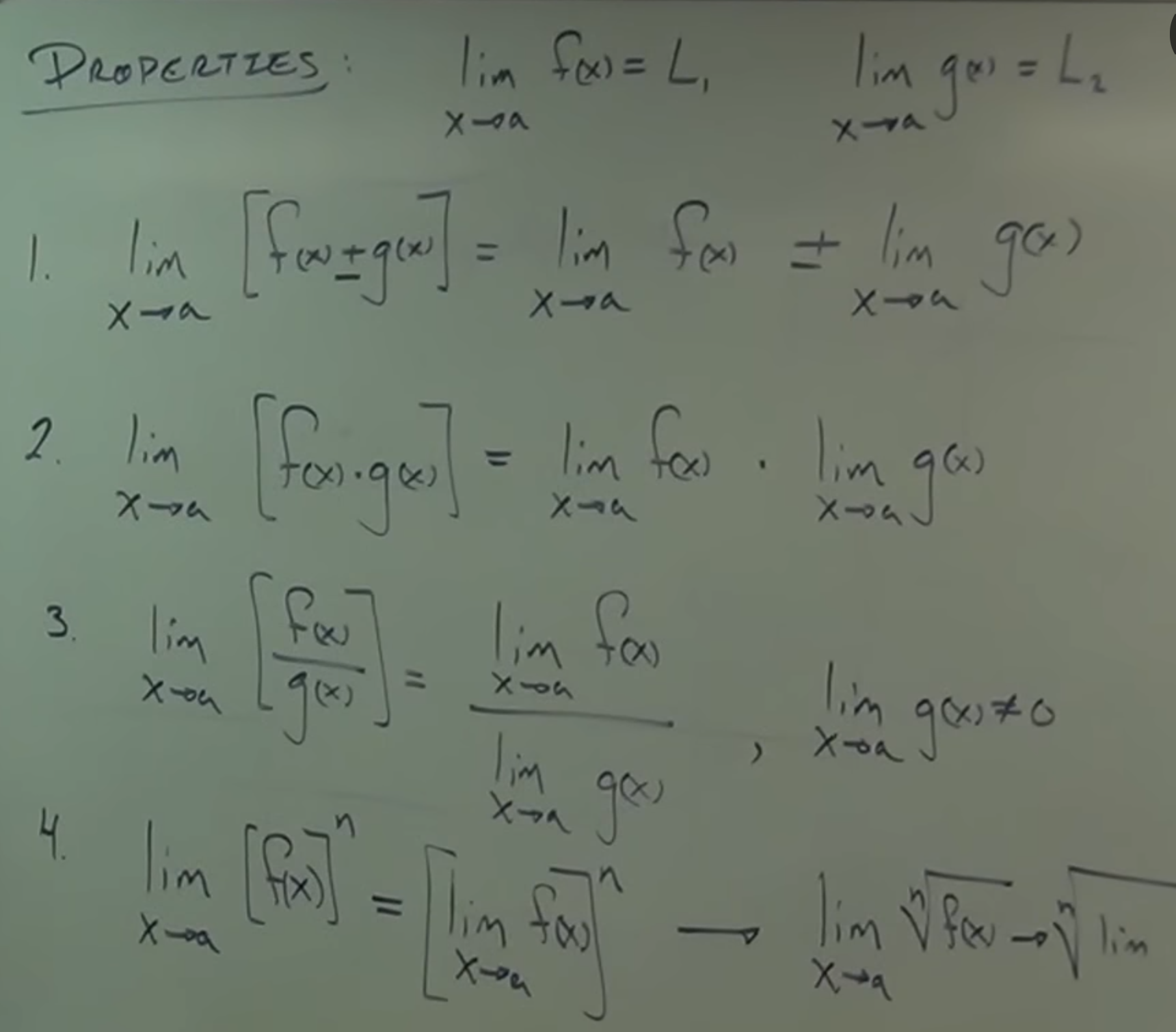
The properties of limits are introduced, including sum, difference, product, quotient, and e𝒙ponents.
-
If $\displaystyle \lim_{x\to a}𝒇(𝒙)=L$ and $\displaystyle \lim_{x\to a}𝓰(𝒙)=L_{2}$, then:
- 1.2.1 $\displaystyle \lim_{x\to a}\big(𝒇(𝒙)\pm 𝓰(𝒙)\big)=\lim_{x\to a} 𝒇(𝒙)\
\pm\ \lim_{x\to a} 𝓰(𝒙)$
- 1.2.2 $\displaystyle \lim_{x\to a}\big(𝒇(𝒙)\cdot 𝓰(𝒙)\big)=\big(\lim_{x\to a}
𝒇(𝒙)\big)\cdot \big(\lim_{x\to a} 𝓰(𝒙)\big)$
- 1.2.3 $\displaystyle \lim_{x\to a}\dfrac{𝒇(𝒙)}{𝓰(𝒙)}=\dfrac{\lim_{x\to a}
𝒇(𝒙)}{\lim_{x\to a} 𝓰(𝒙)}$, provided $\displaystyle \lim_{x\to a} 𝓰(𝒙)\neq 0$
-
1.2.4 $\displaystyle \lim_{x\to a}\big(𝒇(𝒙)\big)^{n}=\big(\lim_{x\to a} 𝒇(𝒙)\big)^{n}$
- ▣ 1.2.4.1 $\displaystyle \lim_{x\to
a}\sqrt[n]{\,𝒇(𝒙)\,}=\sqrt[n]{\,\lim_{x\to a} 𝒇(𝒙)\,}$ (✔ The property is valid only if the
limit exists, and in the case of even roots, the value inside the root must be non-negative)
-
11:05. Recapitulation
Evaluating Limits in Polynomials
-
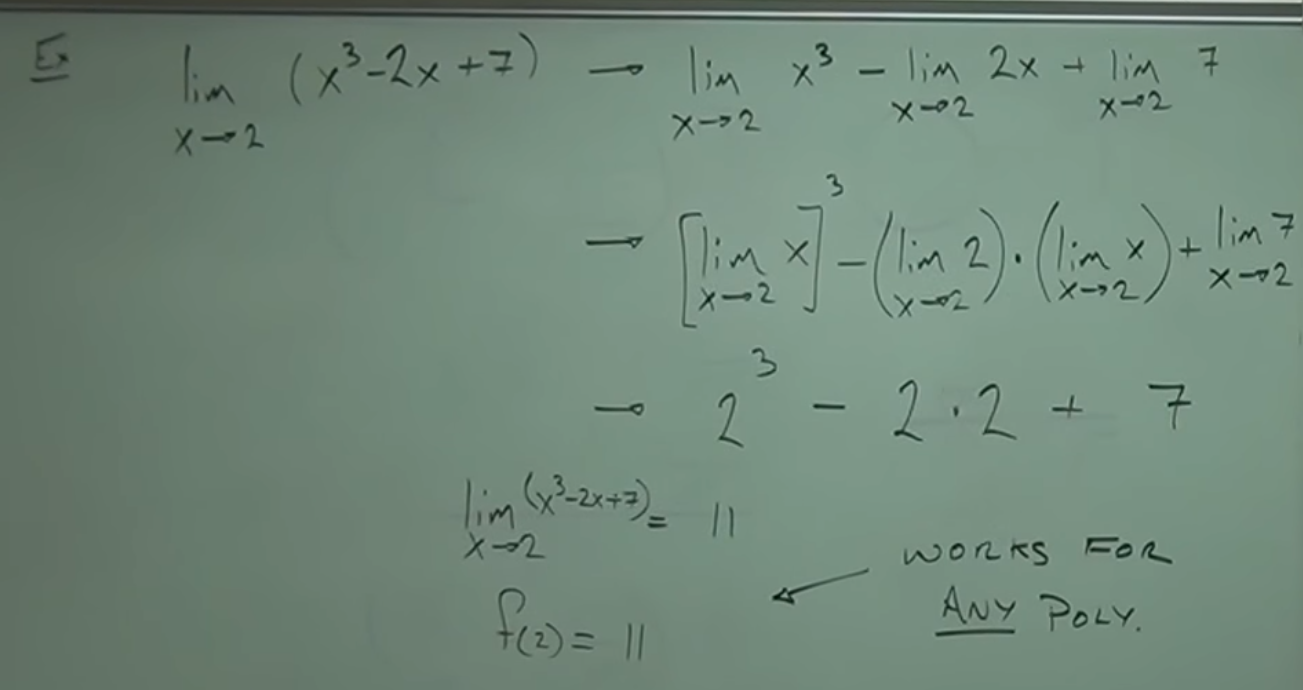
12:20. 🧩 Evaluation of
$\displaystyle \lim_{x\to 2}\ (𝒙^{3}-2𝒙+7)$:
– [📷image]
-
$\displaystyle \lim_{x\to 2}(𝒙^{3}-2𝒙+7)$ is calculated using the properties of limits.
- $\displaystyle \lim_{x\to 2}𝒙^{3}-\lim_{x\to 2}2𝒙+\lim_{x\to 2}7$
- $\displaystyle \lim_{x\to 2}𝒙^{3}-\big(\lim_{x\to 2}2\big)\cdot \big(\lim_{x\to
2}𝒙\big)+\lim_{x\to 2}7$
- $\displaystyle \lim_{x\to 2}𝒙^{3}-2𝒙+7=11$
- $f(2)=11$
-
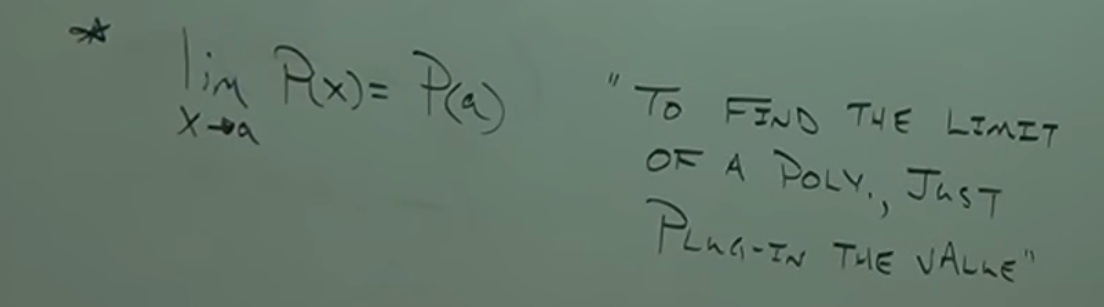
17:04. 𝑻𝒉𝒆 𝑳𝒊𝒎𝒊𝒕
𝒐𝒇 𝑨𝒏𝒚 𝑷𝒐𝒍𝒚𝒏𝒐𝒎𝒊𝒂𝒍:
– [📷image]
-
$\displaystyle \lim_{x\to a}\mathcal{P}(𝒙)=\mathcal{P}(𝒂)$
- 𝑻𝒉𝒆 𝒍𝒊𝒎𝒊𝒕 𝒐𝒇 𝒂 𝒑𝒐𝒍𝒚𝒏𝒐𝒎𝒊𝒂𝒍 𝒇𝒖𝒏𝒄𝒕𝒊𝒐𝒏 𝒂𝒔 $𝒙$
𝒂𝒑𝒑𝒓𝒐𝒂𝒄𝒉𝒆𝒔 𝒂 𝒑𝒐𝒊𝒏𝒕 $a$ 𝒊𝒔 𝒋𝒖𝒔𝒕 𝒕𝒉𝒆 𝒗𝒂𝒍𝒖𝒆 𝒐𝒇 𝒕𝒉𝒆 𝒑𝒐𝒍𝒚𝒏𝒐𝒎𝒊𝒂𝒍
𝒂𝒕 𝒕𝒉𝒂𝒕 𝒑𝒐𝒊𝒏𝒕.
-
20:16. 🧩 Evaluation of
$\displaystyle \lim_{x\to 2}\ \big(𝒙^{5}-3𝒙+4\big)^{3}$:
– [📷image]
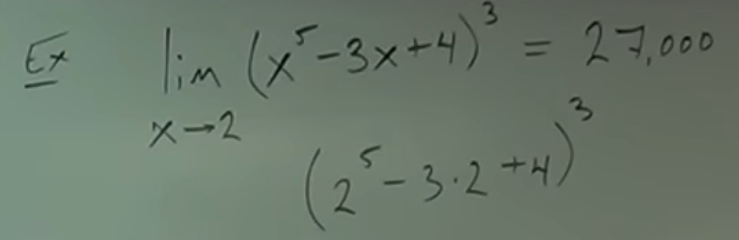
- The calculation is simplified by evaluating the function at $𝒙=2$ and then cubing the
result.
Limits of Non-Polynomial Functions
-
23:05. 🧩 Evaluation of
$\displaystyle \lim_{x\to 2}\ \dfrac{4𝒙^{2}+1}{𝒙+3}$:
– [📷image]
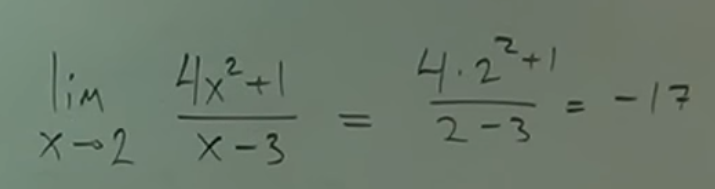
- Apply property 1.2.3 → $\displaystyle \dfrac{\lim_{x\to 2}(4𝒙^{2}+1)}{\lim_{x\to
2}(𝒙+3)}$
- Then we check that both the numerator and the denominator are polynomials, so we can
substitute $𝒙=2$ directly.
-
26:20. 🧩 Evaluation of
$\displaystyle \lim_{x\to 1}\ \sqrt[3]{\dfrac{5𝒙+7}{𝒙^{2}+1}}$
– [📷image]
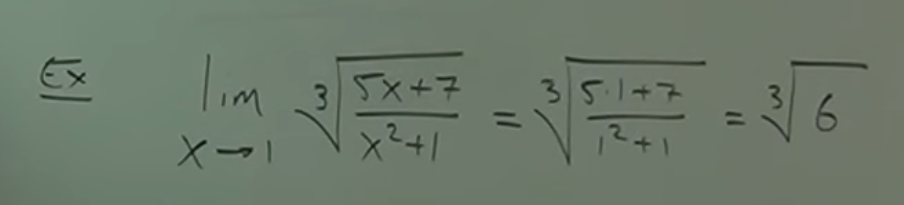
- $\displaystyle \lim_{x\to 1}\sqrt[3]{\dfrac{5𝒙+7}{𝒙^{2}+1}}=\sqrt[3]{\dfrac{5\cdot
1+7}{1^{2}+1}}=\sqrt[3]{6}$
- It is mentioned that the same properties as for polynomials can be used, as long as domain
issues, such as division by zero, are avoided.
-
28:50. 🧩 Evaluation of
$\displaystyle \lim_{x\to 2}\ \dfrac{𝒙^{2}-4}{𝒙-2}$
– [📷image]
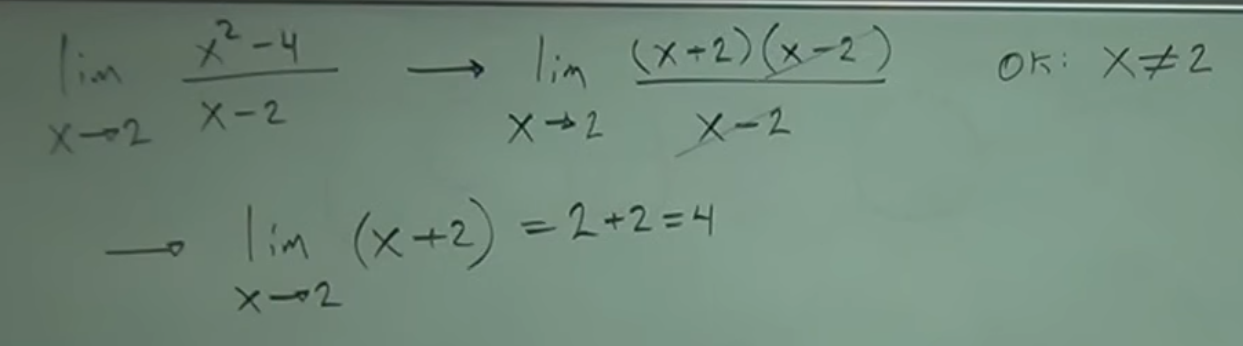
- $\displaystyle \lim_{x\to 2}\dfrac{𝒙^{2}-4}{𝒙-2}$
- $\displaystyle \lim_{x\to 2}\dfrac{(𝒙+2)(𝒙-2)}{𝒙-2}$
- $\displaystyle \lim_{x\to 2}\big[\,𝒙+2\,\big]$
- Cancel $(𝒙-2)$, since we are not evaluating exactly at $𝒙=2$, but rather approaching it.
-
$\displaystyle \lim_{x\to 2}\big[𝒙+2\big]=2+2=4$
-
The original function is undefined because the denominator becomes zero $(𝒙-2=0)$.
- This creates a 𝒉𝒐𝒍𝒆 in the graph at the point $(2,4)$. The function does not
diverge to infinity; it simply has a removable discontinuity.
- This is different from a vertical asymptote, which occurs when the denominator
approaches zero but the numerator does 𝒏𝒐𝒕 approach
zero at the same time (the numerator doesn’t become zero when the denominator does) — causing the
function to diverge to $+\infty$ or $-\infty$.
-
📝 N͟O͟T͟E͟: 𝑰𝒇 𝒕𝒉𝒆 𝒅𝒆𝒏𝒐𝒎𝒊𝒏𝒂𝒕𝒐𝒓 𝒃𝒆𝒄𝒐𝒎𝒆𝒔 𝒛𝒆𝒓𝒐 𝒂𝒏𝒅 𝒘𝒆 𝒄𝒂𝒏 𝒔𝒊𝒎𝒑𝒍𝒊𝒇𝒚
𝒕𝒉𝒆 𝒆𝒙𝒑𝒓𝒆𝒔𝒔𝒊𝒐𝒏 𝒃𝒚 𝒄𝒂𝒏𝒄𝒆𝒍𝒊𝒏𝒈 𝒂 𝒄𝒐𝒎𝒎𝒐𝒏 𝒇𝒂𝒄𝒕𝒐𝒓 𝒘𝒊𝒕𝒉 𝒕𝒉𝒆
𝒏𝒖𝒎𝒆𝒓𝒂𝒕𝒐𝒓, 𝒕𝒉𝒆𝒏 𝒕𝒉𝒆𝒓𝒆'𝒔 𝒋𝒖𝒔𝒕 𝒂 𝒉𝒐𝒍𝒆 — 𝒕𝒉𝒆 𝒇𝒖𝒏𝒄𝒕𝒊𝒐𝒏 𝒊𝒔 𝒔𝒕𝒊𝒍𝒍
𝒘𝒆𝒍𝒍-𝒃𝒆𝒉𝒂𝒗𝒆𝒅 𝒏𝒆𝒂𝒓𝒃𝒚. 𝑩𝒖𝒕 𝒊𝒇 𝒕𝒉𝒆 𝒅𝒆𝒏𝒐𝒎𝒊𝒏𝒂𝒕𝒐𝒓 𝒊𝒔 𝒛𝒆𝒓𝒐 𝒂𝒏𝒅 𝒘𝒆
𝒄͟𝒂͟𝒏͟’͟𝒕͟ 𝒔𝒊𝒎𝒑𝒍𝒊𝒇𝒚, 𝒕𝒉𝒆 𝒇𝒖𝒏𝒄𝒕𝒊𝒐𝒏 𝒃𝒍𝒐𝒘𝒔 𝒖𝒑 — 𝒕𝒉𝒂𝒕'𝒔 𝒂 𝒗𝒆𝒓𝒕𝒊𝒄𝒂𝒍
𝒂𝒔𝒚𝒎𝒑𝒕𝒐𝒕𝒆.
Factorization and Simplification to Evaluate Limits
-
33:45. Factorization and
Simplification to Evaluate Limits:
-
🧩 Evaluation of $\displaystyle \lim_{x\to -4}\ \dfrac{2𝒙+8}{𝒙^{2}+𝒙-12}$
– [📷image]
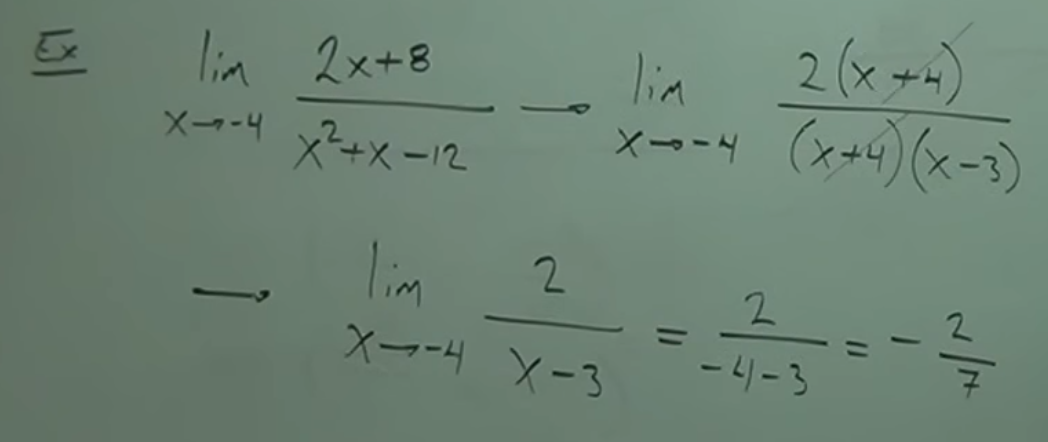
- $\displaystyle \lim_{x\to -4}\dfrac{2𝒙+8}{𝒙^{2}+𝒙-12}$
- $\displaystyle \lim_{x\to -4}\dfrac{2(𝒙+4)}{(𝒙+4)(𝒙-3)}$
- $\displaystyle \lim_{x\to -4}\dfrac{2}{𝒙-3}=
\dfrac{2}{-4-3}=\dfrac{2}{-7}=-\dfrac{2}{7}$
- The technique of factoring and simplifying serve for evaluate limits when direct
substitution results in $0/0$.
-
𝑪𝒐𝒎𝒎𝒐𝒏 𝒇𝒂𝒄𝒕𝒐𝒓𝒔 𝒊𝒏 𝒂 $0/0$ 𝒊𝒏𝒅𝒆𝒕𝒆𝒓𝒎𝒊𝒏𝒂𝒕𝒊𝒐𝒏 𝒇𝒐𝒓 𝒑𝒐𝒍𝒚𝒏𝒐𝒎𝒊𝒂𝒍𝒔: 𝑰𝒇
𝒃𝒐𝒕𝒉 𝒕𝒉𝒆 𝒏𝒖𝒎𝒆𝒓𝒂𝒕𝒐𝒓 𝒂𝒏𝒅 𝒕𝒉𝒆 𝒅𝒆𝒏𝒐𝒎𝒊𝒏𝒂𝒕𝒐𝒓 𝒂𝒓𝒆 𝒑𝒐𝒍𝒚𝒏𝒐𝒎𝒊𝒂𝒍𝒔
𝒂𝒏𝒅 𝒃𝒆𝒄𝒐𝒎𝒆 $0$ 𝒂𝒕 𝒕𝒉𝒆 𝒔𝒂𝒎𝒆 𝒑𝒐𝒊𝒏𝒕 $x=c$, 𝒊𝒕 𝒎𝒆𝒂𝒏𝒔 $x=c$ 𝒊𝒔 𝒂 𝒓𝒐𝒐𝒕 𝒐𝒇
𝒃𝒐𝒕𝒉 𝒑𝒐𝒍𝒚𝒏𝒐𝒎𝒊𝒂𝒍𝒔. 𝑻𝒉𝒊𝒔 𝒊𝒎𝒑𝒍𝒊𝒆𝒔 𝒕𝒉𝒆𝒚 𝒔𝒉𝒂𝒓𝒆
𝒂 𝒄𝒐𝒎𝒎𝒐𝒏 𝒇𝒂𝒄𝒕𝒐𝒓 $(𝒙-𝒄)$. 𝑻𝒉𝒊𝒔 𝒇𝒂𝒄𝒕𝒐𝒓 𝒄𝒂𝒏 𝒃𝒆 𝒆𝒍𝒊𝒎𝒊𝒏𝒂𝒕𝒆𝒅
𝒕𝒉𝒓𝒐𝒖𝒈𝒉 𝒔𝒊𝒎𝒑𝒍𝒊𝒇𝒊𝒄𝒂𝒕𝒊𝒐𝒏, 𝒂𝒍𝒍𝒐𝒘𝒊𝒏𝒈 𝒕𝒉𝒆 𝒍𝒊𝒎𝒊𝒕 𝒕𝒐 𝒃𝒆 𝒓𝒆𝒔𝒐𝒍𝒗𝒆𝒅.
- The importance of maintaining the limit notation until the limit is evaluated is
emphasized.
Limits with Vertical Asymptotes
-
38:23. 🧩 Evaluation of
$\displaystyle \lim_{x\to 5}\ \dfrac{𝒙^{2}-3𝒙-10}{𝒙^{2}-10𝒙+25}$
– [📷image]
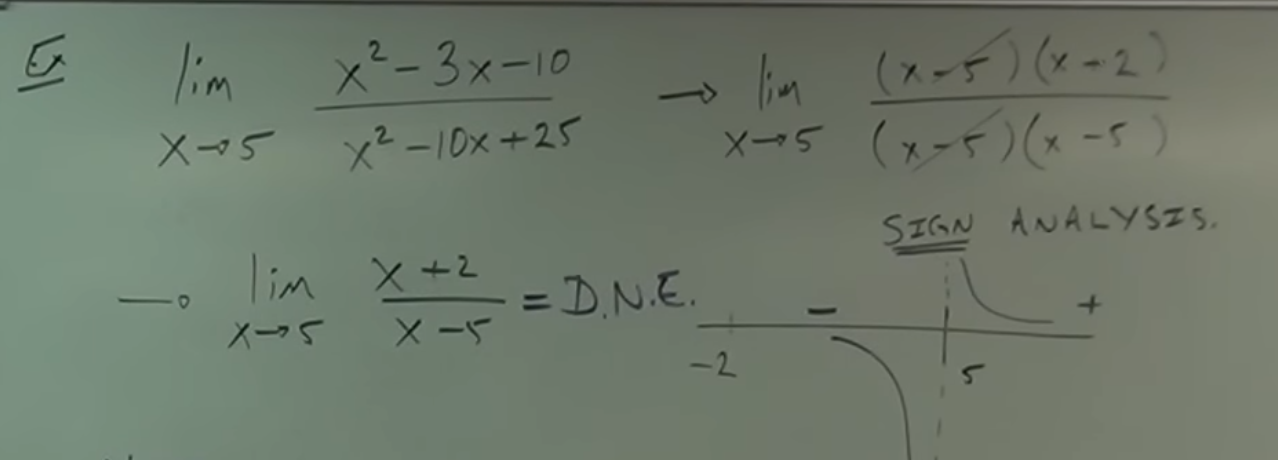
- $\displaystyle \lim_{x\to 5}\dfrac{𝒙^{2}-3𝒙-10}{𝒙^{2}-10𝒙+25}$ is attempted by
factoring and simplifying, but a 🔶vertical asymptote🔶 is found.
- $\displaystyle \lim_{x\to 5}\dfrac{(𝒙-5)(𝒙+2)}{(𝒙-5)(𝒙-5)}$ = $\displaystyle
\lim_{x\to 5}\dfrac{𝒙+2}{𝒙-5}$
-
📝 N͟O͟T͟E͟: Before rushing to factor the expression, 𝒂𝒍𝒘𝒂𝒚𝒔 𝒄𝒉𝒆𝒄𝒌 the value you're
approaching—in this case, $𝒙=5$.
If plugging in the number gives a defined result, there's no need to factor. Factoring would just waste time
and might confuse you unnecessarily.
-
The difference is clarified between:
- A 𝒉𝒐𝒍𝒆 in the graph (removable discontinuity, can be simplified), and
- A 🔶vertical asymptote🔶 (non-removable, cannot be simplified).
-
40:45. ͟𝐒͟𝐢͟𝐠͟𝐧͟
͟𝐀͟𝐧͟𝐚͟𝐥͟𝐲͟𝐬͟𝐢͟𝐬͟ ͟𝐓͟𝐞͟𝐬͟𝐭͟:
- The sign analysis test is presented to determine the behavior of a function
around a 🔶vertical asymptote🔶.
-
Steps for Sign Analysis at $𝒙=5$:
-
1. Check the function:
- At $𝒙=5$, the denominator becomes $0$ and cannot be canceled out.
- This means there is a 🔶vertical asymptote🔶 at $𝒙=5$ — not a hole.
-
2. Identify key points:
- Problem point: $𝒙=5$
- Optional helper point: $𝒙=-2$ (just to clearly separate intervals on the
number line)
-
3. Draw a number line to analyze signs
-
4. Pick a number to the right of 5 (e.g., $𝒙=6$):
- $𝒇(𝒙)=\dfrac{𝒙+2}{𝒙-5}$
- $𝒇(6)=\dfrac{6+2}{6-5}=\dfrac{8}{1}=8>0$ → Positive
- So as $𝒙\to 5^{+}$, $𝒇(𝒙)\to +\infty$
-
5. Pick a number to the left of 5 (e.g., $𝒙=0$):
- $𝒇(𝒙)=\dfrac{𝒙+2}{𝒙-5}$
- $𝒇(0)=\dfrac{0+2}{0-5}=\dfrac{2}{-5}=-\dfrac{2}{5}<0$ → Negative
- So as $𝒙\to 5^{-}$, $𝒇(𝒙)\to -\infty$
-
6. The limit D.N.E because the left-hand limit ($-\infty$) and right-hand limit ($+\infty$) are not
the same.
This confirms a vertical asymptote at $𝒙=5$.
Summary of Techniques for Evaluating Limits
-
47:35. Summary of Techniques
for Evaluating Limits
-
📝 N͟O͟T͟E͟:
- ① If $0/0$, factor and simplify.
- ② If you can’t cancel the “problem,” check with ͟𝐒͟𝐢͟𝐠͟𝐧͟
͟𝐀͟𝐧͟𝐚͟𝐥͟𝐲͟𝐬͟𝐢͟𝐬͟ ͟𝐓͟𝐞͟𝐬͟𝐭͟ because the limit might not exist.
Rationalization to Evaluate Limits
-
Rationalization to Evaluate Limits:
-
When solving limits involving radicals:
-
① Multiply by the conjugate:
- Especially if there’s a radical in the denominator.
- The goal is to eliminate the radical from the denominator. Multiply by the
conjugate to use the identity:
- $(a-b)(a+b)=a^{2}-b^{2}$
- This clears the radical in the denominator.
-
② Do not expand (distribute) the numerator immediately:
- Avoid expanding the numerator right away.
- First, look to simplify — sometimes you can cancel factors.
- If you expand too soon, you might miss cancellations and make the problem messier.
-
50:50. 🧩 Evaluation of
$\displaystyle \lim_{x\to 1}\ \dfrac{𝒙-1}{\sqrt{𝒙}-1}$
– [📷image]
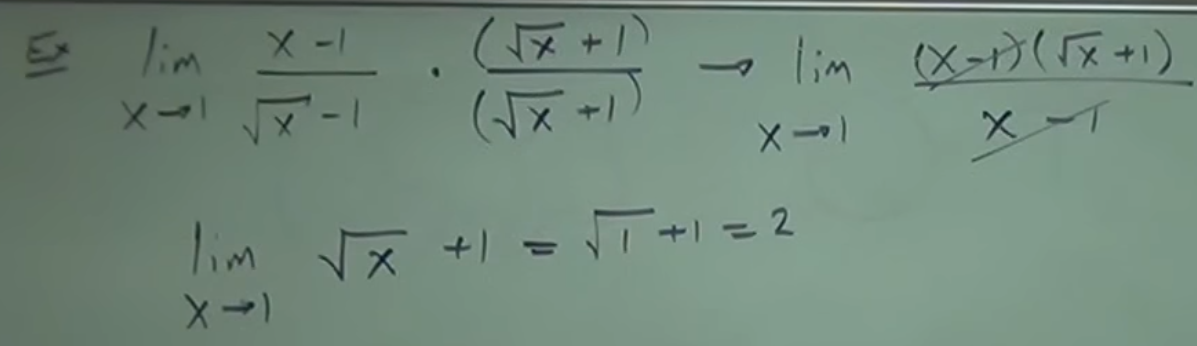
- $\displaystyle \lim_{x\to 1}\dfrac{𝒙-1}{\sqrt{𝒙}-1}$
- $\displaystyle \lim_{x\to 1}\dfrac{(𝒙-1)\cdot(\sqrt{𝒙}+1)}{(𝒙-1)}$ Multiply by the
conjugate: $\dfrac{\sqrt{𝒙}+1}{\sqrt{𝒙}+1}$
- $\displaystyle \lim_{x\to 1}\big(\sqrt{𝒙}+1\big)$ Simplify cancelling $(𝒙-1)$
- $\sqrt{1}+1=2$ Substitute directly
-
55:25. 🧩 Evaluation of
$\displaystyle \lim_{x\to 0}\ \dfrac{\sqrt{1+𝒙}-1}{𝒙}$
– [📷image]
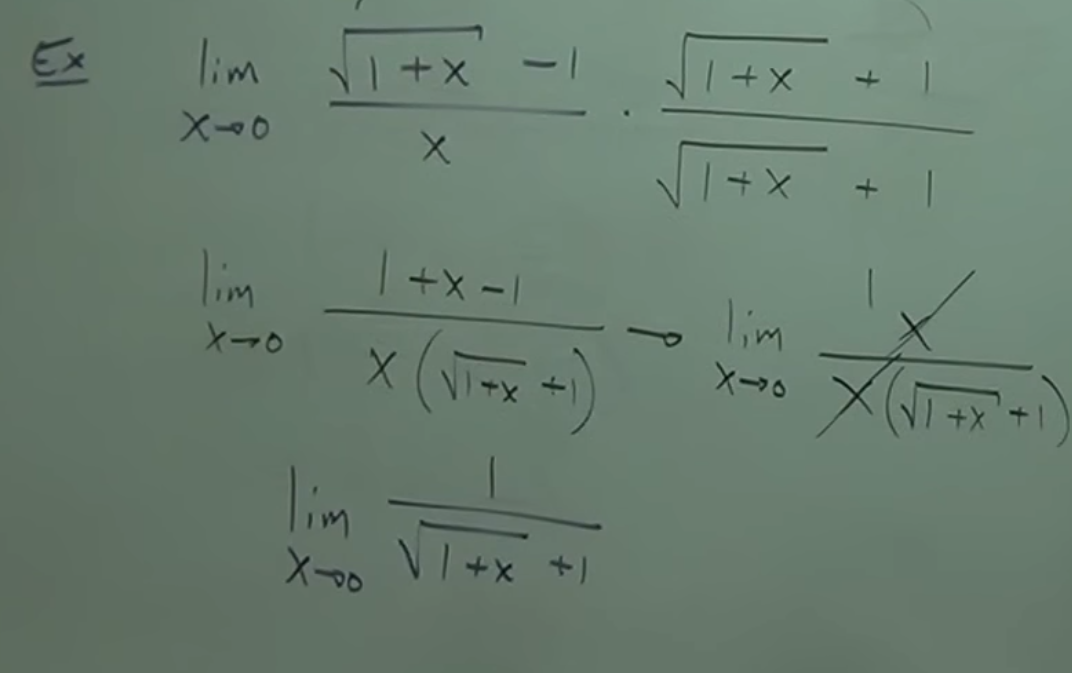
- $\displaystyle \lim_{x\to 0}\dfrac{\sqrt{1+𝒙}-1}{𝒙}$
- $\displaystyle \lim_{x\to 0}\dfrac{(1+𝒙)-1}{\,𝒙\cdot(\sqrt{1+𝒙}+1)\,}$ Multiply by the
conjugate: $\dfrac{\sqrt{1+𝒙}+1}{\sqrt{1+𝒙}+1}$
- $\displaystyle \lim_{x\to 0}\dfrac{1}{\sqrt{1+𝒙}+1}$ Simplify cancelling $𝒙$
- $\dfrac{1}{\sqrt{1+0}+1}=\dfrac{1}{2}$ Substitute directly
Limits by Parts
-
1:01:10. Limits by Parts
- The concept of limits by parts is introduced, where different functions are considered for
different intervals of the domain.
-
I͟D͟E͟A͟: To evaluate a limit by parts (limits for piecewise functions), the one-sided limits 🟪at the
points '𝒄' of change of the functions must be considered🟪
and see if they're equal:
- ① You must check the limit from the left $(𝒙\to 𝒄^{-})$ and from the right $(𝒙\to
𝒄^{+})$ at the point $𝒄$.
- Finding the limit from the left means identifying which piece of the function
approaches $𝒄$ from values smaller than $𝒄$.
- Finding the limit from the right means identifying which piece of the function
approaches $𝒄$ from values larger than $𝒄$.
- ② If both one-sided limits are equal, then the limit exists at $𝒄$. If they are
different, the overall limit does not exist at that point.
-
1:03:12. 🧩 Evaluation of
Limits by Parts:
– [📷image-1]
 – [📷image-2]
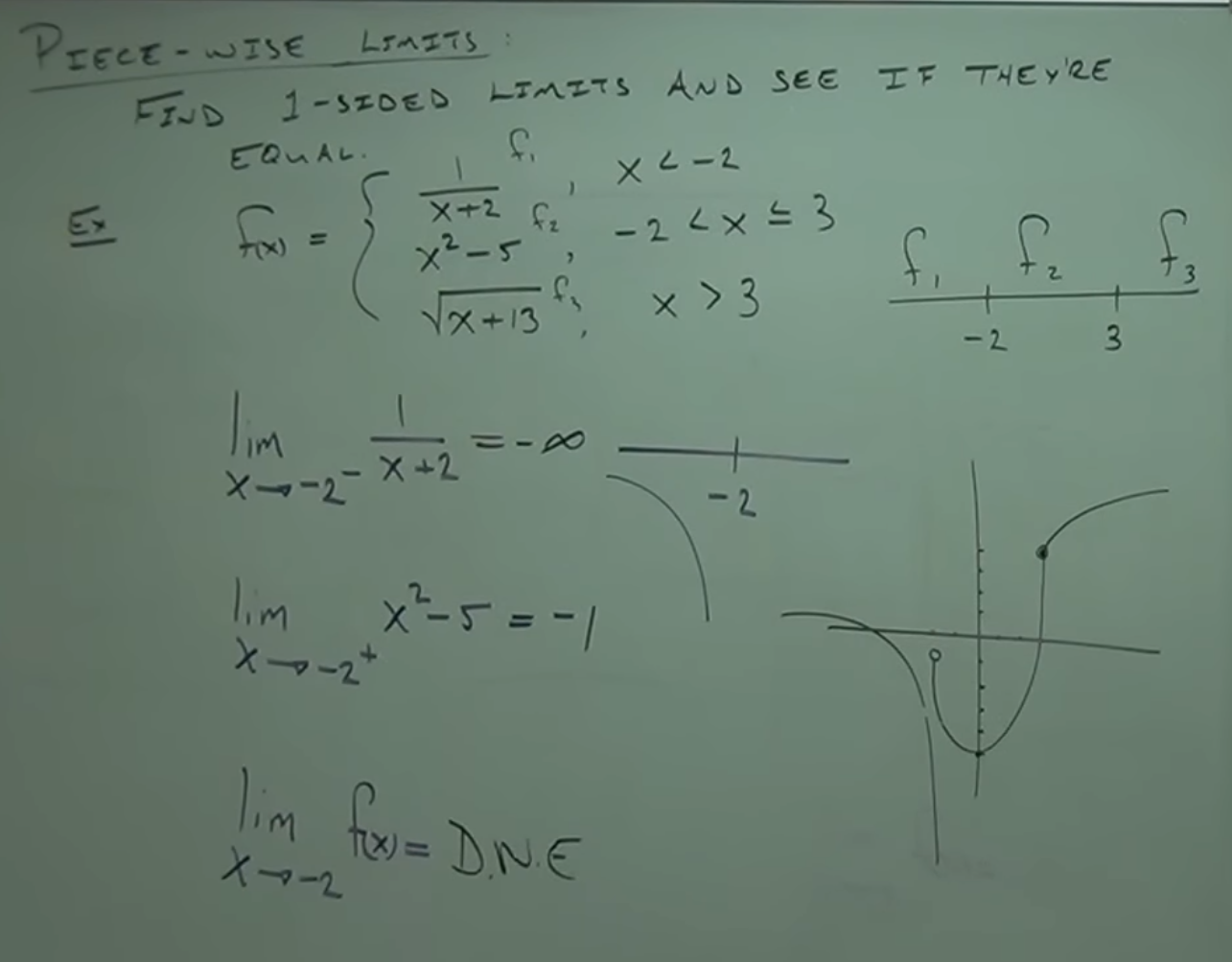
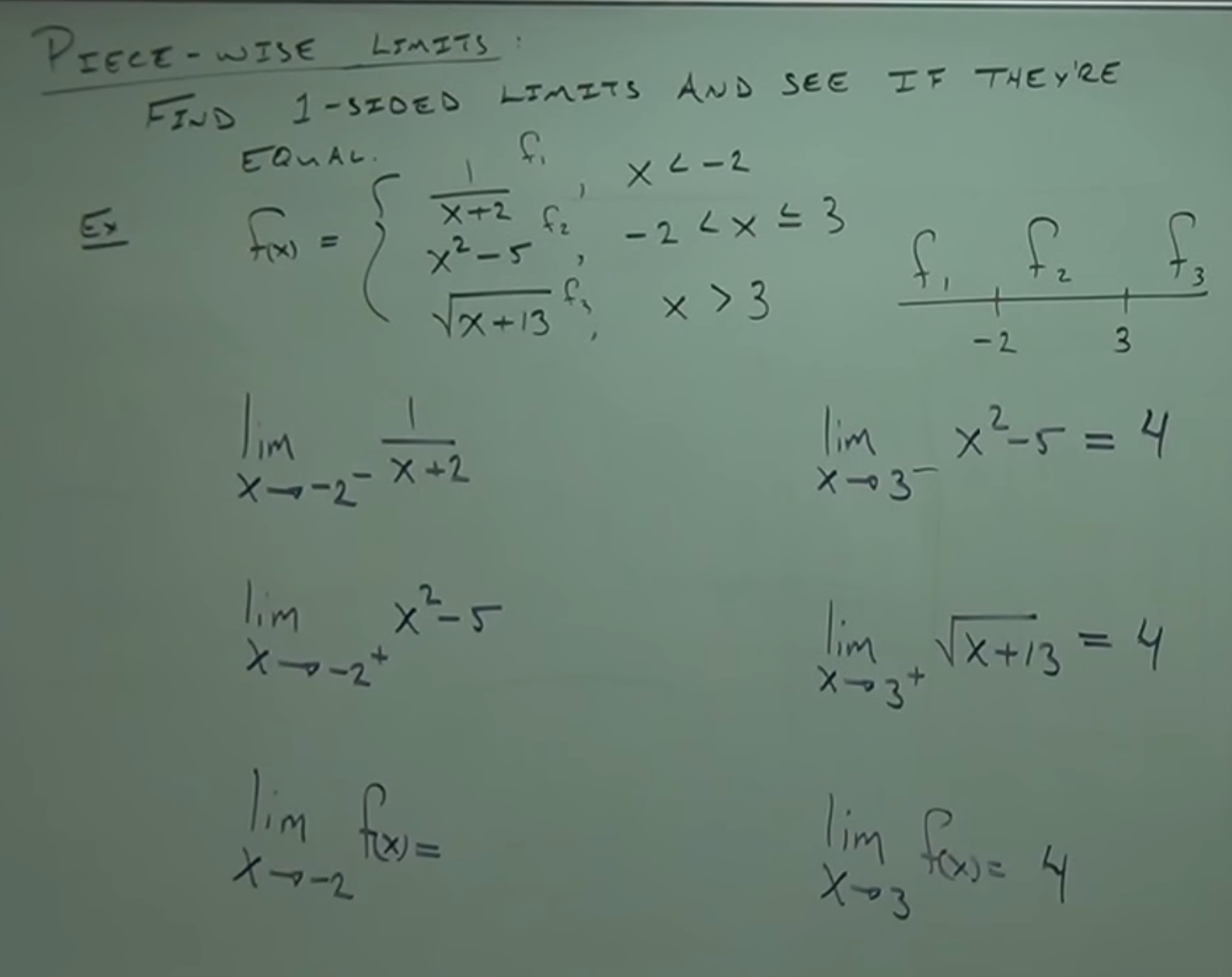
- The need to determine which function to use for each one-sided limit, depending on the
interval of the domain, is emphasized.
-
An e𝒙ample of limit by parts is worked out for a function defined in three intervals. The function is:
-
$\displaystyle𝒇(𝒙)=\begin{cases}\dfrac{1}{𝒙+2}, & \text{if } 𝒙<-2 \quad (𝒇_{1})\\[6pt]𝒙^{2}-5, &
\text{if } -2<𝒙\le 3 \quad (𝒇_{2})\\[6pt]\sqrt{𝒙+13}, & \text{if } 𝒙>3 \quad (𝒇_{3})\end{cases}$
- 🟪Points '𝒄' of Change: find the limits as $𝒙$ approaches $-2$ and $3$🟪
-
1:05:10. Graphical
Representation the e𝒙ample.
-
In this piecewise function $𝒇(𝒙)$:
-
🟪We must check the limit at each transition point $(𝒙=-2 \text{ and } 𝒙=3)$🟪. Steps:
-
1. Find the limit from the left $(𝒙\to 𝒄^{-})$ and the right $(𝒙\to 𝒄^{+})$ separately at the
point $𝒄$:
- Finding the limit from the left means identifying which piece of the function
is used when approaching $𝒄$ from the left.
- Example: For $𝒙\to -2^{-}$, use $𝒇_{1}(𝒙)$.
- Example: For $𝒙\to 3^{-}$, use $𝒇_{2}(𝒙)$.
- Finding the limit from the right means identifying which piece of the function
is used when approaching $𝒄$ from the right.
- Example: For $𝒙\to -2^{+}$, use $𝒇_{2}(𝒙)$.
- Example: For $𝒙\to 3^{+}$, use $𝒇_{3}(𝒙)$.
-
2. Compare the limits at each point:
- $𝒙=3$
- $\displaystyle \lim_{x\to 3^{-}}\big(𝒙^{2}-5\big)=4$
- $\displaystyle \lim_{x\to 3^{+}}\sqrt{𝒙+13}=4$
- $\displaystyle \lim_{x\to 3}𝒇(𝒙)=4$
- Due to the left and right limits are equal, the limit exists at $𝒙=3$.
- $𝒙=-2$
- $\displaystyle \lim_{x\to -2^{-}} \dfrac{1}{𝒙+2}=-\infty$
- $\displaystyle \lim_{x\to -2^{+}} 𝒙^{2}-5=-1$
- $\displaystyle \lim_{x\to -2}𝒇(𝒙)=\text{D.N.E.}$ (Does Not Exist)
- Due to they are different, the limit does not exist at $𝒙=-2$.
Limits in Trigonometric Functions
-
1:19:43. 𝙨𝒊𝙣(𝒙) 𝒂𝙣𝒅
𝒄𝙤𝒔(𝒙) 𝙖𝙧𝙚 𝙘𝙤𝙣𝙩𝙞𝙣𝙪𝙤𝙪𝙨 𝒆𝙫𝒆𝙧𝙮𝙬𝒉𝙚𝙧𝙚.
– [📷image]
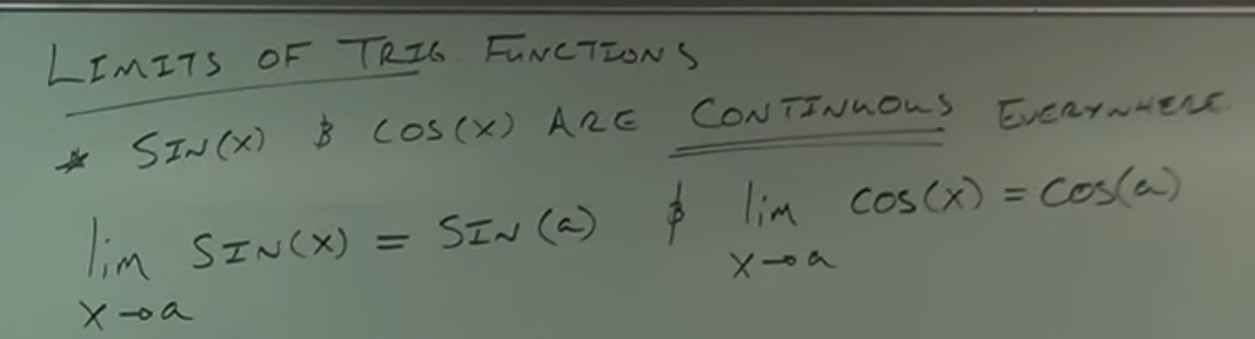
- $\displaystyle \lim_{x\to a}\sin(𝒙)=\sin(𝒂)$
- $\displaystyle \lim_{x\to a}\cos(𝒙)=\cos(𝒂)$
-
1:22:32. 𝑻𝒉𝒆
𝒇𝒖𝒏𝒄𝒕𝒊𝒐𝒏 $\tan(𝒙)$ 𝒆𝒙𝒊𝒔𝒕𝒔 𝒆𝒙𝒄𝒆𝒑𝒕 𝒂𝒕 𝒕𝒉𝒆 𝒑𝒐𝒊𝒏𝒕𝒔 𝒘𝒉𝒆𝒓𝒆 $\cos(𝒙)=0$.
𝑻𝒉𝒆𝒔𝒆 𝒑𝒐𝒊𝒏𝒕𝒔 𝒂𝒓𝒆 $𝒙=\pm \pi/2+n\pi,\ n\in\mathbb{Z}$.
– [📷image]
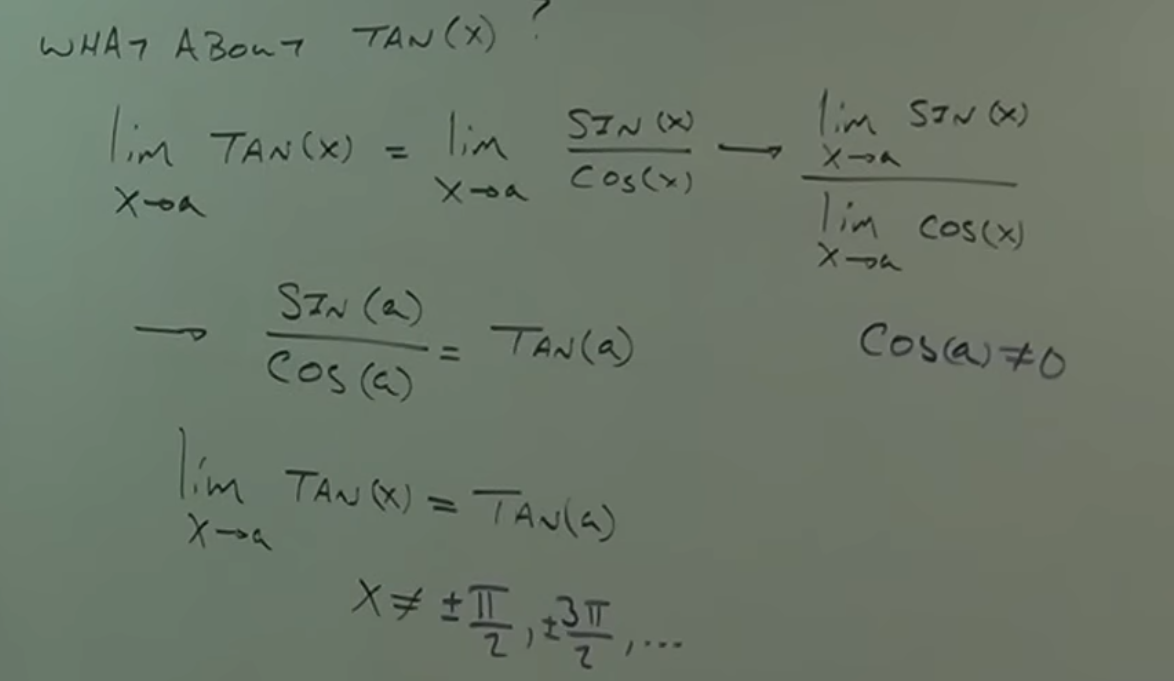
- $\displaystyle \lim_{x\to a}\tan(𝒙)=\tan(a)$ ; $𝒙\neq \pm \pi/2+n\pi,\ n\in\mathbb{Z}$.
-
1:28:15. 🧩 Evaluation of
$\displaystyle \lim_{x\to 1}\ \cos\!\left(\dfrac{𝒙^{2}-1}{𝒙-1}\right)$
– [📷image]
- $\cos(𝒙)$ is continuous so by composition ...
- $\displaystyle \cos\!\left(\lim_{x\to 1}\dfrac{𝒙^{2}-1}{𝒙-1}\right)$
- $\displaystyle \cos\!\left(\lim_{x\to 1}\dfrac{(𝒙+1)(𝒙-1)}{𝒙-1}\right)$
- $\displaystyle \cos\!\big(\lim_{x\to 1}(𝒙+1)\big)$
- $\cos(1+1)$
- $\cos(2)$
-
📝N͟O͟T͟E͟: Since $\cos(𝒙)$ is continuous, we can move the limit inside by the composition rule:
- 𝓟𝓻𝓸𝓹𝓮𝓻𝓽𝔂: Limit of Continuous Functions (Composition Rule)
- Statement:
- If $𝒇(𝒙)$ is continuous at $𝒙=a$, then:
- $\displaystyle \lim_{x\to a}𝒇(𝒙)=𝒇(a)$
- Application:
-
For continuous functions like $\sin(𝒙)$, $\cos(𝒙)$, polynomials, rationals, exponentials,
etc.,
you can move the limit inside:
-
$\displaystyle \lim_{x\to a}𝒇(𝒙)=𝒇\!\big(\lim_{x\to a} 𝒙\big)=𝒇(a)$
- Important:
-
This is why, when dealing with continuous functions, limits are straightforward to compute.
-
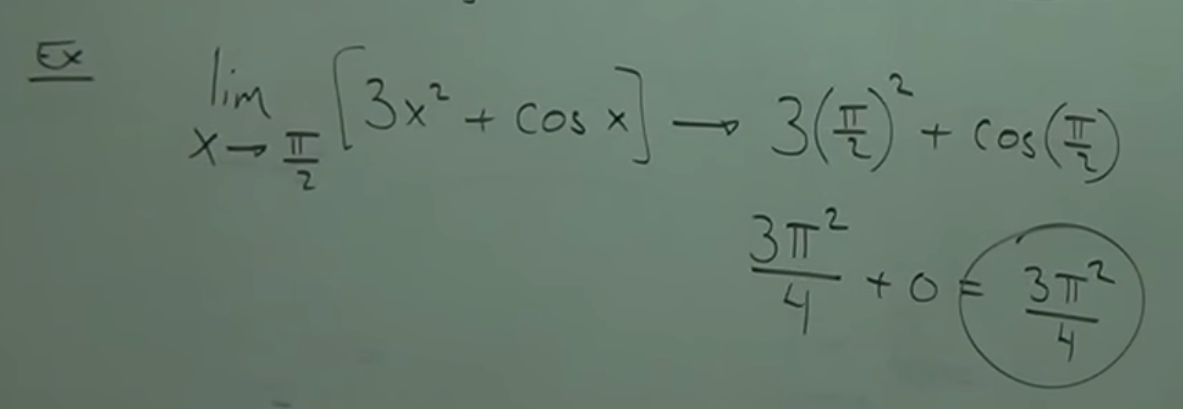
1:33:00. 🧩 Evaluation of
$\displaystyle \lim_{x\to \pi/2}\ \big(3𝒙^{2}+\cos(𝒙)\big)$
– [📷image]
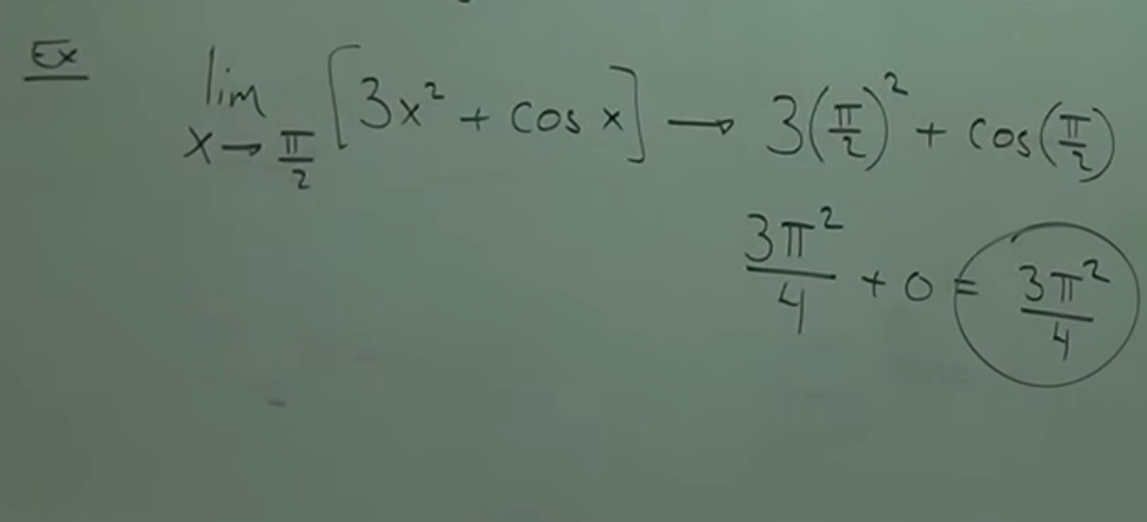
- Since there is no issue of discontinuity or undefined values at $𝒙=\pi/2$, we are
allowed to directly substitute the value into the expression.
-
📝N͟O͟T͟E͟: Whenever the function is continuous at the point — meaning there is no division by zero,
no square root of a negative number in the real domain, and no discontinuity —
we can evaluate the limit by direct substitution.
-
So: $\displaystyle \lim_{x\to \pi/2}\ \big(3𝒙^{2}+\cos(𝒙)\big)=3(\pi/2)^{2}+\cos(\pi/2)=3\cdot
\dfrac{\pi^{2}}{4}+0=\dfrac{3\pi^{2}}{4}$
-
1:37:15. ∴
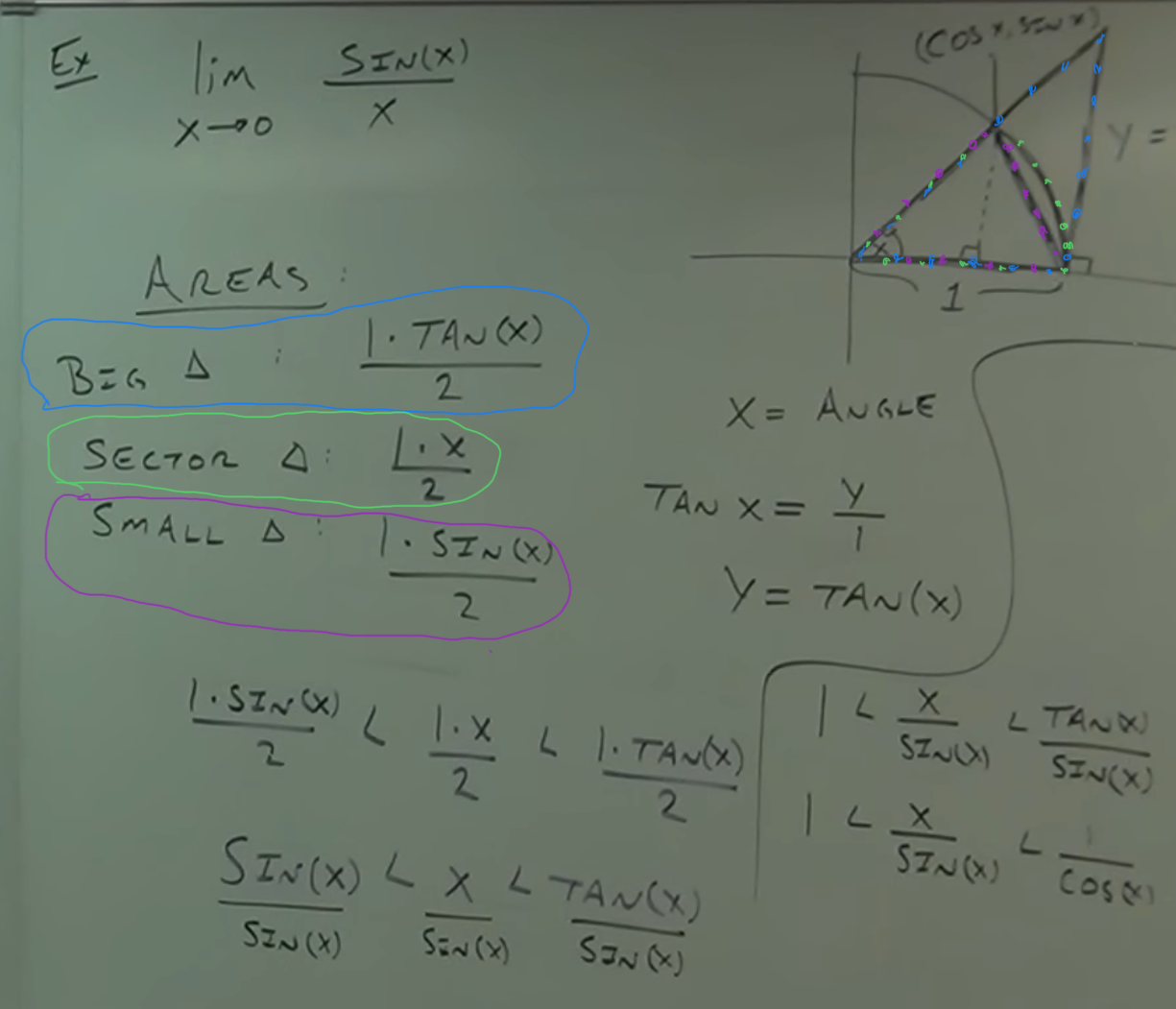
𝑫𝒆𝒎𝒐𝒏𝒔𝒕𝒓𝒂𝒕𝒊𝒐𝒏 𝒐𝒇 $\displaystyle \lim_{x\to 0}\ \dfrac{\sin 𝒙}{𝒙}=1$
– [📷image-1]
 – [📷image-2]
- $\displaystyle \lim_{x\to 0}\dfrac{\sin 𝒙}{𝒙}=1$ is demonstrated using the squeeze
theorem and areas of triangles and sectors.
- Triangles and sectors in a unit circle are constructed to compare their areas and
establish the necessary inequalities for the squeeze theorem.
-
To understand why $\displaystyle \lim_{x\to 0}\dfrac{\sin(𝒙)}{𝒙}=1$, we can use a geometric approach
involving areas in the unit circle. Here's a step-by-step explanation:
-
1. Unit Circle Setup:
- Consider a unit circle centered at the origin.
- Let $𝒙$ be an angle near $0$ on the positive $𝒙$-axis.
-
2. First Triangle; Two possible interpretations:
-
Option 1: Right triangle
- Base $=\cos(𝒙)$, height $=\sin(𝒙)$.
- Area $=\dfrac{1}{2}\cdot \cos(𝒙)\cdot \sin(𝒙)$.
- It is a right triangle formed by dropping a perpendicular from the circle
to the $x$-axis.
-
Option 2: General triangle (more accurate for this limit discussion)
- Base $=1$ (the radius of the unit circle).
- Height $=\sin(𝒙)$.
- Area $=\dfrac{1}{2}\cdot 1\cdot \sin(𝒙)=\dfrac{1}{2}\sin(𝒙)$.
- This is a scalene triangle (three unequal sides), not necessarily a right
triangle.
-
📝N͟O͟T͟E͟: For the purpose of proving the limit $\displaystyle \lim_{x\to
0}\dfrac{\sin(𝒙)}{𝒙}=1$, we usually consider the triangle where the base is $1$ and the height
is $\sin(𝒙)$,
leading to the simpler expression $\text{Area}=\dfrac{1}{2}\sin(𝒙)$.
-
3. Sector Area (Area $=\dfrac{1}{2}\cdot 𝒙$):
- The sector is formed by the angle $𝒙$ in the unit circle.
- The area formula for a sector is $\dfrac{1}{2}\,r^{2}\theta$. Since $r=1$, it
simplifies to $\dfrac{1}{2}\,𝒙$.
-
4. Larger Triangle Involving the Tangent Line:
- Extend the tangent line from the point where the terminal side meets the
circle.
- his creates a larger triangle whose height corresponds to $\tan(𝒙)$.
-
5. Setting Up Inequalities:
-
Comparing areas:
- $\dfrac{1}{2}\sin(𝒙)<\dfrac{1}{2}\,𝒙<\dfrac{1}{2}\tan(𝒙)$
-
6. Simplifying the Inequalities:
- Multiply through by $2$:
- $\sin(𝒙)<𝒙<\tan(𝒙)$< /li>
- Divide all parts by $\sin(𝒙)$:
- $1<\dfrac{𝒙}{\sin(𝒙)}<\dfrac{1}{\cos(𝒙)}$< /li>
-
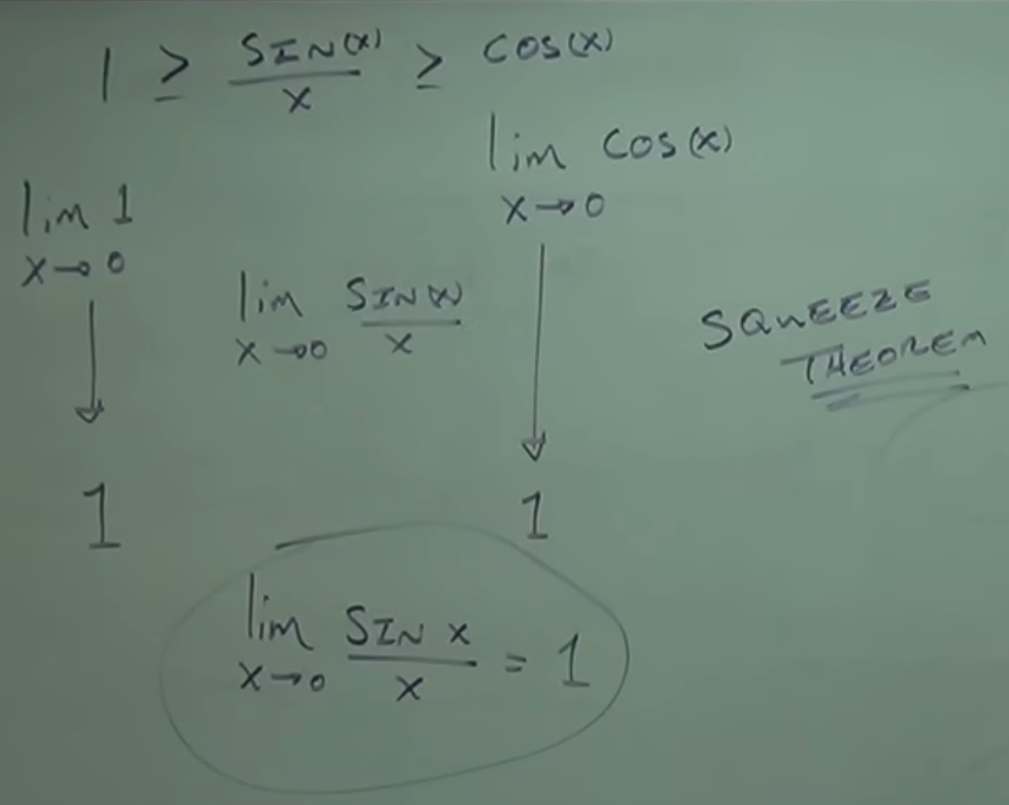
By taking the reciprocal of all positive terms, the inequality reverses its direction:
- $1<\dfrac{𝒙}{\sin(𝒙)}<\dfrac{1}{\cos(𝒙)}\ \Longrightarrow\
\cos(𝒙)<\dfrac{\sin(𝒙)}{𝒙}<1$
-
7. Applying the Squeeze Theorem:
- As $𝒙\to 0$, $\cos(𝒙)\to 1$, so $1/\cos(𝒙)\to 1$.
- Thus, $𝒙/\sin(𝒙)$ is squeezed between $1$ and something approaching $1$.
- By the Squeeze Theorem: $\displaystyle \lim_{x\to 0}\dfrac{\sin(𝒙)}{𝒙}=1$
-
📝N͟O͟T͟E͟: In the proof using the Squeeze Theorem for $\displaystyle \lim_{x\to
0}\big(\sin(𝒙)/𝒙\big)=1$, it is correct to use the symbol “$<$” instead of “$\le$”. The reason is:
- We are comparing areas or values strictly, not saying they are equal.
- For very small $𝒙$ near $0$ (but not exactly $0$), we have strict inequalities.
- The Squeeze Theorem only requires the function to be trapped between two functions,
not necessarily touching them.
- Thus, using “$<$” is perfectly fine and appropriate.
-
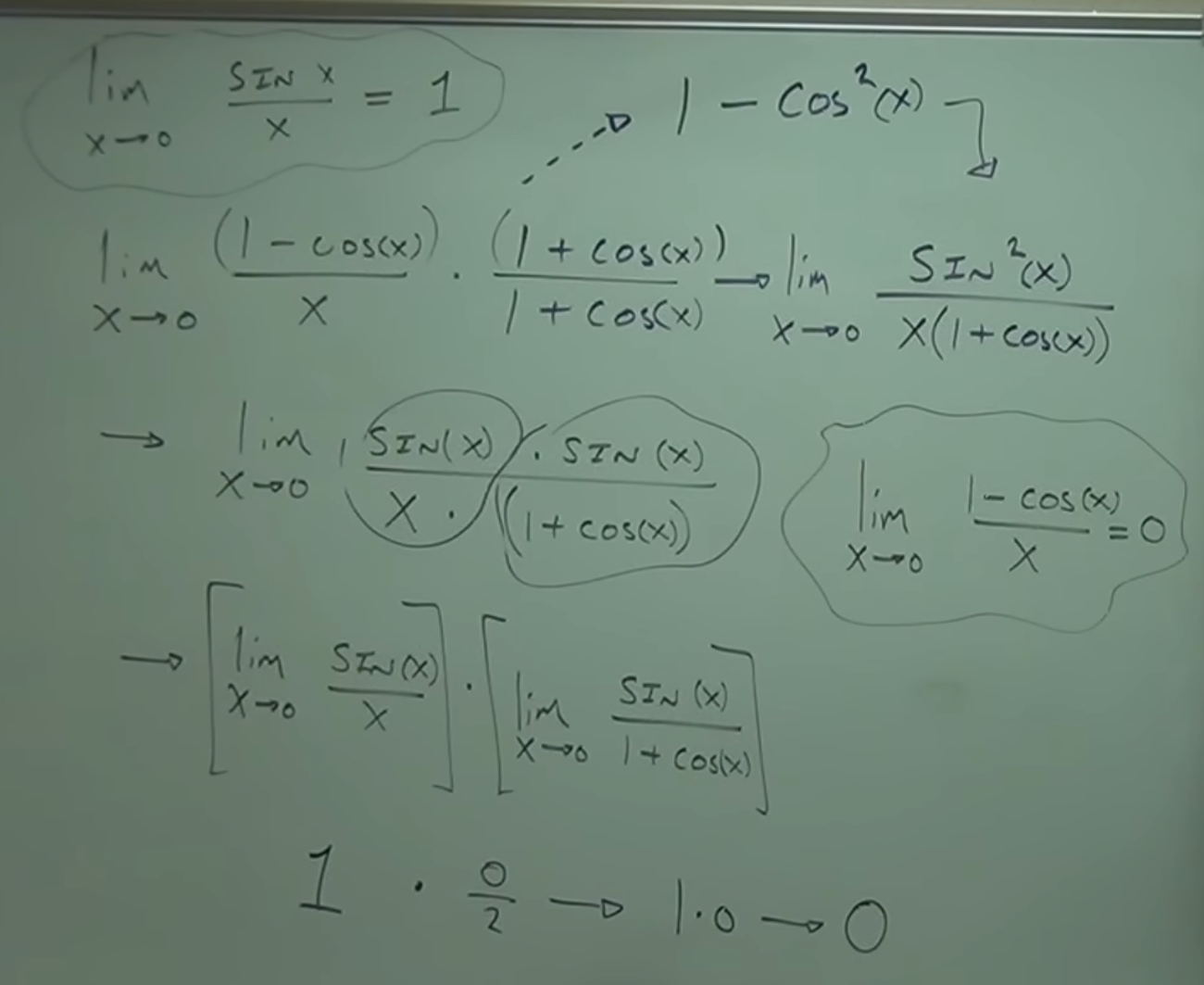
1:55:00. 🧩 Evaluation of
$\displaystyle \lim_{x\to 0}\ \dfrac{1-\cos 𝒙}{𝒙}$
– [📷image]
-
$\displaystyle \lim_{x\to 0}\dfrac{1-\cos 𝒙}{𝒙}$ is calculated using the technique of multiplying by the
conjugate.
-
The trigonometric identity $1-\cos^{2} 𝒙=\sin^{2} 𝒙$ is used to simplify the expression after multiplying
by the conjugate.
-
Multiply and divide by the conjugate of the numerator $(1+\cos(𝒙))$:
- $\displaystyle \lim_{x\to 0}\dfrac{(1-\cos(𝒙))(1+\cos(𝒙))}{𝒙\,(1+\cos(𝒙))}$
- $\displaystyle \lim_{x\to 0}\dfrac{1-\cos^{2}(𝒙)}{𝒙\,(1+\cos(𝒙))}$
-
Use the identity: $1-\cos^{2}(𝒙)=\sin^{2}(𝒙)$
- $\displaystyle \lim_{x\to 0}\dfrac{\sin^{2}(𝒙)}{𝒙\,(1+\cos(𝒙))}$
-
Split into two factors:
- $\displaystyle \left(\lim_{x\to 0}\dfrac{\sin(𝒙)}{𝒙}\right)\cdot \left(\lim_{x\to
0}\dfrac{\sin(𝒙)}{1+\cos(𝒙)}\right)$
-
Apply known limits:
- $\displaystyle \lim_{x\to 0}\dfrac{\sin(𝒙)}{𝒙}=1,\quad \lim_{x\to
0}\dfrac{\sin(𝒙)}{1+\cos(𝒙)}=\dfrac{0}{2}=0$
-
$\displaystyle \lim_{x\to 0}\dfrac{1-\cos 𝒙}{𝒙}=0$
-
2:02:55. 🧩 Evaluation of
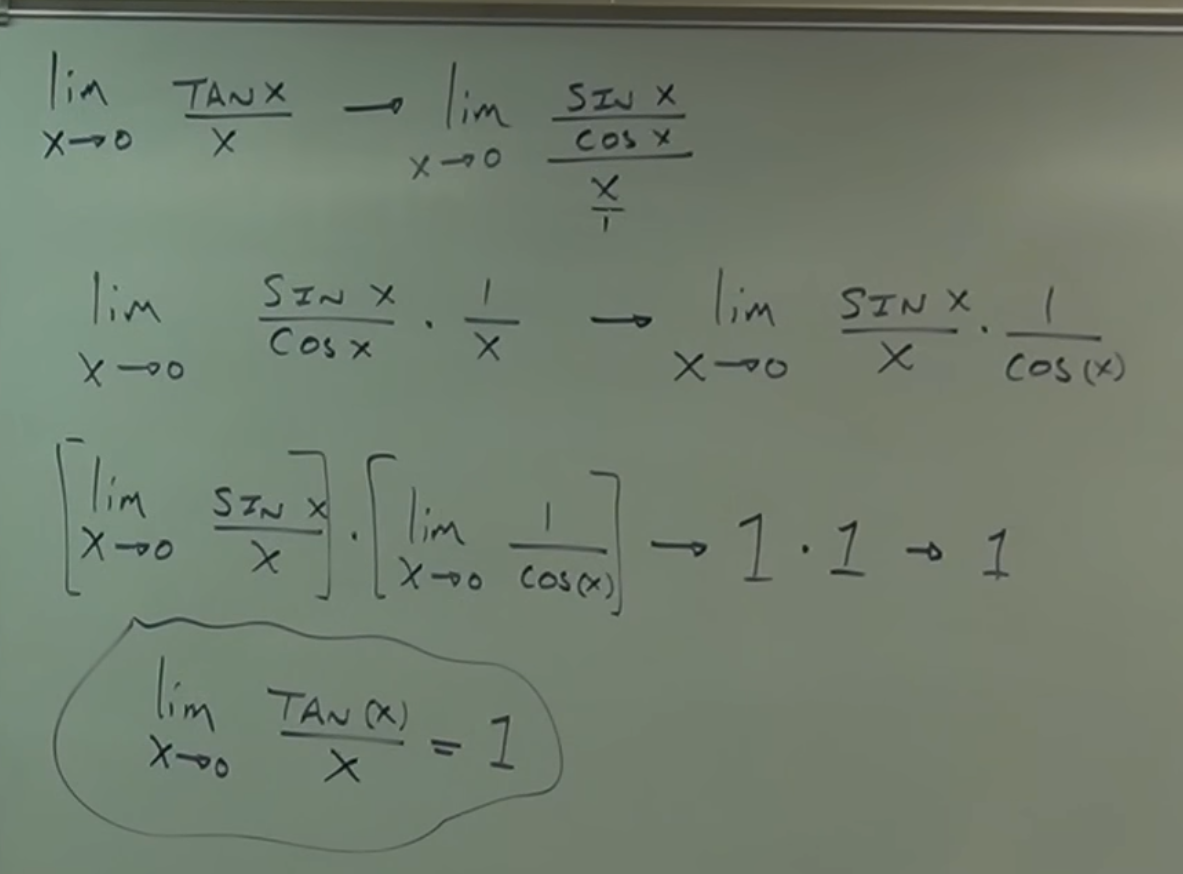
$\displaystyle \lim_{x\to 0}\ \dfrac{\tan 𝒙}{𝒙}$
– [📷image]
-
$\tan 𝒙=\dfrac{\sin 𝒙}{\cos 𝒙}$.
-
The expression is split into two limits:
-
$\displaystyle \lim_{x\to 0}\dfrac{\sin 𝒙}{𝒙}$ and
$\displaystyle \lim_{x\to 0}\dfrac{1}{\cos 𝒙}$.
-
Rewrite tangent as sine over cosine:
-
$\displaystyle \lim_{x\to 0}\dfrac{\sin(𝒙)/\cos(𝒙)}{𝒙}$
-
Simplify the complex fraction:
-
$\displaystyle
\lim_{x\to 0}\dfrac{\sin(𝒙)}{\cos(𝒙)}\cdot \dfrac{1}{𝒙}
=\left(\lim_{x\to 0}\dfrac{\sin(𝒙)}{𝒙}\right)
\cdot
\left(\lim_{x\to 0}\dfrac{1}{\cos(𝒙)}\right)
=1\cdot 1$
-
$\displaystyle \lim_{x\to 0}\dfrac{\tan 𝒙}{𝒙}=1$
Manipulation of Trigonometric Limits
-
Manipulation of Trigonometric Limits
- Various examples of manipulating trigonometric limits to match known identities are
presented.
- Examples with $\sin 𝒙/𝒙$, $(1-\cos 𝒙)/𝒙$, and $\tan 𝒙/𝒙$ are included.
- Techniques such as multiplying by a constant, splitting the limit into multiple limits,
and using trigonometric identities are used.
- "We transform the unknown into something known" using mathematical
tools such as simplifications, identities, or properties.
-
2:08:00. 🧩 Evaluation of
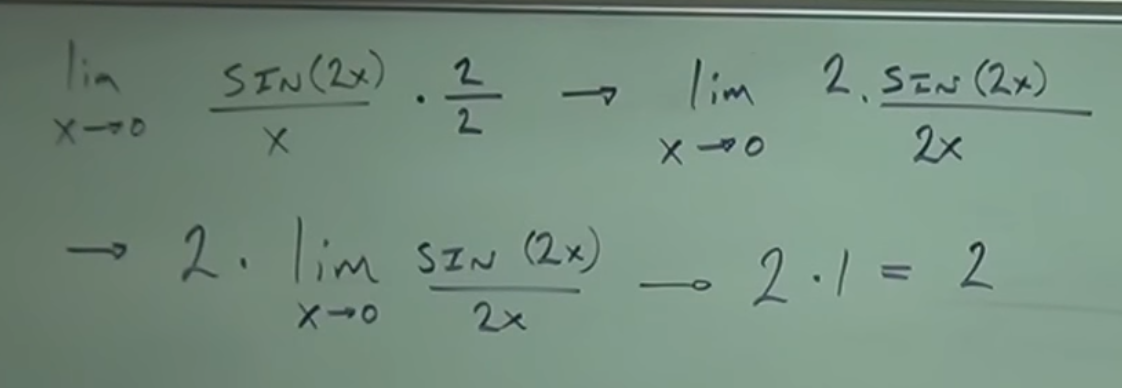
$\displaystyle \lim_{x\to 0}\ \dfrac{\sin(2𝒙)}{𝒙}$
– [📷image]
-
Multiply by $2/2$ to create a form we can use:
-
$\displaystyle \lim_{x\to 0}\dfrac{\sin(2𝒙)}{𝒙}\cdot \dfrac{2}{2}$
-
Rearrange the expression:
-
$\displaystyle \lim_{x\to 0}\dfrac{2\sin(2𝒙)}{2𝒙}$
-
Factor out the constant $2$:
-
$\displaystyle 2\cdot \lim_{x\to 0}\dfrac{\sin(2𝒙)}{2𝒙}$
-
Recognize the standard limit (with $u=2𝒙$):
-
$2\cdot \lim_{u\to 0}\dfrac{\sin u}{u}=2$
-
$\displaystyle \lim_{x\to 0}\dfrac{\sin(2𝒙)}{𝒙}=2$
-
2:13:40. 🧩 Evaluation of
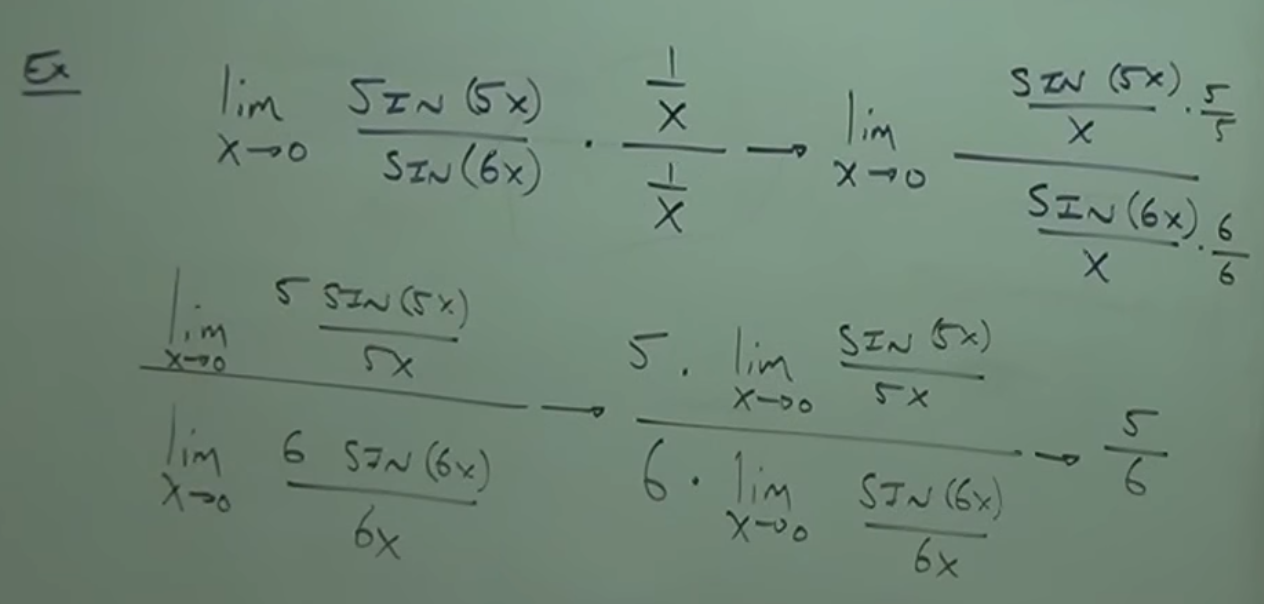
$\displaystyle \lim_{x\to 0}\ \dfrac{\sin(5𝒙)}{\sin(6𝒙)}$
– [📷image]
-
Multiply numerator and denominator by $1/𝒙$:
-
$\displaystyle \lim_{x\to 0}\dfrac{\sin(5𝒙)}{𝒙}\Big/\dfrac{\sin(6𝒙)}{𝒙}$
-
Multiply numerator and denominator by constants:
-
$\displaystyle \lim_{x\to 0}\left(\dfrac{\sin(5𝒙)}{𝒙}\cdot
\dfrac{5}{5}\right)\Big/\left(\dfrac{\sin(6𝒙)}{𝒙}\cdot \dfrac{6}{6}\right)$
-
Rearrange the expression:
-
$\displaystyle \dfrac{5}{6}\cdot \lim_{x\to 0}\dfrac{\sin(5𝒙)}{5𝒙}\Big/\lim_{x\to
0}\dfrac{\sin(6𝒙)}{6𝒙}$
-
Apply the standard limit identity ($u=5𝒙,\ 6𝒙$):
-
$\displaystyle \lim_{x\to 0}\dfrac{\sin u}{u}=1$
-
So: $\dfrac{5}{6}\cdot \dfrac{1}{1}=\dfrac{5}{6}$
-
Therefore: $\displaystyle \lim_{x\to 0}\dfrac{\sin(5𝒙)}{\sin(6𝒙)}=\dfrac{5}{6}$
-
2:20:25. 🧩 Evaluation of
$\displaystyle \lim_{x\to 0}\ \dfrac{\sin(𝒙^{2})}{𝒙}$
– [📷image]
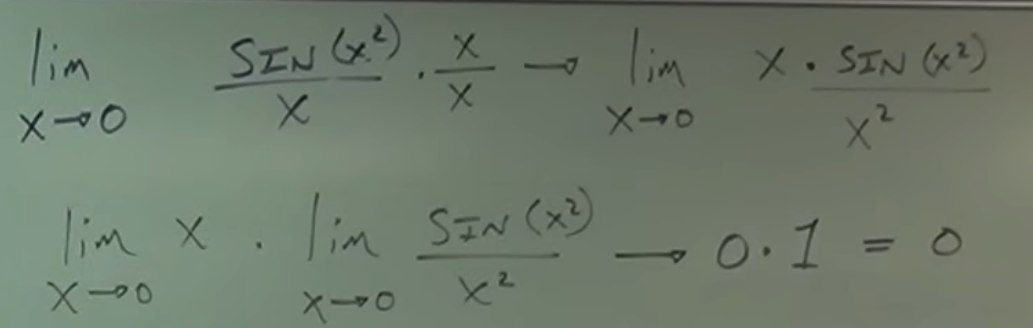
- Rewrite as a product:
-
$\displaystyle \lim_{x\to 0}\left(\dfrac{\sin(𝒙^{2})}{𝒙}\right)\cdot \dfrac{𝒙}{𝒙}$
- Rearranged:
-
$\displaystyle \lim_{x\to 0}\, 𝒙\cdot \dfrac{\sin(𝒙^{2})}{𝒙^{2}}$
- Split the limit:
-
$\displaystyle \big(\lim_{x\to 0} 𝒙\big)\cdot \big(\lim_{x\to 0}\dfrac{\sin(𝒙^{2})}{𝒙^{2}}\big)$
- Use the standard limit identity:
-
$\displaystyle \lim_{u\to 0}\dfrac{\sin u}{u}=1 \quad (u=𝒙^{2})$
- Therefore:
-
$\displaystyle \lim_{x\to 0}\dfrac{\sin(𝒙^{2})}{𝒙}=0$
-
2:24:20. 🧩 Evaluation of
$\displaystyle \lim_{x\to 0}\ \dfrac{\sin^{2}(𝒙)}{𝒙}$
– [📷image]
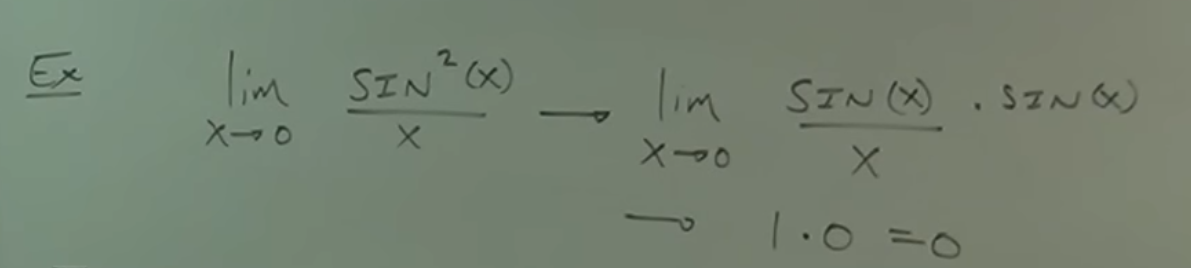
- Use the identity:
-
$\sin^{2}(𝒙)=\sin(𝒙)\cdot \sin(𝒙)$
- Rewrite the expression:
-
$\displaystyle \lim_{x\to 0}\left(\dfrac{\sin(𝒙)}{𝒙}\right)\cdot \sin(𝒙)$
- Split the limit:
-
$\displaystyle \left(\lim_{x\to 0}\dfrac{\sin(𝒙)}{𝒙}\right)\cdot \left(\lim_{x\to 0}\sin(𝒙)\right)$
- Apply known limits:
-
$\displaystyle \lim_{x\to 0}\dfrac{\sin^{2}(𝒙)}{𝒙}=0$
-
2:25:45. 🧩 Evaluation of
$\displaystyle \lim_{x\to 0}\ \sin\!\left(\dfrac{1}{𝒙}\right)$ (Graphical approach)
– [📷image]
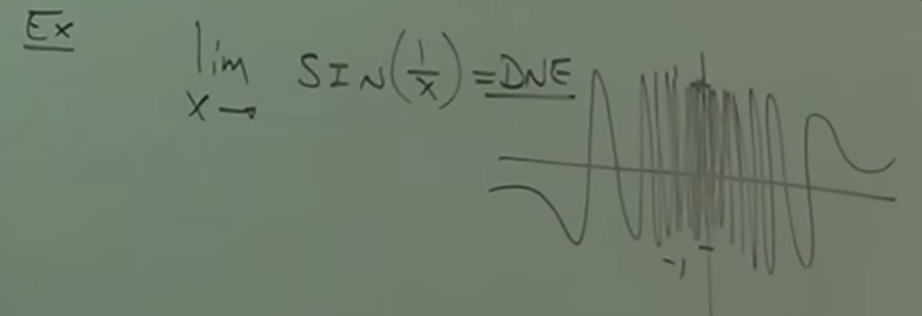
- $\displaystyle \lim_{x\to 0}\sin\!\left(\dfrac{1}{𝒙}\right)=\text{D.N.E}$
-
Graph behavior:
- As $x$ approaches $0$, $1/x$ increases rapidly in magnitude.
- This makes the sine function oscillate faster and faster.
-
Infinite waves:
- The graph oscillates infinitely between $-1$ and $1$ as $x\to 0$.
- It doesn't "settle" on any value — it doesn’t flatten or approach a specific number.
-
No fixed value:
- For the limit to exist, $\sin(1/x)$ would need to get closer to a single number.
- But instead, it keeps jumping around with no stabilization.
- There are infinitely many peaks and valleys, getting tighter near $x=0$.
-
Conclusion:
- Since the function doesn't approach any one value as $x\to 0$, the limit does not
exist.
- The graph shows a dense “band” of oscillation between $-1$ and $1$ near $x=0$.
-
2:25:45. 🧩 Evaluation of
$\displaystyle \lim_{x\to 0}\ x\cdot \sin\!\left(\dfrac{1}{𝒙}\right)$
– [📷image]
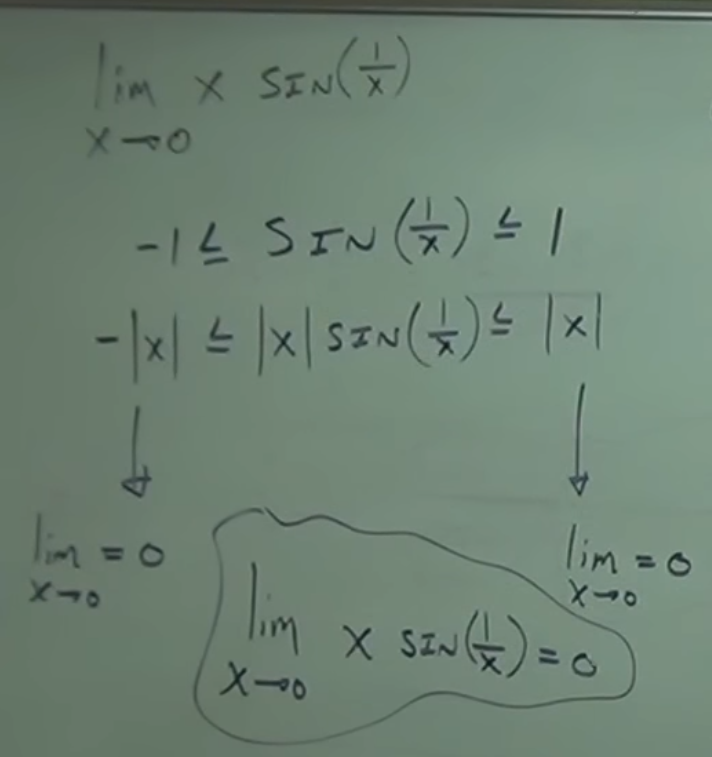
- The correct approach is to apply the Squeeze Theorem:
- We know that:
- Multiplying all parts by $𝒙$ (which tends to $0$), we get:
- $-|𝒙|\le 𝒙\cdot \sin(1/𝒙)\le |𝒙|$
- 📝N͟O͟T͟E͟:
- we know that:
- When multiplying by $𝒙$, the direction of the inequalities depends on the sign
of $𝒙$:
- If $𝒙>0$, the inequality remains the same.
- If $𝒙<0$, the inequality reverses direction.
- To avoid this problem, we use the absolute value on the bounds of the
inequality, as follows:
- $-|𝒙|\le 𝒙\,\sin(1/𝒙)\le |𝒙|$
-
We introduce the absolute value to keep the direction of the inequality consistent, since multiplying by
$𝒙$ would
reverse the inequality when $𝒙<0$. Using $|𝒙|$ ensures the inequality remains $-|𝒙|\le 𝒙\cdot
\sin(1/𝒙)\le |𝒙|$ for both positive and negative $𝒙$.
- Apply limits:
- $\displaystyle \lim_{x\to 0}\big(-|𝒙|\big)\ \le\ \lim_{x\to 0}\big(𝒙\cdot
\sin(1/𝒙)\big)\ \le\ \lim_{x\to 0}|𝒙|$
- And since:
- $\displaystyle \lim_{x\to 0}|𝒙|=0\quad \Rightarrow\quad 0\le \lim_{x\to
0}\big(𝒙\cdot \sin(1/𝒙)\big)\le 0$
- By the Squeeze Theorem, it follows that:
- $\displaystyle \lim_{x\to 0}\, 𝒙\cdot \sin\!\left(\dfrac{1}{𝒙}\right)=0$
- ⚠📝 NOTE: At first glance, the limit:
- $\displaystyle \lim_{x\to 0} 𝒙 \cdot \sin\!\left(\dfrac{1}{𝒙}\right)$
- might look like it fits the identity:
- $\displaystyle \lim_{u\to 0} \dfrac{\sin u}{u}=1$
-
But that identity 𝐨𝐧𝐥𝐲 𝐚𝐩𝐩𝐥𝐢𝐞𝐬 when the argument of the sine and the
denominator both approach $0$ at the same time.
Now, if we rewrite:
- $\displaystyle 𝒙 \cdot
\sin\!\left(\dfrac{1}{𝒙}\right)=\dfrac{\sin(1/𝒙)}{1/𝒙}$
- Here, as $𝒙\to 0$:
- $1/𝒙\to \infty$,
- and $\sin(1/𝒙)$ keeps oscillating between $-1$ and $1$ with no limit.
- So the expression $\sin(1/𝒙)/(1/𝒙)$ doesn't approach $1$, and we 𝐜𝐚𝐧𝐧𝐨𝐭
apply the identity.
-
2:35:33. 🧩 Evaluation of
$\displaystyle \lim_{x\to 0}\ \dfrac{2-\cos(3𝒙)-\cos(4𝒙)}{𝒙}$
– [📷image]
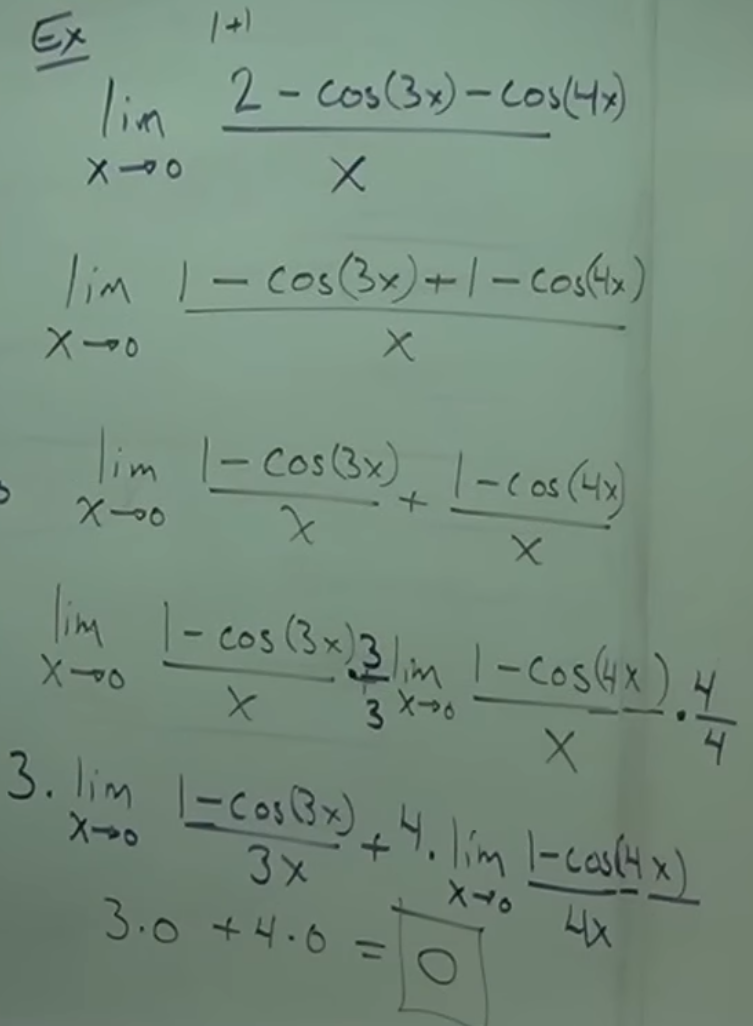
- Rewrite the expression:
- $\displaystyle \lim_{x\to 0}\dfrac{2-\cos(3𝒙)-\cos(4𝒙)}{𝒙}$
- Use the identity:
- $2-\cos(3𝒙)-\cos(4𝒙)=\big(1-\cos(3𝒙)\big)+\big(1-\cos(4𝒙)\big)$
- Split into two separate limits:
- $\displaystyle \lim_{x\to 0}\dfrac{1-\cos(3𝒙)}{𝒙}\ +\ \lim_{x\to
0}\dfrac{1-\cos(4𝒙)}{𝒙}$
- Multiply and divide to match the standard form:
- $\displaystyle \lim_{x\to 0}\dfrac{1-\cos(3𝒙)}{3𝒙}\cdot 3\ +\ \lim_{x\to
0}\dfrac{1-\cos(4𝒙)}{4𝒙}\cdot 4$
- Apply the known limit:
- $\displaystyle \lim_{u\to 0}\dfrac{1-\cos u}{u}=0$
- Evaluate:
- Final result:
- $\displaystyle \lim_{x\to 0}\dfrac{2-\cos(3𝒙)-\cos(4𝒙)}{𝒙}=0$
-
2:40:45. 🧩 Evaluation of
$\displaystyle \lim_{x\to 0}\ \dfrac{𝒙^{2}-3\sin(𝒙)}{𝒙}$
– [📷image]
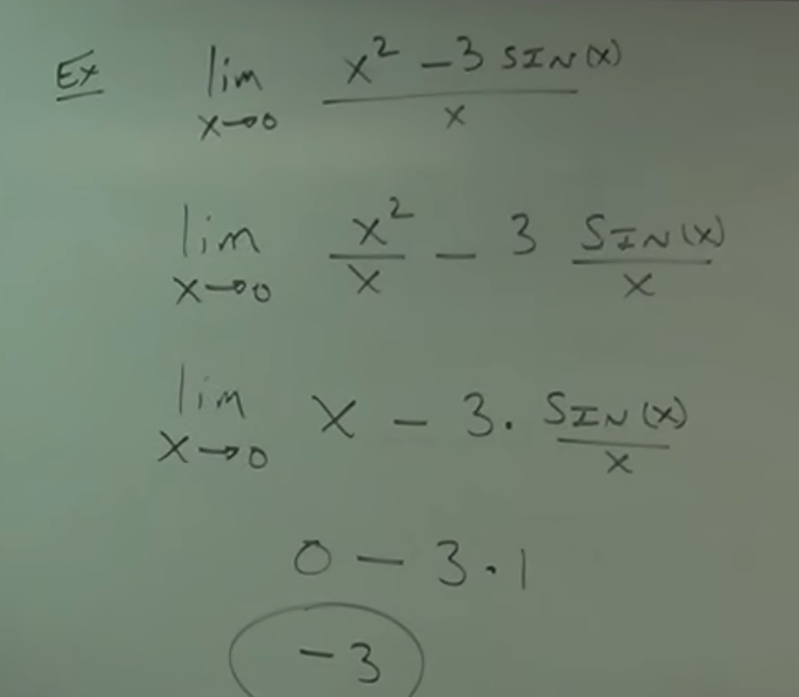
- Rewrite the expression:
- $\displaystyle \lim_{x\to 0}\dfrac{𝒙^{2}-3\sin(𝒙)}{𝒙}$
- Split the terms:
- $\displaystyle \lim_{x\to 0}\left(\dfrac{𝒙^{2}}{𝒙}\right)-3\cdot
\left(\dfrac{\sin(𝒙)}{𝒙}\right)$
- Simplify each part:
- $\displaystyle \lim_{x\to 0} 𝒙-3\cdot \left(\dfrac{\sin(𝒙)}{𝒙}\right)$
- Apply limits:
- $\displaystyle \lim_{x\to 0} 𝒙=0$
- $\displaystyle \lim_{x\to 0}\dfrac{\sin(𝒙)}{𝒙}=1$
- Compute:
- Final result:
- $\displaystyle \lim_{x\to 0}\dfrac{𝒙^{2}-3\sin(𝒙)}{𝒙}=-3$
-
2:42:24. 🧩 Evaluation of
$\displaystyle \lim_{t\to 0}\ \dfrac{t^{2}}{1-\cos^{2}(t)}$
– [📷image]
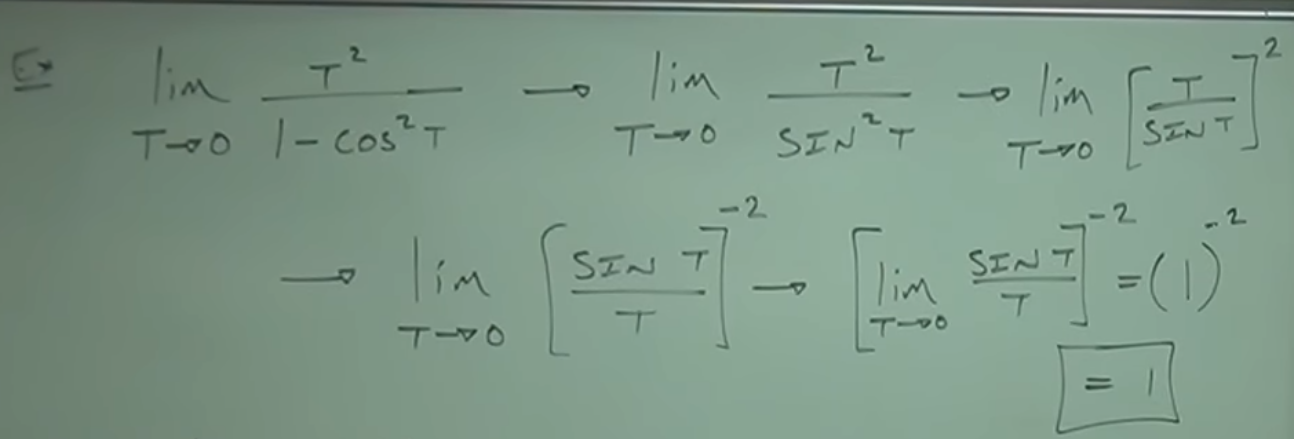
- Use the trigonometric identity:
- $1-\cos^{2}(t)=\sin^{2}(t)$
- Rewrite the limit:
- $\displaystyle \lim_{t\to 0}\dfrac{t^{2}}{1-\cos^{2}(t)}=\lim_{t\to
0}\dfrac{t^{2}}{\sin^{2}(t)}=\lim_{t\to 0}\left(\dfrac{t}{\sin t}\right)^{2}$
- Recognize the limit structure:
- $\displaystyle \lim_{t\to 0}\dfrac{\sin T}{T}=1$
- Then: $\displaystyle \lim_{t\to 0}\dfrac{t}{\sin t}=\left(\lim_{t\to
0}\dfrac{\sin t}{t}\right)^{-1}=1^{-1}=1$
- Apply the limit:
- $\big(\lim_{t\to 0} t/\sin t\big)^{2}=1^{2}=1$
- Final result: $1$
-
2:50:00. 🧩 Evaluation
of $\displaystyle \lim_{x\to 0}\ \dfrac{𝒙}{\cos(\pi/2-𝒙)}$
– [📷image]

- Use the co-function identity:
- $\cos(\pi/2-𝒙)=\sin(𝒙)$
- 📝 N͟O͟T͟E͟: Two angles are complementary if they add up to $90^\circ$:
- $\sin(\text{angle})\ \leftrightarrow\ \cos(\text{complement of angle})$
- Replace the expression using the identity:
- $\displaystyle \lim_{x\to 0}\dfrac{𝒙}{\sin(𝒙)}$
- Recognize the standard limit:
- $\displaystyle \lim_{x\to 0}\dfrac{𝒙}{\sin(𝒙)}=1$
-
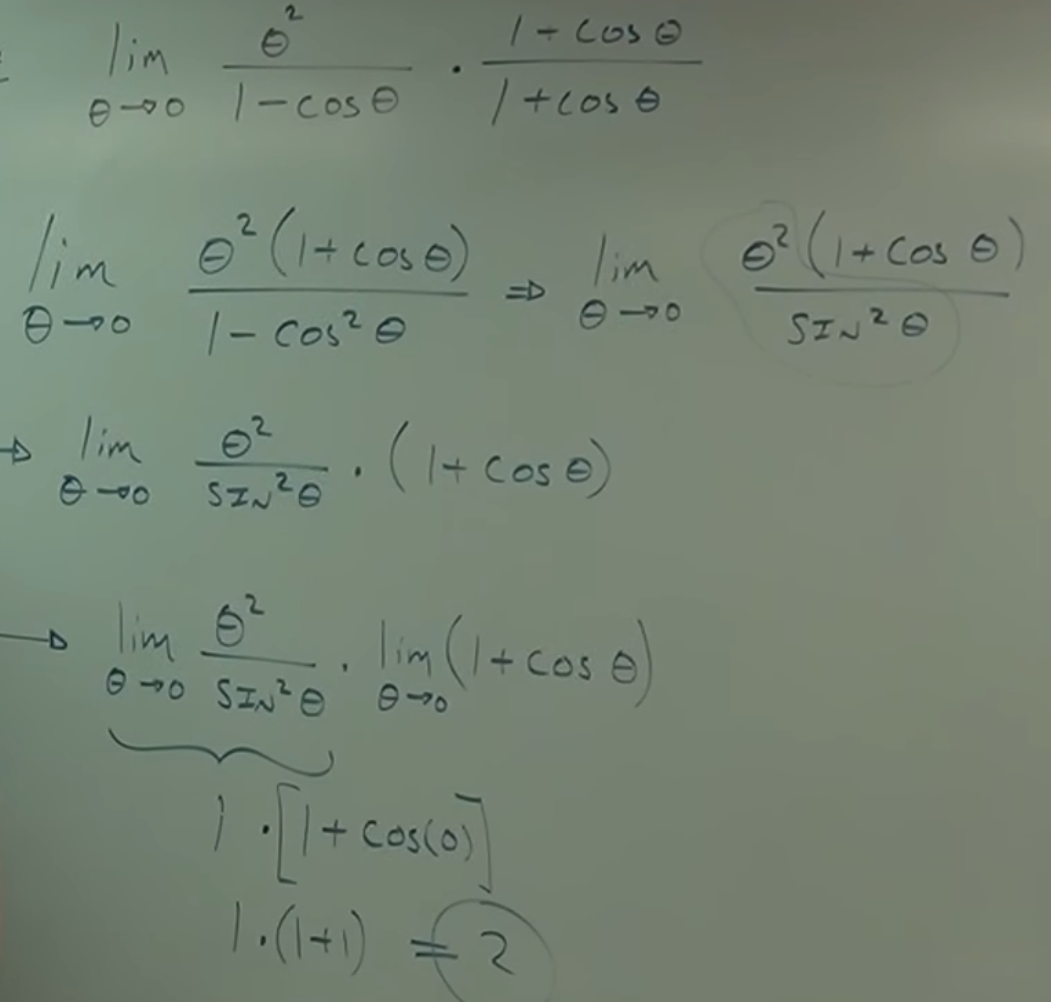
2:53:40. 🧩
Evaluation of $\displaystyle \lim_{\theta\to 0}\ \dfrac{\theta^{2}}{\,1-\cos(\theta)\,}$
– [📷image]
-
Multiply by $1$ in the form of $\dfrac{1+\cos(\theta)}{1+\cos(\theta)}$ to simplify:
-
$\displaystyle \lim_{\theta\to 0}\dfrac{\theta^{2}\big(1+\cos(\theta)\big)}{1-\cos^{2}(\theta)}$
-
Use the identity: $1-\cos^{2}(\theta)=\sin^{2}(\theta)$
-
$\displaystyle \lim_{\theta\to 0}\dfrac{\theta^{2}\big(1+\cos(\theta)\big)}{\sin^{2}(\theta)}$
-
Separate into two limits:
-
$\displaystyle \left(\lim_{\theta\to 0}\dfrac{\theta^{2}}{\sin^{2}(\theta)}\right)\cdot
\left(\lim_{\theta\to 0}1+\cos(\theta)\right)$
-
Use the identity:
-
$\displaystyle \lim_{\theta\to 0}\dfrac{\theta}{\sin(\theta)}=1$, so:
-
$\displaystyle \lim_{\theta\to 0}\left(\dfrac{\theta}{\sin(\theta)}\right)^{2}=1^{2}=1$
-
Evaluate the limits:
-
$1\cdot \big(1+\cos(0)\big)=1\cdot (1+1)=2$
    ─────●───────────────●────
        -2               5
                          |
                          |
                          ╰----
    ─────●───────────────●────
        -2               5
                          |
                          |
                          ╰----
    ─────●───────────────●────
        -2           ---╮5
                        |
                        |
         𝒇₁ ⇢  ⇠    𝒇₂    ⇢  ⇠  𝒇₃
    <─────────|──────────────|──────────>
             -2              3