Calculus 1 lecture 1.5
Slope Of a Curve, Velocity, and Rates Of Change
Tangent line and rate of change
- 0:50.
Introduction.
- Main objective of calculus:
- Find the slope of the tangent line to a curve at a point.
- Equivalent statement: Find the slope of a curve at a point.
- Using limits to find the slope of the tangent line to a curve at a point.
- Importance of understanding the mathematical concept, not just the formulas.
- 3:20. Creating
the formula for the slope of a curve from the slope of a secant line (that conect two points).
- 4:03.
Definitions:
– [📷image]
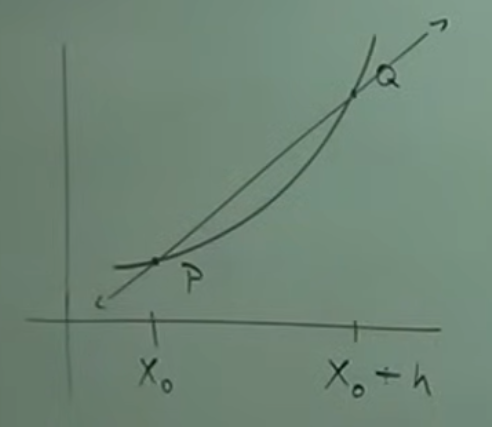
- A curve
- P: a poin to find the slope of a curve at a point P.
- Q: a point to stablish the secant line from P to Q.
- 𝒙₀: 𝒙 coordinate of P and 𝒙₀ + h 𝒙 coordinate of Q
- h: distance from P to Q
- The idea is take Q really relly really close to P that is the idea of limit.
- 6:44.
Calculating the 𝒚-values of the points: 𝒇(𝒙₀) and 𝒇(𝒙₀ + h).
– [📷image]
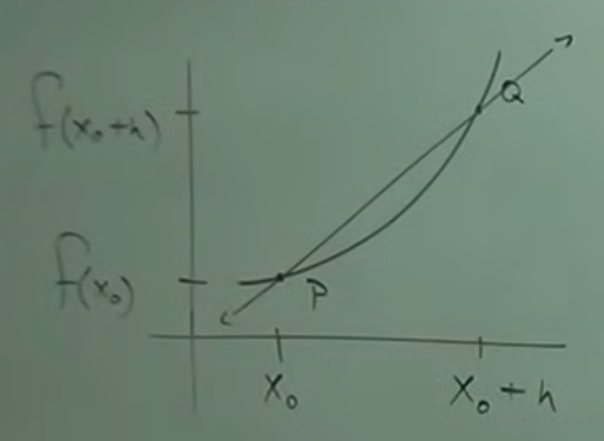
- 7:24.
Reminder of the goal: finding the slope of the curve at point P.
- 8:32.
Calculating the slope of the secant line ($\Delta \mathit{y} / \Delta \mathit{x}$) using points P and Q.
– [📷image]
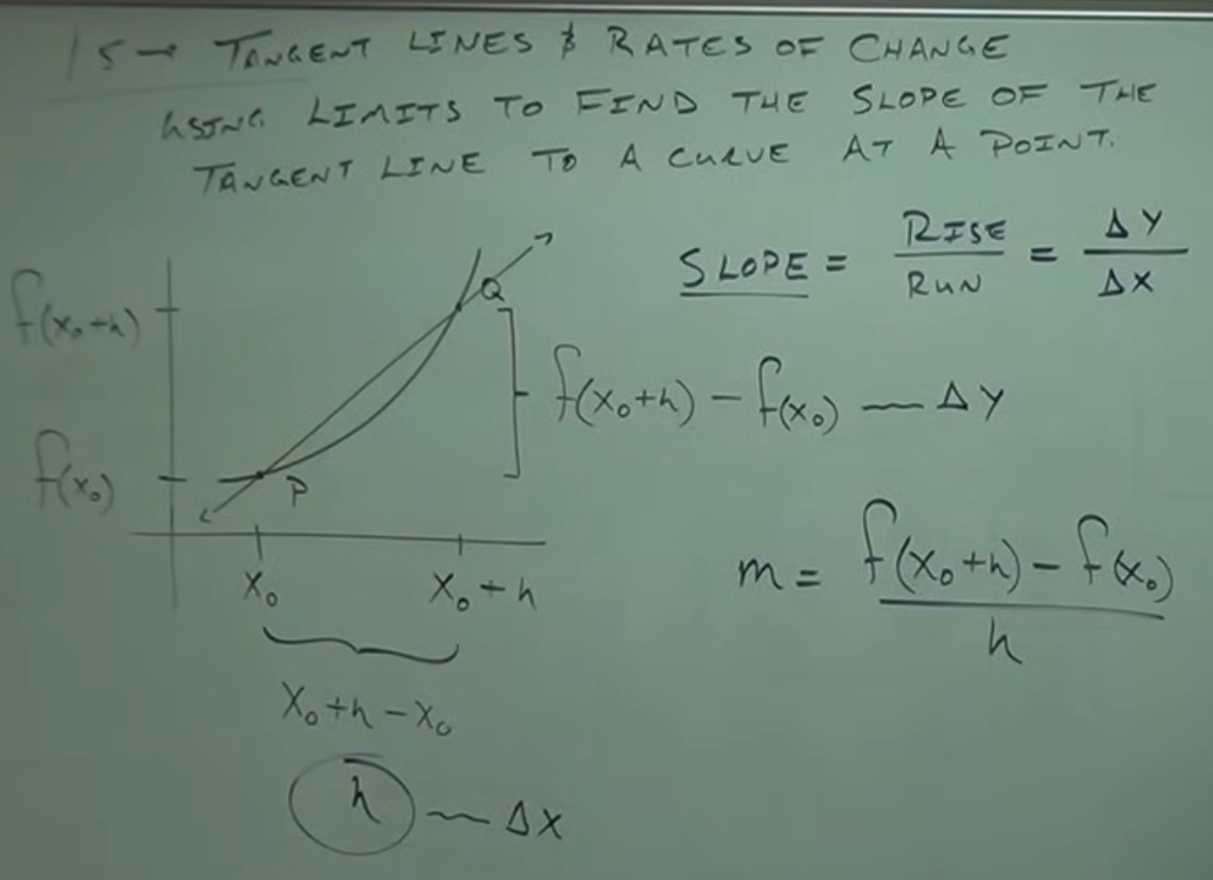
- $\Delta \mathit{x}=x_0+h-x_0=h$ and $\Delta \mathit{y}=f(x_0+h)-f(x_0)$
- $m=\displaystyle \dfrac{f(x_0+h)-f(x_0)}{h}$
- 14:00.
Introducing the concept of a limit to bring Q closer to (infinitely smaller) P: this is (h → 0).
– [📷image]
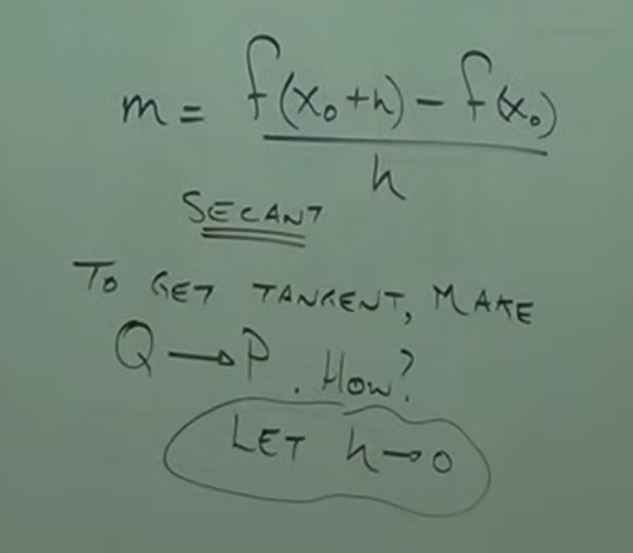
- Transition from the slope of the secant (m) to the slope of the tangent
($m_{\text{tan}}$)
using the limit:
- $m_{\text{tan}}=\displaystyle \lim_{h\to 0}\dfrac{f(x_0+h)-f(x_0)}{h}$
- 17:30.
Explanation of why we cannot simply set h = 0 (undefined).
- 18:33. 🧩
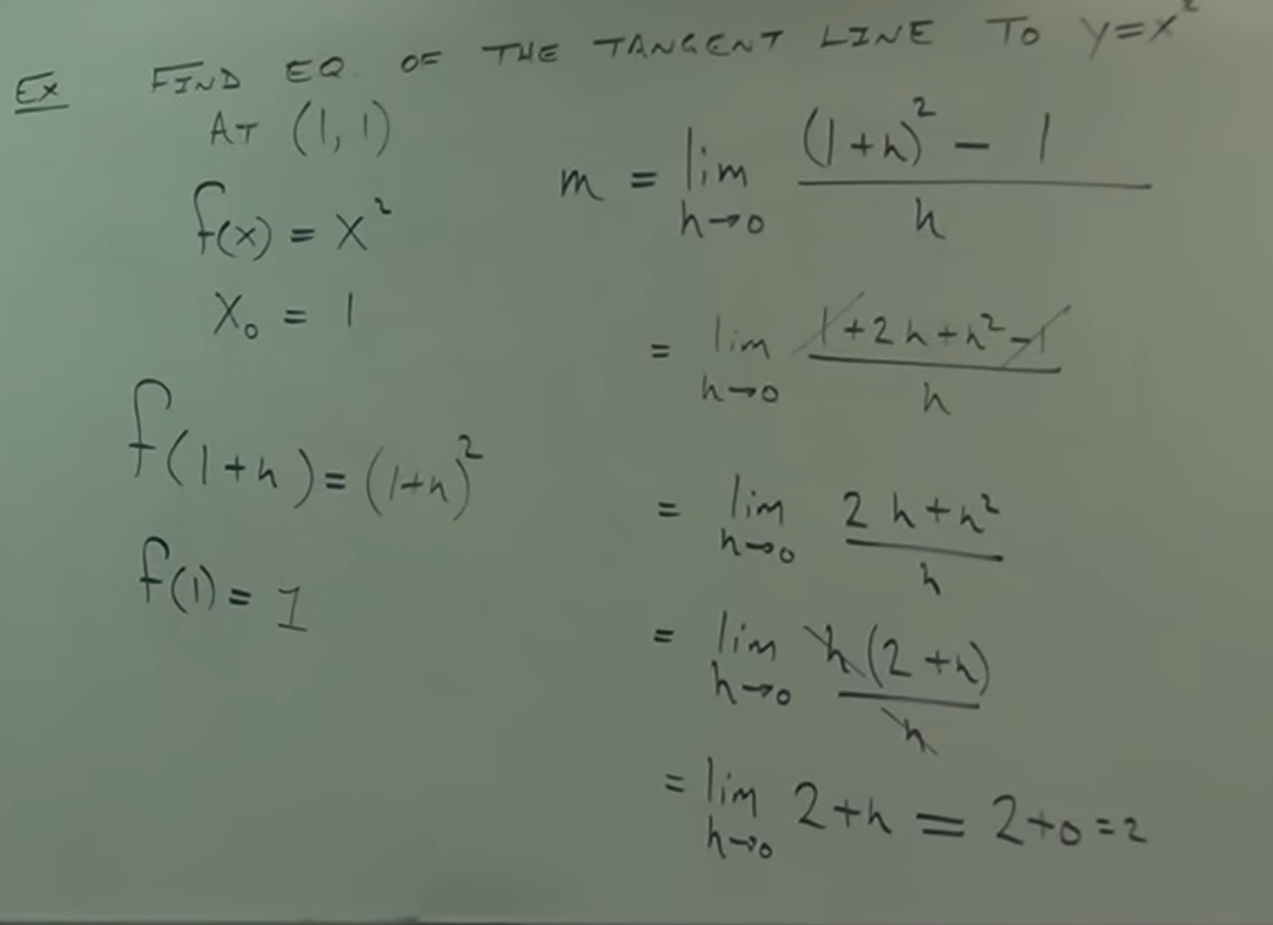
Example 1 – Finding the equation of the tangent line to: 𝒚 = x² at (1, 1)
– [📷image-1]
 – [📷image-2]
- 19:42.
Steps to find the equation of the tangent line.
- Identification of 𝒇(𝒙) = 𝒙² and x₀ = 1.
- Calculating 𝒇(𝒙₀ + h) = 𝒇(1 + h) = $(1+h)^{2}$.
- Calculating 𝒇(𝒙₀) = 𝒇(1) = $1$.
- Take the limit $m_{\text{tan}}=\displaystyle \lim_{h\to 0}\dfrac{f(x_0+h)-f(x_0)}{h}$
- $m_{\text{tan}}=\displaystyle \lim_{h\to 0}\dfrac{(1+h)^{2}-1}{h}=\displaystyle
\lim_{h\to 0}\dfrac{1+h+2h^{2}-1}{h} =\displaystyle \lim_{h\to 0}(2+h)=0$
- Hence, the slope of the tangent line is $2$.
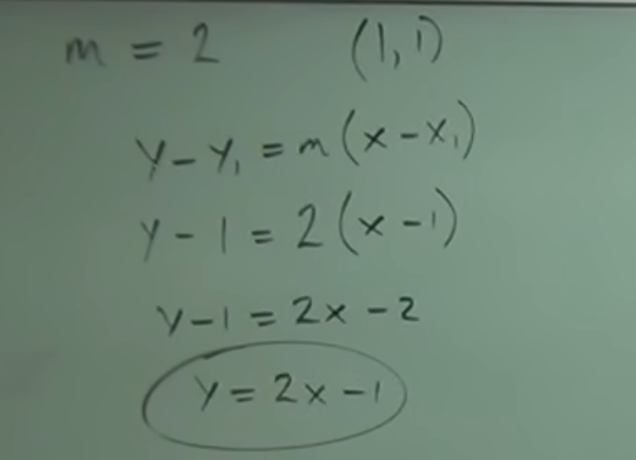
- 28:20. Using the point-slope form to find the equation of the tangent line at
(1,1).
- $\mathit{y}-y_1=m(x-x_1)$.
- The equation of the tangent line is $\mathit{y}=2x-1$.
- 30:55. 🧩
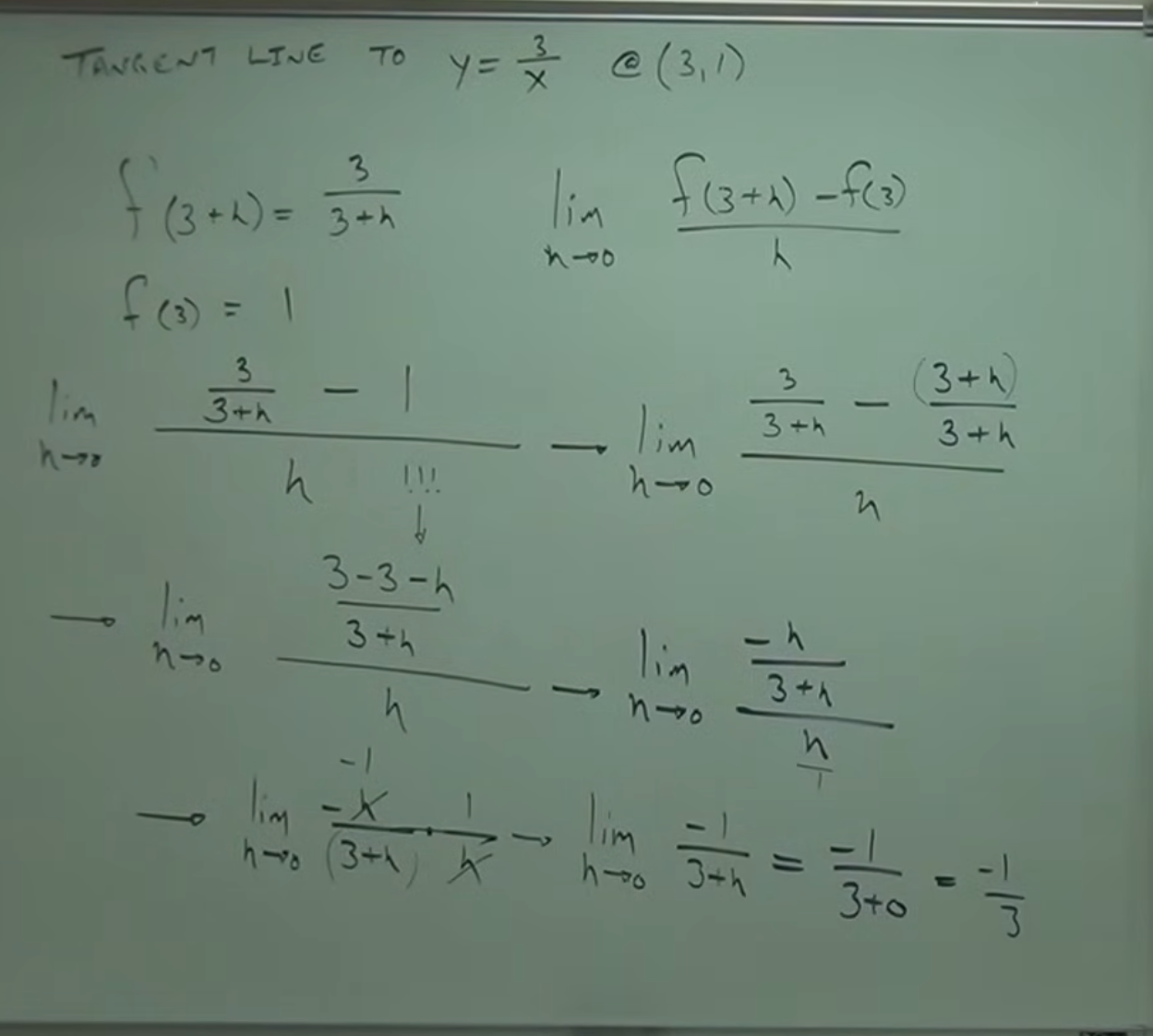
Example 2 – Finding the equation of the tangent line to 𝒚 = 3/x at (3, 1)
– [📷image-1]
 – [📷image-2]
- Steps to restating the goal and using the formula for the slope of the tangent.
- Identification of 𝒇(𝒙) = $3/x$ and $x_0=3$.
- Calculating 𝒇(𝒙₀ + h) = 𝒇(3 + h) = $\dfrac{3}{3+h}$.
- Calculating 𝒇(𝒙₀) = 𝒇(3) = $1$.
- Take the limit $m_{\text{tan}}=\displaystyle \lim_{h\to 0}\dfrac{f(x_0+h)-f(x_0)}{h}$
- $m_{\text{tan}}=\displaystyle \lim_{h\to
0}\dfrac{\dfrac{3}{3+h}-1}{h}=\displaystyle \lim_{h\to 0}\dfrac{-\,h/(3+h)}{h} =\displaystyle
\lim_{h\to 0}\left(-\dfrac{1}{3+h}\right)=-\dfrac{1}{3}$
- Hence, the slope of the tangent line is $-1/3$.
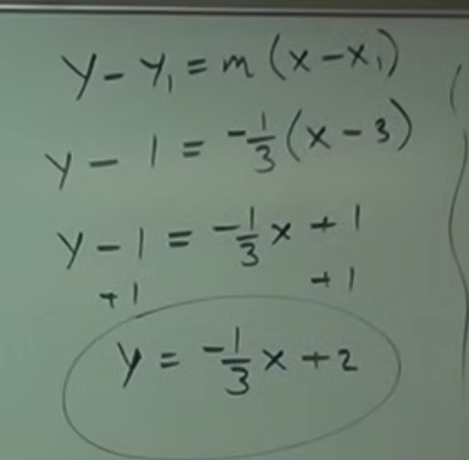
- 41:20. Using the point-slope form to find the equation of the tangent line at
(1,1).
- $\mathit{y}-y_1=m(x-x_1)$.
- The equation of the tangent line is $\mathit{y}=-\dfrac{1}{3}x+2$.
- 44:57. 🧩
Example 3 – Finding the slope of tangent lines to 𝒚 = √x at any point
– [📷image]
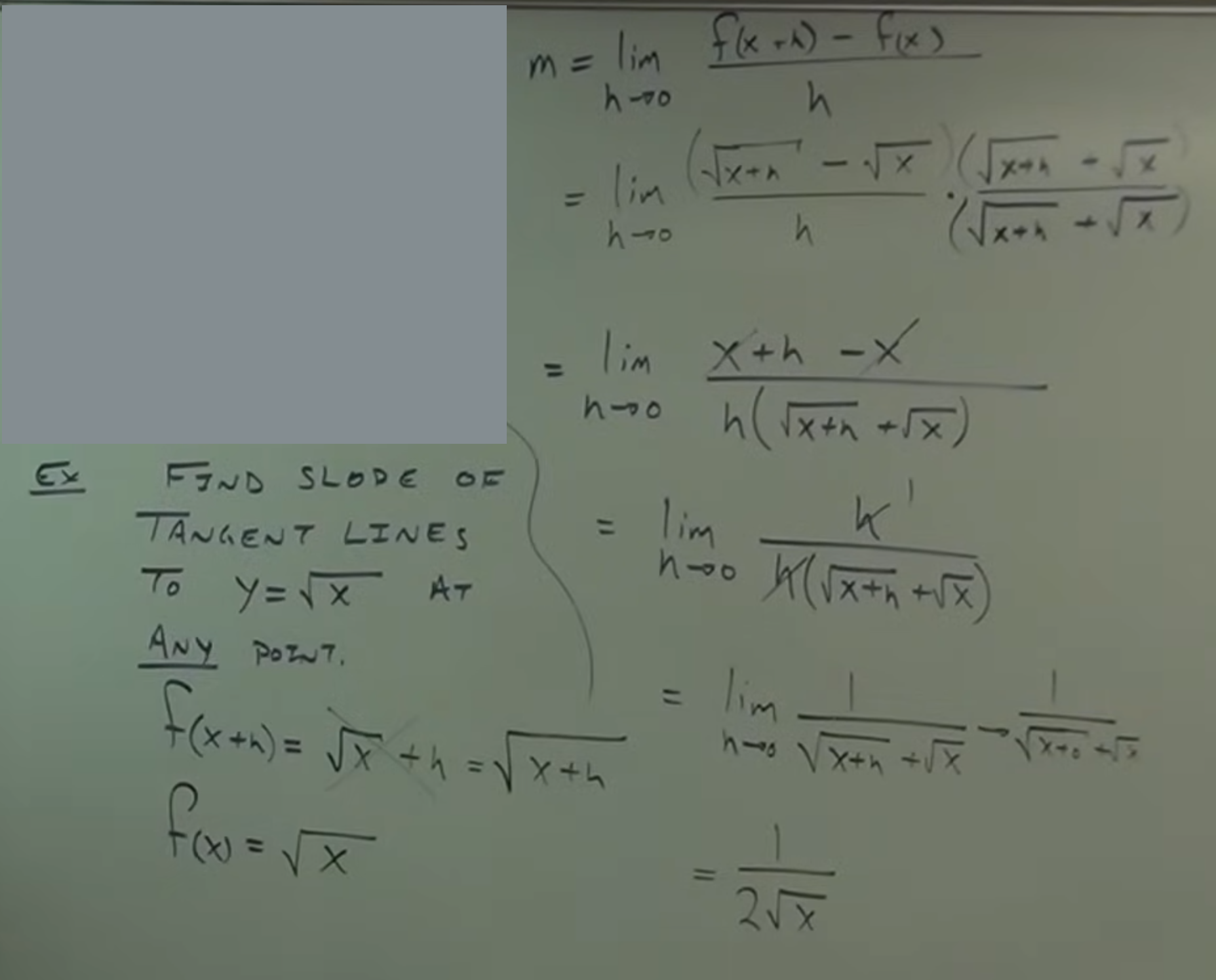
- Objective: derive a general formula for the slope of the tangent to 𝒚 = √x at any point
x.
- Identification of 𝒇(𝒙) = $\sqrt{x}$.
- Calculating 𝒇(x + h) = $\sqrt{x+h}$.
- Take the limit $m_{\text{tan}}=\displaystyle \lim_{h\to 0}\dfrac{f(x_0+h)-f(x_0)}{h}$
- $m_{\text{tan}}=\displaystyle \lim_{h\to 0}\dfrac{\sqrt{x+h}-\sqrt{x}}{h}$
- $\displaystyle \lim_{h\to 0}\dfrac{(x+h)-x}{h\cdot\big(\sqrt{x+h}+\sqrt{x}\big)}$
multiplicate by de conjugat $\dfrac{\sqrt{x+h}+\sqrt{x}}{\sqrt{x+h}+\sqrt{x}}$
- $\displaystyle \lim_{h\to 0}\dfrac{1}{\sqrt{x+h}+\sqrt{x}}=\dfrac{1}{2\sqrt{x}}$
- Hence, the slope of the tangent line 𝐚𝐭 𝐚𝐧𝐲 𝐩𝐨𝐢𝐧𝐭 is $\dfrac{1}{2\sqrt{x}}$
- 55:00. Obtaining the general formula for the slope of the tangent:
$m=\dfrac{1}{2\sqrt{x}}$.
- Explanation that this formula allows computing the slope at any point on the
curve.
- 57:35. Sharp point:
- At a sharp point on a curve, 𝘁͟𝗵͟𝗲͟ ͟𝘀͟𝗹͟𝗼͟𝗽͟𝗲͟𝘀͟ ͟𝗳͟𝗿͟𝗼͟𝗺͟
͟𝘁͟𝗵͟𝗲͟ ͟𝗹͟𝗲͟𝗳͟𝘁͟ ͟𝗮͟𝗻͟𝗱͟ ͟𝗿͟𝗶͟𝗴͟𝗵͟𝘁͟ ͟𝘀͟𝗶͟𝗱͟𝗲͟𝘀͟ ͟𝗮͟𝗿͟𝗲͟
͟𝗱͟𝗶͟𝗳͟𝗳͟𝗲͟𝗿͟e͟𝗻͟𝘁͟. This discrepancy
causes the limit defining the tangent slope ($m_{\text{tan}}$) to fail, as it does not exist
uniquely. Consequently,
an infinite number of tangent lines with varying slopes can be drawn through that sharp point.
Applications of Average and instantaneous velocity
- 58:54.
Introduction to applications.
- 𝗔̳𝘃̳𝗲̳𝗿̳𝗮̳𝗴̳𝗲̳ ̳𝘃̳𝗲̳𝗹̳𝗼̳𝗰̳𝗶̳𝘁̳𝘆̳ ($V_{\text{ave}}$) corresponds to the
slope of the secant line between two points, calculated as:
- $m_{\text{secant}}=\displaystyle \dfrac{f(x_0+h)-f(x_0)}{h}$
- 𝗜̳𝗻̳𝘀̳𝘁̳𝗮̳𝗻̳𝘁̳𝗮̳𝗻̳𝗲̳𝗼̳𝘂̳𝘀̳ ̳𝘃̳𝗲̳𝗹̳𝗼̳𝗰̳𝗶̳𝘁̳𝘆̳ ($V_{\text{inst}}$)
matches the slope of the tangent line at a single point, given by:
- $m_{\text{tan}}=\displaystyle \lim_{h\to 0}\dfrac{f(x_0+h)-f(x_0)}{h}$
- 59:03.
𝗔̳𝘃̳𝗲̳𝗿̳𝗮̳𝗴̳𝗲̳ ̳𝘃̳𝗲̳𝗹̳𝗼̳𝗰̳𝗶̳𝘁̳𝘆̳
- Distance traveled over elapsed time.
- $V_{\text{ave}}=$ displacement / time $=\displaystyle \dfrac{f(t_0+h)-f(t_0)}{h}$
- 1:01:26.
Relationship between the average velocity formula and the slope formula.
- Both formulas represent the slope between two points.
- Average velocity is the slope of the secant line on a position vs. time graph.
- 1:02:20.
🧩 Example: Finding average velocity of $s(t)=1+3t-2t^{2}$ over the interval [1,3]
– [📷image]
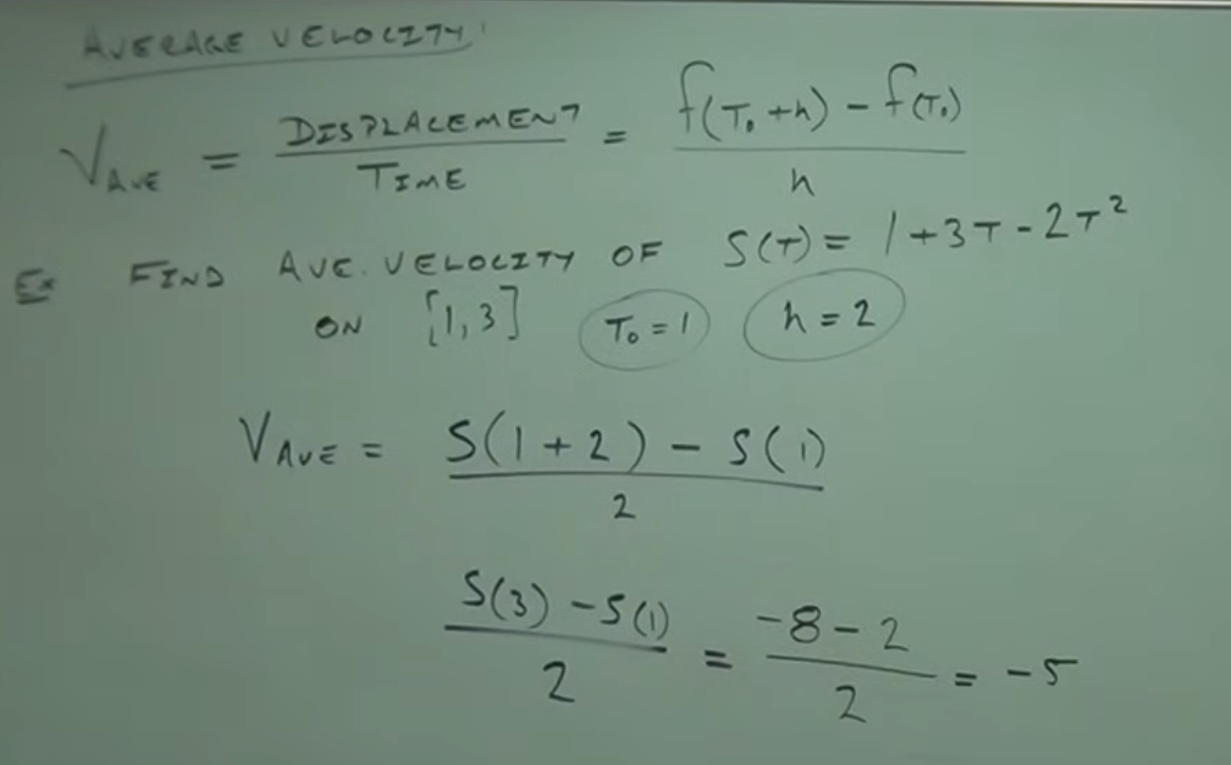
- Identification of $t_0=1$ and $h=2$.
- Calculating $s(t_0+h)=s(3)=-8$.
- Calculating $s(t_0)=s(1)=2$.
- Computing the average velocity: $\displaystyle
\dfrac{s(3)-s(1)}{2}=\dfrac{-8-2}{2}=-5$.
- 1:08:55.
Introduction to the difference between velocity and speed.
- Average Velocity:
- Type: Vector
- Includes: Direction and magnitude
- Use:Indicates the overall change in position over time, providing information
about both the rate of displacement and the direction.
- Speed:
- Type: Scalar
- Includes: Only magnitude
- Use: Measures the total distance traveled over a period of time without regard to
direction.
- 1:10:02.
𝗜̳𝗻̳𝘀̳𝘁̳𝗮̳𝗻̳𝘁̳𝗮̳𝗻̳𝗲̳𝗼̳𝘂̳𝘀̳ ̳𝘃̳𝗲̳𝗹̳𝗼̳𝗰̳𝗶̳𝘁̳𝘆̳
– [📷image]
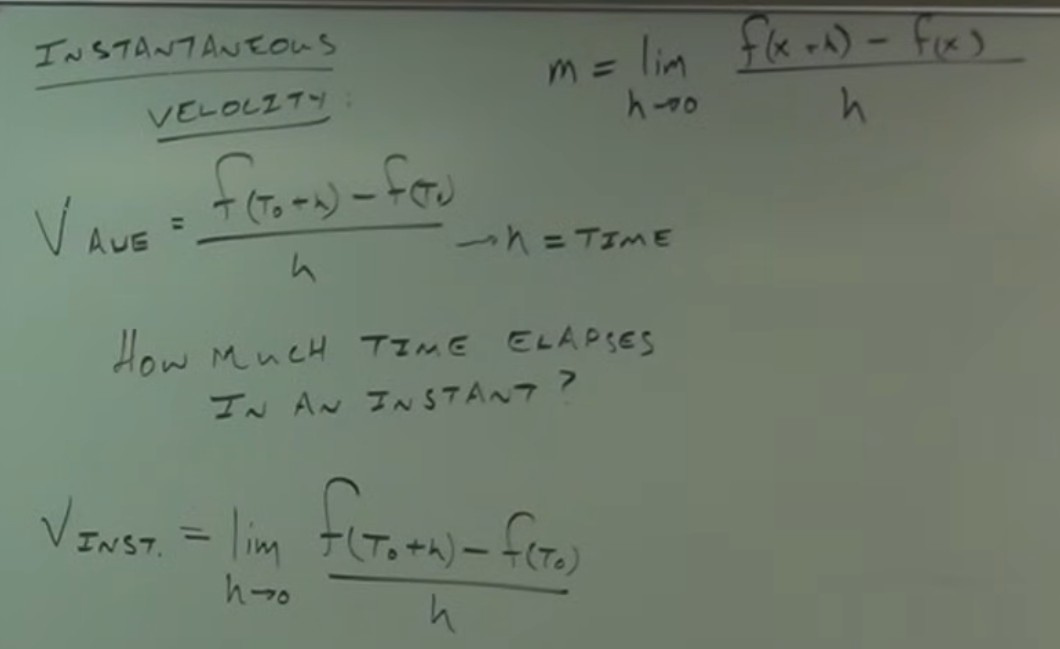
- Velocity at a specific instant in time.
- 1:11:25. 𝙃𝙤𝙬 𝙢𝙪𝙘𝙝 𝙩𝙞𝙢𝙚 𝙚𝙡𝙖𝙥𝙨𝙚𝙨 𝙞𝙣 𝙖𝙣 𝙞𝙣𝙨𝙩𝙖𝙣𝙩?
- 1:12:55. Instantaneous velocity is found by letting h approach zero in the average
velocity formula.
- 1:13:23. This involves using a limit.
- How we make average velocity instant?
- $\displaystyle \lim_{h\to 0}\dfrac{f(t_0+h)-f(t_0)}{h}$; $h=$ time
- 1:14:20. Relationship between instantaneous velocity and the slope of a curve at a
point.
- Both represent the instantaneous rate of change.
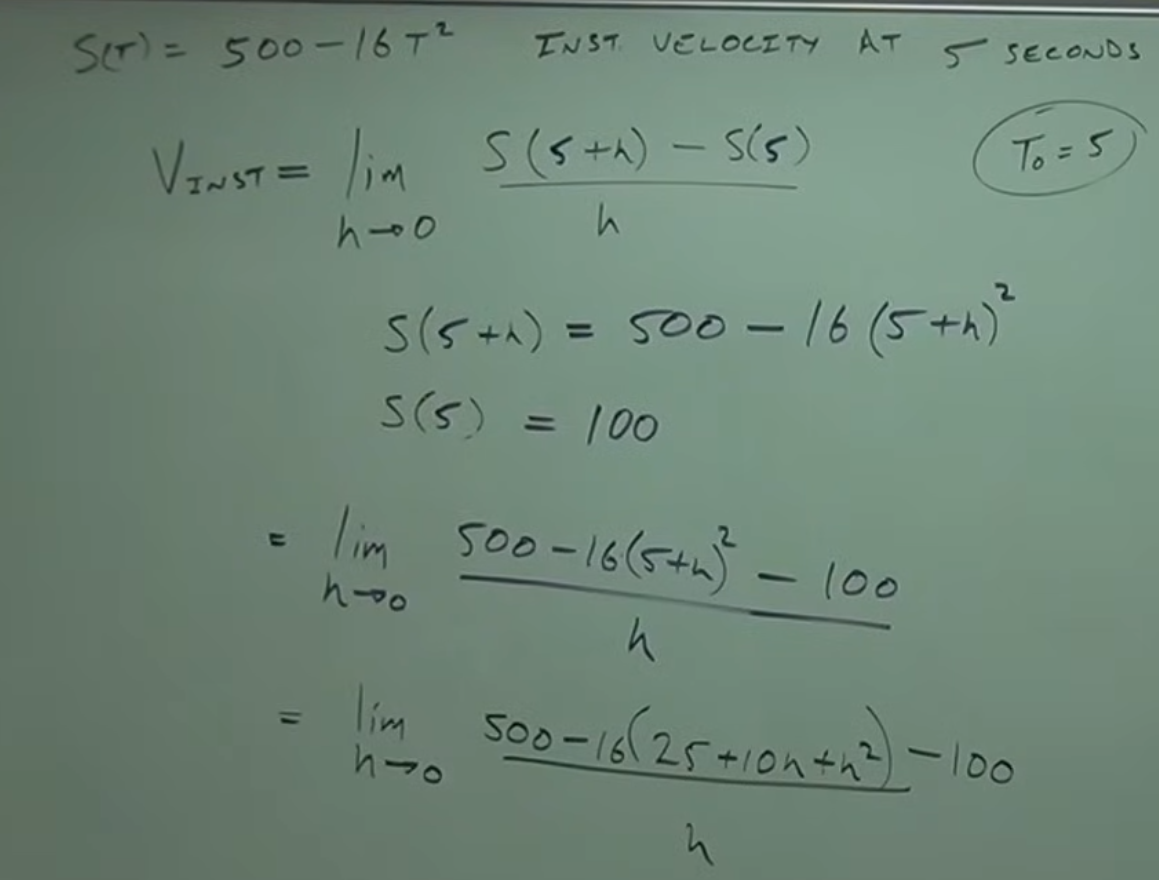
- 1:15:23. 🧩 Example: Finding instantaneous velocity of $s(t)=500-16t^{2}$ after 5
seconds.
– [📷image-1]
 – [📷image-2]
- $\displaystyle \lim_{h\to 0}\dfrac{s(t_0+h)-s(t_0)}{h}$
- Identification of $t_0=5$.
- Calculating $s(t_0+h)=s(5+h)=500-16(5+h)^{2}$.
- Calculating $s(t_0)=s(5)=100$.
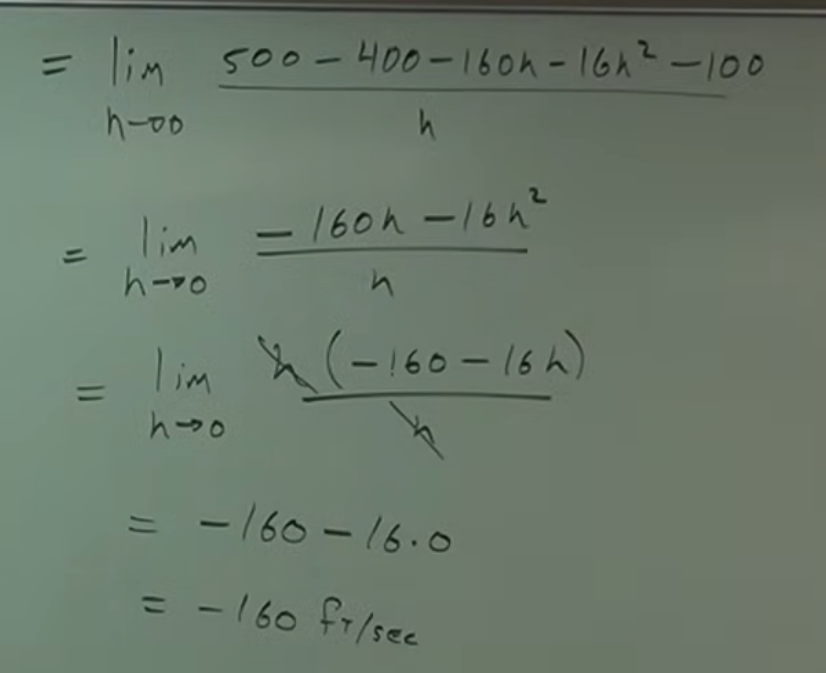
- 1:27:00. Substituting into the instantaneous velocity formula and simplifying.
- Take the limit
- $\displaystyle \lim_{h\to
0}\dfrac{s(t_0+h)-s(t_0)}{h}=V_{\text{inst}}=\displaystyle \lim_{h\to
0}\dfrac{500-16(25+10h+h^{2})-100}{h}$
- Simplify the expression:
- $V_{\text{inst}}=\displaystyle \lim_{h\to
0}\dfrac{500-400-160h-16h^{2}-100}{h}$
- $V_{\text{inst}}=\displaystyle \lim_{h\to 0}\dfrac{-160h-16h^{2}}{h}$
- Cancel the common factor of $h$:
- $V_{\text{inst}}=\displaystyle \lim_{h\to 0}\big(-160-16h\big)$
- Evaluate the limit as $h$ approaches $0$:
- $V_{\text{inst}}=-160\ \text{ft/sec}$
- 1:32:37. Computing the instantaneous velocity in general (for any time $t$ so ̵t̵₀̵
̵=̵ ̵5̵) and obtaining the formula: $v(t)=-32t$.
– [📷image]
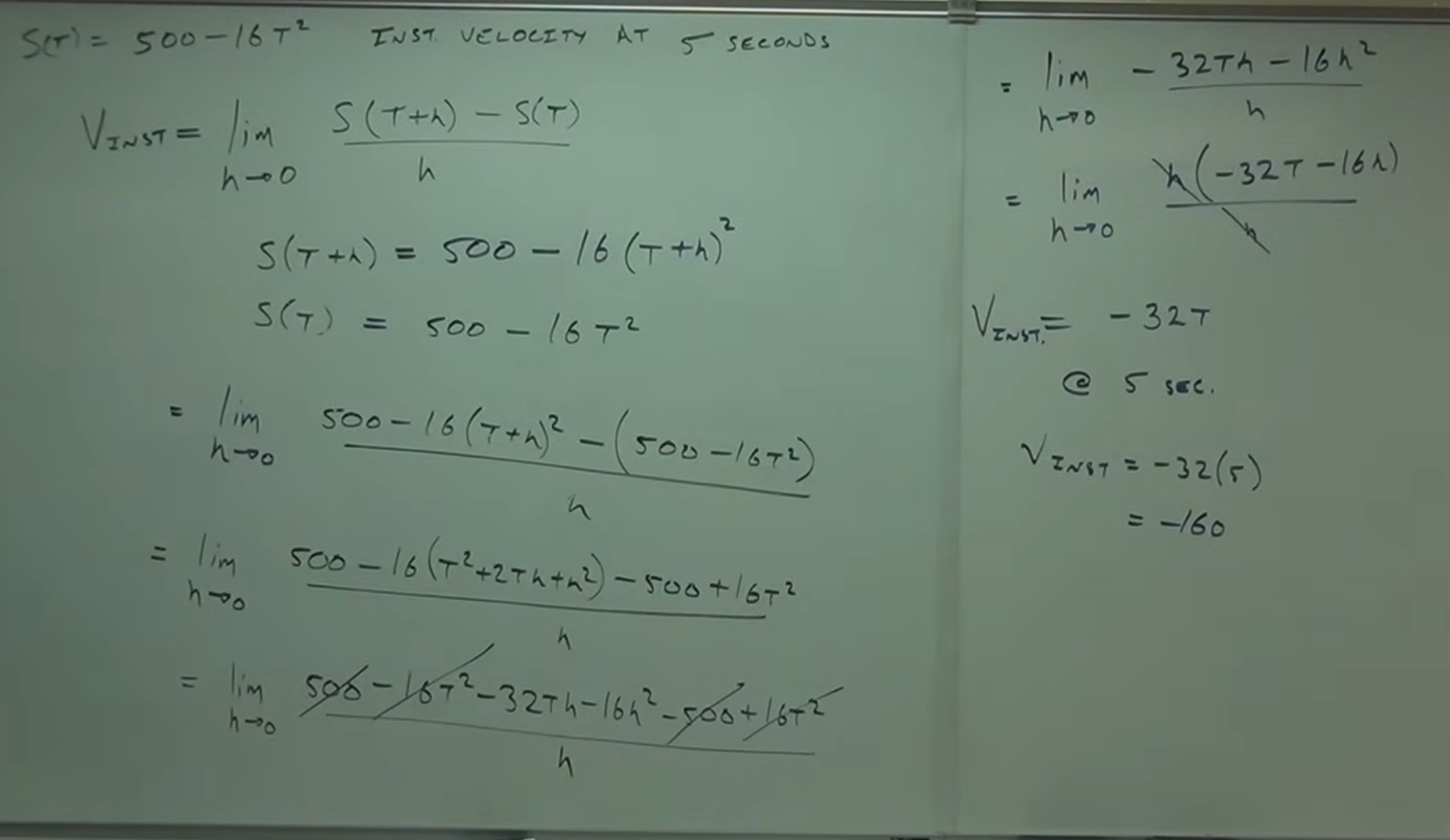
- Set up the formula for instantaneous velocity:
- $V_{\text{inst}}=\displaystyle \lim_{h\to 0}\dfrac{s(T+h)-s(T)}{h}$
- Substitute the given position functions:
- $s(T+h)=500-16(T+h)^{2}$
- $s(T)=500-16T^{2}$
- Substitute the expressions:
- $V_{\text{inst}}=\displaystyle \lim_{h\to
0}\dfrac{500-16(T^{2}+2Th+h^{2})-(500-16T^{2})}{h}$
- Expand and simplify:
- $V_{\text{inst}}=\displaystyle \lim_{h\to
0}\dfrac{500-16T^{2}-32Th-16h^{2}-500+16T^{2}}{h}$
- Cancel common terms:
- $V_{\text{inst}}=\displaystyle \lim_{h\to 0}\dfrac{-32Th-16h^{2}}{h}$
- Factor out the common term $(h)$:
- $V_{\text{inst}}=\displaystyle \lim_{h\to 0}\big(-32T-16h\big)$
- Evaluate the limit as $h$ approaches $0$:
- Substitute $T=5$ seconds:
- $V_{\text{inst}}=-32(5)$
- $V_{\text{inst}}=-160\ \text{ft/sec}$
- 1:38:29. Explanation of the difference between velocity and speed.
- Speed is the absolute value of velocity.
Average and Instantaneous rate of change
- 1:39:23.
Connection between slope and rate of change.
- The slope is a rate of change.
- 1:39:59.
The average rate of change is the slope of the secant line between two points.
- 1:41:58.
The instantaneous rate of change is the slope of the curve at one point.
- 1:43:10.
Rate of change:
- Average rate of change:
- $r_{\text{av}}=\displaystyle \dfrac{f(x_0+h)-f(x_0)}{h}$
- instantaneous rate of change:
- $r_{\text{inst}}=\displaystyle \lim_{h\to 0}\dfrac{f(x_0+h)-f(x_0)}{h}$
- 1:46:37. 🧩
Example: Finding the average and instantaneous rate of change of a curve 𝒇(𝒙) = 3𝒙² - 4, r_ave:[2,5] and
r_inst:-2
- Average rate of change: $r_{\text{av}}=\displaystyle \dfrac{f(x_0+h)-f(x_0)}{h}$
- $f(x_0)=f(2)$
- $f(x_0+h)=f\big(2+(5-2)\big)=f(5)$
- $r_{\text{av}}=\displaystyle
\dfrac{f(x_0+h)-f(x_0)}{h}=\dfrac{f(5)-f(2)}{3}=\dfrac{63}{3}=21$
- instantaneous rate of change: $r_{\text{inst}}=\displaystyle \lim_{h\to
0}\dfrac{f(x_0+h)-f(x_0)}{h}$
- $f(x_0)=3x_0^{2}-4$
- $f(x_0+h)=f\big(3(x_0+h)^{2}-4\big)=3x_0^{2}+6x_0h+h^{2}-4$
- $r_{\text{inst}}=\displaystyle \lim_{h\to
0}\dfrac{\big(3x_0^{2}+6x_0h+h^{2}-4\big)-\big(3x_0^{2}-4\big)}{h}=\displaystyle \lim_{h\to
0}\dfrac{6x_0h+h^{2}}{h} =\displaystyle \lim_{h\to 0}\big(6x_0+h\big)=6x_0$
- $r_{\text{inst}\_\!x_0:-2}=-12$