Calculus 1 lecture 2.1
Introduction To The Derivative Of a Function
Introduction to the concept of the derivative.
- 0:00. Reminder of the limit of the difference quotient
– [📷image]
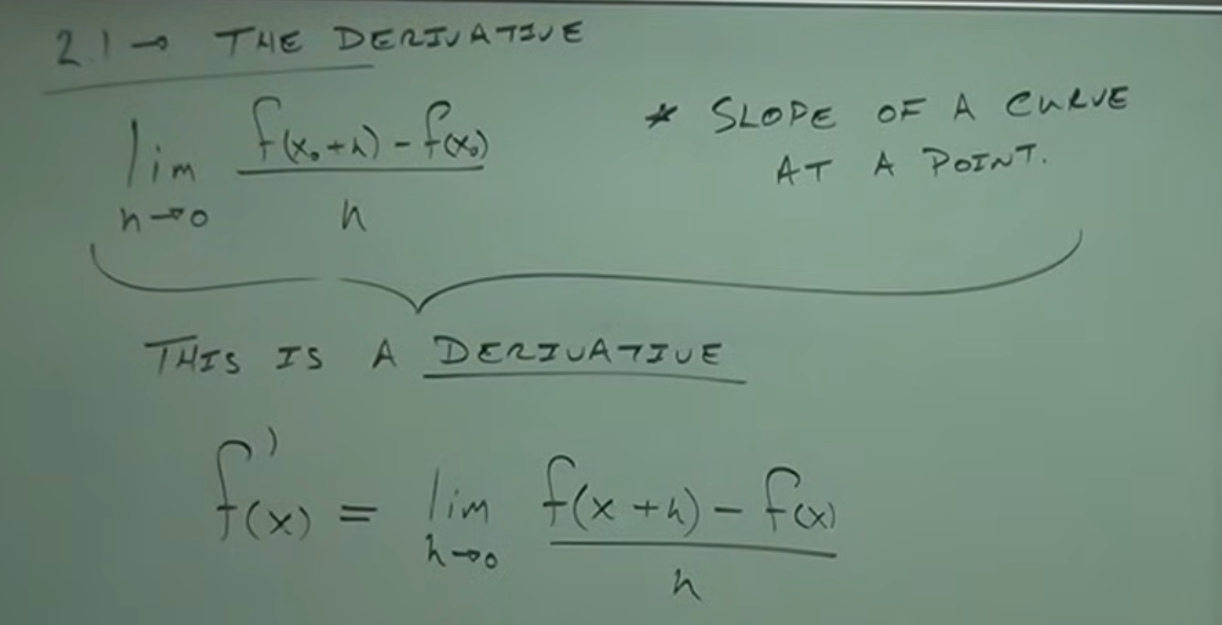
- $\displaystyle \lim_{h\to 0}\dfrac{𝒇(𝒙_{0}+h)-𝒇(𝒙_{0})}{h}$
- This limit has been used to calculate the instantaneous rate of change, instantaneous velocity, and the slope of a curve at a point.
- The concept of the derivative
- It is defined as the 𝒔𝙡𝒐𝙥𝒆 𝒐𝙛 𝙖 𝙘𝒖𝙧𝒗𝙚 𝙖𝒕 𝒂 𝒑𝙤𝙞𝙣𝒕.
- The derivative of a function at a specific point provides the slope of the curve at that point, which is also equivalent to the 𝙨𝙡𝙤𝙥𝙚 𝙤𝙛 𝙩𝙝𝙚 𝙩𝙖𝙣𝙜𝙚𝙣𝙩 𝙡𝙞𝙣𝙚 𝙩𝙤 𝙩𝙝𝙚 𝙘𝙪𝙧𝙫𝙚 𝙖𝙩 𝙩𝙝𝙖𝙩 𝙨𝙖𝙢𝙚 𝙥𝙤𝙞𝙣𝙩.
- 2:05. The importance of understanding the meaning of the derivative
- The slope of a curve at a point.
- 2:30. The notation for the derivative
- $\displaystyle 𝒇'(𝒙)=\lim_{h\to 0}\dfrac{𝒇(𝒙+h)-𝒇(𝒙)}{h}$
- Read as "the derivative of the function 𝒇 with respect to 𝒙."
- Also referred to as "𝒇 prime of 𝒙."
- 3:25. The specific point 𝒙₀ is removed from the notation:
- This indicates that the general derivative function is being sought.
Examples dedicated to finding the derivative of a function.
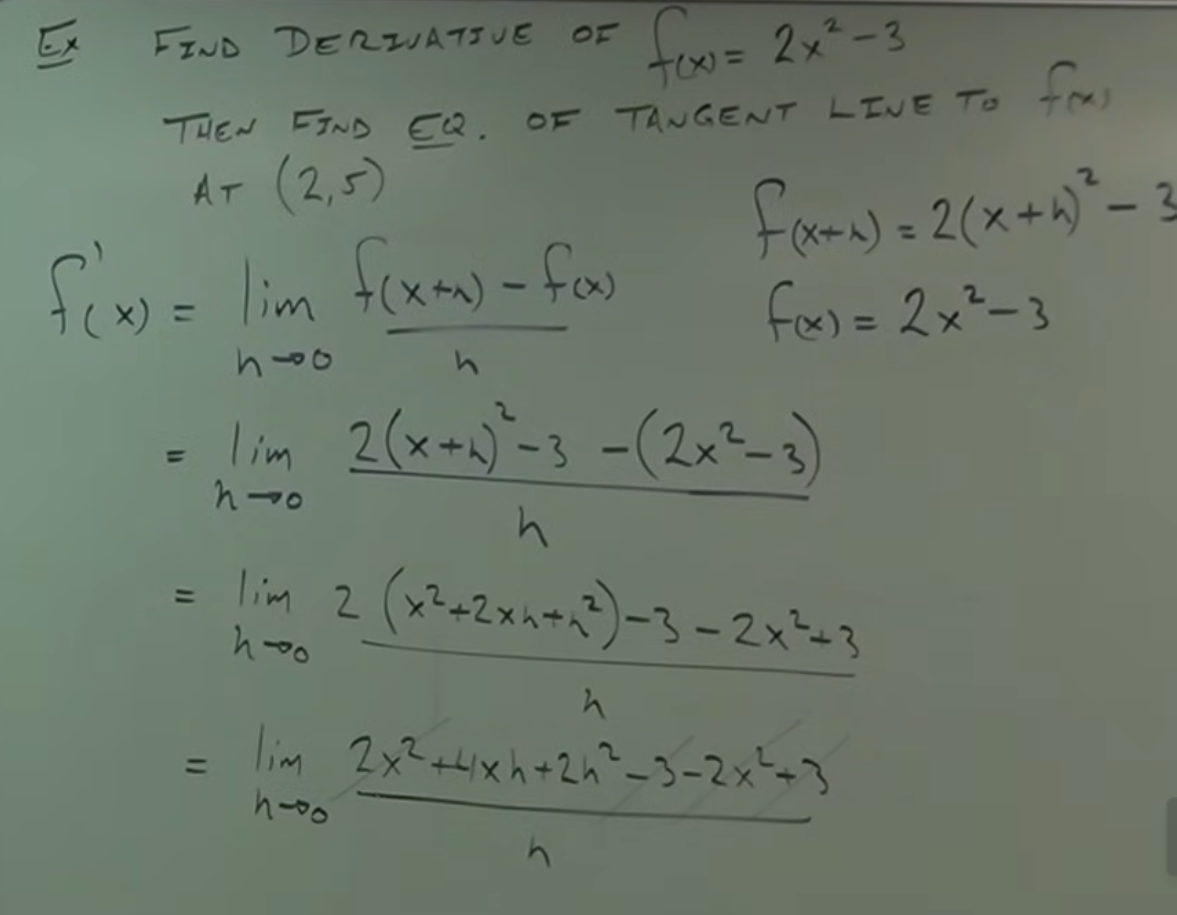
- 5:33. 🧩 Example – Find the derivative of the function $𝒇(𝒙)=2x^{2}-3$ and the equation
of the tangent line at the point $(2,5)$.
– [📷image-1]
 – [📷image-2]
- 7:00. The formula for what is a derivative.
- $\displaystyle 𝒇'(𝒙)=\lim_{h\to 0}\dfrac{𝒇(𝒙+h)-𝒇(𝒙)}{h}$
- Calculate $𝒇(𝒙+h)$ and $𝒇(𝒙)$ for the given function:
- $𝒇(𝒙+h)=2(𝒙+h)^{2}-3$
- $𝒇(𝒙)=2𝒙^{2}-3$
- Substitution into the formula:
- $\displaystyle 𝒇'(𝒙)=\lim_{h\to 0}\dfrac{2(𝒙+h)^{2}-3-\big(2𝒙^{2}-3\big)}{h}$
- Process of factoring:
- Expand the expression:
- $\displaystyle 𝒇'(𝒙)=\lim_{h\to 0}\dfrac{2(𝒙^{2}+2𝒙 h+h^{2})-3-2𝒙^{2}+3}{h}$
- Simplify:
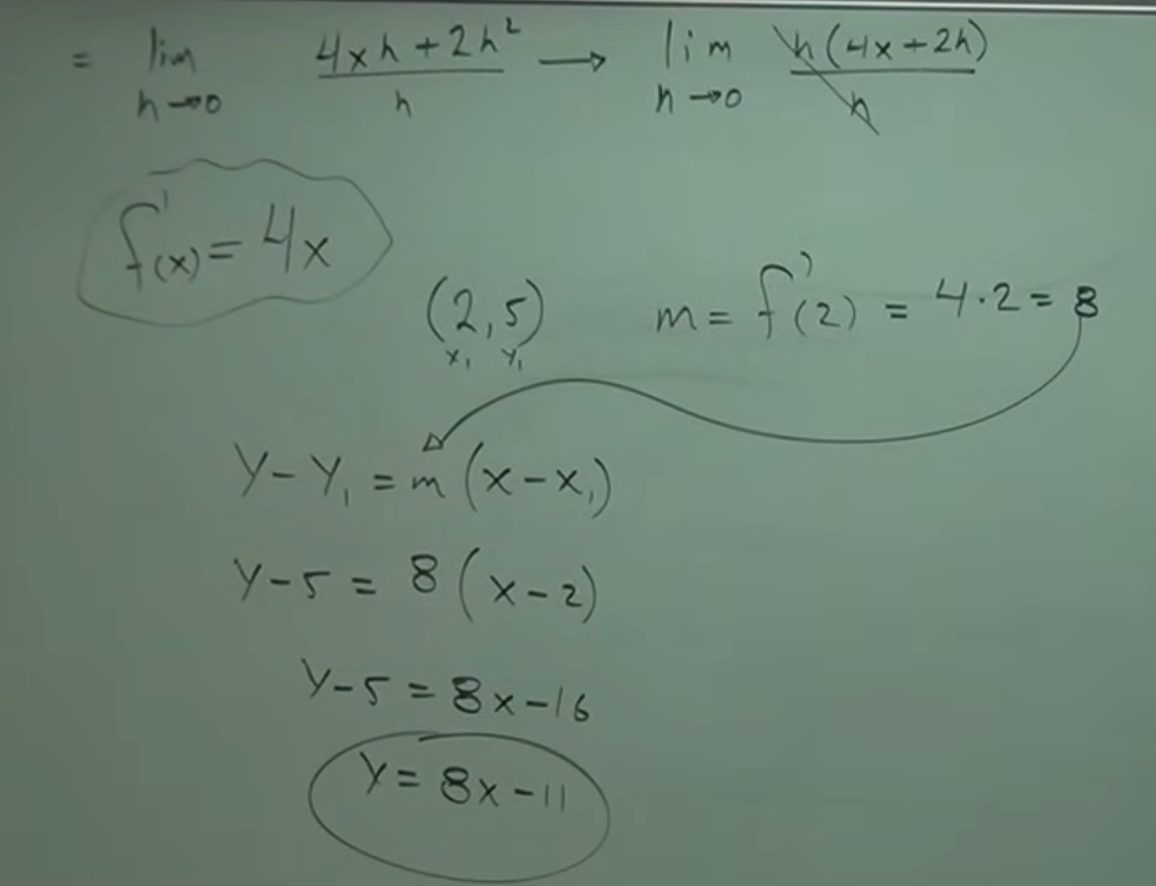
- $\displaystyle 𝒇'(𝒙)=\lim_{h\to 0}\dfrac{4𝒙 h+2h^{2}}{h}$
- Factor out $h$:
- $\displaystyle 𝒇'(𝒙)=\lim_{h\to 0}\dfrac{h\,(4𝒙+2h)}{h}$
- Cancel $h$:
- $\displaystyle 𝒇'(𝒙)=\lim_{h\to 0}\big(4𝒙+2h\big)$
- Expand the expression:
- Limit calculation:
- As $h$ approaches zero, $𝒇'(𝒙)=4x$ is obtained.
- Use of the derivative
- How to find the slope of the curve at any point.
- By applying the derivative to the given point $𝒙=2$ from $(2,5)$
- $m=𝒇'(2)=4\cdot 2=8$
- By applying the derivative to the given point $𝒙=2$ from $(2,5)$
- How to find the slope of the curve at any point.
- 12:54. Use the point-slope form:
- $𝒚-𝒚_{1}=m(𝒙-𝒙_{1})$
- Substitute the point $(2,5)$ and slope $(8)$:
- $𝒚-5=8(𝒙-2)$
- Expand:
- $𝒚-5=8𝒙-16$
- $𝒚=8𝒙-11$
- Final answer:
- Equation of the tangent line: $𝒚=8𝒙-11$
- 7:00. The formula for what is a derivative.
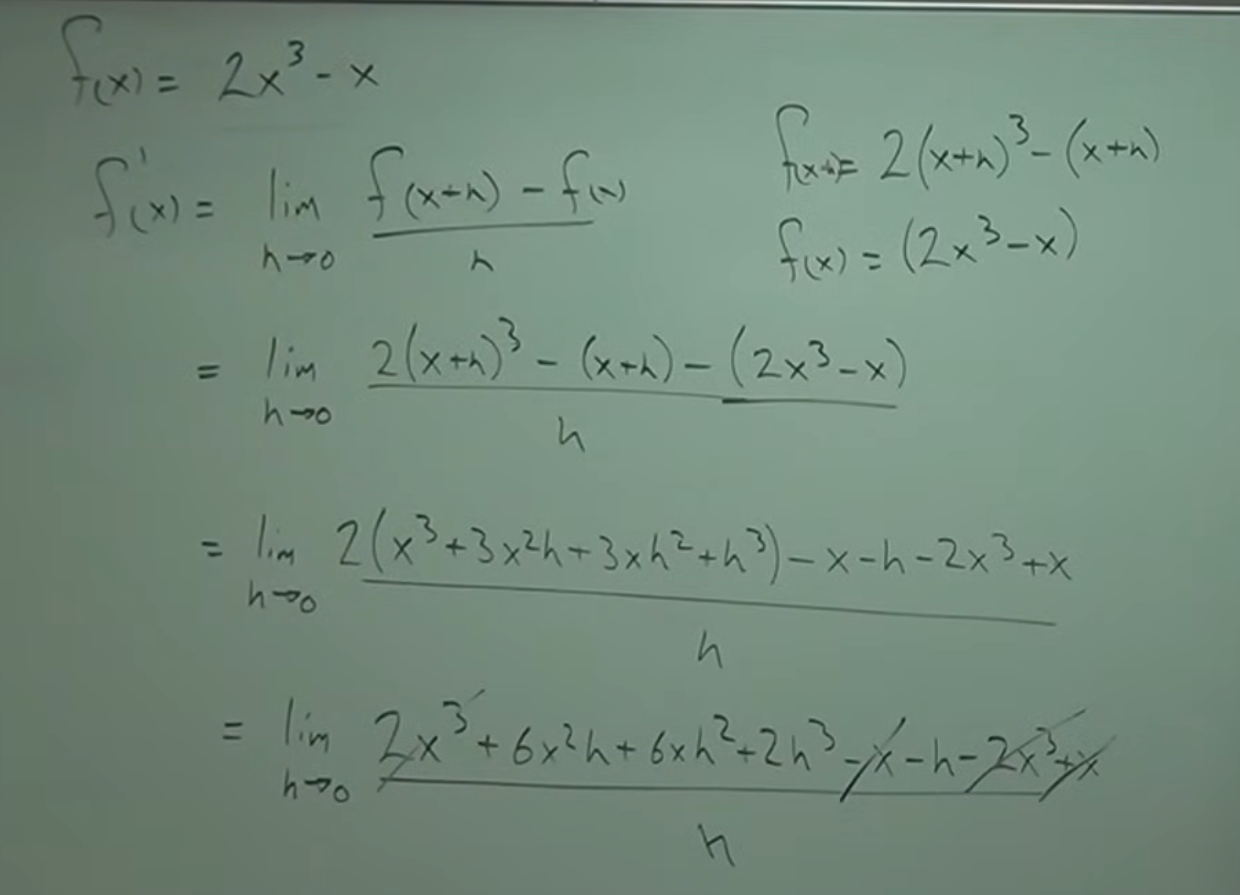
- 16:00. 🧩 Example – Find the derivative of the function $𝒇(𝒙)=2x^{3}-x$.
– [📷image-1]
 – [📷image-2]
- 17:10. The formula for what is a derivative.
- $\displaystyle 𝒇'(𝒙)=\lim_{h\to 0}\dfrac{𝒇(𝒙+h)-𝒇(𝒙)}{h}$
- Calculate $𝒇(𝒙+h)$ and $𝒇(𝒙)$ for the given function:
- $𝒇(𝒙+h)=2(𝒙+h)^{3}-(𝒙+h)$
- $𝒇(𝒙)=2𝒙^{3}-𝒙$
- Substitution into the formula:
- $\displaystyle 𝒇'(𝒙)=\lim_{h\to 0}\dfrac{2(𝒙+h)^{3}-(𝒙+h)-\big(2𝒙^{3}-𝒙\big)}{h}$
- Process of factoring:
- Expand the expression:
- $\displaystyle 𝒇'(𝒙)=\lim_{h\to 0}\dfrac{2\big(𝒙^{3}+3𝒙^{2}h+3𝒙 h^{2}+h^{3}\big)-(𝒙+h)-2𝒙^{3}+𝒙}{h}$
- Simplify:
- $\displaystyle 𝒇'(𝒙)=\lim_{h\to 0}\dfrac{2𝒙^{3}+6𝒙^{2}h+6𝒙 h^{2}+2h^{3}-𝒙-h-2𝒙^{3}+𝒙}{h}$
- Combine like terms:
- $\displaystyle 𝒇'(𝒙)=\lim_{h\to 0}\dfrac{6𝒙^{2}h+6𝒙 h^{2}+2h^{3}-h}{h}$
- Factor out $h$:
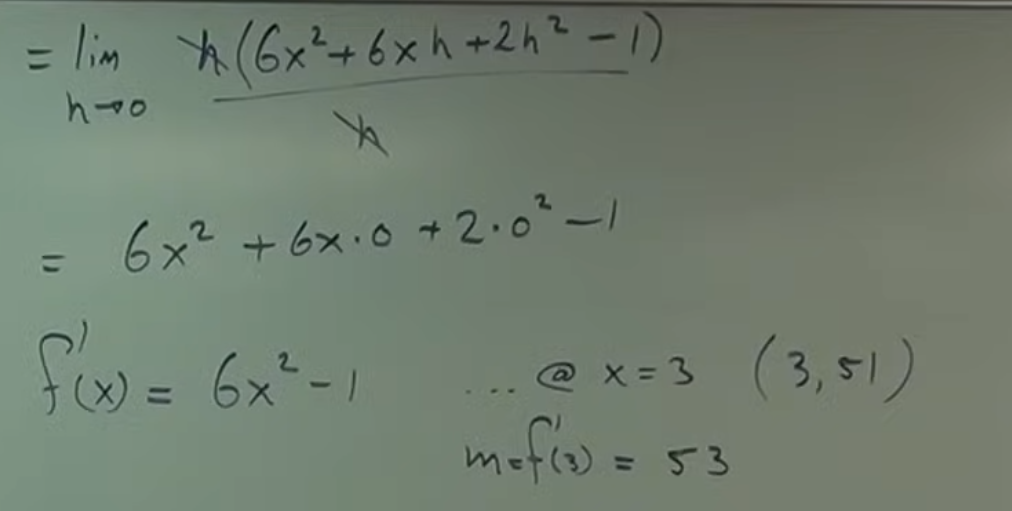
- $\displaystyle 𝒇'(𝒙)=\lim_{h\to 0}\dfrac{h\,(6𝒙^{2}+6𝒙 h+2h^{2}-1)}{h}$
- Cancel $h$:
- $\displaystyle 𝒇'(𝒙)=\lim_{h\to 0}\big(6𝒙^{2}+6𝒙 h+2h^{2}-1\big)$
- Expand the expression:
- Limit calculation:
- As $h$ approaches zero:
- $𝒇'(𝒙)=6𝒙^{2}-1$
- As $h$ approaches zero:
- Use of the derivative
- How to find the slope of the curve at any point.
- By applying the derivative to the given point $𝒙=3$:
- $m=𝒇'(3)=6(3)^{2}-1=53$
- By applying the derivative to the given point $𝒙=3$:
- How to find the slope of the curve at any point.
- 17:10. The formula for what is a derivative.
- 27:30. 🧩 Example – Find the derivative of the function $𝒇(𝒙)=3x+2$.
– [📷image]

- Explanation of linear functions:
- The slope is constant, so the derivative is the coefficient of $x$ (in this case, $3$).
- 29:10. Generalization:
- For any linear function of the form $y=mx+b$, the derivative is always $m$.
- Explanation of linear functions:
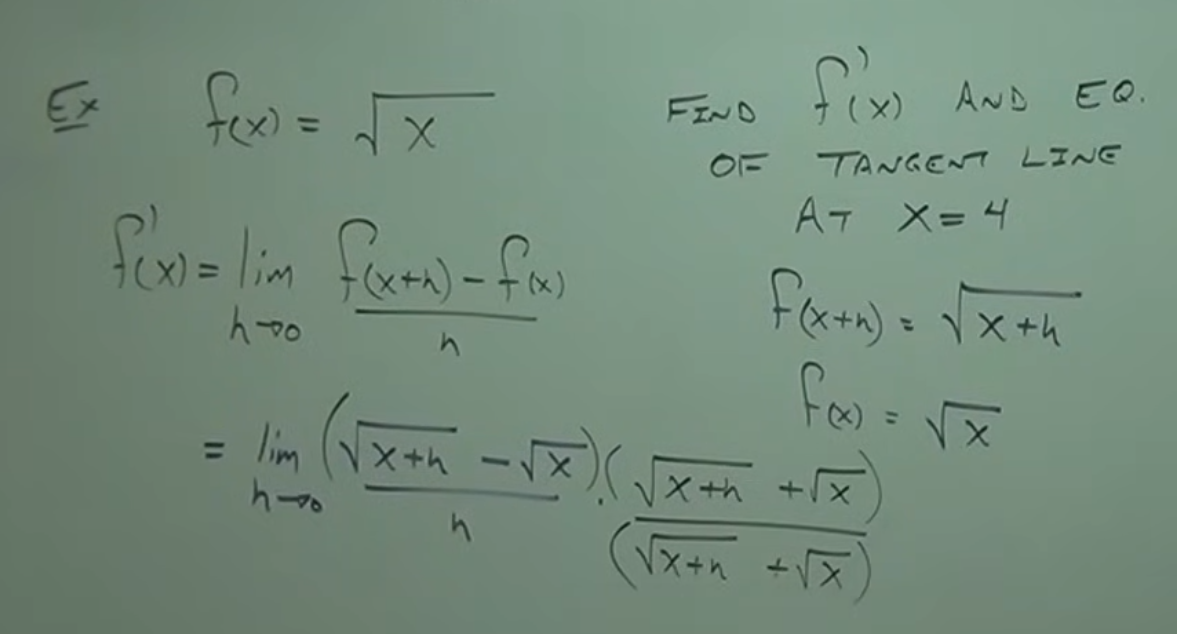
- 31:10. 🧩 Example – Find the derivative of the function $𝒇(𝒙)=\sqrt{x}$ and the equation
of the tangent line at $x=4$.
– [📷image-1]
 – [📷image-2]
- Use of the The formula for what is a derivative:
- $\displaystyle 𝒇'(𝒙)=\lim_{h\to 0}\dfrac{𝒇(𝒙+h)-𝒇(𝒙)}{h}$
- Necessary because it is not a linear function.
- 32:25. Importance of finding the general derivative function:
- Before evaluating at a specific point.
- Calculate $𝒇(𝒙+h)$ and $𝒇(𝒙)$ for the given function:
- $𝒇(𝒙+h)=\sqrt{𝒙+h}$
- $𝒇(𝒙)=\sqrt{𝒙}$
- Substitution into the formula:
- $\displaystyle 𝒇'(𝒙)=\lim_{h\to 0}\dfrac{\sqrt{𝒙+h}-\sqrt{𝒙}}{h}$
- Process of factoring:
- Multiply and divide by the conjugate to rationalize the numerator:
- $\displaystyle 𝒇'(𝒙)=\lim_{h\to 0}\dfrac{\big(\sqrt{𝒙+h}-\sqrt{𝒙}\big)\big(\sqrt{𝒙+h}+\sqrt{𝒙}\big)}{\,h\big(\sqrt{𝒙+h}+\sqrt{𝒙}\big)}$
- Expand the numerator using the difference of squares:
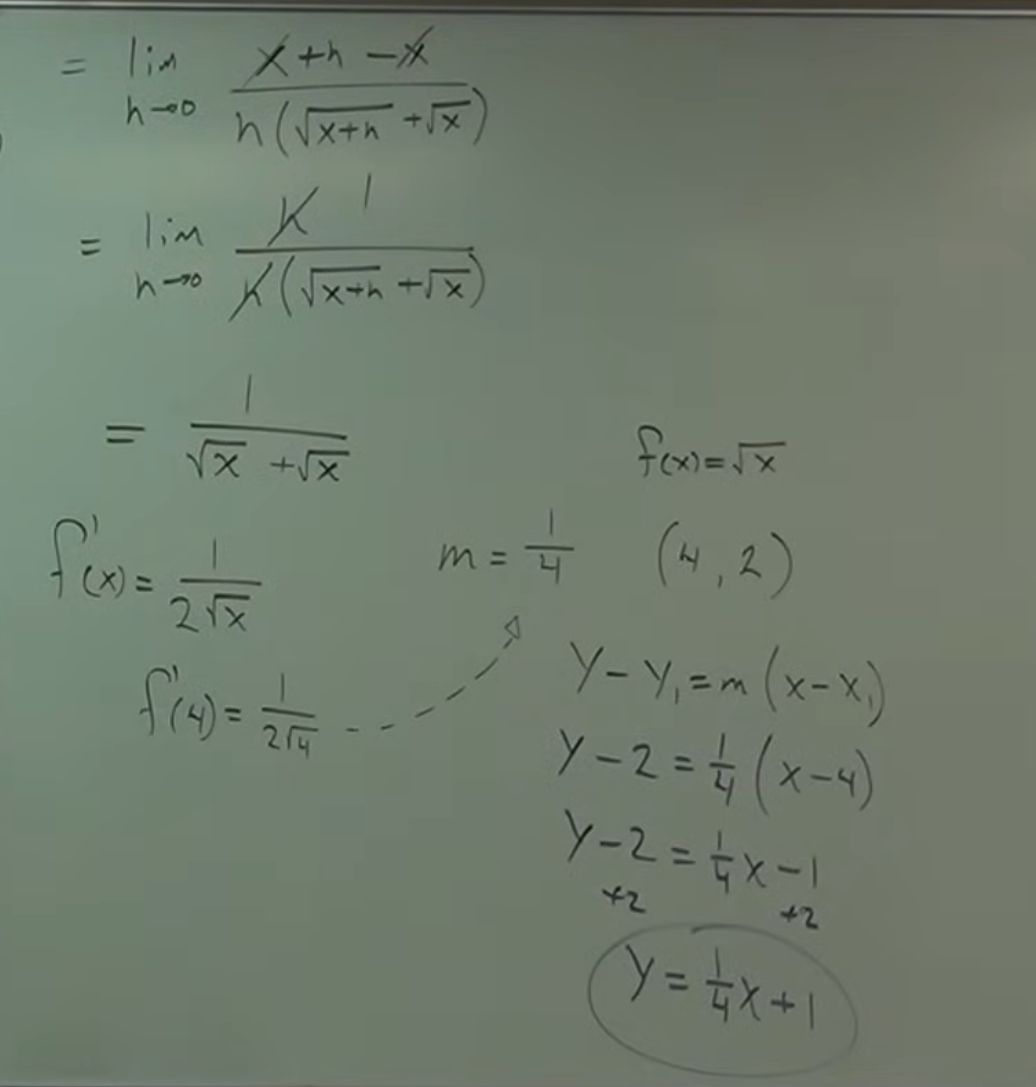
- $\displaystyle 𝒇'(𝒙)=\lim_{h\to 0}\dfrac{(𝒙+h)-𝒙}{\,h\big(\sqrt{𝒙+h}+\sqrt{𝒙}\big)}$
- Simplify:
- $\displaystyle 𝒇'(𝒙)=\lim_{h\to 0}\dfrac{h}{\,h\big(\sqrt{𝒙+h}+\sqrt{𝒙}\big)}$
- Cancel $h$:
- $\displaystyle 𝒇'(𝒙)=\lim_{h\to 0}\dfrac{1}{\sqrt{𝒙+h}+\sqrt{𝒙}}$
- Multiply and divide by the conjugate to rationalize the numerator:
- Limit calculation:
- As $h$ approaches zero:
- $\displaystyle 𝒇'(𝒙)=\dfrac{1}{2\sqrt{𝒙}}$
- As $h$ approaches zero:
- Use of the derivative
- How to find the slope of the curve at the point $𝒙=4$:
- $m=𝒇'(4)=\dfrac{1}{2\sqrt{4}}=\dfrac{1}{4}$
- How to find the slope of the curve at the point $𝒙=4$:
- 37:13. Explanation to find the equation of the tangent line. Application of the
point-slope method.
- Find the value of the function at the point:
- $𝒇(4)=\sqrt{4}=2$
- Point: $(4,2)$
- $𝒚-𝒚_{1}=m(𝒙-𝒙_{1})$
- Substitute the point $(4,2)$ and slope $\big(\dfrac{1}{4}\big)$:
- $𝒚-2=\dfrac{1}{4}(𝒙-4)$
- Expand:
- $𝒚-2=\dfrac{1}{4}𝒙-1$
- $𝒚=\dfrac{1}{4}𝒙+1$
- Final answer:
- Equation of the tangent line: $𝒚=\dfrac{1}{4}𝒙+1$
- Find the value of the function at the point:
- Use of the The formula for what is a derivative:
Introduction of the concept of instantaneous velocity as the derivative of the position function.
- 41:00. Definition of instantaneous velocity:
– [📷image]
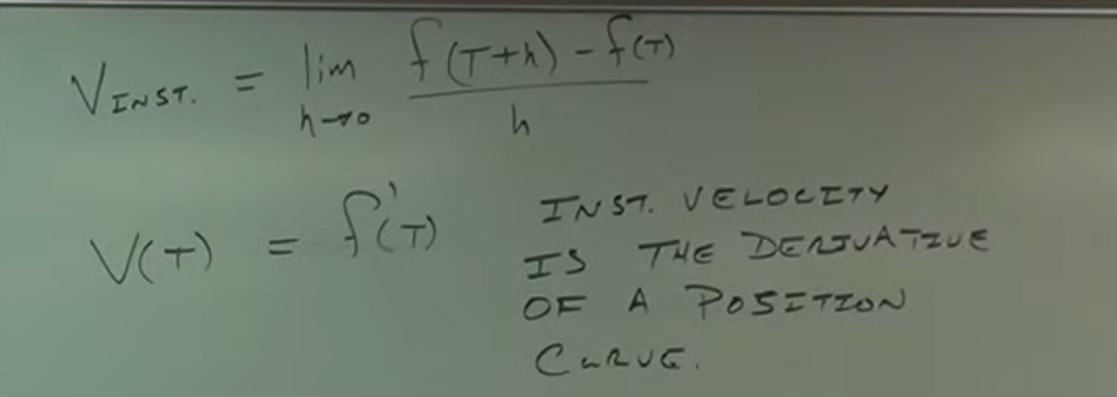
- $\displaystyle v_{\text{inst.}}=\lim_{h\to 0}\dfrac{𝒇(t+h)-𝒇(t)}{h}$
- $v_{\text{inst.}}=v(t)=𝒇'(t)$
- Instantanious velocity is the first derivative of a position curve
- Relationship between instantaneous velocity and the derivative:
- $v(t)=s'(t)$, where $s(t)$ is the psition function.
- $\displaystyle v(t)=\lim_{h\to 0}\dfrac{s(t+h)-s(t)}{h}$
- 42:45. 🧩 Example – The position function $s(t)=1250-16t^{2}$ is provided for an object
falling from the Empire State Building.
- 43:14. Three questions are posed:
– [📷image-1]
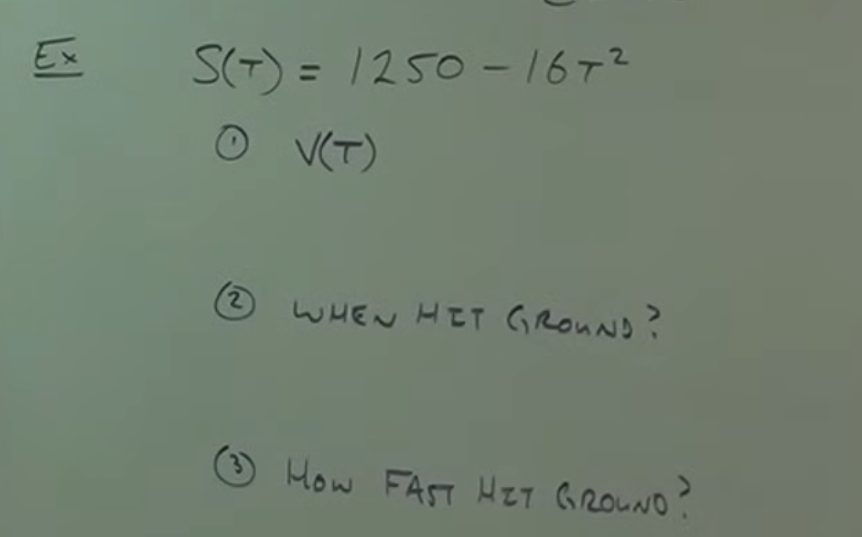
- 1. Find the formula for instantaneous velocity $v(t)$.
– [📷image-2]
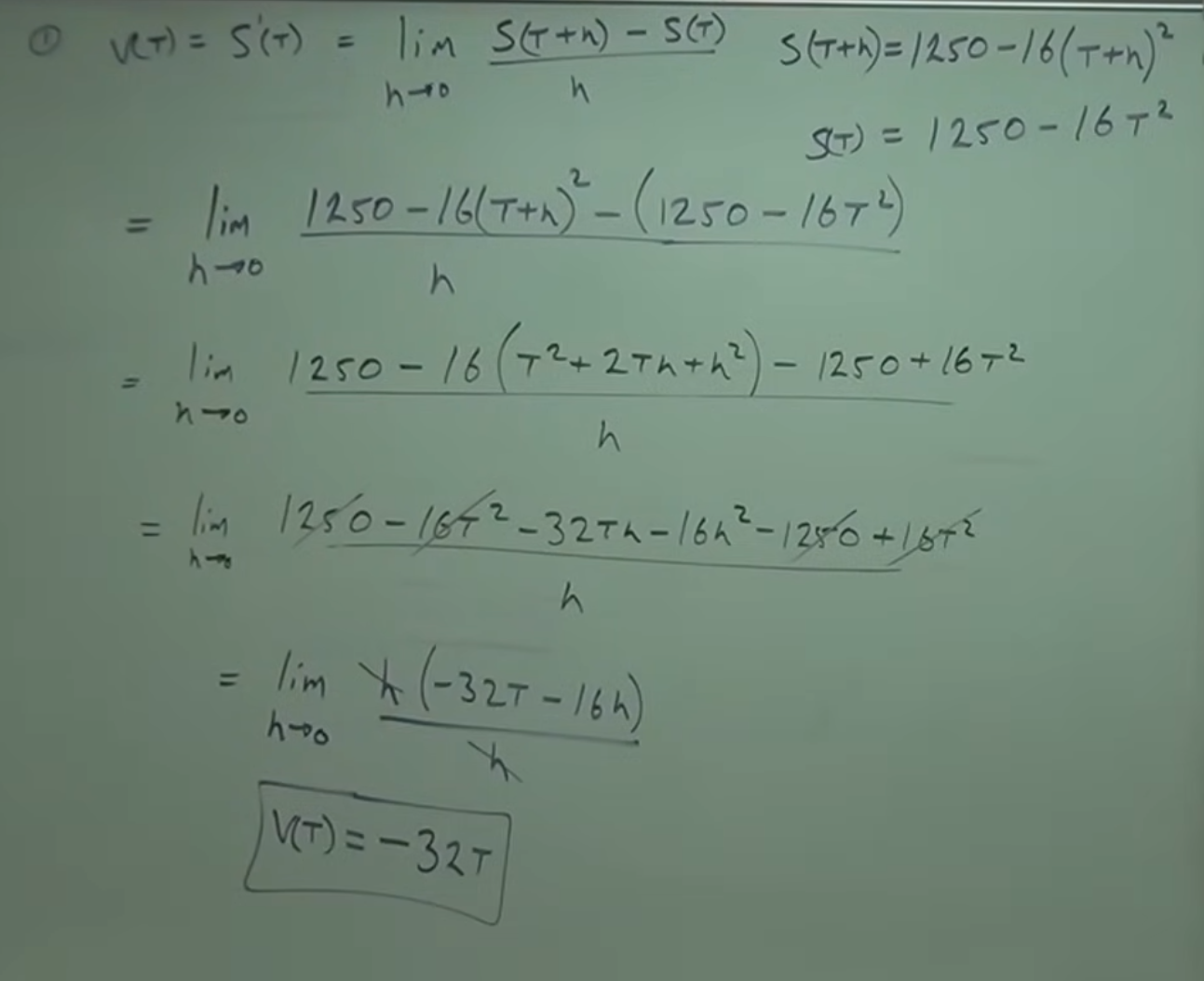
- 47:20. The first question is solved: find $v(t)$.
- Formula for instantaneous velocity:
- $\displaystyle v(t)=s'(t)=\lim_{h\to 0}\dfrac{s(t+h)-s(t)}{h}$
- Step 1: Define the functions:
- $s(t+h)=1250-16(t+h)^{2}$
- $s(t)=1250-16t^{2}$
- Step 2: Substitution into the formula:
- $\displaystyle v(t)=\lim_{h\to 0}\dfrac{1250-16(t+h)^{2}-\big(1250-16t^{2}\big)}{h}$
- Step 3: Expand the square:
- $\displaystyle v(t)=\lim_{h\to 0}\dfrac{1250-16\big(t^{2}+2t h+h^{2}\big)-1250+16t^{2}}{h}$
- Step 4: Simplify the expression:
- $\displaystyle v(t)=\lim_{h\to 0}\dfrac{1250-16t^{2}-32t h-16h^{2}-1250+16t^{2}}{h}$
- Step 5: Cancel out common terms:
- $\displaystyle v(t)=\lim_{h\to 0}\dfrac{-32t h-16h^{2}}{h}$
- Step 6: Factor out $h$:
- $\displaystyle v(t)=\lim_{h\to 0}\dfrac{h(-32t-16h)}{h}$
- Step 7: Cancel $h$:
- $\displaystyle v(t)=\lim_{h\to 0}\big(-32t-16h\big)$
- Step 8: Apply the limit as $h\to 0$:
- $v(t)=-32t$
- Final answer:
- The instantaneous velocity $v(t)=-32t$.
- Formula for instantaneous velocity:
- 47:20. The first question is solved: find $v(t)$.
- 2. Determine when the object hits the ground.
– [📷image-3]
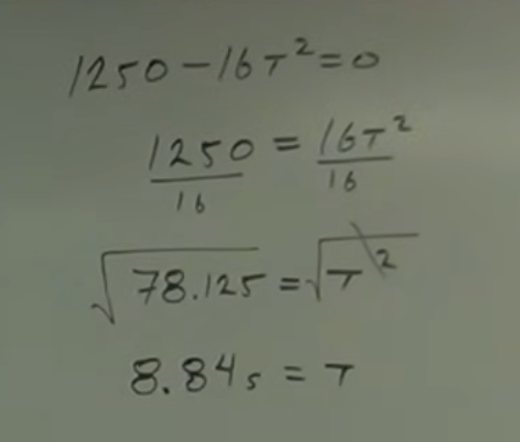
- 51:16. The second question is solved: determine when the object hits the
ground.
- The equation $1250-16t^{2}=0$ is posed to find the time when the height is zero.
- It is solved from the equation, obtaining $t=\sqrt{\dfrac{1250}{16}}$.
- It is calculated, obtaining $t\approx 8.84$ seconds.
- 51:16. The second question is solved: determine when the object hits the
ground.
- 3. Calculate the velocity of the object upon impact.
– [📷image-4]
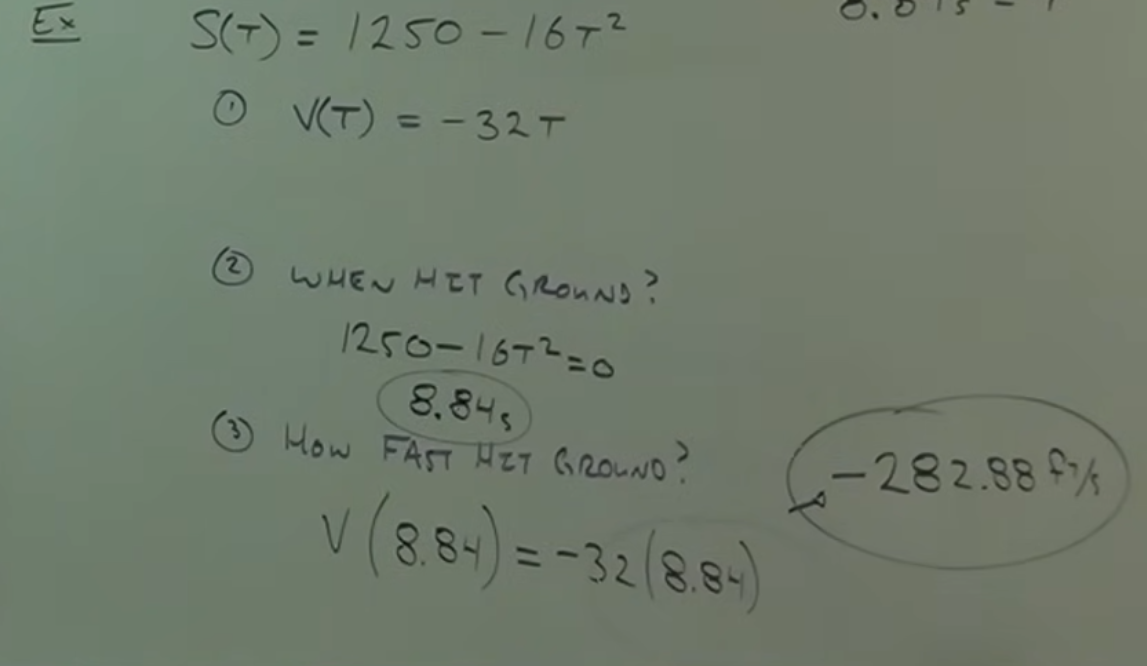
- 54:29. The third question is solved: calculate the velocity of the object upon
impact.
- $t=8.84$ seconds is substituted into the formula for instantaneous velocity $v(t)=-32t$.
- The velocity is calculated, obtaining $v(8.84)\approx -282.88$ feet per second.
- 54:29. The third question is solved: calculate the velocity of the object upon
impact.
- 1. Find the formula for instantaneous velocity $v(t)$.
– [📷image-2]
- 43:14. Three questions are posed:
– [📷image-1]
Introduction to differentiability.
- 57:00. A function's ability to have a derivative at a point.
- 57:36. It is explained that for a function to be differentiable at a point, the limit of
the difference
quotient must exist at that point.
- $\displaystyle 𝒇'(𝒙)=\lim_{h\to 0}\dfrac{𝒇(𝒙+h)-𝒇(𝒙)}{h}$ must exist
- 58:40. Relationship between differentiability and limits:
- Differentiability exists if the limit of the difference quotient exists.
- The existence of the limit is connected with continuity and the equality of the one-sided limits.
- Differentiability exists if the limit of the difference quotient exists.
- 59:20. Two implications of differentiability:
– [📷image]
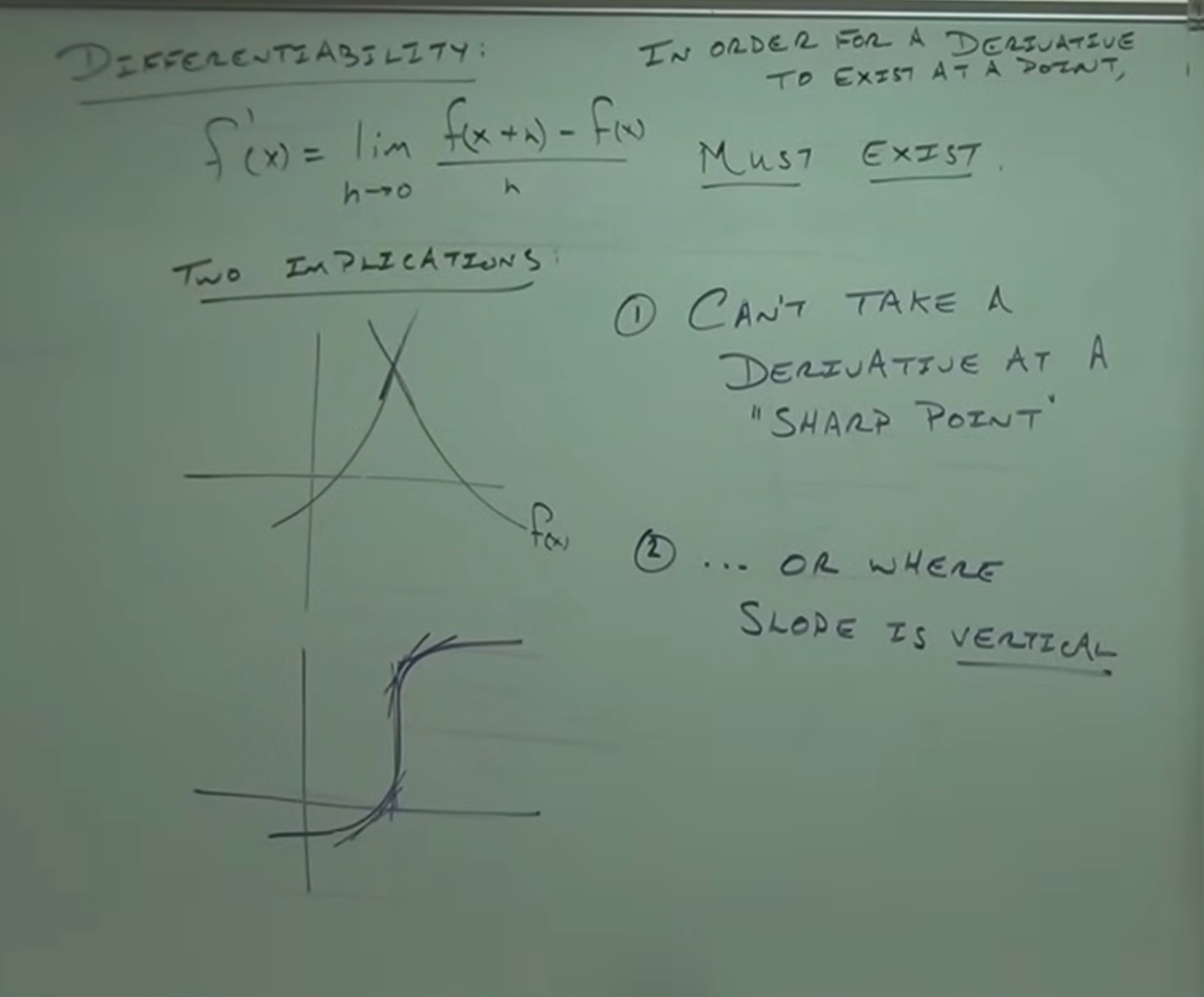
- 59:40. ① ᴛʜᴇ ᴅᴇʀɪᴠᴀᴛɪᴠᴇ ᴄᴀɴɴᴏᴛ ʙᴇ ᴛᴀᴋᴇɴ ᴀᴛ ᴀ ꜱʜᴀʀᴩ ᴩᴏɪɴᴛ 𝑎.
-
The slope from the left ≠ The slope from the right $𝒇'^{-}(𝑎)$ ≠ $𝒇'^{+}(𝑎)$ $\displaystyle \lim_{h\to 0^{-}}\dfrac{𝒇(𝑎+h)-𝒇(𝑎)}{h}$ ≠ $\displaystyle \lim_{h\to 0^{+}}\dfrac{𝒇(𝑎+h)-𝒇(𝑎)}{h}$ - The slope of the function exist but the limit of our slop doesn't exist
- $\displaystyle \lim_{𝒙\to 𝑎}𝒇(𝒙)$ exits
- $\displaystyle \lim_{h\to 0}\dfrac{𝒇(𝑎+h)-𝒇(𝑎)}{h}$ doesn't exist
-
- 1:03:16. ② ᴛʜᴇ ᴅᴇʀɪᴠᴀᴛɪᴠᴇ ᴄᴀɴɴᴏᴛ ʙᴇ ᴛᴀᴋᴇɴ ᴀᴛ ᴀ ᴩᴏɪɴᴛ ᴡʜᴇʀᴇ ᴛʜᴇ ꜱʟᴏᴩᴇ ɪꜱ ᴠᴇʀᴛɪᴄᴀʟ
(ᴜɴᴅᴇꜰɪɴᴇᴅ).
- It is explained that the limit of the derivative at a point with a vertical slope does not exist because the one-sided limits tend to positive and negative infinity, respectively.
- 59:40. ① ᴛʜᴇ ᴅᴇʀɪᴠᴀᴛɪᴠᴇ ᴄᴀɴɴᴏᴛ ʙᴇ ᴛᴀᴋᴇɴ ᴀᴛ ᴀ ꜱʜᴀʀᴩ ᴩᴏɪɴᴛ 𝑎.
- 1:04:45. 🧩 Example – The differentiability of the absolute value function $𝒇(𝒙)=|x|$ is
analyzed.
– [📷image]
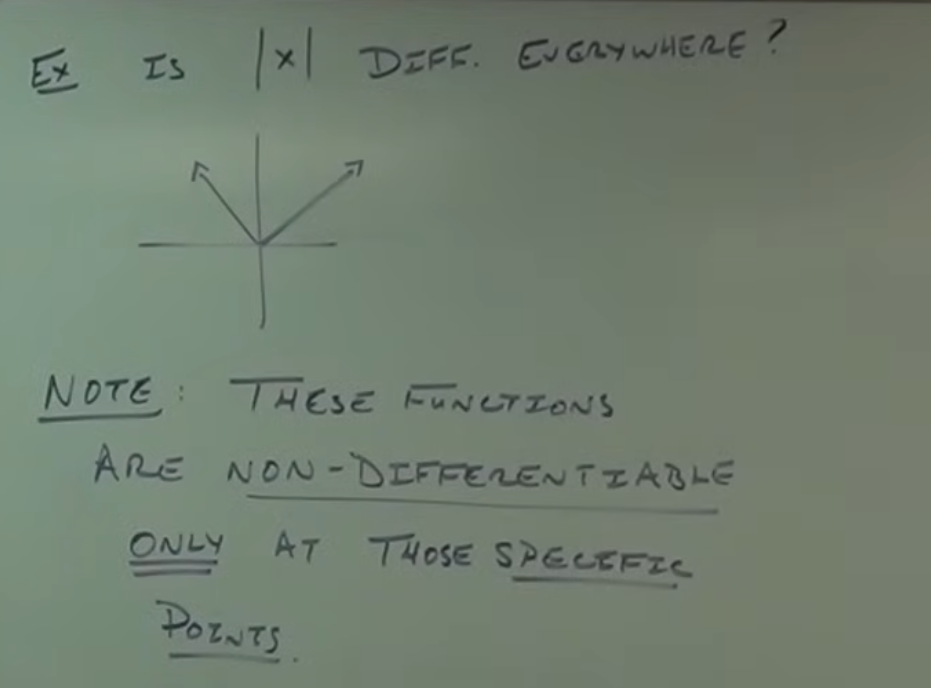
- It is observed that the function has a sharp point at $x=0$.
- It is explained that the function is not differentiable at $x=0$ because the slopes of the one-sided limits are different ($-1$ and $1$).
- It is clarified that the function is differentiable at all other points.
- 1:07:47.Relationship between continuity and differentiability
– [📷image]
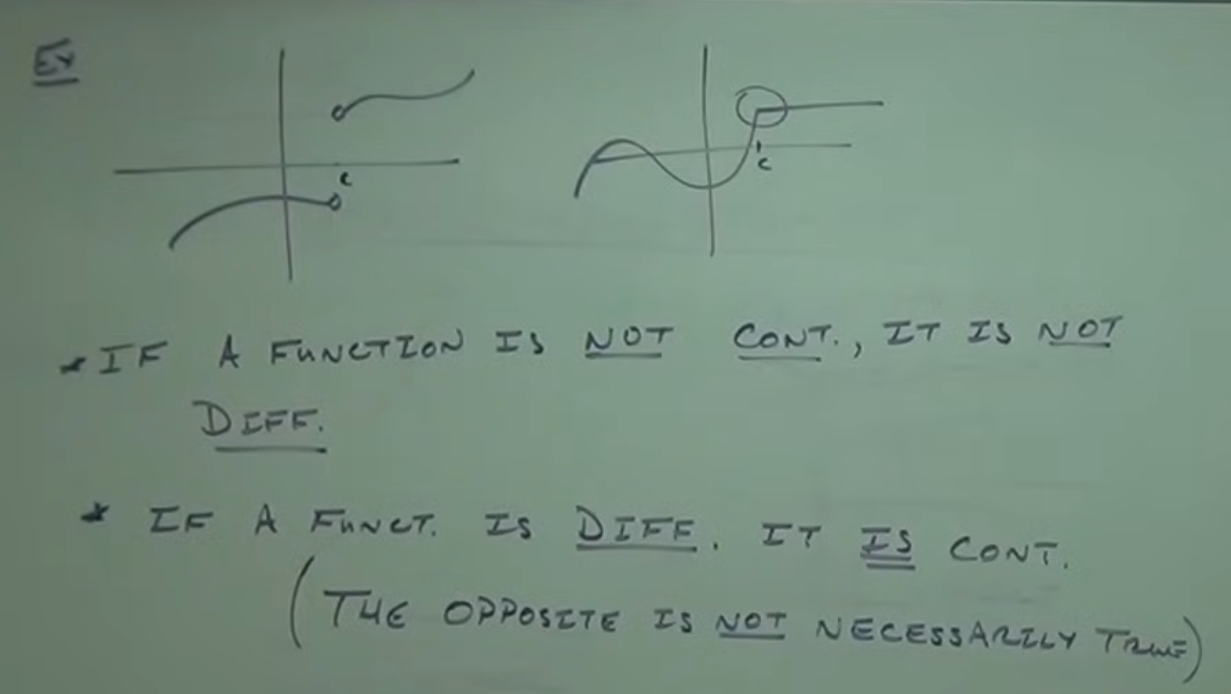
- A graph is used to illustrate a function discontinuous at a point.
- It is concluded that ɪꜰ ᴀ ꜰᴜɴᴄᴛɪᴏɴ ɪꜱ ɴᴏᴛ ᴄᴏɴᴛɪɴɪᴜᴏᴜꜱ ᴀᴛ ᴀ ᴩᴏɪɴᴛ, ɪᴛ ɪꜱ ɴᴏᴛ
ᴅɪꜰꜰᴇʀᴇɴᴛɪᴀʙʟᴇ ᴀᴛ ᴛʜᴀᴛ ᴩᴏɪɴᴛ.
- $\displaystyle \lim_{x\to a}𝒇(𝒙)\neq 𝒇(a)\;\Rightarrow\;𝒇'(a)$ does not exist
- It is concluded that ɪꜰ ᴀ ꜰᴜɴᴄᴛɪᴏɴ ɪꜱ ɴᴏᴛ ᴄᴏɴᴛɪɴɪᴜᴏᴜꜱ ᴀᴛ ᴀ ᴩᴏɪɴᴛ, ɪᴛ ɪꜱ ɴᴏᴛ
ᴅɪꜰꜰᴇʀᴇɴᴛɪᴀʙʟᴇ ᴀᴛ ᴛʜᴀᴛ ᴩᴏɪɴᴛ.
- 1:09:00. A graph is used to illustrate a function continuous at a point but not
differentiable at that point (a sharp point).
- It is concluded that ᴄᴏɴᴛɪɴᴜɪᴛy ᴅᴏᴇꜱ ɴᴏᴛ ɪᴍᴩʟy ᴅɪꜰꜰᴇʀᴇɴᴛɪᴀʙɪʟɪᴛy.
- $\displaystyle \lim_{x\to a}𝒇(𝒙)=\;𝒇(a)\;\nRightarrow\;𝒇'(a)$
- It is established that ᴅɪꜰꜣᴇʀᴇɴᴛɪᴀʙɪʟɪᴛy ɪᴍᴩʟɪᴇꜱ ᴄᴏɴᴛɪɴᴜɪᴛy.
- $𝒇'(a)$ exist $\Rightarrow$ $\displaystyle \lim_{x\to a}𝒇(𝒙)=𝒇(a)$
- It is reiterated that differentiability is a stronger condition than continuity.
- Differentiability ⇒ Continuity
- Continuity ⇏ Differentiability
- It is concluded that ᴄᴏɴᴛɪɴᴜɪᴛy ᴅᴏᴇꜱ ɴᴏᴛ ɪᴍᴩʟy ᴅɪꜰꜰᴇʀᴇɴᴛɪᴀʙɪʟɪᴛy.
- A graph is used to illustrate a function discontinuous at a point.
- 1:11:28. The different notations for the derivative are reviewed.
– [📷image]
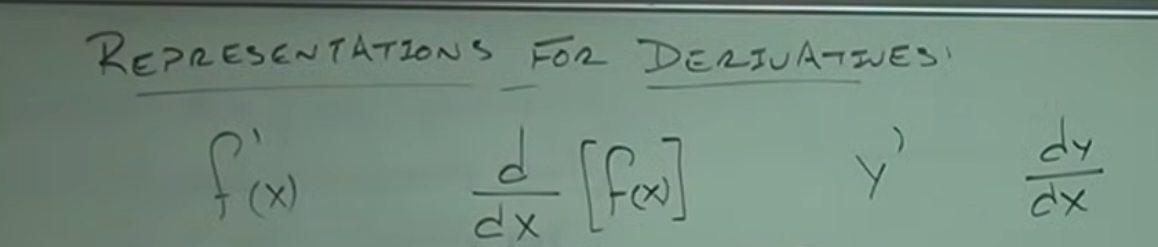
- Prime notation: $𝒇'(𝒙)$
- Leibniz notation: $\dfrac{d}{dx}\big[𝒇(𝒙)\big]$
- Prime notation for functions with variable $𝒚$: $𝒚'$
- Leibniz notation for functions with variable $𝒚$: $\dfrac{d𝒚}{d𝒙}$
- 1:13:24. It is explained how to evaluate derivatives at specific points.
– [📷image]
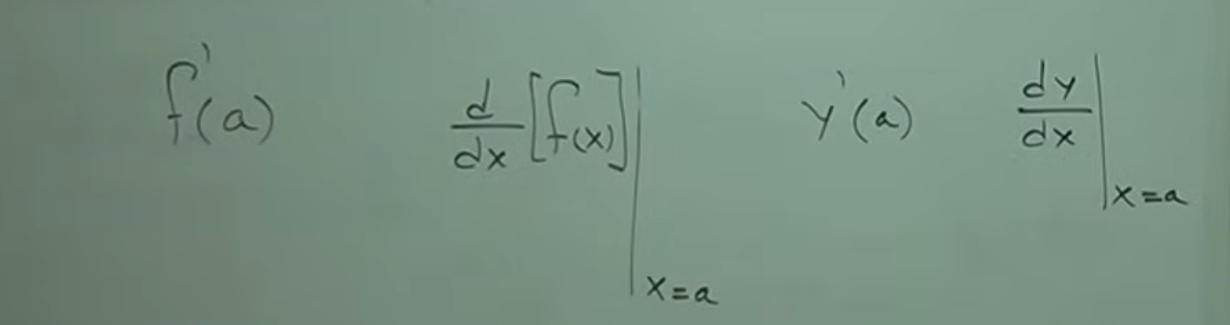
- Notation to evaluate the derivative of $𝒇$ at point $a$: $𝒇'(𝑎)$
- Alternative notation to evaluate the derivative of $𝒇$ at point $a$: $\left.\dfrac{d}{d𝒙}\big[𝒇(𝒙)\big]\right|_{𝒙=𝑎}$
- Notation to evaluate the derivative of $𝒚$ at point $a$: $𝒚'(𝑎)$
- Alternative notation to evaluate the derivative of $𝒚$ at point $a$: $\left.\dfrac{d𝒚}{d𝒙}\right|_{𝒙=𝑎}$