Calculus 1 lecture 2.2
Techniques Of Differentiation (finding derivatives of functions easily)
I ntroduction.
- 0:21.
Derivative of a Constant. Exploring the slope of a horizontal line
– [📷image]
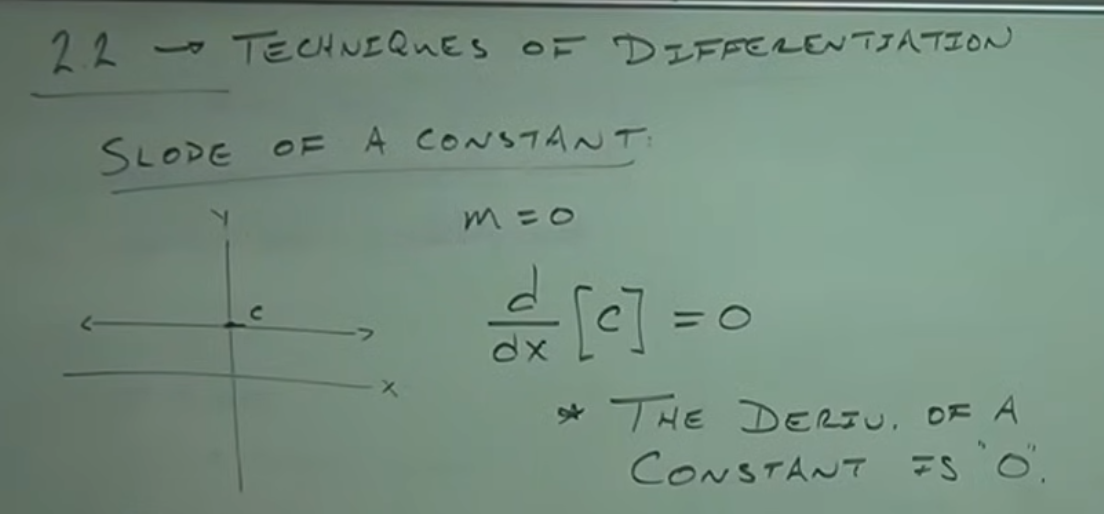
- Graph of a constant: Horizontal or vertical? 🧩 Example – : $𝒚=c$.
- The slope of a constant line is zero.
- 1:27. Meaning
of "derivative": Represents the slope of a curve.
- The derivative as the slope of a function.
- Generalization: the derivative of any constant is zero.
- The relationship between the slope of a horizontal line and the derivative of a constant
is the same $=0$.
- 2:44. In
summary: The derivative of a constant is zero.
- Basic 🧩 Examples –:
– [📷image]

- Derivative of $3$.
- Derivative of $-1$.
- Derivative of $\pi$.
Formula for finding a derivativ.
- 4:10. Using
limits to find derivatives when there is a variable.
- $\dfrac{d}{d𝑥}[𝒇(𝒙)]=\displaystyle \lim_{h\to 0}\dfrac{𝒇(𝒙+h)-𝒇(𝒙)}{h}$
- 4:53. 🧩
Example – : Find the derivative of $𝒇(𝒙)=𝒙^{3}$.
– [📷image]
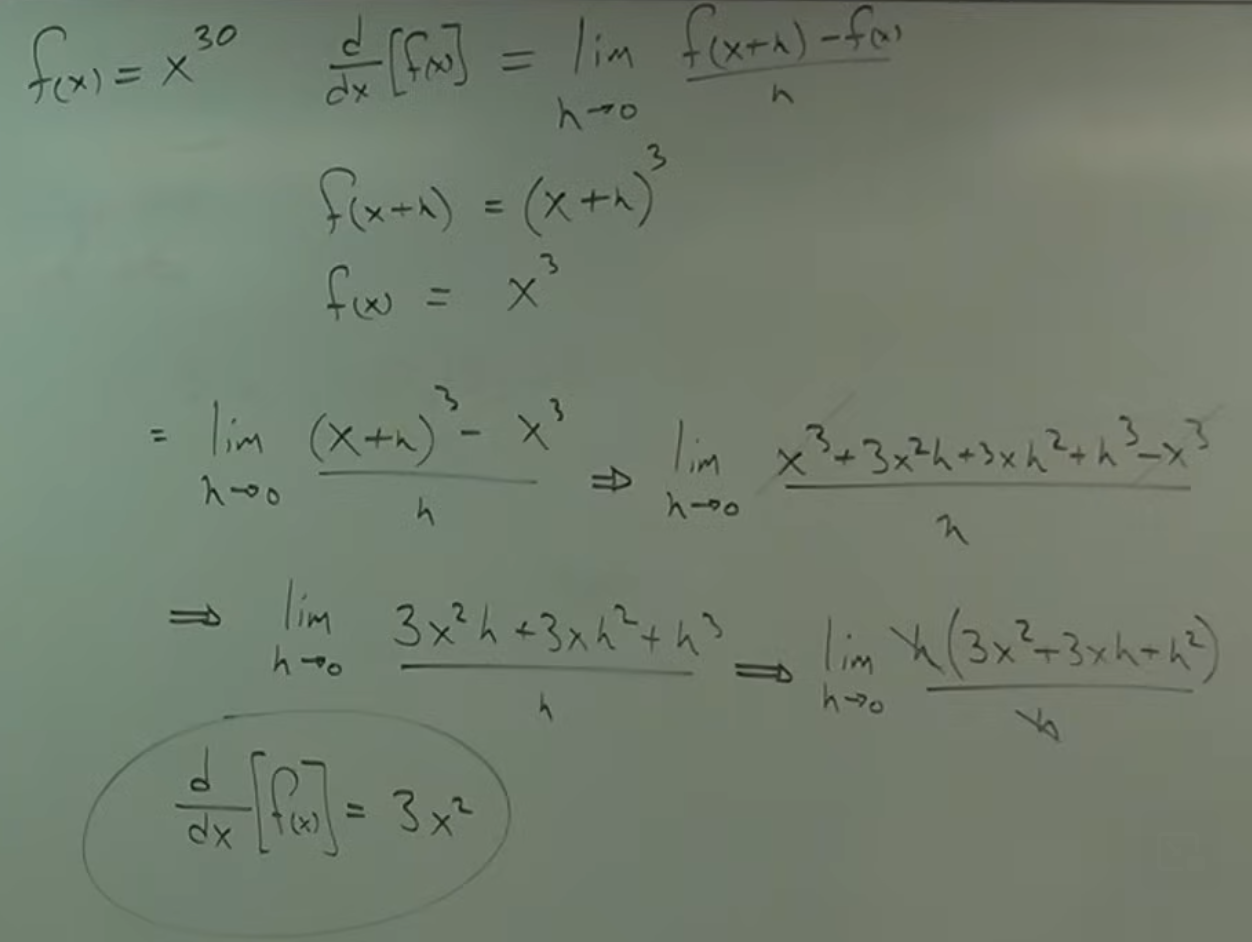
- Formula for the derivative:
- $𝒇'(𝒙)=\displaystyle \lim_{h\to 0}\dfrac{𝒇(𝒙+h)-𝒇(𝒙)}{h}$
- Step 1: Define the functions:
- $𝒇(𝒙+h)=(𝒙+h)^{3}$
- $𝒇(𝒙)=𝒙^{3}$
- Step 2: Substitution into the formula:
- $𝒇'(𝒙)=\displaystyle \lim_{h\to 0}\dfrac{(𝒙+h)^{3}-𝒙^{3}}{h}$
- Step 3: Expand the cube:
- $(𝒙+h)^{3}=𝒙^{3}+3𝒙^{2}h+3𝒙h^{2}+h^{3}$
- Step 4: Substitution of the expanded expression:
- $𝒇'(𝒙)=\displaystyle \lim_{h\to
0}\dfrac{(𝒙^{3}+3𝒙^{2}h+3𝒙h^{2}+h^{3})-𝒙^{3}}{h}$
- Step 5: Simplify the expression:
- $𝒇'(𝒙)=\displaystyle \lim_{h\to 0}\dfrac{3𝒙^{2}h+3𝒙h^{2}+h^{3}}{h}$
- Step 6: Factor out $h$:
- $𝒇'(𝒙)=\displaystyle \lim_{h\to 0}\dfrac{h\big(3𝒙^{2}+3𝒙h+h^{2}\big)}{h}$
- Step 7: Cancel $h$:
- $𝒇'(𝒙)=\displaystyle \lim_{h\to 0}\big(3𝒙^{2}+3𝒙h+h^{2}\big)$
- Step 8: Apply the limit as $h\to 0$:
- Final answer:
- The derivative of $𝒇(𝒙)=𝒙^{3}$ is $𝒇'(𝒙)=3𝒙^{2}$.
- 7:51. The
expression $3𝒙^{2}$ gives the slope of the curve $𝒙^{3}$ at any point.
P ower rule for derivatives
- 8:35. Looking
for an easier method to find the derivative.
- Observing the pattern in the derivative of $𝒙^{3}$.
- Introduction to the power rule for derivatives: a shorthand method.
- 11:58.
ᴩᴏᴡᴇʀ ʀᴜʟᴇ ꜰᴏʀ ᴅᴇʀɪᴠᴀᴛɪᴠᴇꜱ:
– [📷image]
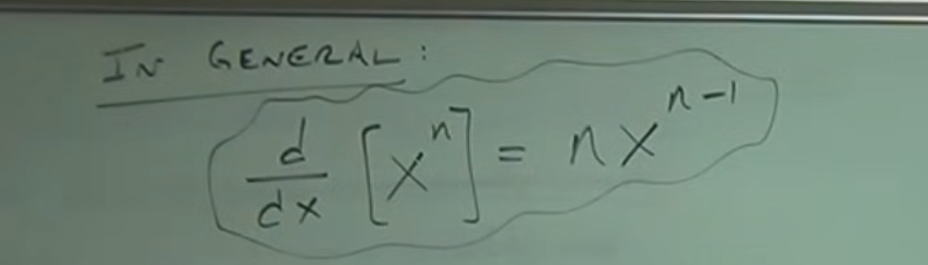
- $\dfrac{d}{d𝑥}[𝒙^{n}]=n\cdot 𝒙^{\,n-1}$, where $n$ is an integer (for now).
- 13:14. 🧩
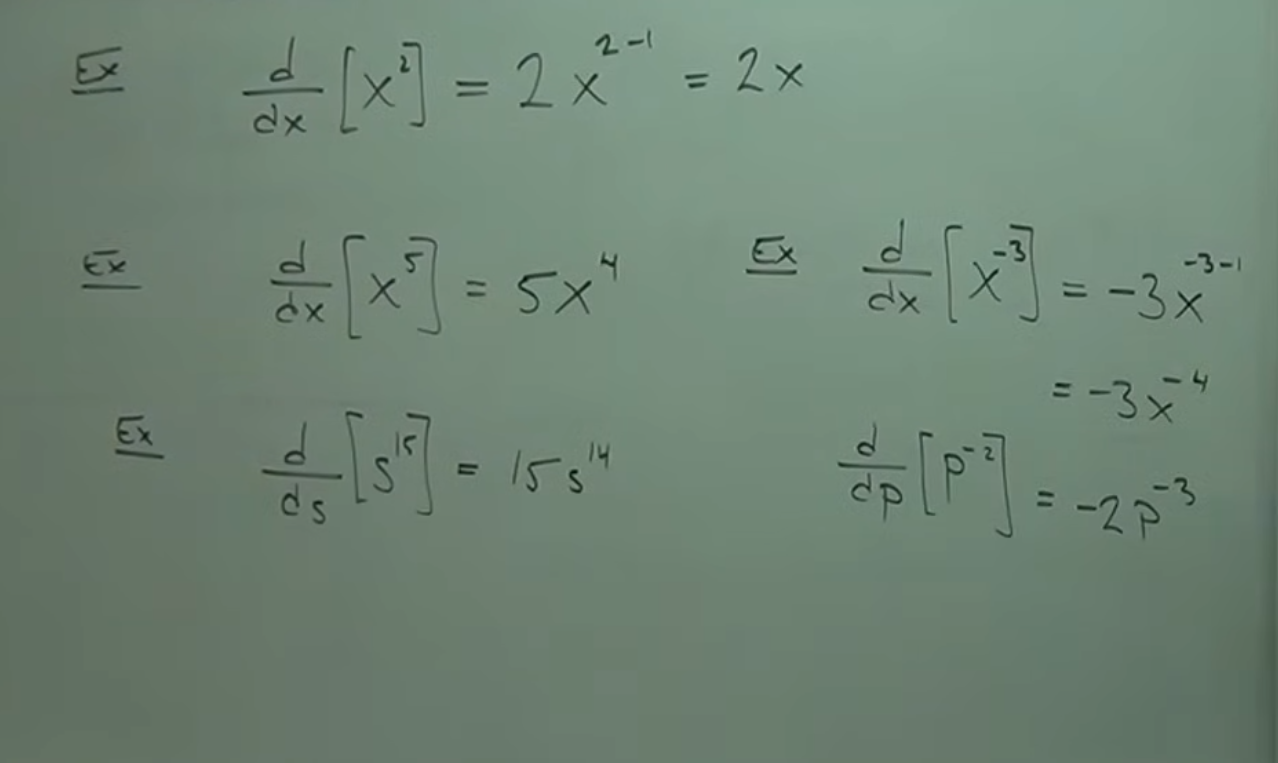
Examples – of the Power Rule:
– [📷image-1]
 – [📷image-2]
- $\dfrac{d}{d𝑥}[𝑥^{2}]=2𝑥$.
- $\dfrac{d}{d𝑥}[𝑥^{5}]=5𝒙^{4}$.
- $\dfrac{d}{d𝒔}[𝒔^{15}]=15𝒔^{14}$.
- Adaptation of notation according to the variable.
- 16:21.
Derivatives with Negative Exponents
- $\dfrac{d}{d𝑥}[𝒙^{-3}]=-3𝒙^{-4}$
- $\dfrac{d}{d𝒑}[𝒑^{-2}]=-2𝒑^{-3}$
- $\dfrac{d}{d𝒑}\big[-2𝒑^{-5}\big]=10𝒑^{-6}=\dfrac{10}{𝒑^{6}}$
- General rule: Rewrite the derivative with positive exponents
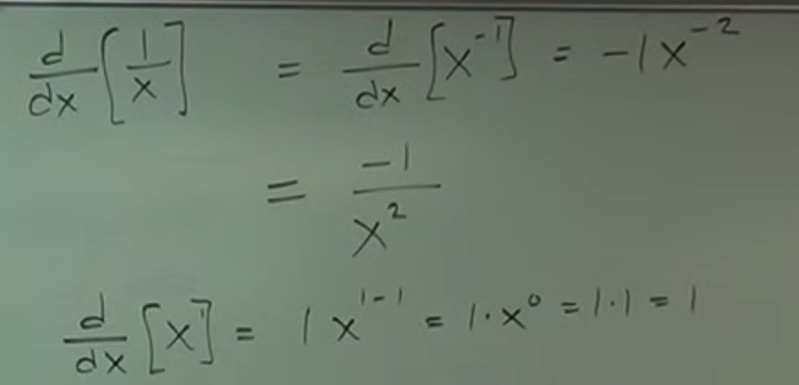
- $\dfrac{d}{d𝑥}\Big[\dfrac{1}{𝒙}\Big]=-\dfrac{1}{𝒙^{2}}$
- $\dfrac{d}{d𝑥}[𝒙]=1\cdot 𝒙^{0}=1$
D erivatives with constant multiplicative factors
- 20:25.
ʀᴜʟᴇ ꜰᴏʀ ᴅᴇʀɪᴠᴀᴛɪᴠᴇꜱ ᴡɪᴛʜ ᴄᴏɴꜱᴛᴀɴᴛ ᴍᴜʟᴛɪᴩʟɪᴄᴀᴛɪᴠᴇ ꜰᴀᴄᴛᴏʀꜱ:
– [📷image]
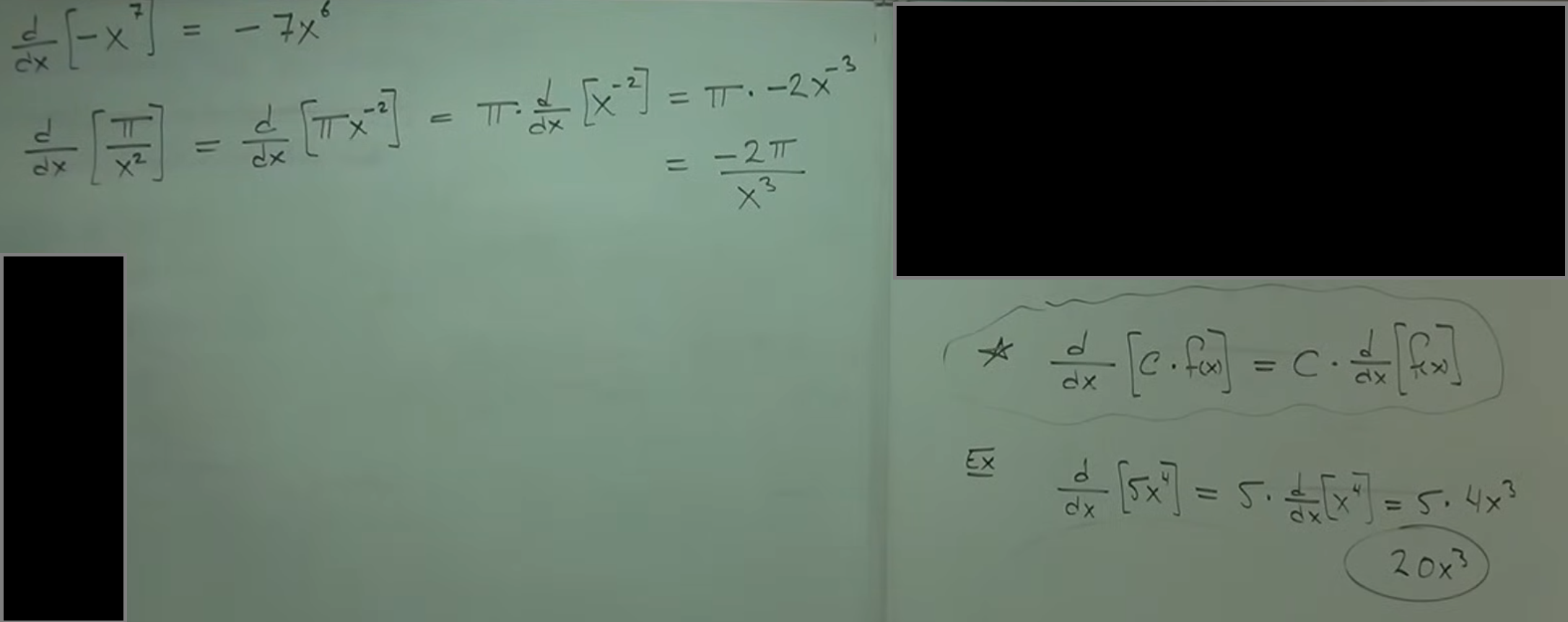
- $\dfrac{d}{d𝑥}[𝖼\cdot 𝒇(𝒙)]=𝖼\cdot \dfrac{d}{d𝑥}[𝒇(𝒙)]$, where $𝖼$ is a constant.
- 22:00. 🧩
Example – : $\dfrac{d}{d𝑥}[5𝒙^{4}]=5\cdot \dfrac{d}{d𝑥}[𝒙^{4}]=20𝒙^{3}$.
- 23:13. 🧩
Example – : $\dfrac{d}{d𝑥}[-𝒙^{7}]=-1\cdot \dfrac{d}{d𝑥}[𝒙^{7}]=-7𝑥^{6}$.
- 24:06. 🧩
Example – : $\dfrac{d}{d𝑥}\Big[\dfrac{\pi}{𝒙^{2}}\Big]$.
- Rewrite the expression to apply the power rule: $\dfrac{d}{d𝑥}\big[\pi\cdot
𝒙^{-2}\big]$.
- Apply the constant multiplicative rule: $\pi\cdot \dfrac{d}{d𝑥}[𝒙^{-2}]=-2\pi 𝒙^{-3}$.
- Rewrite with positive exponents: $-\dfrac{2\pi}{𝒙^{3}}$.
D erivatives of sums and differences
- 27:25.
ʀᴜʟᴇ ꜰᴏʀ ᴅᴇʀɪᴠᴀᴛɪᴠᴇꜱ ᴏꜰ ꜱᴜᴍꜱ ᴀɴᴅ ᴅɪꜰꜰᴇʀᴇɴᴄᴇꜱ:
– [📷image]
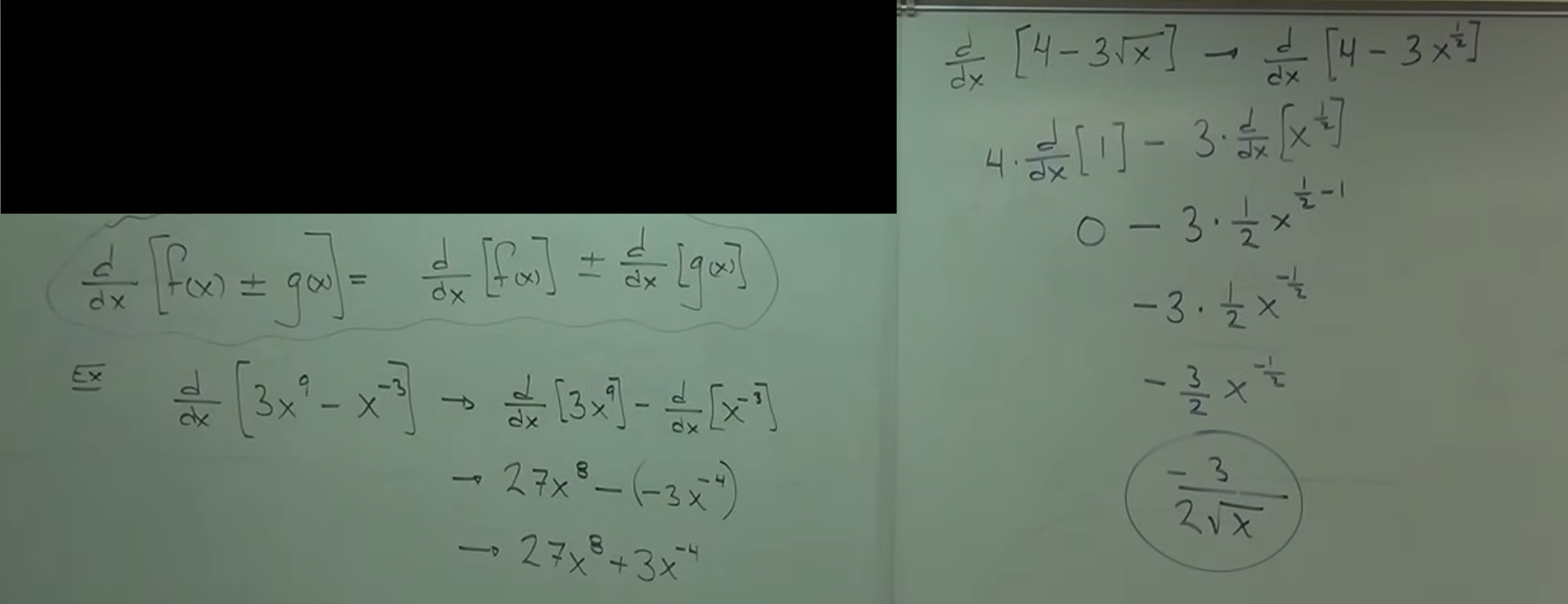
- $\dfrac{d}{d𝑥}\big[𝒇(𝒙)\pm 𝓰(𝑥)\big]=\dfrac{d}{d𝑥}[𝒇(𝒙)]\pm
\dfrac{d}{d𝑥}[𝓰(𝑥)]$.
- 28:40. 🧩
Example – : $\dfrac{d}{d𝑥}\big[3𝒙^{9}-𝒙^{-3}\big]$.
- Separate the derivative into two terms: $\dfrac{d}{d𝑥}[3𝑥^{9}]-\dfrac{d}{d𝑥}[𝑥^{-3}]$.
- Apply the constant multiplicative rule: $3\cdot
\dfrac{d}{d𝑥}[𝒙^{9}]-\dfrac{d}{d𝑥}[𝑥^{-3}]$.
- Result: $27𝒙^{8}-(-3𝒙^{-4})=27𝒙^{8}+\dfrac{3}{𝒙^{4}}$.
- 36:50. 🧩
Example – : $\dfrac{d}{d𝑥}\big[5𝒙^{7}-3𝒙^{4}+2𝒙^{3}+𝒙-1\big]=35𝒙^{6}-12𝒙^{3}+6𝒙^{2}+1$.
D erivatives with fractional exponents
- 32:54. 🧩
Example – : $\dfrac{d}{d𝑥}\big[4-3\sqrt{𝒙}\big]$.
– [📷image]
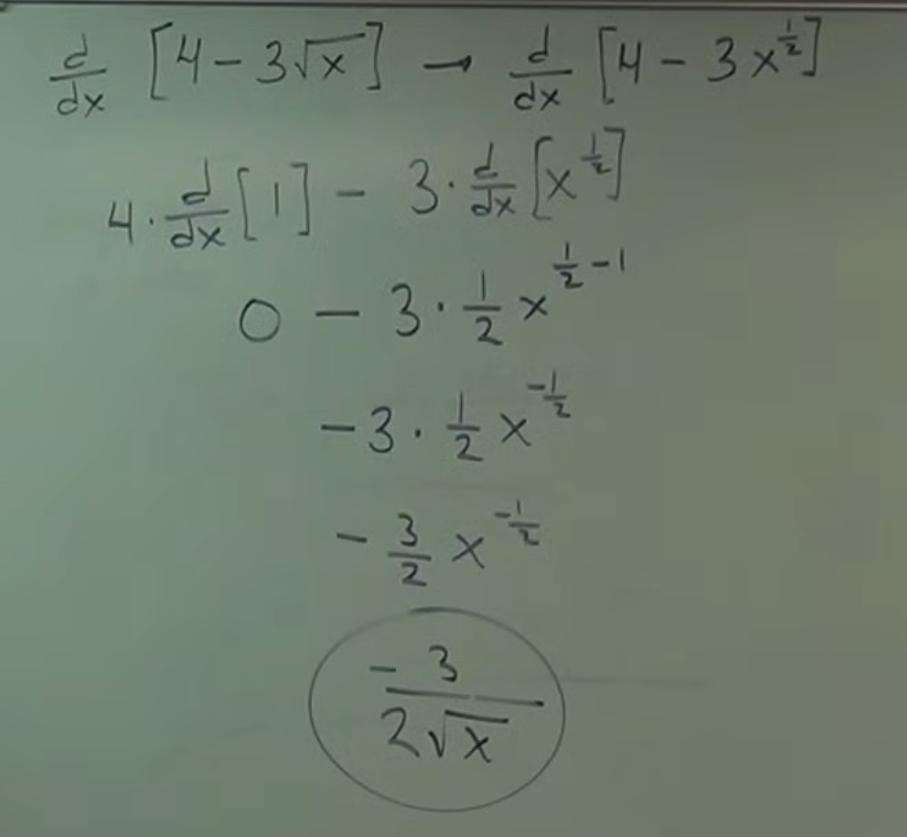
- Rewrite the root as a fractional exponent:
$\dfrac{d}{d𝑥}[4]-\dfrac{d}{d𝑥}\big[3𝒙^{1/2}\big]$.
- Apply the power rule: $0-\dfrac{3}{2}𝒙^{-1/2}$.
H orizontal tangent lines
- 40:10.
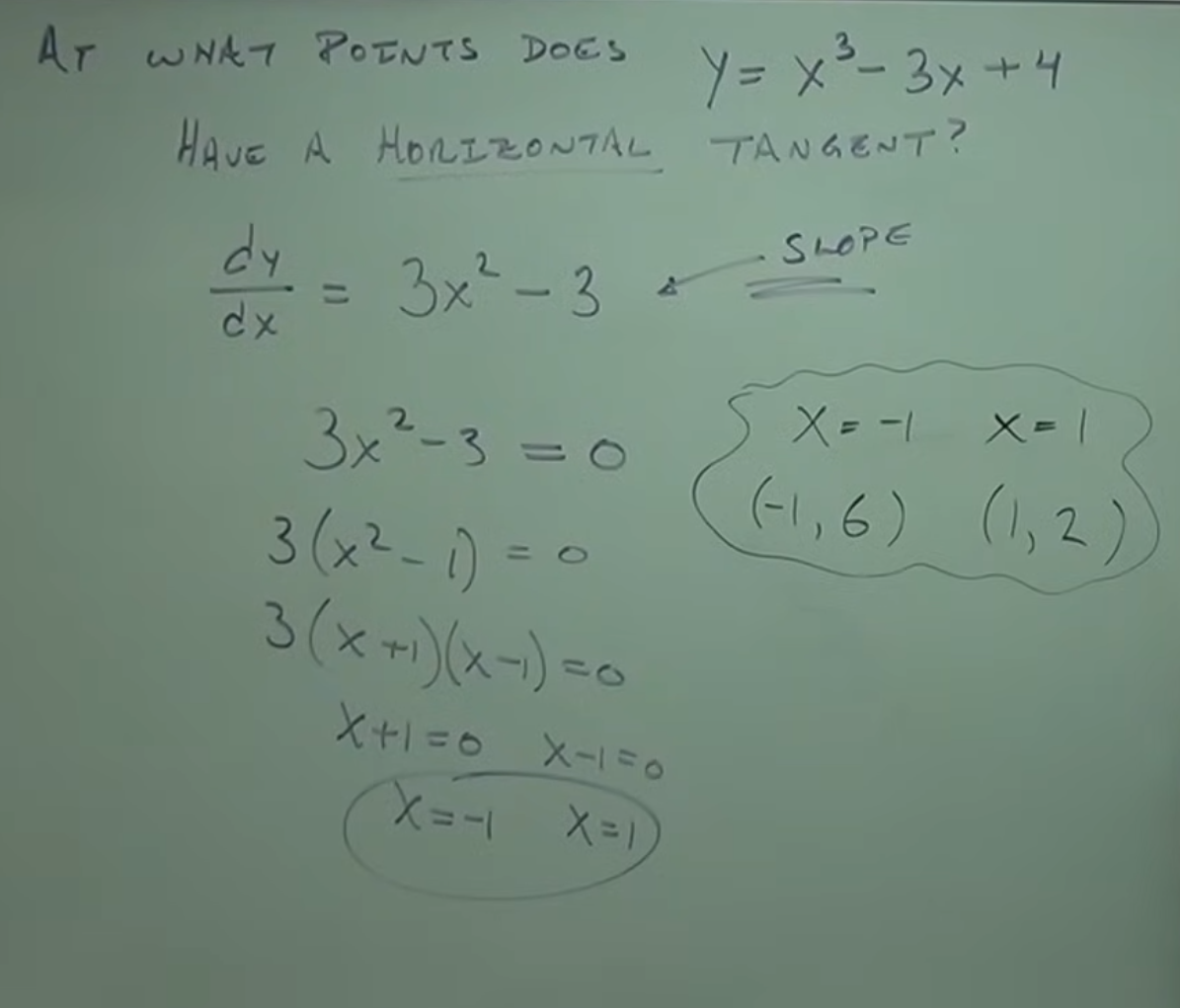
Application of derivatives: finding points where a function has horizontal tangent lines.
– [📷image]
- 41:00.
Horizontal tangent lines have a slope of zero.
- 42:00. To
find points with horizontal tangent lines:
- Find the derivative of the function.
- Set the derivative equal to zero.
- Solve for $𝒙$.
- 43:00. 🧩
Example – : Find the points where $𝒚=𝒙^{3}-3𝒙+4$ has horizontal tangent lines.
- Find the derivative: $\dfrac{d𝒚}{d𝑥}=3𝒙²-3$.
- 44:25. When a curve’s slope is zero at a point, it signifies a critical point that
may be a local or global
maximum or minimum. Identifying these points is crucial for optimization and analyzing the behavior of
functions in various fiel𝒅𝒔.:
- Local extrema (maximum or minimum) are the highest or lowest points within a
nearby region.
- Global extrema (maximum or minimum) are the absolute highest or lowest points
across the entire domain.
- Set the derivative to zero: $3𝒙²-3=0$.
- Solve for $𝒙$: $𝒙=1$; $𝒙=-1$
- Find the corresponding points on the original function: $(-1,\;6)\text{ and }(1,\;2)$.
H igher-order derivatives
- 47:31.
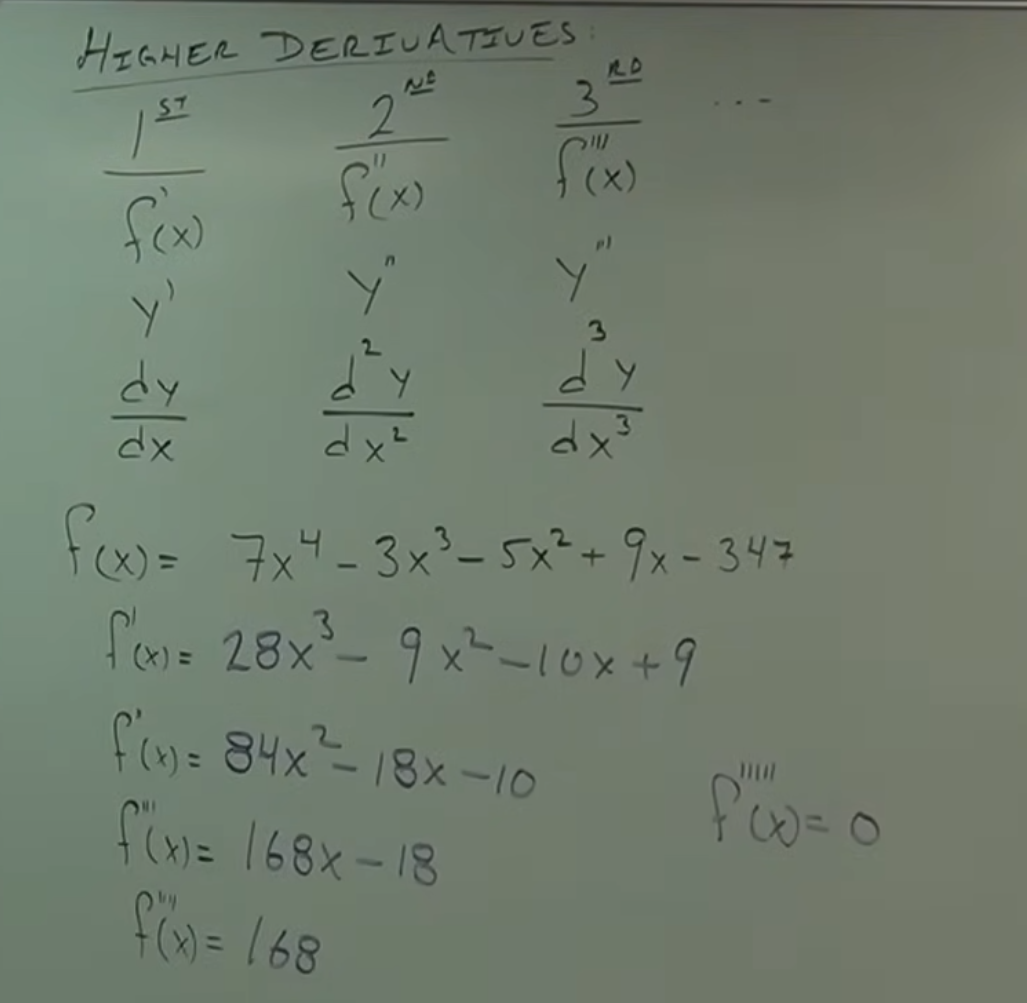
Introduction to higher-order derivatives.
– [📷image]
- 48:12.
Notation for higher-order derivatives:
- $f''(𝒙)$ for the second derivative.
- $f'''(𝒙)$ for the third derivative, and so on.
- $\dfrac{d^{2}𝒚}{d𝑥^{2}}$ for the second derivative of $𝒚$ with respect to $𝑥$.
- $\dfrac{d^{3}𝒚}{d𝑥^{3}}$ for the third derivative of $𝒚$ with respect to $𝑥$, and so
on.
- 52:00.
Finding all higher-order derivatives of $7𝒙^{4}-3𝒙^{3}-5𝒙^{2}+9𝒙-347$.
- First derivative: $28𝒙^{3}-9𝒙^{2}-10𝒙+9$.
- Second derivative: $84𝒙^{2}-18𝒙-10$.
- Third derivative: $168𝒙-18$.
- Fourth derivative: $168$.
- Fifth derivative: $0$.
- Sixth derivative and all subsequent derivatives: $0$.
- 56:36. In
polynomials, higher-order derivatives eventually become zero.
Derivatives of complex quotients
- 58:45. 🧩
Example – : $\dfrac{d}{d𝑥}\Big[\dfrac{𝒙^{5}-2𝒙-3}{3\sqrt{𝒙}}\Big]$.
– [📷image]
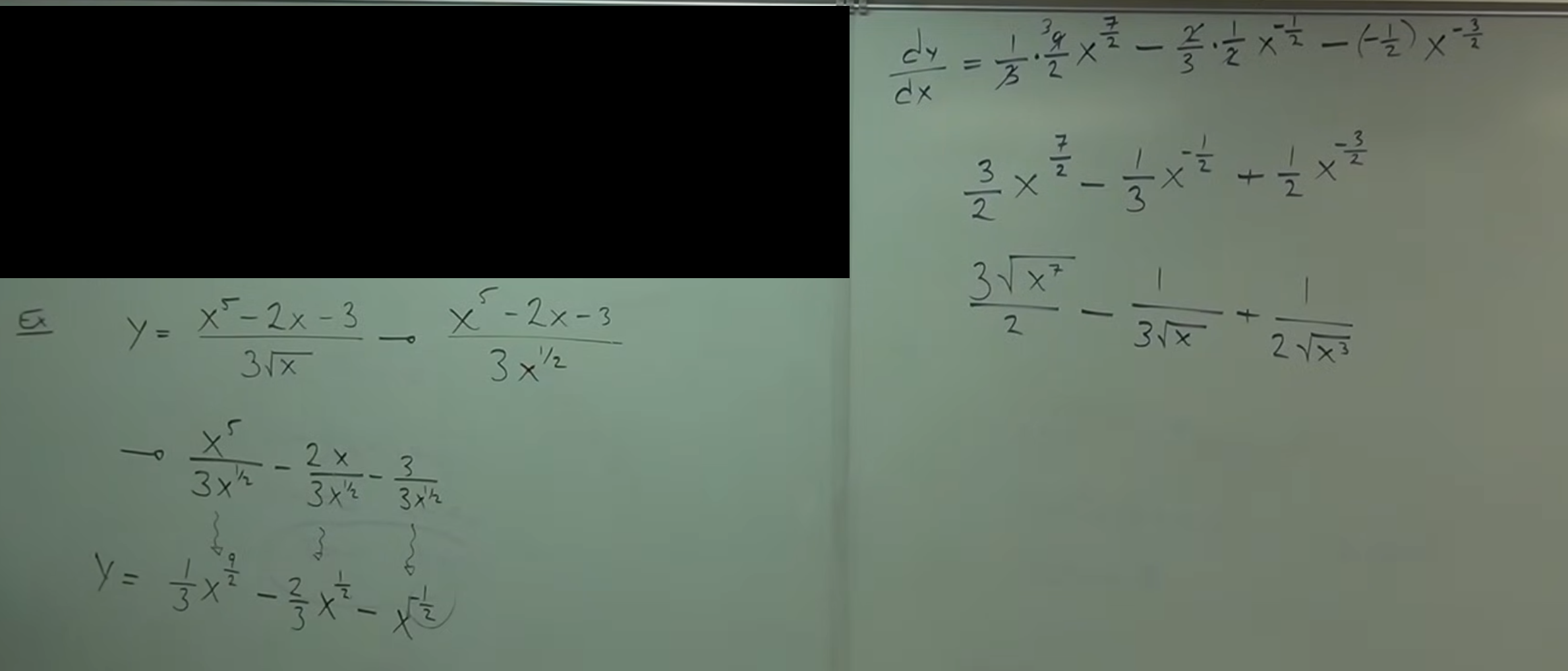
- Simplify the expression: $\dfrac{𝒙^{5}-2𝒙-3}{3𝒙^{1/2}}$.
- Cannot take the derivative of each term of the quotient separately.
- Separate the fraction into three terms:
$\dfrac{𝒙^{5}}{3𝒙^{1/2}}-\dfrac{2𝒙}{3𝒙^{1/2}}-\dfrac{3}{3𝒙^{1/2}}$.
- 1:02:35.
Simplify each term using exponent properties.
- $\dfrac{𝒙^{5}}{3𝒙^{1/2}}=\dfrac{1}{3}𝒙^{9/2}$
- $\dfrac{2𝒙}{3𝒙^{1/2}}=\dfrac{2}{3}𝒙^{1/2}$
- $\dfrac{3}{3𝒙^{1/2}}=𝒙^{-1/2}$
- 1:06:48.
Take the derivative of each term separately.
- Result: $\dfrac{3}{2}𝒙^{7/2}-\dfrac{1}{3}𝒙^{-1/2}+\dfrac{1}{2}𝒙^{-3/2}$
- 1:10:48.
Rewrite the derivative with roots:
$\dfrac{3}{2}\sqrt{𝒙^{7}}-\dfrac{1}{3\sqrt{𝒙}}+\dfrac{1}{2\sqrt{𝒙^{3}}}$.