Calculus 1 lecture 2.3
The Product and Quotient Rules For Derivatives Of Functions
I ntroduction.
- 0:00. Introduction to the lesson on the product rule and the quotient rule for
derivatives.
- 0:19. Brief review of the lesson topics: product rule and quotient rule.
Product rule
- 0:41. Presentation of the scenario: Is it possible to derive the product of two functions?
- 0:52. 🧩 Example – with basic functions: $𝒇(𝒙)=𝒙^{2}$ and $𝓰(𝒙)=𝒙^{3}$. 📷
– [📷image]
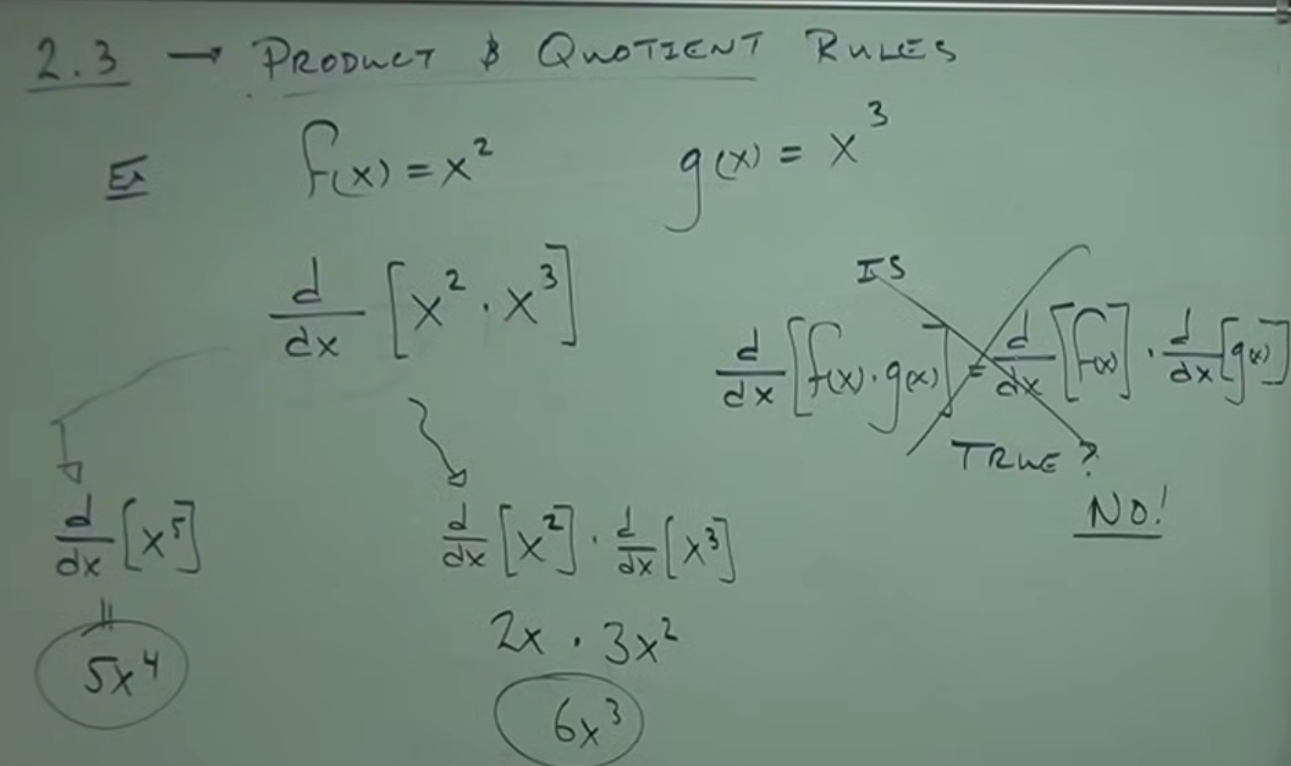
- Posing the main question: Is $\dfrac{d}{dx}\big[𝒇(𝒙)\cdot
𝓰(𝒙)\big]=\dfrac{d}{dx}\big[𝒇(𝒙)\big]\cdot \dfrac{d}{dx}\big[𝓰(𝒙)\big]$?
- 1:47. Analysis of the question through the given Example.
- It is observed that $𝒇(𝒙)\cdot 𝓰(𝒙)=𝒙^{5}$.
- Calculating $\dfrac{d}{dx}\big(𝒙^{5}\big)=5𝒙^{4}$.
- Calculating separately $\dfrac{d}{dx}\big[𝒇(𝒙)\big]\cdot
\dfrac{d}{dx}\big[𝓰(𝒙)\big]$.
- A different answer is obtained: $6𝒙^{3}$.
- Conclusion: Derivatives cannot be separated by multiplication.
- 4:48. Need for a rule to derive products of functions.
- 5:00. Introduction to the concept of the product rule.
- 5:21. Explanation of the product rule.
- 6:05. Interpretation in words of the product rule.
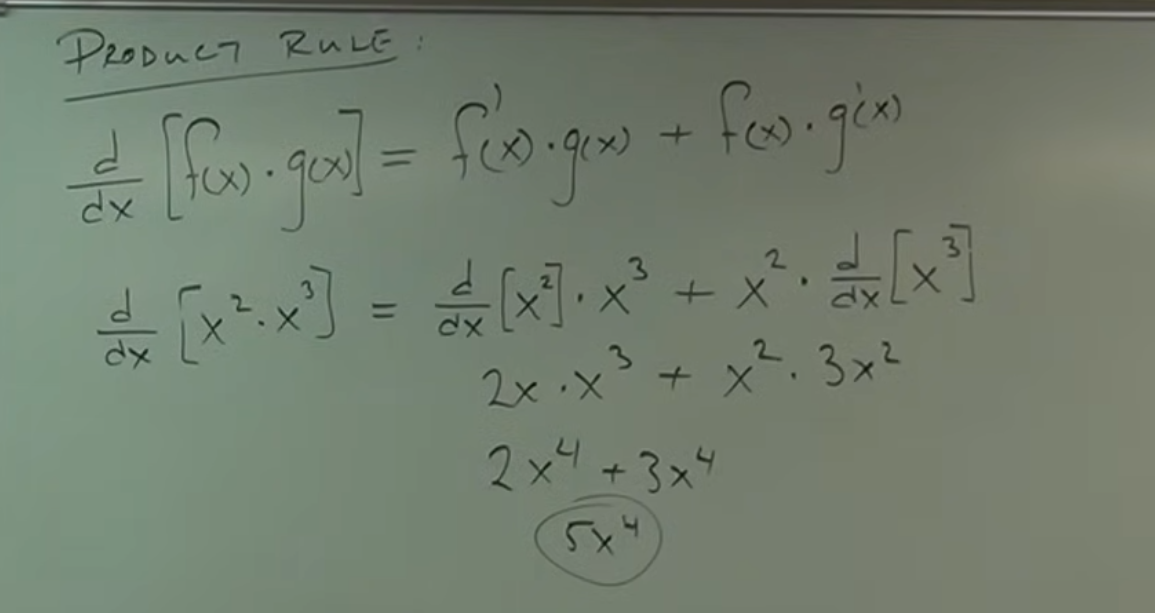
- Formula of the product rule:
- $\dfrac{d}{dx}\big[𝒇(𝒙)\cdot 𝓰(𝒙)\big]=\dfrac{d}{dx}\big[𝒇(𝒙)\big]\cdot
𝓰(𝒙)+𝒇(𝒙)\cdot \dfrac{d}{dx}\big[𝓰(𝒙)\big]$.
- 7:13. Verification of the product rule using the initial Example. 📷
– [📷image]
- Emphasis on the importance of the notation $\dfrac{d}{dx}$ to indicate the function to be
derived.
- $\dfrac{d}{dx}\big[𝒇(𝒙)\cdot 𝓰(𝒙)\big]=𝒇'(𝒙)\cdot 𝓰(𝒙)+𝒇(𝒙)\cdot 𝓰'(𝒙)$
- $\dfrac{d}{dx}\big[𝒙^{2}\cdot 𝒙^{3}\big]=\dfrac{d}{dx}\big[𝒙^{2}\big]\cdot
𝒙^{3}+𝒙^{2}\cdot \dfrac{d}{dx}\big[𝒙^{3}\big]$
- $2𝒙\cdot 𝒙^{3}+𝒙^{2}\cdot 3𝒙^{2}$
- $2𝒙^{4}+3𝒙^{4}=5𝒙^{4}$
- Mention of the need for a formal proof to generalize the rule.
Preliminary considerations for the product rule: evaluating distribution.
-
10:34.
Presentation of an example where distribution is possible.
- 🧩 Example –: $(𝒙^{2}-1)\cdot(3𝒙^{4}-2𝒙)$
-
11:09. Anticipation of scenarios where distribution will n̲o̲t̲ be feasible.
-
11:23. 🧩 Example – with a high exponent, where distribution would be tedious.
- $(𝒙^{2}-1)\cdot(3𝒙^{4}-2𝒙)^{4}$
- This is why the project rule become very important
-
12:19. 🧩 Example – A Constant in the Product Rule
📷
– [📷image]
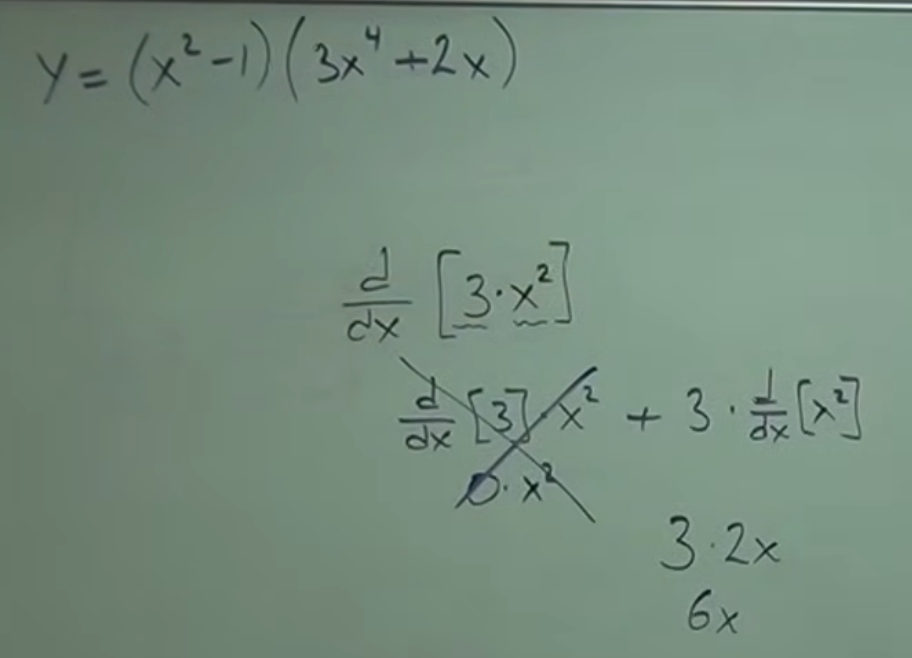
- Why is the product rule not used here? Because the constant's derivative is zero,
so it contributes nothing.
-
14:10. Two ways to solve $𝐲'$ from $𝐲=(𝒙^{2}-1)(3𝒙^{4}+2𝒙)$
📷
– [📷image]
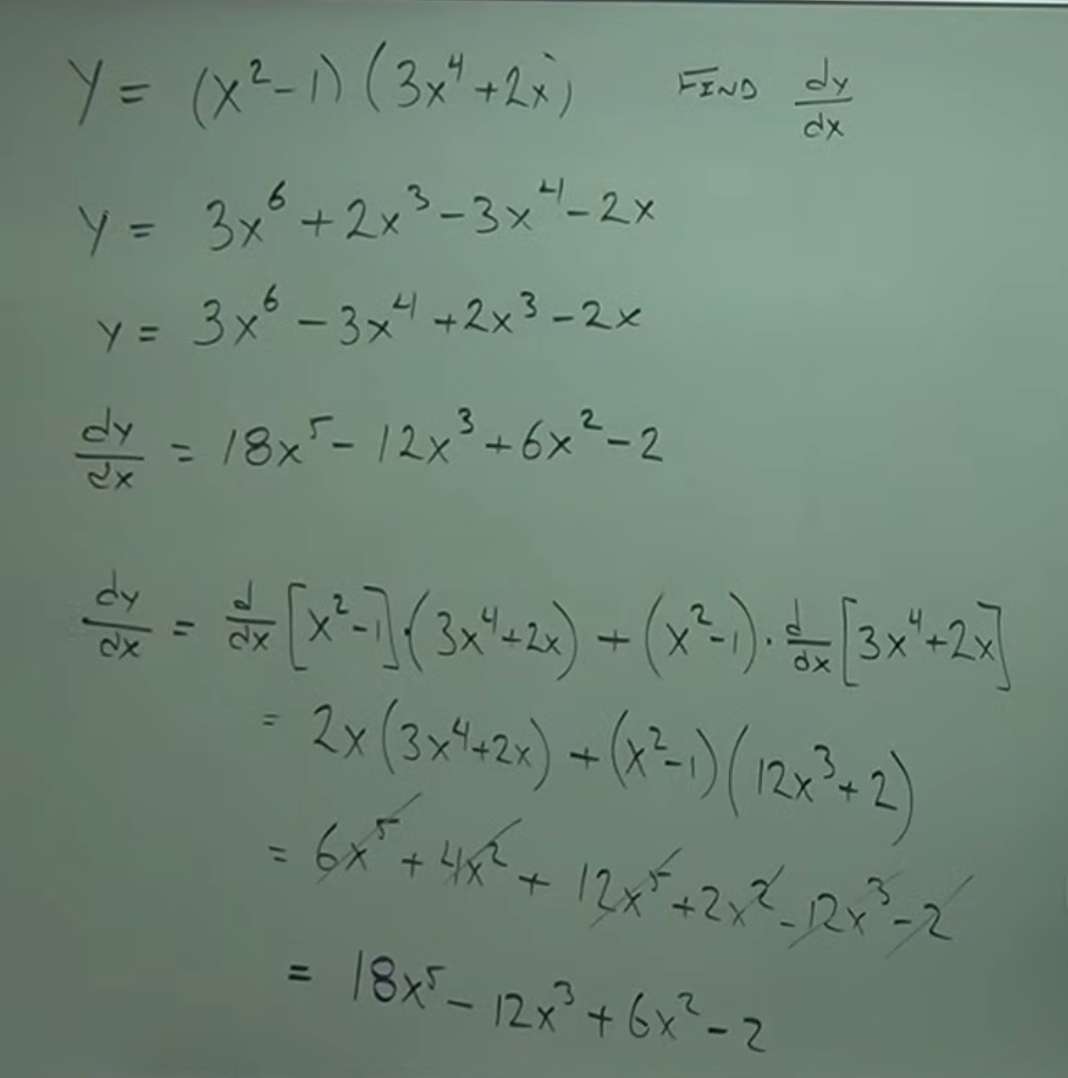
- Applying distribution
- Expand:
- $𝐲=3𝒙^{6}+2𝒙^{3}-3𝒙^{4}-2𝒙$
- $𝐲=3𝒙^{6}-3𝒙^{4}+2𝒙^{3}-2𝒙$
- Derivative (power rule):
- $\dfrac{d𝐲}{d𝒙}=18𝒙^{5}-12𝒙^{3}+6𝒙^{2}-2$
-
15:15. Applying the product rule Given:
- Product rule Setup
- Aply formula:
-
$\\dfrac{d𝐲}{d𝒙}=\\dfrac{d}{d𝒙}\big[(𝒙^{2}-1)(3𝒙^{4}+2𝒙)\big]=\\dfrac{d}{d𝒙}\big[𝒙^{2}-1\big]\cdot(3𝒙^{4}+2𝒙)+(𝒙^{2}-1)\cdot
\\dfrac{d}{d𝒙}\big[3𝒙^{4}+2𝒙\big]$
- Differentiate each part:
- $=(2𝒙)(3𝒙^{4}+2𝒙)+(𝒙^{2}-1)(12𝒙^{3}+2)$
- Expand both products:
- $=6𝒙^{5}+4𝒙^{2}+12𝒙^{5}+2𝒙^{2}-12𝒙^{3}-2$
- Combine like terms:
- $\\dfrac{d𝐲}{d𝒙}=18𝒙^{5}-12𝒙^{3}+6𝒙^{2}-2$
Application of the product rule
- 19:36. You need to understand the product rule first because it's one of the fundamental
tools for differentiating expressions
where two functions are multiplied: $\big(𝒇(𝒙)\cdot 𝓰(𝒙)\big)'=𝒇'(𝒙)\cdot 𝓰(𝒙)+𝒇(𝒙)\cdot 𝓰'(𝒙)$.
Later on, you'll often encounter problems where this rule appears in combination with the chain
rule: $\big(𝒇(𝓰(𝒙))\big)'=𝒇'\big(𝓰(𝒙)\big)\cdot 𝓰'(𝒙)$
or with the quotient rule: $\big(\dfrac{𝒇(𝒙)}{𝓰(𝒙)}\big)'=\dfrac{𝒇'(𝒙)\cdot 𝓰(𝒙)-𝒇(𝒙)\cdot
𝓰'(𝒙)}{\big(𝓰(𝒙)\big)^{2}}$.
Understanding the product rule early will make it easier to handle these more complex derivative rules as they
often work together.
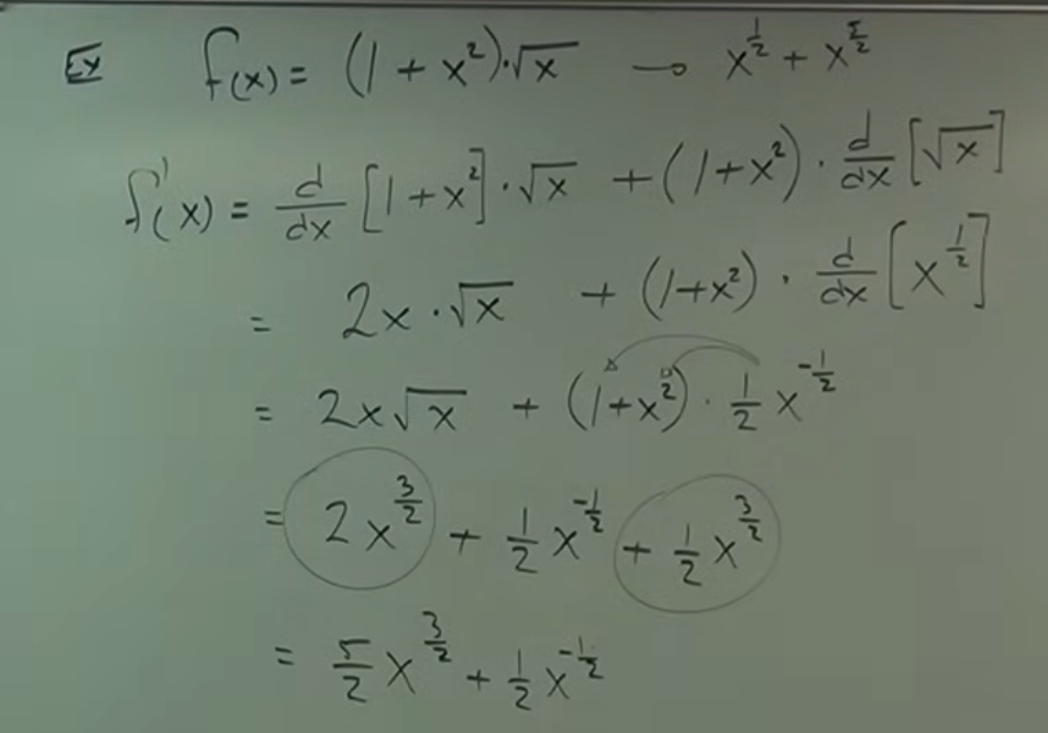
- 20:10. 🧩 Example – $(𝒙^{2}+1)\cdot \sqrt{𝒙}$ 📷
– [📷image]
- Apply the product rule:
- $𝒇'(𝒙)=\dfrac{d}{d𝒙}[1+𝒙^{2}]\cdot 𝒙^{1/2}+(1+𝒙^{2})\cdot
\dfrac{d}{d𝒙}\big[𝒙^{1/2}\big]$
- $𝒇'(𝒙)=2𝒙\cdot 𝒙^{1/2}+(1+𝒙^{2})\cdot \dfrac{1}{2}\cdot 𝒙^{-1/2}$
- Distribute:
- $𝒇'(𝒙)=2𝒙\cdot 𝒙^{1/2}+\dfrac{1}{2}\cdot 𝒙^{-1/2}+\dfrac{1}{2}\cdot
𝒙^{2}\cdot 𝒙^{-1/2}$
- $𝒇'(𝒙)=2\cdot 𝒙^{3/2}+\dfrac{1}{2}\cdot 𝒙^{-1/2}+\dfrac{1}{2}\cdot 𝒙^{3/2}$
- $𝒇'(𝒙)=\dfrac{5}{2}\cdot 𝒙^{3/2}+\dfrac{1}{2}\cdot 𝒙^{-1/2}$
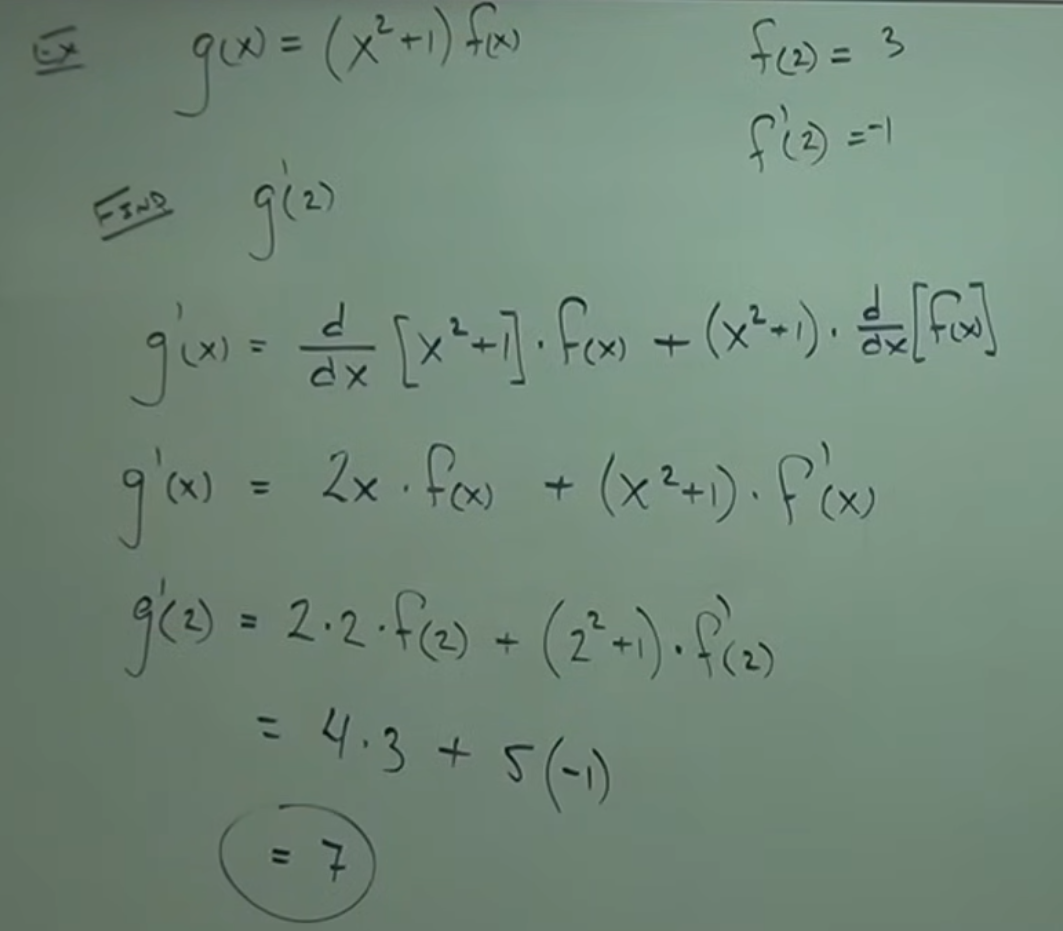
- 32:10. 🧩 Example – Find $𝓰'(2)$ ; $𝓰(𝒙)=(𝒙^{2}+1)\cdot 𝒇(𝒙)$ where $𝒇(2)=3$ and
$𝒇'(2)=1$ 📷
– [📷image]
- Apply the product rule:
- $𝓰'(𝒙)=\dfrac{d}{d𝒙}\big[(𝒙^{2}+1)\big]\cdot 𝒇(𝒙)+(𝒙^{2}+1)\cdot
\dfrac{d}{d𝒙}\big[𝒇(𝒙)\big]$
- $𝓰'(𝒙)=2𝒙\cdot 𝒇(𝒙)+(𝒙^{2}+1)\cdot 𝒇'(𝒙)$
- Substitute $𝒙=2$:
- $𝓰'(2)=2\cdot 2\cdot 𝒇(2)+(2^{2}+1)\cdot 𝒇'(2)$
- $𝓰'(2)=4\cdot 3+5\cdot(-1)$
- $𝓰'(2)=12-5=7$
Quotient rule
- 39:10. Posing the question: Is it possible to derive the quotient of two functions?
- Dismissing the possibility of deriving the numerator and the denominator separately.
- 40:00. Introduction to the quotient rule.
- 40:50. Presentation of the formula for the quotient rule. 📷
– [📷image]
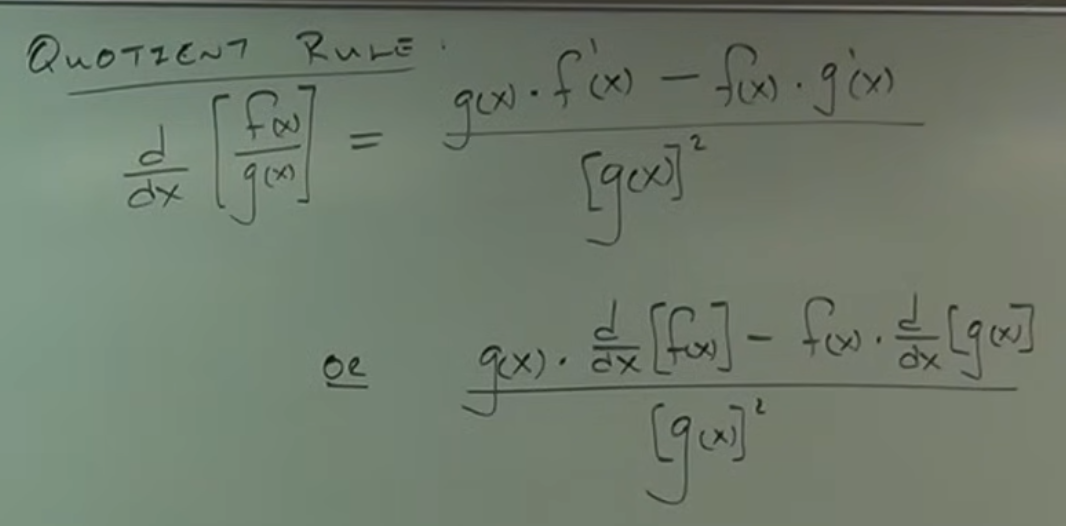
- $\dfrac{d}{d𝒙}\Big[\dfrac{𝒇(𝒙)}{𝓰(𝒙)}\Big]=\dfrac{𝓰(𝒙)\cdot 𝒇'(𝒙)-𝒇(𝒙)\cdot
𝓰'(𝒙)}{\big(𝓰(𝒙)\big)^{2}}$
- Likewise $\dfrac{d}{d𝒙}\Big[\dfrac{𝒇(𝒙)}{𝓰(𝒙)}\Big]=\dfrac{𝒇'(𝒙)\cdot
𝓰(𝒙)-𝒇(𝒙)\cdot 𝓰'(𝒙)}{\big(𝓰(𝒙)\big)^{2}}$
- 42:20. Other notation
- $\dfrac{𝓰(𝒙)\cdot \dfrac{d}{d𝒙}\big[𝒇(𝒙)\big]-𝒇(𝒙)\cdot
\dfrac{d}{d𝒙}\big[𝓰(𝒙)\big]}{\big(𝓰(𝒙)\big)^{2}}$
- Likewise $\dfrac{\dfrac{d}{d𝒙}\big[𝒇(𝒙)\big]\cdot 𝓰(𝒙)-𝒇(𝒙)\cdot
\dfrac{d}{d𝒙}\big[𝓰(𝒙)\big]}{\big(𝓰(𝒙)\big)^{2}}$
Application examples of the quotient rule
- 45:40. 🧩 Example –: $𝑦=\dfrac{𝒙^{3}-3𝒙^{2}-5}{2𝒙+5}$
- An example where the quotient rule is necessary.
- 46:10. Comparison with a case where prior simplification is possible.
- $𝑦=\dfrac{𝒙^{3}-3𝒙^{2}-5}{2𝒙}$
- Iinstead of directly using the quotient rule, you can split the fraction into
simpler parts, combine
exponents, and differentiate each piece separatel.
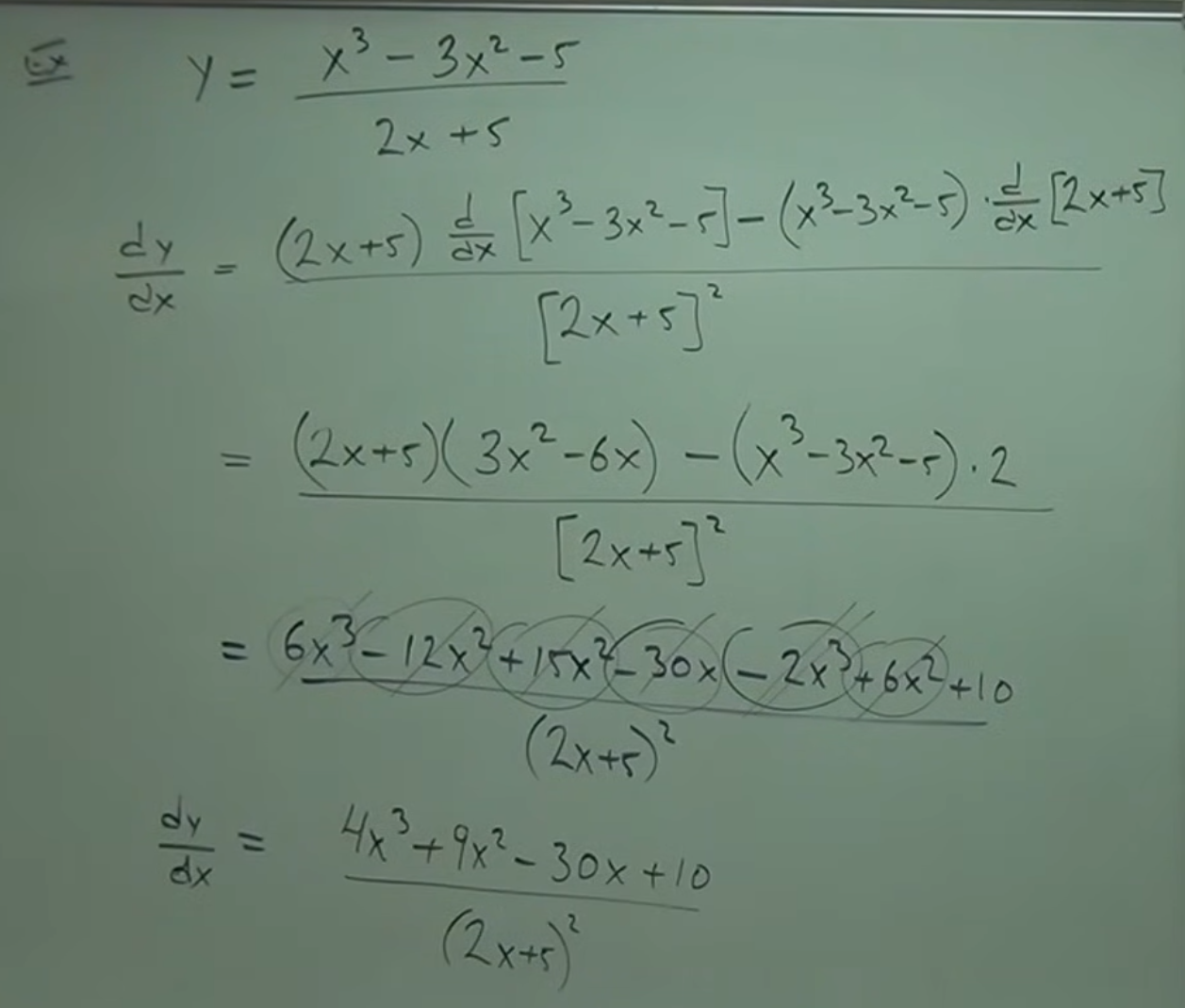
- 48:00. Explanation of how to set up the quotient rule for the given example. 📷
– [📷image]
- Apply the quotient rule:
- $\dfrac{d𝑦}{d𝒙}=\dfrac{(2𝒙+5)\cdot
\dfrac{d}{d𝒙}(𝒙^{3}-3𝒙^{2}-5)-(𝒙^{3}-3𝒙^{2}-5)\cdot \dfrac{d}{d𝒙}(2𝒙+5)}{(2𝒙+5)^{2}}$
- Calculate derivatives:
- $\dfrac{d}{d𝒙}(𝒙^{3}-3𝒙^{2}-5)=3𝒙^{2}-6𝒙$
- $\dfrac{d}{d𝒙}(2𝒙+5)=2$
- Substitute and expand:
- Numerator: $(2𝒙+5)(3𝒙^{2}-6𝒙)-(𝒙^{3}-3𝒙^{2}-5)\cdot 2$
- Denominator: $(2𝒙+5)^{2}$
- Expand the numerator:
- $6𝒙^{3}-12𝒙^{2}+15𝒙^{2}-30𝒙-2𝒙^{3}+6𝒙^{2}+10$
- Simplify:
- Final answer:
- $\dfrac{d𝑦}{d𝒙}=\dfrac{4𝒙^{3}+9𝒙^{2}-30𝒙+10}{(2𝒙+5)^{2}}$
- Emphasis on the importance of using parentheses for correct distribution.
Product rule within the quotient rule
- 57:55. 🧩 Example – where the product rule and quotient rule are combined:
$𝒇(𝒙)=\dfrac{(3𝒙-1)(𝒙^{2}+4)}{𝒙^{2}+2}$ 📷
– [📷image]
- Explanation of the importance of identifying which rule has higher hierarchy in the
problem.
- 58:20. Description of setting up the quotient rule for the given example, including the
product rule within it.
- 1:00:50. Emphasis on the importance of following the notation $\dfrac{d}{d𝒙}$ to
perform derivatives correctly.
- Apply the quotient rule:
- $𝒇'(𝒙)=\dfrac{(𝒙^{2}+2)\cdot
\dfrac{d}{d𝒙}\big[(3𝒙-1)(𝒙^{2}+4)\big]-(3𝒙-1)(𝒙^{2}+4)\cdot
\dfrac{d}{d𝒙}\big[𝒙^{2}+2\big]}{(𝒙^{2}+2)^{2}}$
- Calculate derivatives:
- $\dfrac{d}{d𝒙}\big[(3𝒙-1)(𝒙^{2}+4)\big]=3(𝒙^{2}+4)+2𝒙(3𝒙-1)$
- $\dfrac{d}{d𝒙}\big[𝒙^{2}+2\big]=2𝒙$
- Substitute and expand:
- Numerator: $(𝒙^{2}+2)\big[3(𝒙^{2}+4)+2𝒙(3𝒙-1)\big]-(3𝒙-1)(𝒙^{2}+4)\cdot 2𝒙$
- Denominator: $(𝒙^{2}+2)^{2}$