Calculus 1 lecture 2.6
Discussion Of The Chain Rule For Derivatives Of Functions
Introduction and relevance of the chain rule
- 0:00. Introduction to the Chain Rule and its importance in calculus.
- The Cha+in Rule as the last main differentiation rule.
- The three fundamental differentiation rules: Product Rule, Quotient Rule, and Chain Rule.
- The Chain Rule as a method for **deriving compositions of functions.**
Motivation and examples of the chain rule
- 1:19. Review of the concept of function compositions.
- 1:26. Example illustrating the need for the Chain Rule: derivative of $(3𝒙^{2}-4)^{100}$
- Presentation of examples of derivatives that can be calculated without the chain rule:
- $\dfrac{d}{d𝒙}\big[3𝒙^{2}\cdot 4\big]$
- $\dfrac{d}{d𝒙}\big[(3𝒙^{2}\cdot 4)^{2}\big]$; you can apply the product rule or
expand, then differentiate.
- $\dfrac{d}{d𝒙}\big[(3𝒙^{2}\cdot 4)^{3}\big]$; still doable, but becomes tedious.
- Presentation of examples of derivatives that are difficult to calculate _without the
chain rule_:
- $\dfrac{d}{d𝒙}\big[(3𝒙^{2}\cdot 4)^{100}\big]$
- Difficulty of deriving the expression $(3𝒙^{2}-4)^{100}$ using traditional methods.
- 2:31. The Chain Rule as an efficient solution for this type of derivative.
Explanation of the chain rule through an example
- 3:06. Expression of $(3𝒙^{2}-4)^{100}$ as a ᴄ̳ᴏ̳ᴍ̳ᴩ̳ᴏ̳ꜱ̳ɪ̳ᴛ̳ɪ̳ᴏ̳ɴ̳ ̳ᴏ̳ꜰ̳
̳ꜰ̳ᴜ̳ɴ̳ᴄ̳ᴛ̳ɪ̳ᴏ̳ɴ̳ꜱ̳.
– [📷image]
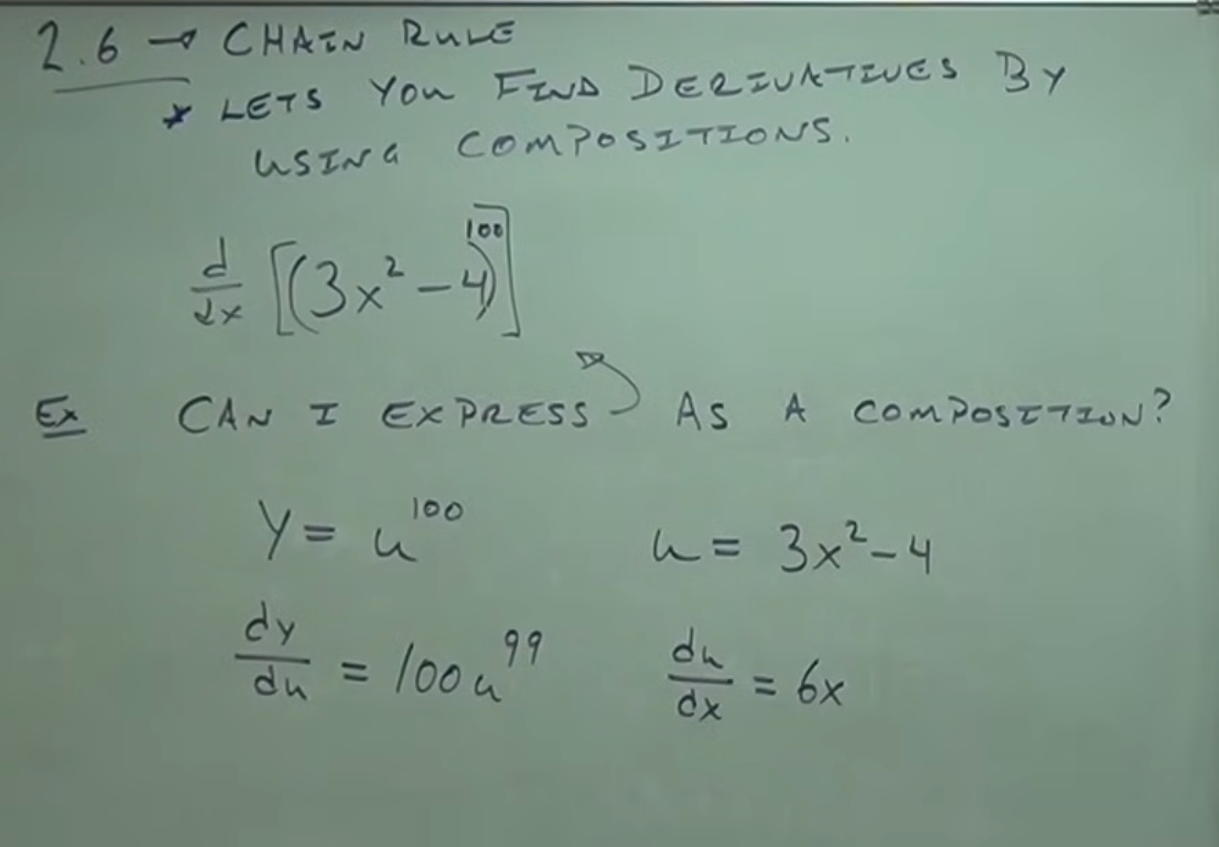
- Motivation: Recognizing compositions is essential before applying the chain rule.
- 3:40. Method to identify the ɪ̳ɴ̳ɴ̳ᴇ̳ʀ̳ ̳ᴀ̳ɴ̳ᴅ̳ ̳ᴏ̳ᴜ̳ᴛ̳ᴇ̳ʀ̳ ̳ꜰ̳ᴜ̳ɴ̳ᴄ̳ᴛ̳ɪ̳ᴏ̳ɴ̳ꜱ̳ ̳ɪ̳ɴ̳ ̳ᴀ̳
̳ᴄ̳ᴏ̳ᴍ̳ᴩ̳ᴏ̳ꜱ̳ɪ̳ᴛ̳ɪ̳ᴏ̳ɴ̳.
- 4:01. Definition of the "outer" and "inner" functions: $y=u^{100}$ and $u=3𝒙^{2}-4$.
- 4:47. Verification: substituting $u$ into $y$ recovers the original function.
- 5:07. Calculation of $\dfrac{dy}{du}$ ($y=u^{100}$) and $\dfrac{du}{d𝒙}$ ($u=3𝒙^{2}-4$).
- Objective: find $\dfrac{dy}{dx}$
- $\dfrac{dy}{du}=100u^{99}$
- $\dfrac{du}{d𝒙}=6𝒙$
- Chain Rule in action:
$\dfrac{dy}{dx}=\dfrac{dy}{du}\cdot\dfrac{du}{dx}=(\dfrac{dy}{\cancel{du}})\cdot(\dfrac{\cancel{du}}{dx})$
- Notice how the intermediate variable $(u)$ "cancels" out, leaving the derivative in
terms of $x$.
- Mastering this identification process is crucial for differentiating any composite
function efficiently.
- 7:50. Justification of Leibniz notation for the derivative.
- The Chain Rule:
- $\dfrac{dy}{dx}=\dfrac{dy}{du}\cdot\dfrac{du}{dx}$
- 8:45. Application of the Chain Rule to the example $(3𝒙^{2}-4)^{100}$
– [📷image]
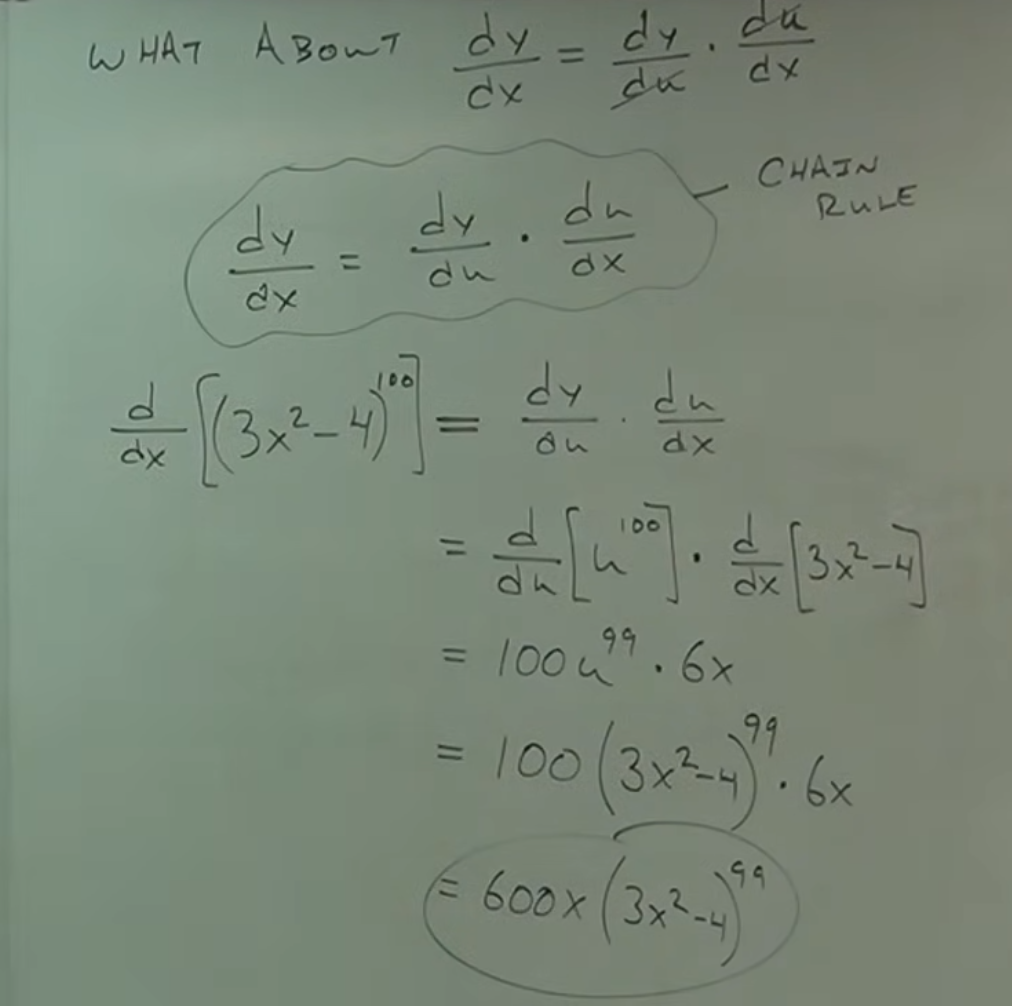
- $\dfrac{d}{dx}\big[(3𝒙^{2}-4)^{100}\big]=\dfrac{dy}{du}\cdot\dfrac{du}{dx}$
- $\dfrac{d}{du}\big[u^{100}\big]\cdot\dfrac{d}{dx}\big[3𝒙^{2}-4\big]$
- $100u^{99}\cdot 6𝒙$
- $100u^{99}\cdot 6𝒙\Big|_{u=3𝒙^{2}-4}$
- $100(3𝒙^{2}-4)^{99}\cdot 6𝒙$
- $600𝒙(3𝒙^{2}-4)^{99}$
- 12:06. Simplification of the differentiation process using the Chain Rule.
- Go for this step $\dfrac{d}{dx}\big[(3𝒙^{2}-4)^{100}\big]$ to this
$100(3𝒙^{2}-4)^{99}\cdot 6𝒙$
- The Chain Rule turns the derivative $\dfrac{d}{dx}\big[(3𝒙^{2}-4)^{100}\big]$ directly
into $100(3𝒙^{2}-4)^{99}\cdot 6𝒙$, making the process systematic.
- Remark:The Power Rule is actually a special case (corollary) of the Chain Rule, when the
inner function is simply $x$.
- In other words: if $y=x^{n}$, then $\dfrac{dy}{dx}=n x^{n-1}$, which fits the Chain
Rule with inner function $u=x$.
- The Chain Rule generalizes the Power Rule to any composition, not just powers of $x$.
Interpretation and generalization of the Power Rule
- 13:20. Definition of the Generalized Power Rule.
– [📷image]
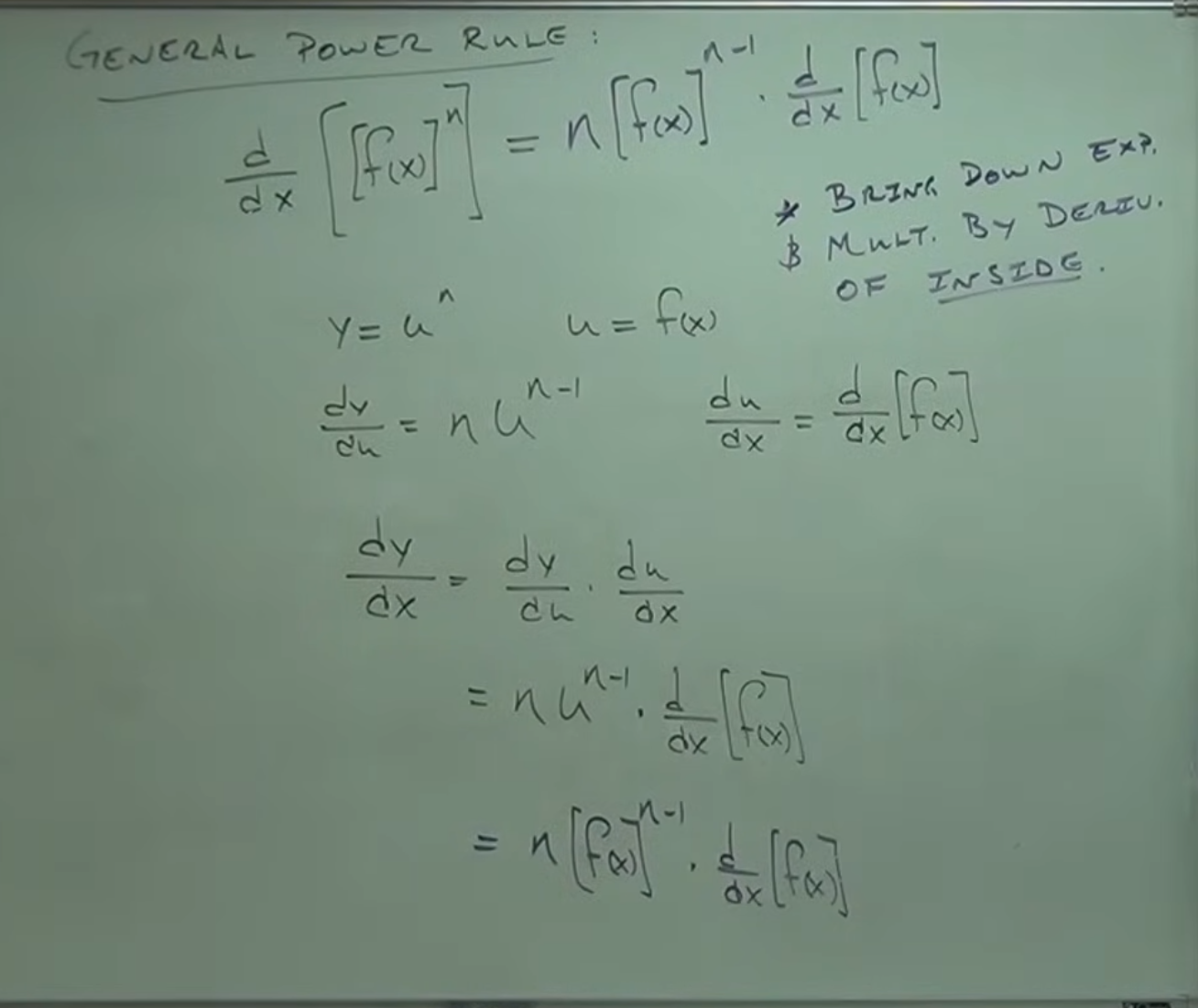
- 14:05. Demonstration of the Chain Rule from the definition of compositions.
- $\dfrac{d}{dx}\big[(𝒇(𝒙))^{n}\big]$
- $y=u^{n},\;\;u=𝒇(𝒙)$
- $\dfrac{dy}{du}=n\cdot u^{n-1};\;\; \dfrac{du}{dx}=\dfrac{d}{dx}\big[𝒇(𝒙)\big]$
$=\Big(\dfrac{dy}{du}\Big)\cdot\Big(\dfrac{du}{dx}\Big)$
- $n\cdot u^{n-1}\cdot\dfrac{d}{dx}\big[𝒇(𝒙)\big]$
- $n\cdot\big\{𝒇(𝒙)^{\,n-1}\cdot\dfrac{d}{dx}\big[𝒇(𝒙)\big]\big\}$
- 16:26. **General formula for the derivative of a function raised to a power**:
-
$\dfrac{d}{d𝒙}\big[(𝒇(𝒙))^{n}\big]=n\cdot\{𝒇(𝒙)^{\,n-1}\}\cdot\dfrac{d}{d𝒙}\big[𝒇(𝒙)\big]$
- 18:40. Statement in simple language of the Generalized Power Rule.
- 1. Multiply by the exponent $n$.
- 2. Keep the base function raised to $n-1$ (i.e., reduce the exponent by one).
- 3. Multiply by the derivative of the base function.
Examples and applications of the chain rule
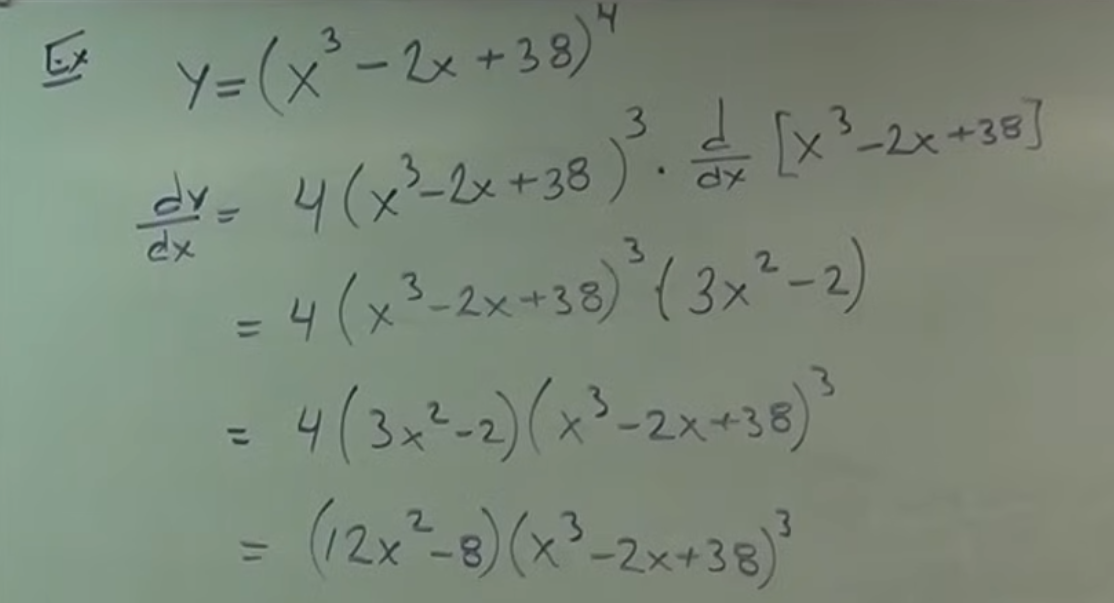
- 19:50. $y=(𝒙^{3}-2𝒙+38)^{4}$ find $y'$
– [📷image]
- Importance of recognizing function compositions when applying the Chain Rule.
- Common errors when applying the Generalized Power Rule (forgetting to subtract $1$ from
the exponent).
- Use of parentheses to indicate the multiplication of the inner derivative.
- Relationship between the Generalized Power Rule and the simple Power Rule.
Additional examples:combination of differentiation rules
- 24:25. 🧩 Example –: $\dfrac{d}{d𝒙}\big[(𝒙)^{6}\big]$
– [📷image]
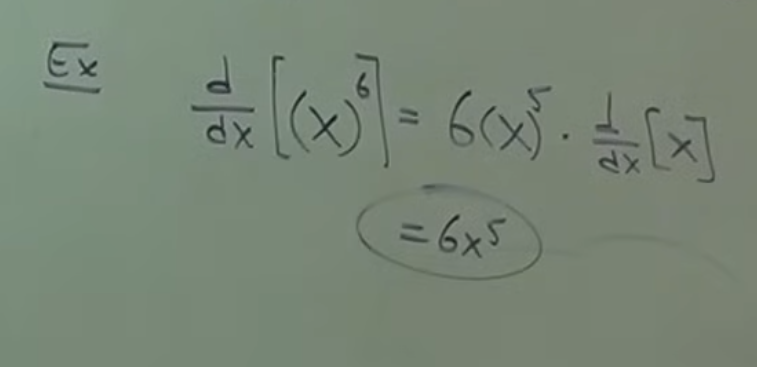
- Could you do the general power rule?
- 26:20. 🧩 Example –: $\dfrac{d}{d𝒙}\big[(2𝒙-3)(𝒙^{2}-5)^{3}\big]$
– [📷image]
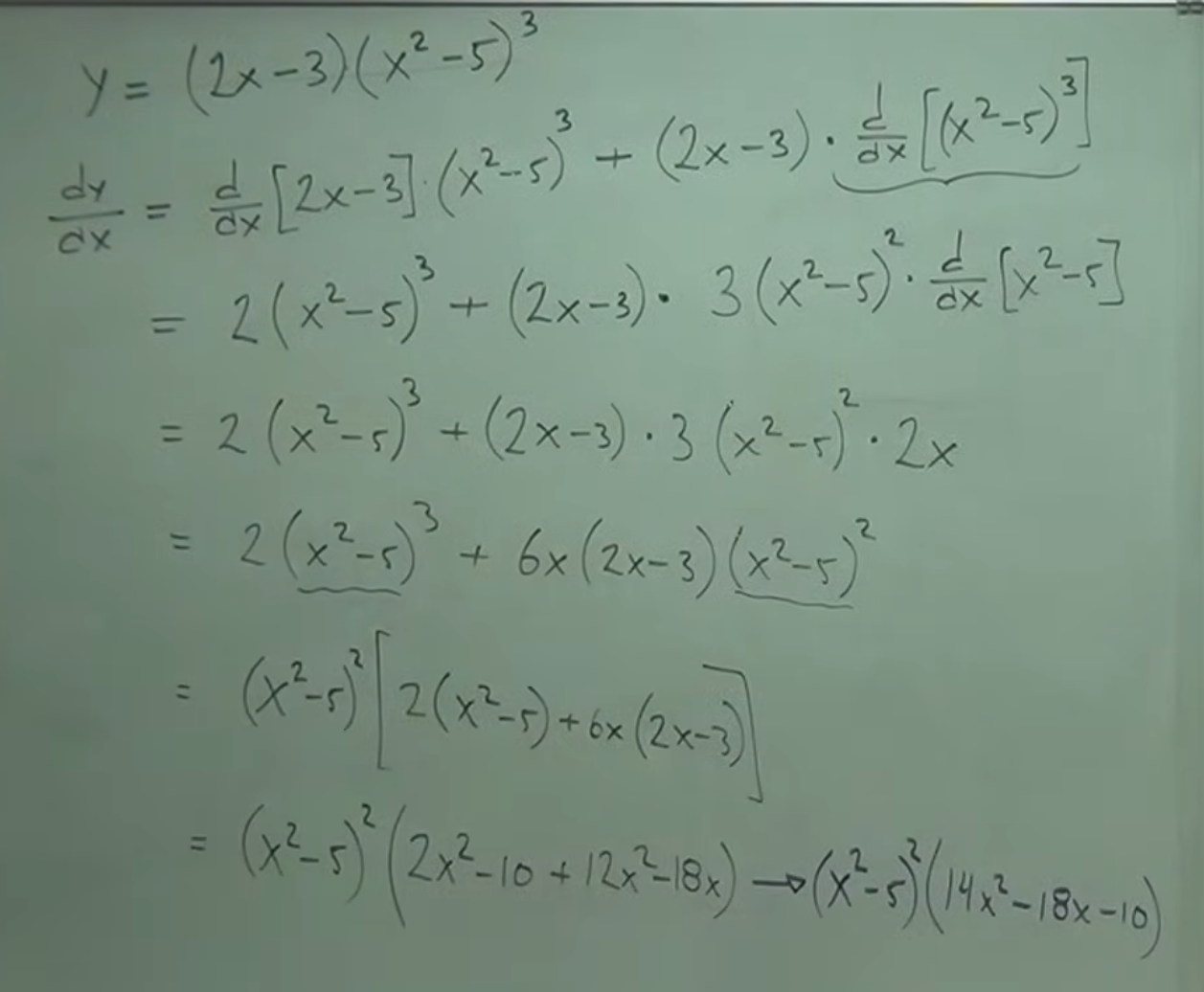
- Example combining the Product Rule and the Generalized Power Rule.
- Determining which rule to apply first: the Product Rule applies to the entire expression.
- 27:28. $\dfrac{d}{d𝒙}\Big[\dfrac{(𝒙^{2}-1)^{2}}{(𝒙+4)}\Big]$
- Identifying the necessary differentiation rules: Chain Rule (or Generalized Power
Rule) and Quotient Rule.
- Order of application: Quotient Rule first
- 28:00. $\dfrac{d}{d𝒙}\Big[\Big(\dfrac{(𝒙^{2}-1)^{2}}{(𝒙+4)}\Big)^{5}\Big]$
- Order of application: Generalized Power Rule, then Quotient Rule, and finally
another Generalized Power Rule
within the Quotient Rule.
- 29:38. $\dfrac{d}{d𝒙}\big[(2𝒙-3)(𝒙^{2}-5)^{3}\big]$
- Application of the Product Rule as the main rule
- 29:38. Application of the Product Rule as the main rule
- $y=(𝒙^{3}-2𝒙+38)^{4}$
- $\dfrac{dy}{dx}=4(𝒙^{3}-2𝒙+38)^{3}\cdot\dfrac{d}{dx}\big[𝒙^{3}-2𝒙+38\big]$
- $4(𝒙^{3}-2𝒙+38)^{3}\big(3𝒙^{2}-2\big)$
- $4\big(3𝒙^{2}-2\big)(𝒙^{3}-2𝒙+38)^{3}$
- $(12𝒙^{2}-8)(𝒙^{3}-2𝒙+38)^{3}$
- 39:05. 🧩 Example –: $\dfrac{d}{d𝒙}\big[\sqrt{\,5𝒙^{2}-1\,}\big]$
– [📷image]
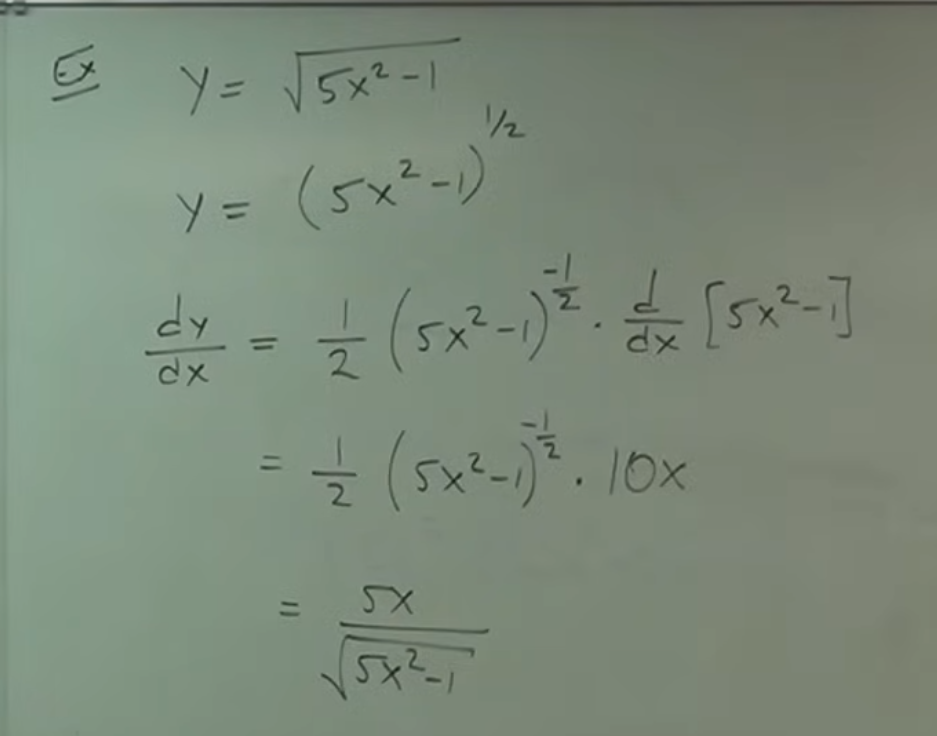
- Application of the Chain Rule to derivatives involving square roots.
- Representing square roots as fractional exponents to facilitate differentiation.
- $y=(5𝒙^{2}-1)^{1/2}$
- $\dfrac{dy}{dx}=\dfrac{1}{2}(5𝒙^{2}-1)^{-1/2}\cdot\dfrac{d}{dx}\big[5𝒙^{2}-1\big]$
- $\dfrac{1}{2}(5𝒙^{2}-1)^{-1/2}\cdot 10𝒙$
- $\dfrac{5𝒙}{\sqrt{5𝒙^{2}-1}}$
Extension of the chain rule to trigonometric functions
- 43:08. Derivative of the function $\cos(𝒙^{4})$ using the Chain Rule.
– [📷image]
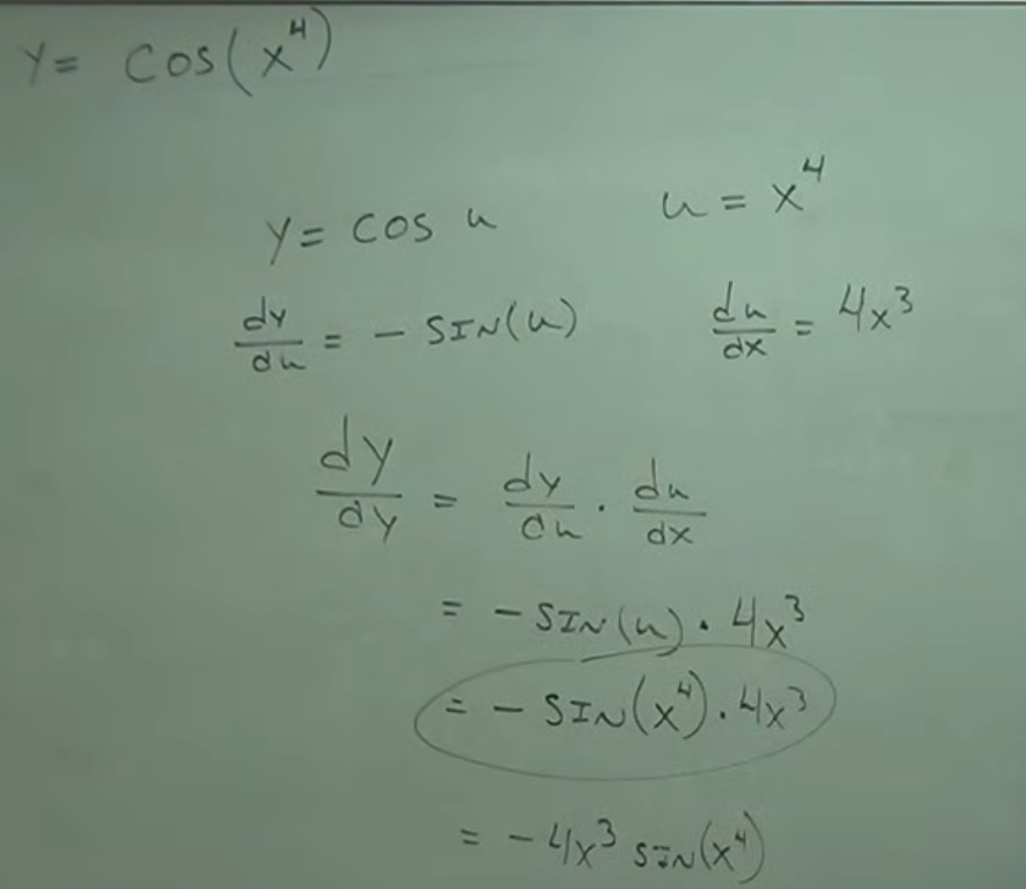
- Identifying the outer function (cosine) and the inner function $(𝒙^{4})$.
- Applying the Chain Rule: derive the outer function, keep the inner function unchanged,
and multiply by the derivative of the inner function.
- $\dfrac{dy}{du}=-\sin(u)$
- $\dfrac{du}{dx}=4𝒙^{3}$
- $\dfrac{dy}{dx}=\Big(\dfrac{dy}{du}\Big)\cdot\Big(\dfrac{du}{dx}\Big)$
$=-\sin(u)\cdot 4𝒙^{3}$ $=-\sin(𝒙^{4})\cdot 4𝒙^{3}$ $=-4𝒙^{3}\sin(𝒙^{4})$
- 46:07. **Statement of the Chain Rule for trigonometric functions**:
- $\dfrac{d}{dx}\big[𝒇(𝓰(𝒙))\big]=𝒇'\!\big(𝓰(𝒙)\big)\cdot 𝓰'(𝒙)$.
Additional examples and practice with the chain rule
- 48:22. Practice with examples combining the Chain Rule, Product Rule, and Quotient Rule.
- 49:09. 🧩 Example –: $\dfrac{d}{d𝒙}\big[\sin(4𝒙^{5})\big]$
– [📷image]
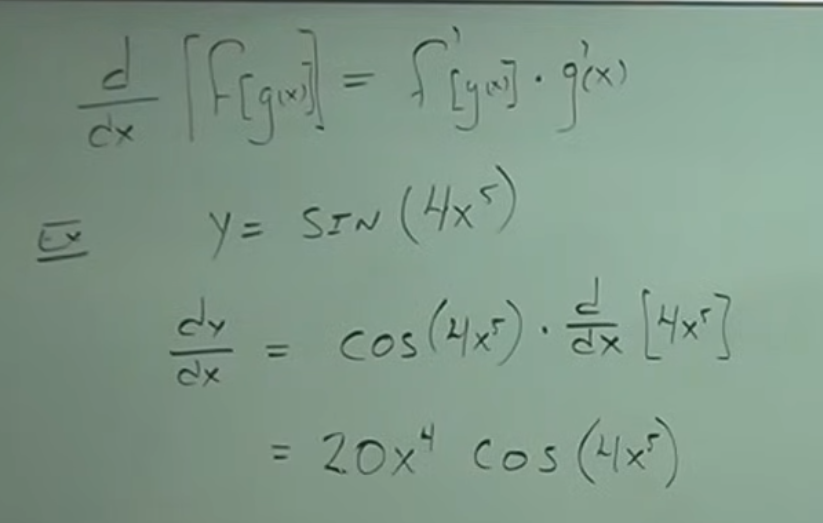
- Example of a trigonometric function with a composite argument
- Identifying that this is a Chain Rule.
- Recognizing the composition of functions: the outer function is sine and the inner
function is $4𝒙^{5}$.
- Applying the Chain Rule: derive the outer function, keep the inner function unchanged,
and multiply
by the derivative of the inner function.
- $\dfrac{dy}{dx}=\cos(4𝒙^{5})\cdot\dfrac{d}{dx}\big[4𝒙^{5}\big]$
$=20𝒙^{4}\cos(4𝒙^{5})$
- 52:15. 🧩 Example –: $\dfrac{d}{d𝒙}\big[\cos^{2}(𝒙^{4})\big]$
– [📷image]
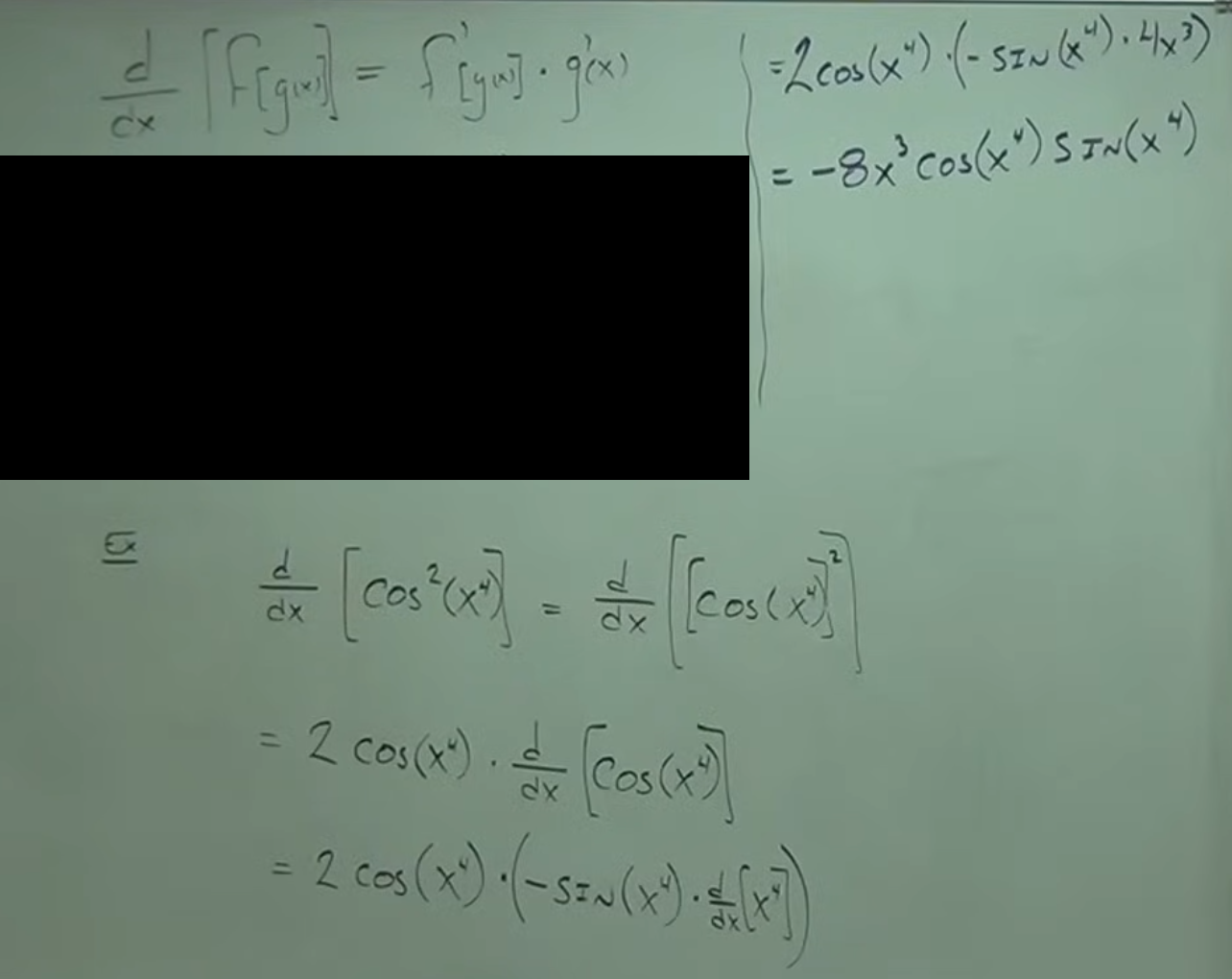
- **Recommendation**: analyze the structure of a problem before applying differentiation
rules.
- Distinction between the general Chain Rule and the Generalized Power Rule.
- In this context, the Generalized Power Rule refers to the Chain Rule applied to a
function raised to a power.
- $\dfrac{d}{d𝒙}\big[\cos^{2}(𝒙^{4})\big]=\dfrac{d}{d𝒙}\big[(\cos(𝒙^{4}))^{2}\big]$
- $2\cos(𝒙^{4})\cdot\dfrac{d}{dx}\big[\cos(𝒙^{4})\big]$
- $2\cos(𝒙^{4})\cdot\big(-\sin(𝒙^{4})\cdot\dfrac{d}{dx}[𝒙^{4}]\big)$
- $2\cos(𝒙^{4})\cdot\big(-\sin(𝒙^{4})\cdot 4𝒙^{3}\big)$
- $-8𝒙^{3}\cos(𝒙^{4})\sin(𝒙^{4})$
- 1:01:08. 🧩 Example –: $\dfrac{d}{d𝒙}\big[\tan(3𝒙^{2}-2𝒙)\big]$
– [📷image]
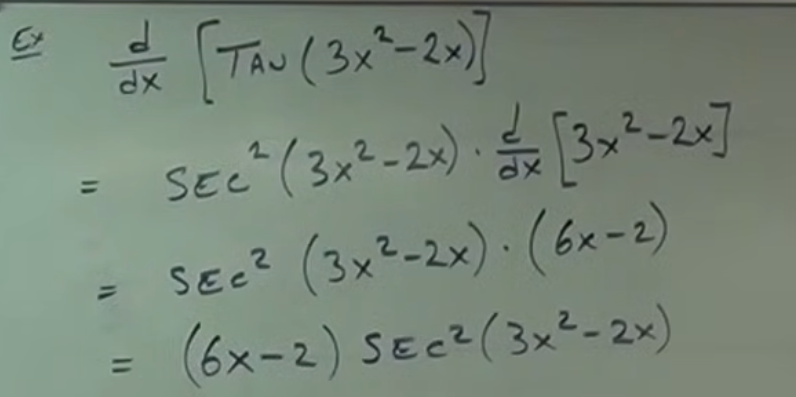
- If $\dfrac{d}{d𝒙}\big[\tan^{4}(3𝒙^{2}-2𝒙)\big]$ then first general power rule
- Identifying the Chain Rule: the outer function is tangent and the inner function is
$3𝒙^{2}-2𝒙$.
- Applying the Chain Rule: derive the outer function, keep the inner function unchanged,
and multiply by the
derivative of the inner function.
-
$\dfrac{d}{dx}\big[\tan(3𝒙^{2}-2𝒙)\big]=\sec^{2}(3𝒙^{2}-2𝒙)\cdot\dfrac{d}{dx}[3𝒙^{2}-2𝒙]$
- $\sec^{2}(3𝒙^{2}-2𝒙)\cdot(6𝒙-2)$
- $(6𝒙-2)\sec^{2}(3𝒙^{2}-2𝒙)$
- Common errors when applying the Chain Rule to trigonometric functions: forgetting to
multiply by the derivative
of the argument.
- 1:06:37. 🧩 Example –: $\dfrac{d}{d𝒙}\big[\sqrt{\,𝒙^{3}+\csc(𝒙^{3})\,}\big]$
– [📷image]
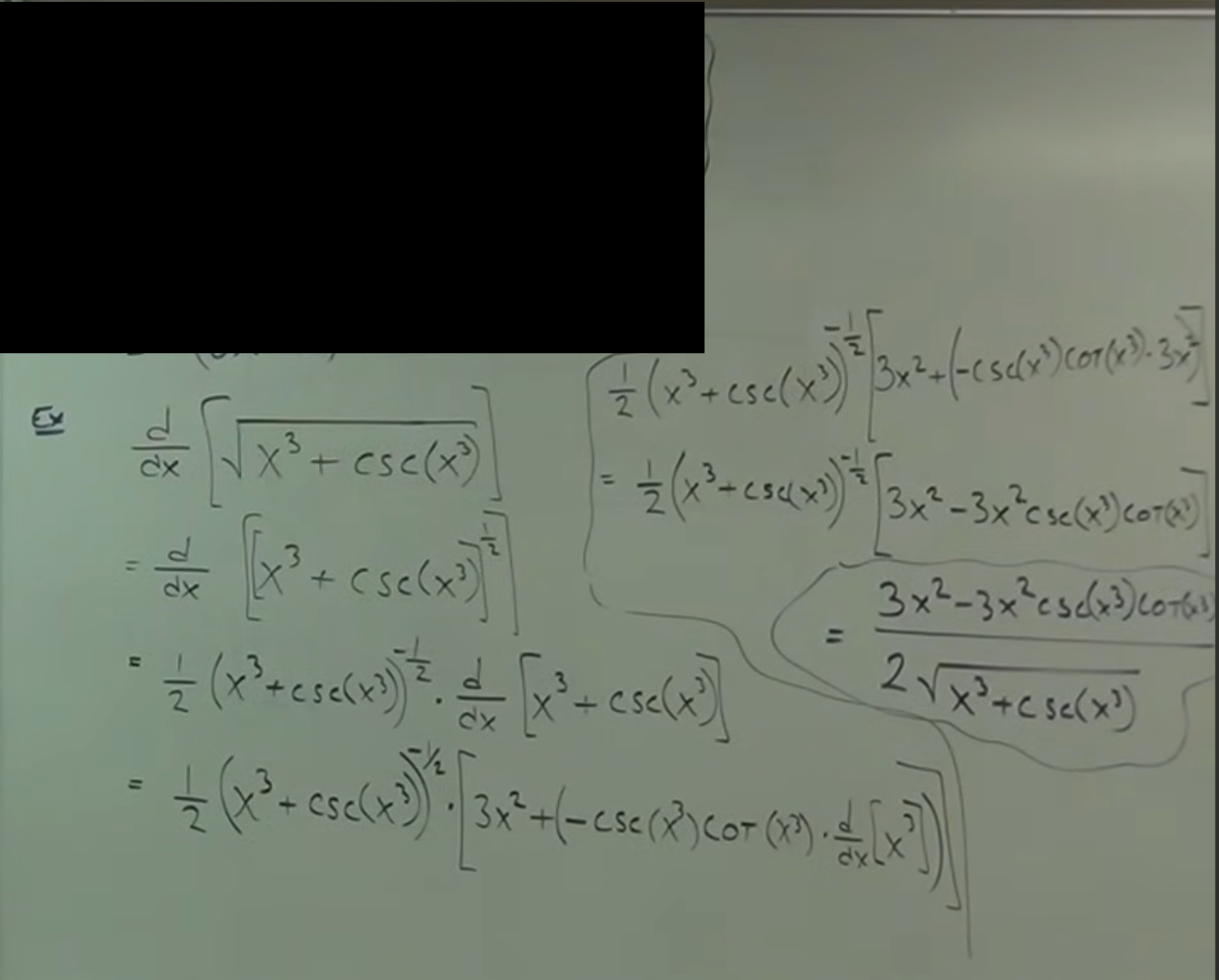
- Simplifying the expression by moving the negative exponent to the denominator.
- Identifying the Generalized Power Rule: the outer function is raising to the power of
$-1/2$ and the inner function
is the expression within the parentheses.
- Applying the Generalized Power Rule: bring down the exponent, keep the internal
expression unchanged, and multiply
by the derivative of the internal expression.
- To derive the internal function, it is necessary to apply the Sum Rule, Product Rule, and
Chain Rule.
-
$\dfrac{d}{d𝒙}\big[\sqrt{\,𝒙^{3}+\csc(𝒙^{3})\,}\big]=\dfrac{d}{d𝒙}\big[(𝒙^{3}+\csc(𝒙^{3}))^{1/2}\big]$
- $\dfrac{1}{2}(𝒙^{3}+\csc(𝒙^{3}))^{-1/2}\cdot\dfrac{d}{dx}\big[𝒙^{3}+\csc(𝒙^{3})\big]$
-
$\dfrac{1}{2}(𝒙^{3}+\csc(𝒙^{3}))^{-1/2}\cdot\big[3𝒙^{2}+\dfrac{d}{dx}\big(\csc(𝒙^{3})\big)\big]$
-
$\dfrac{1}{2}(𝒙^{3}+\csc(𝒙^{3}))^{-1/2}\cdot\big[3𝒙^{2}+(-\csc(𝒙^{3})\cot(𝒙^{3}))\cdot\dfrac{d}{dx}[𝒙^{3}]\big]$
-
$\dfrac{1}{2}(𝒙^{3}+\csc(𝒙^{3}))^{-1/2}\cdot\big[3𝒙^{2}-3𝒙^{2}\csc(𝒙^{3})\cot(𝒙^{3})\big]$
- $\dfrac{\,3𝒙^{2}-3𝒙^{2}\csc(𝒙^{3})\cot(𝒙^{3})\,}{\,2\sqrt{\,𝒙^{3}+\csc(𝒙^{3})\,}}$
- 1:19:15. 🧩 Example –: $\dfrac{d}{d𝒙}\big[(3+𝒙^{2}\cdot\cot(𝒙^{2}))^{-3}\big]$
– [📷image]
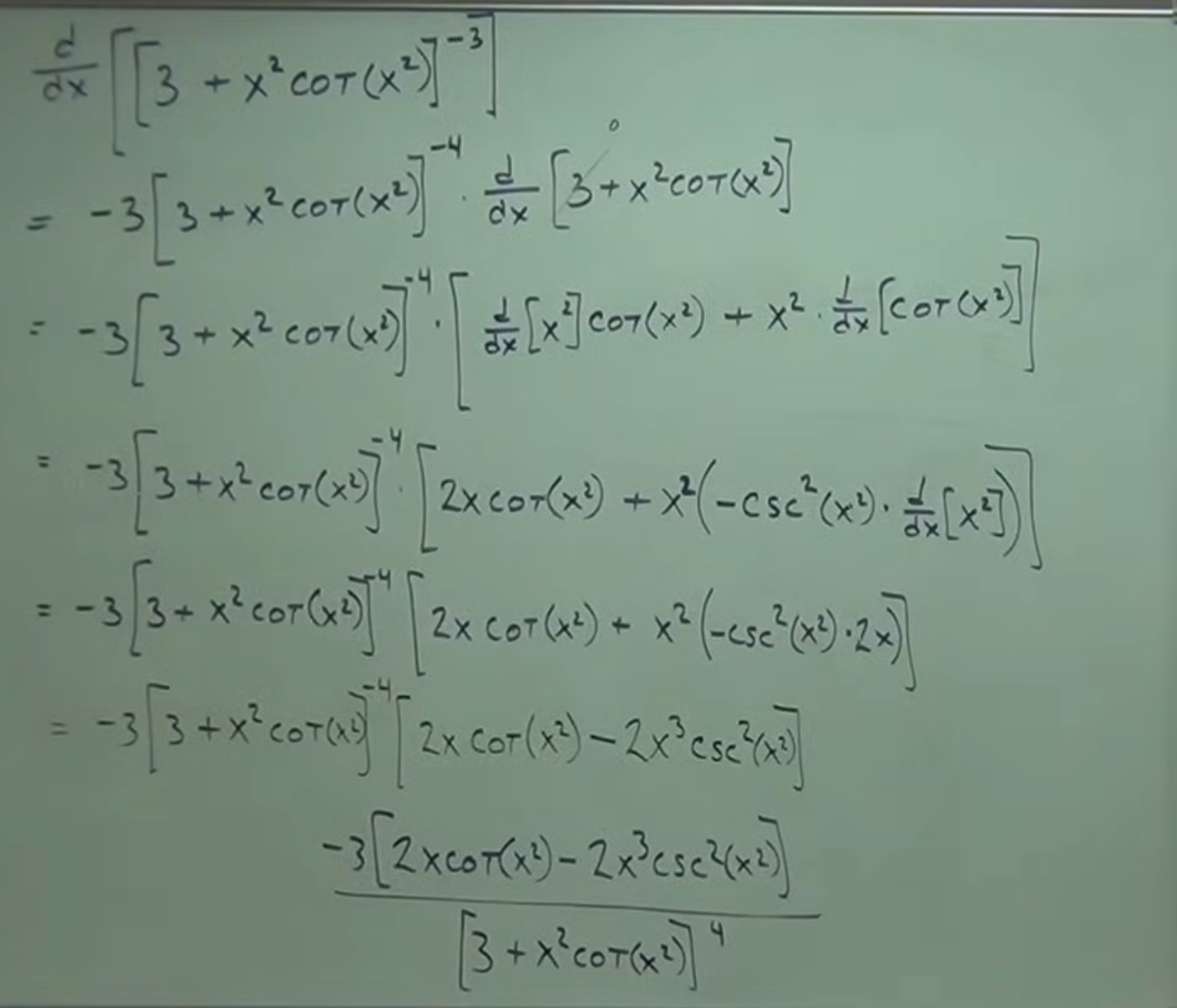
- Example illustrating the convenience of simplifying expressions before applying the
Quotient Rule.
- In this case,
$\dfrac{d}{dx}\Big[\dfrac{1}{\big(3+𝒙^{2}\cdot\cot(𝒙^{2})\big)^{3}}\Big]$, it is recommended to move the
denominator to the numerator with a negative exponent to apply the Generalized Power Rule.
- Avoid using the Quotient Rule, as it can complicate the differentiation process.
-
$\dfrac{d}{dx}\big[3+𝒙^{2}\cot(𝒙^{2})\big]^{-3}=-3\big[3+𝒙^{2}\cot(𝒙^{2})\big]^{-4}\cdot\dfrac{d}{dx}\big[3+𝒙^{2}\cot(𝒙^{2})\big]$
-
$-3\big[3+𝒙^{2}\cot(𝒙^{2})\big]^{-4}\cdot\big[\dfrac{d}{dx}(𝒙^{2})\cdot\cot(𝒙^{2})+𝒙^{2}\cdot\dfrac{d}{dx}(\cot(𝒙^{2}))\big]$
-
$-3\big[3+𝒙^{2}\cot(𝒙^{2})\big]^{-4}\cdot\big[2𝒙\cdot\cot(𝒙^{2})+𝒙^{2}\cdot(-\csc^{2}(𝒙^{2})\cdot\dfrac{d}{dx}[𝒙^{2}])\big]$
-
$=-3\big[3+𝒙^{2}\cot(𝒙^{2})\big]^{-4}\cdot\big[2𝒙\cdot\cot(𝒙^{2})+𝒙^{2}\cdot(-\csc^{2}(𝒙^{2})\cdot
2𝒙)\big]$
-
$-3\big[3+𝒙^{2}\cot(𝒙^{2})\big]^{-4}\cdot\big[2𝒙\cot(𝒙^{2})-2𝒙^{3}\csc^{2}(𝒙^{2})\big]$
-
$-\dfrac{3\big[2𝒙\cot(𝒙^{2})-2𝒙^{3}\csc^{2}(𝒙^{2})\big]}{\big[3+𝒙^{2}\cot(𝒙^{2})\big]^{4}}$
- 1:31:20. 🧩 Example –: $\dfrac{d}{d𝒙}\Big[\dfrac{1+\cos(𝒙^{2})}{1+\sin(𝒙^{2})}\Big]$
– [📷image]
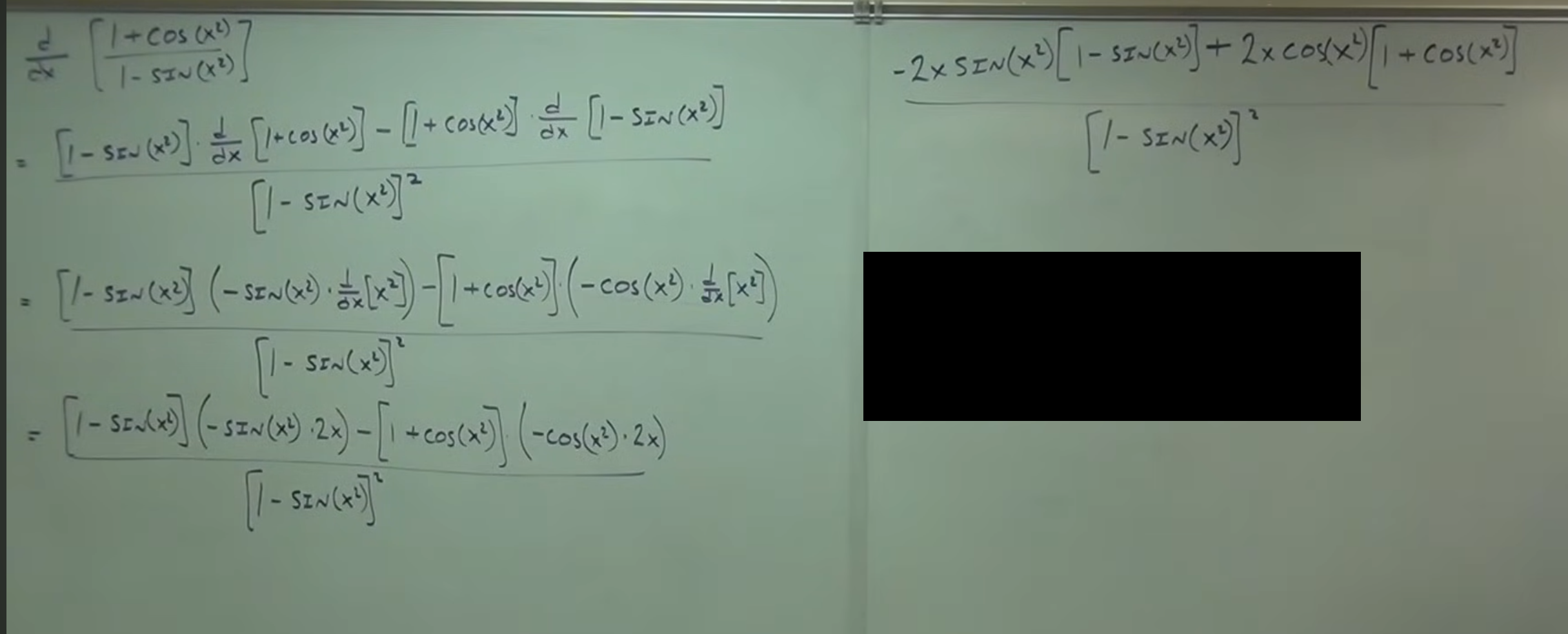
- If $\dfrac{d}{d𝒙}\Big[\dfrac{1+\cos(𝒙^{2})}{1+\sin(𝒙^{2})}\Big]^{5}$ then apply
general power rule, quotient rule and chain rule
- Apply the **quotient rule**:
- $\dfrac{d}{dx}\Big[\dfrac{𝒇(𝒙)}{𝗀(𝒙)}\Big]=\dfrac{𝒇'(𝒙)\cdot 𝗀(𝒙)-𝒇(𝒙)\cdot
𝗀'(𝒙)}{\big(𝗀(𝒙)\big)^{2}}$
- Here: $𝒇(𝒙)=1+\cos(𝒙^{2})$ aand $𝗀(𝒙)=1+\sin(𝒙^{2})$
- Compute the derivatives using the **chain rule**:
- $𝒇'(𝒙)=\dfrac{d}{dx}\big[1+\cos(𝒙^{2})\big]=-\sin(𝒙^{2})\cdot 2𝒙$
- $𝗀'(𝒙)=\dfrac{d}{dx}\big[1+\sin(𝒙^{2})\big]=\cos(𝒙^{2})\cdot 2𝒙$
- Plug into the quotient rule formula:
- Numerator:
- $𝒇'(𝒙)\cdot 𝗀(𝒙)-𝒇(𝒙)\cdot 𝗀'(𝒙)$
- $\big[-\sin(𝒙^{2})\cdot
2𝒙\big]\cdot\big[1+\sin(𝒙^{2})\big]-\big[1+\cos(𝒙^{2})\big]\cdot\big[\cos(𝒙^{2})\cdot
2𝒙\big]$
- $2𝒙\big[-\sin(𝒙^{2})-\sin^{2}(𝒙^{2})-\cos(𝒙^{2})-\cos^{2}(𝒙^{2})\big]$
- Denominator:
- $\big[1+\sin(𝒙^{2})\big]^{2}$
- Final answer:
- $\dfrac{d}{dx}\Big[\dfrac{1+\cos(𝒙^{2})}{1+\sin(𝒙^{2})}\Big]$
$=\dfrac{2𝒙\big[-\sin(𝒙^{2})-\sin^{2}(𝒙^{2})-\cos(𝒙^{2})-\cos^{2}(𝒙^{2})\big]}{\big[1+\sin(𝒙^{2})\big]^{2}}$
- 1:32:10. 🧩 Example –: $\dfrac{d}{d𝒙}\big[𝒙^{2}\cdot\sin(3𝒙)\big]$
– [📷image]
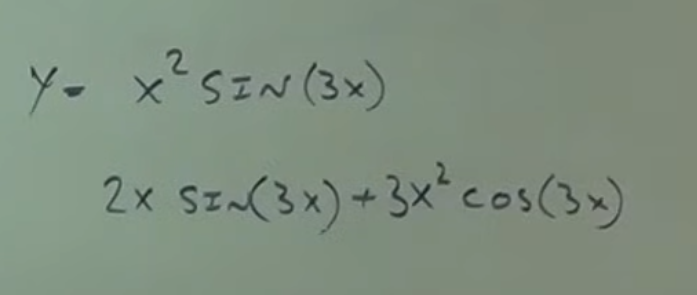
- Product rule and then chain rule
- Apply the product rule:
- $\dfrac{d}{dx}\big[𝒇(𝒙)\cdot 𝗀(𝒙)\big]=𝒇'(𝒙)\cdot 𝗀(𝒙)+𝒇(𝒙)\cdot 𝗀'(𝒙)$
- Here $𝒇(𝒙)=𝒙^{2}$ and $𝗀(𝒙)=\sin(3𝒙)$
- Compute the derivatives:
- $𝒇'(𝒙)=2𝒙$
- $𝗀'(𝒙)=\dfrac{d}{dx}\big[\sin(3𝒙)\big]=\cos(3𝒙)\cdot 3$ (by the **chain
rule**)
- Now substitute into the product rule formula:
-
$\dfrac{d}{dx}\big[𝒙^{2}\cdot\sin(3𝒙)\big]=2𝒙\cdot\sin(3𝒙)+𝒙^{2}\cdot\big[\cos(3𝒙)\cdot
3\big]$
- $2𝒙\cdot\sin(3𝒙)+3𝒙^{2}\cdot\cos(3𝒙)$