Calculus 1 lecture 2.7
Implicit Differentiation
Introduction to implicit differentiation
- [0:00]. Introduction to the topic: implicit differentiation.
- Review of the explicit form of equations 𝐲 = 𝒇(𝒙):
- 🧩 Example –: 𝐲 = $3𝒙^{2}+4$
- Definition of explicit form: 𝐲 is isolated on one side of the equation, "𝐲" is given
explicitly.
- Explicit Form: In this form, 𝐲 is expressed directly in terms of 𝒙 (e.g., 𝐲 =
$3𝒙^{2}+4$).
This makes differentiation straightforward as standard rules can be applied directly.
- [1:30]. Definition of implicit form –
[📷image]
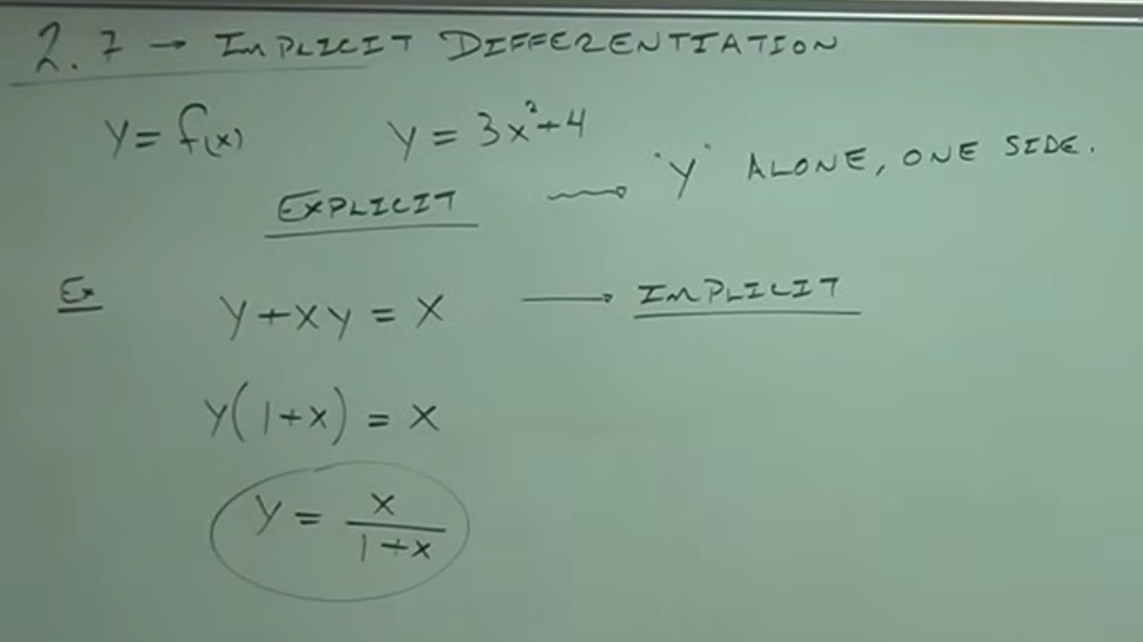
- 🧩 Example –: $𝑦+𝑥𝑦=𝑥$
- Sometimes we can convert an implicit function into an explicit one.
- Solve for 𝑦: $𝑦=\dfrac{𝑥}{1+𝑥}$
- [2:25]. 🧩 Example –: $𝑥^{2}+𝑦^{2}=25$ –
[📷image]
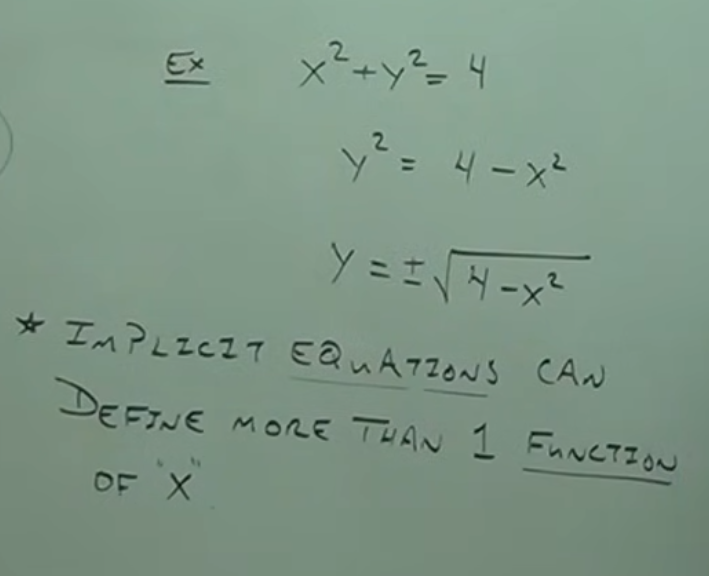
- 𝑦 is not isolated; the variables 𝑥 and 𝑦 are mixed together.
- Implicit form: Here, 𝑦 is intertwined with 𝑥 in the equation (e.g.,
$𝑥^{2}+𝑦^{2}=25$). This requires treating 𝑦
as a function of 𝑥 and often necessitates the use of the chain rule during differentiation.
- [4:18]. Implicit equations can often define more than one function of
𝒙
- $𝑥^{2}+𝑦^{2}=25 \;\Leftrightarrow\; 𝑦=\pm\sqrt{25-𝑥^{2}}$
- $𝑦=\sqrt{25-𝑥^{2}}$: Represents the upper semicircle (positive).
- $𝑦=-\sqrt{25-𝑥^{2}}$: Represents the lower semicircle (negative).
- Explicit differentiation fails when 𝑦 is not a single function, as in
$𝑦=\pm\sqrt{25-𝑥^{2}}$, which represents
two semicircles. Implicit differentiation handles this directly by differentiating the entire
equation ($𝑥^{2}+𝑦^{2}=25$)
without solving for 𝑦, allowing for slopes that depend on both 𝑥 and 𝑦.
- 'allowing for slopes that depend on both 𝑥 and 𝑦': meaning that the
derivative at each point is determined
by both the 𝑥 and 𝑦 coordinates, not just by 𝑥 alone, as happens with explicit functions
- When there are multiple solutions for 𝑦 (for example, $+\sqrt{}$ and
$-\sqrt{}$), each point $(𝑥,𝑦)$ can have its own slope,
which is calculated using implicit differentiation.
Definition of the implicit differentiation technique
- [4:55]. Review of the concepts of explicit and implicit forms.
- Understanding the distinction between explicit and implicit forms is crucial because it
determines
the method used for differentiation. In explicit differentiation, 𝐲 is expressed directly in terms of
𝒙,
making it straightforward to apply standard differentiation rules. In contrast, implicit differentiation
is necessary when 𝐲 cannot be easily isolated, requiring the application of the chain rule during
differentiation.
- In explicit differentiation, the relationship between 𝐲 and 𝒙 is clear and direct,
allowing for straightforward
differentiation. However, many real-world problems result in equations where 𝐲 cannot be neatly isolated.
Implicit
differentiation allows us to find $\dfrac{d𝑦}{d𝒙}$ without rearranging the equation, by treating 𝐲 as a
function of 𝒙 and
applying differentiation rules accordingly.
- [5:20]. 🧩 Example: $2𝒙^{3}+3𝑦^{3}=9𝑥𝑦$
- [5:40]. It is not always possible to convert an implicit equation to explicit form.
- We need another method to find derivatives, instead of just assuming 𝑦 equals a
function of 𝑥.
- There has to be a different way—and there is. It's called implicit
differentiation.
- How to take a derivative for $2𝒙^{3}+3𝑦^{3}=9𝑥𝑦$ without solving for 𝑦.
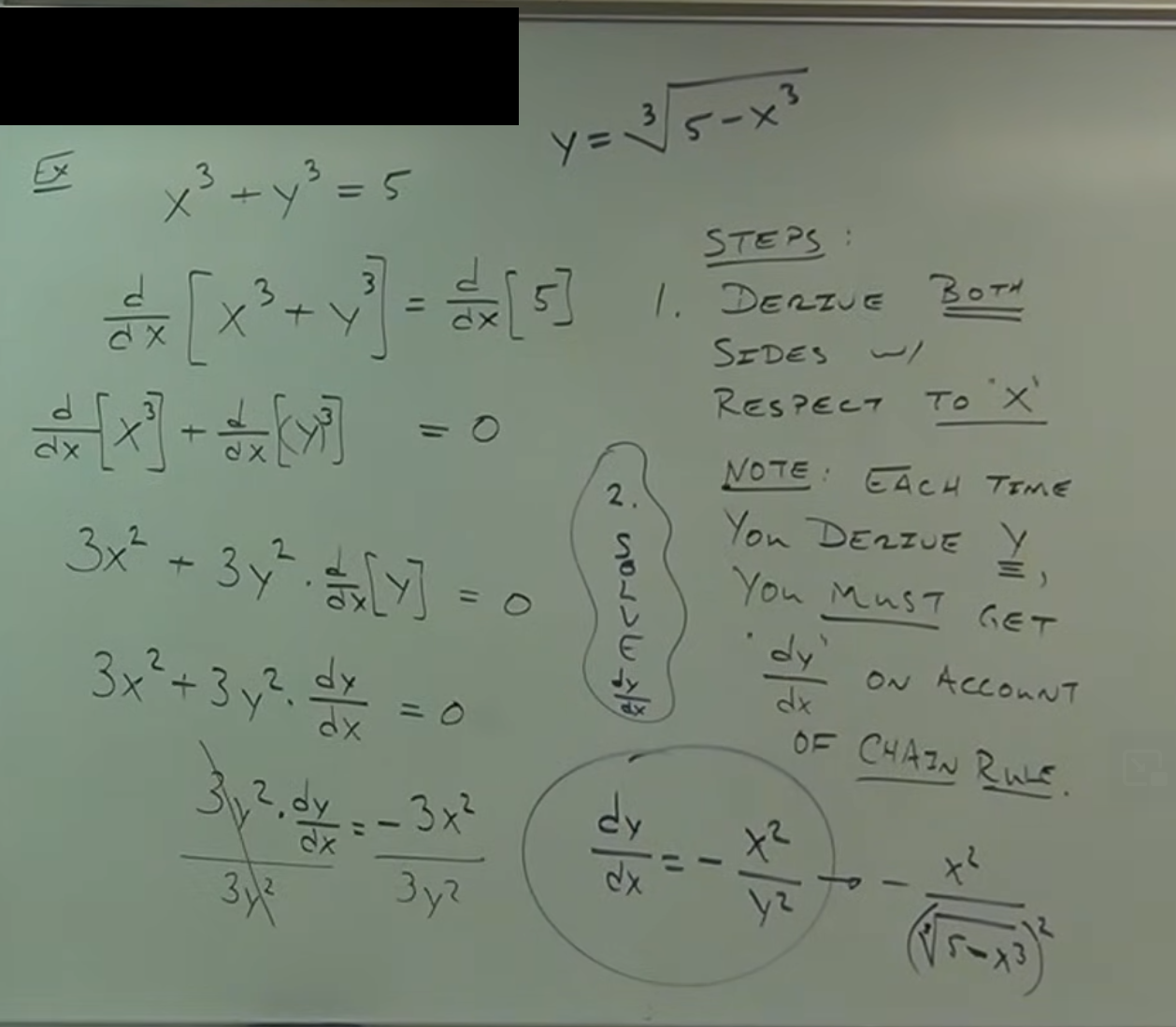
- [8:02]. 🧩 Example –: $𝒙^{3}+𝐲^{3}=5$ –
[📷image]
- Example of converting implicit equations to explicit forms.
- Some equations naturally present in implicit form cannot be easily rearranged to solve
for 𝐲. Attempting
to isolate 𝐲 might be complex or impossible, especially with higher-degree polynomials or
transcendental
functions. Implicit differentiation provides a systematic way to find derivatives without
needing to solve for 𝐲 explicitly.
- To solve $𝒙^{3}+𝐲^{3}=5$, we could solve for 𝐲, subtract $𝒙^{3}$, and take the cube
root, allowing us to find the derivative directly. However,
the goal is to learn implicit differentiation, which lets us find the derivative without solving for 𝐲.
- [9:33]. Key point: You must treat 𝐲 as a function of 𝒙, because
if 𝐲 can be expressed in terms of 𝒙, it depends on 𝒙.
Steps for implicit differentiation
- [9:50]. ꜱ̲ᴛ̲ᴇ̲ᴩ̲ 1: Differentiate both sides of the equation with respect to 𝑥.
- from 🧩 Example –: $𝒙^{3}+𝐲^{3}=5$ –
[📷image]
- Remember that you are differentiating with respect to 𝑥, while 𝑦 is a function of 𝑥.
- You can differentiate term by term if the equation allows.
- Derivative of both sides:
- $\dfrac{d}{d𝒙}\big[𝑥^{3}+𝑦^{3}\big]=\dfrac{d}{d𝒙}[5]$
- $\dfrac{d}{d𝒙}[𝑥^{3}]+\dfrac{d}{d𝒙}[𝑦^{3}]=\dfrac{d}{d𝒙}[5]$
- $3𝑥^{2}+3𝑦^{2}\cdot\dfrac{d}{d𝒙}[𝑦]=0$
- When differentiating a term that includes 𝑦, apply the chain rule.
- This requires treating 𝑦 as a function of 𝒙 and often necessitates the use
of the chain rule.
- 𝑦 is a function of 𝒙 that you do not know explicitly.
- $\dfrac{d}{d𝒙}[𝑦]$ is the derivative of 𝑦 with respect to 𝒙, represented
as $\dfrac{d𝑦}{d𝒙}$.
- Each time you differentiate 𝑦, you must include a $\dfrac{d𝑦}{d𝒙}$ factor
due to the chain rule.
- It’s just like
$\dfrac{d}{d𝒙}(3𝒙^{2}-1)^{4}\;\to\;4(3𝒙^{2}-1)^{3}\cdot\dfrac{d}{d𝒙}[3𝒙^{2}-1]$, but
now $3𝒙^{2}-1$ is “𝑦”—an unknown function.
- [19:00]. ꜱ̲ᴛ̲ᴇ̲ᴩ̲ 2: Solve the equation for $\dfrac{d𝑦}{d𝒙}$.
- $3𝑥^{2}+3𝑦^{2}\cdot\dfrac{d}{d𝒙}[𝑦]=0 \;\;\Rightarrow\;\;
\dfrac{d}{d𝒙}[𝑦]=-\dfrac{𝑥^{2}}{𝑦^{2}}$
- [19:58]. ꜱ̲ᴛ̲ᴇ̲ᴩ̲ 3: Convert the implicit derivative to explicit form (optional)
- Once the implicit derivative $\dfrac{d𝑦}{d𝒙}$ is obtained, the next step is to
substitute the solutions for 𝑦 from the original equation.
- If the original equation has multiple branches (e.g., $𝑦=\pm\sqrt[3]{\,5-𝑥^{3}\,}$),
substitute each solution separately to find the specific slope for each branch.
- For the positive branch $𝑦=\sqrt[3]{\,5-𝑥^{3}\,}$, substitute this expression for 𝑦
in $\dfrac{d𝑦}{d𝒙}$ to get the explicit slope for that branch.
- For the negative branch $𝑦=-\sqrt[3]{\,5-𝑥^{3}\,}$, do the same, resulting in a
different slope for the negative branch.
- This ensures that you have the correct slope for each portion of the graph, providing a
complete understanding of the function's behavior.
Examples of implicit differentiation
- [23:30]. 🧩 Example –: $3𝐲^{2}+\sin(𝐲)=4𝒙^{5}$ –
[📷image]
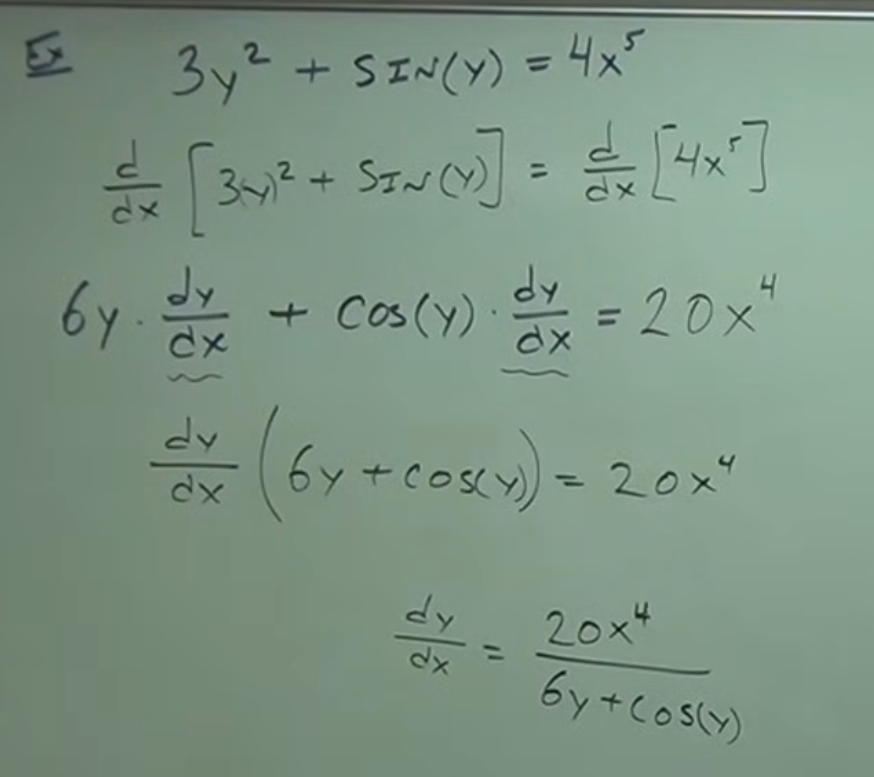
- ꜱ̲ᴛ̲ᴇ̲ᴩ̲ 1: Differentiate both sides with respect to 𝒙
- $\dfrac{d}{d𝒙}\big[3𝐲^{2}+\sin(𝐲)\big]=\dfrac{d}{d𝒙}[4𝒙^{5}]$
- $6𝐲\cdot\dfrac{d𝐲}{d𝒙}+\cos(𝐲)\cdot\dfrac{d𝐲}{d𝒙}=20𝒙^{4}$ # Apply the chain
rule to both terms with 𝐲
- $\dfrac{d𝐲}{d𝒙}\cdot\big(6𝐲+\cos(𝐲)\big)=20𝒙^{4}$ # Factor out 𝒅𝐲/𝒅𝒙
- ꜱ̲ᴛ̲ᴇ̲ᴩ̲ 2: Solve the equation for $\dfrac{d𝑦}{d𝒙}$.
- $\dfrac{d𝐲}{d𝒙}=\dfrac{20𝒙^{4}}{\,6𝐲+\cos(𝐲)\,}$
- [28:52]. The key idea is to remember that you always obtain a $\dfrac{d𝑦}{d𝒙}$ when
differentiating 𝐲.
- [30:50]. Implicit differentiation is simply differentiating without being able to
solve for 𝐲.
- implicit differentiation is used when you cannot (or do not) solve for 𝐲 explicitly
in terms of 𝒙.
Instead, you differentiate both sides of an equation as they are, treating 𝐲 as a function of 𝒙
(i.e., $𝐲=𝐲(𝒙)$) and applying the chain rule where necessary.
- [31:28]. 🧩 Example –: $𝒙\cdot 𝐲=1$ –
[📷image]
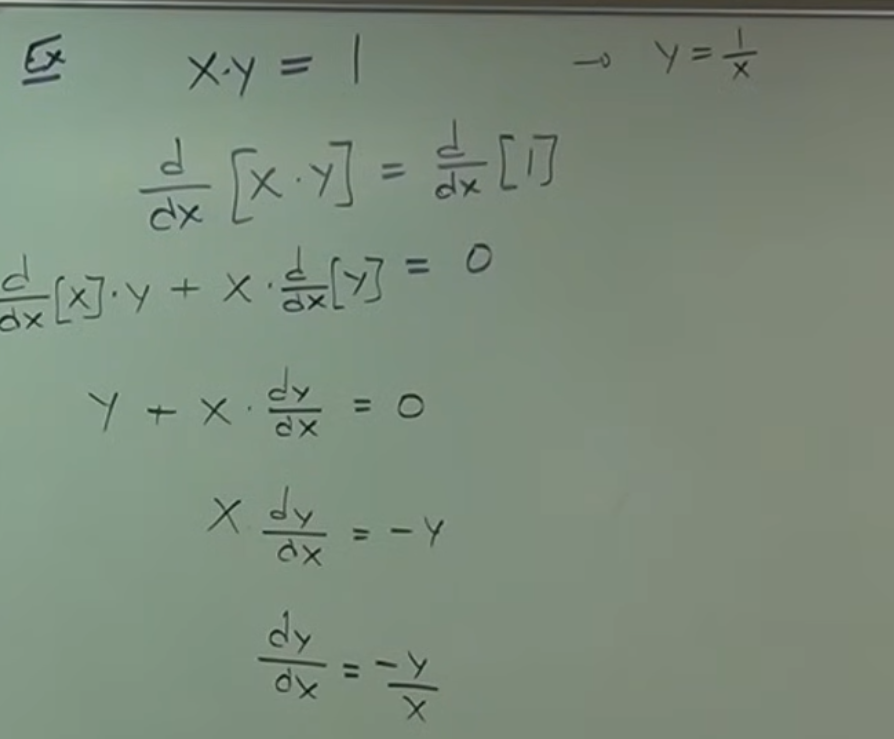
- You must use the product rule when differentiating $𝒙\cdot 𝐲$.
- ꜱ̲ᴛ̲ᴇ̲ᴩ̲ 1: Differentiate both sides of the equation with respect to 𝑥
- $𝐲+𝒙\cdot\dfrac{d𝑦}{d𝒙}=0$
- ꜱ̲ᴛ̲ᴇ̲ᴩ̲ 2: Solve the equation for $\dfrac{d𝑦}{d𝒙}$.
- $\dfrac{d𝑦}{d𝒙}=-\dfrac{𝐲}{𝒙}$
- ꜱ̲ᴛ̲ᴇ̲ᴩ̲ 3: Convert the implicit derivative to explicit form.
- $𝒙\cdot 𝐲=1 \;\Rightarrow\; 𝐲=\dfrac{1}{𝒙}$
- substitute the solutions for 𝑦 from the original equation.
- $\dfrac{d𝑦}{d𝒙}=-\dfrac{𝐲}{𝒙} \;\Rightarrow\;
\dfrac{d𝑦}{d𝒙}=-\dfrac{(1/𝒙)}{𝒙}=-\dfrac{1}{𝒙^{2}}$
- [36:00]. In implicit differentiation, you must identify when to apply the product rule
or the quotient rule.
Second derivative of an implicit function
- [36:12]. 🧩 Example –: $3𝒙^{2}-𝐲^{2}=16$ –
[📷image]
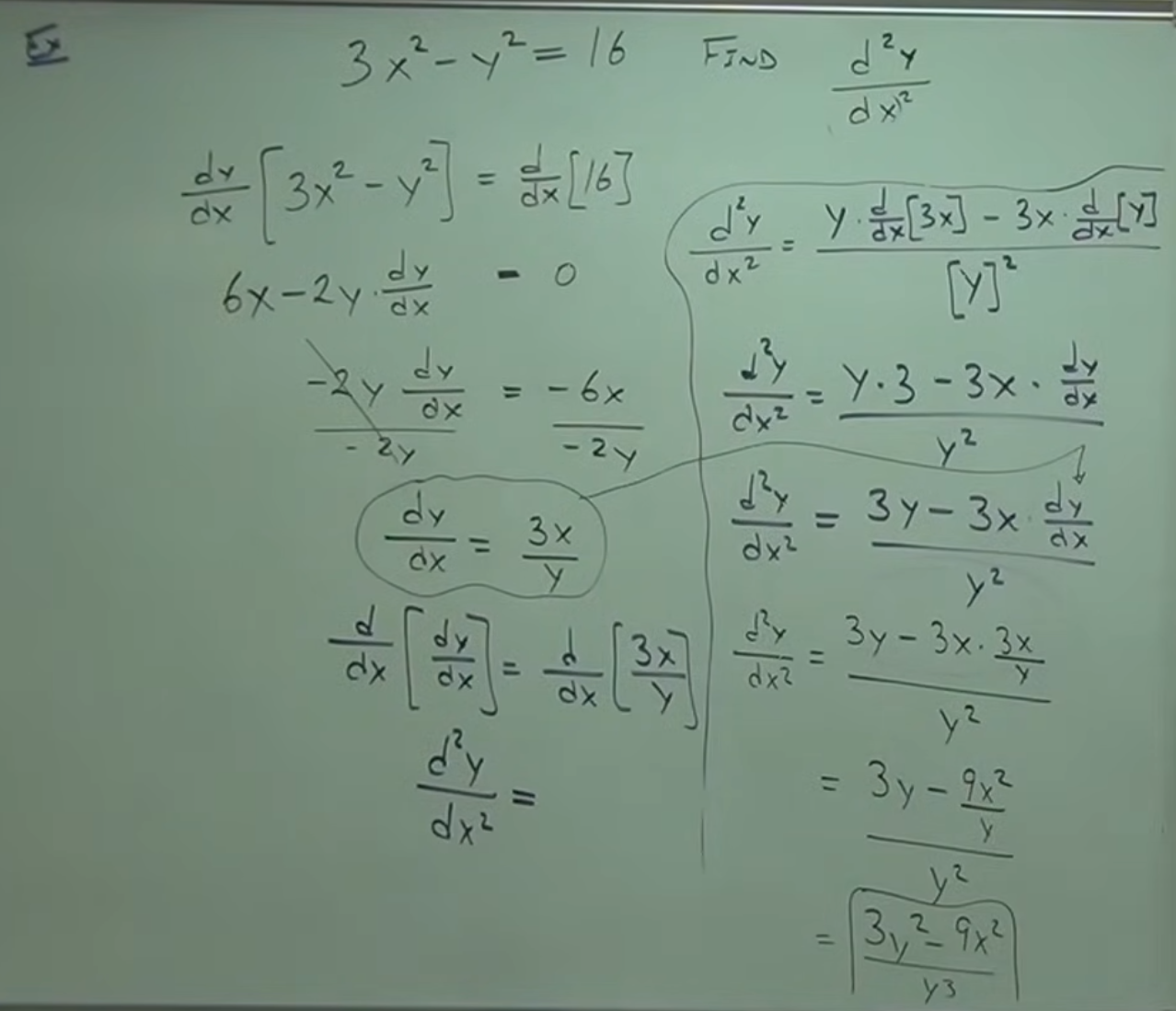
- Find the first derivative
- $\dfrac{d}{d𝒙}[\,3𝒙^{2}-𝐲^{2}\,]=\dfrac{d}{d𝒙}[16]$
- $6𝒙-2𝐲\cdot\dfrac{d𝐲}{d𝒙}=0$
- $-2𝐲\cdot\dfrac{d𝐲}{d𝒙}=-6𝒙$
- $\dfrac{d𝐲}{d𝒙}=\dfrac{3𝒙}{𝐲}$
- [38:06]. To find the second derivative, differentiate the first derivative with
respect to 𝒙.
- Use the notation $\dfrac{d^{2}𝐲}{d𝒙^{2}}$ for the second derivative.
- Apply the quotient rule:
- $\dfrac{d}{d𝒙}\Big[\dfrac{d𝐲}{d𝒙}\Big]=\dfrac{d}{d𝒙}\Big[\dfrac{3𝒙}{𝐲}\Big]$
-
$\dfrac{d^{2}𝐲}{d𝒙^{2}}=\dfrac{\,𝐲\cdot\dfrac{d}{d𝒙}(3𝒙)-3𝒙\cdot\dfrac{d}{d𝒙}(𝐲)\,}{𝐲^{2}}$
- $\dfrac{d^{2}𝐲}{d𝒙^{2}}=\dfrac{\,𝐲\cdot 3-3𝒙\cdot\dfrac{d𝐲}{d𝒙}\,}{𝐲^{2}}$
- Substitute the expression found for $\dfrac{d𝐲}{d𝒙}$:
-
$\dfrac{d^{2}𝐲}{d𝒙^{2}}=\dfrac{\,3𝐲-3𝒙\cdot\big(\dfrac{3𝒙}{𝐲}\big)\,}{𝐲^{2}}$
- $\dfrac{d^{2}𝐲}{d𝒙^{2}}=\dfrac{\,3𝐲-\dfrac{9𝒙^{2}}{𝐲}\,}{𝐲^{2}}$
- Simplify the result:
- $\dfrac{d^{2}𝐲}{d𝒙^{2}}=\dfrac{3𝐲^{2}-9𝒙^{2}}{𝐲^{3}}$ # We write $3𝐲$ as
$3𝐲=\dfrac{3𝐲^{2}}{𝐲}$ to obtain a common denominator.
Geometric interpretation of the implicit derivative
- [44:22]. 🧩 Example – : Find the slopes at $(2,-1)$ and $(2,1)$ for $𝐲^{2}-𝒙+1=0$ –
[📷image]
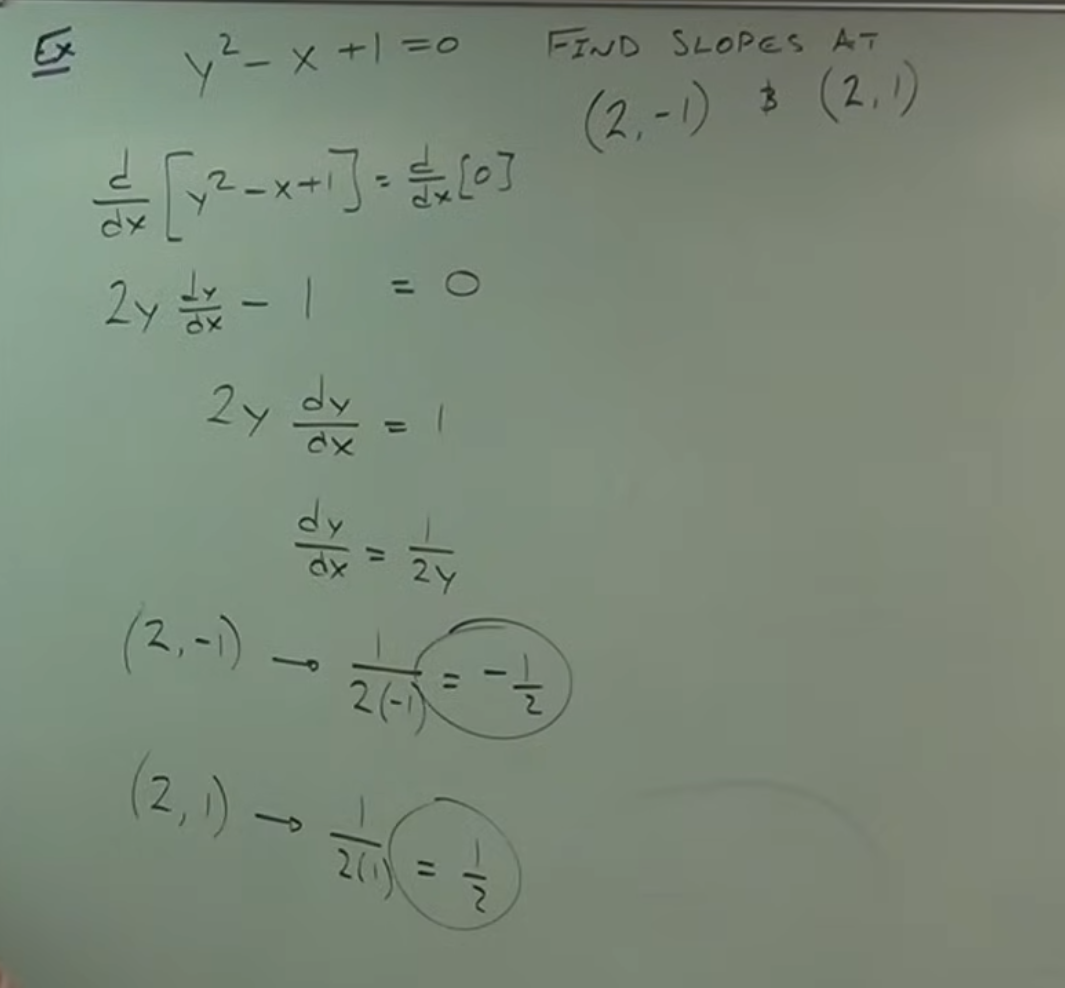
- Differentiate both sides with respect to 𝒙:
- $\dfrac{d}{d𝒙}[\,𝐲^{2}-𝒙+1\,]=\dfrac{d}{d𝒙}[0]$ # Differentiate both sides
- $2𝐲\cdot\dfrac{d𝐲}{d𝒙}-1=0$ # Chain rule for $𝐲^{2}$, derivative of 𝒙 is $1$
- $2𝐲\cdot\dfrac{d𝐲}{d𝒙}=1$
- $\dfrac{d𝐲}{d𝒙}=\dfrac{1}{2𝐲}$ # Isolate 𝒅𝐲/𝒅𝒙
- Evaluate the slope at $(2,-1)$:
- $\dfrac{d𝐲}{d𝒙}\Big|_{(2,-1)}=\dfrac{1}{2\cdot(-1)}=-\dfrac{1}{2}$ # Substitute
$𝐲=-1$
- Evaluate the slope at $(2,1)$:
- $\dfrac{d𝐲}{d𝒙}\Big|_{(2,1)}=\dfrac{1}{2\cdot 1}=\dfrac{1}{2}$ # Substitute $𝐲=1$
- Comment:
- In implicit differentiation, the slope at a point can depend on both 𝒙 and 𝐲.
- Here, the derivative formula $\dfrac{d𝐲}{d𝒙}=\dfrac{1}{2𝐲}$ shows that the slope
only depends on the 𝐲 value.
- So, for each point, substitute the corresponding 𝐲 to find the slope.
Equation of the tangent line to an implicit curve
- [47:28]. Implicit differentiation can be used to find the equation of the tangent line to
a curve at a given point.
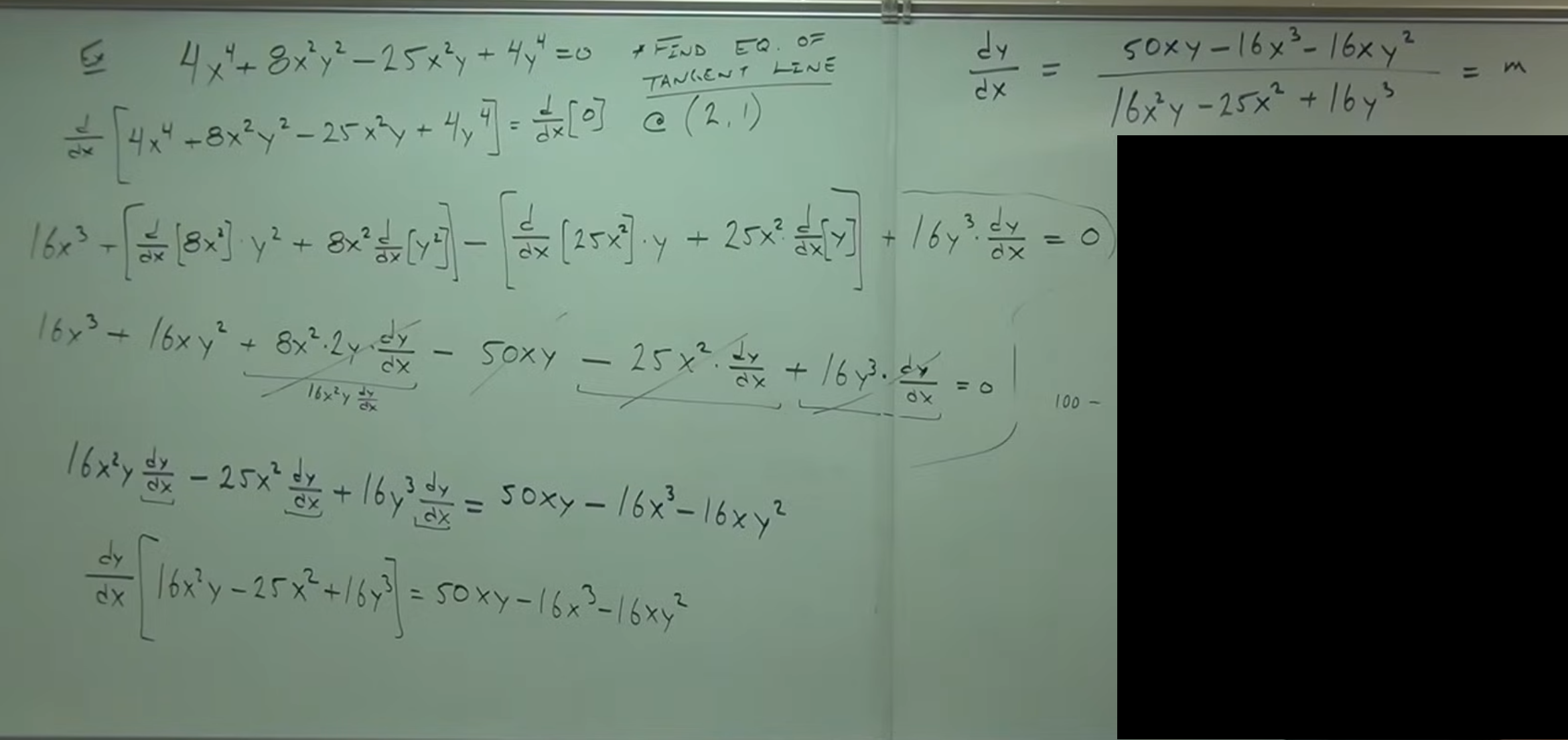
- [48:01]. 🧩 Example –: $4𝒙^{4}+8𝒙^{2}𝐲^{2}-25𝒙^{2}𝐲+16𝐲^{4}=0$ obtain the slope of
the tangent line at the point $(2,1)$. –
[📷image-1]
 –
[📷image-2]
–
[📷image-2]
- Differentiate both sides with respect to 𝒙:
-
$\dfrac{d}{d𝒙}\big[\,4𝒙^{4}+8𝒙^{2}𝐲^{2}-25𝒙^{2}𝐲+4𝐲^{4}\,\big]=\dfrac{d}{d𝒙}[0]$ # Differentiate
term by term
- Apply the product and chain rules to each term:
-
$16𝒙^{3}+\dfrac{d}{d𝒙}[8𝒙^{2}𝐲^{2}]-\dfrac{d}{d𝒙}[25𝒙^{2}𝐲]+\dfrac{d}{d𝒙}[4𝐲^{4}]=0$
- $16𝒙^{3}+16𝒙𝐲^{2}+8𝒙^{2}\cdot 2𝐲\cdot\dfrac{d𝐲}{d𝒙}-(25\cdot
2𝒙𝐲+25𝒙^{2}\cdot\dfrac{d𝐲}{d𝒙})+16𝐲^{3}\cdot\dfrac{d𝐲}{d𝒙}=0$
-
$16𝒙^{3}+16𝒙𝐲^{2}\cdot\dfrac{d𝐲}{d𝒙}-50𝒙𝐲-25𝒙^{2}\cdot\dfrac{d𝐲}{d𝒙}+16𝐲^{3}\cdot\dfrac{d𝐲}{d𝒙}=0$
# Collect all terms with 𝒅𝐲/𝒅𝒙
- Collect all terms with $\dfrac{d𝐲}{d𝒙}$ to one side:
- $(16𝒙^{2}𝐲-25𝒙^{2}+16𝐲^{3})\cdot\dfrac{d𝐲}{d𝒙}=50𝒙𝐲-16𝒙^{3}-16𝒙𝐲^{2}$ #
Move other terms to the right
- Solve for $\dfrac{d𝐲}{d𝒙}$:
-
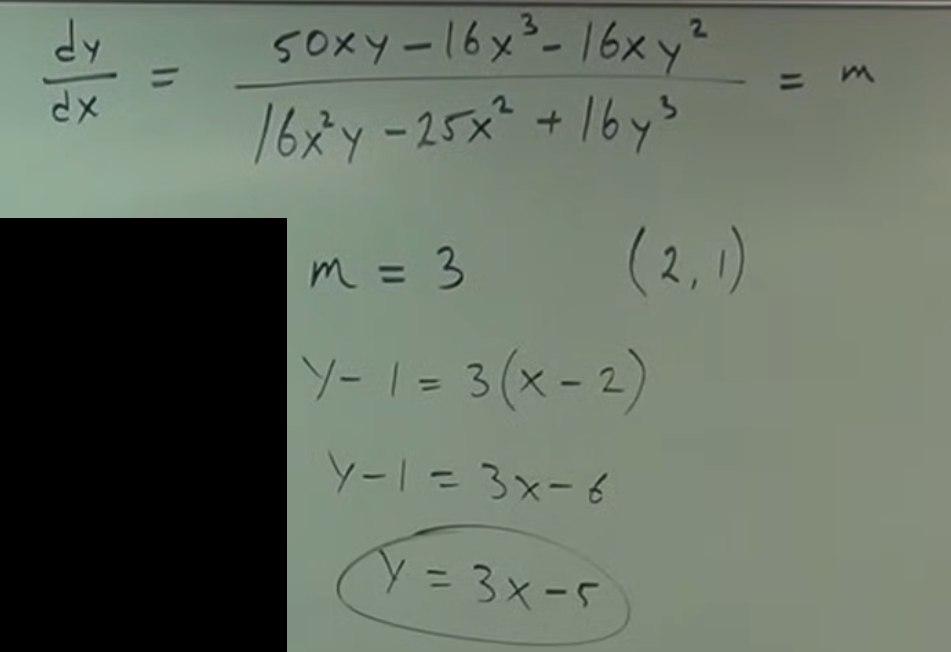
$\dfrac{d𝐲}{d𝒙}=\dfrac{\,50𝒙𝐲-16𝒙^{3}-16𝒙𝐲^{2}\,}{\,16𝒙^{2}𝐲-25𝒙^{2}+16𝐲^{3}\,}$ # This is
the implicit derivative
- This result gives the slope of the tangent line at any point $(𝒙,𝐲)$ on the curve.
- Evaluate $\dfrac{d𝑦}{d𝑥}$ at the point $(2,1)$ to obtain the slope of the tangent line.
- At the point $(2,1)$:
- $\dfrac{d𝐲}{d𝒙}=\dfrac{50\cdot 2\cdot 1-16\cdot 8-16\cdot 2\cdot 1}{16\cdot
4\cdot 1-25\cdot 4+16\cdot 1}$
- $=\dfrac{100-128-32}{64-100+16}$
- $=\dfrac{-60}{-20}$
- $=3$
- So, $m=3$ # Slope at $(2,1)$
- Use the point-slope formula to find the equation of the tangent line.
- Equation of the tangent line at $(2,1)$:
- Use point-slope form:
$𝐲-1=3(𝒙-2)$
- Simplify:
$𝐲-1=3𝒙-6$
$𝐲=3𝒙-5$ # Final equation of the tangent line at $(2,1)$
Related rates
- [1:07:21]. Introduction to the concept of related rates: word problems involving implicit
derivatives.
- Techniques for solving related rates problems will be presented in the next session.