Calculus 1 lecture 2.8 Related Rates
Introduction to the concept of related rates
- [0:00]. Definition and examples.
- Definition of related rates: how a formula relates to its change over time.
- Examples:
- Cost as a function of time.
- Profit as a function of time.
- Volume in expansion or contraction as a function of time.
- Objective of related rates: relating a formula to time.
Introductory example: cone with water leak
-
[📷image]
- [1:05]. Description and variables.
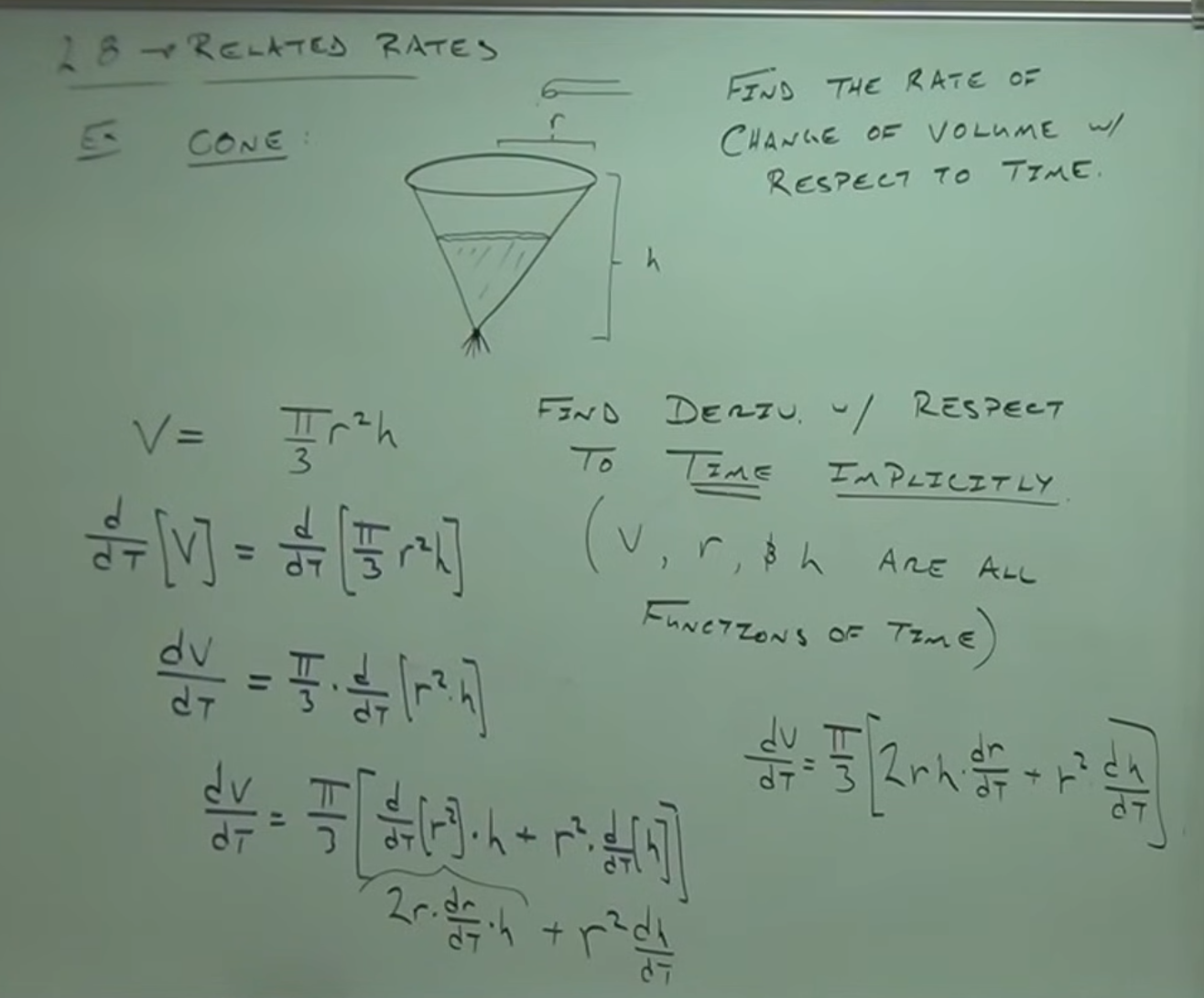
- Description of the problem:
- A cone with a water leak at the bottom.
- The water level in the cone changes over time.
- Variables to consider:
- Height of the water ($𝒉$).
- Radius of the water surface ($𝒓$).
- [2:45]. Objective: Find the rate of change of the volume of water with respect to time
($\dfrac{d𝓥}{d𝓉}$).
- [3:34]. Considerations:
- The height ($𝒉$) and radius ($𝒓$) of the water change as the water drains.
- The volume of water ($𝓥$) depends on $𝒉$ and $𝒓$, and thus also changes over time.
- [4:13]. Steps to Solve the Problem:
- Step 1: Find a formula that relates the involved variables.
- In this case, the formula for the volume of a cone: $𝓥=\dfrac{\pi}{3}𝒓^{2}𝒉$.
- [5:35] Step 2: Differentiate the formula implicitly with respect to time ($𝓉$).
- Justification: Volume ($𝓥$), radius ($𝒓$), and height ($𝒉$) are functions of
time.
- Use the chain rule to differentiate each variable with respect to $𝓉$, resulting
in
terms like $\dfrac{d𝓥}{d𝓉}$, $\dfrac{d𝒓}{d𝓉}$, and $\dfrac{d𝒉}{d𝓉}$.
- Take advantage of Implicit Differentiation
- Why Use Implicit Differentiation in Related Rates.
- Many related rates problems present relationships where variables cannot
be easily isolated.
- Implicit differentiation allows us to handle these complexities by:
- Treating dependent variables (like $𝐲$) as functions of independent
variables (like $𝒙$ or $𝓉$).
- Applying the chain rule to account for the interdependence of
variables.
- Example Insight: In the cone with a water leak example, the
volume $𝓥$ depends on both the radius $𝒓$ and the height $𝒉$,
which are themselves changing over time. Implicit differentiation
facilitates finding how $𝓥$ changes with time
without needing to isolate $𝒓$ or $𝒉$.
- [8:27]. Interpretation of the Derivative Terms:
- $\dfrac{d}{d𝓉}[𝓥]=\dfrac{d}{d𝓉}\!\Big[\dfrac{\pi}{3}𝒓^{2}𝒉\Big]$
- $\dfrac{d𝓥}{d𝓉}$: Rate of change of volume with respect to time; $𝓥$ is a
function of $𝓉$; describes how the volume is changing with respect to time.
- $\dfrac{d𝒓}{d𝓉}$: Rate of change of radius with respect to time; $𝒓$ is a
function of $𝓉$; describes how the radius is changing with respect to time.
- $\dfrac{d𝒉}{d𝓉}$: Rate of change of height with respect to time; $𝒉$ is a
function of $𝓉$; describes how the height is changing with respect to time.
- [10:00]. Use of the product rule when differentiating the volume formula.
- $\dfrac{d}{d𝓉}[𝓥]=\dfrac{d}{d𝓉}\!\Big[\dfrac{\pi}{3}𝒓^{2}𝒉\Big]$
- Differentiate implicitly, as $r$ and $h$ depend on $t$
- $\dfrac{d𝓥}{d𝓉}=\dfrac{\pi}{3}\cdot\dfrac{d}{d𝓉}[𝒓^{2}𝒉]$ # Constants can be
factored out
- $\dfrac{d𝓥}{d𝓉}=\dfrac{\pi}{3}\cdot\Big[\,\dfrac{d}{d𝓉}(𝒓^{2})\cdot
𝒉+𝒓^{2}\cdot\dfrac{d𝒉}{d𝓉}\,\Big]$ # Product rule: $\dfrac{d}{d𝓉}[uv]=\dfrac{d}{d𝓉}[u]\cdot
v+u\cdot\dfrac{d}{d𝓉}[v]$
- $\dfrac{d}{d𝓉}(𝒓^{2})=2𝒓\cdot\dfrac{d𝒓}{d𝓉}$ # Chain rule, since
$𝒓=𝒓(𝓉)$
- $\dfrac{d𝓥}{d𝓉}=\dfrac{\pi}{3}\cdot\Big[\,2𝒓\cdot\dfrac{d𝒓}{d𝓉}\cdot
𝒉+𝒓^{2}\cdot\dfrac{d𝒉}{d𝓉}\,\Big]$ # Substitute the result above
-
$\dfrac{d𝓥}{d𝓉}=\dfrac{\pi}{3}\Big[\,2𝒓𝒉\cdot\dfrac{d𝒓}{d𝓉}+𝒓^{2}\cdot\dfrac{d𝒉}{d𝓉}\,\Big]$
# This gives the rate of change of volume in terms of rates of $r$ and $h$
- [13:33]. Information Needed to Solve the Problem:
- Value of the radius ($𝒓$) at a given moment.
- Value of the height ($𝒉$) at a given moment.
- Rate of change of the radius ($\dfrac{d𝒓}{d𝓉}$).
- Rate of change of the height ($\dfrac{d𝒉}{d𝓉}$).
- [14:54]. Transition to Simpler Examples to Illustrate the Concept of Related Rates.
– [📷image]
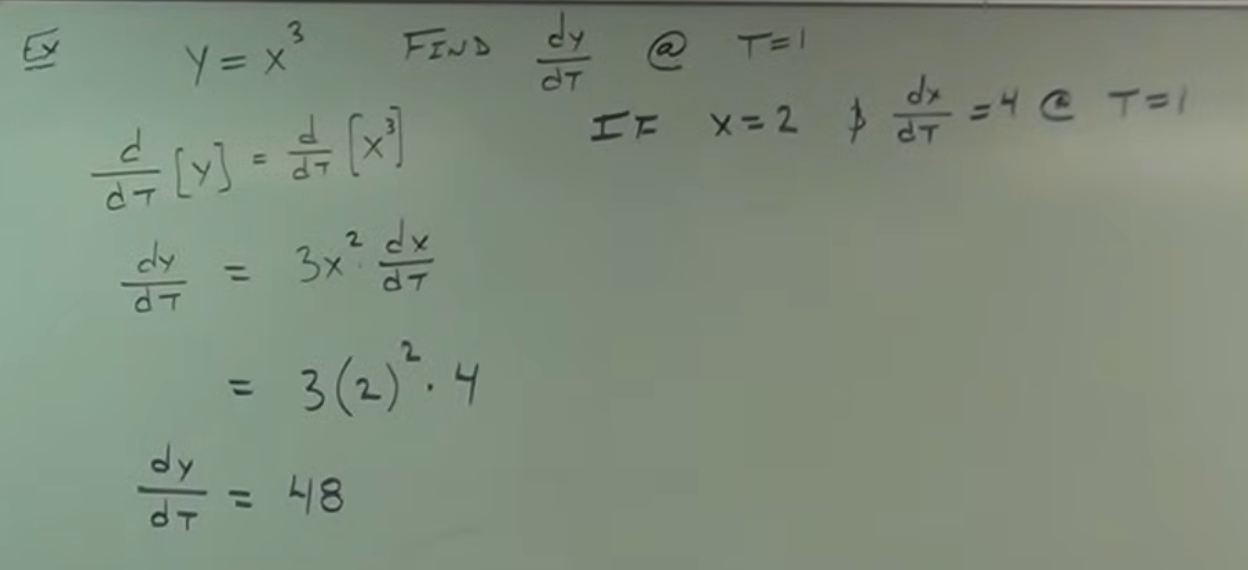
- [15:26]. 🧩 Example –: Find $\dfrac{d𝑦}{d𝓉}$ when $𝑦=𝒙^{3}$ at $𝓉=1$
- Assume that $𝑦$ and $𝒙$ are functions of time ($𝓉$).
- Differentiate the equation implicitly with respect to $𝓉$, resulting in
$\dfrac{d𝑦}{d𝓉}=3𝒙^{2}\cdot\dfrac{d𝒙}{d𝓉}$
- [17:34]. Additional Information Needed!:
- Value of $𝒙$ at a given moment (e.g., $𝓉=1$) and value of
$\dfrac{d𝒙}{d𝓉}$ at the same moment (e.g., $𝓉=1$).
- Find this out: If $𝒙=2$ and $\dfrac{d𝒙}{d𝓉}=4$ at $𝓉=1$.
- What is happening at $𝓉=1$?
- $\dfrac{d𝒙}{d𝓉}=4$ "The variable $𝒙$ is changing with
respect to time $𝓉$ at a rate of 4 units per unit of time."
- The actual position is $𝒙=2$
- $\dfrac{d𝑦}{d𝓉}=3\cdot(2)^{2}\cdot 4=3\cdot 4\cdot 4=48$
- So, at $𝓉=1$, $\dfrac{d𝑦}{d𝓉}=48$
🧩Example: oil spill
-
[📷image]
- [19:46]. Description ad objective of the problem:
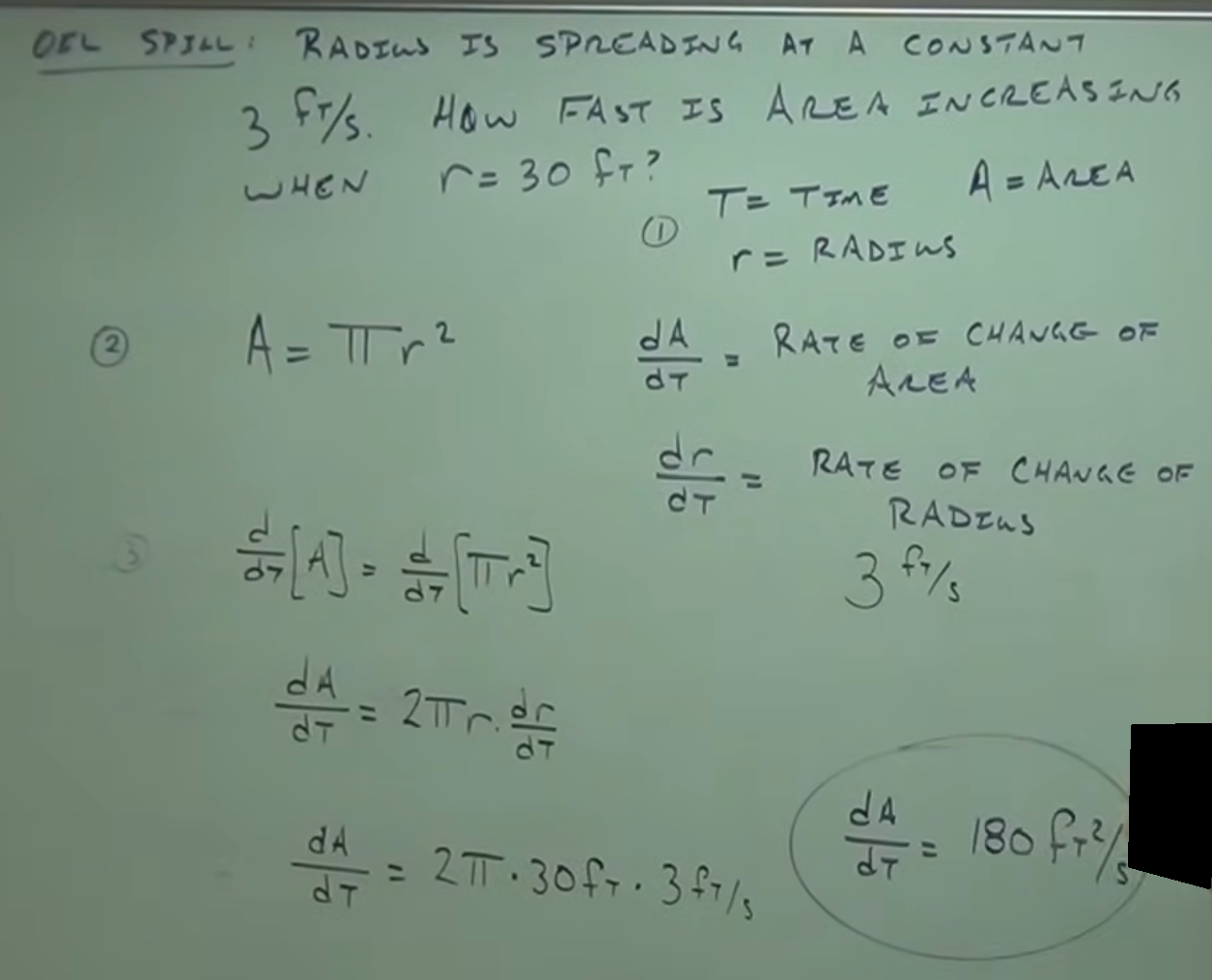
- An oil spill is expanding in a circular shape.
- The radius of the spill is increasing at a constant rate of 3 feet (0.91 m) per
second.
- Objective: Determine how quickly the area of the spill is increasing when the
radius is 30 feet (9.14 m).
- [23:19]. Steps to Solve the Problem:
- Step 1: Assign letters to the variables:
- $𝓉$ for time.
- $𝓐$ for area.
- $𝒓$ for radius.
- Step 2: Identify the formula that relates the variables:
- In this case, the area of a circle: $𝓐=\pi 𝒓^{2}$.
- Step 3: Identify the given rates in the problem:
- $\dfrac{d𝒓}{d𝓉}=3$ feet per second (rate of change of the radius).
- $\dfrac{d𝓐}{d𝓉}$ rate of change of area
- [27:12]. Step 6: Differentiate the formula implicitly with respect to time
($𝓉$):
- $\dfrac{d𝓐}{d𝓉}=2\pi 𝒓\cdot\dfrac{d𝒓}{d𝓉}$
- Step 5: Substitute the known values into the differentiated equation and solve for
the unknown rate of change ($\dfrac{d𝓐}{d𝓉}$):
- $\dfrac{d𝓐}{d𝓉}=2\pi\cdot (30\ \text{feet})\cdot\big(3\
\text{feet/second}\big)=180\pi\ \text{square feet per second}.$
🧩Example: camera following a rocket
-
[📷image-1]
 – [📷image-2]
- [30:18]. Description ad objective of the problem.
- Description of the problem:
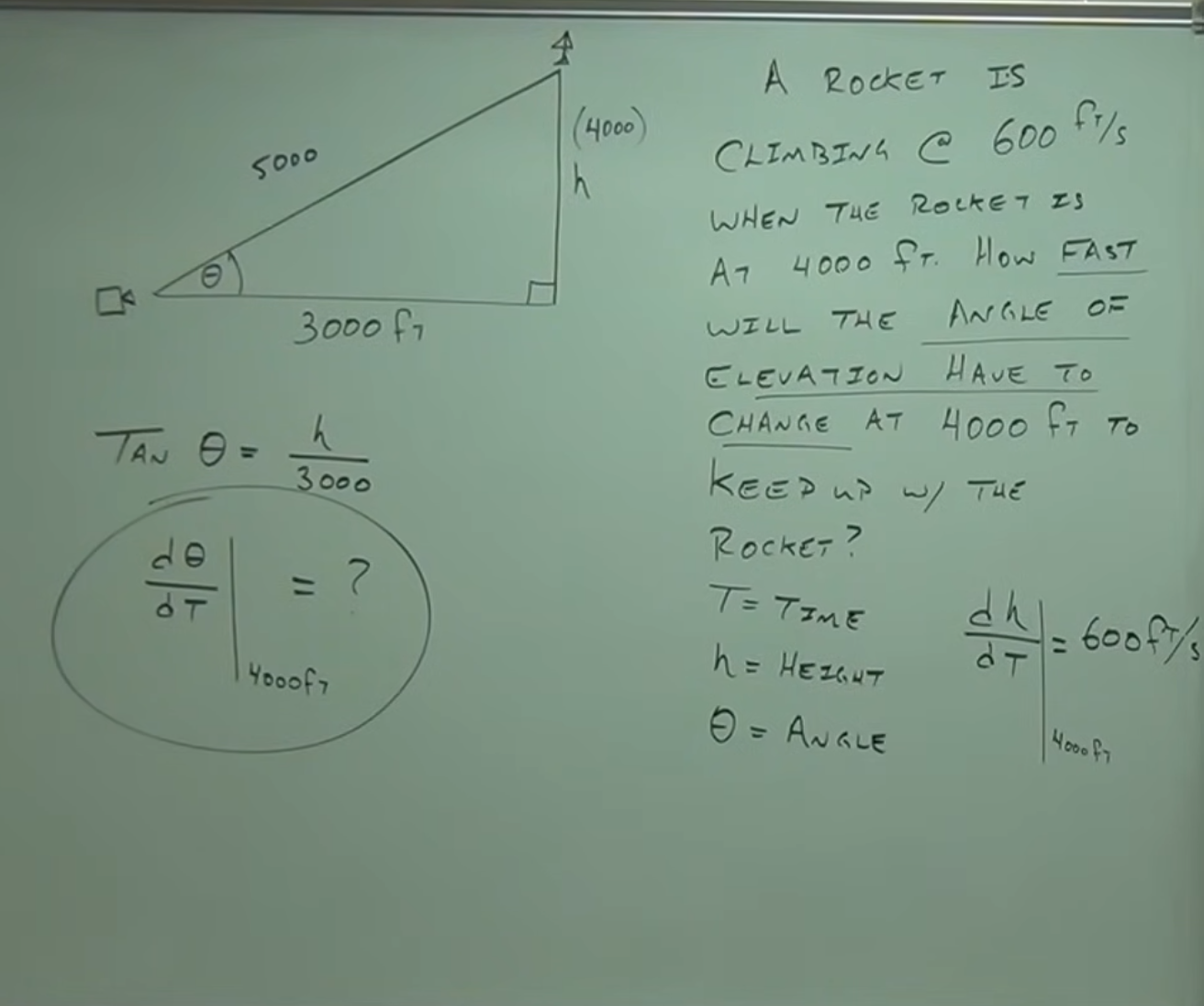
- A rocket is launched from the ground vertically.
- A camera on the ground must follow the rocket by adjusting its elevation
angle.
It is a distance of 3000 feet (0.91 km) from the rocket.
- The rocket ascends at a speed of 600 feet (0.18 km) per second when the
rocket is at 4000 feet (1.22 km).
- Objective: Determine how quickly the elevation angle of the camera must change
to keep the rocket centered
in the frame when the rocket is 4000 feet high.
- [31:43]. Considerations:
- The height of the rocket ($𝒉$) changes over time.
- The elevation angle of the camera ($\theta$) must change to follow the rocket.
- [32:29]. Steps to Solve the Problem:
- Step 1: Assign letters to the variables:
- $𝓉$ for time.
- $𝒉$ for the height of the rocket.
- $\theta$ for the elevation angle of the camera.
- Step 2: Find a formula that relates the variables:
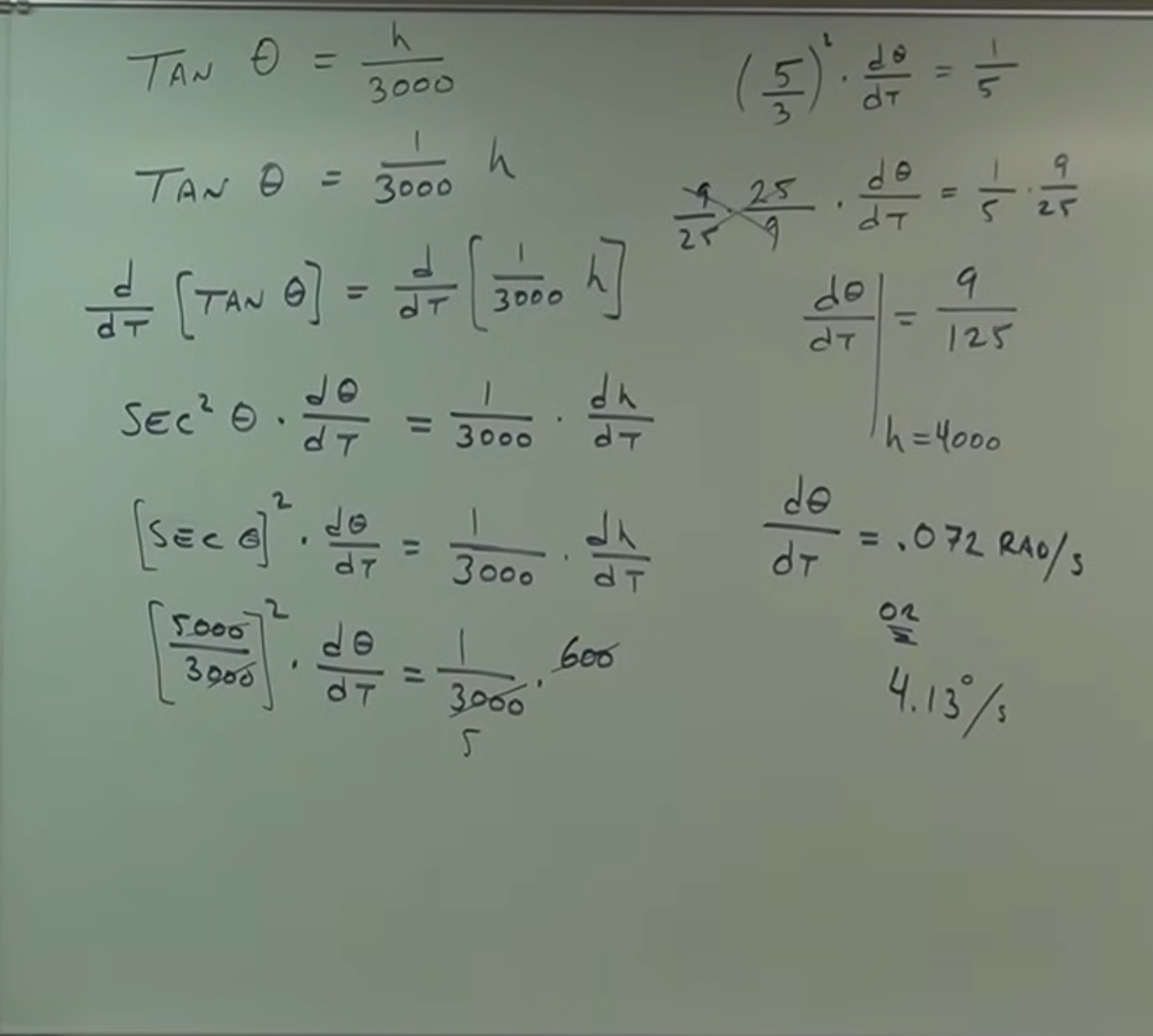
- Use the tangent function: $\tan(\theta)=\dfrac{𝒉}{3000}$
(where $3000$ is the constant horizontal distance between the camera and the launch point).
- [36:30]. Step 3: Identify the given rates in the problem:
- $\dfrac{d𝒉}{d𝓉}=600$ feet (0.18 km) per second (rate of change of the
rocket's height) when $𝒉=4000$ feet (1.22 km).
- $\dfrac{d\theta}{d𝓉}$ rate of change of angle of the camera.
- [42:32]. Step 4: Differentiate the formula implicitly with respect to time
($𝓉$):
-
$\dfrac{d}{d𝓉}\big[\tan(\theta)\big]=\dfrac{d}{d𝓉}\!\Big[\dfrac{1}{3000}\cdot 𝒉\Big]$
-
$\sec^{2}(\theta)\cdot\dfrac{d\theta}{d𝓉}=\dfrac{1}{3000}\cdot\dfrac{d𝒉}{d𝓉}$
- [44:40]. Step 5: Determine the value of $\sec^{2}(\theta)$ when the rocket's
height is 4000 feet (1.22 km):
- Use the Pythagorean theorem to calculate the hypotenuse of the right
triangle formed by the rocket, the camera, and the ground.
- The rocket is $4{,}000$ feet high.
-
$\text{hypotenuse}^{2}=4000^{2}+3000^{2}\;\Rightarrow\;\text{hypotenuse}=5000$ feet
- Use the definition of secant ($\sec(\theta)=1/\cos(\theta)$) to calculate
$\sec(\theta)$.
- $\cos(\theta)=\dfrac{3000}{5000}=\dfrac{3}{5}\;\Rightarrow\;
\sec(\theta)=\dfrac{5}{3}$
- Step 6: Substitute the known values into the differentiated equation and solve
for the unknown rate of change ($\dfrac{d\theta}{d𝓉}$):
- $\dfrac{d\theta}{d𝓉}=\dfrac{\big(\dfrac{1}{3000}\big)\big(600\
\text{feet/second}\big)}{\big(\dfrac{5}{3}\big)^{2}}=\dfrac{9}{125}\ \text{radians/second}$
(when the height is $4000$ feet)
- Convert the rate of change to degrees per second: $\big(\dfrac{9}{125}\
\text{radians/second}\big)\cdot\dfrac{180^\circ}{\pi}\approx 4.13^\circ/\text{second}$