Calculus 1 lecture 3.1 Increasing / Decreasing and Concavity of functions
Increasing and decreasing intervals
- [0:47]. Definition of increasing and decreasing intervals.
– [📷image]
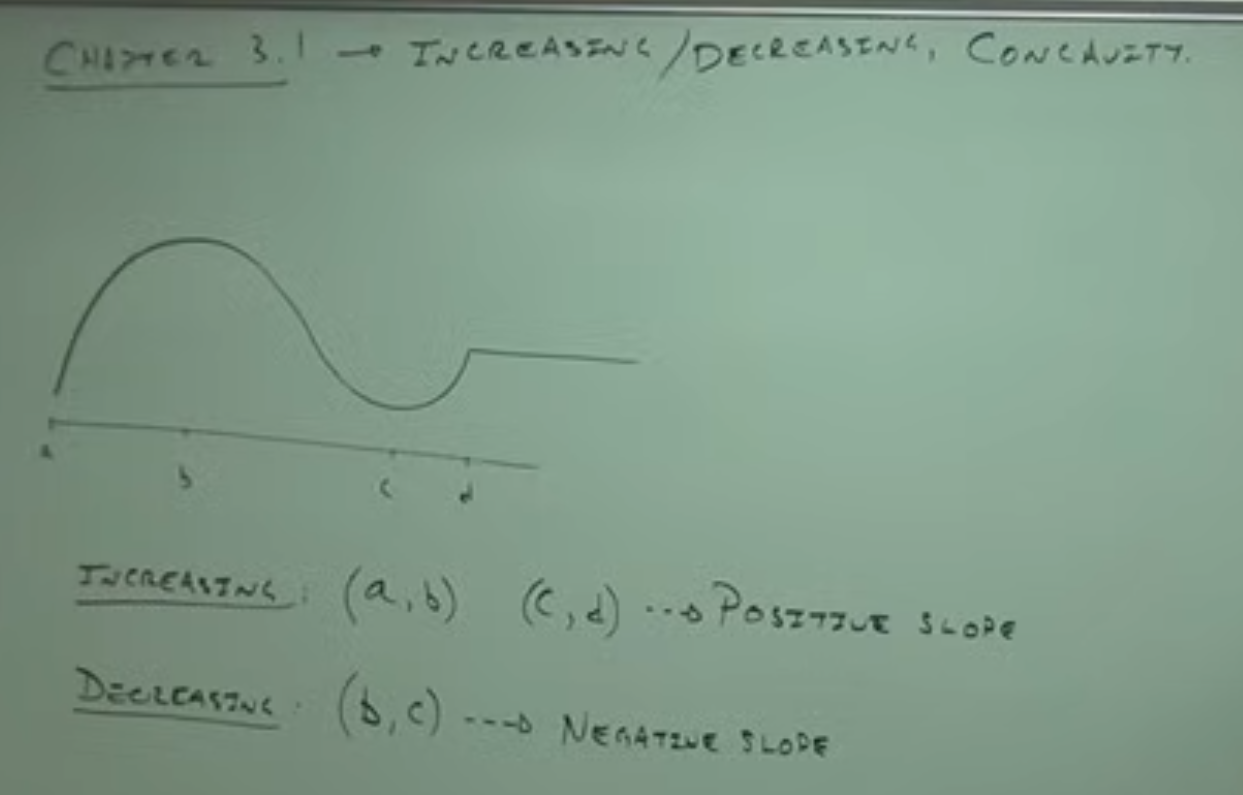
- Graphical Example: Identifying intervals where the function rises or falls when
reading the graph from left to right along 𝒙-axses
- Increasing and decreasing intervals.
- [3:05]. Relationship between the slope and increasing/decreasing intervals.
- Analysis of the slope at each point within increasing and decreasing intervals.
- An increasing interval has a positive slope (↗) and a decreasing interval has a
negative slope (↘).
- [5:56]. Formalization of the concept of increasing/decreasing intervals using the
derivative.
– [📷image]
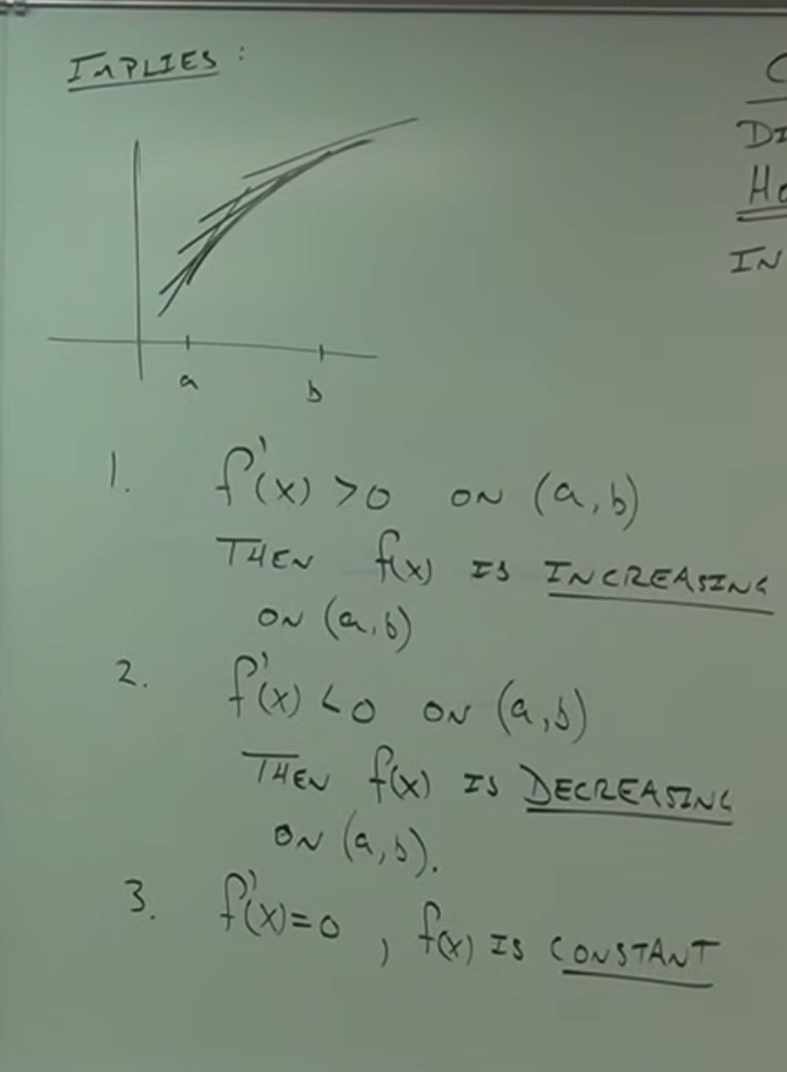
- If $𝒇'(𝒙)>0$ in an interval, then $𝒇(𝒙)$ is increasing in that interval.
- If $𝒇'(𝒙)<0$ in an interval, then $𝒇(𝒙)$ is decreasing in that interval.
- If $𝒇'(𝒙)=0$ at a point or interval, then $𝒇(𝒙)$ is constant at that point or
interval.
- Typically there will be a change from increasing to decreasing or vice versa.
- Sign analysis: Checking the sign of $𝒇'(𝒙)$ to find where $𝒇(𝒙)$ goes up,
down, or stays flat.
Concavity and points of inflection
- [9:53]. Definition of concavity: The direction of the curve's curvature.
- Concavity describes how the slope of the function changes.
- How a slope of a curve is increasing or decreasing.
- increasing changing positively.
- Decresing changing megatively.
- [11:15]. Graph example: Two different directions of a curve's curvature in a
increasing function.
– [📷image]
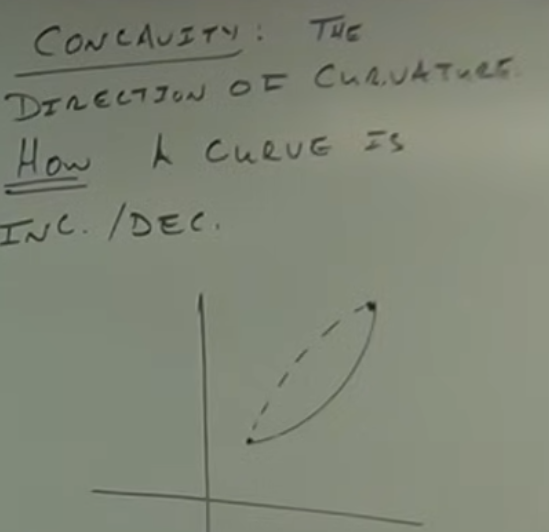
- ◞ → Increasing curve, accelerating (concave up)
- ◜ → Increasing curve, decelerating (concave down)
- [13:35]. Relationship between the second derivative and concavity.
– [📷image]
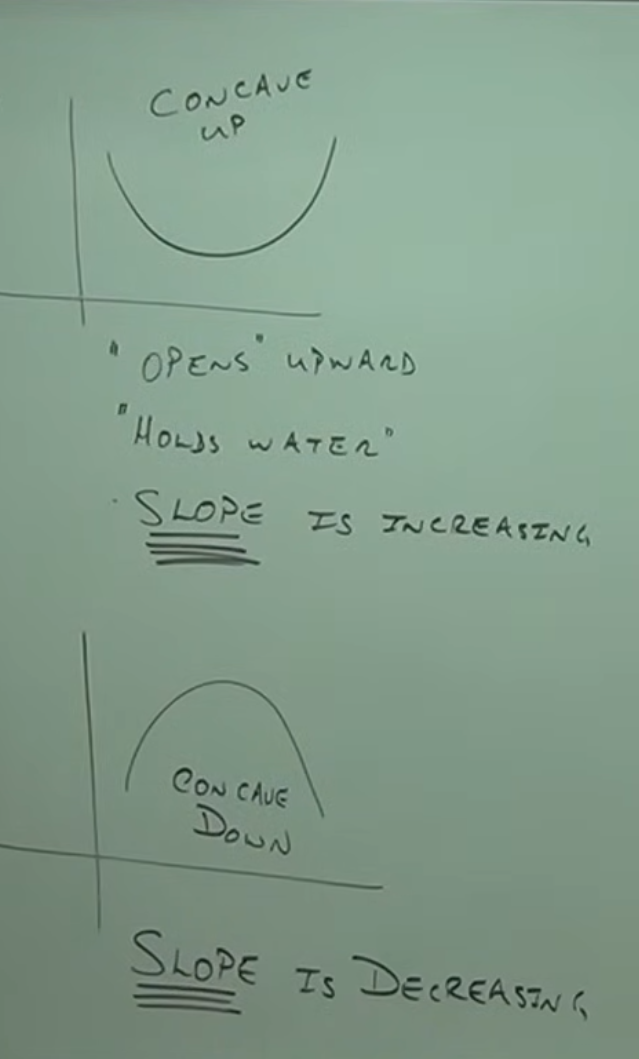
- The second derivative represents the rate of change of the slope.
- Types of Concavity:
- ᴄᴏɴᴄᴀᴠᴇ ᴜᴩ
- Description: The graph of the function curves upward, resembling a cup (U) .
- Second Derivative: Positive ($𝒇''(𝒙)>0$)
- Slope Behavior: The slope of the function is increasing.
- Example: $𝒇(𝒙)=𝒙^{2}$
- ᴄᴏɴᴄᴀᴠᴇ ᴅᴏᴡɴ
- Description: The graph of the function curves downward, resembling a cap (∩).
- Second Derivative: Negative ($𝒇''(𝒙)<0$)
- Slope Behavior: The slope of the function is decreasing.
- Example: $𝒇(𝒙)=-𝒙^{2}$
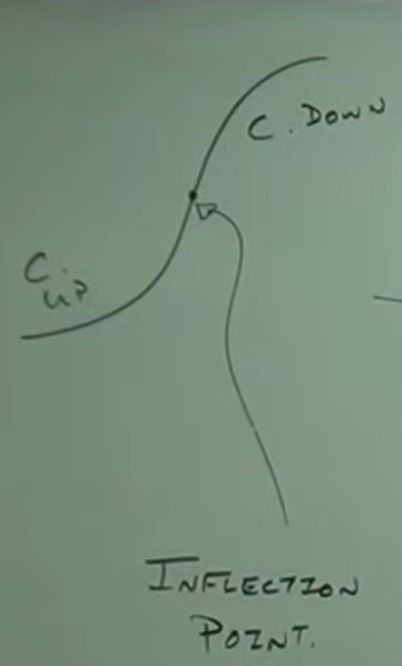
- [18:30]. Points of inflection: Points where the curve changes
concavity.
– [📷image-1]
 – [📷image-2]
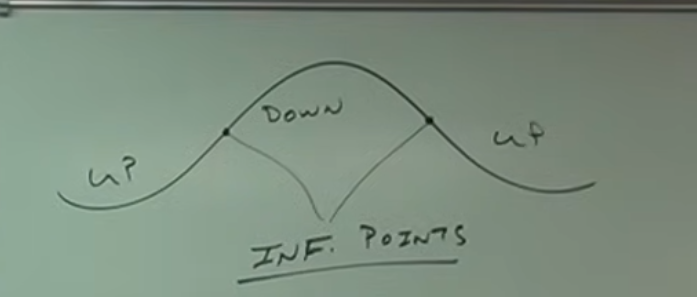
- Graphical Example of points of inflection and how concavity changes
around them.
- [20:00]. The second derivative represents the rate of change of the
slope.
– [📷image]
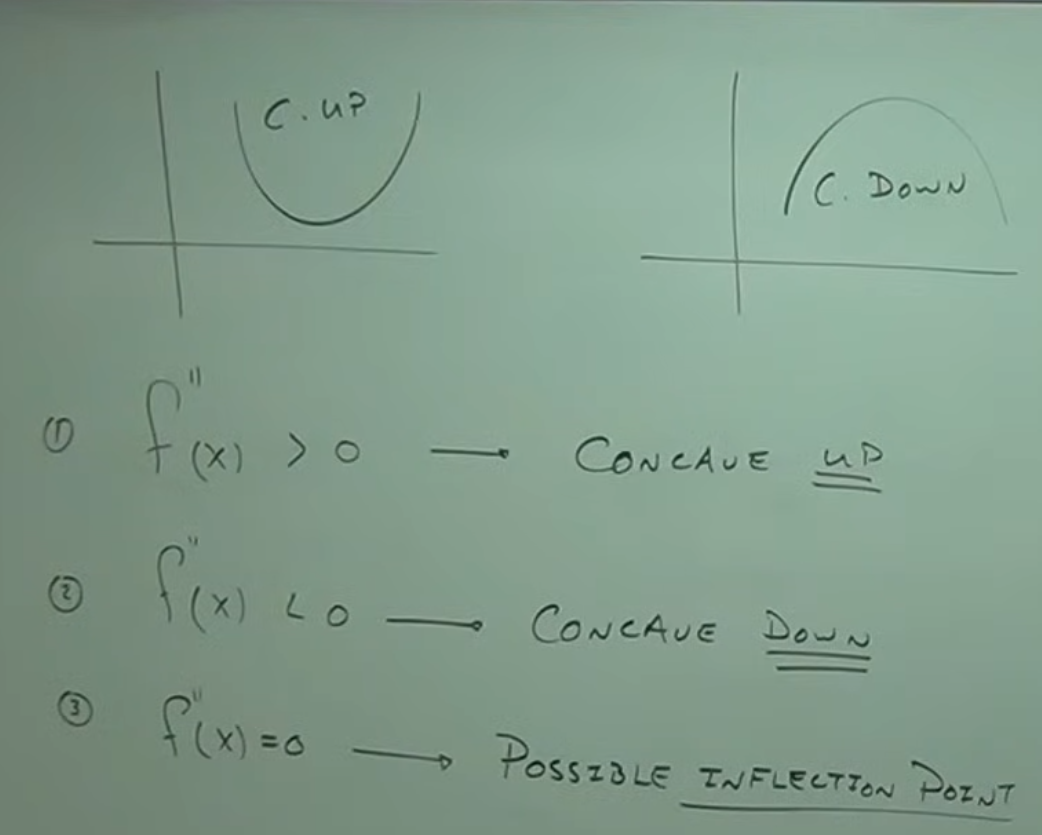
- If $𝒇''(𝒙)>0$ in an interval, then $𝒇(𝒙)$ is concave upward (U) in that
interval.
- If $𝒇''(𝒙)<0$ in an interval, then $𝒇(𝒙)$ is concave downward (∩) in that
interval.
- If $𝒇''(𝒙)=0$, it is a possible point of inflection, where concavity may change.
Identification of intervals and points of inflection on a graph
- [23:00]. 🧩 Example –: Identify increasing/decreasing intervals, concave up/down
intervals, and points of inflection on a given graph.
– [📷image]
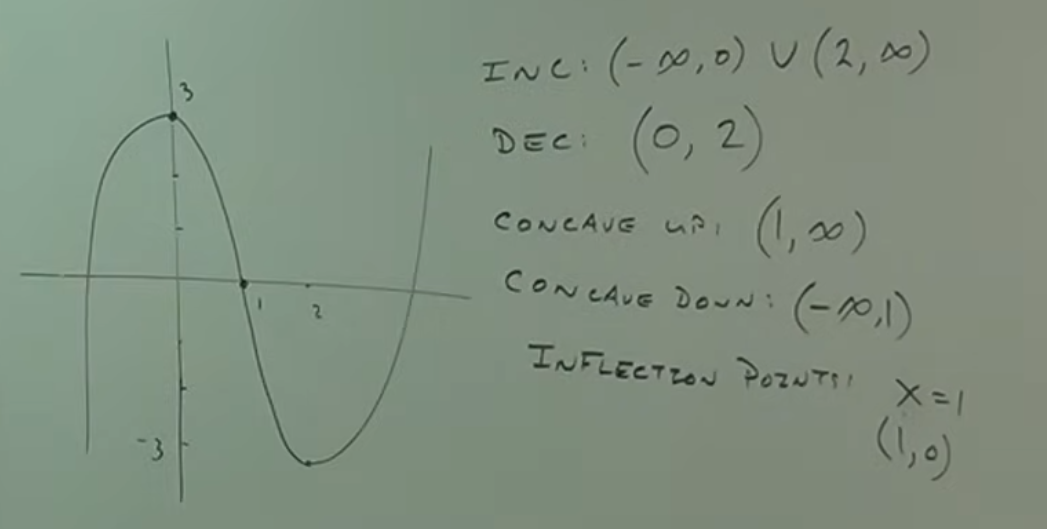
- Analyzing the function along the 𝒙-axis; reading the graph from left to right
along 𝒙-axses
Analyzing the sign of the first and second derivatives at specific points
- [33:06]. 🧩 Example –: Determine the sign of $𝒇'(𝒙)$ and $𝒇''(𝒙)$ at specific points
on a graph.
– [📷image]
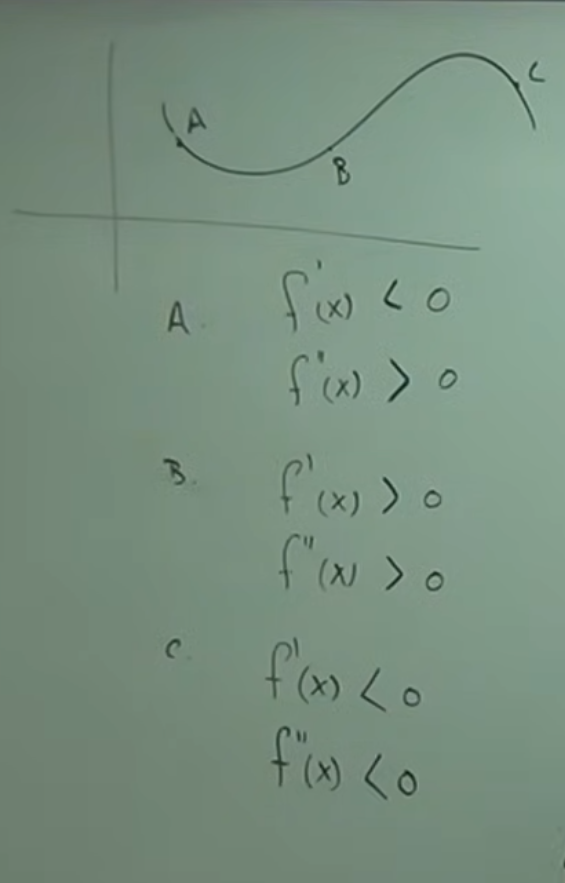
- Explanation of the relationship between the sign of the first derivative and the
function's increasing/decreasing behavior.
- Explanation of the relationship between the sign of the second derivative and the
function's concavity.
Relative extrema: relative maximums and minimums
- [36:47]. Relative Extrema:
– [📷image]
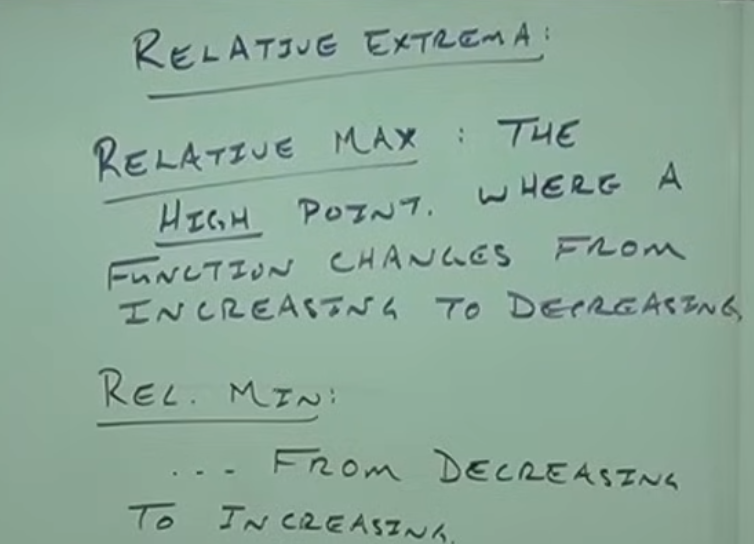
- (ⅰ) Relative Maximum.
- (ⅱ) Relative Minimum.
- [37:09]. Definition of relative extrema: Relative maxima and minima are
high and low points respectively within an interval,
but not necessarily the highest or lowest overall.
- A relative maximum is a point where the function changes from increasing to decreasing.
- A relative minimum is a point where the function changes from decreasing to increasing.
- [40:00]. 🧩 Example –: Graphical Example of relative maximums and minimums.
– [📷image]
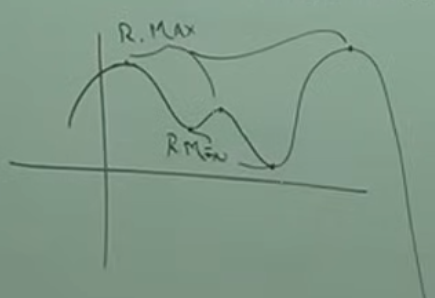
- [41:40]. The slope at relative extrema is zero.
- [42:03]. This means that the tangent line to the curve at that point is horizontal.
Critical numbers and their relationship with relative extrema.
- [42:22]. Critical Numbers and Their Relationship with Relative Extrema.
- Critical numbers are the points where the derivative is z̲e̲r̲o̲ or
u̲n̲d̲e̲f̲i̲n̲e̲d̲— they are the only possible locations where a relative maximum or minimum can
occur.
- [42:37]. Definition of a critical number: A point where the function's
slope is zero or undefined.
- [43:32]. Critical numbers are candidates for being relative maximums or minimums.
- [43:51]. Not all critical numbers are relative maximums or minimums.
– [📷image]
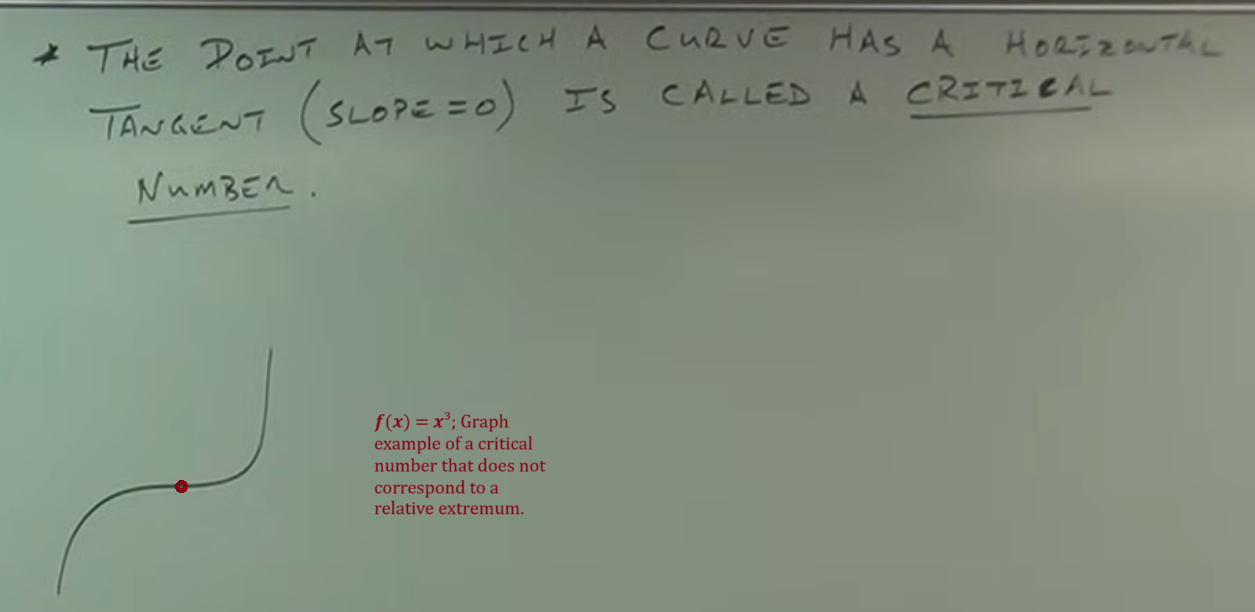
- [43:58]. 🧩 Example –: $𝒇(𝒙)=𝒙^{3}$; Graph example of a critical number that does
not correspond to a relative extremum.
-
[44:18]. Procedure to find critical numbers.
-
Calculate the function's derivative and find the 𝒙-values where the derivative is
zero or
undefined.
- Importance of analyzing points where the derivative is undefined.
-
If the derivative is a fraction, analyze both the
numerator
and the
denominator.
-
Numerator
to find the 𝒙-values where the derivative is
zero
-
[46:19].
Also, examine the
denominator
because it could introduce
undefined
points for the slope, which is significant.
These undefined points can cause the function to change from increasing to decreasing or vice versa.
[47:03]. 🧩 Example –: Finding Critical Numbers $𝒇(𝒙)=𝒙^{3}-3𝒙+1$; Find the critical
numbers of a polynomial function.
– [📷image]
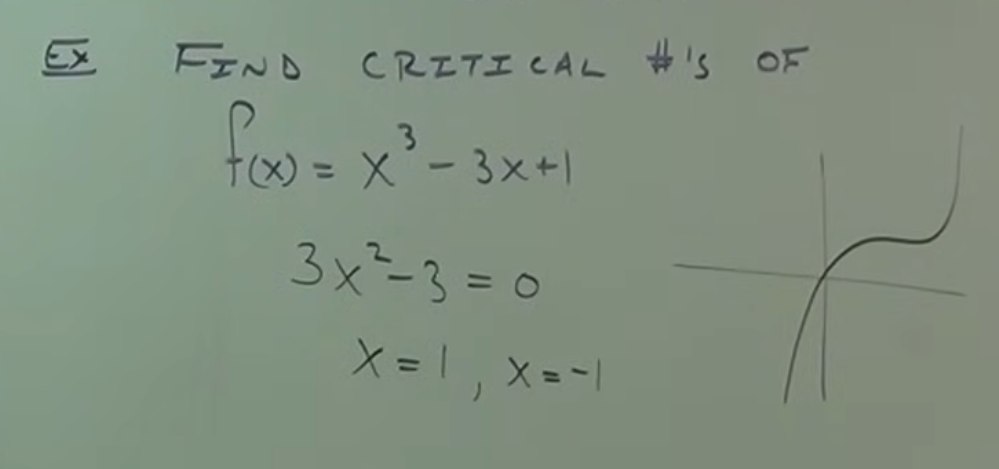
- Calculation of the function's derivative.
- Set the derivative equal to zero and solve for 𝒙.
- Identification of the potential critical numbers.
- [49:10]. Critical numbers do not guarantee the existence of a relative maximum
or minimum.
- 📝N͟O͟T͟E͟: Critical points can be misleading in the following
cases:
- Inflection points — e.g., $𝒇(𝒙)=𝒙^{3}$.
- Nonexistent derivatives — e.g., $𝒇(𝒙)=|𝒙|$.
- Rapid oscillations — e.g., $𝒇(𝒙)=\sin(𝒙)$ near $𝒙\to\infty$.
- Piecewise-defined functions — where the derivative changes abruptly.
Absolute extrema: absolute maximums and minimums
- [50:39]. Definition of absolute extrema: The highest or lowest point of
the function on a given interval.
- The absolute maximum is the greatest value the function attains on the interval.
- The absolute minimum is the least value the function attains on the interval.
- [51:44]. Not all functions have absolute maximums or minimums in an infinite interval
$(-\infty,\infty)$.
– [📷image]
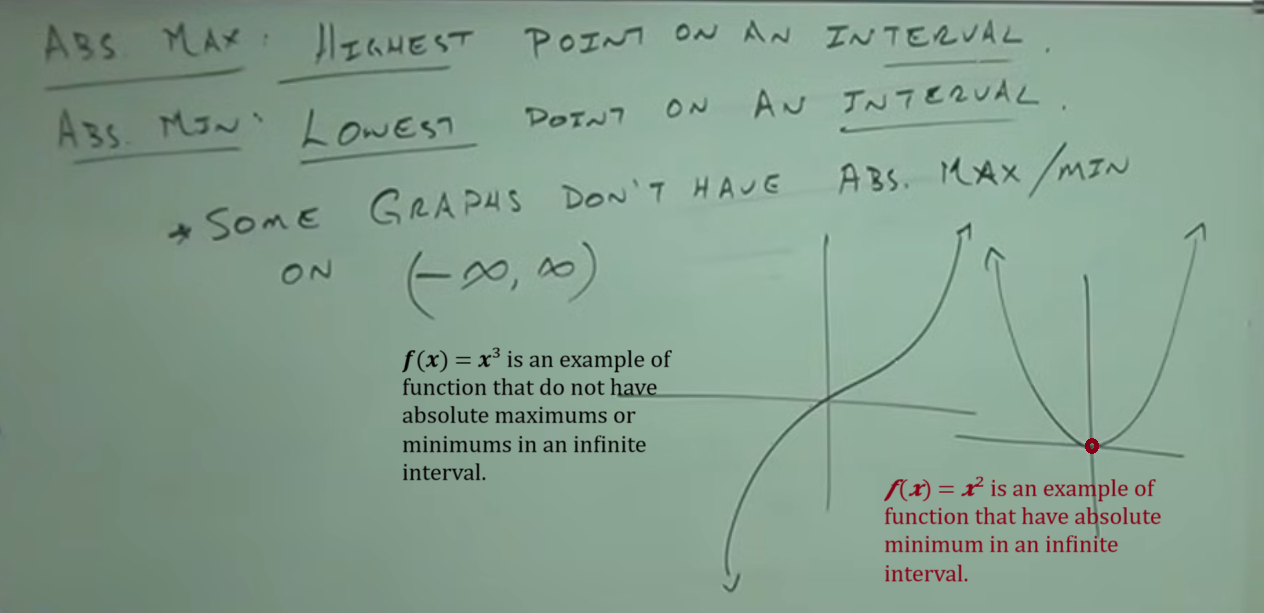
- [52:35]. $𝒇(𝒙)=𝒙^{3}$ is an example of function that do not have absolute maximums
or minimums in an infinite interval.
- [53:10]. $𝒇(𝒙)=𝒙^{2}$ is an example of function that have absolute minimum in an
infinite interval.
- [54:12]. In a closed interval, a continuous function always has an absolute
maximum and minimum.
- Imagine a hallway with two closed doors at the ends. If you walk through the hallway
without jumping,
– [📷image]
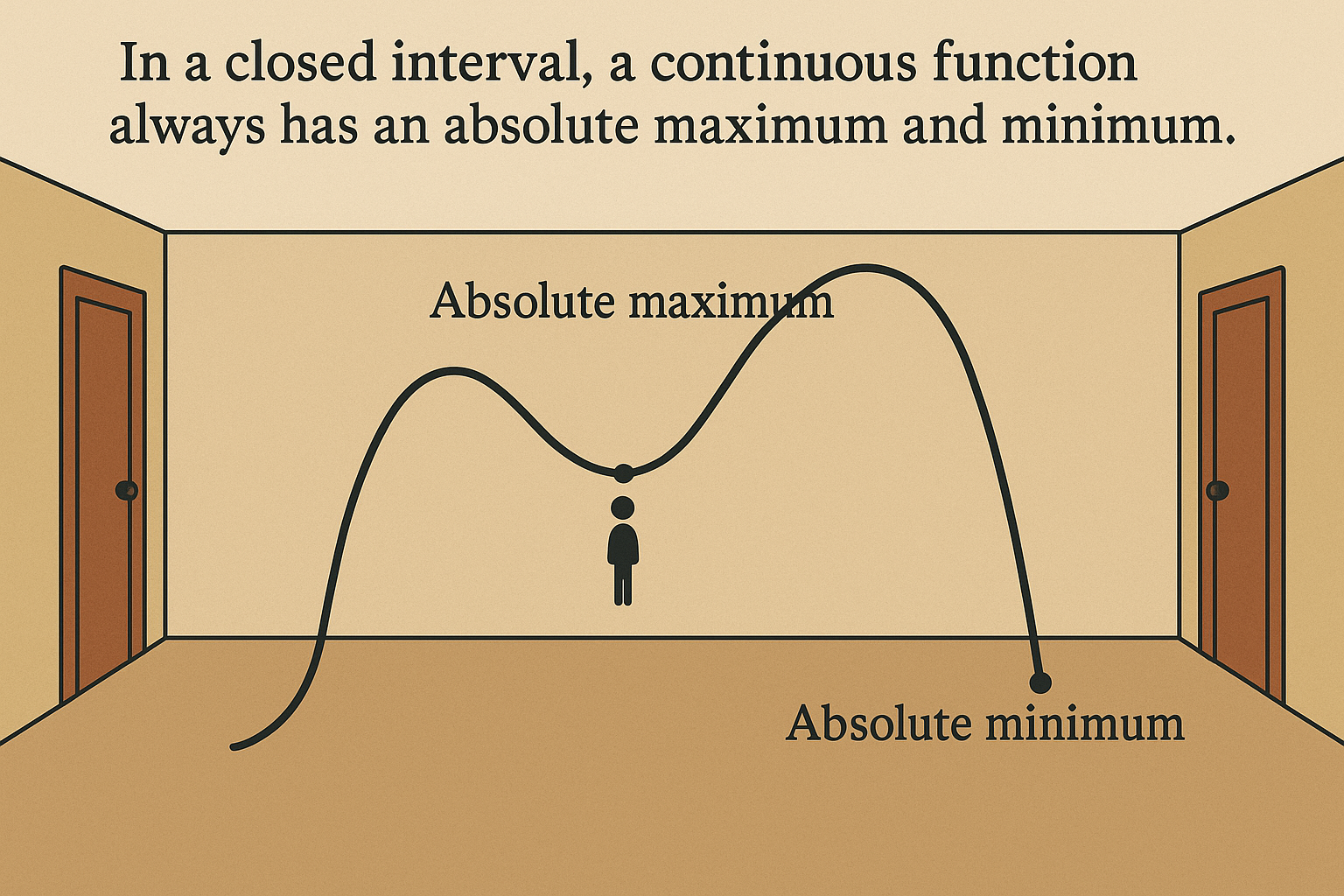
at some point, you’ll reach the highest point, and at another, the lowest point. Since you can’t leave the
hallway,
there will always be a maximum and a minimum.
- Formal (EVT):
_"If $𝒇$ is continuous on a closed interval $[a,b]$, then $𝒇$ attains both a maximum and a minimum on
$[a,b]$."_
(EVT): Extreme Value Theorem
Location of absolute extrema
- [56:15]. The absolute maximum and minimum values of a ᴄ̳ᴏ̳ɴ̳ᴛ̳ɪ̳ɴ̳ᴜ̳ᴏ̳ᴜ̳ꜱ̳ function on a
closed interval occur either:
(ⅰ) at critical points (where the derivative is zero or undefined), or
(ⅱ) at the endpoints.
- Reason: These are the only locations where the function can reach its highest or lowest
values within the interval.
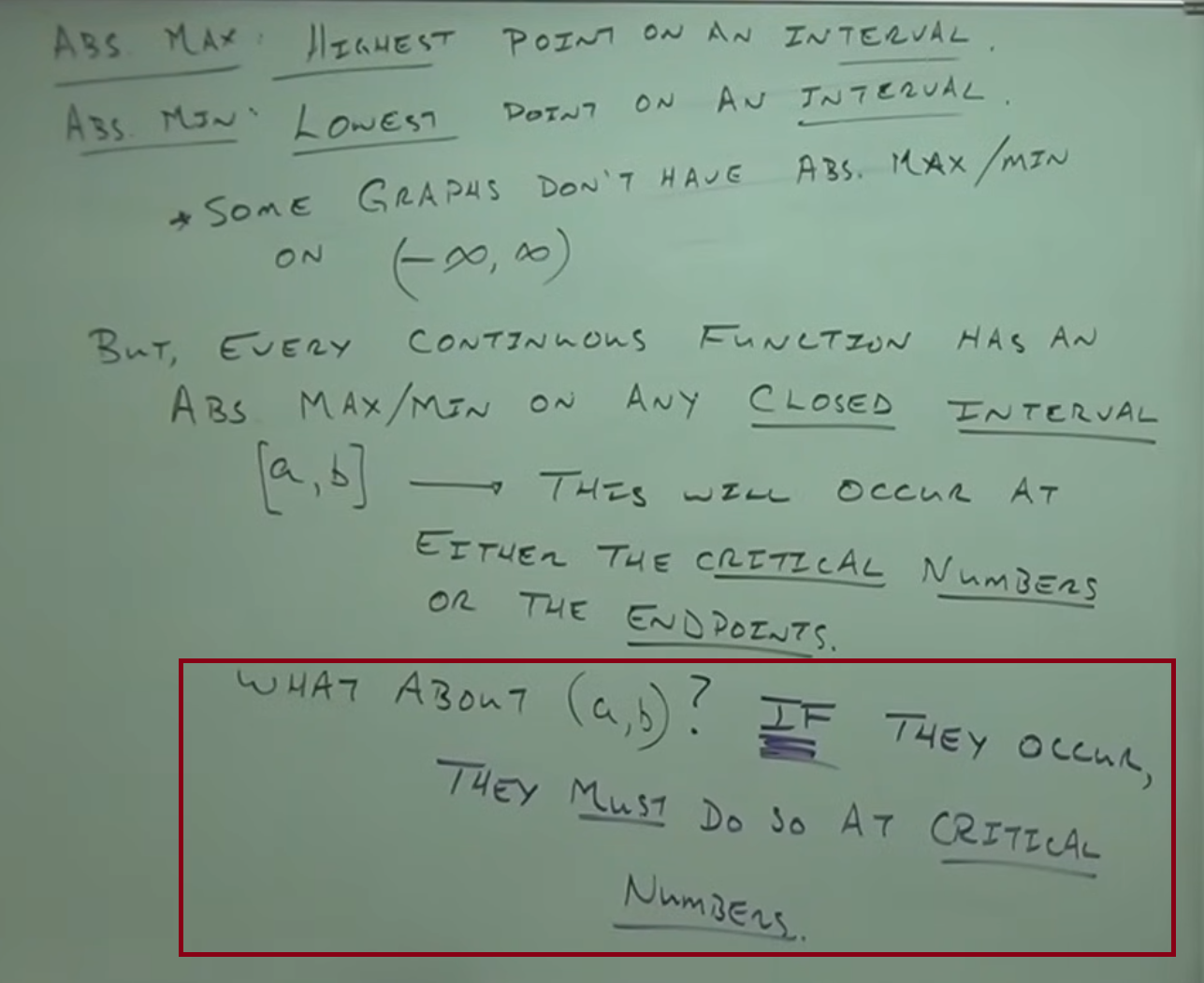
- [59:00]. What happens if we have an open interval? From closed to open interval.
- Example to graphically emphasize why an absolute extremum in an open interval is never
reached, while it can be in a closed one.
– [📷image-1]
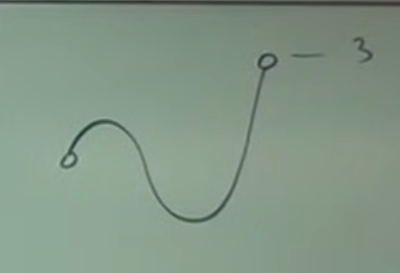
- If we take $3$ as the right endpoint of an open interval, no matter how closely we
approach it, we will never actually reach that point.
- [1:00:55]. In an open interval, absolute extrema 𝓬𝓸𝓾𝓵𝓭 only occur at
critical numbers.
– [📷image-2]
- 𝓘𝓯 𝓪𝓫𝓼𝓸𝓵𝓾𝓽𝓮 𝓮𝔁𝓽𝓻𝓮𝓶𝓪 𝓪𝓻𝓮 𝓷𝓸𝓽 𝓯𝓸𝓾𝓷𝓭 𝓪𝓽 𝓬𝓻𝓲𝓽𝓲𝓬𝓪𝓵
𝓷𝓾𝓶𝓫𝓮𝓻𝓼, 𝓽𝓱𝓮𝔂 𝓭𝓸 𝓷𝓸𝓽 𝓮𝔁𝓲𝓼𝓽 𝓲𝓷 𝓽𝓱𝓮 𝓸𝓹𝓮𝓷 𝓲𝓷𝓽𝓮𝓻𝓿𝓪𝓵.
- [1:02:15]. Previous example showing how including or excluding endpoints affects the
existence of absolute extrema.
– [📷image-3]
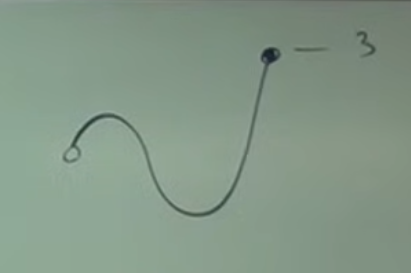
- Now that $3$ is included in the interval (closed), it becomes the absolute maximum.
- We always need to analyze the behavior near the endpoints, even in open intervals. While
the endpoints themselves are not included and therefore
cannot be absolute extrema, the function’s behavior _as it approaches_ those points (via one-sided limits)
must still be considered to compare with
values at critical points.
- [1:03:05]. Different examples of intervals:
-
– [📷image-4]
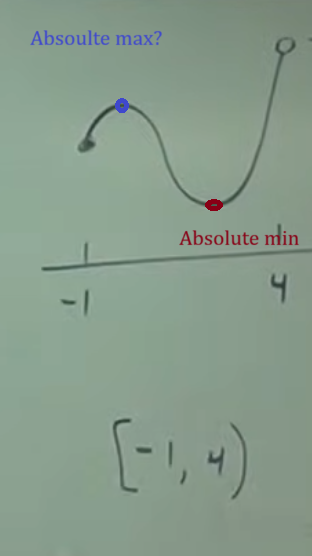
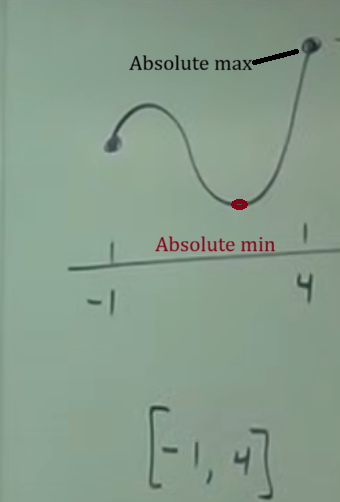 — Interval $[-1,4]$
-
– [📷image-5]
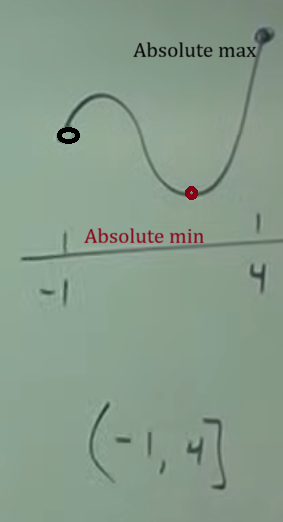 — Interval $(-1,4]$
-
– [📷image-6]
 — Interval $[-1,4)$
- In a closed-open interval like $[-1,4)$, you cannot evaluate
$f(4)$ directly, but you can analyze the limit $\displaystyle \lim_{x\to4^-}
f(x)$.
If this limit is greater than the value at another critical point (such as the blue point in the
image), then that critical point cannot be an absolute
maximum — even if the function never actually reaches $x=4$.
Procedure to find absolute extrema
- [1:04:50]. Procedure to Find Absolute Extrema:
- ➀ Find the critical numbers of the function (where the derivative is zero or
undefined). Evaluate the function at those points.
- ➁ Evaluate the function at the endpoints of the interval.
- If the interval is closed, directly evaluate the function at the endpoints.
- If the interval is open, perform a sign analysis near the endpoints to understand the
function's behavior.
- [1:05:31]. 🧩 Example –: Finding Absolute Extrema on a Closed Interval:
$𝒇(𝒙)=2𝒙^{3}-15𝒙^{2}+36𝒙$ on $[1,5]$
– [📷image]
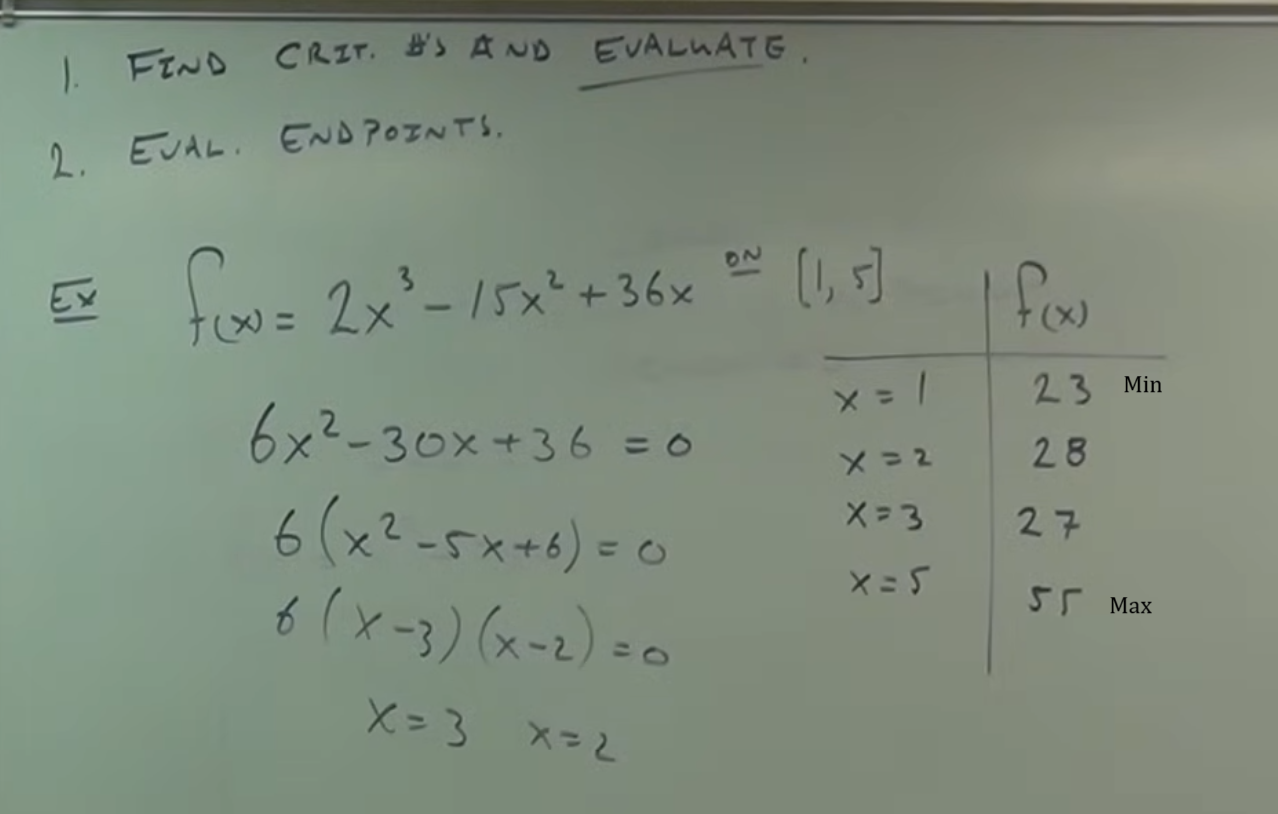
- Calculation of the function's derivative.
- $𝒇'(𝒙)=6𝒙^{2}-30𝒙+36=0$ # First derivative
$=6(𝒙^{2}-5𝒙+6)=0$ # Factor the quadratic
$=6(𝒙-3)(𝒙-2)=0$ # Critical points are where the derivative equals zero
- Find the critical numbers by setting the derivative equal to zero.
- $𝒙=2,\; 𝒙=3$ # Critical numbers within the interval
- Evaluate the function at the critical numbers and the interval's endpoints.
- $𝒙=1\;\to\;𝒇(1)=23$
$𝒙=2\;\to\;𝒇(2)=28$
$𝒙=3\;\to\;𝒇(3)=27$
$𝒙=5\;\to\;𝒇(5)=55$
- Identification of the absolute maximum and absolute minimum.
- $𝒙=1\;\to\;𝒇(1)=23$ # Absolute Minimum value on $[1,5]$
-
$𝒙=5\;\to\;𝒇(5)=55$ # Absolute Maximum value on $[1,5]$
- [1:10:00].
– [📷image]
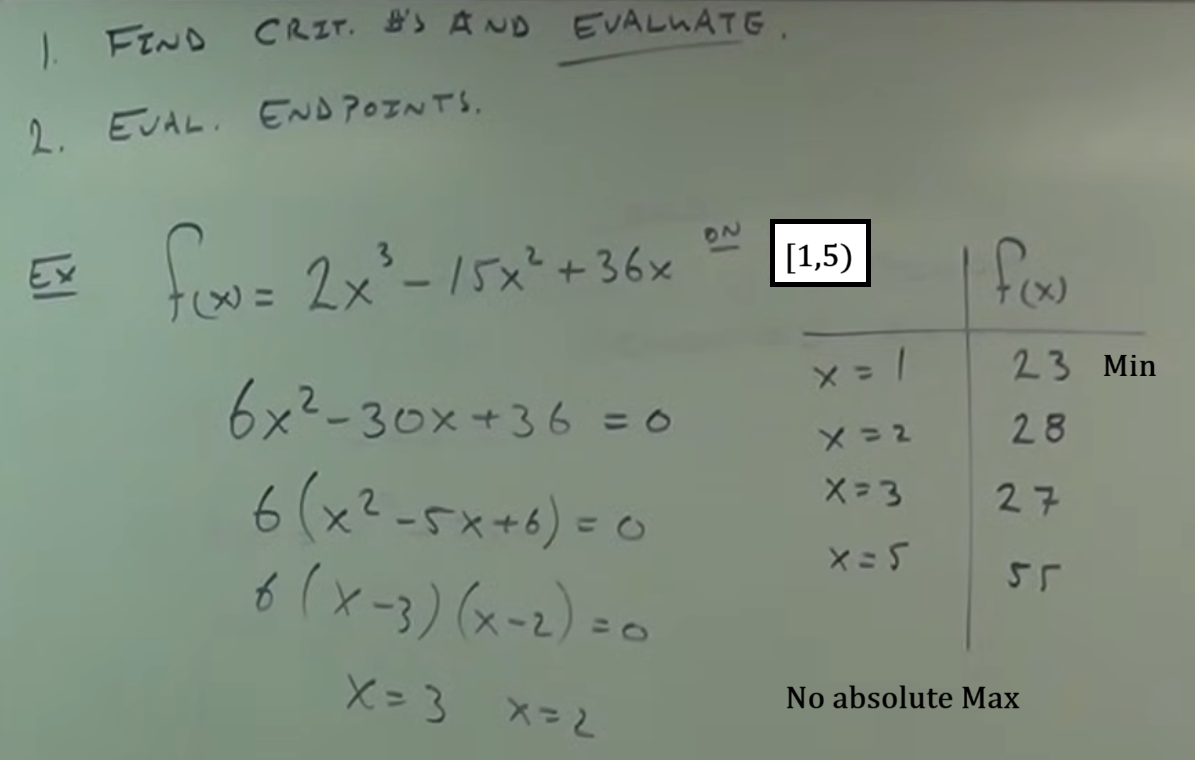 🧩 Example –: Finding Absolute Extrema on a Closed Interval: $𝒇(𝒙)=2𝒙^{3}-15𝒙^{2}+36𝒙$ on
$[1,5)$
🧩 Example –: Finding Absolute Extrema on a Closed Interval: $𝒇(𝒙)=2𝒙^{3}-15𝒙^{2}+36𝒙$ on
$[1,5)$
- $𝒙=1\;\to\;𝒇(1)=23$ # Absolute Minimum value on $[1,5)$
- [1:10:27].
– [📷image]
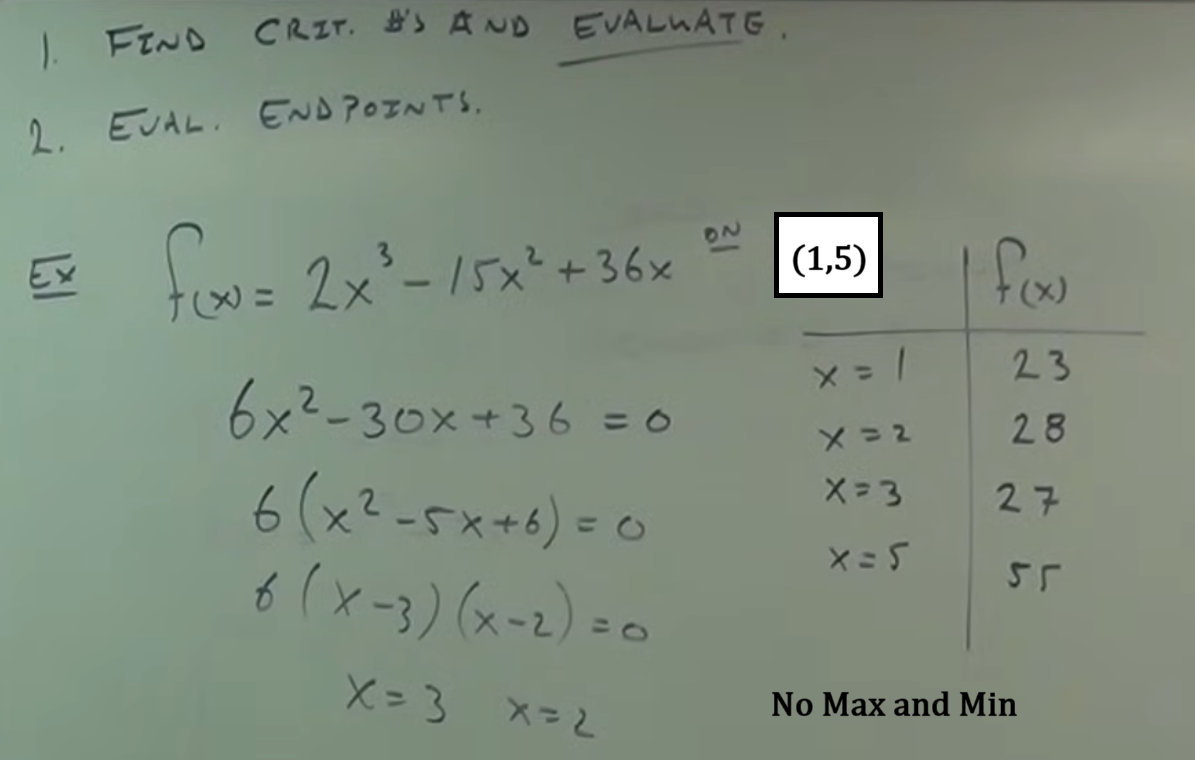 🧩 Example –: Finding Absolute Extrema on a Closed Interval: $𝒇(𝒙)=2𝒙^{3}-15𝒙^{2}+36𝒙$ on
$(1,5)$
🧩 Example –: Finding Absolute Extrema on a Closed Interval: $𝒇(𝒙)=2𝒙^{3}-15𝒙^{2}+36𝒙$ on
$(1,5)$
- [1:10:42]. 🧩 Example –: Finding Absolute Extrema on a Closed Interval
$𝒇(𝒙)=6𝒙^{4/3}-3𝒙^{1/3}$ on $[-1,1]$
– [📷image]
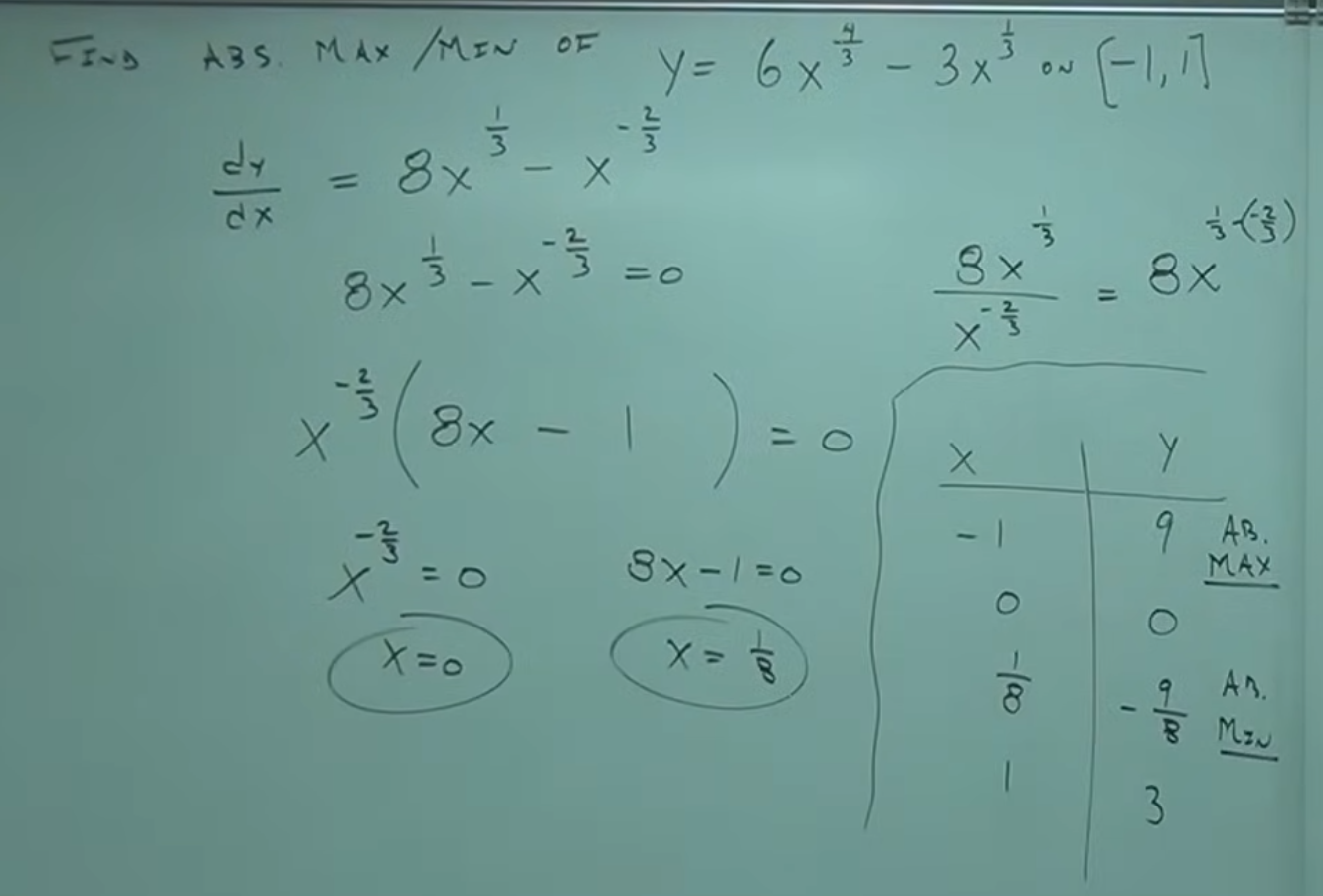
- Calculation of the function's derivative.
- $\dfrac{d𝒚}{d𝒙}=8𝒙^{1/3}-𝒙^{-2/3}$
- Find the critical numbers by setting the derivative equal to zero.
- $8𝒙^{1/3}-𝒙^{-2/3}=0$
- Factor: $𝒙^{-2/3}(8𝒙-1)=0$
- $𝒙^{-2/3}=0$ → $𝒙=0$ No real solution so the derivative is
u̲n̲d̲e̲f̲i̲n̲e̲d̲ at $x=0$, so this is another critical point.
- $8𝒙-1=0\;\Rightarrow\;𝒙=\dfrac{1}{8}$
- [1:16:14]. Evaluate the function at the critical numbers amd at endpoints.
- $𝒇(-1)=6(-1)^{4/3}-3(-1)^{1/3}=6(1)+3=9$
- $𝒇(0)=0$
- $𝒇(1/8)=6(1/8)^{4/3}-3(1/8)^{1/3}=-\dfrac{9}{8}$
- $𝒇(1)=6(1)-3(1)=3$
- Identification of the absolute maximum and absolute minimum.
- $𝒇(-1)=9$ # Absolute Maximum
-
$𝒇(0)=0$
-
$𝒇(1/8)=-\dfrac{9}{8}$ # Absolute Minimum
-
$𝒇(1)=3$
- [1:20:07].
– [📷image]
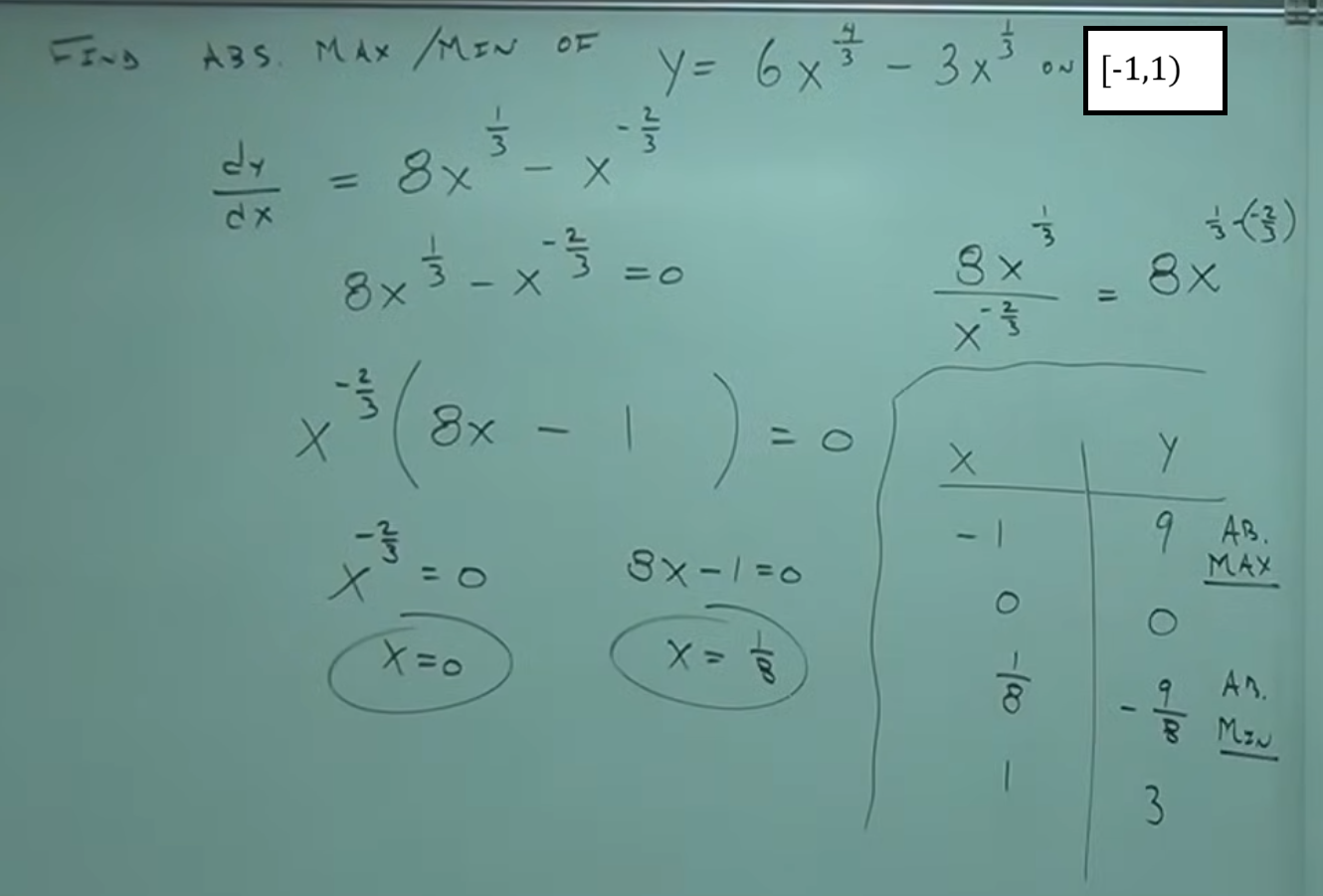 $𝒇(𝒙)=6𝒙^{4/3}-3𝒙^{1/3}$ on $\{-1,1)$
- $𝒇(-1)=9$ # Absolute Maximum
-
$𝒇(0)=0$
-
$𝒇(1/8)=-\dfrac{9}{8}$ # Absolute Minimum
-
$𝒇(1)=3$
- [1:20:27].
– [📷image]
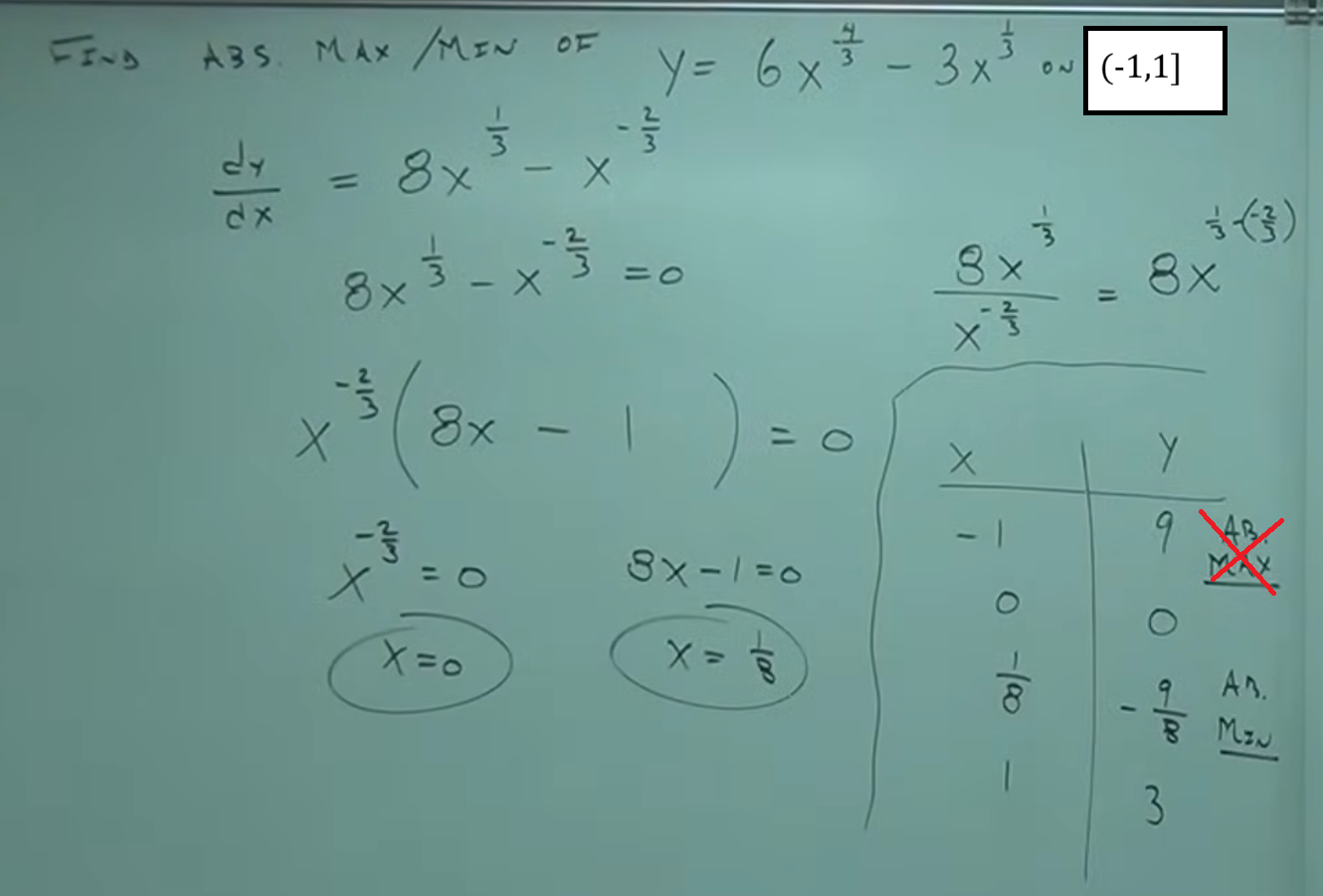 $𝒇(𝒙)=6𝒙^{4/3}-3𝒙^{1/3}$ on $(-1,1]$
- $𝒇(-1)=9$
-
$𝒇(0)=0$
-
$𝒇(1/8)=-\dfrac{9}{8}$ # Absolute Minimum
-
$𝒇(1)=3$
- [1:20:45]. 🧩 Example –: Finding Absolute Extrema on a Closed Interval
$𝒇(𝒙)=\dfrac{1}{𝒙^{2}-𝒙}$, on $(0,1)$
– [📷image]
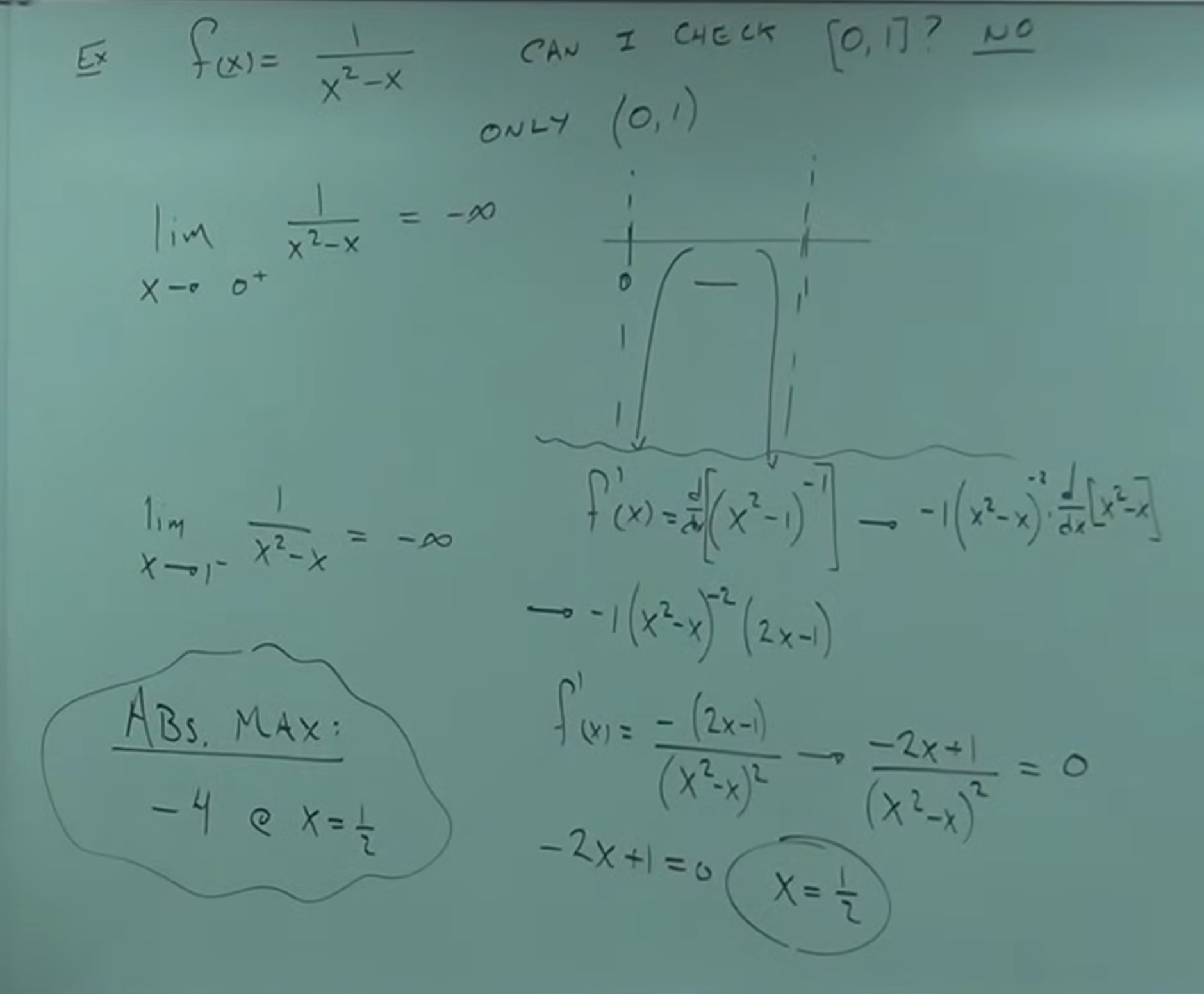
- Can I check $[0,1]$? → No, because the function is undefined at the endpoints.
- Domain: $(0,1)$ only — not closed, so we cannot use the EVT (Extreme Value Theorem)
- [1:23:15]. We must take one-sided limits
- Use sign analysis to determine the function's behavior near the asymptotes.
- For $𝒙$ near $0^{+}$, $𝒙^{2}-𝒙<0\Rightarrow$ denominator negative $\Rightarrow
𝒇(𝒙)<0$ and decreasing sharply
- $\displaystyle \lim_{x\to0^{+}}𝒇(𝒙)=\displaystyle
\lim_{x\to0^{+}}\dfrac{1}{𝒙^{2}-𝒙}=-\infty$
- For $𝒙$ near $1^{-}$, $𝒙^{2}-𝒙<0$ again $\Rightarrow$ same behavior
- $\displaystyle \lim_{x\to1^{-}}𝒇(𝒙)=\displaystyle
\lim_{x\to1^{-}}\dfrac{1}{𝒙^{2}-𝒙}=-\infty$
- Conclusion: Function dives to $-\infty$ near both edges
- In this case, the function tends to negative infinity at both endpoint points.
- Since the function diverges negatively at both ends, no absolute minimum
exists
- [1:27:30]. First derivative.
- $𝒇(𝒙)=(𝒙^{2}-𝒙)^{-1}\;\Rightarrow$ apply chain rule:
- $𝒇'(𝒙)=-1\cdot(𝒙^{2}-𝒙)^{-2}\cdot\dfrac{d}{d𝒙}[𝒙^{2}-𝒙]$
- $𝒇'(𝒙)=-(𝒙^{2}-𝒙)^{-2}\cdot(2𝒙-1)$
- [1:29:35]. Find the critical numbers by setting the derivative equal to zero.
- To solve rational equations, set the numerator equal to zero, as the equation can
only equal zero when the numerator is zero.
- $-(2𝒙-1)=0\Rightarrow 𝒙=\dfrac{1}{2}$
- Check if the solution is in the interval.
- ✔️ yes (inside $(0,1)$)
- 📝N͟O͟T͟E͟: We must always check whether the critical point lies within the
interval, because any solution outside the
interval is not valid for determining absolute extrema on that domain.
- Identification of the absolute maximum and absolute minimum.
- We don't need to check the endpoints because we already did the work by evaluating
the limits at $0$ and $1$.
- $𝒙=\dfrac{1}{2}\;\to\;𝒇\!\left(\dfrac{1}{2}\right)=-4$
- Identification of the absolute maximum and absolute minimum.
- $𝒙=\dfrac{1}{2}\;\to\;𝒇\!\left(\dfrac{1}{2}\right)=-4$ Absolute maximum
- Since $𝒇(x)$ increases on $(0,\tfrac{1}{2})$ and decreases on
$(\tfrac{1}{2},1)$, the critical point at $x=\tfrac{1}{2}$ is an absolute maximum.
- The function has an absolute maximum of $-4$ at $x=\tfrac{1}{2}$
and no absolute minimum as it tends to negative infinity near both endpoints.
- [1:32:45]. Summary of the Procedure to Find Absolute Extrema:
- If the interval is c̲l̲o̲s̲e̲d̲, evaluate the function at the critical numbers and at the
interval's endpoints.
- If the interval is o̲p̲e̲n̲, evaluate the function at the critical numbers and perform a
sign analysis near the endpoints.
- Compare the values: The highest value corresponds to the absolute maximum, and the lowest
value corresponds to the absolute minimum.
- In open intervals, an absolute maximum or minimum exists
only if a critical point's value is greater than or less than the function's limiting values
near the endpoints.