Calculus 1 lecture 3.2
A Brief Discussion Of Rolle's Theorem and Mean-Value theorem
Rolle's theorem
- Introduction to Rolle's Theorem
- Prerequisites:
- The function must be continuous on the closed interval [𝓪, 𝓫].
- The function must be differentiable on the open interval (𝓪, 𝓫).
- The function must satisfy 𝒇(𝓪) = 𝒇(𝓫).
- Implications:
- These conditions guarantee that there exists at least one point 𝓬 in (𝓪, 𝓫) such
that $𝒇'(𝓬)=0$.
- Geometrically, this means that somewhere between 𝓪 and 𝓫, the function has a
horizontal tangent line.
- [0:28]. Explanation of Rolle's Theorem
- If a function 𝒇(𝒙) takes the same value at two endpoints of a closed interval, and is
continuous and differentiable
as stated above, then there must exist at least one point in between where the slope of the tangent line is
zero.
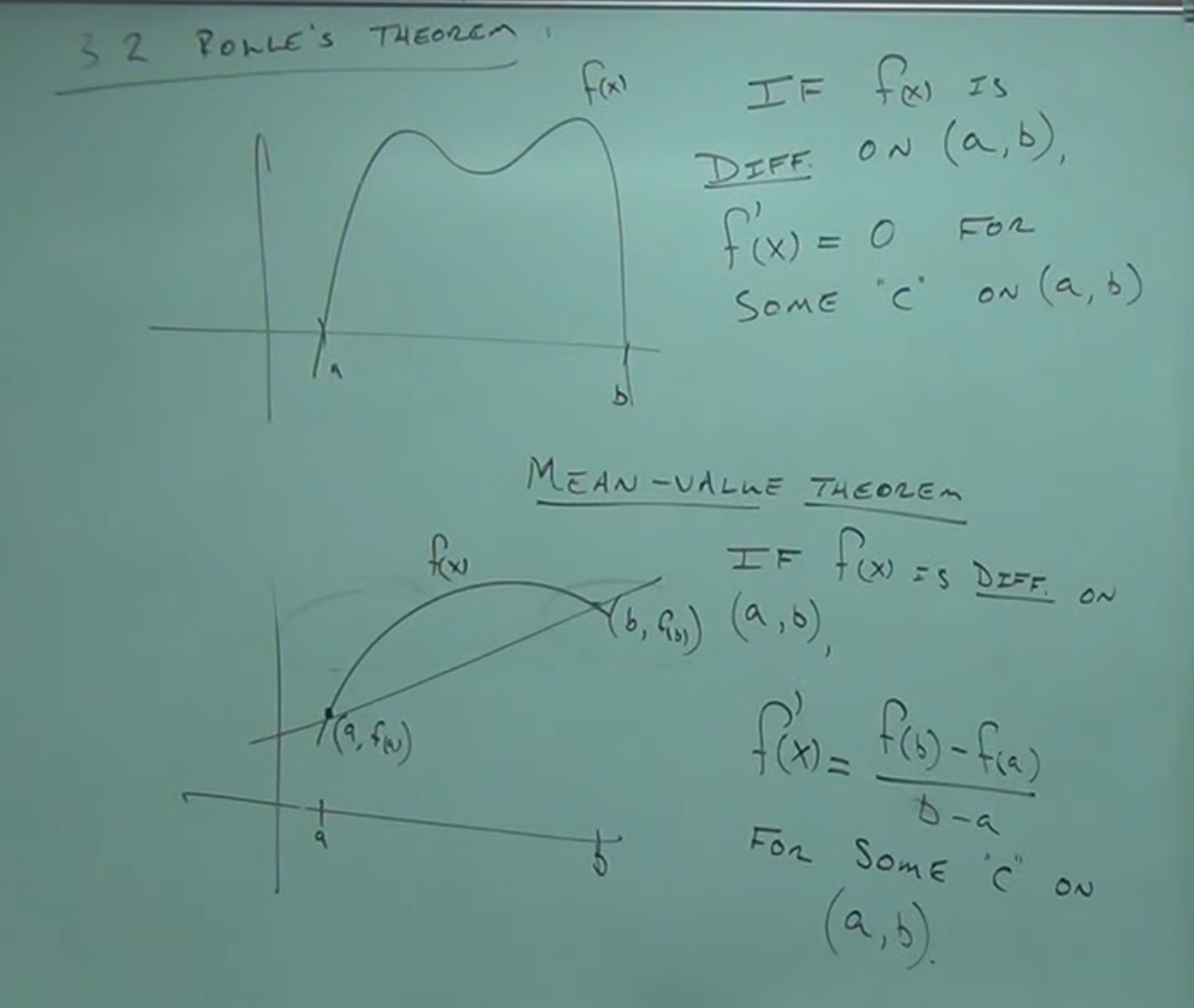
- A common visual example is when a function crosses the 𝒙-axis at two points.
- If 𝒇(𝒙) = 0 at both endpoints and the function is continuous between them,
then Rolle's Theorem guarantees a point in the middle where the slope is zero.
- This represents a special case of Rolle’s Theorem when 𝒇(𝒂) = 𝒇(𝒃) = 0.
- Graphical illustration of the concept.
- Special case – Constant function (the trivial case of Rolle's Theorem):
- If 𝒇(𝒙) = 𝒄 (a constant), then 𝒇 is continuous and differentiable everywhere, and
𝒇(𝓪) = 𝒇(𝓫) = 𝒄 for any [𝓪, 𝓫].
- The derivative $𝒇'(𝒙)=0$ at every point in (𝓪, 𝓫), so Rolle’s Theorem is
satisfied trivially at all points.
- This is considered the trivial case of Rolle’s Theorem.
- [1:14]. Interpretation: At least one point between the two 𝒙-axis crossings will have a
horizontal tangent.
- [1:25]. Transition to the Mean Value Theorem as a corollary of Rolle's Theorem.
- [3:18]. Formal definition of Rolle's Theorem.
- Let 𝒇(𝒙) be a function satisfying the following conditions:
- ⑴ Continuity: 𝒇(𝒙) is continuous on the closed interval [𝓪, 𝓫].
- ⑵ Differentiability: 𝒇(𝒙) is differentiable on the open interval (𝓪, 𝓫).
- ⑶ Equal Endpoint Values: 𝒇(𝓪) = 𝒇(𝓫).
- i̲f̲ these conditions are met,
t̲h̲e̲n̲ there exists at least one point 𝓬 ∈ (𝓪, 𝓫) such that $𝒇'(𝓬)=0$
- Practical Applications.
- Useful in proving the existence of roots and understanding the behavior of functions.
- Helps in establishing the existence of extrema within intervals.
Mean value theorem
- [1:34]. Introduction to the Mean Value Theorem.
- Prerequisites:
- The function must be continuous on the closed interval [𝓪, 𝓫].
- The function must be differentiable on the open interval (𝓪, 𝓫).
- Implications:
- The theorem guarantees that the average rate of change over [𝓪, 𝓫] is attained by
the instantaneous
rate of change at least once within (𝓪, 𝓫).
- This is a fundamental theorem in calculus that bridges the gap between average and
instantaneous rates of change.
- [1:41]. Explanation of the Mean Value Theorem:
- Draw a secant line between two points (A and B) on a curve.
- If the function 𝒇(𝒙) is differentiable between A and B, there must exist at least one
point on the curve where the
slope of the tangent is equal to the slope of the secant.
- Graphical illustration of the concept, showing the tangent parallel to the secant.
- [2:23]. Interpretation: At least one point 𝓬 within the interval (𝓪,𝓫) will have a
tangent line
with 𝓪 slope equal to the slope of the secant line that connects the endpoints (𝓪, 𝒇(𝓪)) and (𝓫, 𝒇(𝓫)).
- [2:42]. Relationship with Rolle's Theorem.
- Rolle's Theorem is a special case of the Mean Value Theorem in which the function values
at the endpoints are equal (𝒇(𝓪) = 𝒇(𝓫)),
so the slope of the secant line is zero, and the conclusion becomes $𝒇'(𝓬)=0$.
- Although Rolle’s Theorem is more specific, it is often proved first and used to derive
the more general Mean Value Theorem,
which is why the MVT is sometimes introduced as a corollary of Rolle’s Theorem.
- Formal relationship between MVT and Rolle’s Theorem:
- Mean Value Theorem (more general):
- i̲f̲ 𝒇 is continuous on [𝓪, 𝓫] and differentiable on (𝓪, 𝓫),
t̲h̲e̲n̲ there exists 𝓬 ∈ (𝓪, 𝓫) such that:
$𝒇'(𝓬)=\dfrac{𝒇(𝓫)-𝒇(𝓪)}{𝓫-𝓪}$
- Rolle’s Theorem (special case of MVT):
- i̲f̲, in addition, 𝒇(𝓪) = 𝒇(𝓫),
t̲h̲e̲n̲ $𝒇'(𝓬)=\dfrac{𝒇(𝓫)-𝒇(𝓪)}{𝓫-𝓪}=0$ ⇒ $𝒇'(𝓬)=0$
- [3:57]. Formal definition of the Mean Value Theorem:
- i̲f̲ a function 𝒇 satisfies the following conditions:
⑴ Continuity: 𝒇 is continuous on the closed interval [𝓪, 𝓫].
⑵ Differentiability: 𝒇 is differentiable on the open interval (𝓪, 𝓫).
t̲h̲e̲n̲ there exists at least one point 𝓬 ∈ (𝓪, 𝓫) such that:
$𝒇'(𝓬)=\dfrac{𝒇(𝓫)-𝒇(𝓪)}{𝓫-𝓪}$
- [4:26]. Interpretation of the formula: The slope of the tangent at point 𝓬 is equal to
the slope of the secant connecting
the points (𝓪,𝒇(𝓪)) and (𝓫, 𝒇(𝓫)).
- Practical Applications.
- Applied in various fields such as physics for motion analysis, in economics for cost and
revenue analysis,
and in engineering for system behavior.
- Foundation for proving other theorems in calculus like Taylor's Theorem and Lagrange's
Remainder Theorem.
Verification of the theorems
- [5:20]. How to verify Rolle's Theorem:
- Verify that the function is continuous on [𝓪, 𝓫] and differentiable on (𝓪, 𝓫).
- Check that 𝒇(𝓪) = 𝒇(𝓫).
- Differentiate the function and solve $𝒇'(𝒙)=0$ to find critical point(s).
- Make sure that the solution(s) lie within the open interval (𝓪, 𝓫).
- [5:37]. How to verify the Mean Value Theorem:
- Verify that the function is continuous on [𝓪, 𝓫] and differentiable on (𝓪, 𝓫).
- Calculate the slope of the secant line: $\dfrac{𝒇(𝓫)-𝒇(𝓪)}{𝓫-𝓪}$.
- Differentiate the function and solve $𝒇'(𝒙)=\dfrac{𝒇(𝓫)-𝒇(𝓪)}{𝓫-𝓪}$ to find the
value(s) of 𝒙 where 𝒙 = 𝓬.
- Ensure that the solution(s) lie within the open interval (𝓪, 𝓫).
- [6:04]. Simple summary: –
[image]