Calculus 1 lecture 3.3
The First Derivative Test For Increasing and Decreasing
Introduction
- [0:00]. Topic: The First Derivative Test — determining intervals of increase and decrease
of a function.
- Identifying where $𝒇′(𝒙)>0$ or $𝒇′(𝒙)<0$ to locate increasing and decreasing
behavior.
- Application to curve sketching: analyzing the shape of a function by detecting local
maxima, minima, and transitions in slope.
Review of previous concepts
- [0:55]. Review of the meaning of the first derivative and its relationship with a
function’s increase and decrease. –
[📷image]
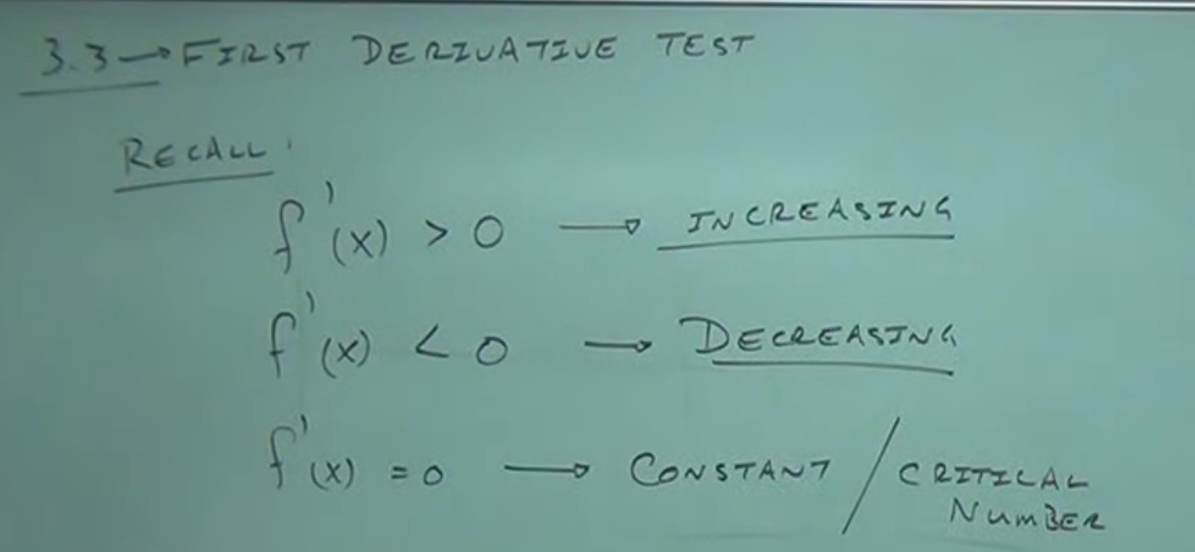
- [1:10]. If $𝒇′(𝒙)>0$, the function $𝒇(𝒙)$ is increasing.
- [2:16]. If $𝒇′(𝒙)<0$, the function $𝒇(𝒙)$ is decreasing.
- [2:33]. If $𝒇′(𝒙)=0$, constant, the function $𝒇(𝒙)$ has a horizontal tangent, and
a critical number is identified.
The first derivative test
- [3:05]. Introduction to the First Derivative Test to find relative extrema (maximums and
minimums).
- [3:26]. Step-by-step explanation of the First Derivative Test: –
[📷image-1]
 –
[📷image-2]
–
[📷image-2]
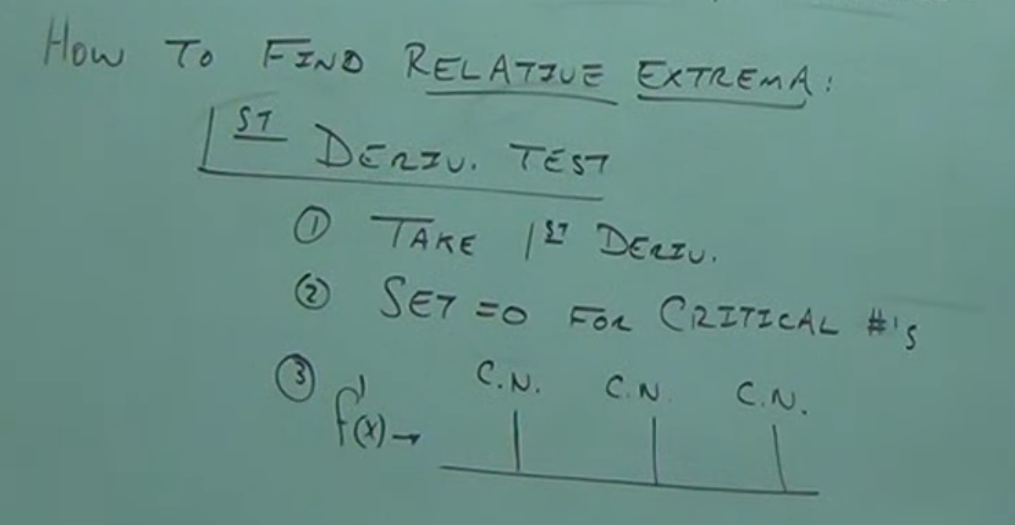
- ❶ [4:21]. Find the first derivative, $𝒇′(𝒙)$.
- ❷ [4:40]. Set the first derivative equal to zero, $𝒇′(𝒙)=0$, to find critical numbers.
- In addition to the values where $𝒇′(𝒙)=0$, you must also include as
critical numbers any point where $𝒇′(𝒙)$ does not exist.
This is because c̲r̲i̲t̲i̲c̲a̲l̲ ̲n̲u̲m̲b̲e̲r̲s̲ are defined as any 𝒙 in the domain of
𝒇 where either t̲h̲e̲ ̲d̲e̲r̲i̲v̲a̲t̲i̲v̲e̲ ̲ ̲i̲s̲ ̲z̲e̲r̲o̲ ̲ or th̲e̲
̲d̲e̲r̲i̲v̲a̲t̲i̲v̲e̲ ̲i̲s̲ ̲u̲n̲d̲e̲f̲i̲n̲e̲d̲..
Even if the derivative does not exist at such a point, it can still correspond to a local maximum, a
local minimum, or some other important change in
the behavior of the function. This kind of points are:
- Points where the denominator is zero (possible vertical asymptotes).
- This occurs when the function is not defined (or tends to ±∞) as 𝒙
approaches a certain value 𝒙 = a.
- Example: $𝒇(𝒙)=\dfrac{1}{𝒙}$. As $𝒙\to 0$, $𝒇(𝒙)\to \pm\infty$, and
the line $𝒙=0$ is a vertical asymptote.
- Sharp corners or cusps (abrupt changes in slope.
- Vertical tangents (infinite slope).
- This occurs when the function is defined at a point, but its derivative
becomes infinite (or tends to ±∞).
- Example: $𝒇(𝒙)=𝒙^{1/3}$ at $𝒙=0$. The function is defined at $𝒙=0$,
but $𝒇′(𝒙)=\dfrac{1}{3𝒙^{2/3}}$ tends to ±∞ as $𝒙\to 0$, indicating a vertical tangent.
- Discontinuities (jump, infinite, removable).
- ❸ [4:58]. Create a first derivative sign chart using the critical numbers.
- Draw a number line and mark the critical points.
- Indicate the sign of $𝒇′(𝒙)$ above the number line for each interval.
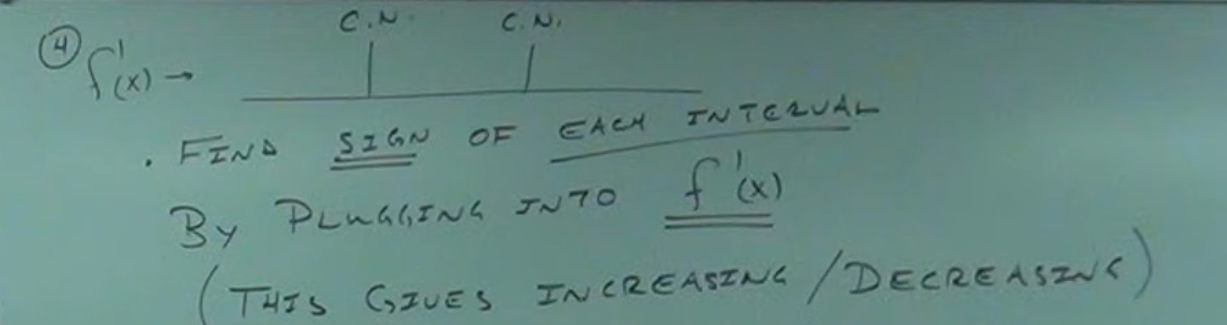
- ❹ [6:16]. Test a point in each interval defined by the critical numbers.
- Determine the sign of $𝒇′(𝒙)$ in each interval.
- Substitute a sample value into $𝒇′(𝒙)$ to check if the slope is positive or
negative.
- The sign of $𝒇′(𝒙)$ tells whether the function is increasing or decreasing in that
interval.
- Local Maximum:
- i̲f̲ $𝒇′(𝒙)$ changes from positive to negative at a critical number,
t̲h̲e̲n̲ there is a local maximum.
- Local Minimum:
- i̲f̲ $𝒇′(𝒙)$ changes from negative to positive at a critical number,
t̲h̲e̲n̲ there is a local minimum.
- Neither Maximum nor Minimum:
- i̲f̲ $𝒇′(𝒙)$ does not change sign at a critical number,
t̲h̲e̲n̲ it is not classified as a maximum or minimum.
- Sometimes referred to as a horizontal inflection point, if:
- $𝒇′(𝒙)=0$.
- The concavity changes (i.e., $𝒇′(𝒙)$ doesn't change sign, but $𝒇″(𝒙)$
does).
- 🧩 Example –: $𝒇(𝒙)=𝒙^3$
- $𝒇′(𝒙)=3𝒙^2$ → $𝒇′(0)=0$, but stays positive on both sides of $0$.
- $𝒇″(𝒙)=6𝒙$ → changes sign at $𝒙=0$.
- So, $𝒙=0$ is a critical point, not a max or min, but a
horizontal inflection point.
- [10:44]. 🧩 Example –: Application of the first derivative test to an example
$𝒇(𝒙)=𝒙^3-3𝒙+1$ –
[📷image]
- ❶ Find the first derivative:
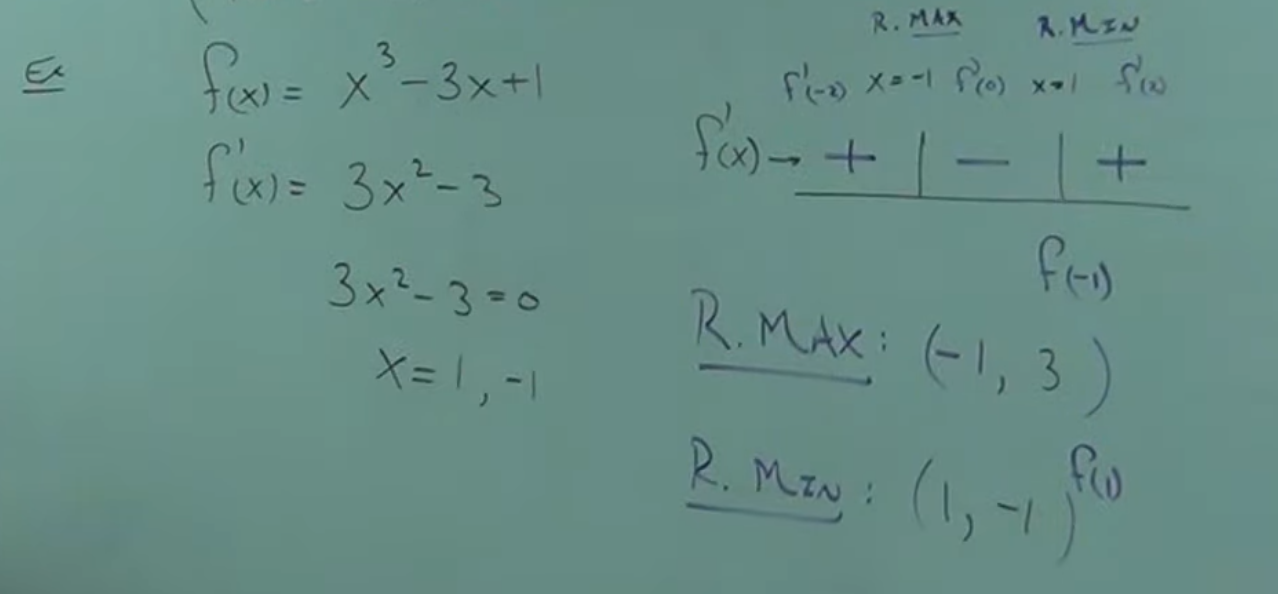
- $𝒇(𝒙)=𝒙^3−3𝒙+1 \Rightarrow 𝒇′(𝒙)=3𝒙^2−3$
- ❷ Set the first derivative equal to zero:
- $3𝒙^2−3=0 \Rightarrow 𝒙^2=1 \Rightarrow 𝒙=−1$ and $𝒙=1$
- There are no points where $𝒇′(𝒙)$ is undefined.
- Critical numbers: $𝒙=−1$, $𝒙=1$ (both are in the domain of the original funcction)
- ❸ Check for values that make the derivative undefined.
- ❸ Create a sign chart for $𝒇′(𝒙)$:
- ❹ Test a value from each interval in $𝒇′(𝒙)$ to determine the sign.
- Test values:
- $𝒙=−2$ → $𝒇′(𝒙)>0$
- $𝒙=0$ → $𝒇′(𝒙)<0$
- $𝒙=2$ → $𝒇′(𝒙)>0$
- Sign chart:
- Apply the First Derivative Test:
- At $𝒙=−1$: $𝒇′$ changes from $+$ to $−$ → Local Maximum
- At $𝒙=1$: $𝒇′$ changes from $−$ to $+$ → Local Minimum
- Evaluate the function at critical points:
- $𝒇(−1)=(-1)^3−3(-1)+1=3$
- $𝒇(1)=1^3−3(1)+1=−1$
- Answer:
- Local Maximum at $(−1,3)$
- Local Minimum at $(1,−1)$
- [17:12]. 🧩 Example –: Presentation of a second example to apply the first derivative test
$𝒇(𝒙)=3𝒙^{5/3}-15𝒙^{2/3}$ –
[📷image]
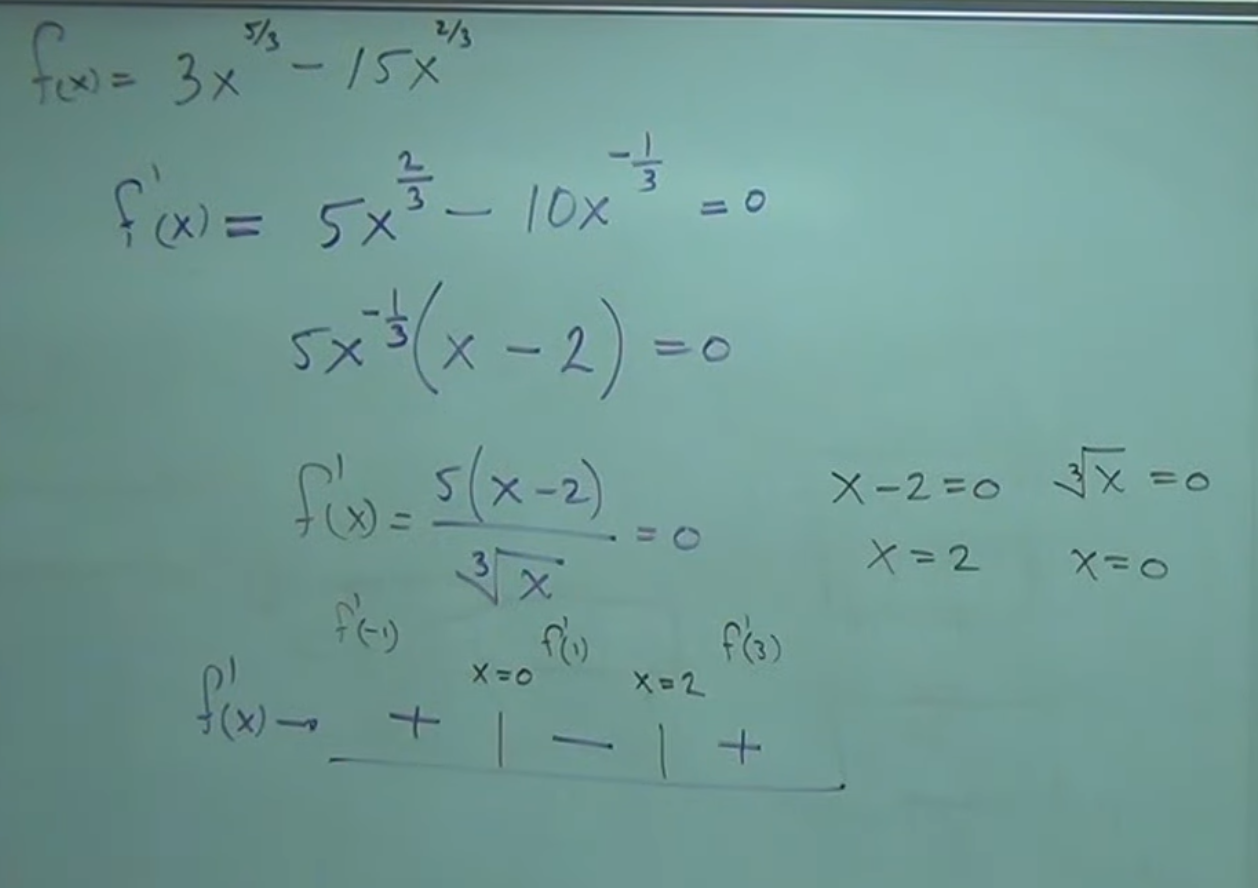
- ❶ Find the first derivative:
- $𝒇(𝒙)=3𝒙^{5/3}-15𝒙^{2/3} \;\Rightarrow\; 𝒇′(𝒙)=5𝒙^{2/3}-10𝒙^{-1/3}$
- ❷ Set the first derivative equal to zero: $5𝒙^{2/3}-10𝒙^{-1/3}=0$
- Multiply both sides by $𝒙^{1/3}$:
- $5𝒙-10=0 \Rightarrow 𝒙=2$
- Check where $𝒇′(𝒙)$ is undefined:
- $𝒇′(𝒙)$ is undefined at $𝒙=0$ (due to $𝒙^{-1/3}$)
- Critical numbers: $𝒙=0$, $𝒙=2$ (both are in the domain of $𝒇$)
- ❸ Create a sign chart for $𝒇′(𝒙)$:
- ❹ Test a value from each interval in $𝒇′(𝒙)$ to determine the sign:
- Test values:
- $𝒙=−1 \;\Rightarrow\; 𝒇′(−1)=5(-1)^{2/3}-10(-1)^{-1/3}>0 \;\Rightarrow\;
𝒇′(𝒙)<0$
- $𝒙=1 \;\Rightarrow\; 𝒇′(1)=5-10<0 \;\Rightarrow\; 𝒇′(𝒙)<0$
- $𝒙=3 \;\Rightarrow\; 𝒇′(3)=5\cdot 3^{2/3}-10\cdot 3^{-1/3}>0 \;\Rightarrow\;
𝒇′(𝒙)>0$
- Sign chart:
- Apply the First Derivative Test:
- At $𝒙=0$: The derivative $𝒇′$ is undefined due to a vertical tangent, so this
point is not considered a local extremum.
- This will become clearer when we study the second derivative test.
- At $𝒙=2$: $𝒇′$ changes from $−$ to $+$ ⇒ Local Minimum.
- Evaluate the function at critical points:
- $𝒇(0)=3\cdot 0-15\cdot 0=0$
- $𝒇(2)=3\,(2)^{5/3}-15\,(2)^{2/3}\approx 9.52-23.81\approx -14.29$
- Answer:
- Local Minimum at $(2,\,−14.29)$
- Vertical tangent (not extremum) at $(0,\,0)$
               C.N       C.N
     𝒇′(x)      ∣          ∣
           ─────●─────────●────────
                -1         1
     𝒇′(𝒙)       ∣          ∣
            ─────●─────────●────────
              -1         1
    𝒇′(𝒙)  +   ∣    −     ∣   +
          ─────●─────────●────────
               0         2
    𝒇′(𝒙)      ∣          ∣
          ─────●─────────●────────
                0         2
    𝒇′(𝒙)   +   ∣    −     ∣  +
           ─────●─────────●────────