Calculus 1 lecture 3.4 The Second Derivative Test For Concavity Of Functions
Introduction
- [0:16]. The
second derivative describes how a function’s slope changes, determining whether the curve is concave up or
concave down. –
[📷image]
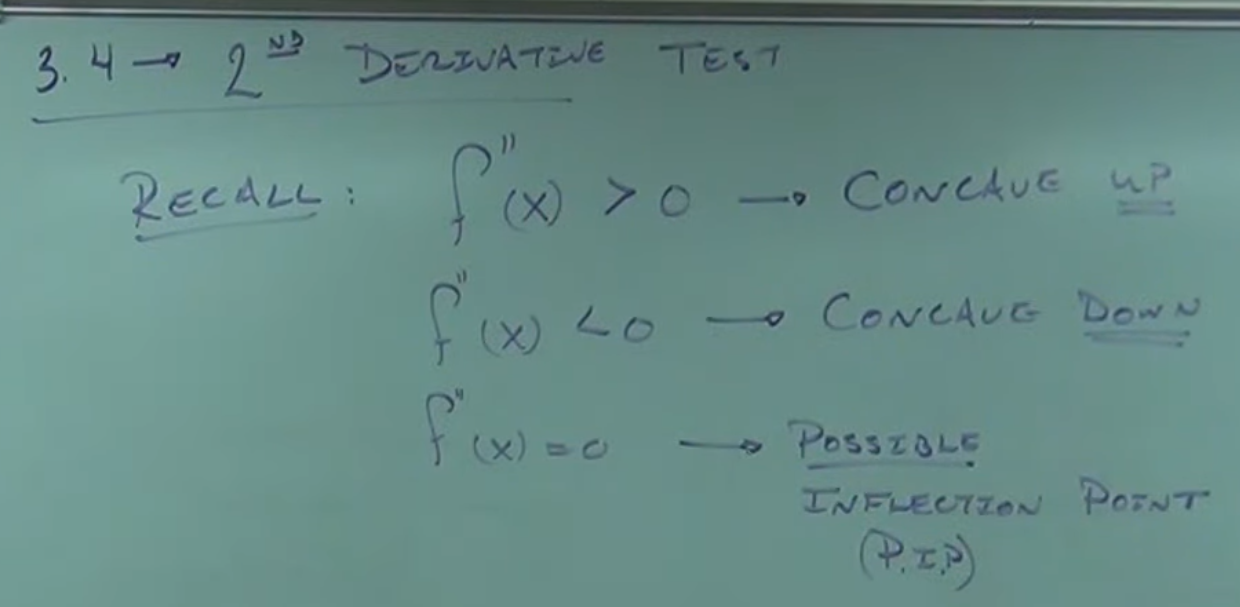
- If the second derivative is positive, the slope is increasing, and the curve is concave
up.
- If the second derivative is negative, the slope is decreasing, and the curve is concave
down.
- If $𝒇′′(𝓬)=0$, this is only a possible inflection point (PIP).
- A brief note: to confirm whether an inflection point truly exists, it is necessary to
check whether
the sign of the second derivative changes on either side of that point.
- If the sign does not change, then there is no real inflection.
Second derivative test
- [3:21].
The second derivative test is used to find inflection points. The steps are: –
[📷image]
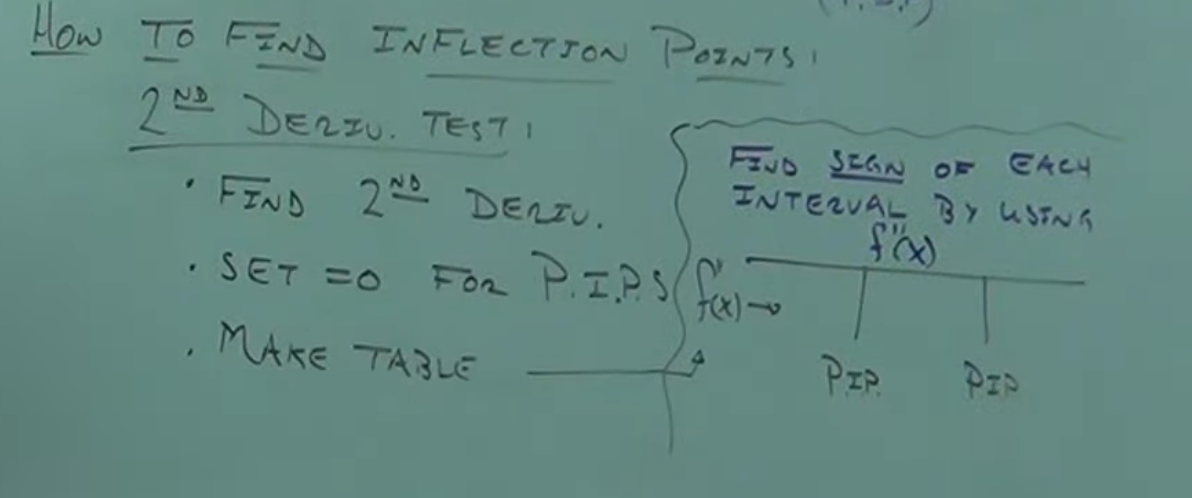
- ❶ Find the function’s second derivative.
- ❷ Set the second derivative equal to zero and solve for $𝒙$. This provides the
possible inflection points.
- Additionally, check for points where the second derivative does not exist (due to
discontinuities, vertical asymptotes, etc.).
These points can also be potential inflection points if the concavity changes.
- ❸ Create a second derivative chart:
- Place the possible inflection points on a number line.
- Evaluate the sign of the second derivative in each interval.
- A positive sign indicates concave up; a negative sign indicates concave down.
-
- ❹ Remember that if $𝒇′′(𝓬)=0$, it is only a possible inflection point. To
confirm if there is a
real change in concavity, you must check the sign of $𝒇′′(𝒙)$ before and after $𝒙=𝓬$.
If there is no change in sign, then there is no true inflection.
- [7:21].
The first derivative provides information about relative maxima and minima, while the second
derivative provides information about concavity and inflection points.
- [8:00]. 🧩
Example –: Find the inflection points of the function $𝒇(𝒙)=𝒙^4-4𝒙^3+12$ –
[📷image]
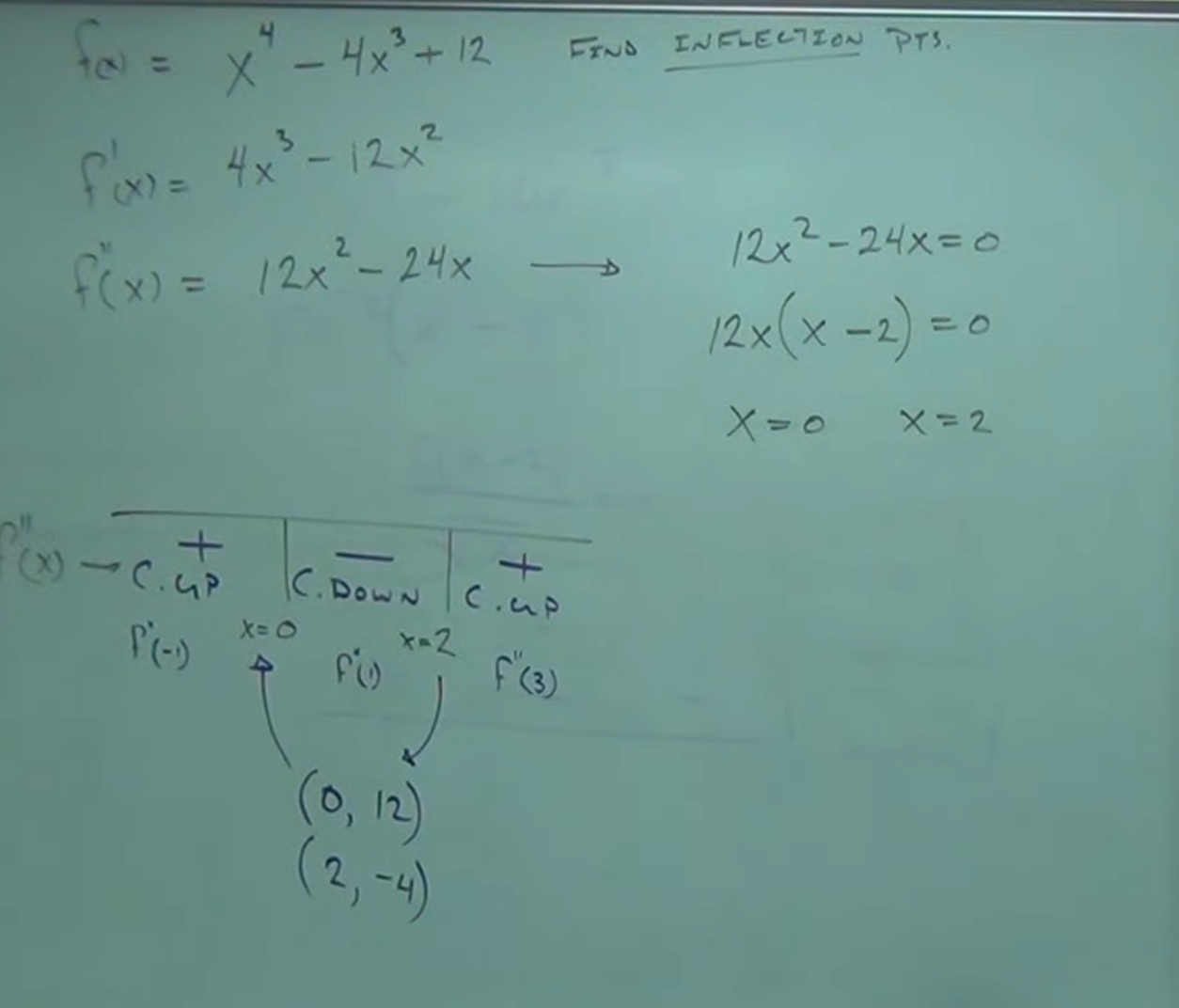
- ❶ Find the first and second derivatives:
- $𝒇′(𝒙)=4𝒙^3-12𝒙^2$
- $𝒇′′(𝒙)=12𝒙^2-24𝒙$
- ❷ Set the second derivative equal to zero and solve for $𝒙$:
- $12𝒙^2-24𝒙=0$
- $𝒙=0,\; 𝒙=2$
- ❸ Create the second derivative chart:
- ❹ The inflection points are $(0,12)$ and $(2,-4)$.
- [15:27].
🧩 Example –: Find the inflection points of the function $𝓰(𝒙)=(𝒙-1)^{1/3}$ –
[📷image]
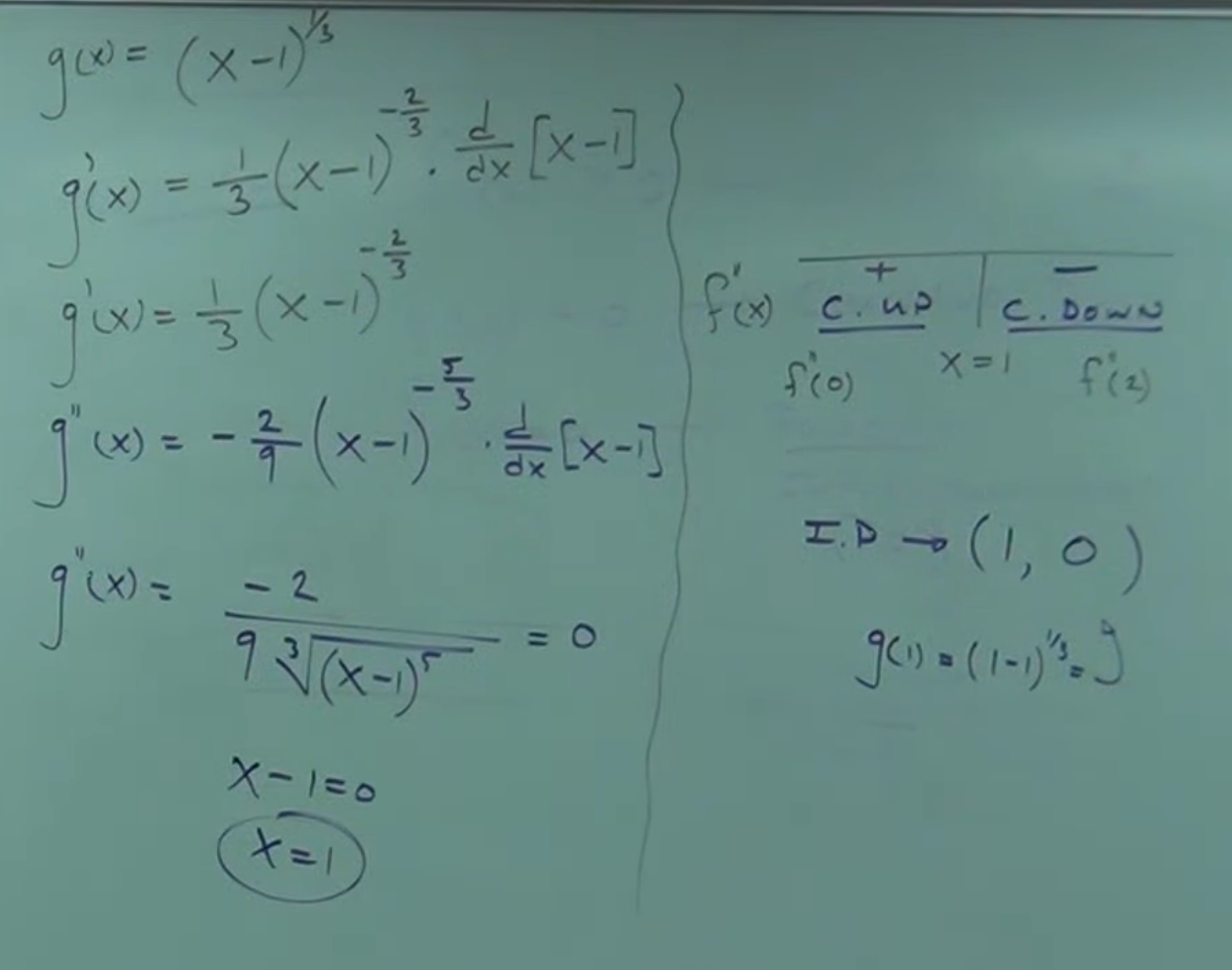
- ❶ Find the first and second derivatives:
- $𝓰′(𝒙)=\dfrac{1}{3}(𝒙-1)^{-2/3}$
- $𝓰′′(𝒙)= -\dfrac{2}{9}(𝒙-1)^{-5/3}$
- ❷ Identify points where the second derivative is undefined:
- ❸ Create the second derivative chart:
- ❹ The inflection point is $(1,0)$.
Combining the first and second derivative tests
- [24:06].
The first and second derivative tests can be combined to get a complete picture of the function’s behavior.
- [25:10].
🧩 Example –: Analyze the function $𝒉(𝒙)=𝒙^3-3𝒙^2+24𝒙-32$ –
[📷image]
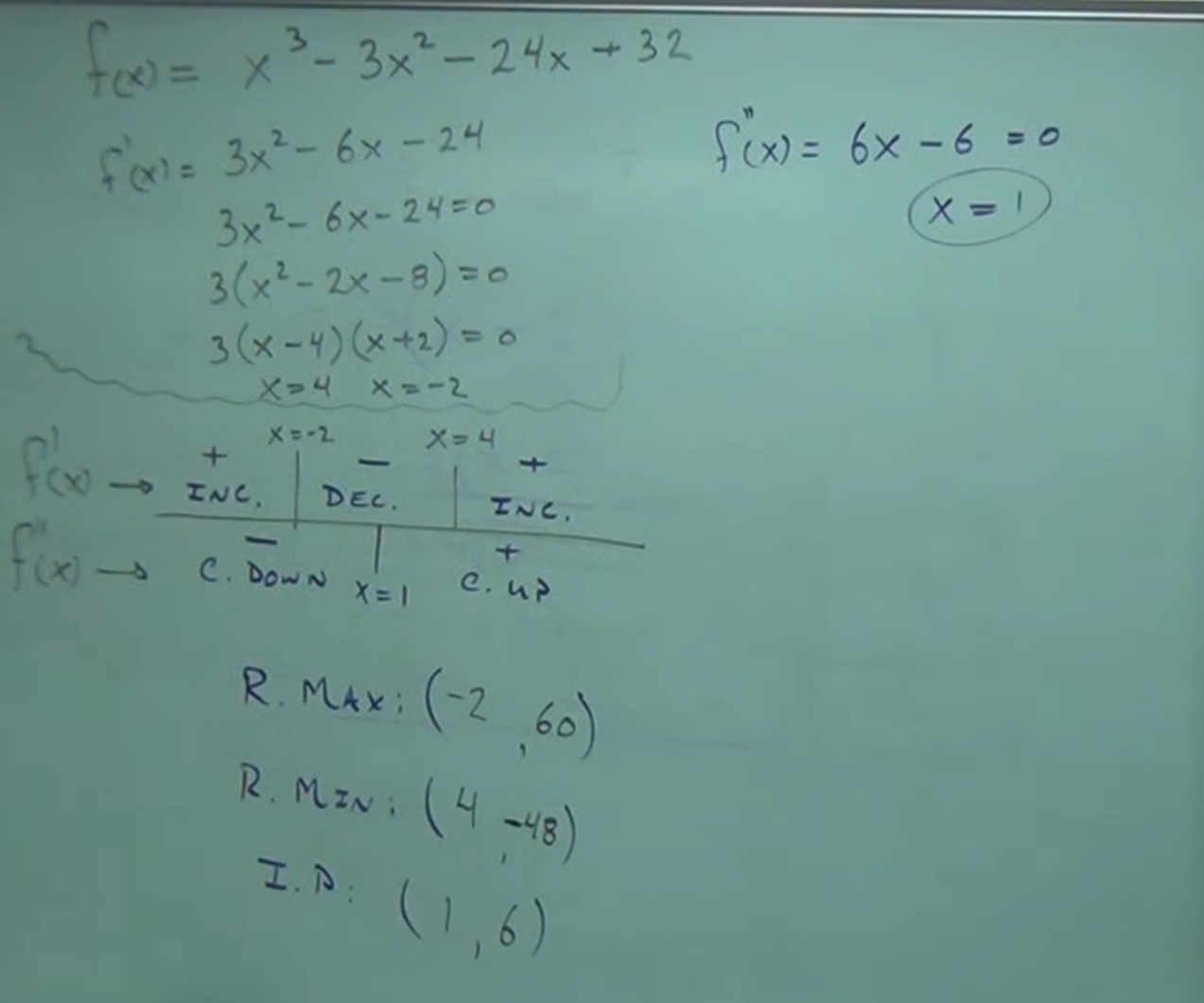
- First Derivative Test:
- $𝒉′(𝒙)=3𝒙^2-6𝒙+24$
- Critical numbers: $𝒙=-2,\; 𝒙=4$
- First derivative chart:
- [29:29]. Second Derivative Test:
- $𝒉′′(𝒙)=6𝒙-6$
- Possible inflection point: $𝒙=1$
- Second derivative chart:
-
Remember, the second derivative can also help classify critical points from
the first derivative test:
- $𝒇′(𝓬)=0$ and $𝒇′′(𝓬)>0$ → relative minimum at $𝒙=𝓬$.
- $𝒇′(𝓬)=0$ and $𝒇′′(𝓬)<0$ → relative maximum at $𝒙=𝓬$.
- $𝒇′(𝓬)=0$ and $𝒇′′(𝓬)=0$ → **inconclusive**, further analysis required.
- [31:53].
Combining both tests provides the following information:
- Relative maximum: $(-2,60)$
- Relative minimum: $(4,-48)$
- Inflection point: $(1,6)$
Limits at infinity
-
[36:01].
Section 3.5 of the course will address limits at infinity, allowing us to analyze a function’s
behavior as $𝒙$ approaches positive or negative infinity.
| Interval |
Sign of $𝒇′′(𝒙)$ |
Concavity |
| $(-\infty,0)$ |
$+$ |
Concave up |
| $(0,2)$ |
$-$ |
Concave down |
| $(2,\infty)$ |
$+$ |
Concave up |
| Interval |
Sign of $𝓰′′(𝒙)$ |
Concavity |
| $(-\infty,1)$ |
$+$ |
Concave up |
| $(1,\infty)$ |
$-$ |
Concave down |
| Interval |
Sign of $𝒉′(𝒙)$ |
Behavior |
| $(-\infty,-2)$ |
$+$ |
Increasing |
| $(-2,4)$ |
$-$ |
Decreasing |
| $(4,\infty)$ |
$+$ |
Increasing |
| Interval |
Sign of $𝒉′′(𝒙)$ |
Concavity |
| $(-\infty,1)$ |
$-$ |
Concave down |
| $(1,\infty)$ |
$+$ |
Concave up |
               ─────────●──────────────●────────
         𝒇′′(𝒙)         ∣               ∣
                       PIP₁           PIP₂ . . .
                             0           2
            𝒇′′(𝒙)     +     ∣     −      ∣   +
                    ─────────●───────────●────────
                               1
            𝒇′′(𝒙)       +     ∣     −
                      ─────────●─────────
                           -2          4
        𝒇′(𝒙)        +     ∣     −     ∣    +
                  ─────────●───────────●────────
                        -2             4
        𝒇′(𝒙)       +    ∣      −       ∣    +
                  ───────●──────●──────●───────
       𝒇′′(𝒙)           -       ∣       +
                                1