Calculus 1 lecture 3.5
Limits Of Functions at Infinity
Review of vertical asymptotes and removable discontinuities
-
[0:00]. Reminder of the
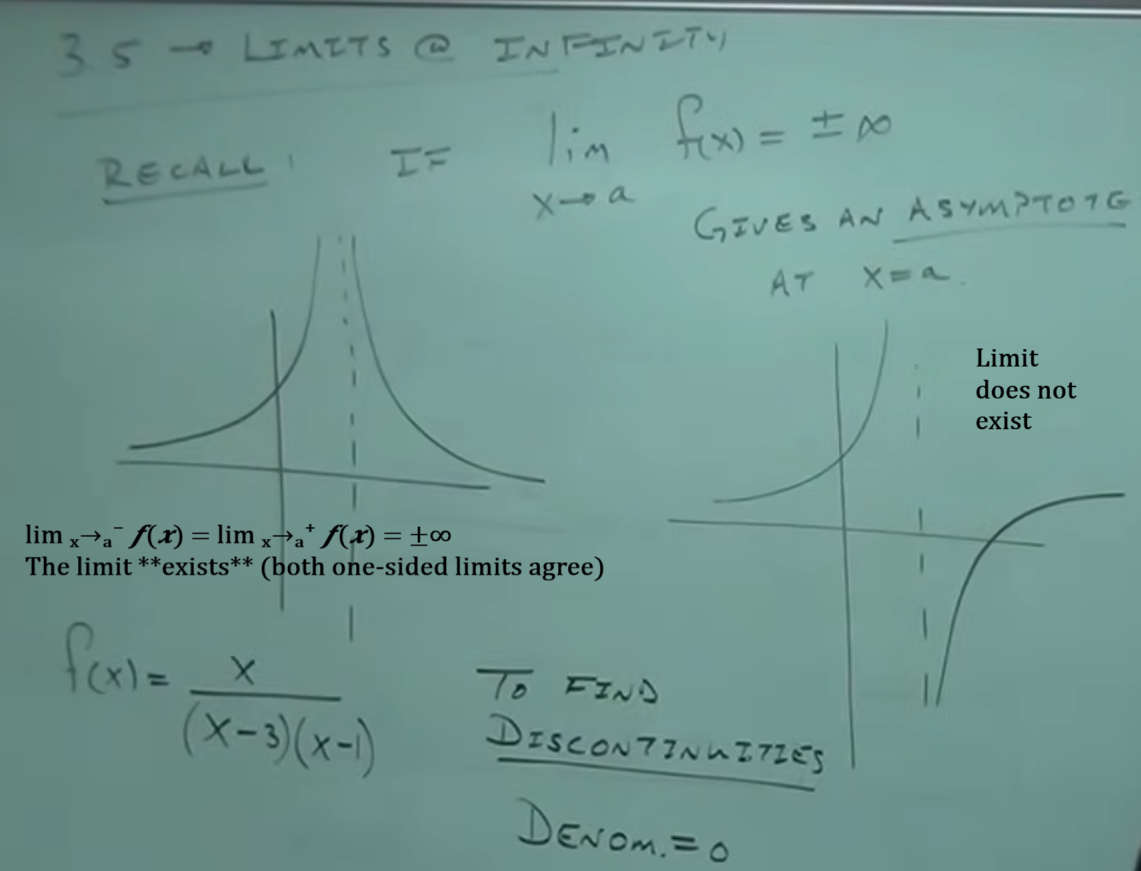
definition of vertical asymptote (VA): $\lim_{x\to a} 𝒇(𝒙)=\pm\infty$
[📷image]
-
Two cases for a vertical asymptote:
- $\lim_{x\to a^-} 𝒇(𝒙)=\lim_{x\to a^+} 𝒇(𝒙)=\pm\infty$ # The limit exists (both one-sided limits agree)
- $\lim_{x\to a^-} 𝒇(𝒙)=\infty$ and $\lim_{x\to a^+} 𝒇(𝒙)=-\infty$ # The limit does not exist (one-sided limits disagree)
-
to find discontinuities denominator equals zero.
- If a factor cannot be canceled, the discontinuity is a vertical asymptote.
- If a factor can be canceled, it is a removable discontinuity, not a vertical asymptote.
-
Two cases for a vertical asymptote:
-
[3:55]. Difference between
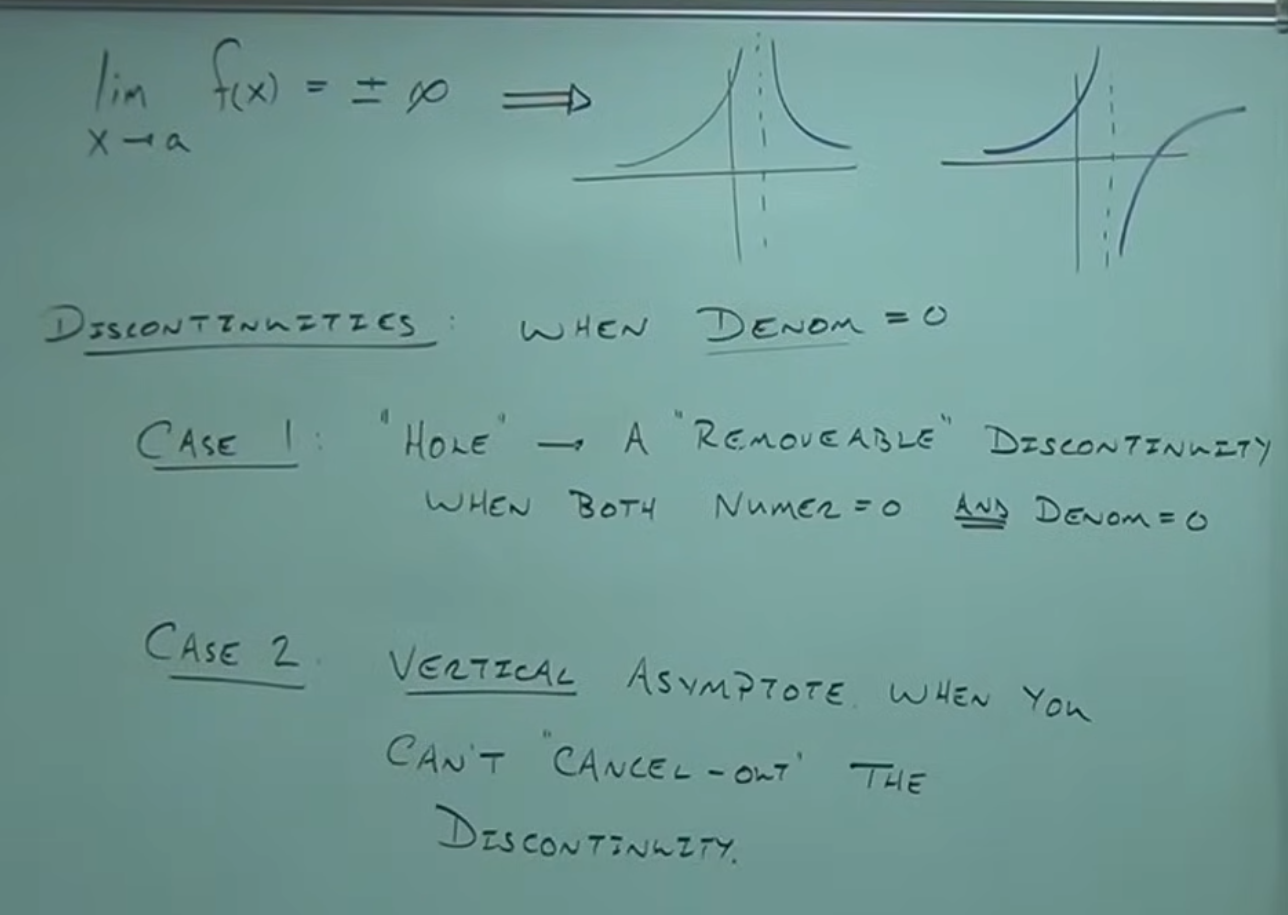
removable discontinuities (holes) and VA.
[📷image]
-
ʜ̳ᴏ̳ʟ̳ᴇ̳ꜱ̳: removable discontinuities where only one point is missing in the function.
- Occur when the numerator and denominator are zero at the same time, allowing cancellation of factors.
- One single point is missing from the function.
-
ᴠ̳ᴀ̳: non-removable discontinuities.
- Occur when discontinuities cannot be canceled.
-
ʜ̳ᴏ̳ʟ̳ᴇ̳ꜱ̳: removable discontinuities where only one point is missing in the function.
-
[6:40]. 🧩 Example –:
$𝒇(𝒙)=\dfrac{𝒙}{(𝒙+3)(𝒙-1)}$
[📷image]
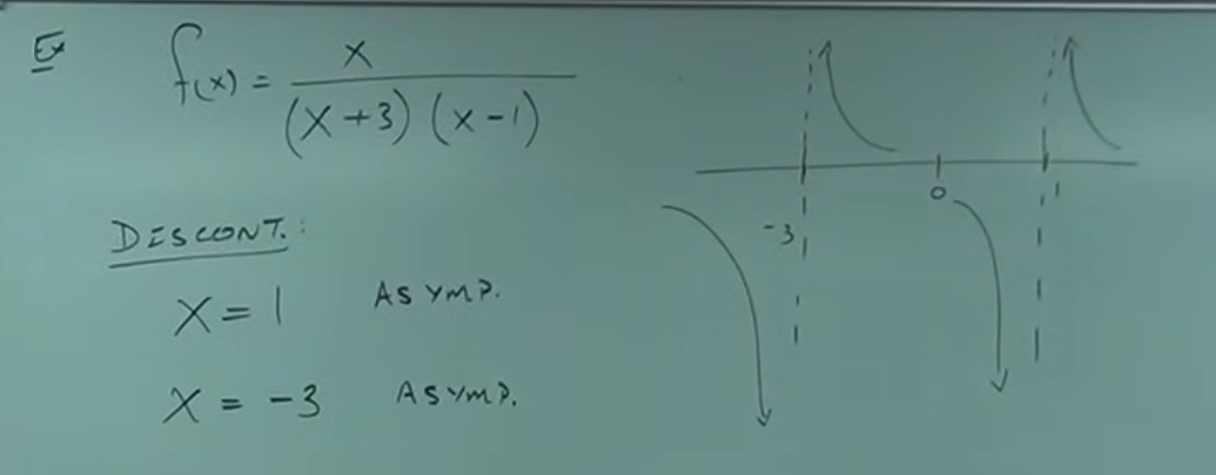
- Vertical asymptotes at $𝒙=1$ and $𝒙=-3$ → non-cancelable factors in the denominator.
-
Critical sign-change values are found by:
- Setting the denominator equal to zero → to identify discontinuities (vertical asymptotes).
-
Setting the numerator equal to zero → to identify values where the function
crosses the $𝒙$-axis.
-
These are not discontinuities, but they must be included in the sign analysis
since they may cause a sign change in the rational expression.
- In this case, $𝒙=0$ makes the numerator zero → the function is zero at this point and may change sign around it.
-
These are not discontinuities, but they must be included in the sign analysis
since they may cause a sign change in the rational expression.
-
General rule for analyzing a rational function $𝒇(𝒙)=\dfrac{𝒫(𝒙)}{𝒬(𝒙)}$:
- Fully factor both $𝒫(𝒙)$ and $𝒬(𝒙)$, and simplify the expression if possible.
-
Identify points of discontinuity from $𝒬(𝒙)=0$:
-
If a factor in the denominator does not cancel with the numerator, its zero
corresponds to a vertical asymptote (VA).
- These values are not in the domain and divide the number line into intervals.
- They are essential in the sign chart, as they may trigger sign changes in $𝒇(𝒙)$.
-
If a factor in the denominator does cancel with one in the numerator, the
corresponding $𝒙$-value results in a hole (removable discontinuity).
- The function is undefined at this point, but the behavior around it may be continuous.
- Holes do not cause sign changes like VAs do, but must still be noted in the analysis.
-
If a factor in the denominator does not cancel with the numerator, its zero
corresponds to a vertical asymptote (VA).
- Set $𝒫(𝒙)=0$ → determine x-intercepts (zeros of the numerator).
- Include them in the sign analysis only if they are in the domain, as they may indicate a sign change in the rational expression.
-
[8:14]. Using sign
analysis to determine behavior around VAs:
- Sign chart:
-
Limits at critical values:
-
Near $𝒙=-3$ (vertical asymptote):
- $\lim_{x\to-3^-} 𝒇(𝒙)=-\infty$ # denominator $\to0^+$, numerator $<0$ ⇒ $-\infty$
- $\lim_{x\to-3^+} 𝒇(𝒙)=+\infty$ # denominator $\to0^-$, numerator $<0$ ⇒ $+\infty$
- Limit does not exist.
-
At $𝒙=0$ (zero of the numerator):
- $\lim_{x\to0} 𝒇(𝒙)=0$ # numerator $\to0$, denominator $\neq0$ ⇒ crosses the x-axis.
-
Near $𝒙=1$ (vertical asymptote):
- $\lim_{x\to1^-} 𝒇(𝒙)=-\infty$ # denominator $\to0^-$, numerator $>0$ ⇒ $-\infty$
- $\lim_{x\to1^+} 𝒇(𝒙)=+\infty$ # denominator $\to0^+$, numerator $>0$ ⇒ $+\infty$
- Limit does not exist.
-
Near $𝒙=-3$ (vertical asymptote):
-
[11:55]. 🧩 Example –:
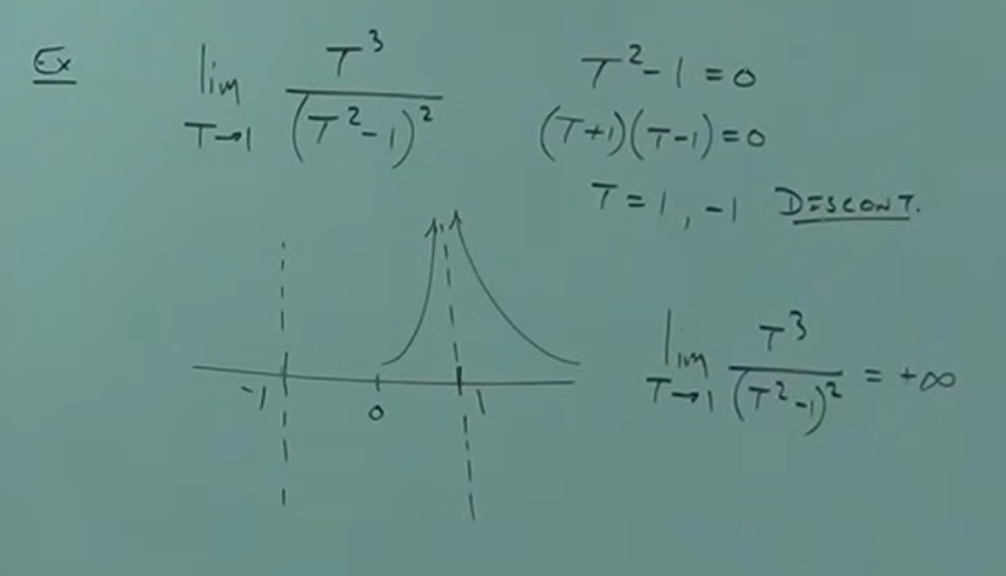
$\lim_{t\to1} \dfrac{t^3}{(t^2-1)^2}$
[📷image]
-
Discontinuities:
- Discontinuities occur where the denominator equals zero.
- For this problem, they happen at $t=\pm1$ because $(t^2-1)^2=0$.
- These are vertical asymptotes as they cannot be removed by factoring (non-removable discontinuities).
-
Focus on the limit:
- Even though there are two discontinuities ($t=\pm1$), only $t=1$ matters since the limit is evaluated near this value.
- $t=-1$ can be ignored for this problem.
-
Importance of the numerator:
- It is crucial for calculating the limit at vertical asymptotes (VA), as these points determine where the function may change its sign in the adjacent intervals.
- Check where the numerator ($t^3=0$) equals zero, which happens at $t=0$.
- $t=0$ is not an asymptote, but it is useful to divide intervals and check for sign changes.
-
Strategy:
- Divide the interval into regions around $t=0$ and $t=1$.
- Evaluate specific points in each region (e.g., $t=0.5,\; t=2$) to understand the function's behavior.
- Sign chart:
- Near $x=1$ (vertical asymptote):
- $\lim_{x\to1^-} 𝒇(𝒙)=+\infty$ # denominator $\to0^-$, numerator $>0$ ⇒ $+\infty$
- $\lim_{x\to1^+} 𝒇(𝒙)=+\infty$ # denominator $\to0^+$, numerator $>0$ ⇒ $+\infty$
- Limit exist: $\lim_{x\to1} 𝒇(𝒙)=+\infty$
- Near $x=1$ (vertical asymptote):
-
Discontinuities:
Limits at infinity
-
[16:30]. Question: What
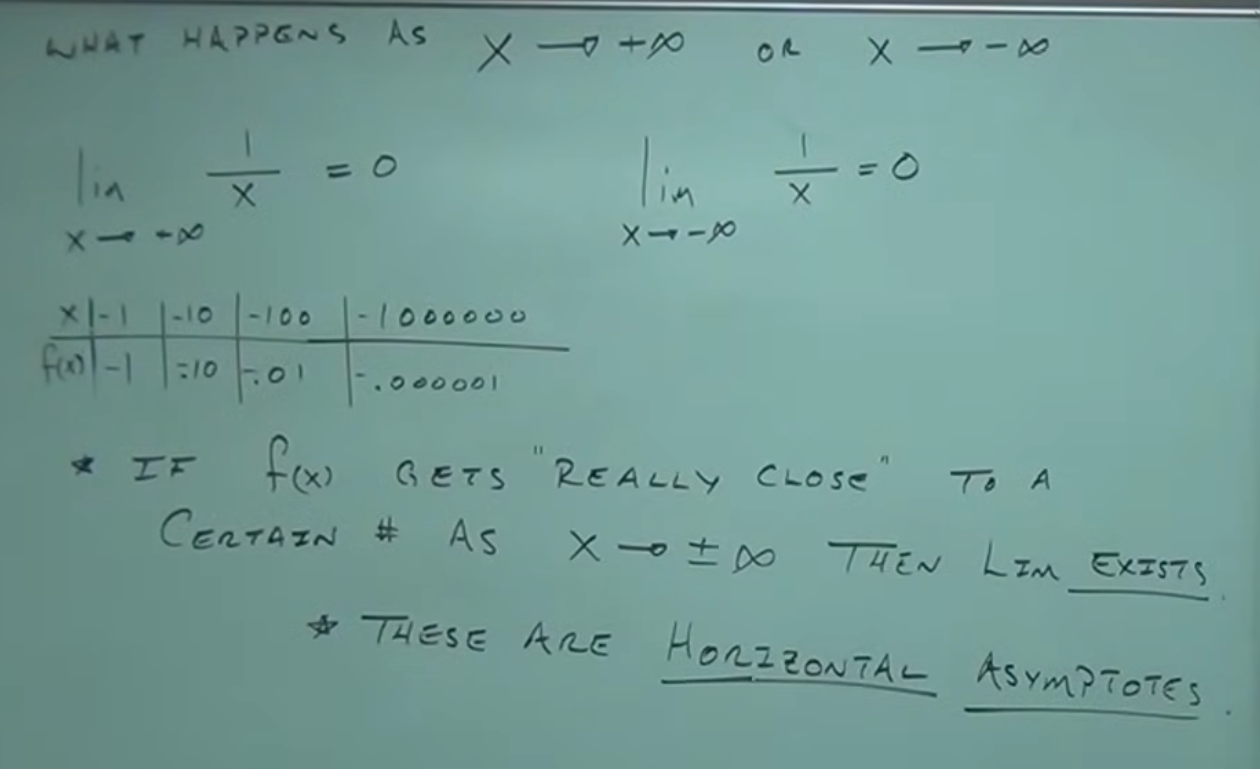
happens to a function as $𝒙$ approaches positive or negative infinity?
[📷image]
-
Exploring the behavior of $1/𝒙$ as $𝒙$ increases:
- As $𝒙$ increases, $1/𝒙$ approaches zero.
- $\lim_{x\to\infty} \dfrac{1}{x}=0$
- $\lim_{x\to-\infty} \dfrac{1}{x}=0$
- As $𝒙$ increases, $1/𝒙$ approaches zero.
-
Exploring the behavior of $1/𝒙$ as $𝒙$ increases:
-
[20:25]. Definition of
limit at infinity :
- If $𝒇(𝒙)$ approaches a number as $𝒙$ approaches infinity, the limit exists.
-
[21:07]. Relation between
limits at infinity and horizontal asymptotes (HA):
- HA represent the value a function approaches as $𝒙$ goes to positive or negative infinity.
-
[23:00]. The rules for
calculating limits as $𝒙\to+\infty$ or $𝒙\to-\infty$
[📷image]
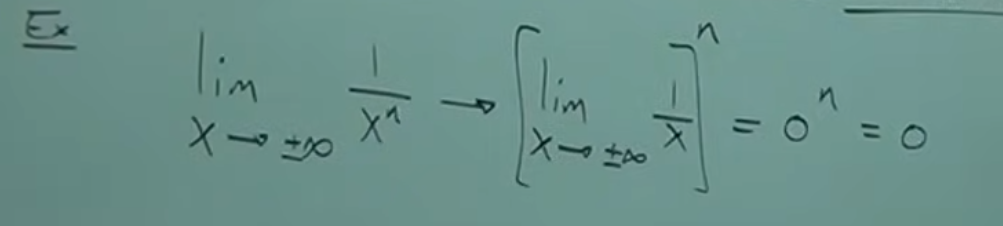 are the same as before. Therefore, the same rules and techniques apply in both cases.
-
$\lim_{x\to\infty} \dfrac{1}{x^n}=0$ for any $n>0$ :
- Any constant divided by a variable raised to a power approaching infinity will approach zero.
-
$\lim_{x\to\infty} \dfrac{1}{x^n}=0$ for any $n>0$ :
-
[26:10]. Behavior of
polynomials at infinity
[📷image]
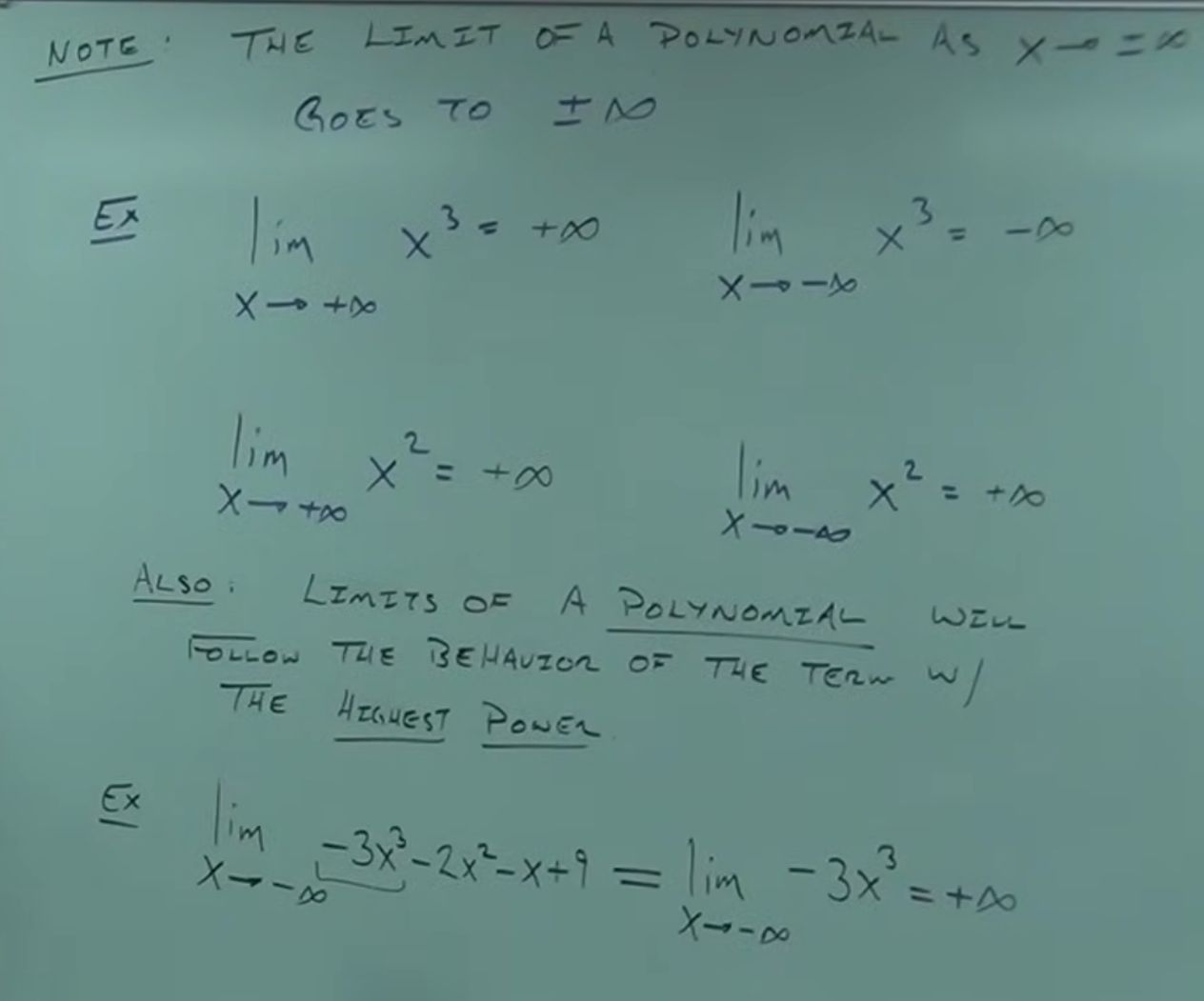
- Polynomials do not approach a specific number at infinity but tend to positive or negative infinity.
-
The behavior of a polynomial at infinity is determined by the highest power term.
- This is because, as $𝒙$ approaches infinity, the lower exponent terms become insignificant compared to the dominant term.
- 🧩 Example –: $\lim_{x\to-\infty} \left(-3x^3-2x^2-x+9\right)=\lim_{x\to-\infty} (-3x^3)=\infty$
Calculating limits at infinity
- [36:27]. Introduction.
-
[38:15]. 🧩 Example –:
$\lim_{x\to\infty} \dfrac{5x-2}{3x+9}$
[📷image]
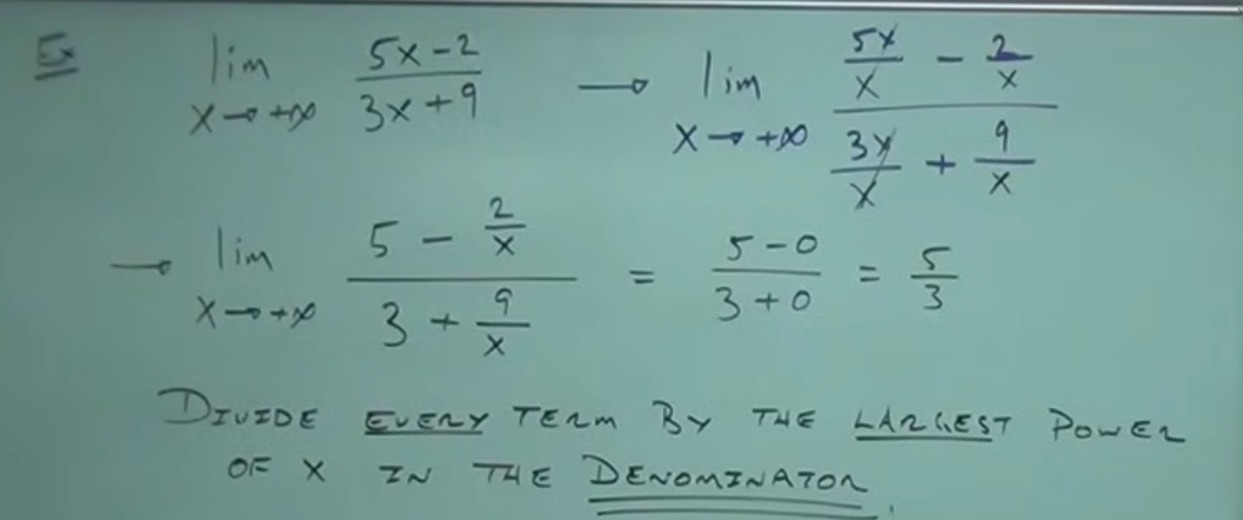
- Key idea: divide each term by the highest power of $𝒙$ in the denominator.
- Terms with $𝒙$ in the denominator approach zero as $𝒙$ approaches infinity.
- $\lim_{x\to\infty} \dfrac{5-2/x}{3+9/x}=\dfrac{5}{3}$
- Observation: the limit at infinity of a rational function where the powers of $𝒙$ in the numerator and denominator are equal is the ratio of the leading coefficients.
-
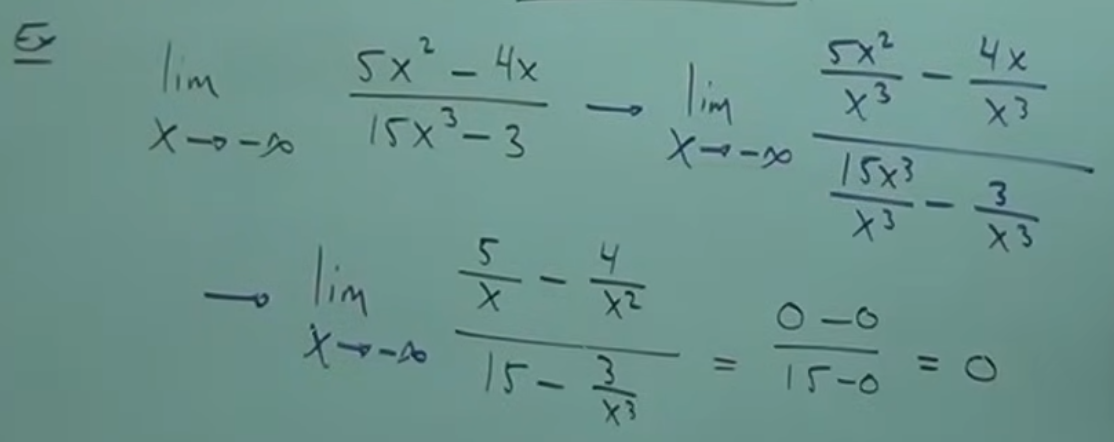
[44:28]. 🧩 Example –:
$\lim_{x\to-\infty} \dfrac{5x^2-4x}{15x^3-3x}$
[📷image]
-
Divide all terms by the highest power of $x$ in the denominator ($x^3$):
- $\lim_{x\to-\infty} \dfrac{5/x-4/x^2}{15-3/x^3}$
-
Analyze behavior as $x\to-\infty$:
- $5/x\to0$, $4/x^2\to0$, $3/x^3\to0$
-
Substitute limits:
- $\dfrac{0-0}{15-0}=0$ $\Rightarrow\ \lim_{x\to-\infty} \dfrac{5x^2-4x}{15x^3-3x}=0$
-
Divide all terms by the highest power of $x$ in the denominator ($x^3$):
-
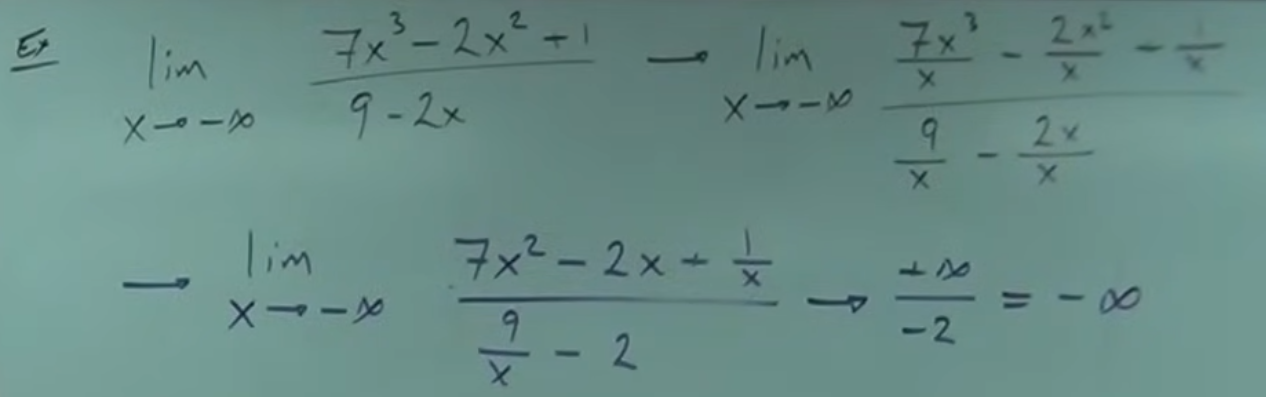
[48:05]. 🧩 Example –:
$\lim_{x\to-\infty} \dfrac{7x^3-2x^2+1}{9-2x}$
[📷image]
-
Divide all terms by the highest power of $x$ in the denominator ($x$):
- $\lim_{x\to-\infty} \dfrac{7x^2-2x+1/x}{9/x-2}$
-
Analyze behavior as $x\to-\infty$:
- $7x^2\to+\infty$, $-2x\to+\infty$, $1/x\to0$, $9/x\to0$, denominator $\to-2$
-
Substitute limits:
- $\dfrac{+\infty}{-2}=-\infty$ $\Rightarrow\ \lim_{x\to-\infty} \dfrac{7x^3-2x^2+1}{9-2x}=-\infty$
-
Divide all terms by the highest power of $x$ in the denominator ($x$):
-
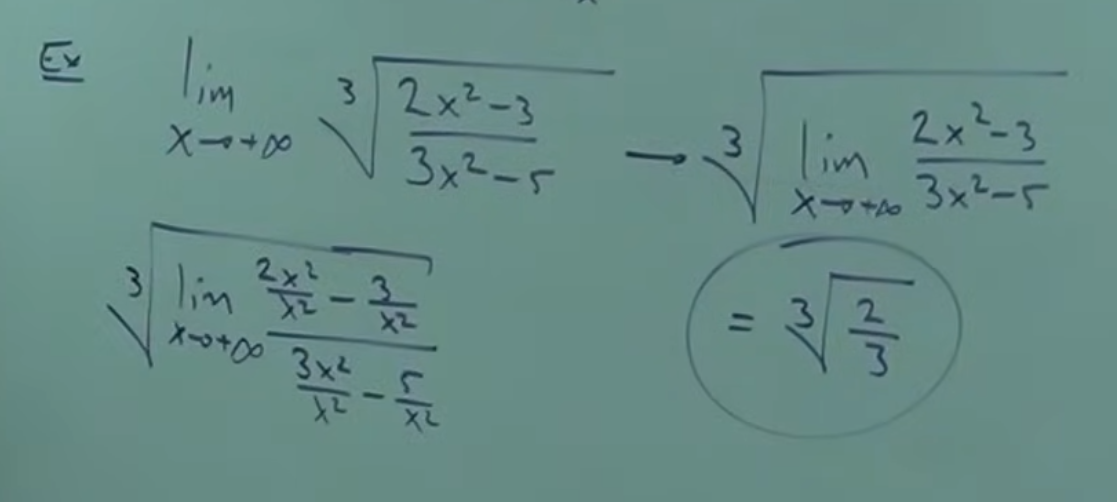
[52:15]. 🧩 Example –:
$\lim_{x\to\infty} \sqrt[3]{\dfrac{2x^2-3}{x^2-5}}$
[📷image]
-
Divide inside by the highest power $x^2$:
- $\sqrt[3]{\dfrac{2-3/x^2}{1-5/x^2}}$
-
Take the limit:
- $\sqrt[3]{\dfrac{2}{1}}=\sqrt[3]{2}$
-
Divide inside by the highest power $x^2$:
-
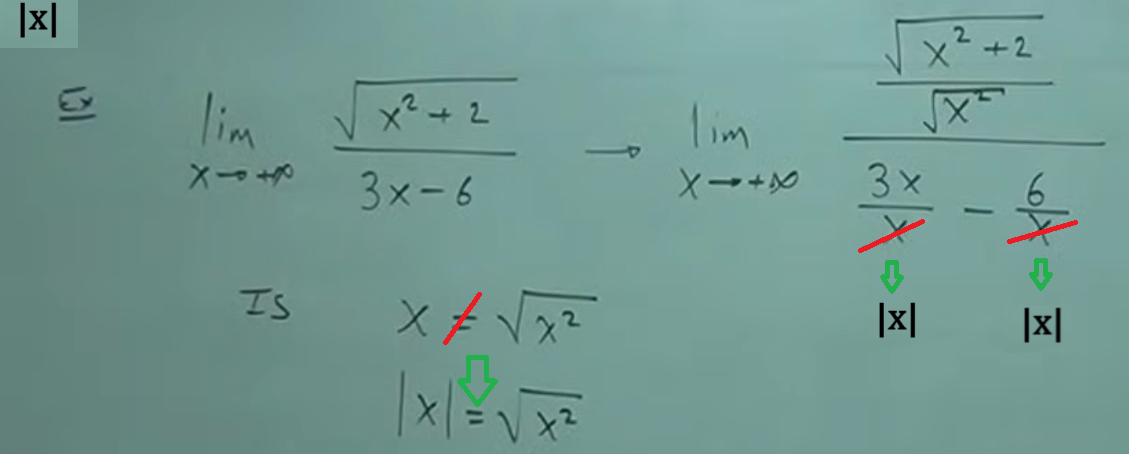
[53:50]. 🧩 Example –:
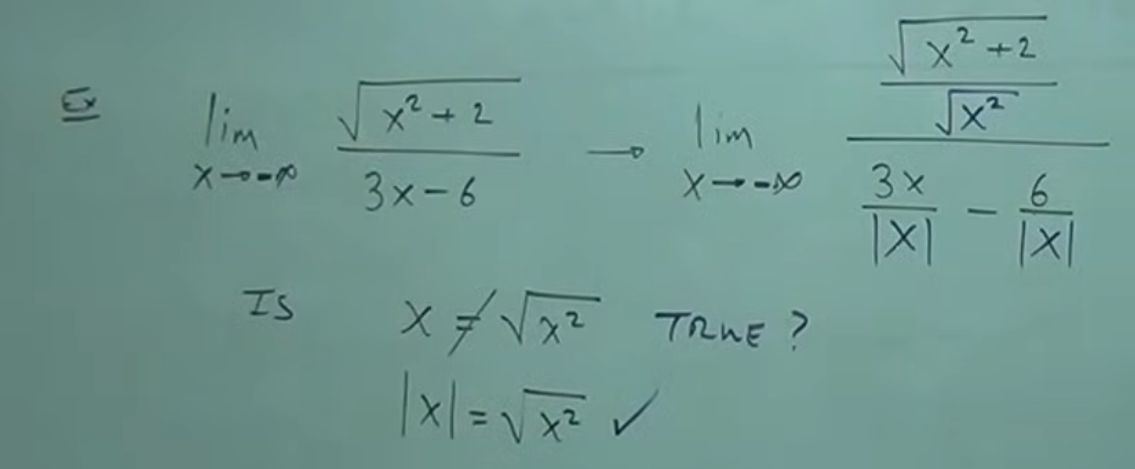
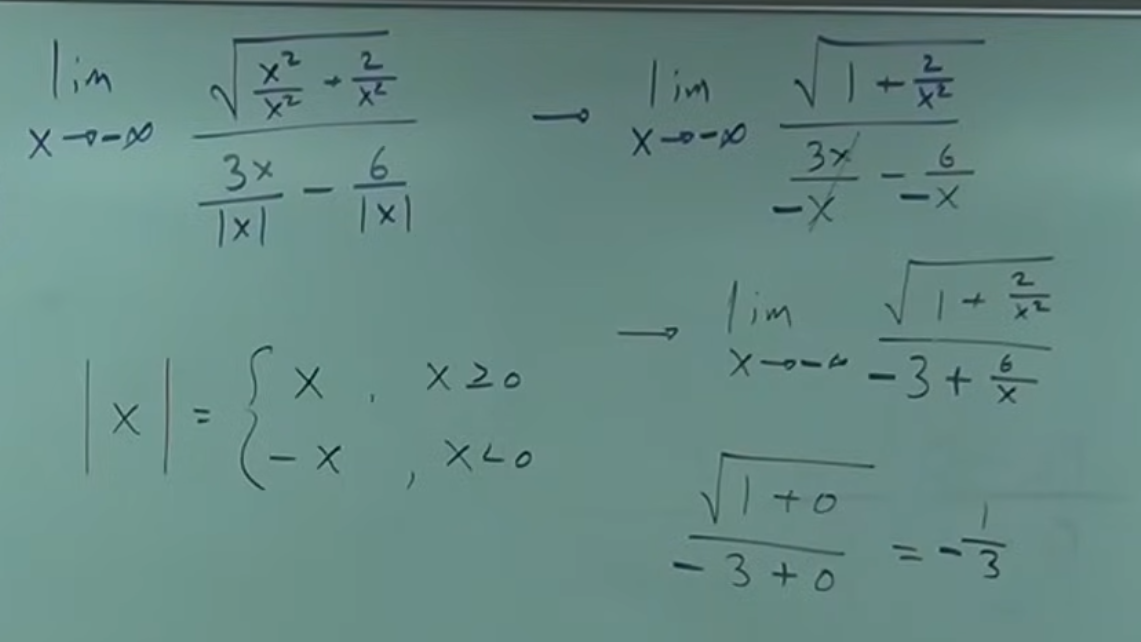
$\lim_{x\to-\infty} \dfrac{\sqrt{x^2+2}}{3x-6}$
[📷image-1]
 [📷image-2]
 [📷image-3]
-
Divide by $x$ (highest power in the denominator):
- ➀ Applied Property: Multiplication of Terms with Fractional Powers: $a\cdot b=\sqrt{a^2b^2}$
- 🧩 Example –: $\dfrac{1}{x}\cdot\sqrt{x^2+2}=\sqrt{\dfrac{x^2+2}{x^2}}$
- ➁ Pay attention to the use of absolute value when simplifying square roots: $\sqrt{x^2}=|x|$
-
(i) Why is $x\neq\sqrt{x^2}$ in general?
- If $x\ge0$: $\sqrt{x^2}=x$
- If $x<0$: e.g., $x=-3\Rightarrow \sqrt{9}=3\neq -3$
-
(ii) Why is $|x|=\sqrt{x^2}$ always true?
- Both yield the non-negative magnitude of $x$.
-
Step 1. Factor inside the root:
- $x^2+2=x^2\,(1+2/x^2)\Rightarrow \sqrt{x^2+2}=|x|\sqrt{1+2/x^2}$
-
Step 2. Substitute:
- $\dfrac{\sqrt{x^2+2}}{3x-6}=\dfrac{|x|\sqrt{1+2/x^2}}{3x-6}$
-
Step 3. Divide numerator/denominator by $x$:
- $\dfrac{|x|/x\cdot\sqrt{1+2/x^2}}{3-6/x}$
-
Step 4. Limit as $x\to-\infty$:
- $|x|/x\to-1$, $\sqrt{1+2/x^2}\to1$, $3-6/x\to3$
-
Conclusion:
- $\lim_{x\to-\infty} \dfrac{\sqrt{x^2+2}}{3x-6}=\dfrac{-1\cdot1}{3}=-\dfrac{1}{3}$
-
Divide by $x$ (highest power in the denominator):
-
[1:06:53]. 🧩 Example –:
$\lim_{x\to\infty}\big(\sqrt{x^4+2}-x^2\big)$
[📷image]
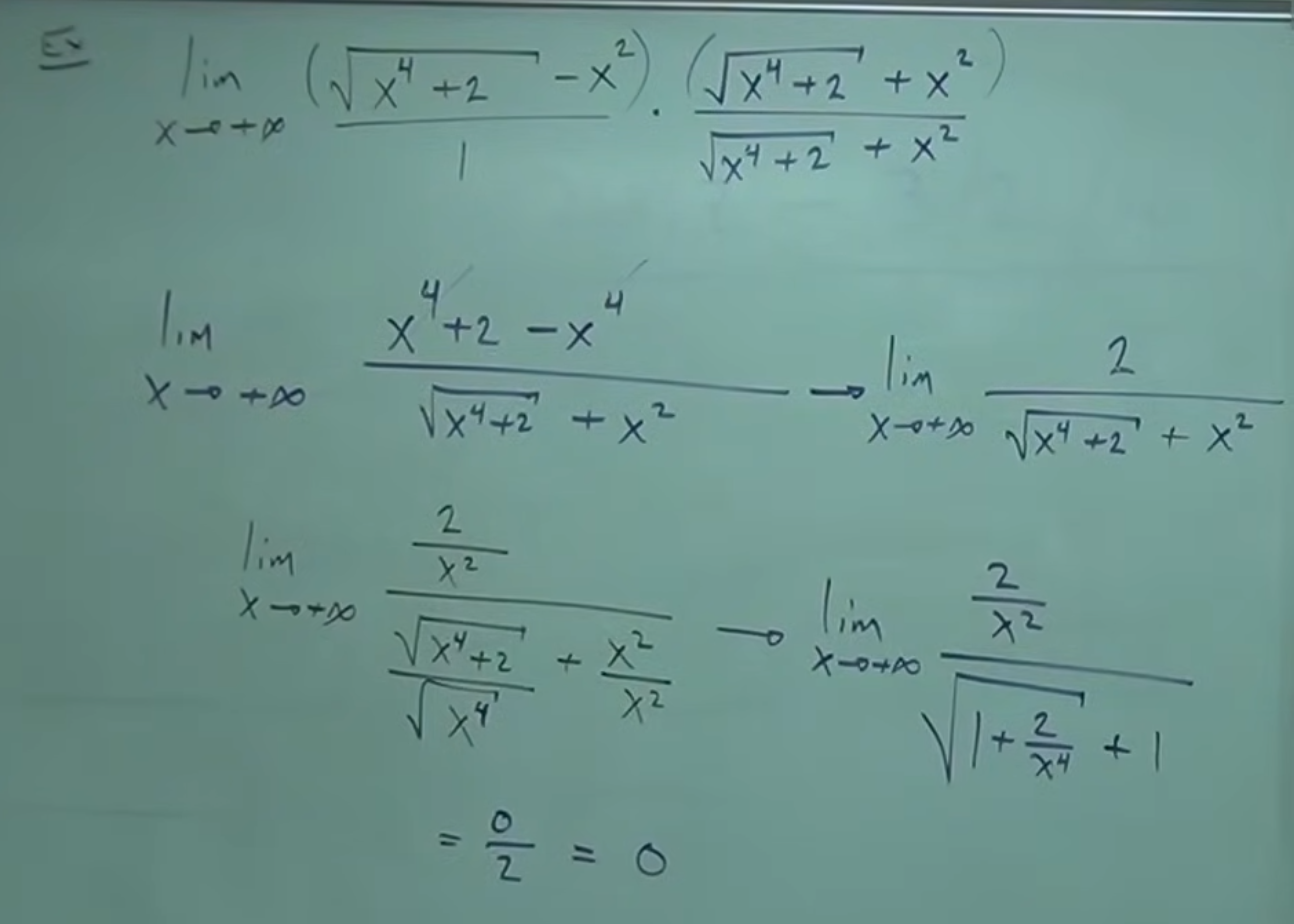
- Rationalize with the conjugate.
- Divide by $x^2$ (highest power relevant).
-
Step 1: Multiply by the conjugate
- $\lim_{x\to\infty} \dfrac{(\sqrt{x^4+2}-x^2)(\sqrt{x^4+2}+x^2)}{\sqrt{x^4+2}+x^2}$
-
Step 2: $(a-b)(a+b)=a^2-b^2$
- $\lim_{x\to\infty} \dfrac{x^4+2-x^4}{\sqrt{x^4+2}+x^2}=\lim_{x\to\infty} \dfrac{2}{\sqrt{x^4+2}+x^2}$
-
Step 3: Divide top/bottom by $x^2$
- $\lim_{x\to\infty} \dfrac{\dfrac{2}{x^2}}{\sqrt{1+\dfrac{2}{x^4}}+1}$
-
Step 4: Take the limit
- $\dfrac{0}{1+1}=0$
-
[1:16:00]. 🧩 Example –:
$\lim_{x\to\infty}\big(\sqrt{x^4+2x^2+x^2}-x^2\big)$
[📷image]
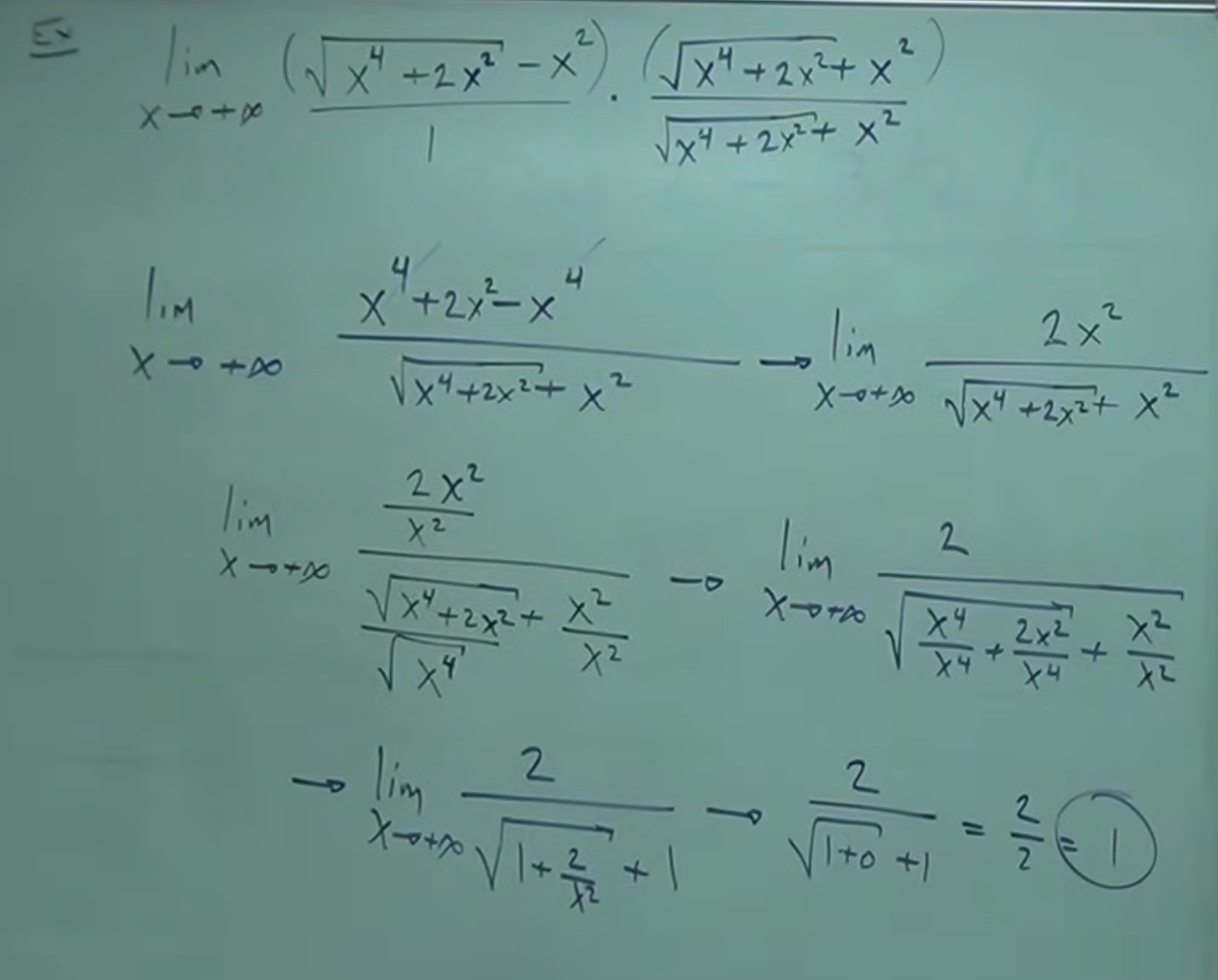
- Rationalize with the conjugate.
- Divide each term by $x^2$.
-
Step 1: Multiply by the conjugate
- $\lim_{x\to\infty}\dfrac{(\sqrt{x^4+2x^2+x^2}-x^2)(\sqrt{x^4+2x^2+x^2}+x^2)}{\sqrt{x^4+2x^2+x^2}+x^2}$
-
Step 2: $(a-b)(a+b)=a^2-b^2$
- $\lim_{x\to\infty}\dfrac{x^4+2x^2+x^2-x^4}{\sqrt{x^4+2x^2+x^2}+x^2}=\lim_{x\to\infty}\dfrac{2x^2}{\sqrt{x^4+2x^2+x^2}+x^2}$
-
Step 3: Divide by $x^2$
- $\lim_{x\to\infty}\dfrac{2}{\sqrt{1+\dfrac{2}{x^2}+\dfrac{1}{x^2}}+1}$
-
Step 4: Take the limit
- $\dfrac{2}{1+1}=1$
-
[1:20:51]. 🧩 Example –:
$\lim_{x\to\infty} \sqrt{7-x}$
[📷image]
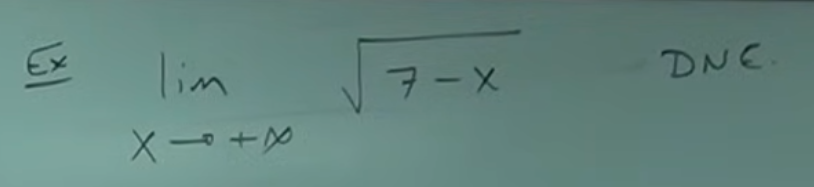
- Does not exist: D.N.E
- The expression inside the square root becomes negative as $𝒙\to+\infty$.
- SUMMARY: INDETERMINATE FORMS
When $x \to \infty$ or $x \to -\infty$ in limits