Calculus 1 leccture 3.7
Optimization; Max / Min Application Problems
Introduction
-
[0:01]. Introduction
- [📷image]
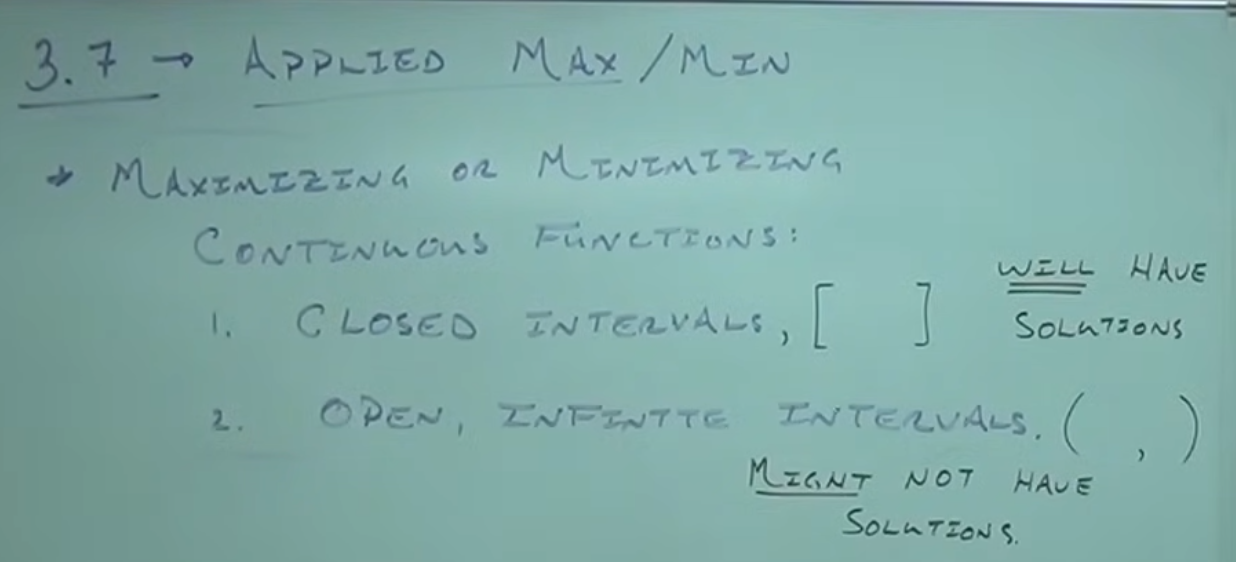
- This lecture focuses on how to maximize and/or minimize continuous functions.
-
Two scenarios are explored:
- Closed Intervals.
- Open Intervals.
- We analyze the existence of absolute maxima and minima in continuous functions and their real-life applications.
-
[0:50]. Real-Life
Applications
-
Minimizing Costs and Maximizing Profits: In business, it is crucial to find the lowest cost and the highest
profit.
- Calculus allows for precise calculations of production and costs to optimize these aspects.
- Design Optimization: Calculus can be used to design products that maximize attributes such as volume, given certain constraints.
-
Minimizing Costs and Maximizing Profits: In business, it is crucial to find the lowest cost and the highest
profit.
Extreme value theorem
-
[2:15]. Extreme Value
Theorem.
-
Closed Intervals:
- If a function is continuous on a closed interval $[\mathcal{a},\mathcal{b}]$, then it must attain both an absolute maximum and an absolute minimum on that interval.
-
These extrema may occur:
- At the endpoints ($x=\mathcal{a}$ or $x=\mathcal{b}$), or
- At critical points within $(\mathcal{a}, \mathcal{b})$ where the derivative is zero or undefined.
-
Open Intervals:
- If a function is continuous on an open interval $(\mathcal{a},\mathcal{b})$, it might not attain absolute extrema.
- This is because there are no endpoints to "trap" the function’s values, and the function might increase or decrease without bound near the edges.
-
Closed Intervals:
Maximizing Examples
-
[3:51]. Maximizing the Area
of a Rectangle
- [📷image]
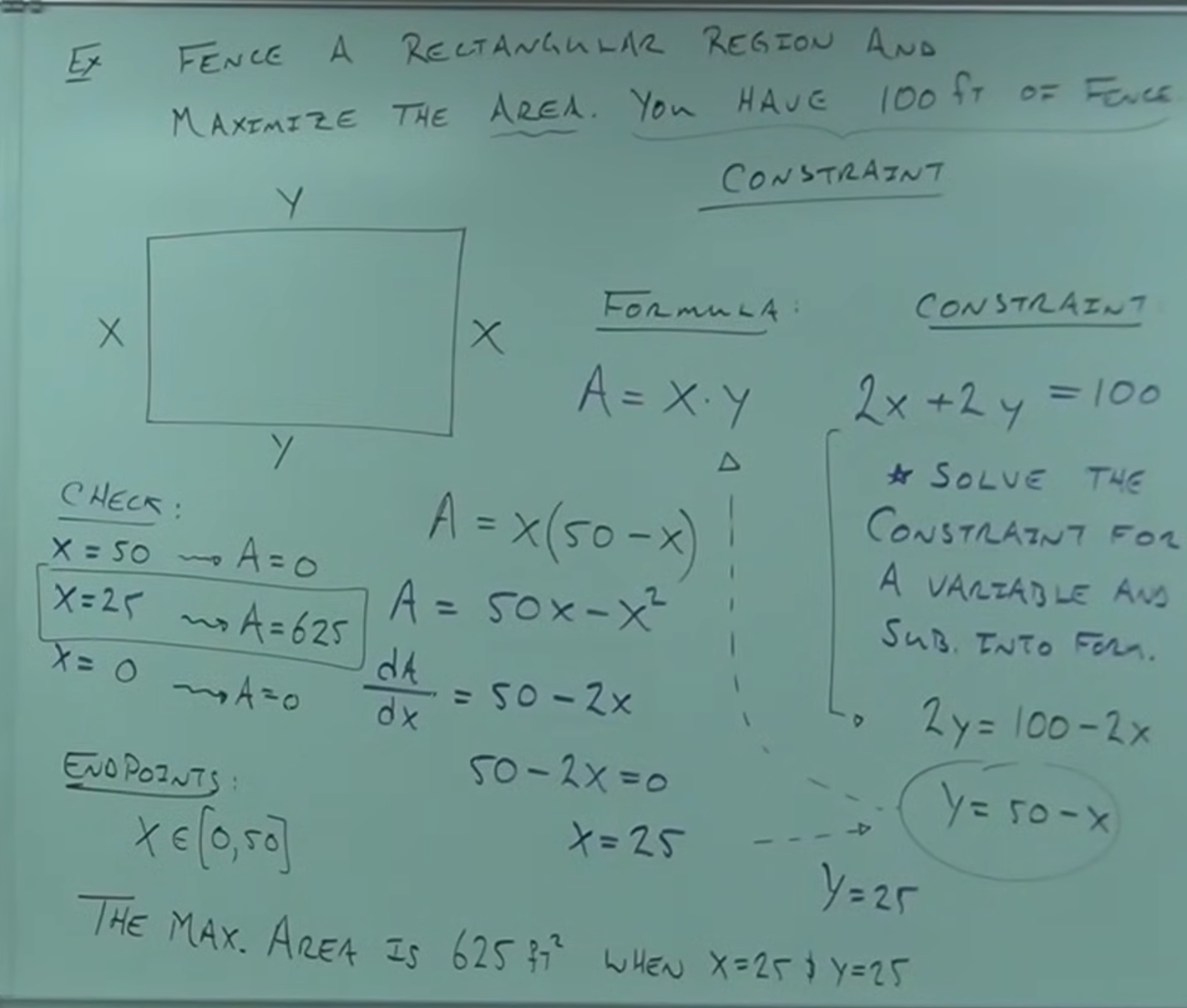
- Problem: Maximize the area of a rectangular region fenced with 100 feet of fencing.
- Identify the Restriction: The total length of fencing (100 ft) corresponds to the rectangle’s perimeter.
- Draw a Diagram: Sketch a rectangle and label its sides as $𝒙$ and $𝑦$.
-
Formulate:
- Area: $A = 𝒙\cdot 𝑦$
-
Constraint:
-
Perimeter: $2𝒙 + 2𝑦 = 100$
- Solve the restriction for one variable:
- $𝑦 = 50 − 𝒙$
-
Substitute into the Area Formula: Substitute $𝑦$ into the area expression:
- $A = 𝒙(50 − 𝒙)$
-
Perimeter: $2𝒙 + 2𝑦 = 100$
-
Find Critical Points: Take the derivative of $𝒜$ with respect to $𝒙$, set it to zero, and solve for $𝒙$
- $ \dfrac{dA}{d𝒙} = 50 − 2𝒙 = 0$
- $𝒙 = 25$
-
Determine Endpoints: The possible minimum and maximum values for $𝒙$ are $0$ and $50$.
-
[18:08]. ᴛʜᴇ ᴩᴏɪɴᴛ:
By the Extreme Value Theorem, the maximum must occur at one of the following:
- $𝒙 = 0,\; 𝒙 = 25,\; 𝒙 = 50$ — all within the interval $𝒙 \in [0, 50]$
-
[18:08]. ᴛʜᴇ ᴩᴏɪɴᴛ:
By the Extreme Value Theorem, the maximum must occur at one of the following:
-
Evaluate the Function at Critical Points and Endpoints:
- $A(0) = 0$
- $A(25) = 625$
- $A(50) = 0$
- Conclusion: The maximum area is $625\ \text{ft}^2$ when $𝒙 = 25$ ft and $𝑦 = 25$ ft, forming a square.
-
[21:41]. Maximizing the
Volume of a Box
- [📷image-1]
 - [📷image-2]
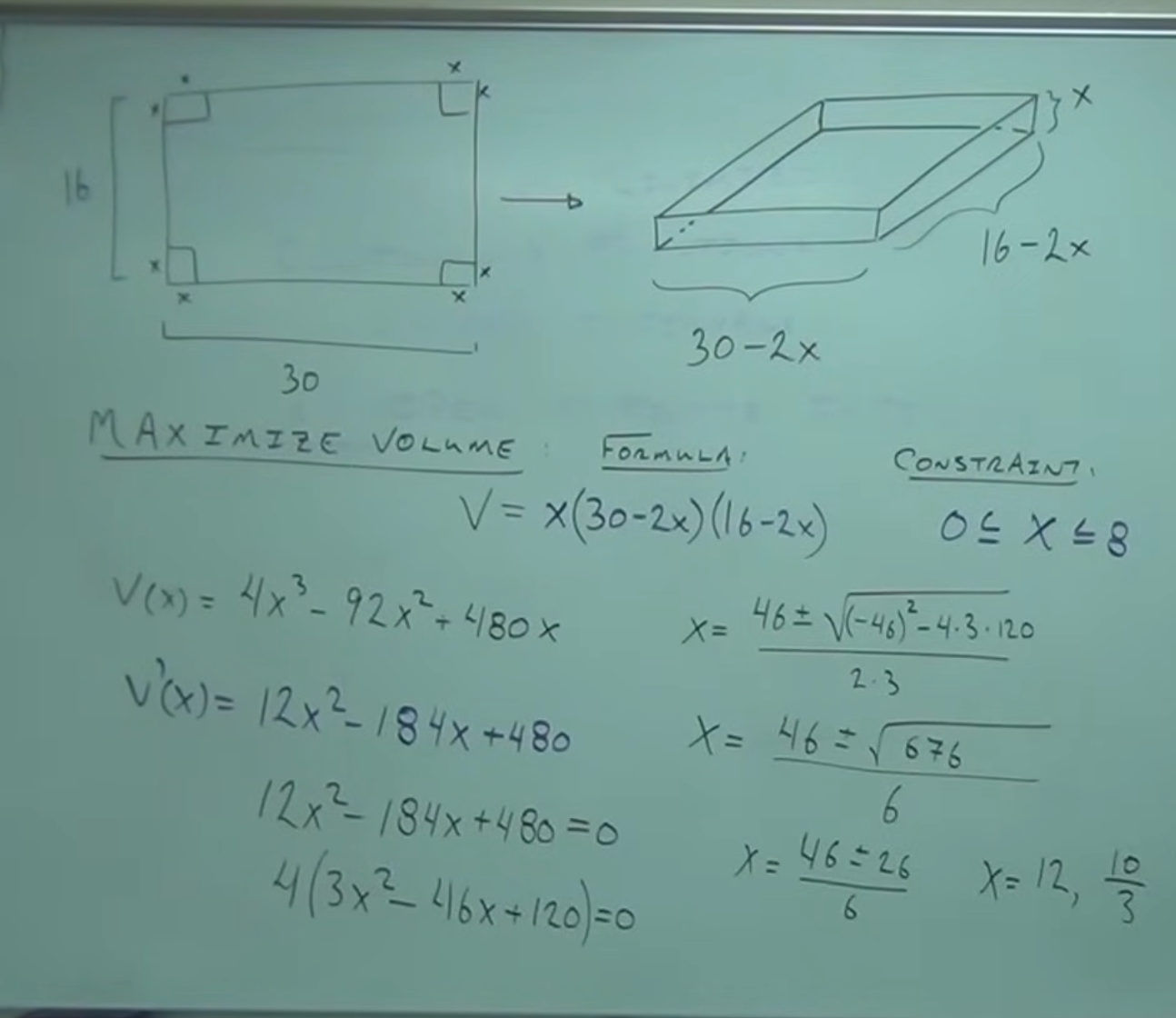
- Problem: An open box is constructed from a $16\times 30$-inch piece of cardboard by cutting squares of side $𝒙$ from each corner and folding up the flaps.
- Draw a Diagram: Sketch the cardboard with the cut-out squares and the resulting box.
- Identify the Restriction: The maximum cut size is $8$ inches (half the length of the shorter side).
-
Formulate Equations:
- Volume: $V = 𝒙(30 − 2𝒙)(16 − 2𝒙)$
- Restriction: $0 \le 𝒙 \le 8$
- Simplify the Volume Formula: Expand and combine like terms as needed.
-
Find Critical Points: Take the derivative of $V$ with respect to $𝒙$, set it to zero, and solve.
- $ \dfrac{dV}{d𝒙} = 12𝒙^2 − 188𝒙 + 480 = 0$
- By factoring or quadratic formula: $𝒙 = 12$ or $𝒙 = \dfrac{10}{3}$
- Discard Invalid Solutions: $𝒙 = 12$ is invalid because it exceeds the restriction.
-
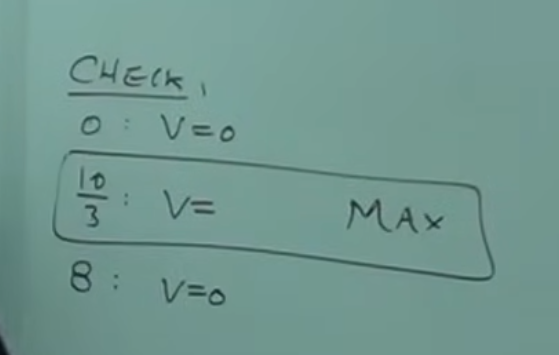
Evaluate the Function at Critical Points and Endpoints:
- $V(0) = 0$
- $V\!\left(\dfrac{10}{3}\right) > 0$
- $V(8) = 0$
- Conclusion: The maximum volume is achieved with a $10/3$-inch cut.
Minimizing Examples
-
[38:33]. Minimizing the
Cost of a Pipeline
- [📷image-1]
 - [📷image-2]
-
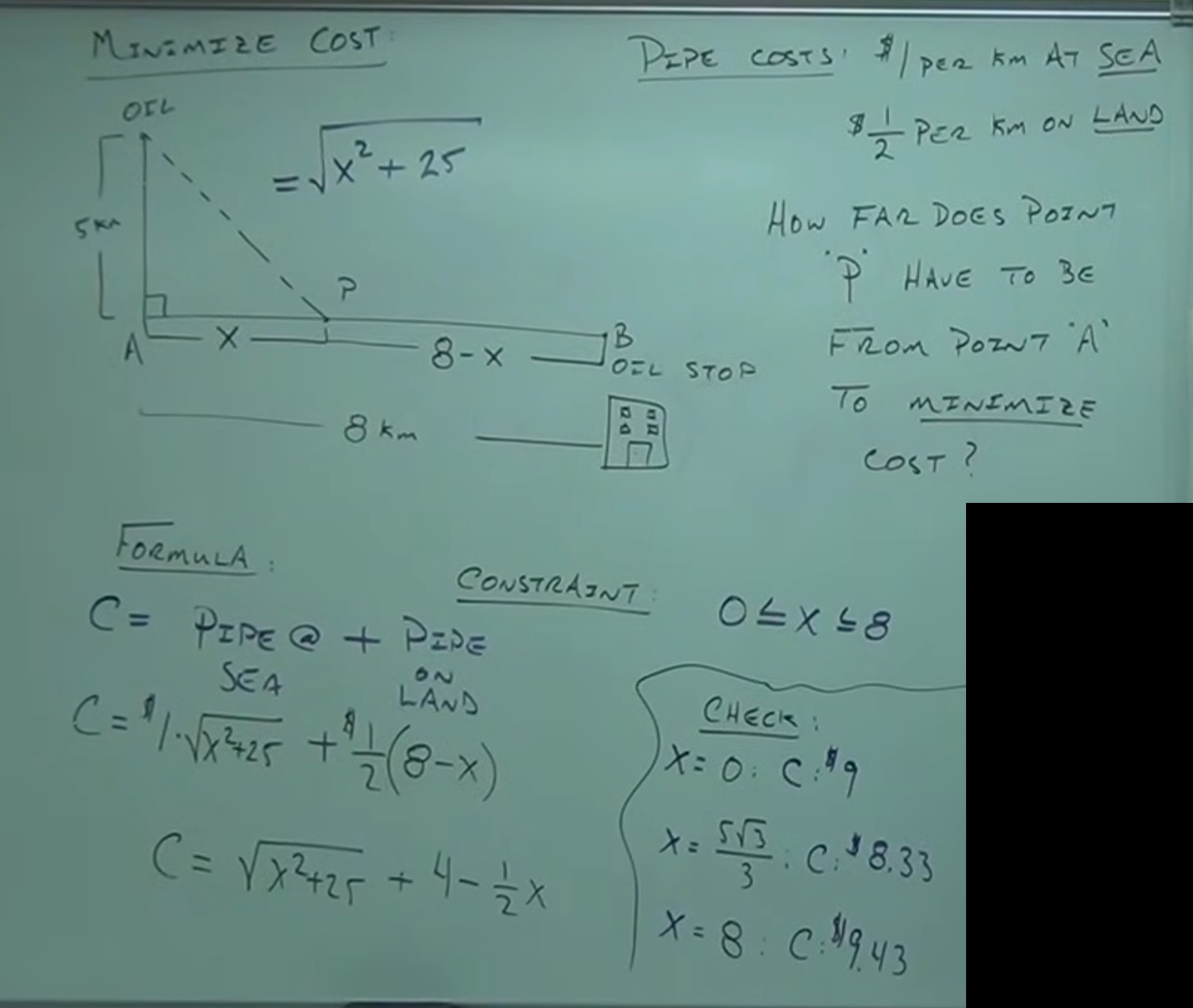
Problem: A pipeline must carry oil from an offshore platform to a refinery on land.
- The pipeline cost is $1 per km offshore and $0.50 per km on land.
- The platform is $5$ km from the coast, and the refinery is $8$ km along the coast.
- Draw a Diagram: Sketch the coastline, the offshore platform, the refinery, and the potential pipeline route.
- Identify the Restriction: The refinery is fixed at $8$ km along the coast.
- Choose a landing point $𝓟=(x,0)$ somewhere along the coast ($0 \le x \le 8$) where the total cost is minimized.
-
Formulate Equations:
-
Cost: $C = \sqrt{x^{2} + 25}\; +\; 0.5\,(8 − x)$
(Here, $x$ is the distance along the coast from the point directly opposite the platform to the pipeline’s landfall) - Restriction: $0 \le x \le 8$
-
Cost: $C = \sqrt{x^{2} + 25}\; +\; 0.5\,(8 − x)$
- Simplify the Cost Equation: Distribute $0.5$ in the expression.
-
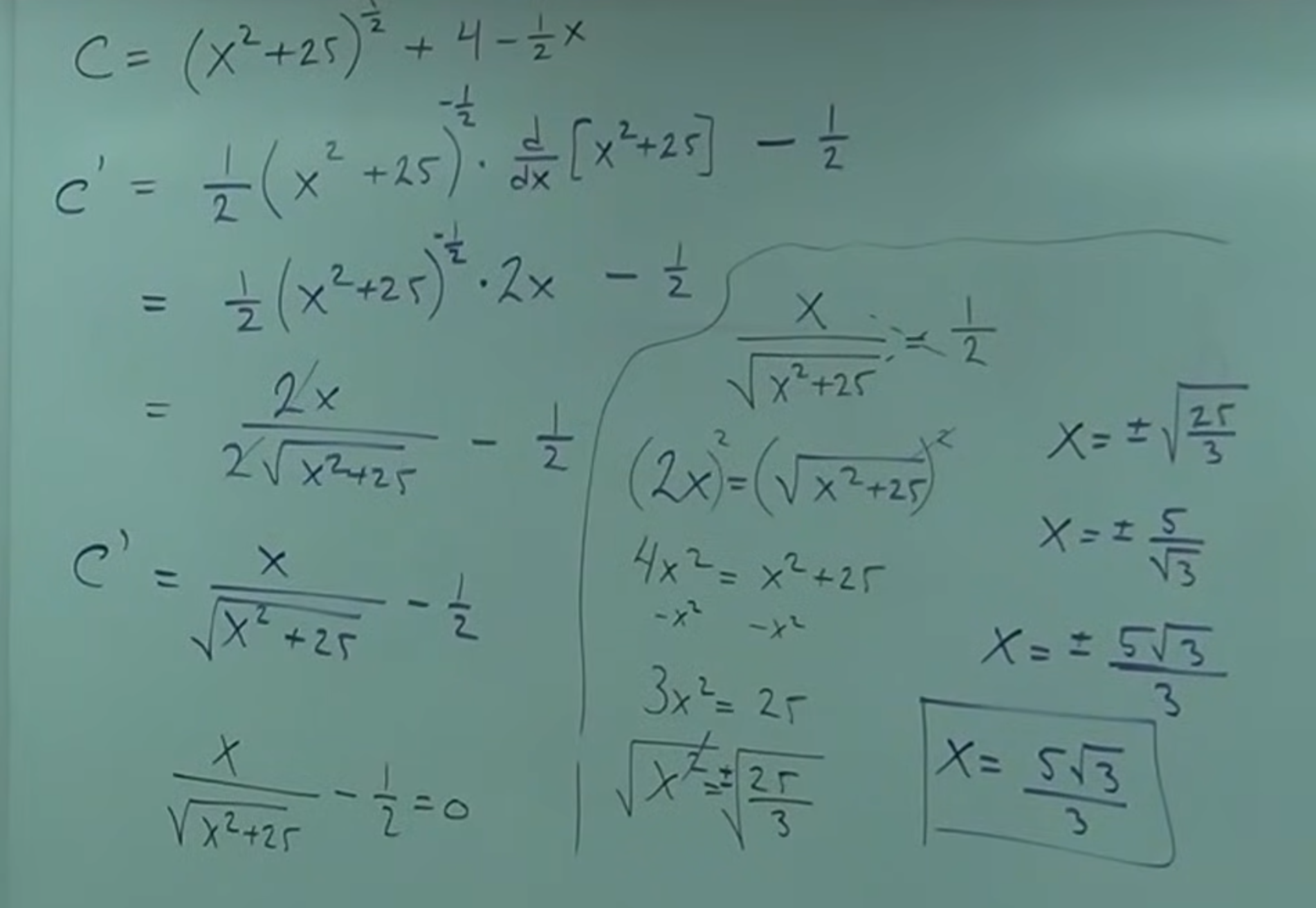
Find Critical Points: Take the derivative of $C$ with respect to $x$, set it to zero, and solve.
- $ \dfrac{dC}{dx} = \dfrac{x}{\sqrt{x^{2} + 25}} − 0.5 = 0$
- Solving yields $x = \dfrac{5\sqrt{3}}{3}$
-
Evaluate the Function at Critical Points and Endpoints:
- $C(0) = 9$
- $C\!\left(\dfrac{5\sqrt{3}}{3}\right) \approx 8.33$
- $C(8) \approx 9.43$
- Conclusion: The minimum cost is about 8.33$ when x $\approx$ 2.9 km.
-
Problem: A pipeline must carry oil from an offshore platform to a refinery on land.
-
[1:12:12]. Minimizing
Material for a Can
- [📷image-1]
 - [📷image-2]
 - [📷image-3]
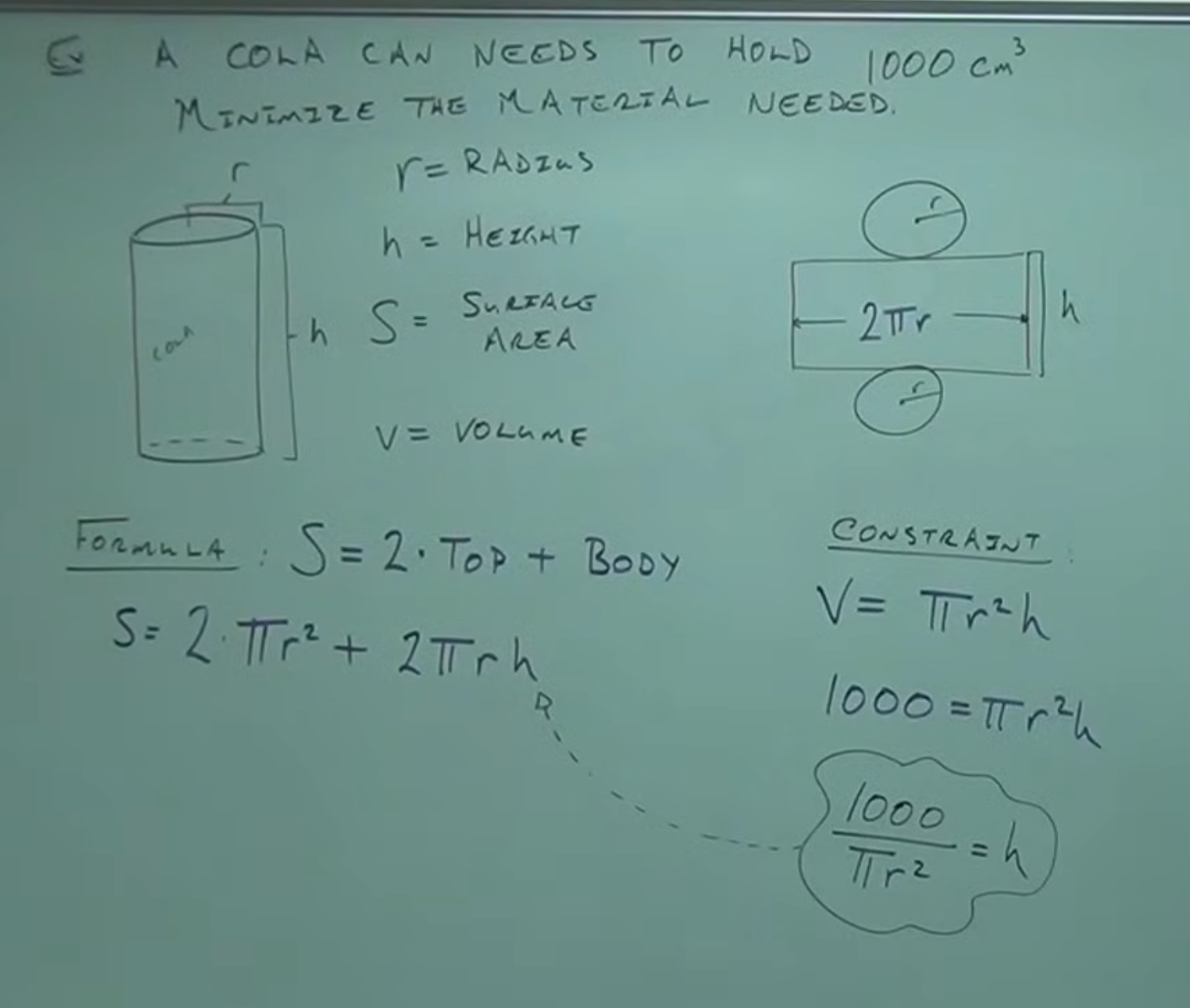
- Problem: Design a cylindrical can that holds $1{,}000\ \text{cm}^3$ of liquid using the least material.
- Draw a Diagram: Sketch a cylinder, labeling the radius $r$ and height $h$.
- Identify the Restriction: The can’s volume is fixed at $1{,}000\ \text{cm}^3$.
-
Formulate Equations:
- Surface Area: $S = 2\pi r^{2} + 2\pi r\,h$
- Restriction (Volume): $\pi r^{2}h = 1000$
-
Solve for One Variable: Solve the volume restriction for $h$.
- $h = \dfrac{1000}{\pi r^{2}}$
-
Substitute into the Surface Area Formula:
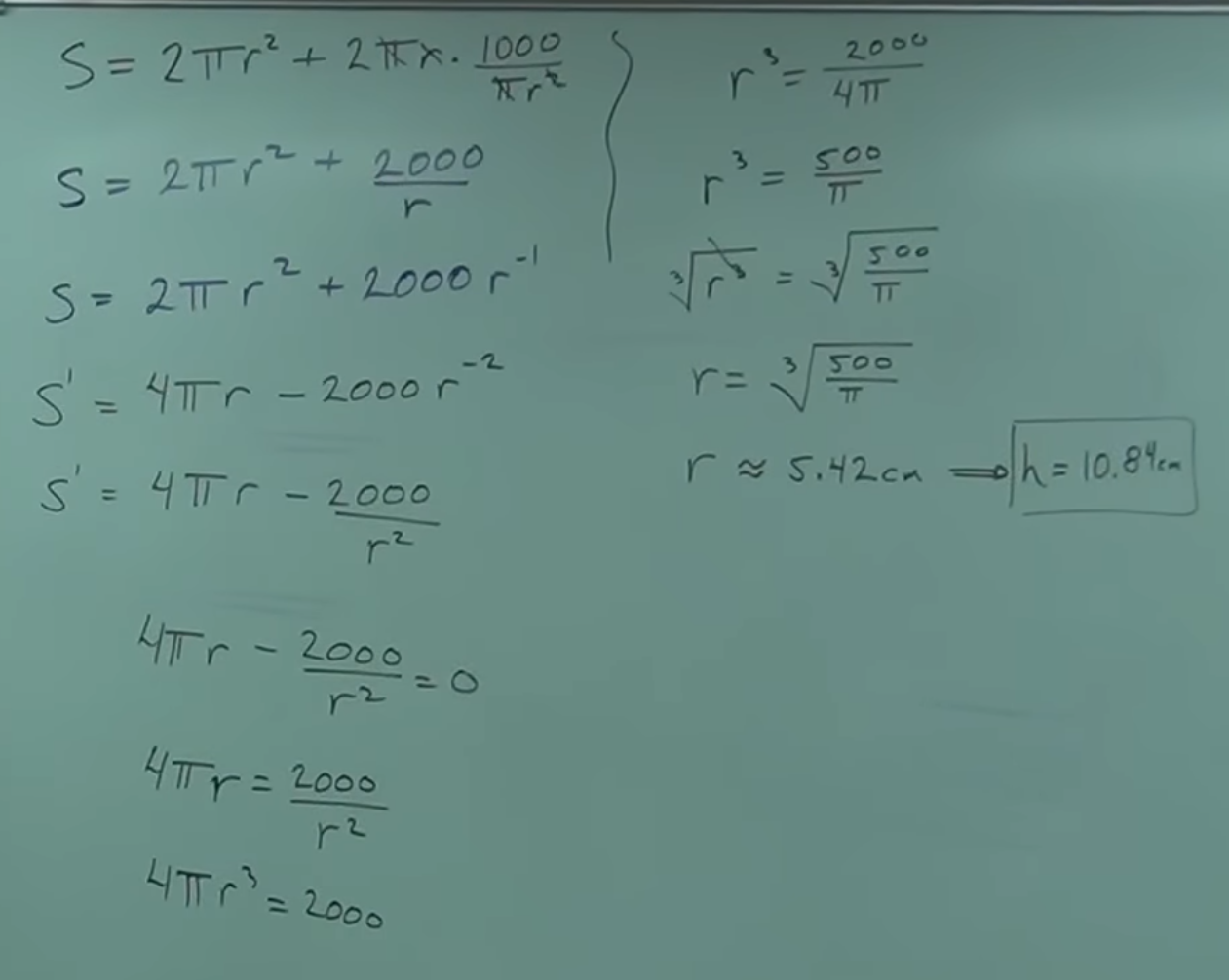
- $S = 2\pi r^{2} + 2\pi r \left(\dfrac{1000}{\pi r^{2}}\right)$
- Simplify: $S = 2\pi r^{2} + \dfrac{2000}{r}$
-
Find Critical Points: Take the derivative of $S$ with respect to $r$, set it to zero, and solve.
- $ \dfrac{dS}{dr} = 4\pi r − \dfrac{2000}{r^{2}} = 0$
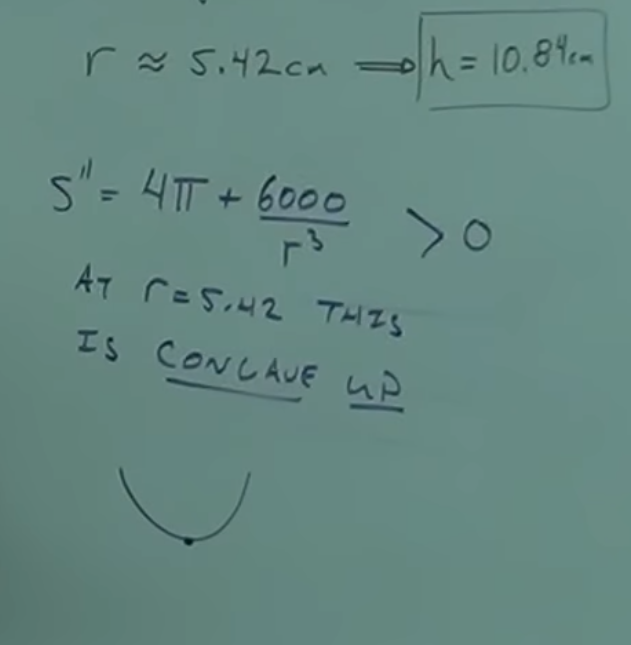
- Solving gives $r = \sqrt[3]{\dfrac{500}{\pi}} \approx 5.42\ \text{cm}$
-
Calculate the Height:
- $h \approx 10.84\ \text{cm}$
-
Verify It’s a Minimum:
- Use the second derivative: $\dfrac{d^{2}S}{dr^{2}} = 4\pi + \dfrac{4000}{r^{3}}$
- Evaluating at $r \approx 5.42$ cm yields a positive result, indicating a minimum.
- Conclusion: The can uses the least material when $r \approx 5.42$ cm and $h \approx 10.84$ cm.