Calculus 1 lecture 4.2
Integration By Substitution
Introduction
- [0:54]. The
need for an integral to fit into the integration table.
- If the integral doesn't fit, it cannot be solved directly.
- The integral must be adjusted in order to fit.
- We aim to manipulate the integral through distribution, division, or trigonometric
functions.
- Intro𝒅𝑢ction to u-substitution, where the letter "$𝑢$" is used.
Example of an integral that cannot be solved directly using basic methods.
- [2:14].
$\displaystyle \int (𝒙^{2}+1)\cdot 2𝒙\,dx$
- Can not fit the integration table but you could do it by distribution.
- $\displaystyle \int (𝒙^{2}+1)^{3}\cdot 2𝒙\,dx$
- The alternative of “raising it to the third power” repeatedly is a long and complicated
process,
but you could do it by distribution.
- 🧩 Example –: $\displaystyle \int (𝒙^{2}+1)^{50}\cdot 2𝒙\,dx$
- There is a need for a better way to solve the problem.
- [3:20].
Substitution is a method to handle complex integrals. –
[📷image]
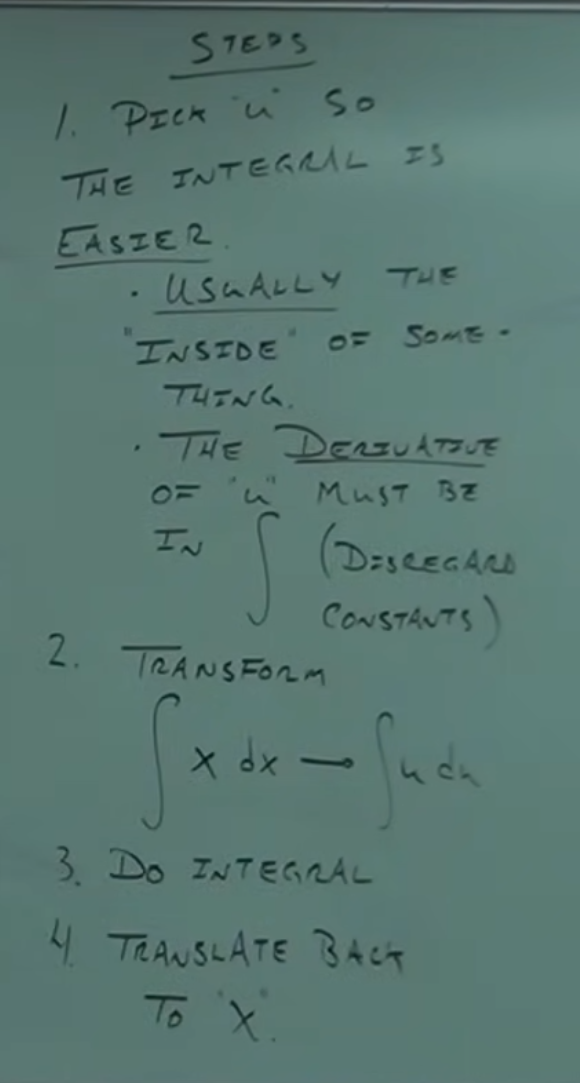
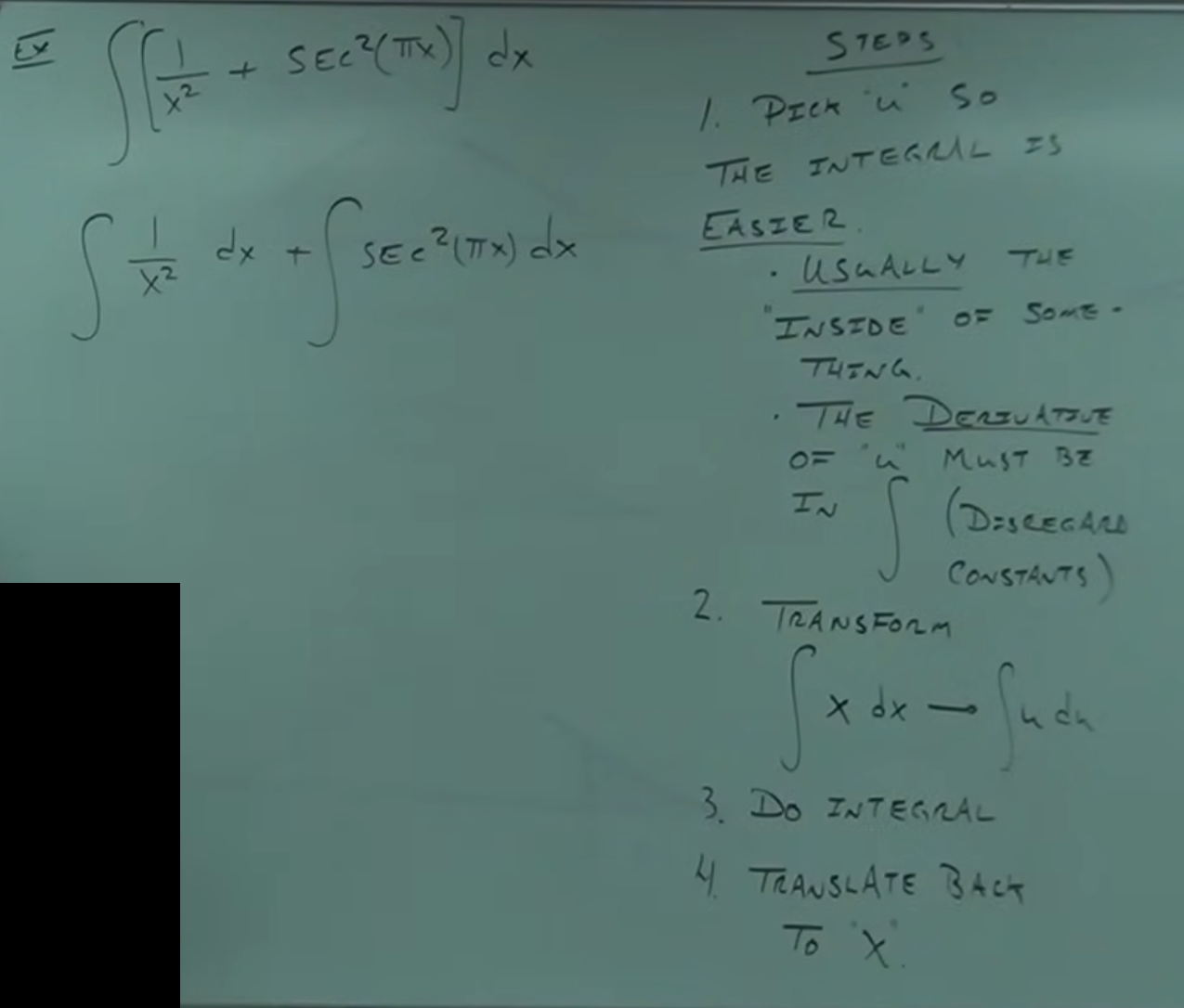
- ❶ Pick “$𝑢$” so the integral is easier.
- Usually the “inside” of some thing.
- The derivative of “$𝑢$” must be in the $\int$ (disregard constants). In this context,
it means that when using
the substitution method to solve an integral, you can disregard constant factors that appear when
differentiating $𝑢$.
- [6:15]. ❷ Transform: $\int 𝒙\,dx \;\to\; \int 𝑢\,du$
- The integral must end up in terms of "$𝑢\,du$."
- After the transformation, the integral must match something in the integration table.
- If the integral does not fit in the table, either another substitution is required or
it cannot be done by these methods.
- There are integrals that cannot be solved with these methods.
- ❸ Do the integral.
- ❹ Translate back to "$𝒙$".
- [9:30]. 🧩
Example (continuation) –: $\displaystyle \int (𝒙^{2}+1)^{50}\cdot 2𝒙\,dx$ –
[📷image]
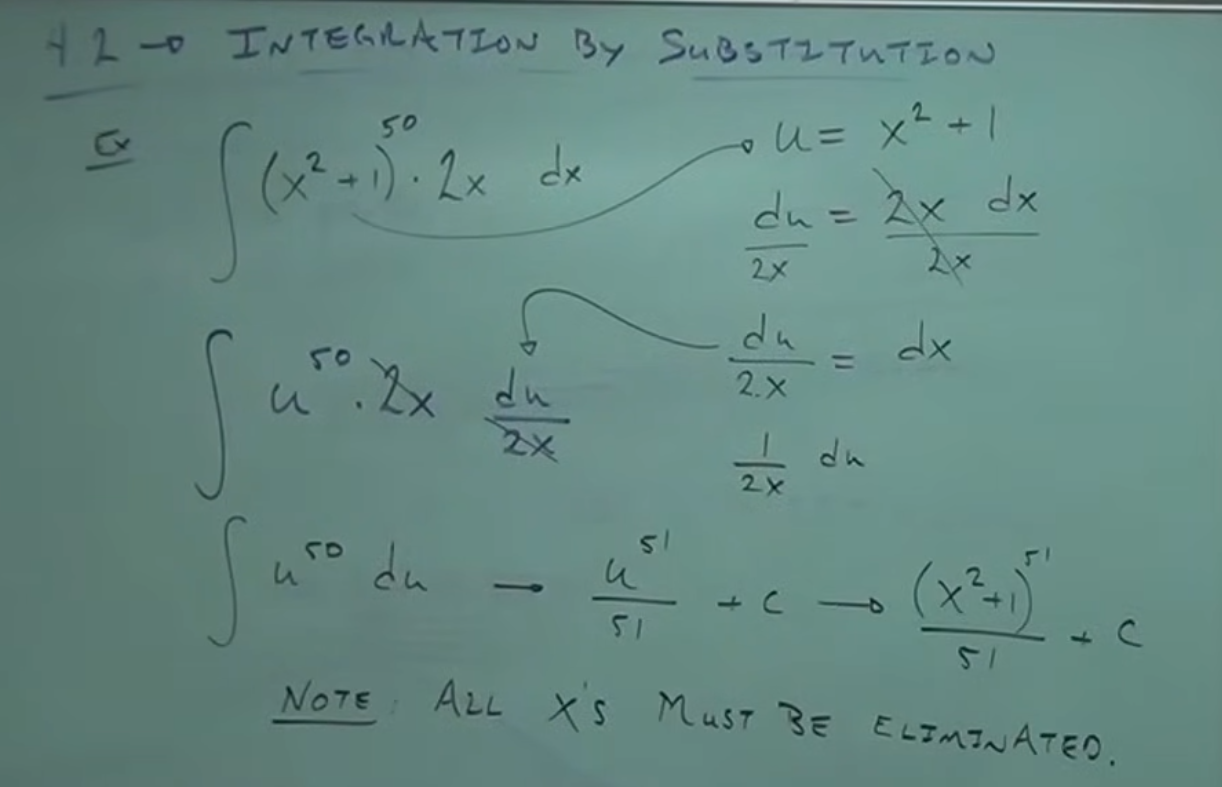
- You must choose a "$u$" whose derivative is present in the integral.
- Constants are not very relevant in the derivative.
- "$u$" is usually chosen as the interior part.
- The derivative of the chosen portion is calculated on both sides.
- [9:26]. Verify that the derivative is in the integral.
- "$dx$" is isolated for the substitution.
- $du=2𝒙\,dx \;\to\; dx=\dfrac{du}{2𝒙}$
- The substitution is carried out in the original integral.
- $\displaystyle \int 𝑢^{50}\cdot 2𝒙\cdot \left(\dfrac{du}{2𝒙}\right)$
- The interior portion is replaced by "$𝑢$".
- "$dx$" is replaced by its "$du$" equivalent.
- The integral is simplified after the substitution.
- $\displaystyle \int 𝑢^{50}\,du$
- The expression is integrated in terms of "$𝑢$".
- $\displaystyle \int 𝑢^{50}\,du=\dfrac{𝑢^{51}}{51}+\mathcal{C}$
- It is stressed that all $𝒙$ terms must vanish before integration.
- You cannot integrate if both "$𝒙$" and "$u$" are present.
- It is reiterated that all "$𝒙$" must disappear prior to integration.
- Translate back to "$𝒙$"
- $\dfrac{𝑢^{51}}{51}+\mathcal{C}\;\to\; \dfrac{(𝒙^{2}+1)^{51}}{51}+\mathcal{C}$
🧩Examples by substitution method
- [17:19].
$\displaystyle \int 𝒙^{2}\,(𝒙^{3}-4)^{5}\,dx$ –
[📷image]
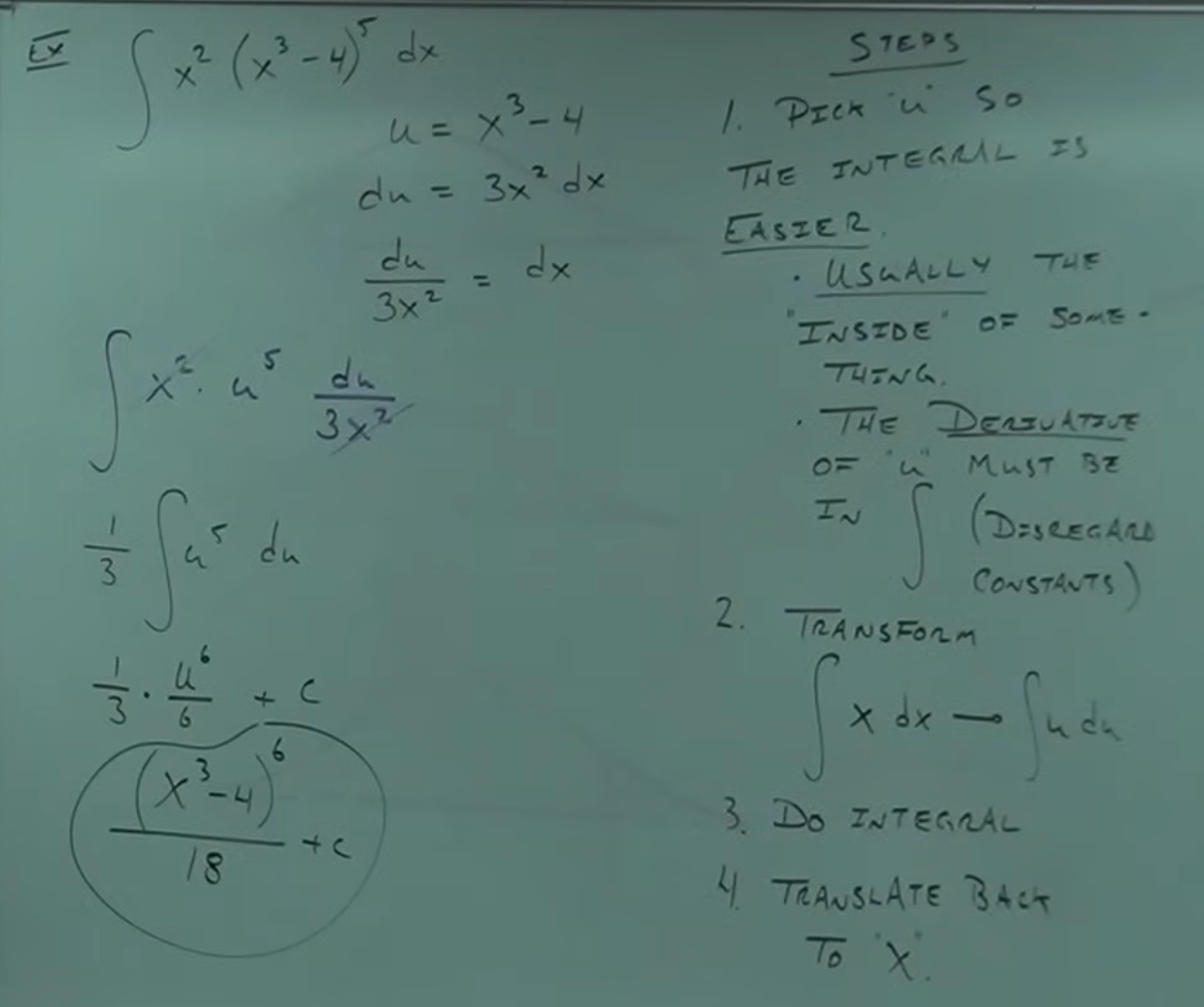
- $𝑢=𝒙^{3}-4 \;\to\; du=3𝒙^{2}\,dx \;\to\; dx=\dfrac{du}{3𝒙^{2}}$
- $\displaystyle \int 𝒙^{2}\cdot 𝑢^{5}\cdot
\left(\dfrac{du}{3𝒙^{2}}\right)=\dfrac{1}{3}\int 𝑢^{5}\,du$
- $=\dfrac{1}{3}\cdot\dfrac{𝑢^{6}}{6}+\mathcal{C}$
- Translate back to "$𝒙$": $\dfrac{(𝒙^{3}-4)^{6}}{18}+\mathcal{C}$
- [21:13].
$\displaystyle \int 𝒙^{2}\,(𝒙^{3}-4)^{5}\,dx$ –
[📷image]
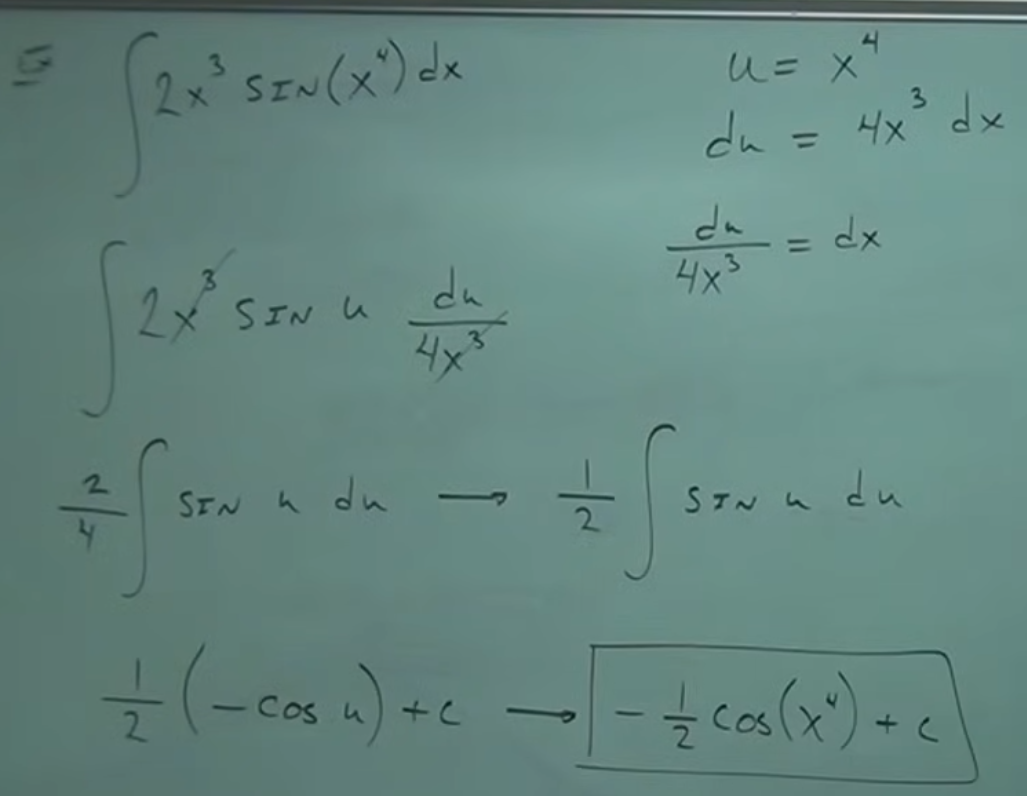
- $𝑢=𝒙^{4} \;\to\; du=4𝒙^{3}\,dx \;\to\; dx=\dfrac{du}{4𝒙^{3}}$
- $\displaystyle \int 2𝒙^{3}\cdot \sin(𝑢)\cdot
\left(\dfrac{du}{4𝒙^{3}}\right)=\dfrac{2}{4}\int \sin(𝑢)\,du$
- $=\dfrac{1}{2}\left(-\cos(𝑢)\right)+\mathcal{C}$
- Translate back to "$𝒙$": $-\dfrac{1}{2}\cos(𝒙^{4})+\mathcal{C}$
- [27:20].
$\displaystyle \int \left(\dfrac{1}{𝒙^{2}}+\sec^{2}(\pi\cdot 𝒙)\right)\,dx$ –
[📷image]
- $\displaystyle \int \dfrac{1}{𝒙^{2}}\,dx \;+\; \int \sec^{2}(\pi 𝒙)\,dx$
- $\displaystyle \int \dfrac{1}{𝒙^{2}}\,dx=-\dfrac{1}{𝒙}+\mathcal{C}$
- $\displaystyle \int \sec^{2}(\pi\cdot 𝒙)\,dx$
- $𝑢=\pi\cdot 𝒙 \;\to\; du=\pi\,dx \;\to\; dx=\dfrac{du}{\pi}$
- $\displaystyle \int \sec^{2}(\pi\cdot 𝒙)\,dx=\dfrac{1}{\pi}\int
\sec^{2}(𝑢)\,du=\dfrac{1}{\pi}\tan(𝑢)+\mathcal{C}$
- Translate back to "$𝒙$": $-\dfrac{1}{𝒙}+\dfrac{1}{\pi}\tan(\pi\cdot 𝒙)+\mathcal{C}$
- [29:00].
$\displaystyle \int \cos(5𝒙)\,dx$ –
[📷image]
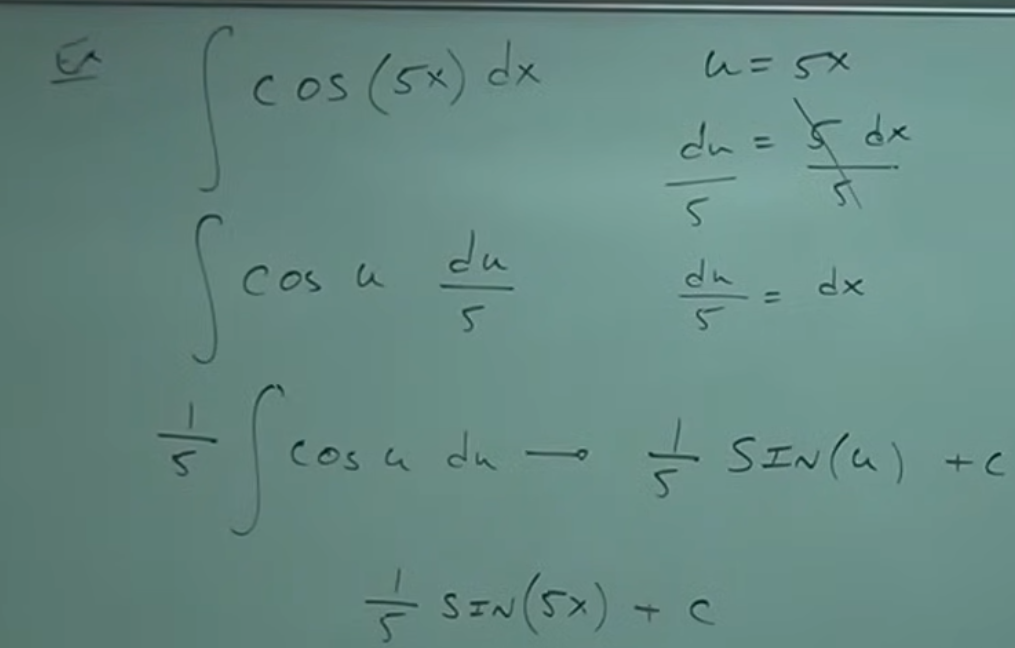
- $𝑢=5𝒙 \;\to\; du=5\,dx \;\to\; dx=\dfrac{du}{5}$
- $\displaystyle \int \cos(5𝒙)\,dx=\int \cos(𝑢)\left(\dfrac{du}{5}\right)$
- $\dfrac{1}{5}\int \cos(𝑢)\,du=\dfrac{1}{5}\sin(𝑢)$
- Translate back to "$𝒙$": $\dfrac{1}{5}\sin(5𝒙)+\mathcal{C}$
- [34:50].
$\displaystyle \int (2𝒙-3)^{15}\,dx$ –
[📷image]
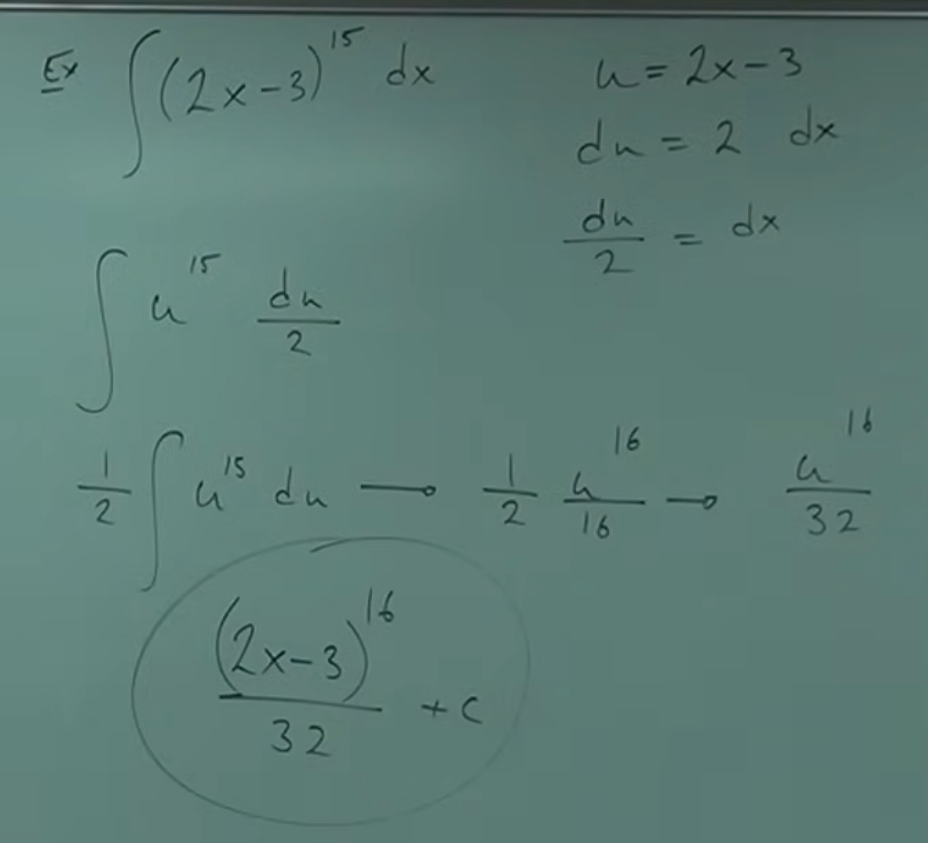
- $𝑢=2𝒙-3 \;\to\; du=2\,dx \;\to\; dx=\dfrac{du}{2}$
- $\displaystyle \int (2𝒙-3)^{15}\,dx=\int 𝑢^{15}\left(\dfrac{du}{2}\right)$
- $\dfrac{1}{2}\int 𝑢^{15}\,du=\dfrac{1}{2}\cdot \dfrac{𝑢^{16}}{16}=\dfrac{𝑢^{16}}{32}$
- Translate back to "$𝒙$": $\dfrac{(2𝒙-3)^{16}}{32}+\mathcal{C}$
- [36:46].
$\displaystyle \int \left(\dfrac{1}{𝒙^{2}}+\sec^{2}(\pi 𝒙)\right)\,dx$ –
[📷image]
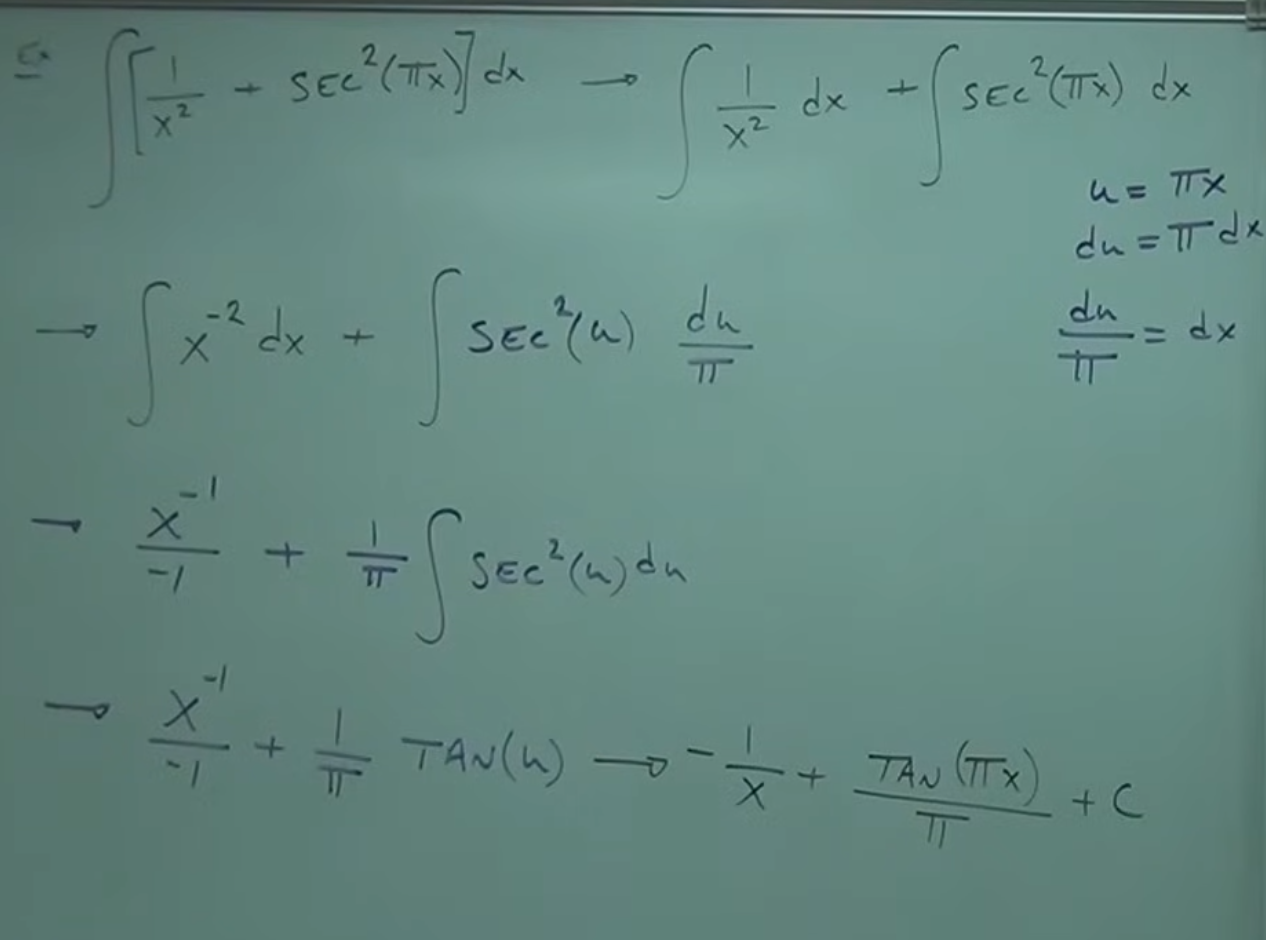
- $\displaystyle \int [𝒙^{-2}+\sec^{2}(\pi 𝒙)]\,dx$
- $\displaystyle \int 𝒙^{-2}\,dx+\int \sec^{2}(\pi 𝒙)\,dx$
- $𝑢=\pi 𝒙,\; du=\pi\,dx,\; dx=\dfrac{du}{\pi}$
- $\displaystyle \int 𝒙^{-2}\,dx+\dfrac{1}{\pi}\int \sec^{2}(𝑢)\,du$
- $-\;𝒙^{-1}+\dfrac{1}{\pi}\int \sec^{2}(𝑢)\,du$
- $-\;𝒙^{-1}+\dfrac{1}{\pi}\tan(𝑢)+\mathcal{C}$
- Translate back to "$𝒙$": $-\;𝒙^{-1}+\dfrac{1}{\pi}\tan(\pi 𝒙)+\mathcal{C}$
- [44:33].
$\displaystyle \int \sin^{2}(𝒙)\,\cos(𝒙)\,dx$ $(𝑢=\cos(𝒙))$ –
[📷image]
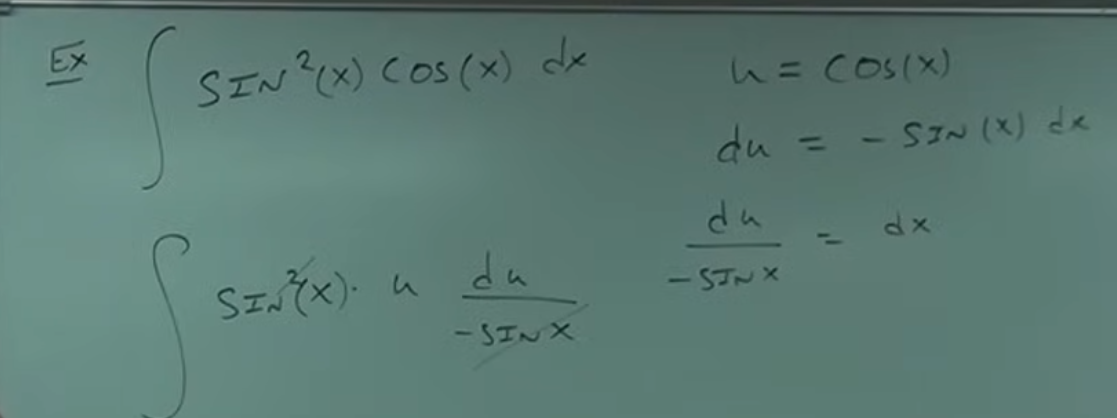
- This is an example of choosing the wrong substitution ($𝑢$) in integration. By selecting
$𝑢=\cos(𝒙)$,
the substitution complicates the integral rather than simplifying it, leading to unnecessary terms or even
making it unsolvable in its current form. Always aim to choose $𝑢$ so that it simplifies the integral
effectively,
often by targeting the "inner" function or a term whose derivative is present elsewhere in the expression.
- $𝑢=\cos(𝒙)$
- $du=-\sin(𝒙)\,dx$
- $dx=\dfrac{du}{-\sin(𝒙)}$
- $\displaystyle \int \sin^{2}(𝒙)\cdot 𝑢\cdot \left(\dfrac{du}{-\sin(𝒙)}\right)\;\;
\color{red}{\text{❌}}$
- [47:00].
$\displaystyle \int \sin^{2}(𝒙)\,\cos(𝒙)\,dx$ –
[📷image]
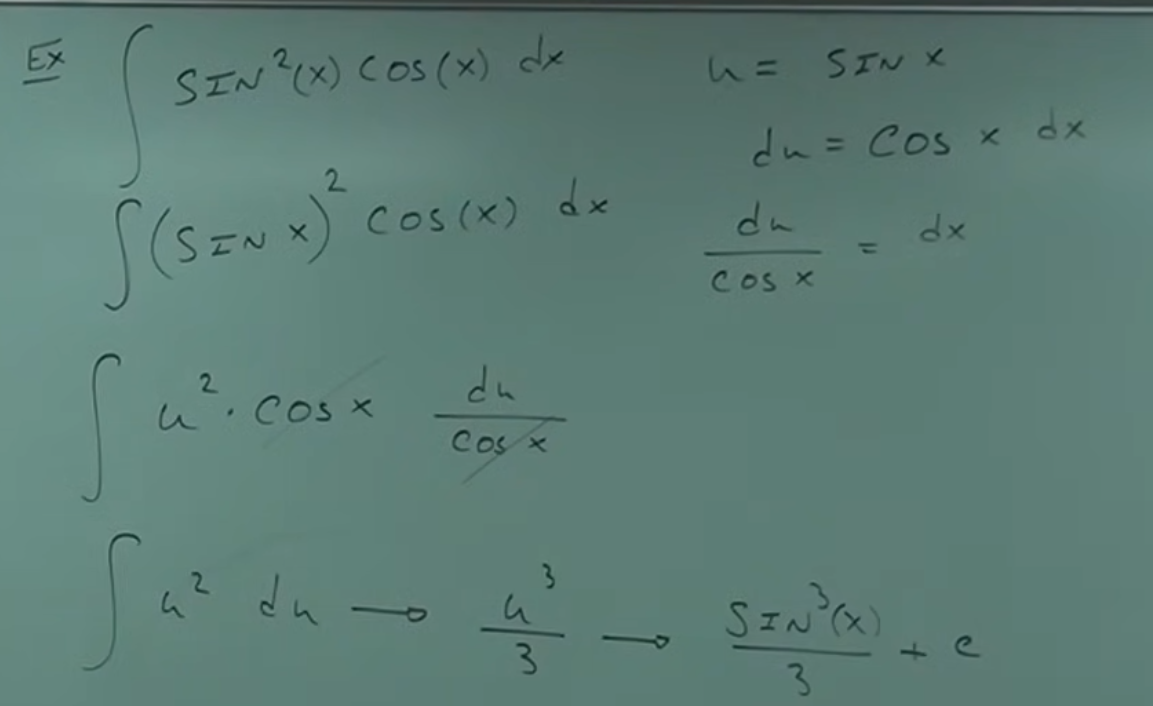
- $\displaystyle \int \sin^{2}(𝒙)\,\cos(𝒙)\,dx$
- $𝑢=\sin(𝒙),\; du=\cos(𝒙)\,dx$
- $\displaystyle \int 𝑢^{2}\,\cos(𝒙)\left(\dfrac{du}{\cos(𝒙)}\right)$
- $\displaystyle \int 𝑢^{2}\,du \;\to\; \dfrac{𝑢^{3}}{3}+\mathcal{C}$
- Translate back to "$𝒙$": $\dfrac{\sin^{3}(𝒙)}{3}+\mathcal{C}$
- [51:25].
$\displaystyle \int \dfrac{\cos(\sqrt{𝒙})}{\sqrt{𝒙}}\,dx$ –
[📷image]
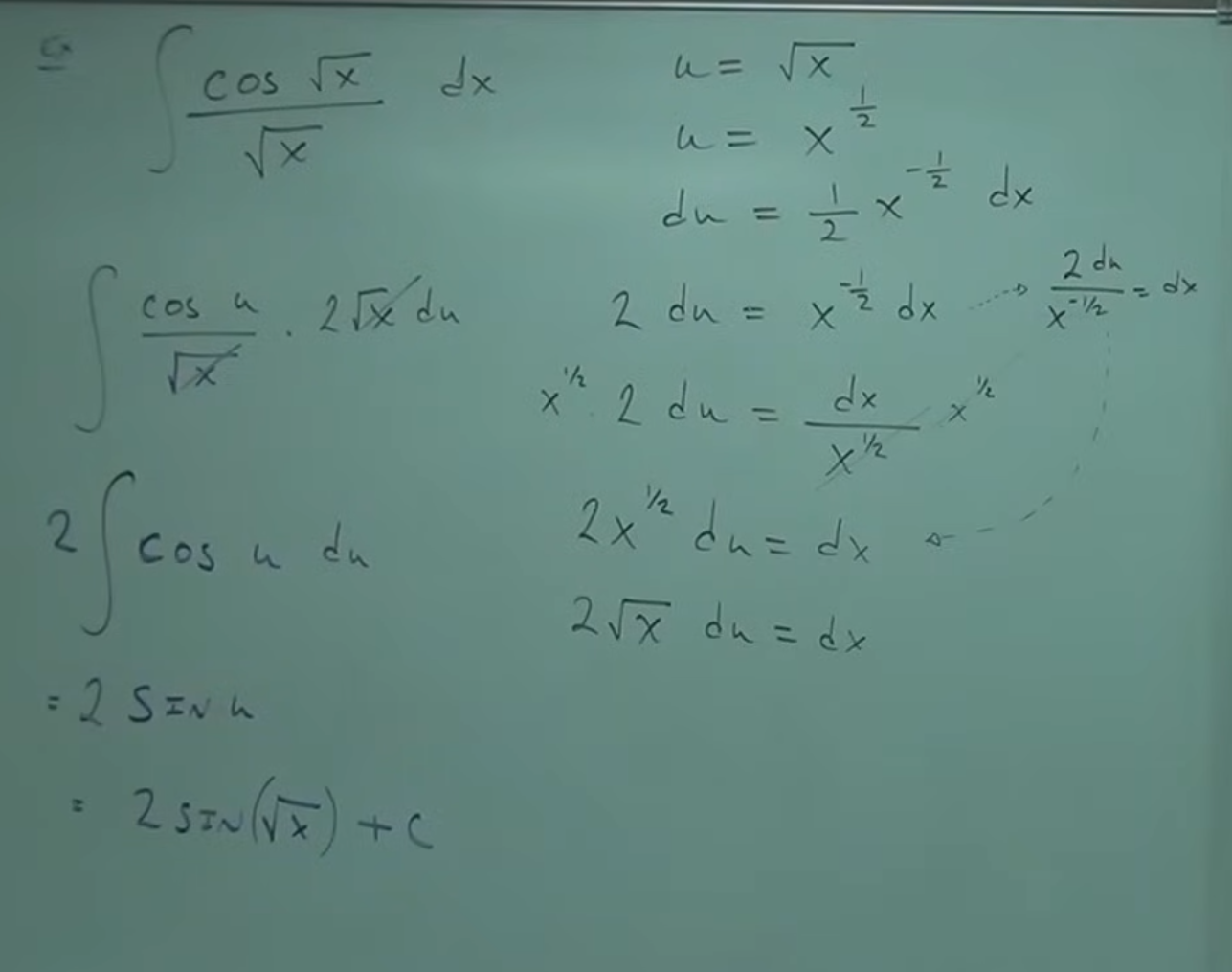
- $𝑢=\sqrt{𝒙}\;\Rightarrow\; du=\dfrac{1}{2}\,𝒙^{-1/2}\,dx$
- $2\,du=𝒙^{-1/2}\,dx \;\to\; 2\,du=\dfrac{1}{𝑢}\,dx \;\to\; dx=2𝑢\,du \;\;
(\text{because } 𝑢=\sqrt{𝒙})$
- $\displaystyle \int \dfrac{\cos(𝑢)}{𝑢}\cdot (2𝑢)\,du \;\to\; 2\int
\cos(𝑢)\,du=2\sin(𝑢)+\mathcal{C}$
- Translate back to "$𝒙$": $2\sin(\sqrt{𝒙})+\mathcal{C}$
- [1:00:00]. $\displaystyle \int 𝒙^{4}\,\sqrt[3]{\,3-5𝒙^{5}\,}\,dx$ –
[📷image]
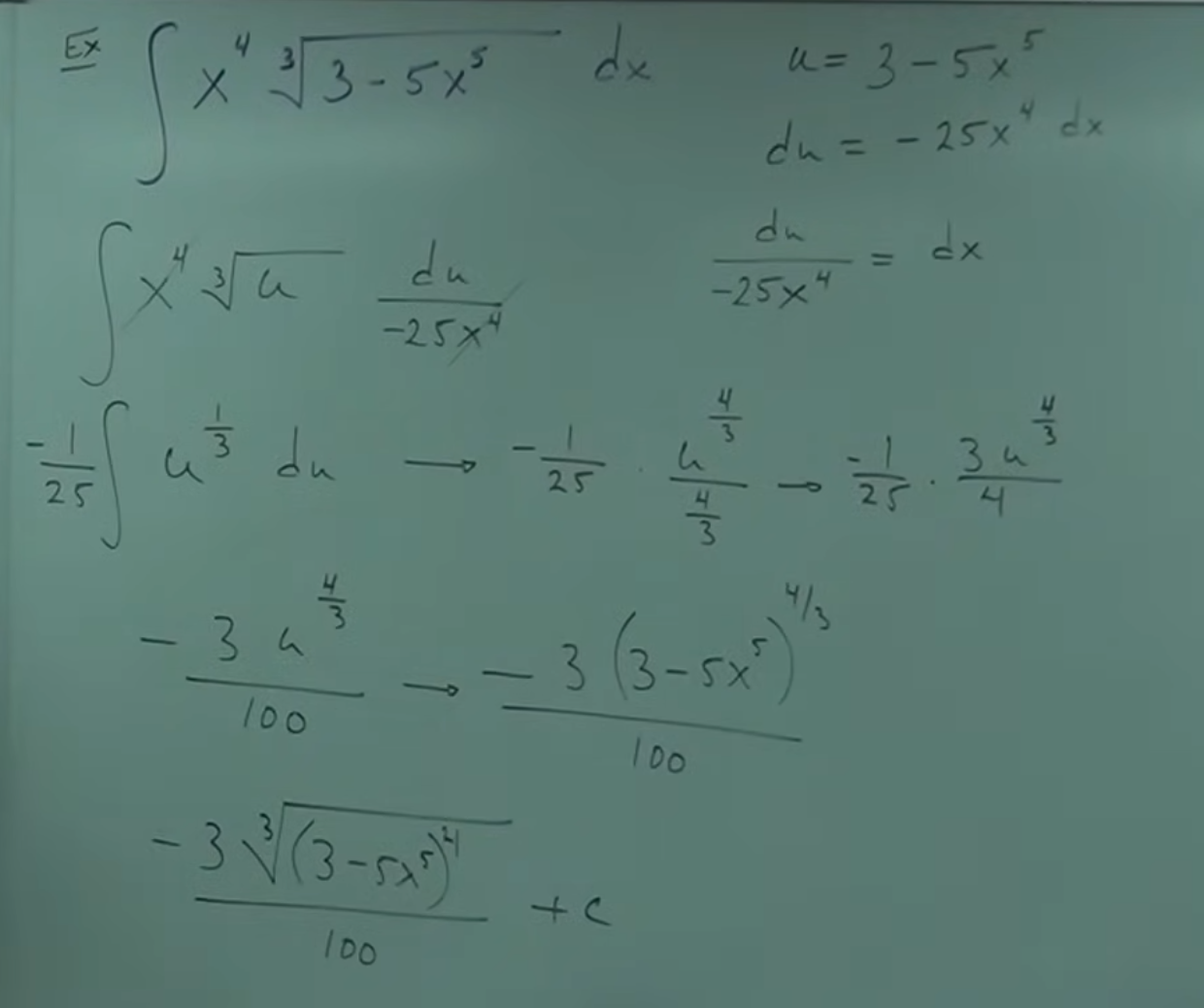
- $𝑢=3-5𝒙^{5} \;\to\; du=-25𝒙^{4}\,dx \;\to\; dx=\dfrac{du}{-25𝒙^{4}}$
- $\displaystyle \int 𝒙^{4}\,\sqrt[3]{𝑢}\left(\dfrac{du}{-25𝒙^{4}}\right)$
- $-\dfrac{1}{25}\int 𝑢^{1/3}\,du$
- $-\dfrac{1}{25}\cdot \dfrac{𝑢^{4/3}}{\dfrac{4}{3}}\;=\;-\dfrac{1}{25}\cdot
\dfrac{3}{4}\,𝑢^{4/3}$
- $-\dfrac{3}{100}\,𝑢^{4/3}$
- Translate back to "$𝒙$":
$-\dfrac{3}{100}\,(3-5𝒙^{5})^{4/3}+\mathcal{C}\;\;\to\;\;-\dfrac{3}{100}\,\sqrt[3]{(3-5𝒙^{5})^{4}}+\mathcal{C}$
- [1:08:40]. $\displaystyle \int 𝒙^{2}\sqrt{\,𝒙-1\,}\,dx$ –
[📷image]
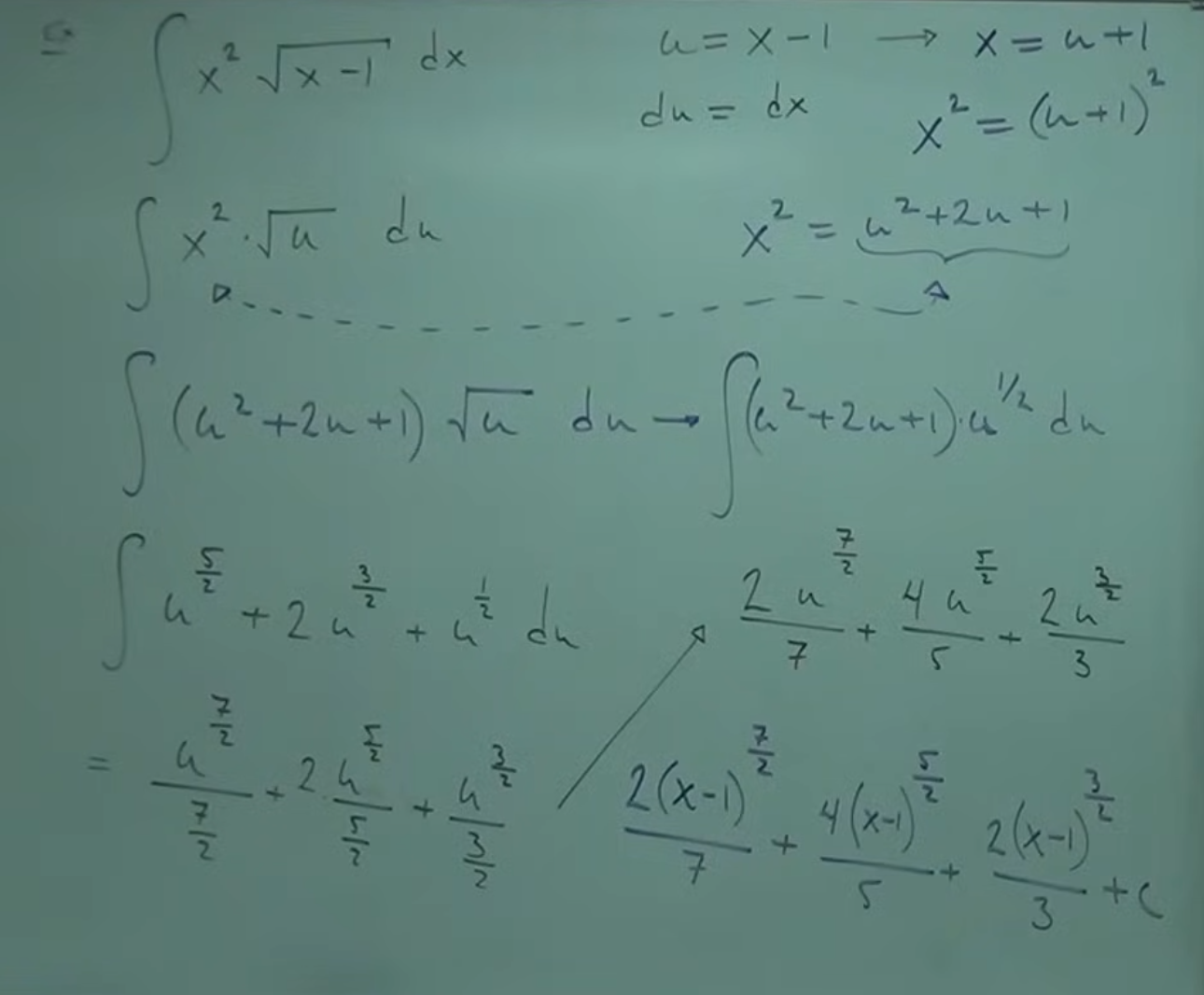
- $𝑢=𝒙-1 \;\to\; 𝒙=𝑢+1 \;\to\; du=dx$
- $\displaystyle \int 𝒙^{2}\sqrt{𝑢}\,du$
- $𝒙^{2}=(𝑢+1)^{2}=𝑢^{2}+2𝑢+1$
- $\displaystyle \int 𝒙^{2}\sqrt{𝑢}\,du \;\to\; \int (𝑢^{2}+2𝑢+1)\cdot
\sqrt{𝑢}\,du$
- $\displaystyle \int (𝑢^{2}+2𝑢+1)\cdot 𝑢^{1/2}\,du \;\to\; \int
\big(𝑢^{5/2}+2𝑢^{3/2}+𝑢^{1/2}\big)\,du$
- $\dfrac{𝑢^{7/2}}{\dfrac{7}{2}}+ 2\,\dfrac{𝑢^{5/2}}{\dfrac{5}{2}}+
\dfrac{𝑢^{3/2}}{\dfrac{3}{2}}$
- $\dfrac{2}{7}𝑢^{7/2}+ \dfrac{4}{5}𝑢^{5/2}+ \dfrac{2}{3}𝑢^{3/2}$
- Translate back to "$𝒙$": $\dfrac{2}{7}(𝒙-1)^{7/2}+ \dfrac{4}{5}(𝒙-1)^{5/2}+
\dfrac{2}{3}(𝒙-1)^{3/2}+\mathcal{C}$
- [1:17:40]. $\displaystyle \int \dfrac{2-𝒙}{\sqrt{\,2𝒙^{2}-8𝒙+1\,}}\,dx$ –
[📷image]
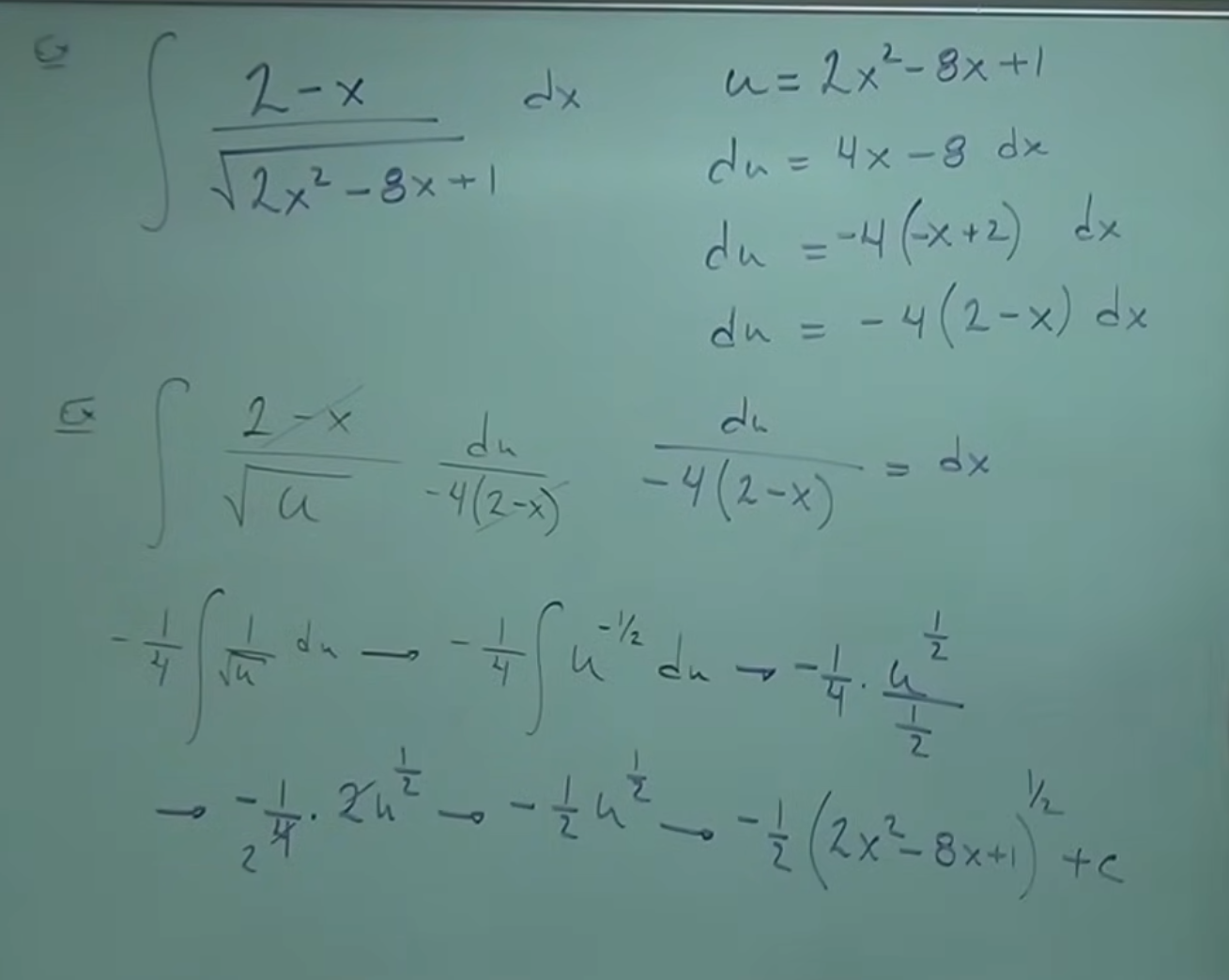
- $𝑢=2𝒙^{2}-8𝒙+1 \;\to\; du=(4𝒙-8)\,dx \;\to\; du=-4(2-𝒙)\,dx \;\to\;
dx=\dfrac{du}{-4(2-𝒙)}$
- $\displaystyle \int \dfrac{2-𝒙}{\sqrt{𝑢}}\left(\dfrac{du}{-4(2-𝒙)}\right)$
- $-\dfrac{1}{4}\int \dfrac{1}{\sqrt{𝑢}}\,du$
- $-\dfrac{1}{4}\int 𝑢^{-1/2}\,du \;\to\; -\dfrac{1}{4}\cdot
\dfrac{𝑢^{1/2}}{\dfrac{1}{2}}$
- $-\dfrac{1}{2}\,𝑢^{1/2}$
- Translate back to "$𝒙$": $-\dfrac{1}{2}\sqrt{\,2𝒙^{2}-8𝒙+1\,}+\mathcal{C}$
- [1:25:07]. $\displaystyle \int \cos^{3}(𝒙)\,dx$ –
[📷image]
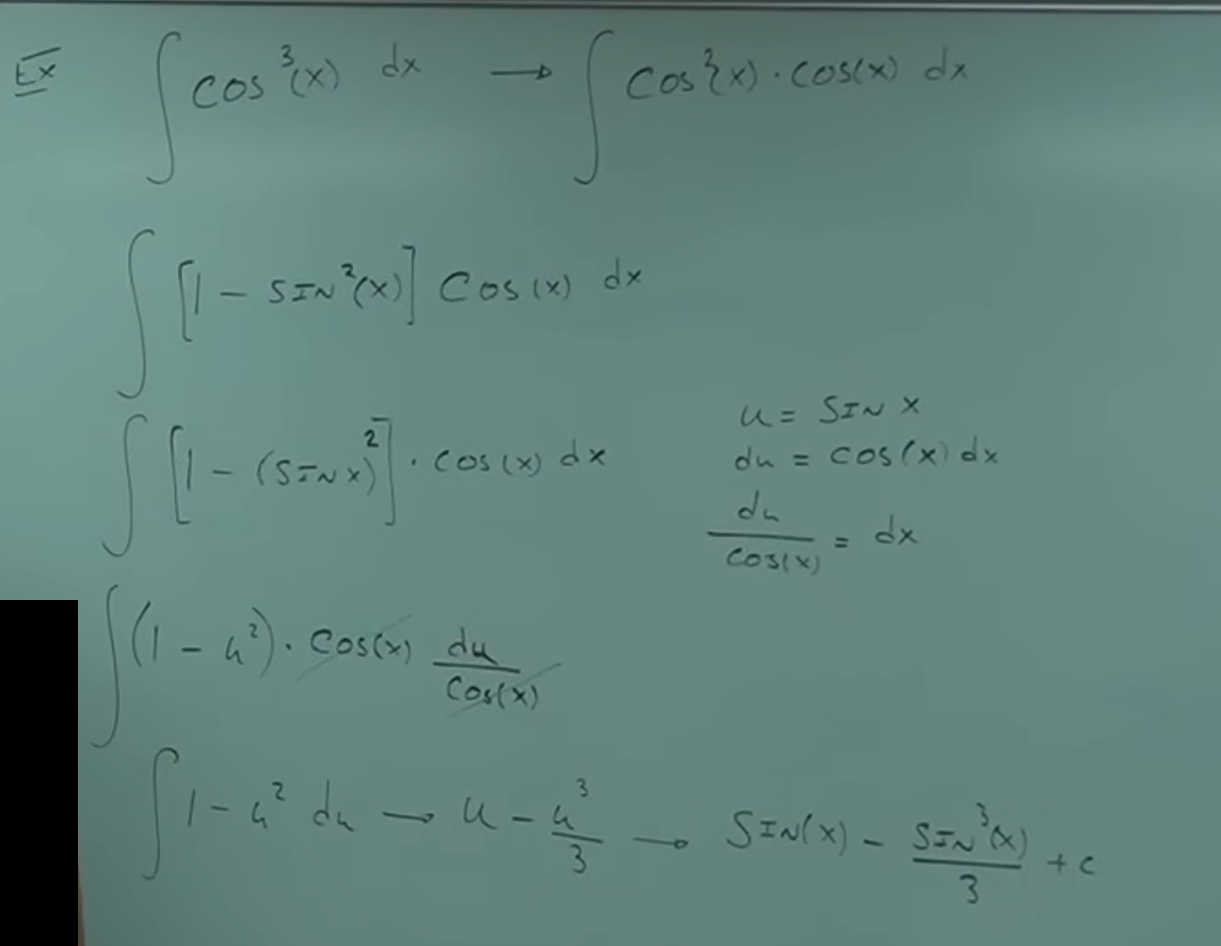
- $\displaystyle \int \cos^{3}(𝒙)\,dx \;\to\; \int \big(\cos^{2}(𝒙)\cdot
\cos(𝒙)\big)\,dx$
- $\displaystyle \int \big[1-\sin^{2}(𝒙)\big]\cos(𝒙)\,dx$
- $\displaystyle \int \big[1-(\sin(𝒙))^{2}\big]\cos(𝒙)\,dx$
- Pick "$𝑢$" so the integral is easier.
- Usually the "inside" of some thing.
- Choosing $u$ as $\sin(𝒙)$ comes from the fact that $\sin(𝒙)$ is "inside" a
more complex operation:
the square $(\sin(𝒙))^{2}$. Furthermore, its derivative, $\cos(𝒙)\,dx$, is present in the
integrand, which
simplifies the substitution.
- $𝑢=\sin(𝒙)\;\to\; du=\cos(𝒙)\,dx \;\to\; \dfrac{du}{\cos(𝒙)}=dx$
- $\displaystyle \int \big[1-𝑢^{2}\big]\cos(𝒙)\left(\dfrac{du}{\cos(𝒙)}\right)$
- $\displaystyle \int \big(1-𝑢^{2}\big)\,du$
- $\displaystyle \int 1\,du-\int 𝑢^{2}\,du \;\to\; 𝑢-\dfrac{𝑢^{3}}{3}$
- Translate back to "$𝒙$": $\sin(𝒙)-\dfrac{\sin^{3}(𝒙)}{3}+\mathcal{C}$