Calculus 1 Lecture 4.4
The Evaluation Of Definite Integrals
Introduction to the definite integral and its connection to the concept of area
-
[0:00]. Introduction to the
definite integral and its connection to the concept of area –
[📷image]
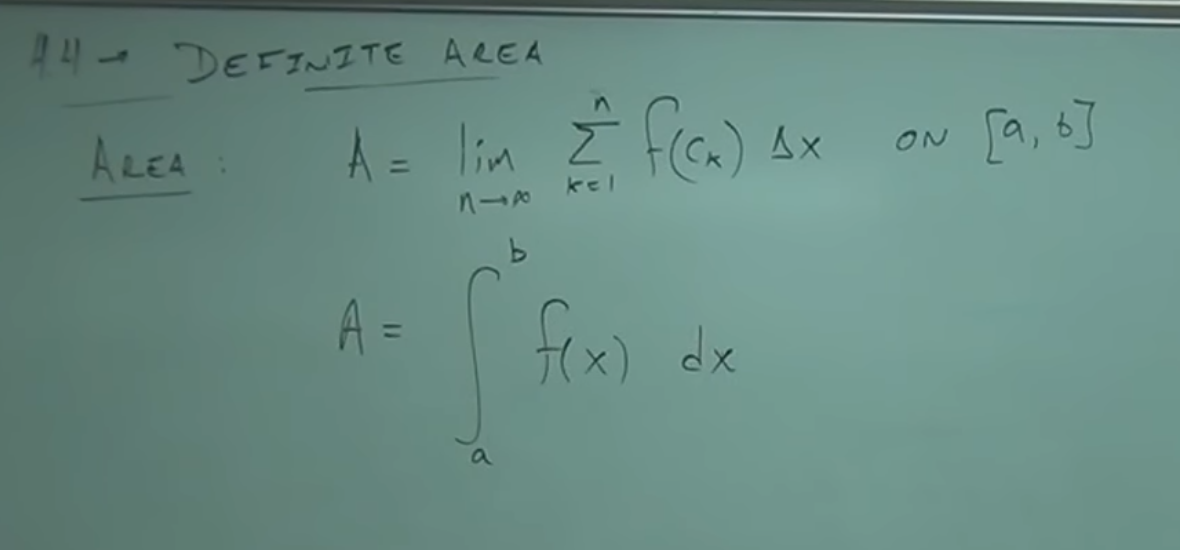
- AREA 𝒜ₙ = $\displaystyle \lim_{n\to\infty}\sum_{k=1}^{n} 𝒇(x_k^* )\cdot \Delta x$ on
$[𝓪,𝓫]$ Equivalent to:
- 𝒜 =$\displaystyle \int_{𝓪}^{𝓫} 𝒇(𝒙)\,dx$
- Indefinite integrals are expressed with “+ $𝓒$” because they represent the family of
antiderivatives without a specific bound,
meaning without defining an exact area. On the other hand, the definite integral, evaluated over an interval
$[𝓪,𝓫]$, precisely
calculates the net area, $𝒜$, under the curve between those two points, considering both the positive and
negative regions depending on
their position relative to the 𝒙-axis.
-
[1:44]. Similarity to
the calculation of derivatives using limits.
- Both the derivative and the integral are based on the concept of a
limit: the derivative is defined as the limit of the difference
quotient (which measures the instantaneous slope), while the integral is conceived as the limit of the
sum of the areas of rectangles
(the Riemann sum). In this process, the height of each rectangle can be arbitrarily chosen within its
subinterval, and although there are
shortcuts for calculating derivatives without always relying on the explicit limit, both concepts share
the central idea of approaching an
exact value through infinitesimal sums or differences.
- " Difference quotient" refers to the average rate of change of a function between
two nearby points. More concretely, if you have a function
𝒇(𝒙), the difference quotient is expressed as $\displaystyle \frac{𝒇(𝒙+h)-𝒇(𝒙)}{h}$
- Limit of a Sum:
- The interval $[𝓪,𝓫]$ is divided into small partitions. In each partition, an
arbitrary point $x_k^*$ is chosen, and a rectangle is formed with height $𝒇(x_k^*)$ and width $\Delta
x$.
- Infinitesimal Rectangles:
- As the number of partitions tends to infinity, the width $\Delta x$ approaches a
differential $dx$ (that is, it becomes infinitesimal), allowing the sum of the rectangles to
transform into an integral.
- Analogy with the Derivative:
- Just as the derivative is defined from the change between two infinitesimally close
points, the integral sums the areas of rectangles whose widths become progressively smaller.
- Geometric Interpretation:
- The integral represents the net area (with sign) under the curve $𝒇(𝒙)$ between the
limits $𝓪$ and $𝓫$.
- Flexibility in Partitions:
- Although partitions of equal width can be used to simplify calculations, this is not
mandatory; what matters is that,
in the limit, all the rectangles become infinitesimally thin.
-
[4:50]. Net signed area:
- 𝒜 = $\displaystyle \int_{𝓪}^{𝓫} 𝒇(𝒙)\,dx$ ⇢ The definite integral is precisely
that sum of very small rectangles, so small that, in the limit, it becomes
exact. The finer these rectangles are ($\Delta x \rightsquigarrow dx$ As the number of rectangles
increases indefinitely: $n\to\infty$), the more accurate the result, allowing us to obtain
the area under the curve $𝒇(𝒙)$ over the interval $[𝓪,𝓫]$.
- Which is equivalent to 𝒜ₙ = $\displaystyle
\lim_{n\to\infty}\sum_{k=1}^{n}𝒇(x_k^*)\cdot \Delta x$ on $[𝓪,𝓫]$
Using geometric methods to find the area
-
[7:00]. 🧩 Example – 1:
$\displaystyle \int_{1}^{4} 2\,dx$ –
[📷image]
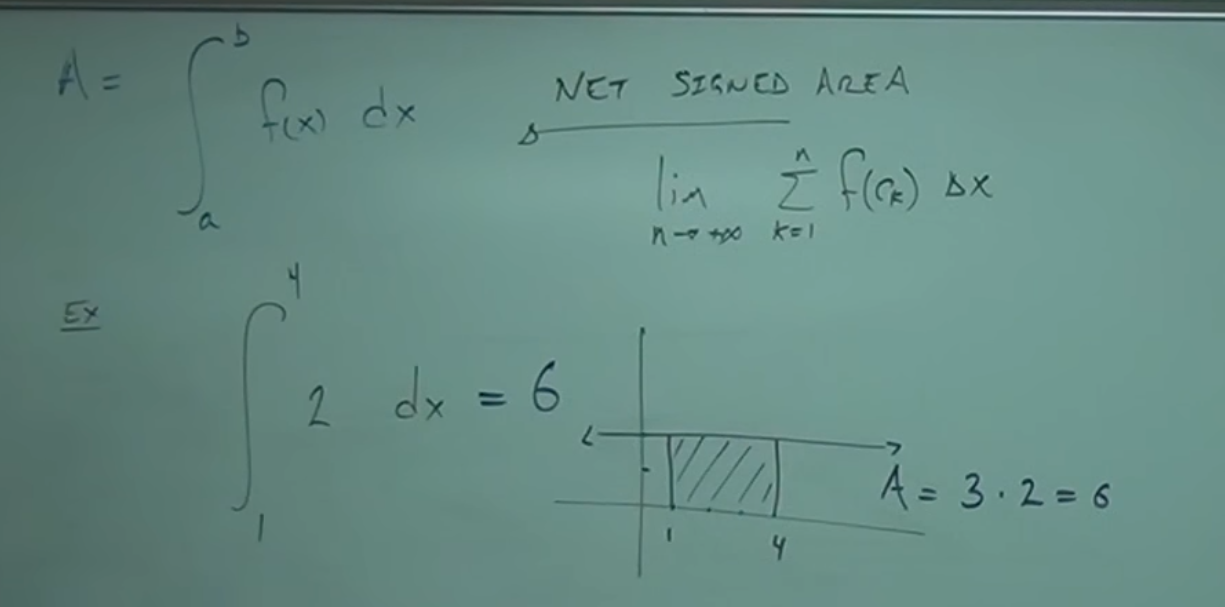
- Integration limits: from 1 to 4.
- Graph of $𝒇(𝒙)=2$.
- $𝒇(𝒙)=2$ is a constant function (horizontal line).
- The area under $𝒇(𝒙)=2$ between 1 and 4 corresponds to the integral’s value.
- Calculating the geometric area of that rectangle.
- Rectangle’s base = 3.
- Rectangle’s height = 2.
- The rectangle’s area is 6 square units, matching the integral’s value.
- The rectangular area remains 6 regardless of the partition.
-
[9:00]. 🧩 Example – 2:
$\displaystyle \int_{-1}^{2} (\;𝒙 + 2\;)\,dx$ –
[📷image]
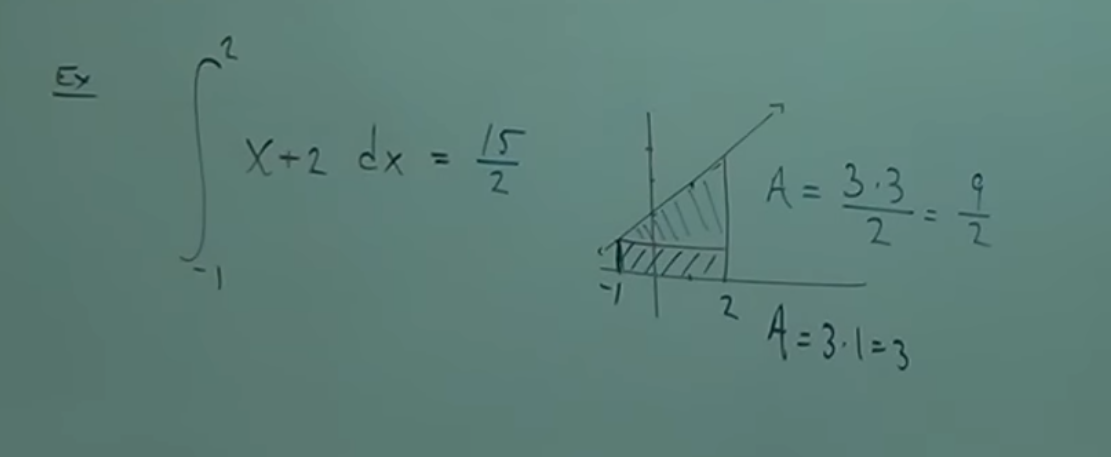
- $𝒇(𝒙)=𝒙+2$.
- Graph of $𝒇(𝒙)=𝒙+2$.
- The graph starts at $y=2$ with slope $1$.
- The integral represents the area under the line $𝒙+2$.
- Splitting the region into a rectangle and a triangle.
- Calculating the rectangle’s area.
- Rectangle’s base = 3.
- Rectangle’s height = 1.
- Rectangle’s area = 3.
- Calculating the triangle’s area.
- Triangle’s base = 3.
- Triangle’s height = 3.
- Triangle’s area = $\displaystyle \frac{9}{2}$.
- Total area is the sum of the rectangle’s area and the triangle’s area.
- Correcting the computation, total area = $\displaystyle \frac{15}{2}$.
-
[12:15]. 🧩 Example – 3:
$\displaystyle \int_{0}^{1} \sqrt{\,1-𝒙^{2}\,}\,dx$ –
[📷image]
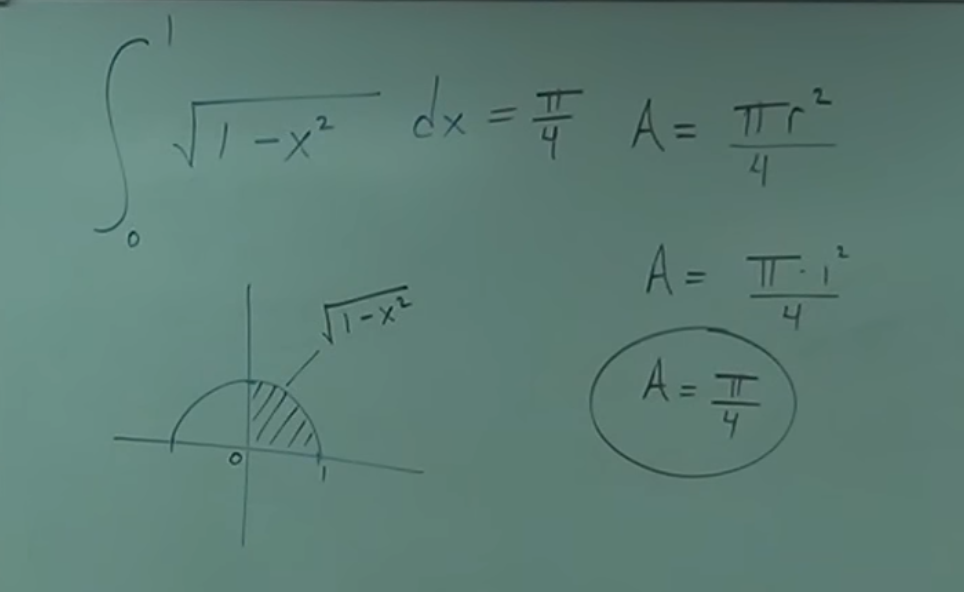
- Identifying the function as the upper half of a circle.
- The definite integral finds area under the function.
- Recognizing $𝒇(𝒙)=\sqrt{\,1-𝒙^{2}\,}$ as a semicircle.
- Semicircle in the upper half-plane.
- The function is a semicircle of radius 1.
- Integration limits from 0 to 1.
- The integration limits need not cover the entire domain of the function.
- That area is a quarter circle.
- Calculating the area of a circle.
- Formula for circle area: $\pi r^{2}$.
- Computing one quarter of a circle.
- The area of a quarter circle is $\displaystyle \frac{\pi}{4}$.
- Definite integrals can sometimes be solved using geometric methods.
- Geometry alone, has limitations for more complex functions.
-
[15:24]. We require
more advanced methods for functions like $𝒙^{3}$ or $𝒙^{2}$.
- Riemann sums as one approach.
Properties of definite integrals
-
–
[📷image-1]
 –
[📷image-2]
–
[📷image-2]
-
[16:40]. 𝒫𝓇𝑜𝓅𝑒𝓇𝓉𝓎
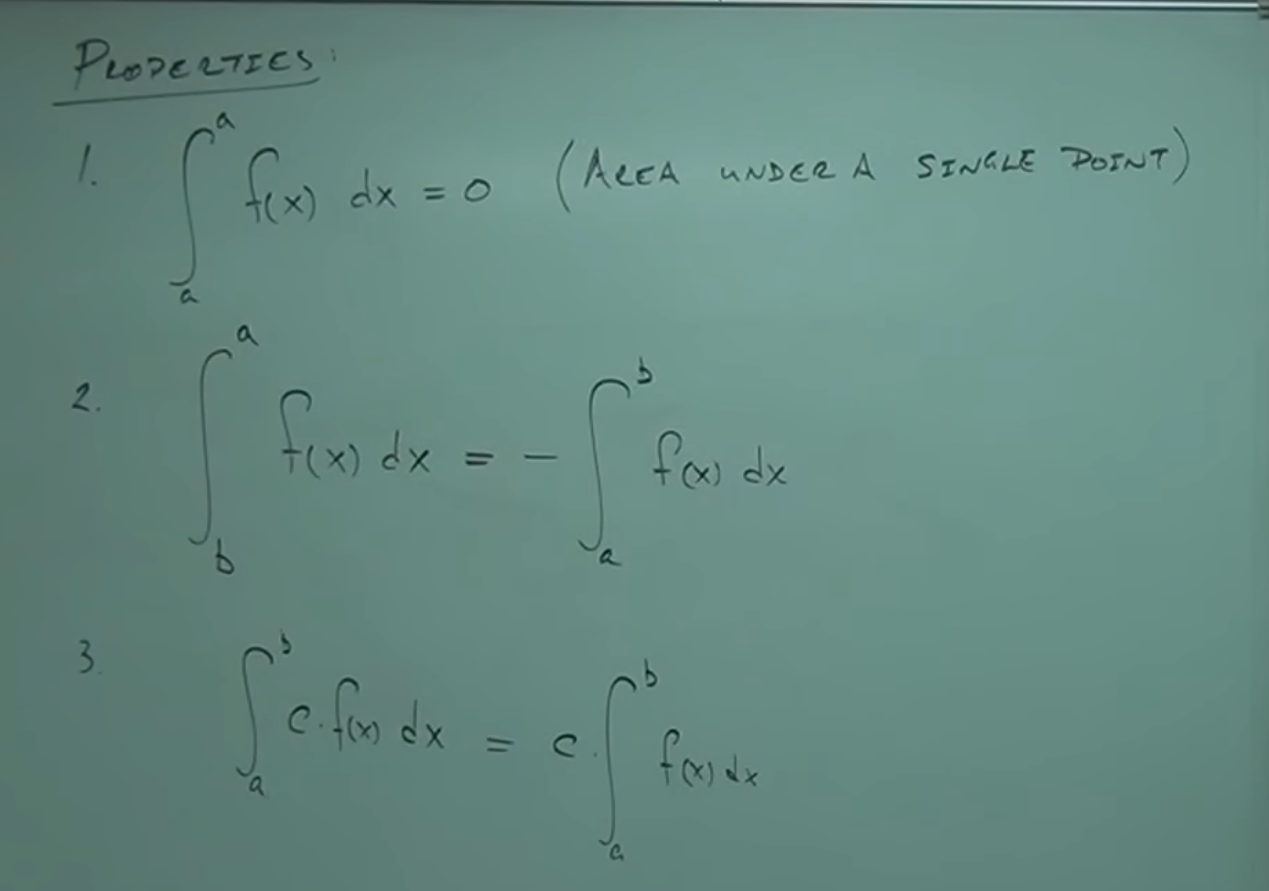
4.4.1: An integral with identical upper and lower limits is zero.
- $\displaystyle \int_{𝓪}^{𝓪} 𝒇(𝒙)\,dx = 0$ (Area under a single point).
- There is no interval over which to integrate.
- The area under a function over a single point is zero.
-
[18:00]. 𝒫𝓇𝑜𝓅𝑒𝓇𝓉𝓎
4.4.2: Reversing the limits of integration changes the sign of the integral.
- $\displaystyle \int_{𝓫}^{𝓪} 𝒇(𝒙)\,dx = - \int_{𝓪}^{𝓫} 𝒇(𝒙)\,dx$
- This 𝒫𝓇𝑜𝓅𝑒𝓇𝓉𝓎 is useful when changing the order of limits during calculations or
simplifying expressions
involving definite integrals.
- The integral from b to a is the negative of the integral from $𝓪$ to $𝓫$.
- The reversed integral represents the area below the 𝒙-axis.
-
[19:20]. 𝒫𝓇𝑜𝓅𝑒𝓇𝓉𝓎
4.4.3: Constants can be factored out of the integral.
- $\displaystyle \int_{𝓪}^{𝓫} 𝓬 \cdot 𝒇(𝒙)\,dx = 𝓬 \cdot \int_{𝓪}^{𝓫} 𝒇(𝒙)\,dx$
-
[19:55]. 𝒫𝓇𝑜𝓅𝑒𝓇𝓉𝓎
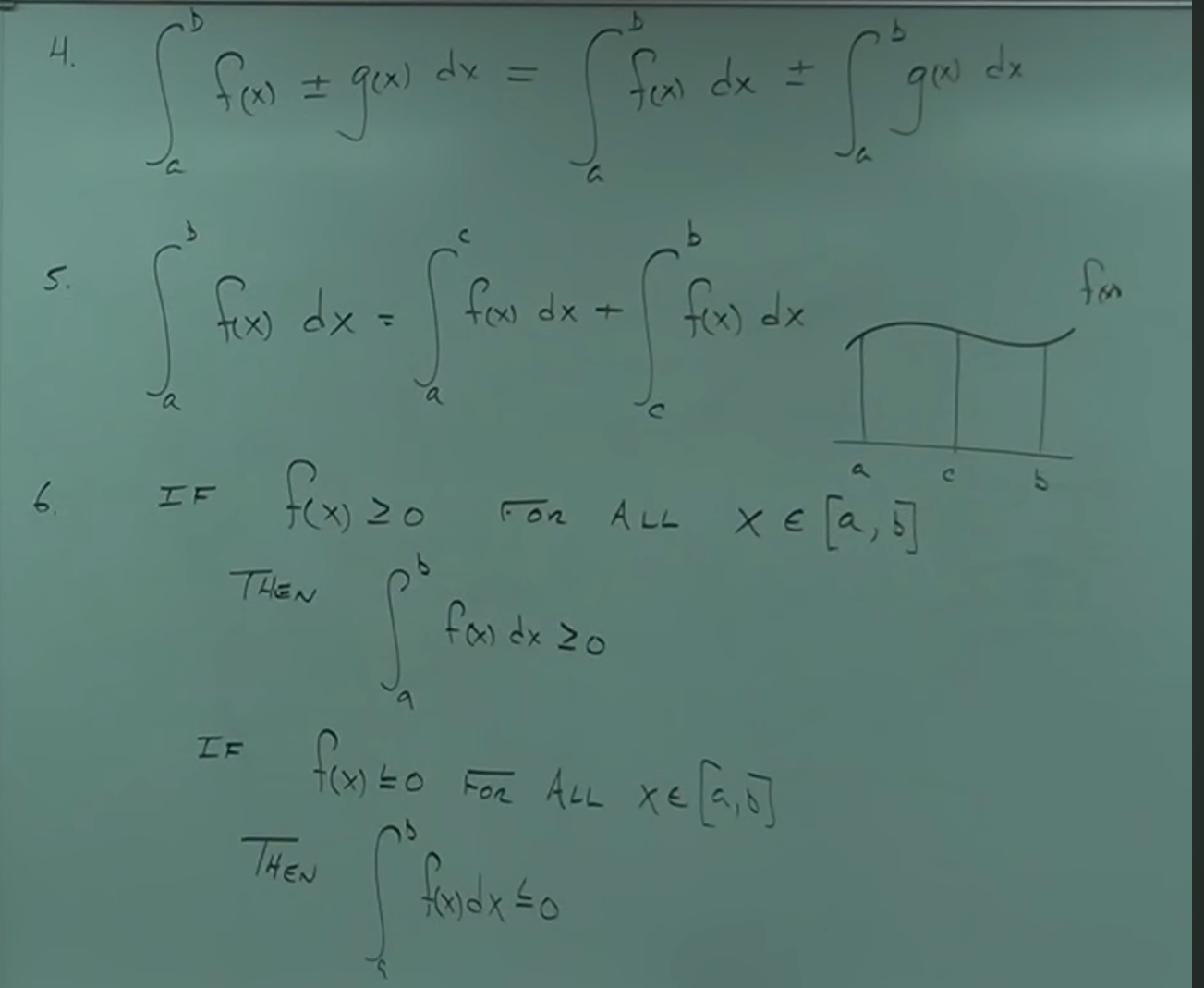
4.4.4: The integral of a sum or difference equals the sum or difference of the integrals.
- $\displaystyle \int_{𝓪}^{𝓫} \big(𝒇(𝒙) \pm 𝓰(𝒙)\big)\,dx = \int_{𝓪}^{𝓫} 𝒇(𝒙)\,dx
\pm \int_{𝓪}^{𝓫} 𝓰(𝒙)\,dx$
-
[21:19]. 𝒫𝓇𝑜𝓅𝑒𝓇𝓉𝓎
4.4.5: You can partition the integral across intervals.
- $\displaystyle \int_{𝓪}^{𝓫} 𝒇(𝒙)\,dx = \int_{𝓪}^{𝓬} 𝒇(𝒙)\,dx + \int_{𝓬}^{𝓫}
𝒇(𝒙)\,dx$ and $𝓪 \le 𝓬 \le 𝓫$
- This interval-splitting 𝒫𝓇𝑜𝓅𝑒𝓇𝓉 only applies to definite integrals.
- Dividing a single integral into multiple intervals.
- The total area can be split into smaller areas, breaking the integral into subintervals.
- The total area is the sum of the areas of the subintervals.
- The integral from 𝓪 to 𝓫 equals the sum of integrals from a to c and from c to b.
- Subinterval limits must align appropriately.
-
[23:16]. 𝒫𝓇𝑜𝓅𝑒𝓇𝓉𝓎
4.4.6: If the function is positive, the integral is positive (and vice versa).
- If $𝒇(𝒙) \ge 0$ for all $𝒙 \in [𝓪,𝓫]$ then $\displaystyle \int_{𝓪}^{𝓫} 𝒇(𝒙)\,dx
\ge 0$
- If $𝒇(𝒙)$ is above the 𝒙-axis, the integral is positive
- If $𝒇(𝒙) \le 0$ for all $𝒙 \in [𝓪,𝓫]$ then $\displaystyle \int_{𝓪}^{𝓫} 𝒇(𝒙)\,dx
\le 0$
- If $𝒇(𝒙)$ is below the 𝒙-axis, the integral is negative
-
[28:20]. 🧩 Example –
Evaluate geometrically: $\displaystyle \int_{0}^{1} \big(4 - 2\sqrt{1-𝒙^{2}}\big)\,dx$ –
[📷image]
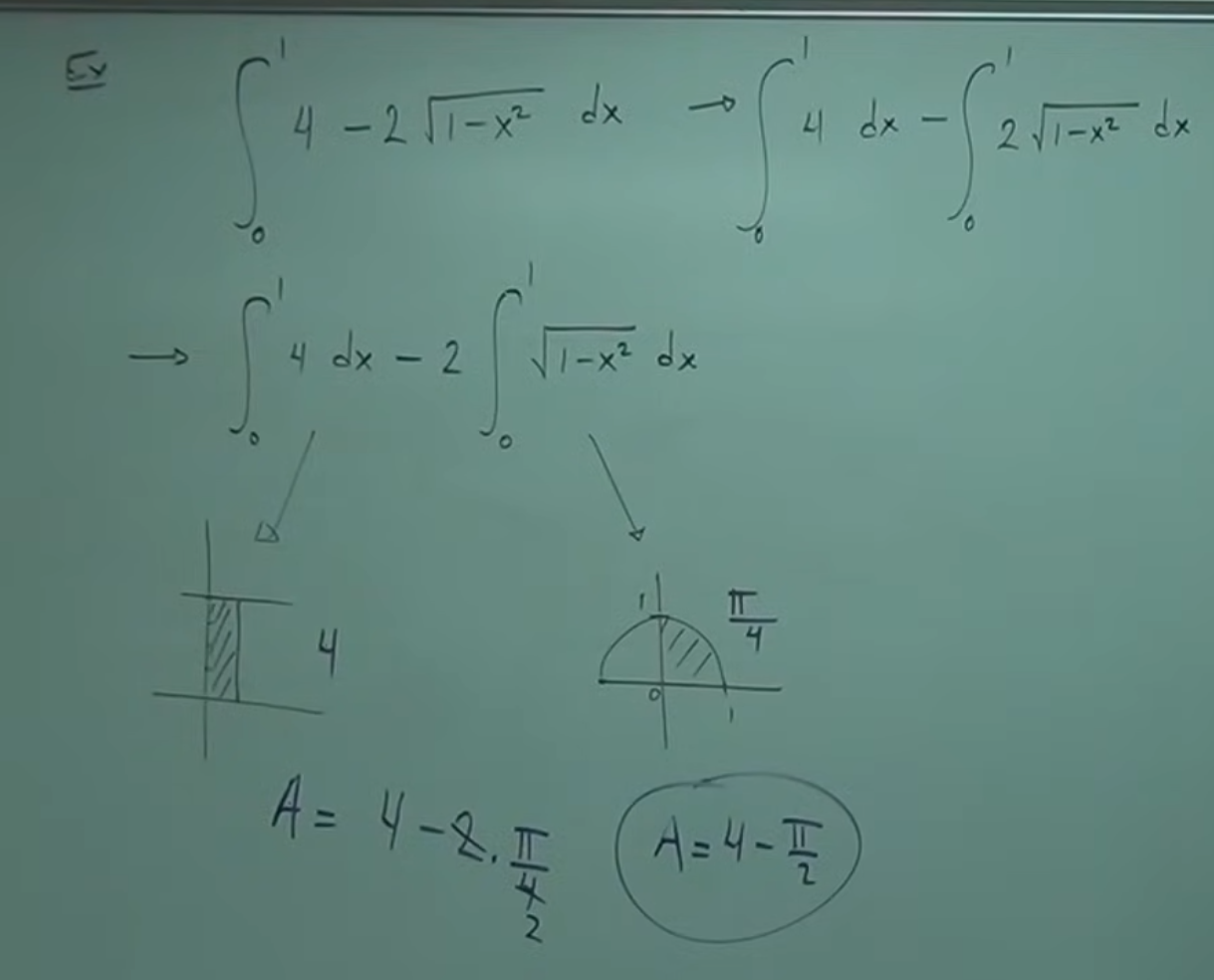
- Step 1: Split by linearity, aply 𝒫𝓇𝑜𝓅𝑒𝓇𝓉𝓎 4.4.3 and 𝒫𝓇𝑜𝓅𝑒𝓇𝓉𝓎 4.4.4
- $\displaystyle \int_{0}^{1} \big(4 - 2\sqrt{1-𝒙^{2}}\big)\,dx \;=$ $\displaystyle
\int_{0}^{1} 4\,dx \;-\; 2 \int_{0}^{1} \sqrt{1-𝒙^{2}}\,dx$
- Step 2: First integral (rectangle of width 1 and height 4)
- $\displaystyle \int_{0}^{1} 4\,dx = 4(1 - 0) = 4$
- Step 3: Second integral (quarter of a unit circle) $y=\sqrt{1-𝒙^{2}}$ is the upper
semicircle of $𝒙^{2}+y^{2}=1$.
- On $[0,1]$ it traces a quarter circle, whose area is $\displaystyle \frac{\pi}{4}$.
- $\displaystyle \int_{0}^{1} 2\sqrt{1-𝒙^{2}}\,dx = 2 \cdot \left(\frac{\pi}{4}\right)
= \frac{\pi}{2}$
- Step 4: Combine
- $\displaystyle \int_{0}^{1} \big(4 - 2\sqrt{1-𝒙^{2}}\big)\,dx = 4 - \frac{\pi}{2}$