Calculus 1 Lecture 4.5
The Fundamental Theorem of Calculus
The Fundamental Theorem of Calculus(FTC)
𝒫𝒜𝑅𝒯 Ⅱ
-
[2:00]. Introduction to the
Fundamental Theorem of Calculus (FTC)
–
[📷image]
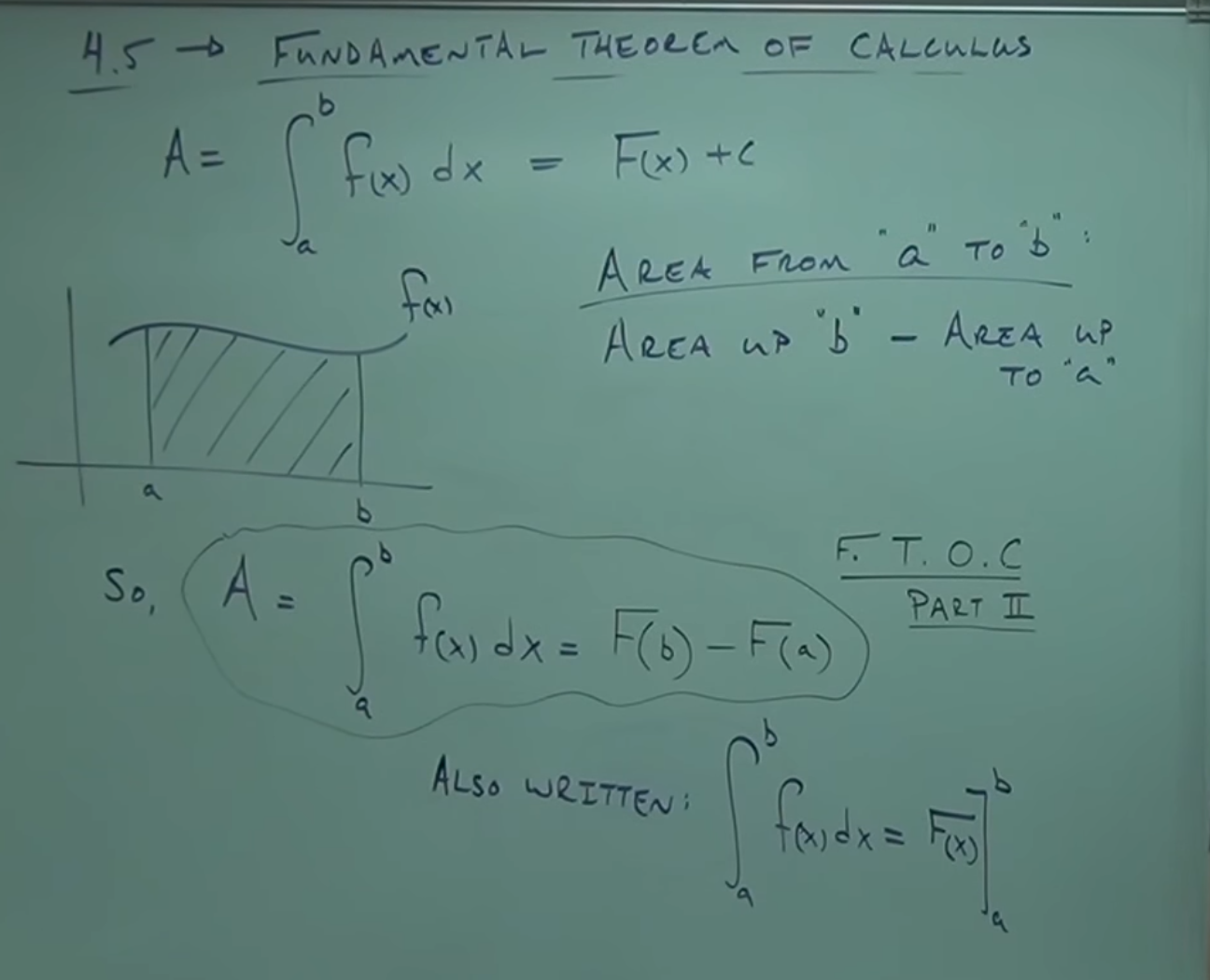
- Visualizing the area under the curve from 𝓪 to 𝓫
- Subtracting areas: area up to 𝓫 minus area up to 𝓪
- Analogy with distance: 𝓫-𝓪
- The area as a function
- Definite integrals as areas with specific limits
- Definition of the definite integral as the difference of the antiderivative evaluated
at the integration limits
- The area from 𝓪 to 𝓫 is $𝓕(𝓫)-𝓕(𝓪)$ (FTC 𝒫𝒜𝑅𝒯 Ⅱ )
- The starting point of the integral does not matter, as long as it’s the same for both
limits
- FTC, 𝒫𝒜𝑅𝒯 II — “Evaluation Theorem”
- Connects the definite integral to any antiderivative.
- Statement of FTC 𝒫𝒜𝑅𝒯 II:
$\displaystyle\left\{\begin{aligned}&\underline{\text{If }}\; 𝒇 \text{ is continuous on } [𝓪,𝓫]
\text{ and } 𝓕 \text{ is an antiderivative of } 𝒇 \text{ on } [𝓪,𝓫] \; (\text{i.e., } 𝓕'(𝒙)=𝒇(𝒙)),
\\[10pt]&\underline{\text{Then }}\; \int_{𝓪}^{𝓫} 𝒇(𝒙)\,𝒅𝒙 \;=\; 𝓕(𝓫) - 𝓕(𝓪)\end{aligned}\right.$
- Equivalent form (Net Change Theorem):
$\displaystyle \int_{𝓪}^{𝓫} 𝓕′(𝒙)\,𝒅𝒙 = 𝓕(𝓫) - 𝓕(𝓪)$.
-
[10:45]. Explanation of why
+𝓒 is eliminated in definite integrals
–
[📷image]
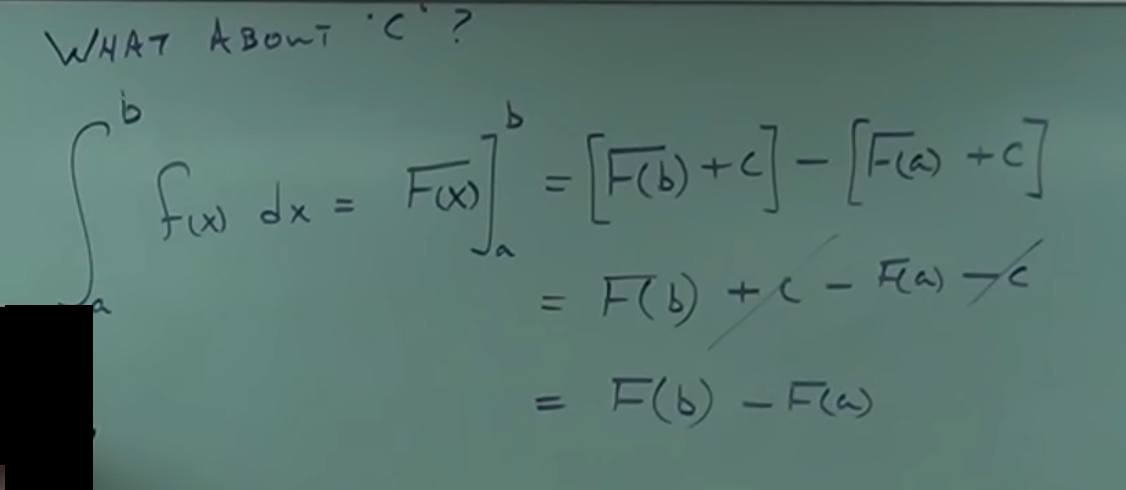
- The constant cancels when subtracting antiderivatives, it belogs to the same function.
- The definite integral results in a single number representing area
-
[11:49]. Examples of
definite integrals
-
[11:49]. 🧩 Example – 1:
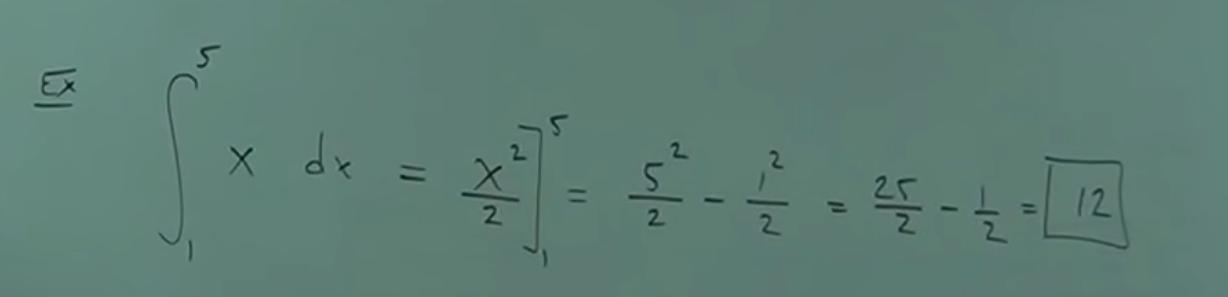
$\displaystyle \int_{1}^{5} 𝒙\cdot 𝒅𝒙$ –
[📷image]
- Antiderivative:
■ $𝓕(𝒙)=\dfrac{𝒙^{2}}{2}$
- Evaluate at the bounds:
■
$\left.\dfrac{𝒙^{2}}{2}\right|_{1}^{5}=\dfrac{5^{2}}{2}-\dfrac{1^{2}}{2}=\dfrac{25}{2}-\dfrac{1}{2}=\dfrac{24}{2}=12$
-
[14:02]. 🧩 Example – 2:
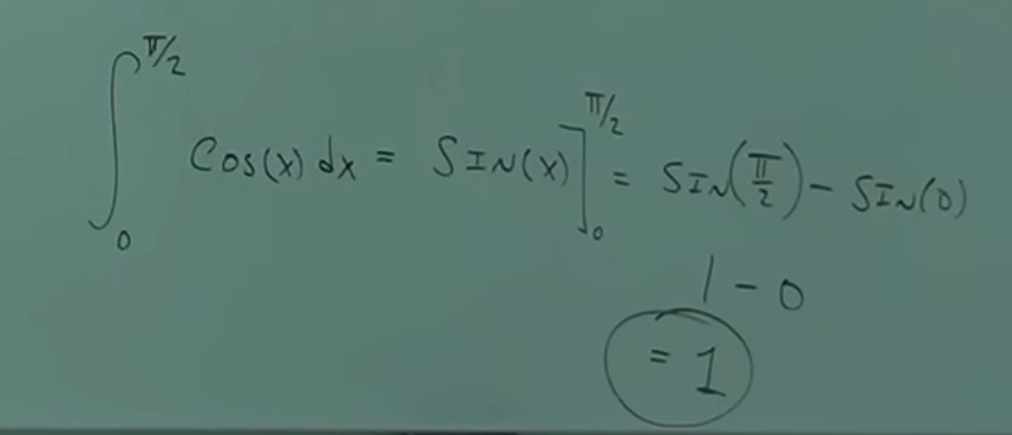
$\displaystyle \int_{0}^{\pi/2} \cos(𝒙)\,𝒅𝒙$ –
[📷image-1]
 –
[📷image-2]
–
[📷image-2]
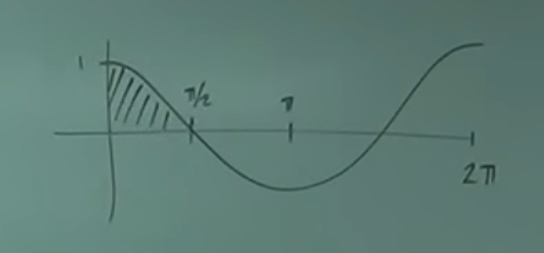
- Antiderivative:
■ $𝓕(𝒙)=\sin(𝒙)$
- Evaluate at the bounds:
■ $\left.\sin(𝒙)\right|_{0}^{\pi/2}=\sin\!\left(\dfrac{\pi}{2}\right)-\sin(0)=1-0=1$
- Visualizing the area under the cosine function
- Relation to the circle’s area
- Introduction to the idea of signed net area
-
[18:30]. 🧩 Example –
3: $\displaystyle \int_{4}^{9} 𝒙^{2}\cdot \sqrt{𝒙}\, 𝒅𝒙$
–
[📷image]
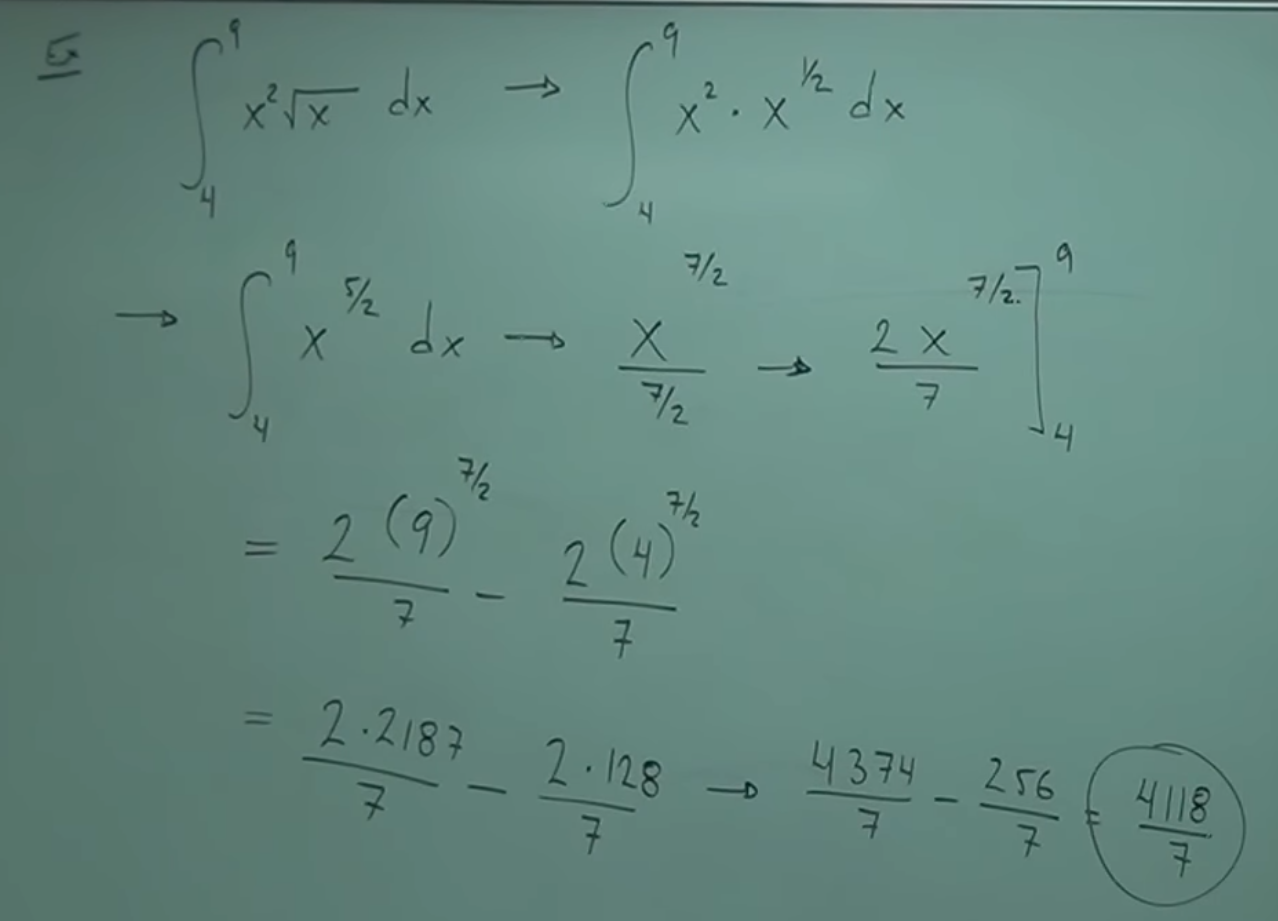
- Rewrite with exponents:
■ $\sqrt{𝒙}=𝒙^{1/2}\;\Rightarrow\; 𝒙^{2}\cdot \sqrt{𝒙}=𝒙^{2}\cdot 𝒙^{1/2}=𝒙^{5/2}$
- Antiderivative::
■ $𝓕(𝒙)=\displaystyle \int 𝒙^{5/2}\,𝒅𝒙=\dfrac{𝒙^{7/2}}{7/2}=\dfrac{2}{7}\cdot 𝒙^{7/2}$
- Evaluate at bounds:
■ $\left.\dfrac{2}{7}\cdot 𝒙^{7/2}\right|_{4}^{9}=\dfrac{2}{7}\cdot 9^{7/2}-\dfrac{2}{7}\cdot
4^{7/2}$
- Powers and roots:
■ $9^{7/2}=(\sqrt{9})^{7}=3^{7}=2187$
■ $4^{7/2}=(\sqrt{4})^{7}=2^{7}=128$
- Final result:
$\dfrac{2}{7}\cdot 2187-\dfrac{2}{7}\cdot 128=\dfrac{4118}{7}$
-
[22:50]. 🧩 Example –
4: $\displaystyle \int_{0}^{\pi/3}\sec^{2}(𝒙)\,𝒅𝒙$ –
[📷image]

- Antiderivative:
■ $𝓕(𝒙)=\displaystyle \int \sec^{2}(𝒙)\,𝒅𝒙=\tan(𝒙)$
- Evaluate at bounds:
■ $\left.\tan(𝒙)\right|_{0}^{\pi/3}=\tan\!\left(\dfrac{\pi}{3}\right)-\tan(0)=\sqrt{3}-0=\sqrt{3}$
-
[25:40]. 🧩 Example –
5: Definite integral with reversed limits $\displaystyle \int_{0}^{4} 𝒙^{3}\,𝒅𝒙$
–
[📷image]
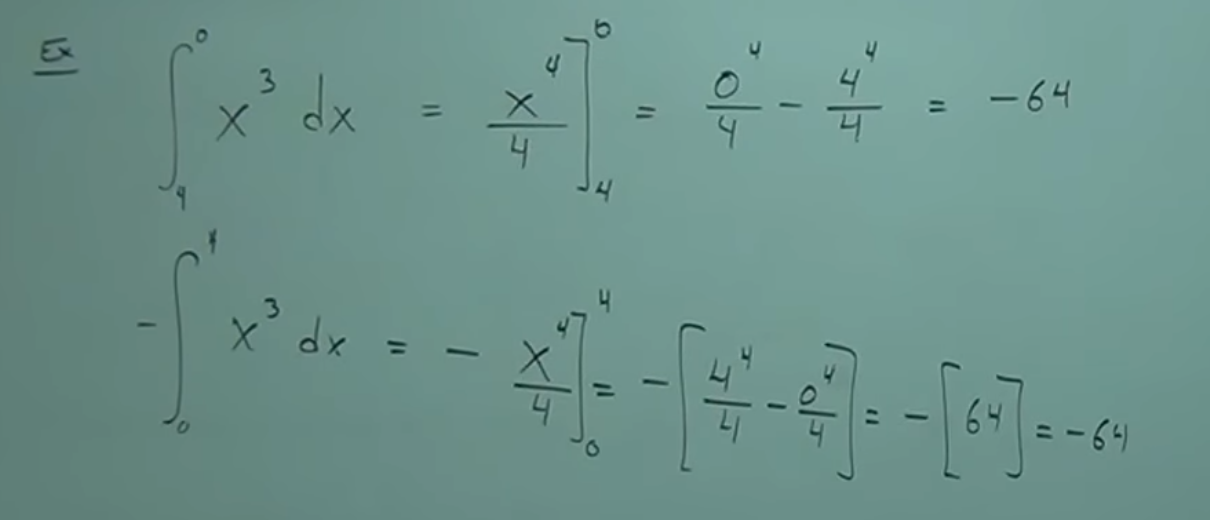
- Apply 𝒫𝓇𝑜𝓅𝑒𝓇𝓉𝓎 4.4.2: Reversing the limits of integration changes the sign of
the integral.
■ $\displaystyle \int_{𝓫}^{𝓪} 𝒇(𝒙)\,𝒅𝒙=-\int_{𝓪}^{𝓫} 𝒇(𝒙)\,𝒅𝒙$
■ $\displaystyle \int_{4}^{0}
𝒙^{3}\,𝒅𝒙=\left.\dfrac{𝒙^{4}}{4}\right|_{4}^{0}=\dfrac{0^{4}}{4}-\dfrac{4^{4}}{4}=-64$
■ $-\displaystyle \int_{0}^{4}
𝒙^{3}\,𝒅𝒙=-\left[\left.\dfrac{𝒙^{4}}{4}\right|_{0}^{4}\right]=-\left[\dfrac{4^{4}}{4}-\dfrac{0^{4}}{4}\right]=-64$
-
[28:25]. 🧩 Example –
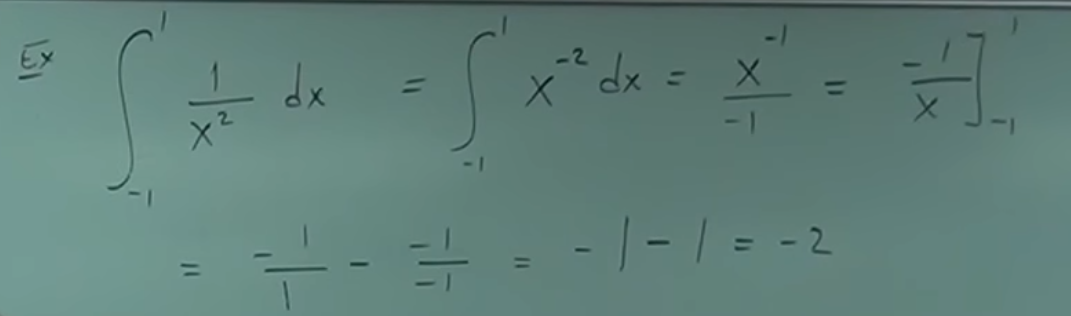
6: $\displaystyle \int_{1}^{-1} \dfrac{1}{𝒙^{2}}\,𝒅𝒙$ –
[📷image-1]
 –
[📷image-2]
–
[📷image-2]
- Rewrite the integrand with negative exponent:
■ $𝒙^{-2}=\dfrac{1}{𝒙^{2}}$
- Apply the power rule:
■ $\displaystyle \int 𝒙^{-2}\,𝒅𝒙=\dfrac{𝒙^{-1}}{-1}=-\dfrac{1}{𝒙}$
- Evaluate the definite integral:
■
$\left.-\dfrac{1}{𝒙}\right|_{-1}^{1}=\left(-\dfrac{1}{1}\right)-\left(-\dfrac{1}{-1}\right)=-1-1=-2\;
\; \; ❓$
- Analysis of the Result
- This result suggests a negative area, which raises concerns
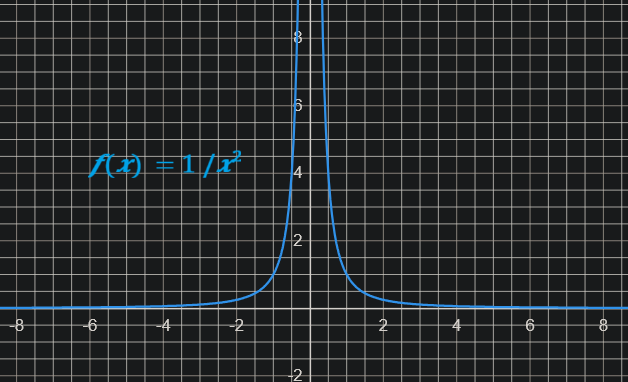
because the function $𝒇(𝒙)=\dfrac{1}{𝒙^{2}}$ is always positive on its domain.
According to:
- 𝒫𝓇𝑜𝓅𝑒𝓇𝓉𝓎 4.4.6: If the function is positive, the integral is positive
(and vice versa).
- If $𝒇(𝒙)\ge 0$ for all $𝒙\in[𝓪,𝓫]$ then $\displaystyle \int_{𝓪}^{𝓫}
𝒇(𝒙)\,𝒅𝒙 \ge 0$
- If $𝒇(𝒙)$ is above the 𝒙-axis, the integral is positive
- If $𝒇(𝒙)\le 0$ for all $𝒙\in[𝓪,𝓫]$ then $\displaystyle \int_{𝓪}^{𝓫}
𝒇(𝒙)\,𝒅𝒙 \le 0$
- If $𝒇(𝒙)$ is below the 𝒙-axis, the integral is negative
- So how can the integral be negative, if the function is positive? The issue lies
in the discontinuity at $𝒙=0$.
- Discontinuity and Asymptote
- The function $𝒇(𝒙)=\dfrac{1}{𝒙^{2}}$ is undefined at
$𝒙=0$, and has a vertical asymptote there.
- Therefore, the interval $[-1,1]$ includes a point of discontinuity.
- This means the integral is not proper and must be treated as an
improper integral, using limits.
- The function is unbounded and discontinuous at $𝒙=0$, leading to an
asymptote.
- [33:00]. Graphical interpretation showing how the asymptote affects
the area.
- Observation: If, because of the asymptote, some of
those rectangles blow up to infinity, then the area can’t be computed.
- Domain issue: When an asymptote lies within or at the limit of
integration, the integral
may diverge or require special treatment (e.g., improper integrals).
- Observation: If the integrand has a vertical
asymptote
that makes some Riemann rectangles unbounded, the corresponding
improper integral diverges; therefore, the area is not defined.
- 🗒️ NOTE: 🛡️ Pre-check: Domain & Continuity of the Integrand
- Before applying any property (like 𝒫𝓇𝑜𝓅𝑒𝓇𝓉𝓎 4.4.6), you must
verify that the integrand $𝒇(𝒙)$ is continuous on the interval $[𝓪,𝓫]$.
- If $𝒇(𝒙)$ is not defined or not continuous at any point in
$[𝓪,𝓫]$, the integral becomes improper.
- For improper integrals, standard properties of definite integrals do
not necessarily apply.
- In particular, you cannot directly say that a positive function
implies a positive integral unless the function is continuous throughout the
interval.
- Think about it:
- Checklist before integrating:
▢ 1. 📌 Is $𝒇(𝒙)$ defined at every point in $[𝓪,𝓫]$?
▢ 2. 📌 Is $𝒇(𝒙)$ continuous on $[𝓪,𝓫]$?
- If yes, proceed with Fundamental Theorem & integral
properties.
- If no, analyze the integral as improper
(i.e., split it or use limits).
- [37:23]. 🧩 Example – 7: Integrals with piecewise-defined functions
– [📷image]
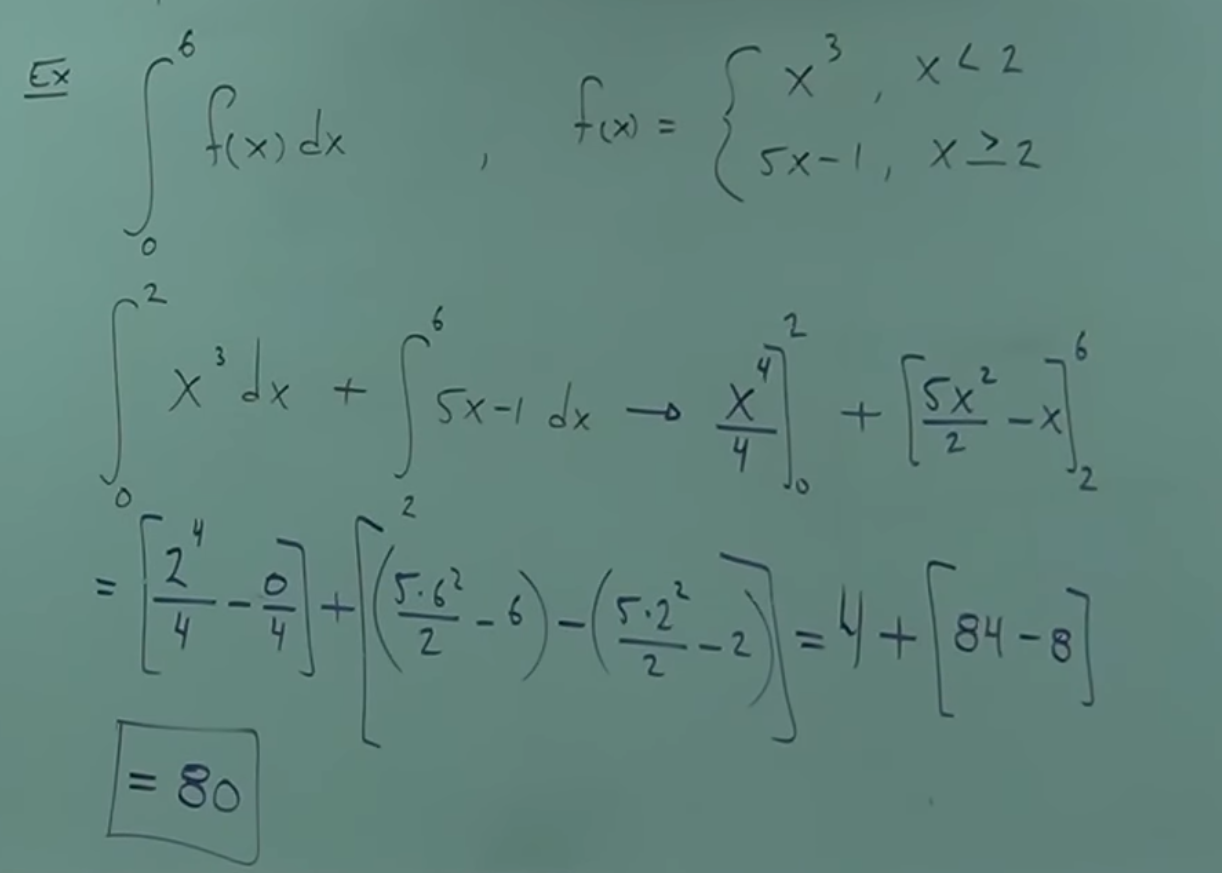
- $ \displaystyle \int_{0}^{6} 𝒇(𝒙)\,𝒅𝒙,\;\; 𝒇(𝒙)=\begin{cases}𝒙^{3}, &
𝒙<2\\[2pt]5𝒙-1, & 𝒙\ge 2\end{cases}$
- Splitting the integral over intervals where the function is defined
- Continuity is required to split the integral properly
- Computing each integral separately:
- $ \displaystyle \int_{0}^{2}
𝒙^{3}\,𝒅𝒙=\left.\dfrac{𝒙^{4}}{4}\right|_{0}^{2}\to \dfrac{2^{4}}{4}-0=\dfrac{16}{4}=4$
- $ \displaystyle \int_{2}^{6} (5𝒙-1)\,𝒅𝒙=\int 5𝒙\,𝒅𝒙+\int
(-1)\,𝒅𝒙=\dfrac{5𝒙^{2}}{2}-𝒙 \;\Rightarrow\;
\left.\left(\dfrac{5𝒙^{2}}{2}-𝒙\right)\right|_{2}^{6}=[90-6]-[10-2]=84-8=76$
- Total area: $4+76=80$
- What happens at $𝒙=2$?
- At $𝒙=2$, the function is discontinuous (it jumps from one
branch to another).
- Therefore, it is not differentiable at that point.
- Result: There is no single, continuous
antiderivative on the entire interval $[0,6]$.
- Can we apply the FTC directly to $\displaystyle \int_{0}^{6}
𝒇(𝒙)\,𝒅𝒙$?
- No.
- The Fundamental Theorem of Calculus – Part II (the evaluation
part) requires that:
- 1. $𝒇(𝒙)$ is continuous over $[𝓪,𝓫]$
- 2. There exists a function $𝓕$ such that $𝓕′(𝒙)=𝒇(𝒙)$
- In this case, these conditions are not met because:
- $𝒇(𝒙)$ is not continuous at $𝒙=2$
- There is no single function $𝓕$ that differentiates to
$𝒇$ over $[0,6]$
- What should we do instead?
- Split the interval into parts where the function is continuous:
- $ \displaystyle \int_{0}^{6} 𝒇(𝒙)\,𝒅𝒙=\int_{0}^{2}
𝒙^{3}\,𝒅𝒙+\int_{2}^{6}(5𝒙-1)\,𝒅𝒙$
- On each subinterval:
- $𝒇(𝒙)$ is continuous
- We can apply FTC Part II
- We compute the area using the appropriate antiderivative for each part
- Think about it:
- Core Idea: If the Fundamental Theorem of Calculus
cannot be applied directly because of a discontinuity inside the
interval,
split the integral into continuous sections and apply the theorem to each one
individually.
- [38:40]. ❌ if $5𝒙-1,\; 𝒙>2$, the function $𝒇(𝒙)$ is not
defined at $𝒙=2$ in the given statement.
- This is a problem because in order to split the definite integral at $𝒙=2$,
the function must be defined at that point.
- Since $𝒇(𝒙)$ omits the value at $𝒙=2$, the expression $\displaystyle
\int_{0}^{6} 𝒇(𝒙)\,𝒅𝒙$ is not properly defined as a standard definite integral.
- To fix this, the piecewise function must include a definition for $𝒙=2$,
either from the left or the right.
Total area
-
[46:50]. Introduction to
the concept of total area Vs. signed net area –
[📷image]
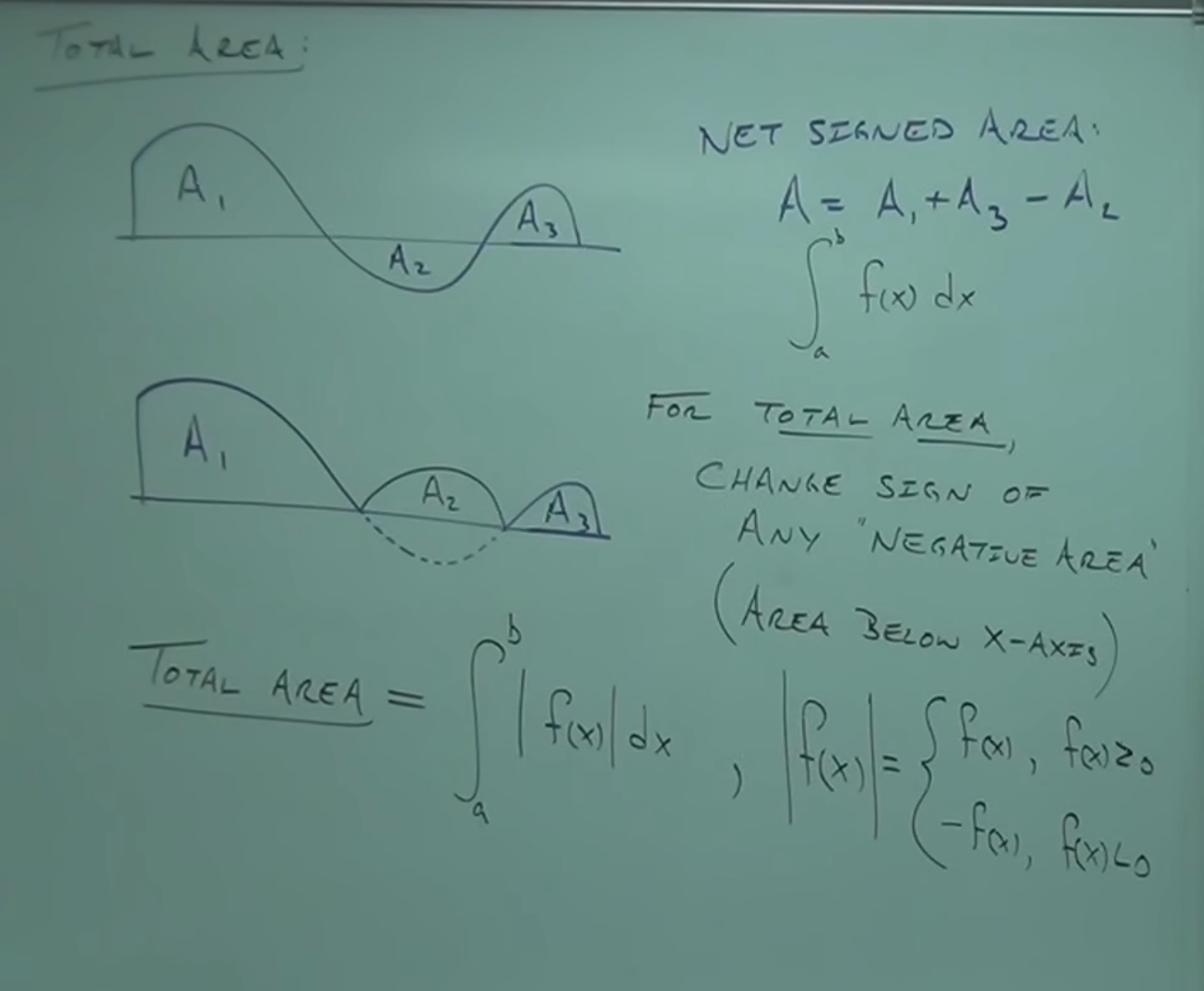
- Explaining the difference between total area and signed net area
- ᴛᴏᴛᴀʟ ᴀʀᴇᴀ: This is calculated by integrating the absolute value of the function over
an interval, ensuring all
areas contribute positively regardless of whether they are above or below the 𝒙-axis.
■ $\displaystyle \int_{𝓪}^{𝓫}\lvert 𝒇(𝒙)\rvert\,𝒅𝒙$ and $\lvert
𝒇(𝒙)\rvert=\begin{cases}𝒇(𝒙), & 𝒇(𝒙)\ge 0\\[2pt]-𝒇(𝒙), & 𝒇(𝒙)<0\end{cases}$
- ꜱɪɢɴᴇᴅ ɴᴇᴛ ᴀʀᴇᴀ: This result comes from a standard integral without absolute values,
where areas above the 𝒙-axis are positive and
those below are negative, potentially leading to cancellation if regions offset each other.
■ $\displaystyle \int_{𝓪}^{𝓫} 𝒇(𝒙)\,𝒅𝒙$
- [54:25]. 🧩
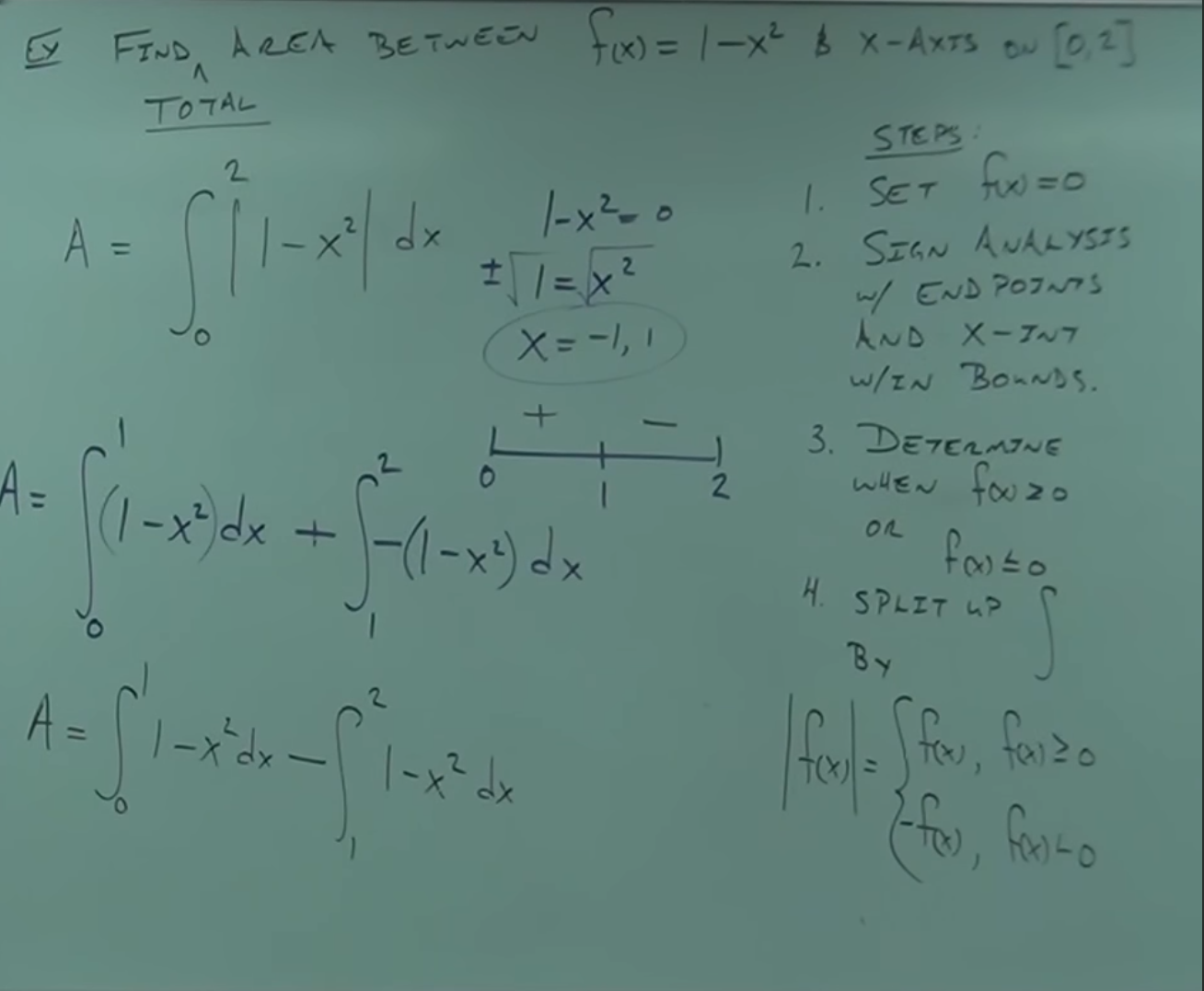
Example – Example of total area calculation using sign analysis: $1-𝒙^{2}$ on $[0,2]$
– [📷image-1]
 – [📷image-2]
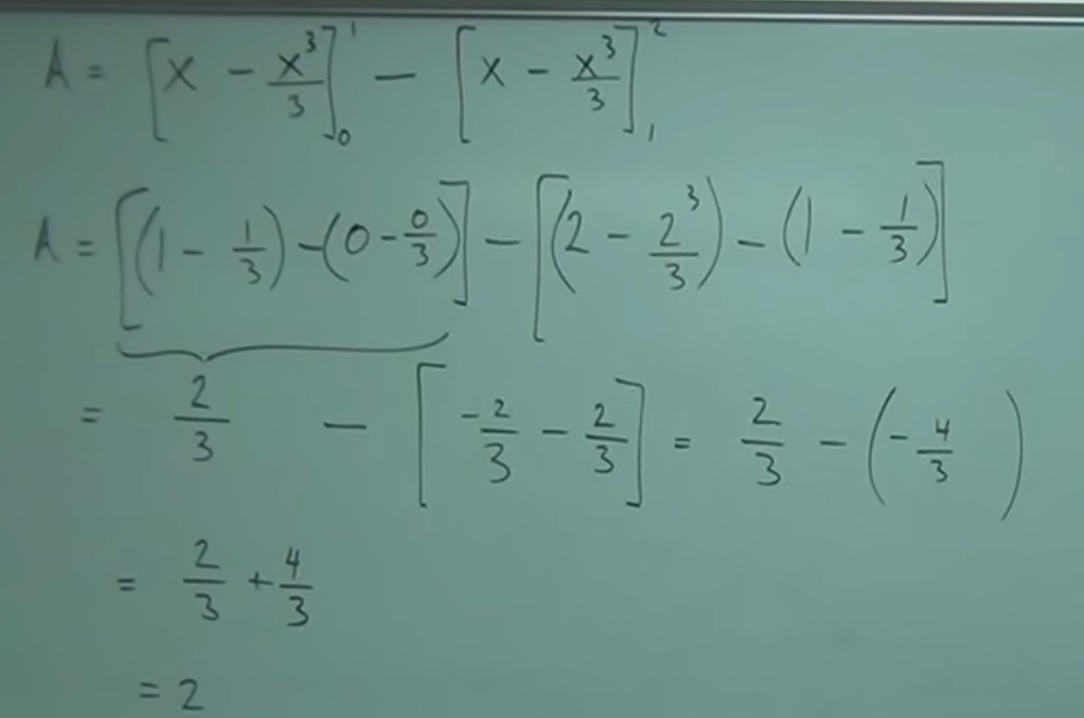
- Step 1: Find zeros of $𝒇(𝒙)=0$
- Solve $1-𝒙^{2}=0 \;\Rightarrow\; 𝒙=\pm 1$
- Step 2: Create a sign analysis using these roots (those which are within the integration
interval) and the interval limits
- Step 3: Determine where $𝒇(𝒙)$ is positive or negative
- Positive: $[0,1]$
- Negative: $[1,2]$
- Step 4: Split the integral according to the sign of $𝒇(𝒙)$
- Use absolute value:
- $ \lvert 𝒇(𝒙)\rvert=\begin{cases}𝒇(𝒙) & \text{if } 𝒇(𝒙)\ge
0\\[2pt]-𝒇(𝒙) & \text{if } 𝒇(𝒙)<0\end{cases}$
- So:
- $A=\displaystyle \int_{0}^{1} (1-𝒙^{2})\,𝒅𝒙+\int_{1}^{2}
-(1-𝒙^{2})\,𝒅𝒙=\int_{0}^{1} (1-𝒙^{2})\,𝒅𝒙-\int_{1}^{2} (1-𝒙^{2})\,𝒅𝒙$
- Step 5: Integrate and evaluate each interval
- First integral:
- $ \displaystyle \int_{0}^{1}
(1-𝒙^{2})\,𝒅𝒙=\left.[𝒙-\dfrac{𝒙^{3}}{3}]\right|_{0}^{1}=(1-\tfrac{1}{3})-(0-0)=\dfrac{2}{3}$
- Second integral:
- $ \displaystyle \int_{1}^{2}
(1-𝒙^{2})\,𝒅𝒙=\left.[𝒙-\dfrac{𝒙^{3}}{3}]\right|_{1}^{2}=\left(2-\dfrac{8}{3}\right)-\left(1-\dfrac{1}{3}\right)=\left(-\dfrac{2}{3}\right)-\left(\dfrac{2}{3}\right)=-\dfrac{4}{3}$
- with the minus sign from before: $-(-\dfrac{4}{3})=+\dfrac{4}{3}$
- Final calculation of total area
- $A=\dfrac{2}{3}+\dfrac{4}{3}=2$
The fundamental theorem of calculus (FTC)
𝒫𝒜𝑅𝒯 Ⅰ
- [1:09:08].
The Fundamental Theorem of Calculus (FTC), 𝒫𝒜𝑅𝒯 Ⅰ
– [📷image]
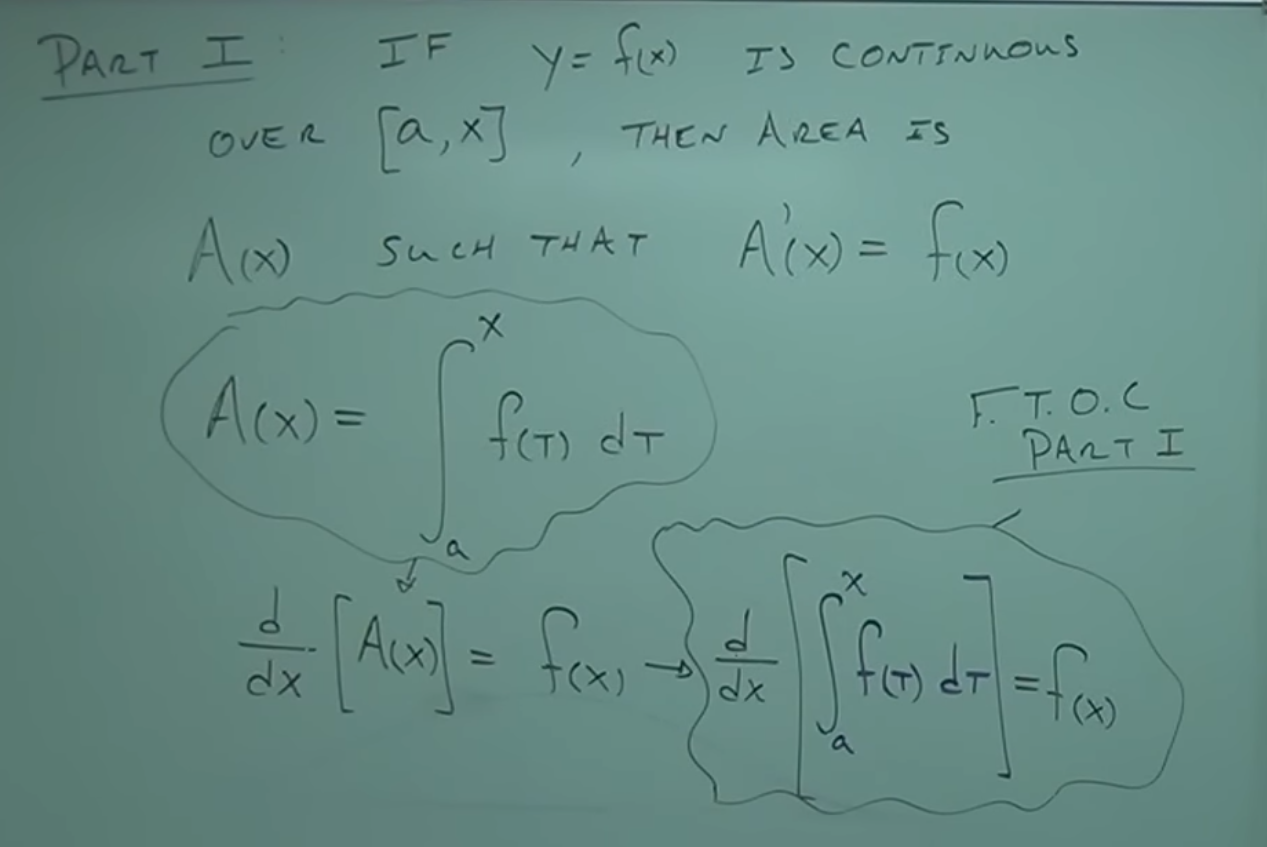
- Derivatives and integrals as inverse operations
- Defining the area function 𝓐(𝒙) as the integral of 𝒇(𝓉) from a to 𝒙
- Statement of FTC 𝒫𝒜𝑅𝒯 Ⅰ :
$\displaystyle\left\{\begin{aligned}&\underline{\text{If }}\; 𝒚 = 𝒇(𝒙) \text{ is continuous over }
[𝓪,𝒙], \\[8pt]&\underline{\text{Then }}\; \text{the area is } 𝒜(𝒙) \text{ such that } 𝒜'(𝒙)=𝒇(𝒙),
\\[12pt]&𝒜(𝒙)=\int_{𝓪}^{𝒙} 𝒇(𝓉)\,𝒅𝓉\end{aligned}\right.$
- Teaching notes:
- If you define the area function from 𝒫𝒜𝑅𝒯 Ⅰ as $𝒜(𝒙)=\displaystyle
\int_{𝓪}^{𝒙} 𝒇(t)\,𝒅t$, then $𝒜′(𝒙)=𝒇(𝒙)$,
and thus $\displaystyle \int_{𝓪}^{𝓫} 𝒇(𝒙)\,𝒅𝒙=𝒜(𝓫)-𝒜(𝓪)$.
- The indefinite integral is a family: $\displaystyle \int 𝒇(𝒙)\,𝒅𝒙=𝓕(𝒙)+𝓒$.
- 𝒫𝒜𝑅𝒯 Ⅱ tells you how to use any $𝓕$ to evaluate the definite integral on
$[𝓪,𝓫]$.
- Typical Calc I hypothesis: $𝒇$ continuous on $[𝓪,𝓫]$ (ensures existence and
evaluability).
- [1:13:00]. Another interpretation of $𝒜(𝒙)$
- $\dfrac{𝒅}{𝒅𝑥}[𝒜(𝒙)]=𝒇(𝒙)\;\Rightarrow\; \dfrac{𝒅}{𝒅𝑥}\!\left[\displaystyle
\int_{𝓪}^{𝒙} 𝒇(𝓉)\,𝒅𝓉 \right]=𝒇(𝒙)$
-
[1:16:50]. 🧩 Example –
Applying the Fundamental Theorem of Calculus (FTC 𝒫𝒜𝑅𝒯 Ⅰ): $\dfrac{𝒅}{𝒅𝑥}\!\left[\displaystyle
\int_{1}^{𝒙} 𝓉^{4}\,𝒅𝓉 \right]$
– [📷image]
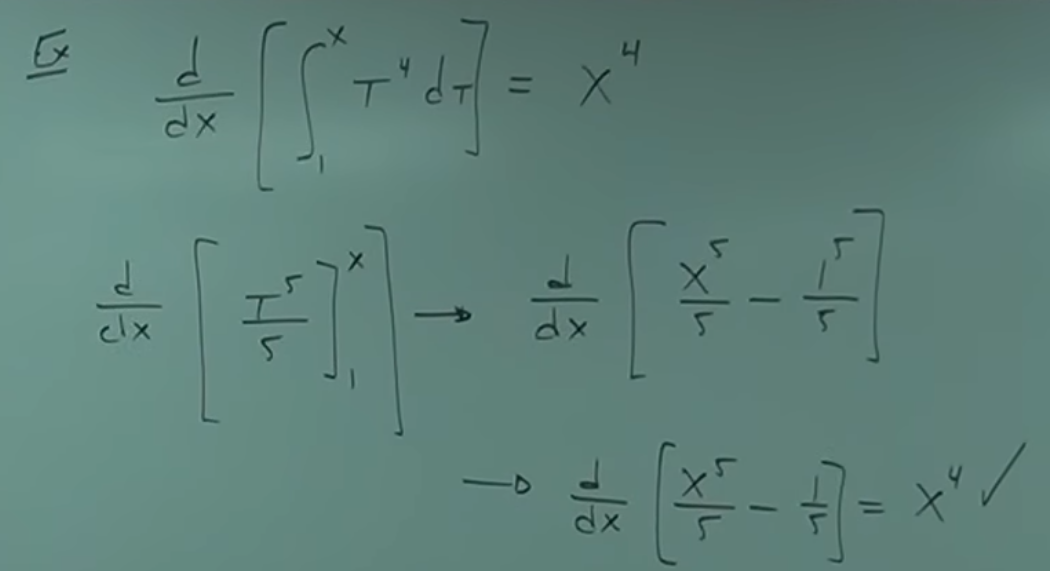
- $\dfrac{𝒅}{𝒅𝑥}\!\left[\displaystyle \int_{1}^{𝒙} 𝓉^{4}\,𝒅𝓉 \right]=𝒙^{4}$
- Find an antiderivative of $𝓉^{4}$
- $\displaystyle \int 𝓉^{4}\,𝒅𝓉=\dfrac{𝓉^{5}}{5}$
- Evaluate the definite integral with limits $[1,𝒙]$:
- $\dfrac{𝒅}{𝒅𝑥}\!\left[\dfrac{𝒙^{5}}{5}-\dfrac{1^{5}}{5}\right] =
\dfrac{𝒅}{𝒅𝑥}\!\left[\dfrac{𝒙^{5}}{5}-\dfrac{1}{5}\right]$
- Differentiate the result:
- $\dfrac{𝒅}{𝒅𝑥}\!\left[\dfrac{𝒙^{5}}{5}-\dfrac{1}{5}\right]=𝒙^{4}$
- Conclusion:
- This confirms the Fundamental Theorem of Calculus (Part I):
- If $𝒜(𝒙)=\displaystyle \int_{𝓪}^{𝒙} 𝒇(𝓉)\,𝒅𝓉$, then $𝒜′(𝒙)=𝒇(𝒙)$ — as
long as $𝒇$ is continuous.
-
[1:19:13].🧩 Example –
Applying the Fundamental Theorem of Calculus (FTC 𝒫𝒜𝑅𝒯 Ⅰ): $\dfrac{𝒅}{𝒅𝑥}\!\left[\displaystyle
\int_{𝓪}^{𝒙} \dfrac{\sin(𝓉)}{𝓉}\,𝒅𝓉 \right]$
–
[📷image]
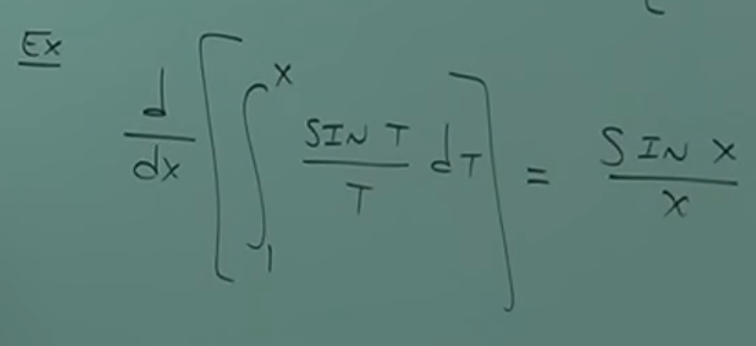
- Conditions for FTC 𝒫𝒜𝑅𝒯 Ⅰ: continuity and boundedness on the interval
- $\dfrac{𝒅}{𝒅𝑥}\!\left[\displaystyle \int_{𝓪}^{𝒙} \dfrac{\sin(𝓉)}{𝓉}\,𝒅𝓉
\right]=\dfrac{\sin(𝒙)}{𝒙}$
Definite integrals with substitution
-
[1:21:00]. Definite
integrals with substitution
- Introduction to the substitution method in definite integrals
-
[1:22:19]. 𝓜𝓮𝓽𝓱𝓸𝓭 I –
[📷image]
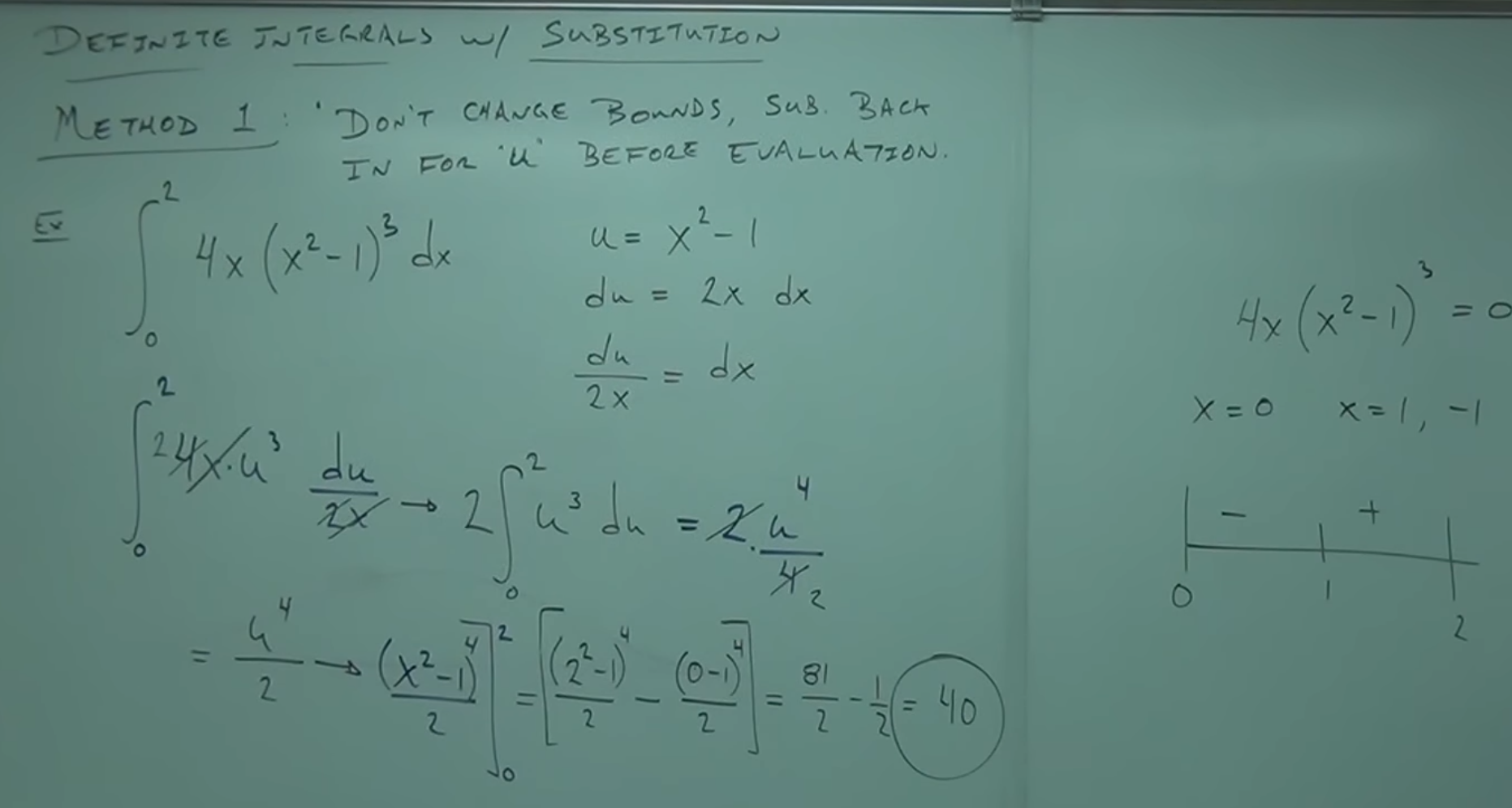
- No change to integration limits; substitute back to 𝒙 before evaluating.
- 🧩 Example – Definite Integral with Substitution (Method 1): $\displaystyle \int_{0}^{2}
4𝒙(𝒙^{2}-1)^{3}\,𝒅𝒙$
- Substitution, finding 𝒅𝓾 and expressing 𝒅𝑥:
■ $𝓾=𝒙^{2}-1$
■ $𝒅𝓾=2𝒙\cdot 𝒅𝒙$
■ $\dfrac{𝒅𝓾}{2𝒙}=𝒅𝒙$
- Rewrite integral:
■ $\displaystyle \int_{0}^{2} 4𝒙(𝒙^{2}-1)^{3}\,𝒅𝒙=\int_{0}^{2} 2\cdot 𝓾^{3}\,𝒅𝓾=2\int_{0}^{2}
𝓾^{3}\,𝒅𝓾$
- Integration:
■ $\displaystyle \int 𝓾^{3}\,𝒅𝓾=\dfrac{𝓾^{4}}{4}\;\Rightarrow\; 2\cdot
\dfrac{𝓾^{4}}{4}=\dfrac{𝓾^{4}}{2}$
- Back-substitution (don’t change bounds):
■ $\dfrac{𝓾^{4}}{2}\;\to\; \left.\dfrac{(𝒙^{2}-1)^{4}}{2}\right|_{0}^{2}$
- Evaluate:
■
$\left.\dfrac{(2^{2}-1)^{4}}{2}\right.-\left.\dfrac{(0^{2}-1)^{4}}{2}\right.=\dfrac{3^{4}}{2}-\dfrac{(-1)^{4}}{2}=\dfrac{81}{2}-\dfrac{1}{2}=40$
-
[1:33:50]. 𝓜𝓮𝓽𝒉𝓸𝓭 II
– [📷image]
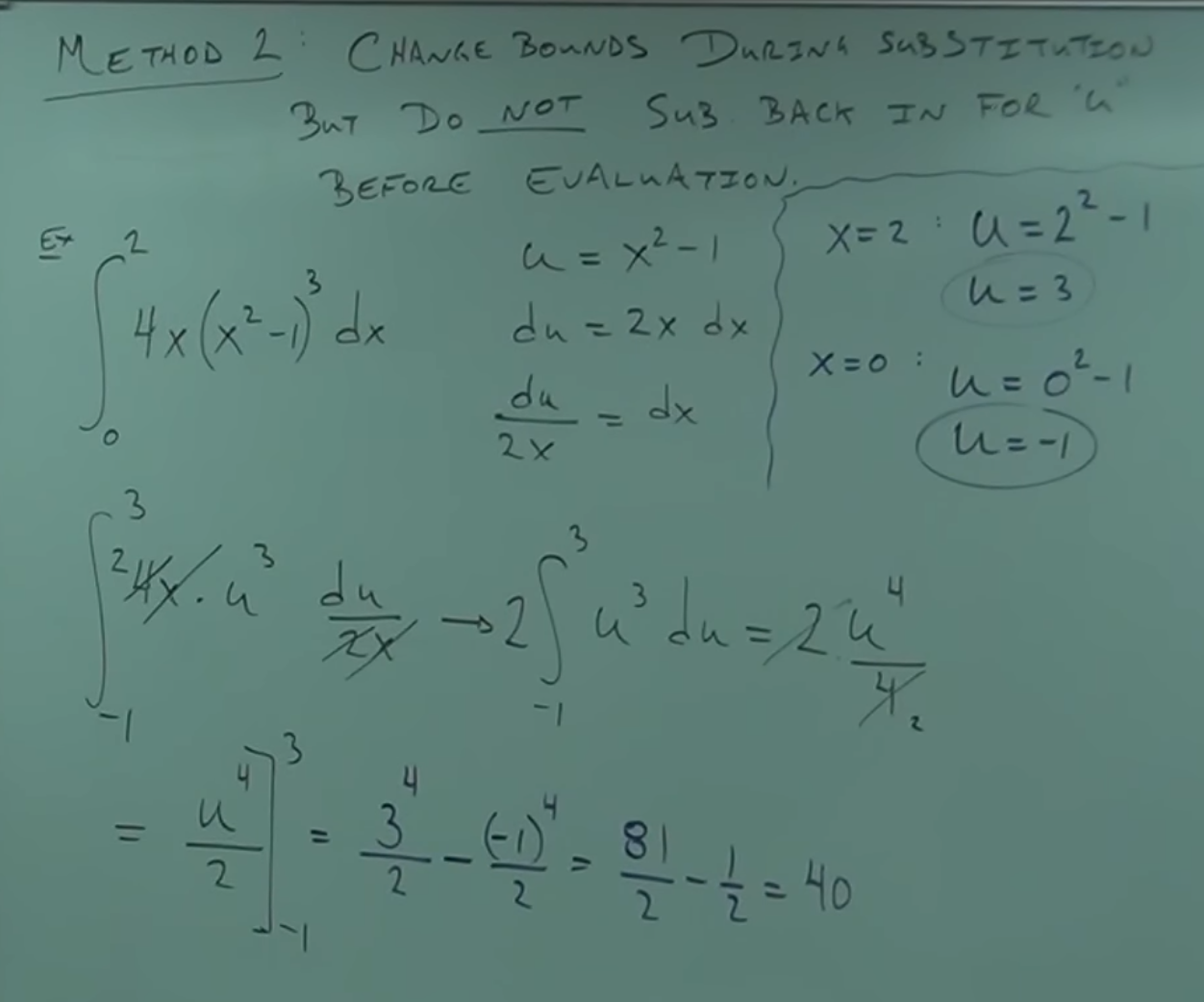
- Change the limits to match $𝓾$; no resubstitution.
- NO Back-substitution
- 🧩 Example – Definite Integral with Substitution (Method 2): $\displaystyle \int_{0}^{2}
4𝒙(𝒙^{2}-1)^{3}\,𝒅𝒙$
- Substitution:
- $𝓾=𝒙^{2}-1$
- $𝒅𝓾=2𝒙\cdot 𝒅𝒙$
- $\dfrac{𝒅𝓾}{2𝒙}=𝒅𝒙$
- Change bounds:
- If $𝒙=2\Rightarrow 𝓾=2^{2}-1=3$
- If $𝒙=0\Rightarrow 𝓾=0^{2}-1=-1$
- Rewrite integral:
- $\displaystyle \int_{0}^{2} 4𝒙(𝒙^{2}-1)^{3}\,𝒅𝒙=\int_{-1}^{3} 2\cdot
𝓾^{3}\,𝒅𝓾=2\int_{-1}^{3} 𝓾^{3}\,𝒅𝓾$
- Integration:
- $\displaystyle \int 𝓾^{3}\,𝒅𝓾=\dfrac{𝓾^{4}}{4}\;\Rightarrow\; 2\cdot
\dfrac{𝓾^{4}}{4}=\dfrac{𝓾^{4}}{2}$
- Evaluate:
-
$\left.\dfrac{𝓾^{4}}{2}\right|_{-1}^{3}=\dfrac{3^{4}}{2}-\dfrac{(-1)^{4}}{2}=\dfrac{81}{2}-\dfrac{1}{2}=40$
- Conclusion:
- By changing the bounds to match the substitution,
- there is no need to back-substitute into $𝒙$.
-
[1:41:00]. Discussion of
both methods and common errors
-
[1:45:40]. 🧩 Example –
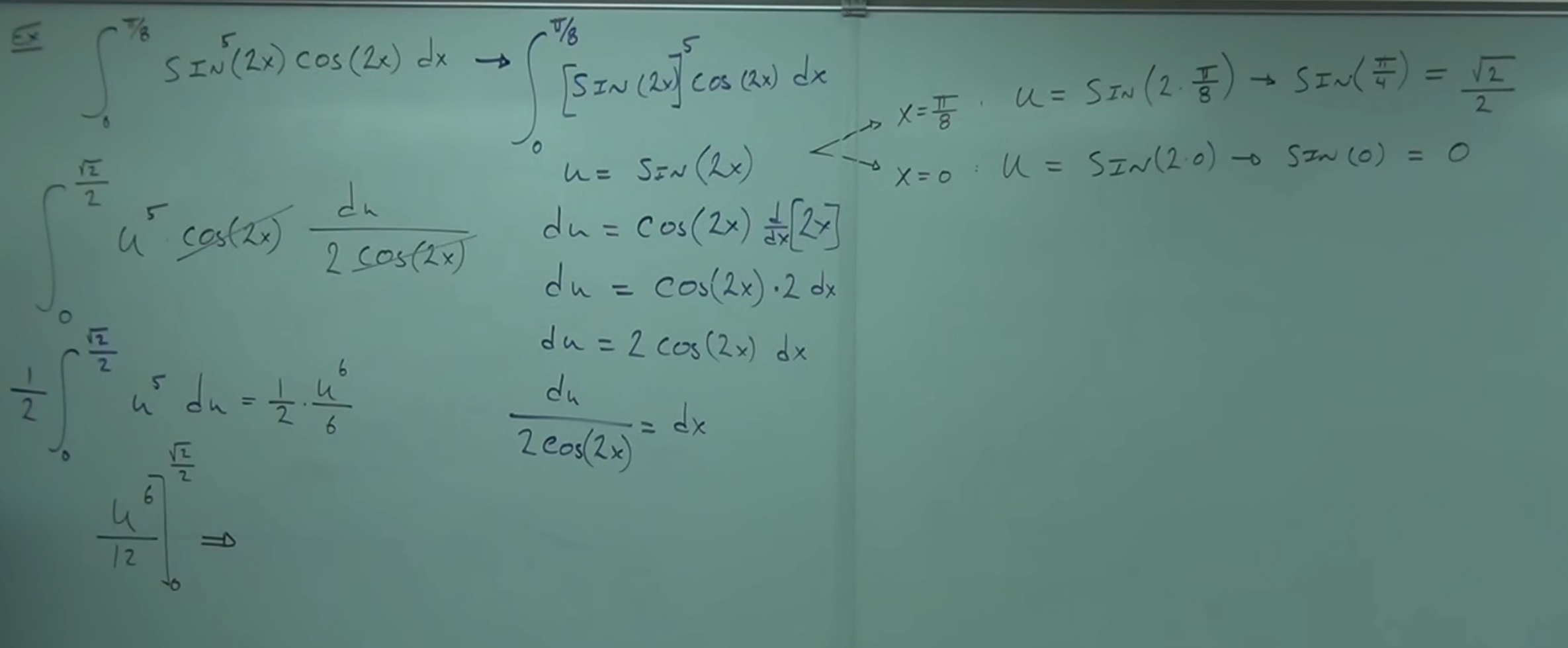
Definite Integral with Substitution (Method 2): $\displaystyle \int_{0}^{\pi/8} \sin^{5}(2𝒙)\cdot
\cos(2𝒙)\,𝒅𝒙$
– [📷image-1]
 – [📷image-2]
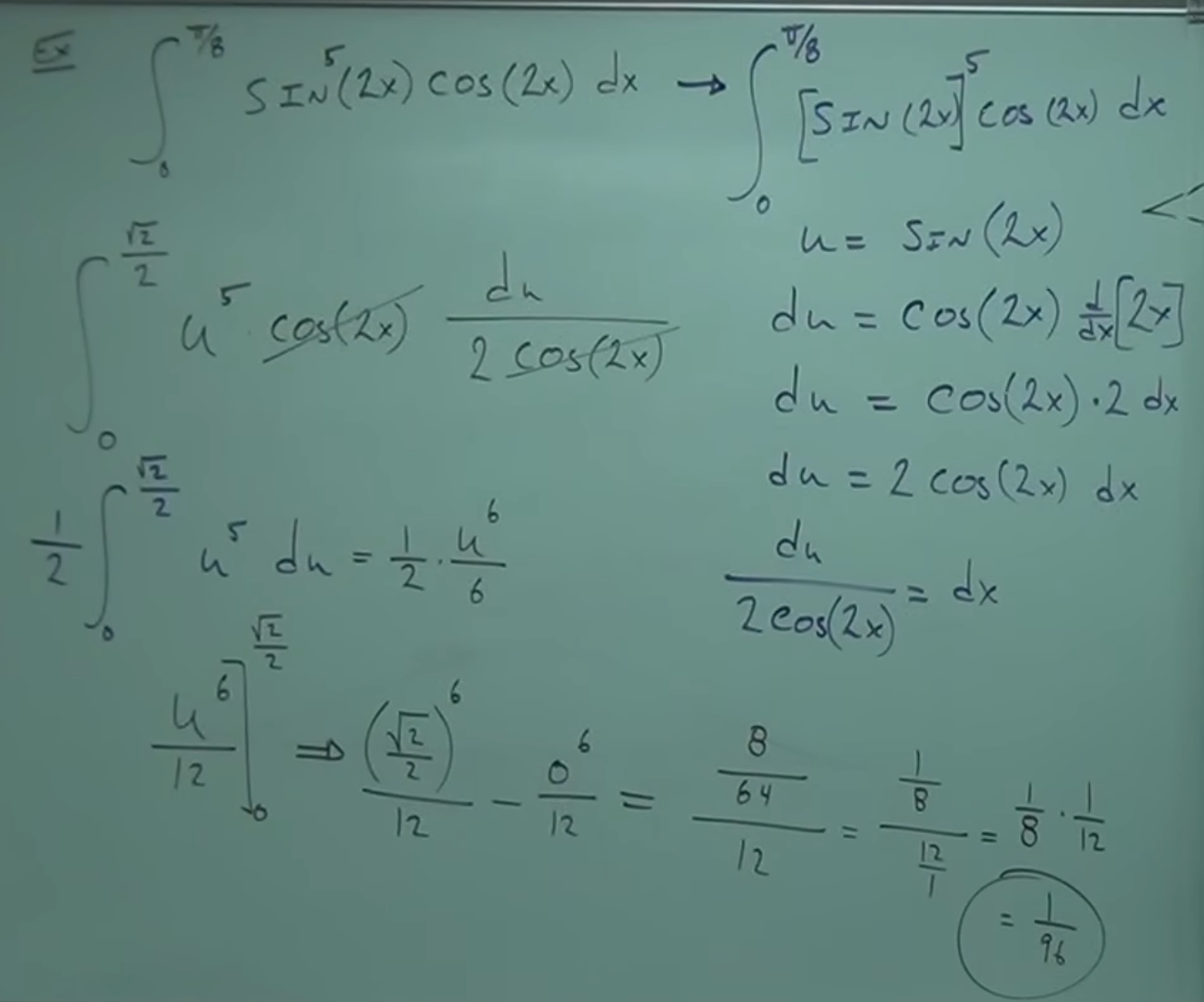
- $\,\displaystyle \int_{0}^{7\pi/8} [\sin(2𝒙)]^{5}\cdot \cos(2𝒙)\,𝒅𝒙$
- The integral is rewritten in the form $[𝓰(𝒙)]^{n}\cdot 𝓰'(𝒙)$, which is exactly
the pattern for applying the reverse chain rule (substitution).
- $𝓾=\sin(2𝒙)$
- $𝒅𝓾=2\cos(2𝒙)\cdot 𝒅𝒙 \;\Rightarrow\; 𝒅𝒙=\dfrac{𝒅𝓾}{2\cos(2𝒙)}$
-
[1:51:02]. Converting
original $𝒙$-limits into new $𝓾$-limits
- $𝒙=0 \Rightarrow 𝓾=\sin(0)=0$
- $𝒙=7\pi/8 \Rightarrow 𝓾=\sin(2\pi/8)=\dfrac{\sqrt{2}}{2}$
- Substituting and integrating
-
$\displaystyle \int_{0}^{\sqrt{2}/2} 𝓾^{5}\cdot
\left(\dfrac{𝒅𝓾}{2}\right)=\dfrac{1}{2}\int_{0}^{\sqrt{2}/2} 𝓾^{5}\,𝒅𝓾=\dfrac{1}{2}\cdot
\left.\dfrac{𝓾^{6}}{6}\right|_{0}^{\sqrt{2}/2}
=\dfrac{1}{12}\left[\left(\dfrac{\sqrt{2}}{2}\right)^{6}-0\right]=\dfrac{1}{12}\cdot
\dfrac{8}{64}=\dfrac{1}{12}\cdot \dfrac{1}{8}=\dfrac{1}{96}$
-
[1:57:15]. 🧩 Example –
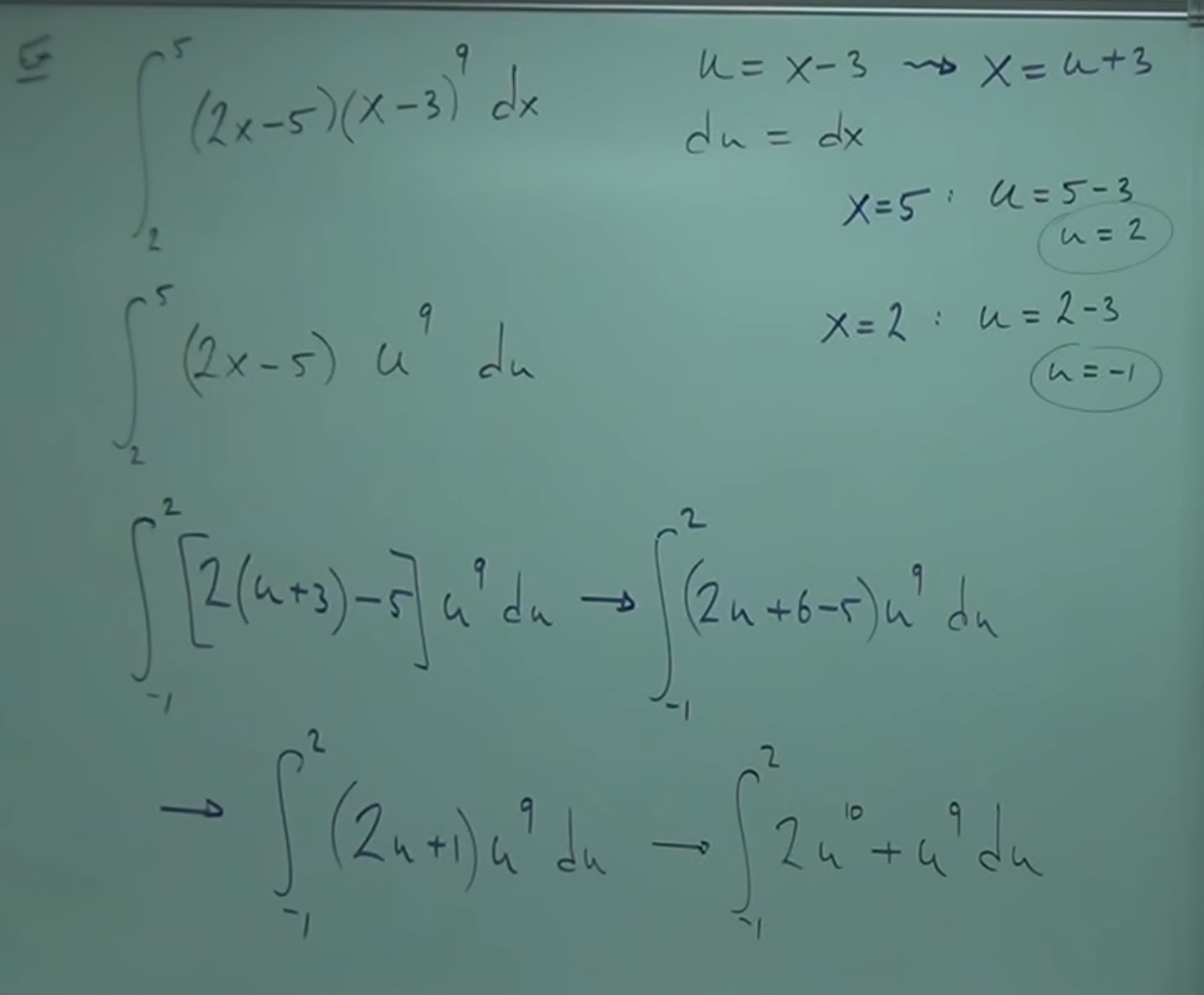
Definite Integral with Substitution (Method 2): $\displaystyle \int_{2}^{5} (2𝒙-5)\,(𝒙-3)^{9}\, 𝒅𝒙$
– [📷image-1]
 – [📷image-2]
- Substitution: $𝓾=𝒙-3$, so that: $𝒅𝓾=𝒅𝑥$
- The integration limits change:
- When $𝒙=2 \Rightarrow 𝓾=2-3=-1$
- When $𝒙=5 \Rightarrow 𝓾=5-3=2$
- Rewriting $2𝒙-5$ in terms of $𝓾$:
- Since $𝒙=𝓾+3$, then: $2𝒙-5=2(𝓾+3)-5=2𝓾+6-5=2𝓾+1$
- Substituting into the integral:
-
$\displaystyle \int_{-1}^{2} (2𝓾+1)\,𝓾^{9}\,𝒅𝓾=\int_{-1}^{2}
(2𝓾^{10}+𝓾^{9})\,𝒅𝓾=\left.\left(\dfrac{2𝓾^{11}}{11}+\dfrac{𝓾^{10}}{10}\right)\right|_{-1}^{2}$
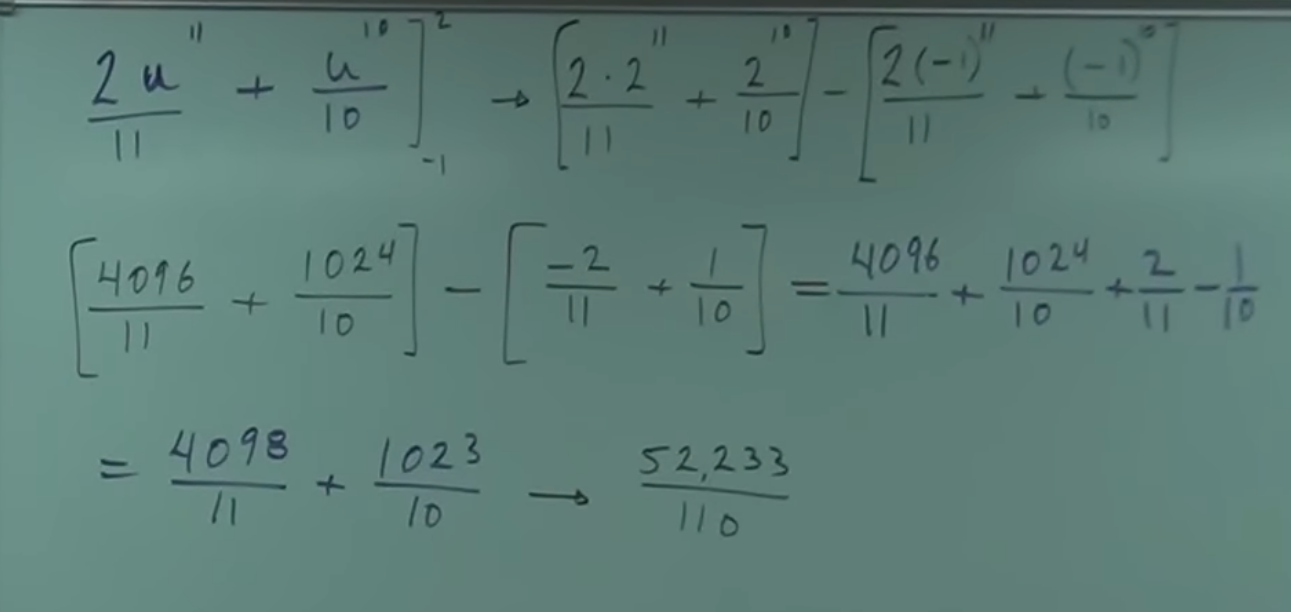
- Evaluation:
-
$\left(\dfrac{2\cdot 2^{11}}{11}+\dfrac{2^{10}}{10}\right)-\left(\dfrac{2\cdot
(-1)^{11}}{11}+\dfrac{(-1)^{10}}{10}\right)=\dfrac{4096}{11}+\dfrac{1024}{10}-\left(-\dfrac{2}{11}+\dfrac{1}{10}\right)=\dfrac{4098}{11}+\dfrac{1023}{10}$
- Final simplified result:
-
[2:11:29]. 🧩 Example –
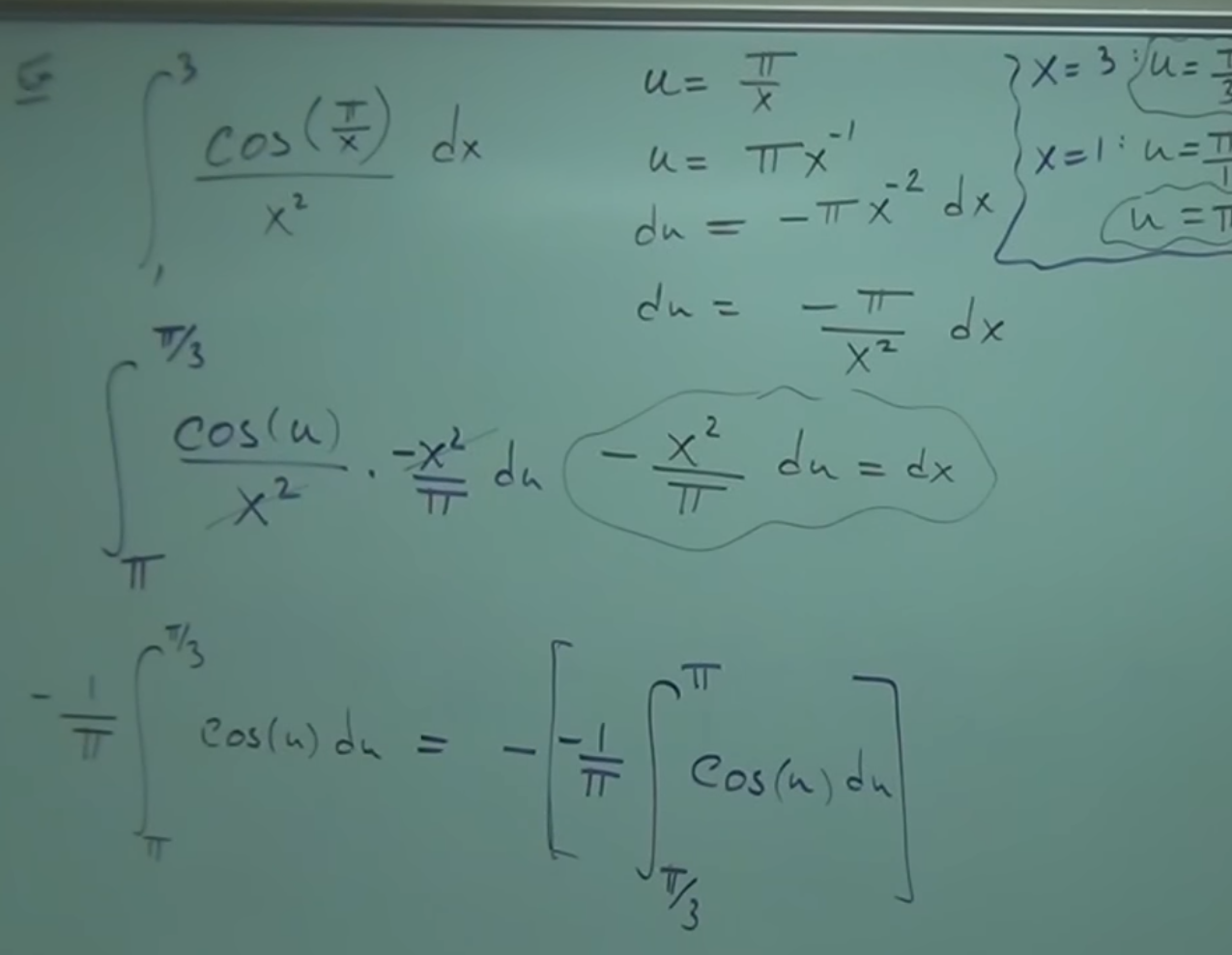
Definite Integral with Substitution (Method 2): $\displaystyle \int_{1}^{3} \dfrac{\cos(\pi/𝒙)}{𝒙^{2}}\,𝒅𝑥$
– [📷image-1]
 – [📷image-2]
- Substitution: $𝓾=\dfrac{\pi}{𝒙}$; $𝒅𝓾=-\pi 𝒙^{-2}\,𝒅𝑥$
- Changing the limits:
- $𝒙=3 \Rightarrow 𝓾=\pi/3$
- $𝒙=1 \Rightarrow 𝓾=\pi$
- Rewriting the integral:
- $\displaystyle \int_{\pi/3}^{\pi} \cos(𝓾)\cdot
\left(-\dfrac{\pi}{𝒙^{2}}\right)\,𝒅𝑥$
- Substituting $𝒅𝑥$:
- $\displaystyle \int_{\pi/3}^{\pi} \cos(𝓾)\cdot \left(-\dfrac{1}{\pi}\right)\,𝒅𝓾$
- Applying the 𝒫𝓇𝑜𝓅𝑒𝓇𝓉𝓎 4.4.2 (indefinite interaks) of sign change in limits:
-
$-\dfrac{1}{\pi}\displaystyle \int_{\pi}^{\pi/3} \cos(𝓾)\,𝒅𝓾=\dfrac{1}{\pi}\displaystyle
\int_{\pi/3}^{\pi} \cos(𝓾)\,𝒅𝓾$
■ 𝒫𝓇𝑜𝓅𝑒𝓇𝓉𝓎 4.4.2: $\displaystyle \int_{𝓫}^{𝓪} 𝒇(𝒙)\,𝒅𝑥=- \int_{𝓪}^{𝓫} 𝒇(𝒙)\,𝒅𝑥$
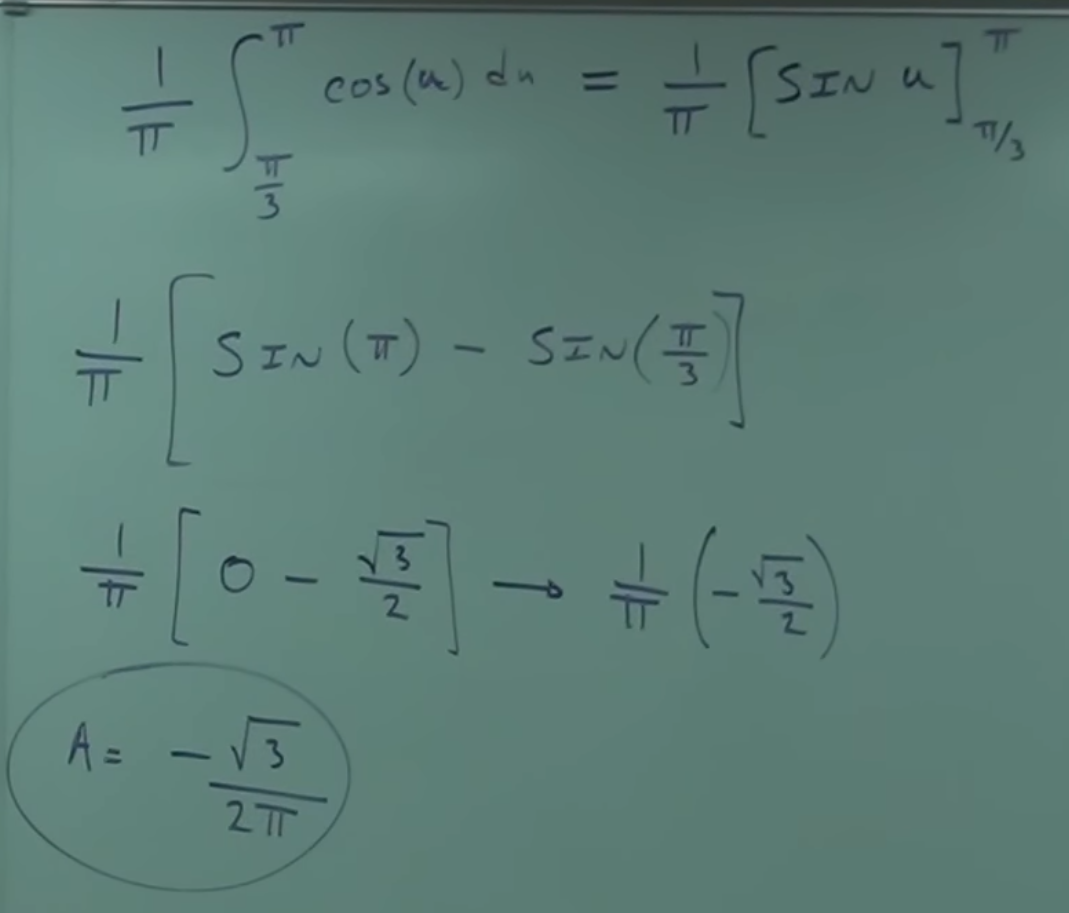
- Final evaluation:
-
$\displaystyle
\dfrac{1}{\pi}\left[\sin(𝓾)\right]\Big|_{\pi/3}^{\pi}=\dfrac{1}{\pi}\big(\sin(\pi)-\sin(\pi/3)\big)=\dfrac{1}{\pi}\left(0-\dfrac{\sqrt{3}}{2}\right)=-\dfrac{\sqrt{3}}{2\pi}$
Integrals of even and odd functions
-
[2:26:40]. Introduction
-
[1:27:30]. ᴇᴠᴇɴ ꜰᴜɴᴄᴛɪᴏɴꜱ
– [📷image]
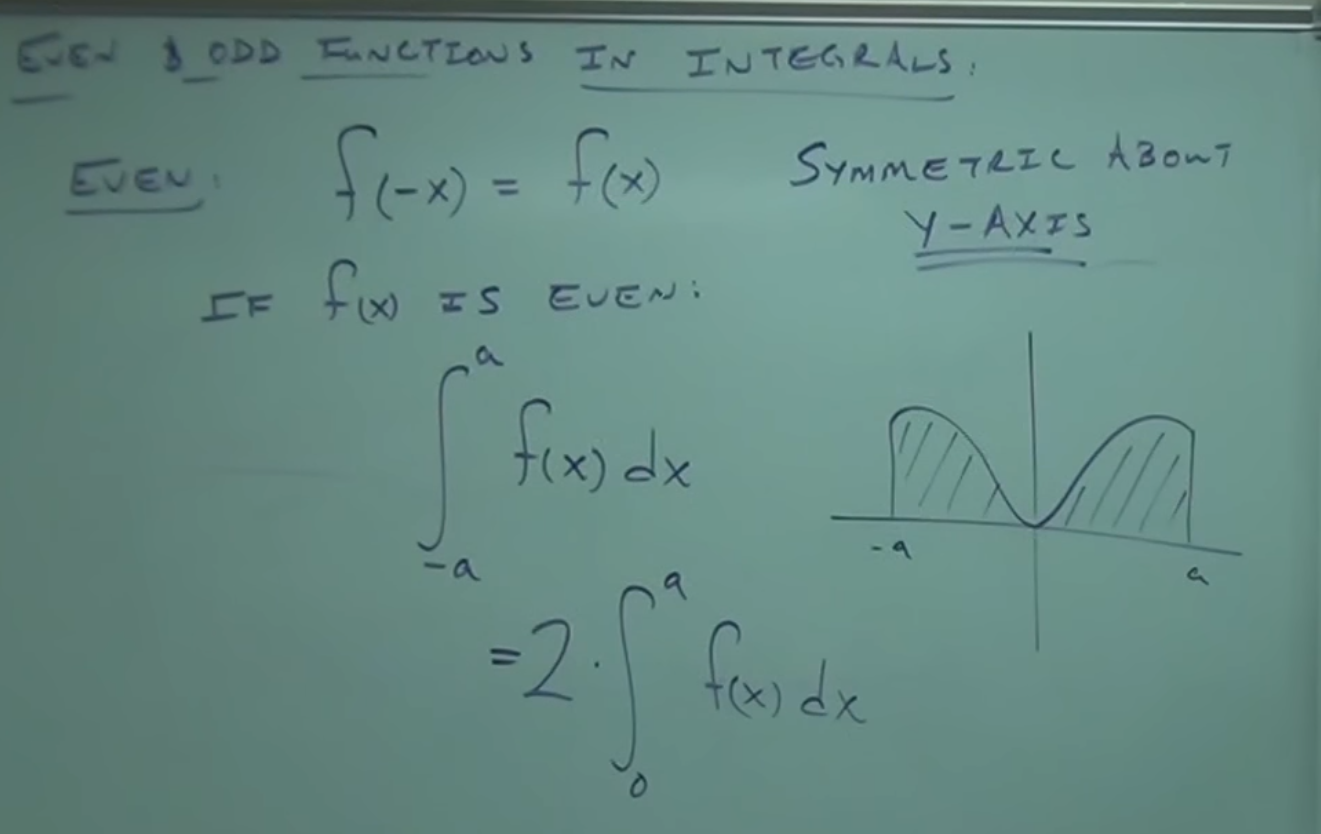
- $𝒇(-𝒙)=𝒇(𝒙)$, showing symmetry about the y-axis
-
Symmetry: The function is symmetric with respect to the y-axis, which means that if we reflect any point on
the
graph over the vertical axis (y-axis), we obtain another point that also belongs to the graph.
-
𝒫𝓇𝑜𝓅𝑒𝓇𝓉𝓎 4.5.1 of integrating an even function over $[-𝓪,𝓪]$
-
If $𝒇(𝒙)$ is even: $\displaystyle \int_{-a}^{a}𝒇(𝒙)\,𝒅𝑥=2\int_{0}^{a}𝒇(𝒙)\,𝒅𝑥$
-
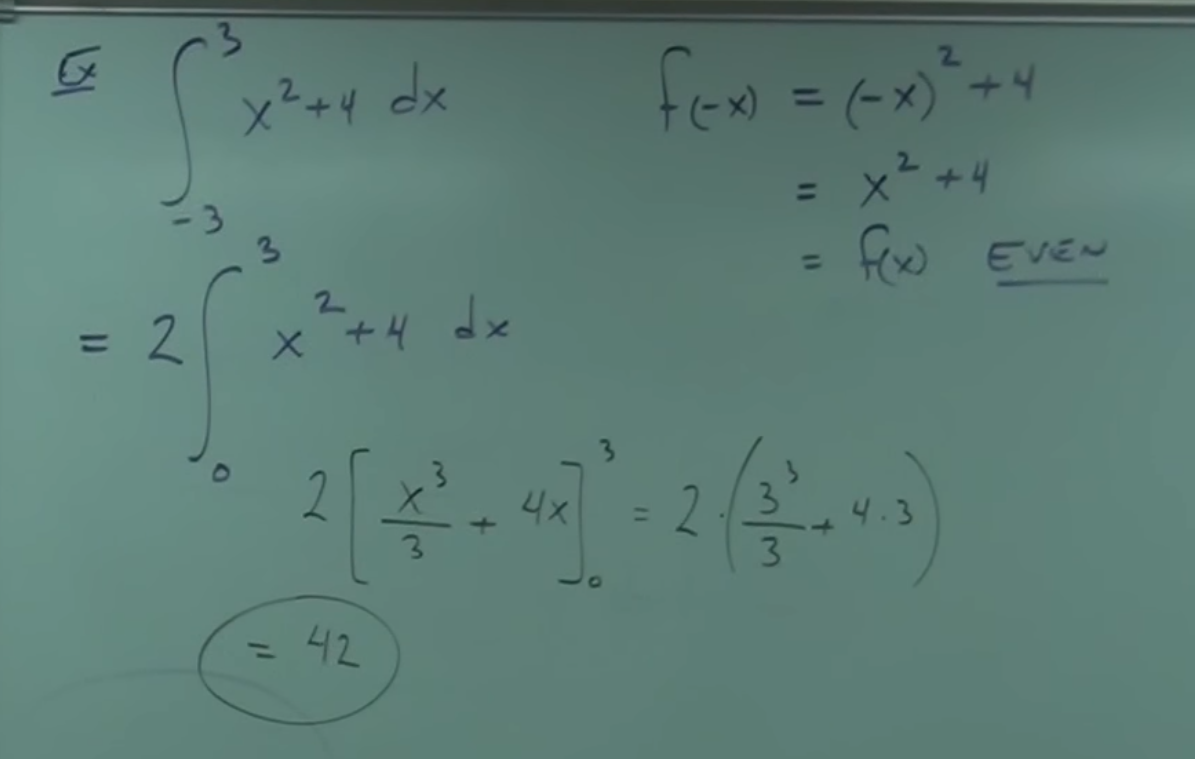
[2:32:30] 🧩 Example – even function: $\displaystyle \int_{-2}^{2}(\,𝒙^{2}+4)\,𝒅𝑥$
– [📷image]
-
Step 1: Identify symmetry
- $𝒇(−𝒙)=(−𝒙)^{2}+4=𝒙^{2}+4=𝒇(𝒙)\;\to\;𝒇$ is even
-
Step 2: Apply property of even functions
- $\displaystyle \int_{-𝓪}^{𝓪}𝒇(𝒙)\,𝒅𝑥=2\int_{0}^{𝓪}𝒇(𝒙)\,𝒅𝑥$
- $\displaystyle \int_{-3}^{3}(\,𝒙^{2}+4)\,𝒅𝑥=2\int_{0}^{3}(\,𝒙^{2}+4)\,𝒅𝑥$
-
Step 3: Compute the integral
- $2\Big[\frac{𝒙^{3}}{3}+4𝒙\Big]\Big|_{0}^{3}$
- $=2\big[(27/3+12)-0\big]$
- $=2(9+12)=2(21)=42$
-
[2:36:10]. ᴏᴅᴅ ꜰᴜɴᴄᴛɪᴏɴꜱ
– [📷image]
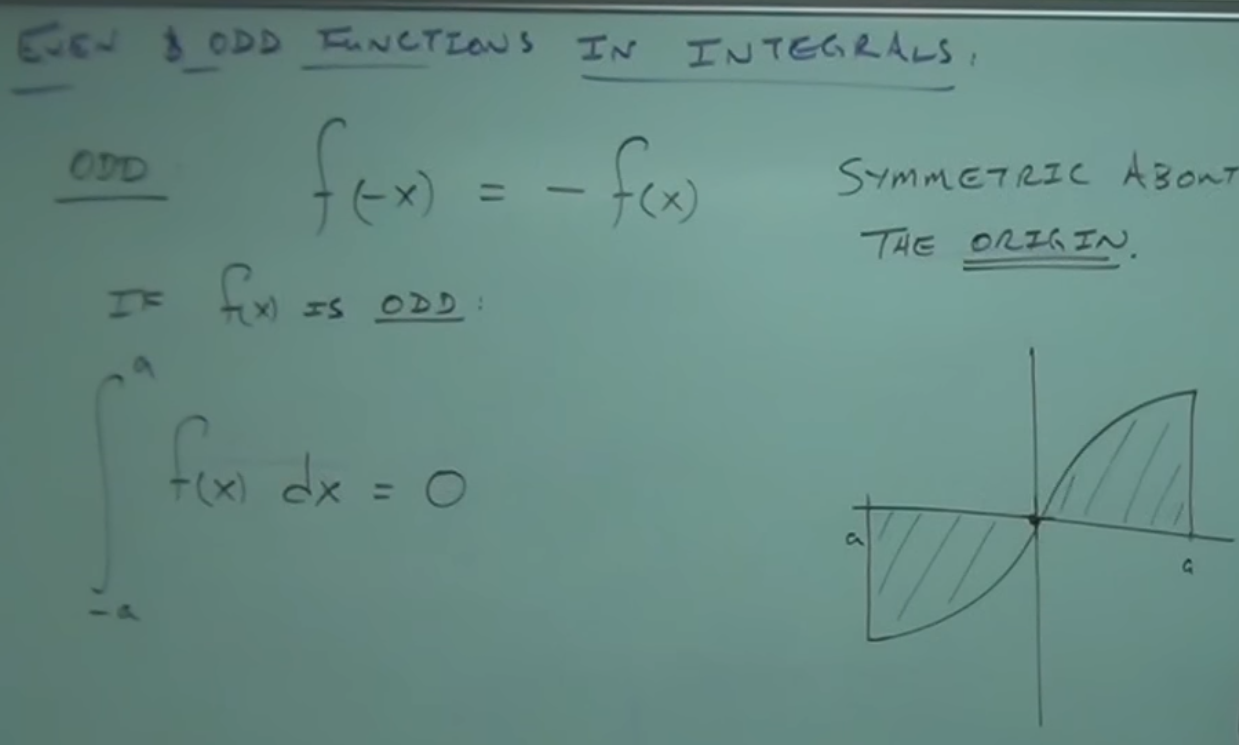
- 𝒇(-𝒙) = -𝒇(𝒙), showing symmetry about the origin.
-
Symmetry: The function exhibits symmetry with respect to the origin, which means that if we rotate any
point on the graph 180 degrees around the origin (switching the signs of both coordinates), we obtain
another point that
also belongs to the graph.
-
𝒫𝓇𝑜𝓅𝑒𝓇𝓉𝓎 4.5.2 of integrating an odd function over [-a, a]
- If 𝒇(𝒙) is odd: ∫[−a, a] 𝒇(𝒙)∙𝒅𝑥 = 0
-
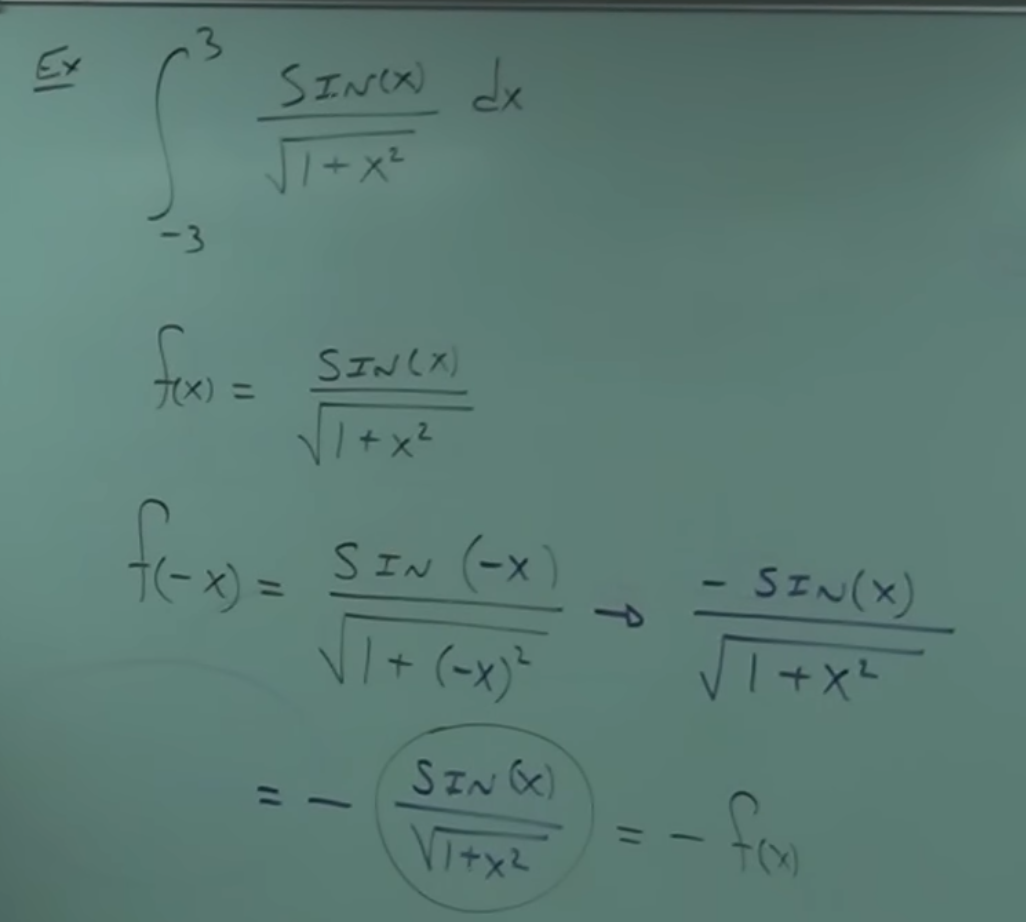
[2:42:10] 🧩 Example – odd
function: [-3, 3] sin(𝒙) / √(1 + 𝒙²) ·𝒅𝑥
– [📷image]
-
Step 1: Define the function
- 𝒇(𝒙) = sin(𝒙) / √(1 + 𝒙²)
-
Step 2: Test odd/even symmetry
-
𝒇(−𝒙) = sin(−𝒙) / √(1 + (−𝒙)²)
= (−sin(𝒙)) / √(1 + 𝒙²)
= −𝒇(𝒙)
- Therefore, 𝒇(𝒙) is odd.
-
Step 3: Apply 𝒫𝓇𝑜𝓅𝑒𝓇𝓉𝓎 4.5.2 of odd functions
-
For any odd function, the areas on symmetric intervals [−𝓪,0] and [0,𝓪] cancel out:
-
From 𝒫𝓇𝑜𝓅𝑒𝓇𝓉𝓎 4.4.5 of definite integrals:
-
∫[−𝓪, 𝓪] 𝒇(𝒙)·𝒅𝑥 = ∫[−𝓪, 0] 𝒇(𝒙)·𝒅𝑥 + ∫[0, 𝓪] 𝒇(𝒙)·𝒅𝑥
- Since 𝒇(−𝒙) = −𝒇(𝒙), the negative side is the exact opposite of the
positive side.
- Thus, the two contributions cancel each other out.
- Conclusion: ∫[−𝓪, 𝓪] 𝒇(𝒙)·𝒅𝑥 = 0