Calculus 1 Lecture 5.1
Finding Area Between Two Curves
Introduction
-
[00:00]. Introduction to finding
the area between two curves
- [📷image]
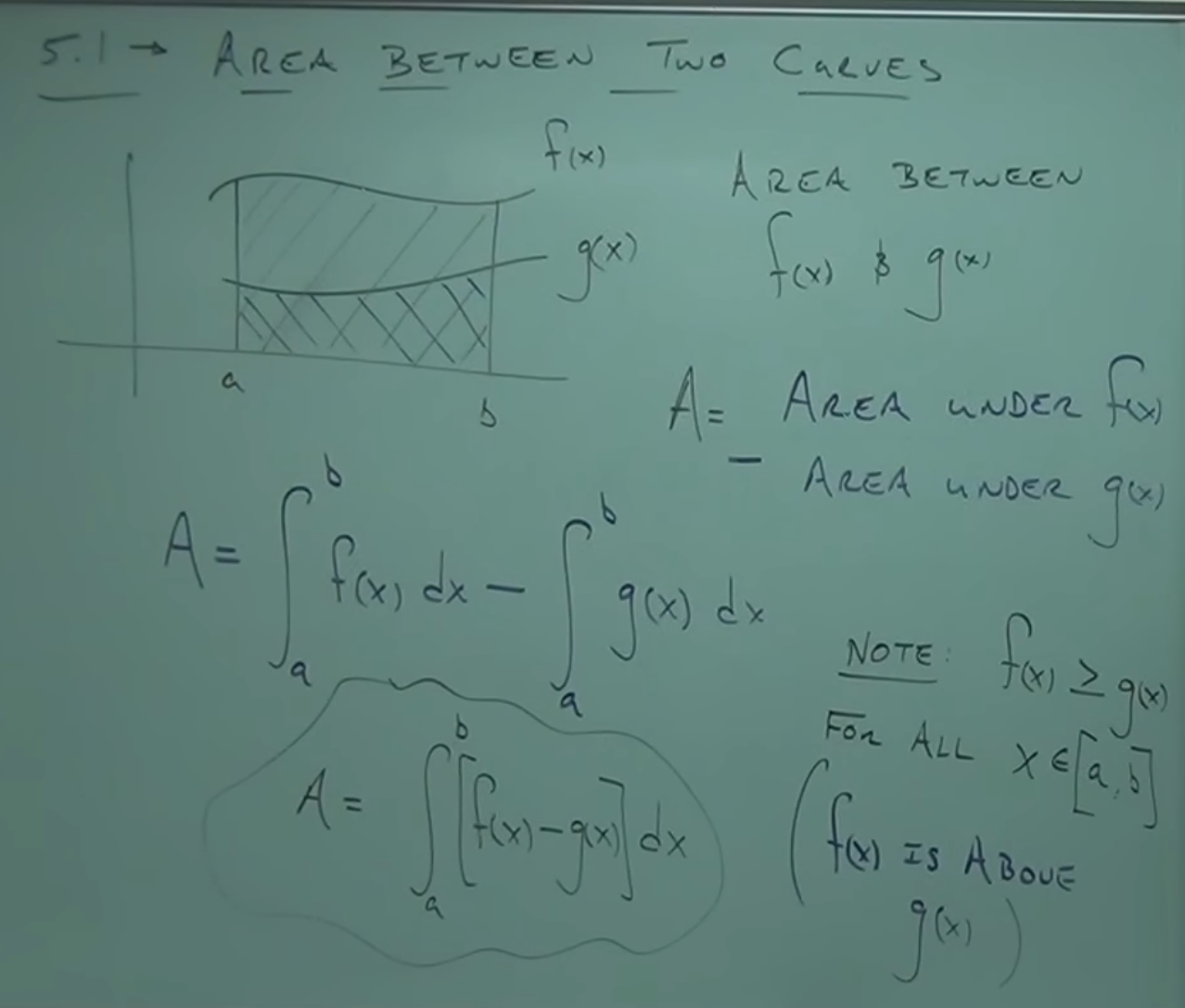
- General idea: A function $𝒇(𝒙)$ is above another function $𝓰(𝒙)$ over an interval
$[𝓪,𝓫]$.
- The area between $𝒇(𝒙)$ and $𝓰(𝒙)$ is the area under $𝒇(𝒙)$ minus the area under
$𝓰(𝒙)$.
- The area between two curves is always non-negative. If you get a negative value, something is wrong (ordering or setup).
- The area between $𝒇(𝒙)$ and $𝓰(𝒙)$ is the area under $𝒇(𝒙)$ minus the area under
$𝓰(𝒙)$.
- [03:55]. Representation with integrals
- Area under $𝒇(𝒙)$ minus area under $𝓰(𝒙)$:
- $\displaystyle \int_{𝓪}^{𝓫}𝒇(𝒙)\,𝒅𝒙 - \int_{𝓪}^{𝓫}𝓰(𝒙)\,𝒅𝒙$
- $\displaystyle \int_{𝓪}^{𝓫}\big(𝒇(𝒙)-𝓰(𝒙)\big)\,𝒅𝒙$, assuming $𝒇(𝒙)\geq 𝓰(𝒙)$ for all $𝒙\in[𝓪,𝓫]$
- $\displaystyle \int_{𝓪}^{𝓫}𝒇(𝒙)\,𝒅𝒙 - \int_{𝓪}^{𝓫}𝓰(𝒙)\,𝒅𝒙$
- [05:59]. Important note: For the single-integral formula to work, $𝒇(𝒙)\geq
𝓰(𝒙)$ on the entire interval $[𝓪,𝓫]$
- $𝒇(𝒙)$ may touch $𝓰(𝒙)$, but must not go below it on $[𝓪,𝓫]$
- If the graphs intersect inside $(𝓪,𝓫)$, split at all intersection points and integrate piecewise, keeping the upper–minus–lower order on each subinterval.
- [09:48]. Relationship with total area
- [📷image]
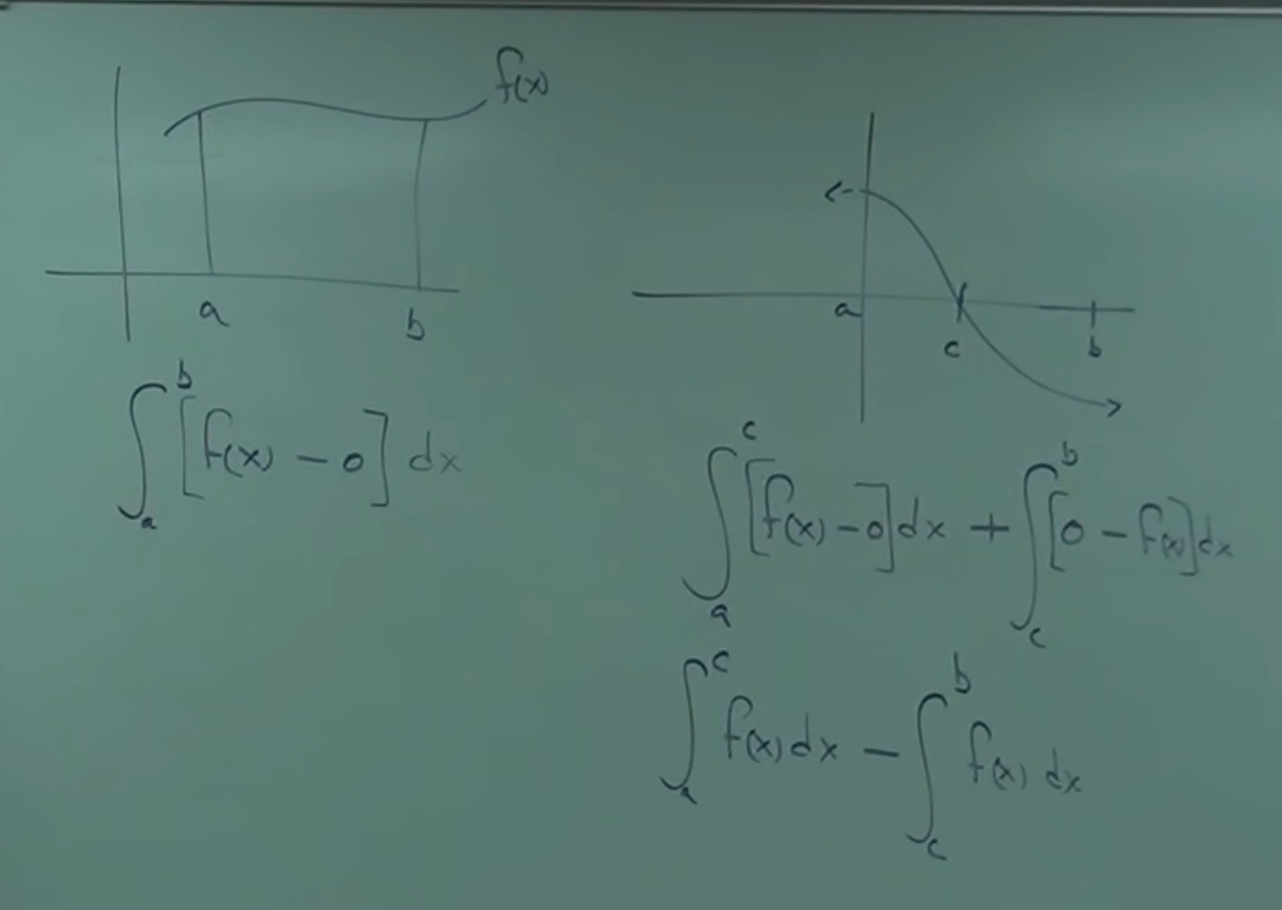
- Generalization: The “area under a curve” is the area between $𝒇(𝒙)$ and the
𝒙-axis ($y=0$).
- $\displaystyle \int_{𝓪}^{𝓫}\big(𝒇(𝒙)-0\big)\,𝒅𝒙$ (here $𝓰(𝒙)=0$).
- If $𝒇(𝒙)$ dips below the 𝒙-axis, use absolute value or split at its zeros:
- “Above − below” by splitting at $𝓬$ where $𝒇(𝓬)=0$:
- $\displaystyle \int_{𝓪}^{𝓬}(𝒇(𝒙)-0)\,𝒅𝒙+\int_{𝓬}^{𝓫}(0-𝒇(𝒙))\,𝒅𝒙=\int_{𝓪}^{𝓬}𝒇(𝒙)\,𝒅𝒙-\int_{𝓬}^{𝓫}𝒇(𝒙)\,𝒅𝒙$
- Equivalently, the total area is $\displaystyle \int_{𝓪}^{𝓫}\lvert 𝒇(𝒙)\rvert\,𝒅𝒙$.
- “Above − below” by splitting at $𝓬$ where $𝒇(𝓬)=0$:
- Conclusion: “Area between two curves” and “area under a curve” are the same concept with $𝓰(𝒙)=0$ as the baseline.
- Generalization: The “area under a curve” is the area between $𝒇(𝒙)$ and the
𝒙-axis ($y=0$).
- Area under $𝒇(𝒙)$ minus area under $𝓰(𝒙)$:
- General idea: A function $𝒇(𝒙)$ is above another function $𝓰(𝒙)$ over an interval
$[𝓪,𝓫]$.
Examples
-
[14:40]. 🧩 Example – Find
the
area: Bounded above by $y=2𝒙+5$ and below by $y=𝒙^{3}$ on $[0,2]$
- [📷image]
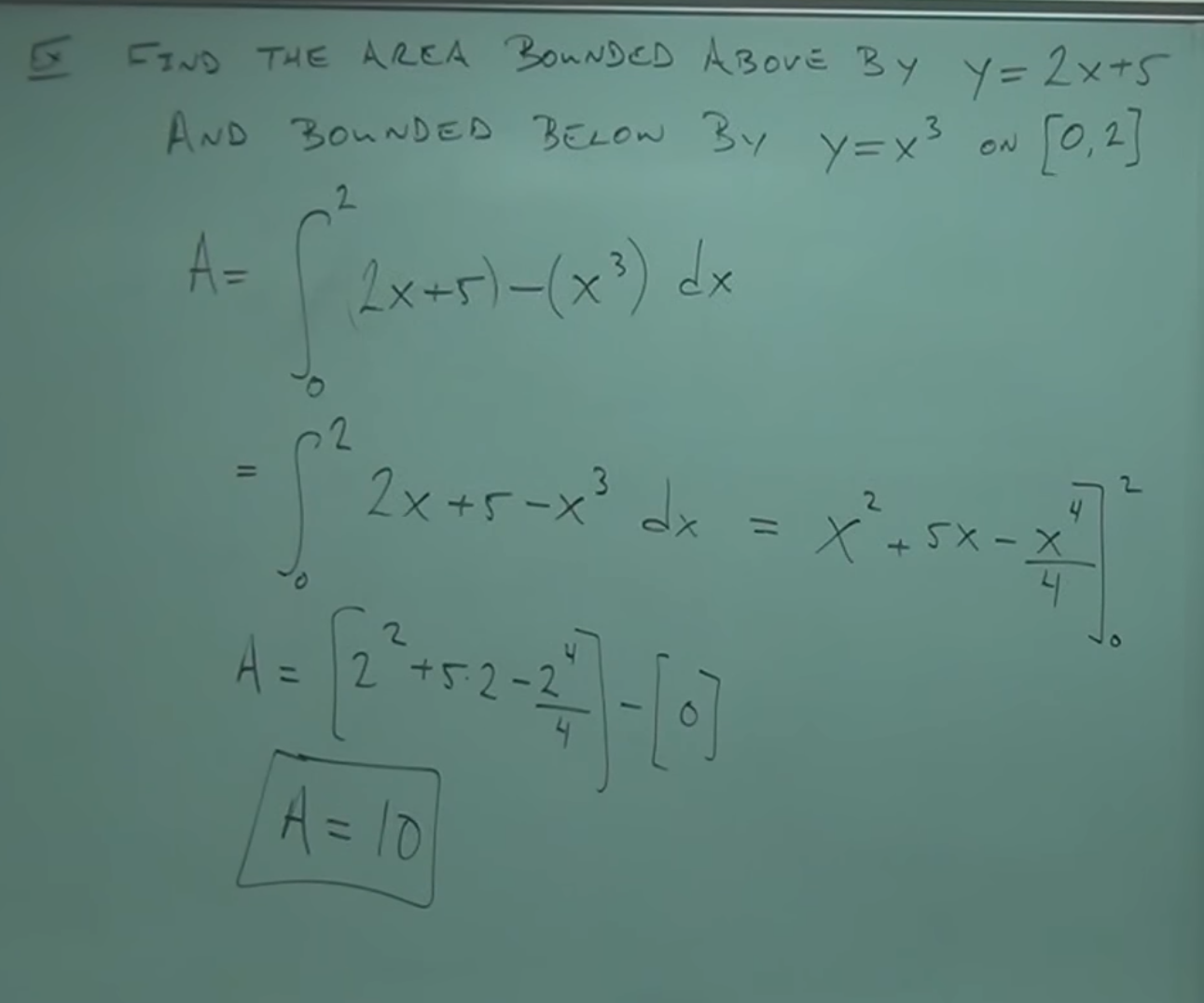
- Problem setup: Identify the integration limits and which function is on top.
-
The importance of parentheses when subtracting the two functions with multiple terms.
-
If the function below had been $𝓰(𝒙)=𝒙^{3}+1$ note the difference between:
- $\displaystyle \int_{0}^{2}\big[(2𝒙+5)-(𝒙^{3}+1)\big]\,𝒅𝒙$ and $\displaystyle \int_{0}^{2}(2𝒙+5)-𝒙^{3}+1\,𝒅𝒙$
-
If the function below had been $𝓰(𝒙)=𝒙^{3}+1$ note the difference between:
-
Integrate and evaluate the resulting integral.
- $\displaystyle 𝓐=\int_{0}^{2}\big((2𝒙+5)-(𝒙^{3})\big)\,𝒅𝒙=\int_{0}^{2}(2𝒙+5-𝒙^{3})\,𝒅𝒙=\Big(𝒙^{2}+5𝒙-\dfrac{𝒙^{4}}{4}\Big)\Big|_{0}^{2}$
- $𝓐=\big(2^{2}+5\cdot2-(2^{4}/4)\big)-0=10$
-
[24:35]. 🧩 Example –
Finding
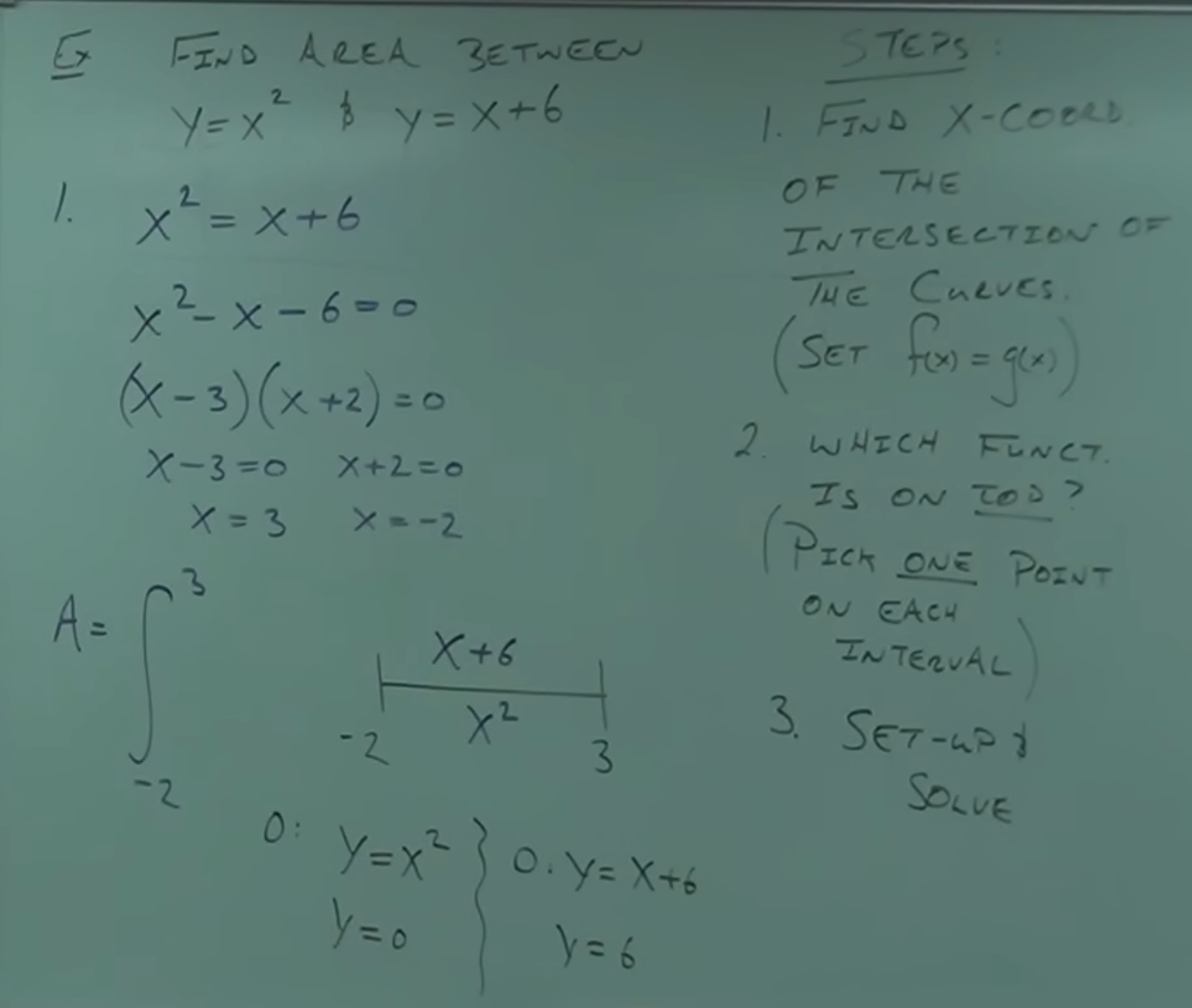
the area between two curves without a given interval: $𝒇(𝒙)=𝒙^{2},\;𝓰(𝒙)=𝒙+6$
- [📷image-1]
 - [📷image-2]
-
Steps to follow
-
[25:10]. 𝒮𝓉ℯ𝓅 1:
Find the intersection points of the curves.
- Set $𝒇(𝒙)=𝓰(𝒙)$.
- Solve $𝒙^{2}=𝒙+6 \;\;\Rightarrow\;\; (𝒙-3)(𝒙+2)=0 \;\;\Rightarrow\;\; 𝒙=-2,𝒙=3$.
- These are the limits of integration.
-
[27:18]. 𝒮𝓉ℯ𝓅 2:
Determine which function is on top in the interval $[−2,3]$.
- Test a point (e.g. $𝒙=0$).
- $𝒇(0)=0^{2}=0,\;𝓰(0)=0+6=6$.
- Since $𝓰(𝒙)>𝒇(𝒙)$, the line $𝒙+6$ is above the parabola $𝒙^{2}$.
-
[32:00]. 𝒮𝓉ℯ𝓅 3:
Set up and solve the integral.
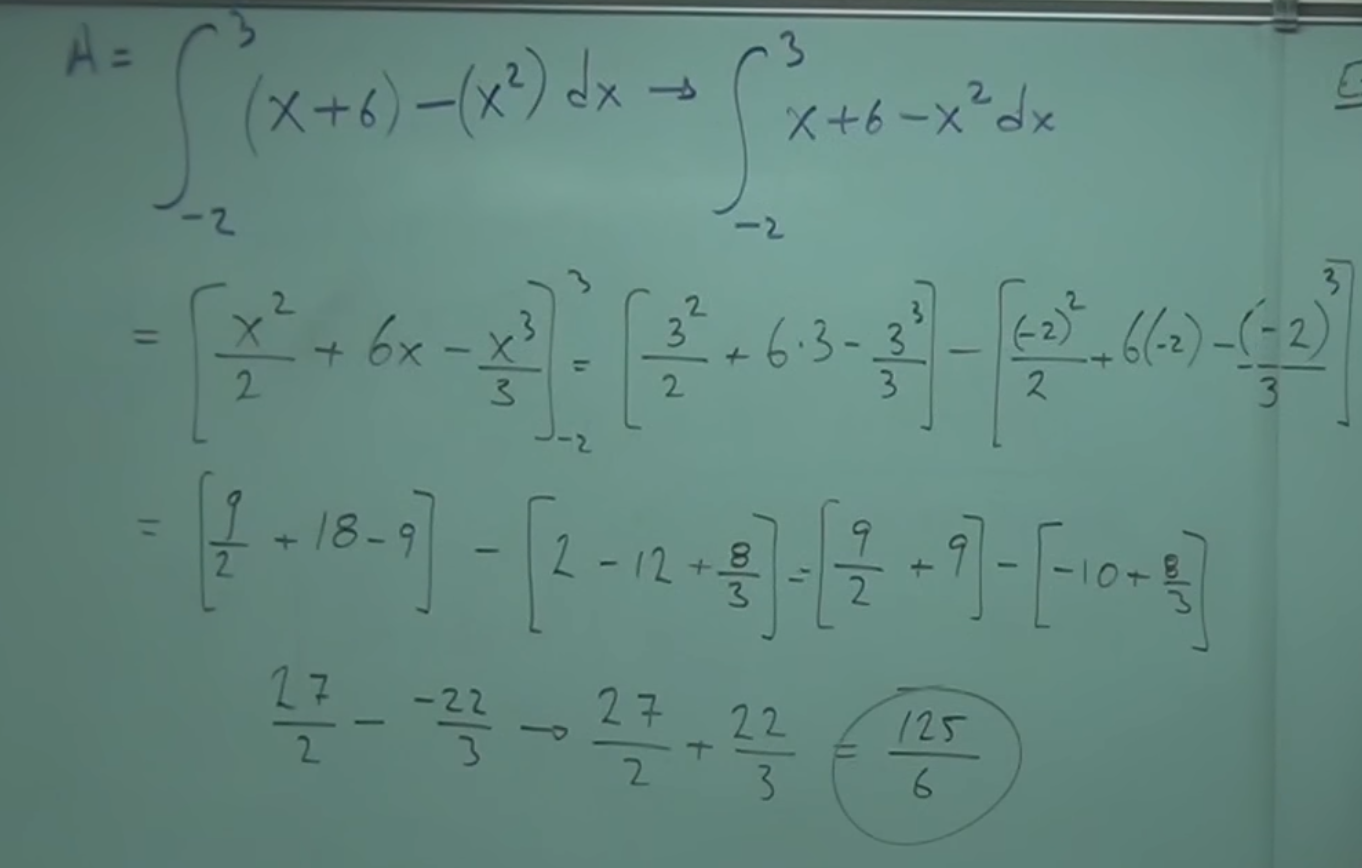
- $\displaystyle 𝓐=\int_{-2}^{3}\big(𝓰(𝒙)-𝒇(𝒙)\big)\,𝒅𝒙 =\int_{-2}^{3}(𝒙+6-𝒙^{2})\,𝒅𝒙$
-
Compute:
- Antiderivative: $\displaystyle \dfrac{1}{2}𝒙^{2}+6𝒙-\dfrac{1}{3}𝒙^{3}.$
- Evaluate: $\displaystyle \Big[\dfrac{1}{2}(3^{2})+6\cdot 3-\dfrac{1}{3}(3^{3})\Big]\;-\;\Big[\dfrac{1}{2}((-2)^{2})+6(-2)-\dfrac{1}{3}((-2)^{3})\Big]$
- Result: $\displaystyle \dfrac{125}{6}$.
-
[25:10]. 𝒮𝓉ℯ𝓅 1:
Find the intersection points of the curves.
-
Steps to follow
-
[38:20]. 🧩 Example –
Finding
the area between two curves without a given interval: $𝒇(𝒙)=𝒙^{3},\;𝓰(𝒙)=𝒙$
- [📷image-1]
 - [📷image-2]
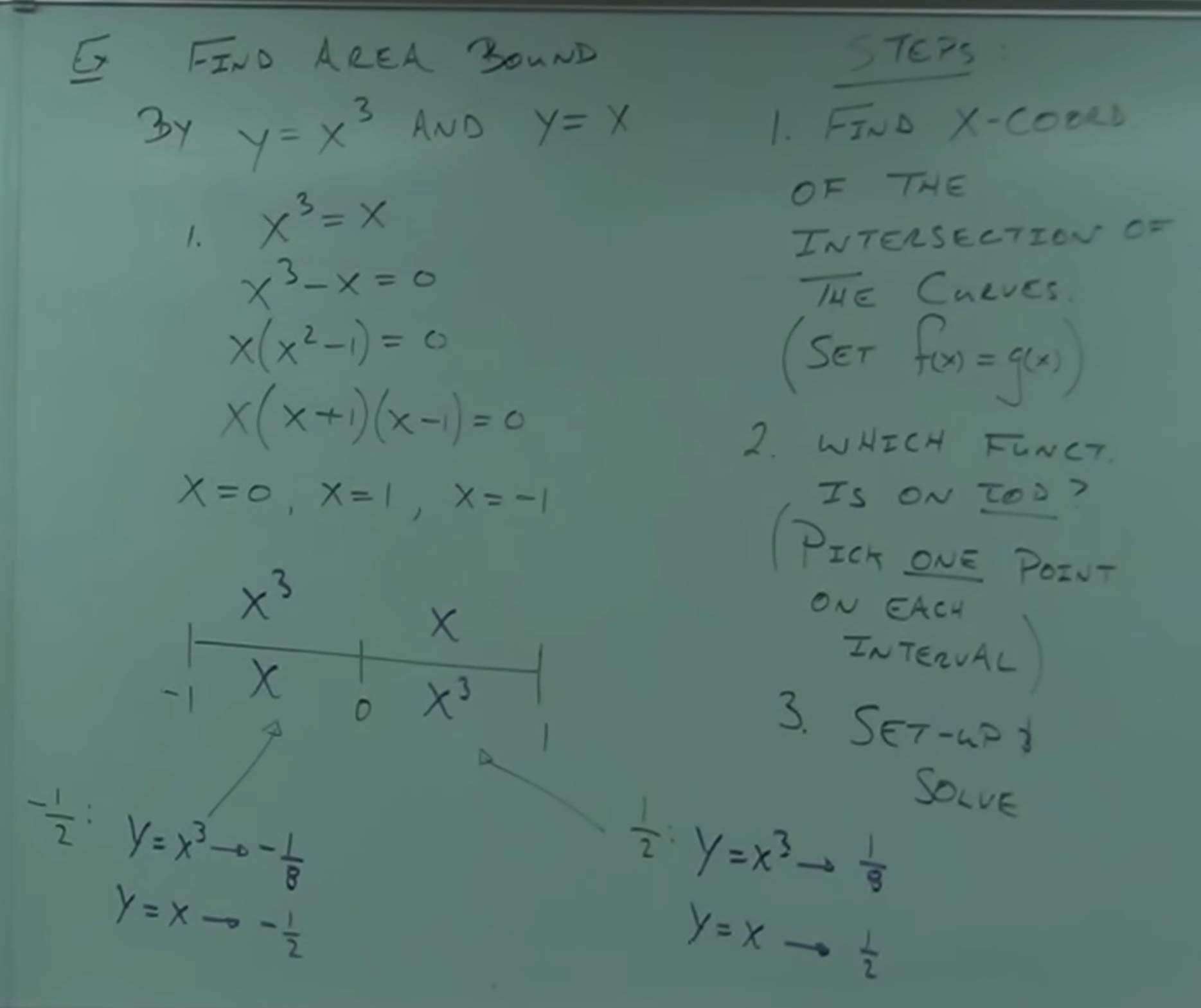
- 𝒮𝓉ℯ𝓅 1: Solve $𝒇(𝒙)=𝒙^{3}=𝒙$ → intersections: $−1,0,1$.
-
𝒮𝓉ℯ𝓅 2: Test points in each interval to see which function is on top.
- $n$ intervals means $n$ integrals
-
For each interval test a point to see which function has the higher value.
- On $[−1,0]$: $𝒙^{3}>𝒙$
- On $[0,1]$: $𝒙>𝒙^{3}$
- Split the problem into $n$ integrals because the functions cross.
-
𝒮𝓉ℯ𝓅 3: Set up the two integrals: $\displaystyle
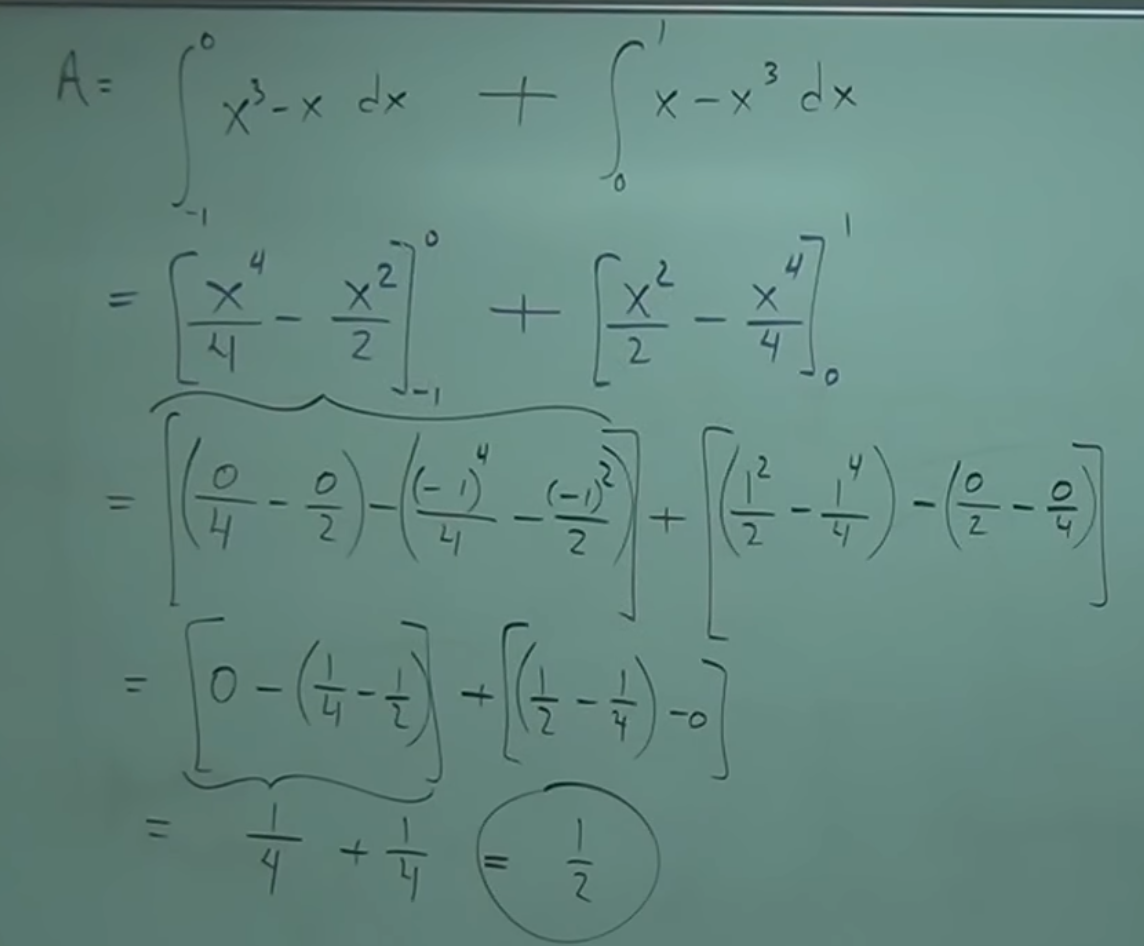
\int_{-1}^{0}(𝒙^{3}-𝒙)\,𝒅𝒙+\int_{0}^{1}(𝒙-𝒙^{3})\,𝒅𝒙$
- Antiderivatives:
- $\displaystyle \int(𝒙^{3}-𝒙)\,𝒅𝒙=\dfrac{𝒙^{4}}{4}-\dfrac{𝒙^{2}}{2}$
- $\displaystyle \int(𝒙-𝒙^{3})\,𝒅𝒙=\dfrac{𝒙^{2}}{2}-\dfrac{𝒙^{4}}{4}$
- Evaluate each piece:
- $\displaystyle\Big[\dfrac{𝒙^{4}}{4}-\dfrac{𝒙^{2}}{2}\Big]_{-1}^{0}=(0-0)-\Big(\dfrac{1}{4}-\dfrac{1}{2}\Big)=\dfrac{1}{4}$
- $\displaystyle\Big[\dfrac{𝒙^{2}}{2}-\dfrac{𝒙^{4}}{4}\Big]_{0}^{1}=\Big(\dfrac{1}{2}-\dfrac{1}{4}\Big)-(0-0)=\dfrac{1}{4}$
- Total area:
- $\displaystyle 𝒜=\dfrac{1}{4}+\dfrac{1}{4}=\dfrac{1}{2}$
- Antiderivatives:
Applications
-
[51:00]. 🧩 Example –
Distance
between two racing cars.
- [📷image]
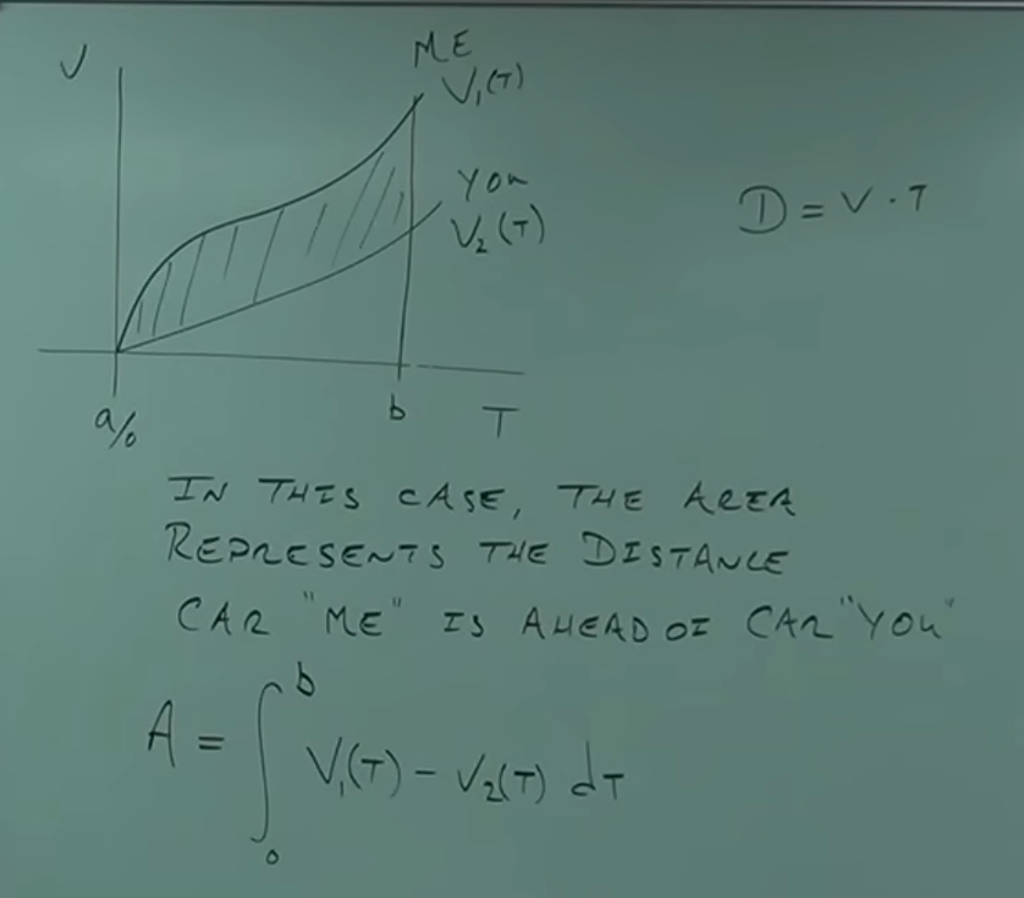
- The curves represent each car’s speed as a function of time.
- The area between the curves represents the distance between the cars.
- The area of each rectangle is $𝓿\cdot𝓽=$ Distance
- Distance $=\displaystyle \int_{𝓪}^{𝓫}\big(\text{Car1 speed}-\text{Car2 speed}\big)\,dt$
- The area shows how far "my" car is ahead of "your" car.
- If the cars cross paths multiple times, multiple integrals must be set up.
- The net integral gives the final distance between the cars.
- [1:00:55]. 🧩 Example – Advanced example: Area between $𝒙=𝑦^{2}$ and $𝑦=𝒙-2$
- [📷image-1]
 - [📷image-2]
 - [📷image-3]
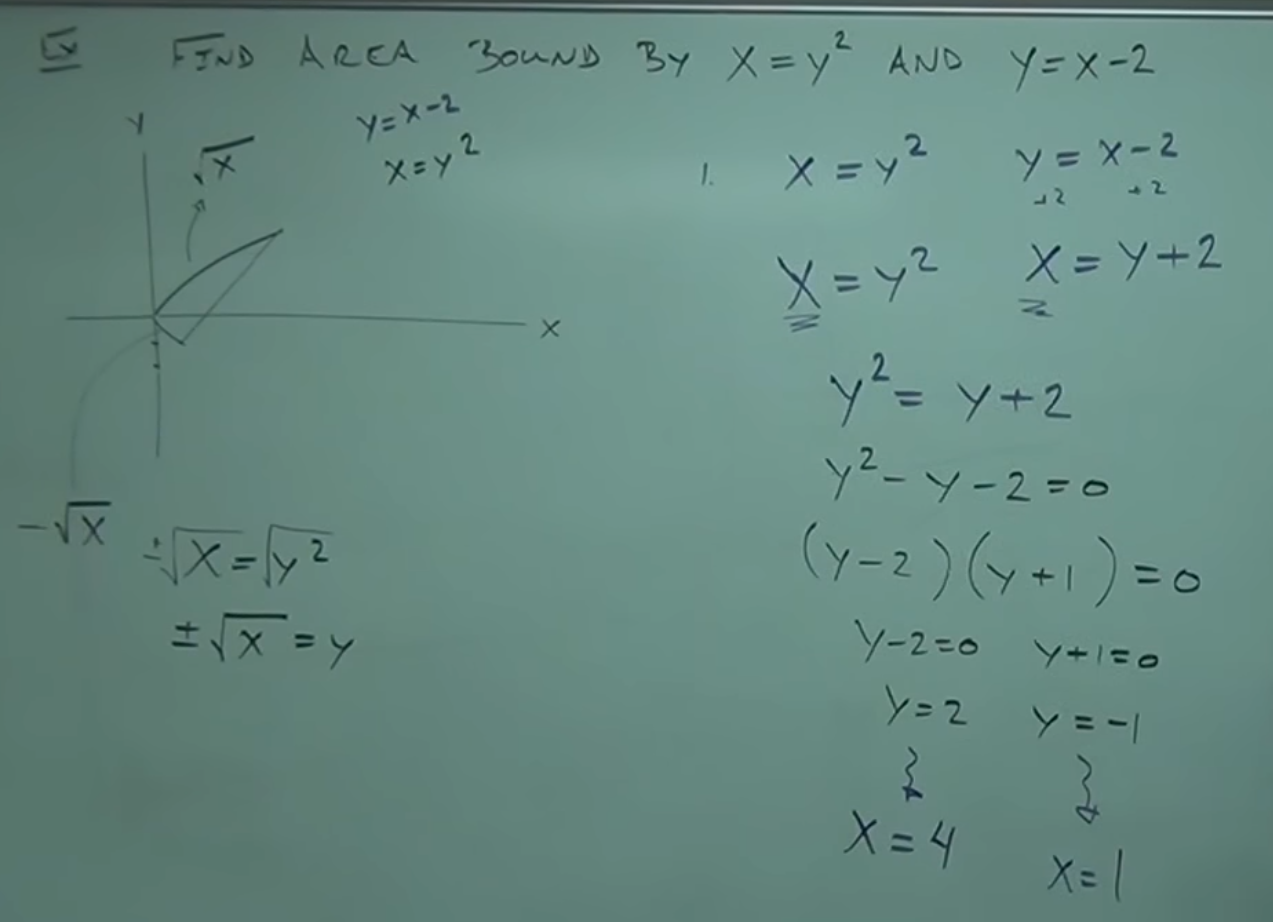
- This problem is tricky because it is not expressed in terms of 𝒙 functions.
- It helps to sketch a graph.
- If you only find the intersection points, you miss part of the area.
- The parabola $𝒙=𝑦^{2}$ starts at $𝒙=0$ (vertex at $(0,0)$).
- [1:05:00]. Integration with respect to 𝒙 Vs. integration with respect to 𝑦
- $𝑦^{2}=𝑦+2$
- Factor the quadratic to find $𝑦$-values of the intersection points.
- $𝑦=-1,\;𝑦=2$
- [1:07:20]. Discussion
- Vertical slices require splitting; horizontal slices do not.
- Riemann view:
- Vertical rectangles need two sub-sums ($[0,1]$ & $[1,4]$);
- Horizontal rectangles need one sub-sum ($𝑦∈[−1,2]$).
- Riemann view:
- Vertical slices require splitting; horizontal slices do not.
- Integration with respect to 𝒙
- 𝒮𝓉ℯ𝓅 1: Solve both equations for $𝑦$ in terms of $𝒙$.
- $𝒙=𝑦^{2}$ becomes $𝑦=±\sqrt{𝒙}$.
- $𝑦=𝒙-2$ remains the same.
- Solve for $𝑦$: $𝑦^{2}=𝑦+2$
- ① Obtaining the values $𝑦=2$ and $𝑦=-1$.
- ② Then, substitute these into $𝒙=𝑦^{2}$ (or $𝒙=𝑦+2$) to find the corresponding $𝒙$-values for the integration limits.
- ③ Finally, the new limits in terms of $𝒙$ will be $𝒙=1$ and $𝒙=4$, allowing the integral to be rewritten in terms of $𝒙$.
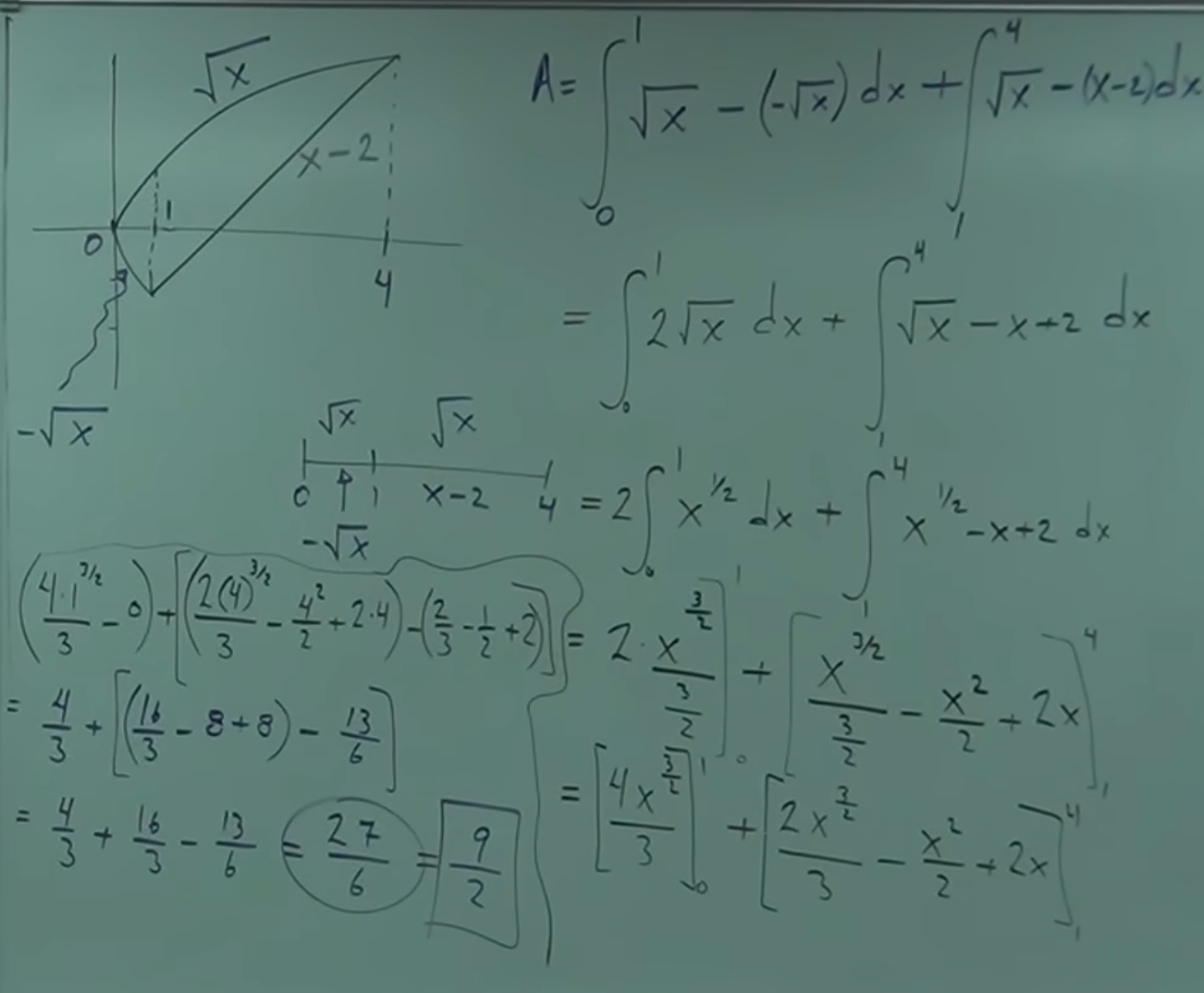
- NOTE1: Functions: $\sqrt{𝒙}$ and $-\sqrt{𝒙}$
- Domain: $𝒙\ge 0$
- Set equal: $\sqrt{𝒙}=-\sqrt{𝒙}$; $2\sqrt{𝒙}=0 \Rightarrow \sqrt{𝒙}=0 \Rightarrow 𝒙=0$
- Intersection point: $(0,0)$
- The functions $\sqrt{𝒙}$ and $-\sqrt{𝒙}$ intersect only at the origin so $𝒙=0$ is another integration limit.
- Intersections of the two curves: at $𝑦=-1 \Rightarrow (𝒙,𝑦)=(1,-1)$; at $𝑦=2 \Rightarrow (𝒙,𝑦)=(4,2)$.
- Solve for $𝑦$: $𝑦^{2}=𝑦+2$
- 𝒮𝓉ℯ𝓅 2: Test points in each interval to see which function is on top.
- The function $𝒙=𝑦^{2}$ starts at $0$ (NOTE1) so there are two intervals
$[0,1]$, $[1,4]$
- 2 intervals means 2 integrals
- [1:12:05]. Re-draw the graph for clarity of the area zone.
- Identify the upper and lower functions in each region.
+√𝒙 +√𝒙 ┌───────┬───────┬ 0 1 4 -√𝒙 𝒙 - 2- Check: at $𝒙=2 \Rightarrow \sqrt{2}\approx 1.414$ vs $𝒙-2=0$ ⇒ top is $\sqrt{𝒙}$; at $𝒙=0.25 \Rightarrow \sqrt{𝒙}=0.5$ and $−\sqrt{𝒙}=−0.5$ ⇒ top is $\sqrt{𝒙}$.
- The function $𝒙=𝑦^{2}$ starts at $0$ (NOTE1) so there are two intervals
$[0,1]$, $[1,4]$
- 𝒮𝓉ℯ𝓅 3: Set up the two integrals:
- [1:17:03]. $\displaystyle \int_{0}^{1}\big(\sqrt{𝒙}-(-\sqrt{𝒙})\big)\,𝒅𝒙+\int_{1}^{4}\big(\sqrt{𝒙}-(𝒙-2)\big)\,𝒅𝒙$
- Evaluation: $\displaystyle \int_{0}^{1}2\,𝒙^{1/2}\,𝒅𝒙+\int_{1}^{4}\big(𝒙^{1/2}-𝒙+2\big)\,𝒅𝒙=9/2$
- 𝒮𝓉ℯ𝓅 1: Solve both equations for $𝑦$ in terms of $𝒙$.
- [1:26:40]. Integration with respect to 𝑦 (the best mode).
- Introduction
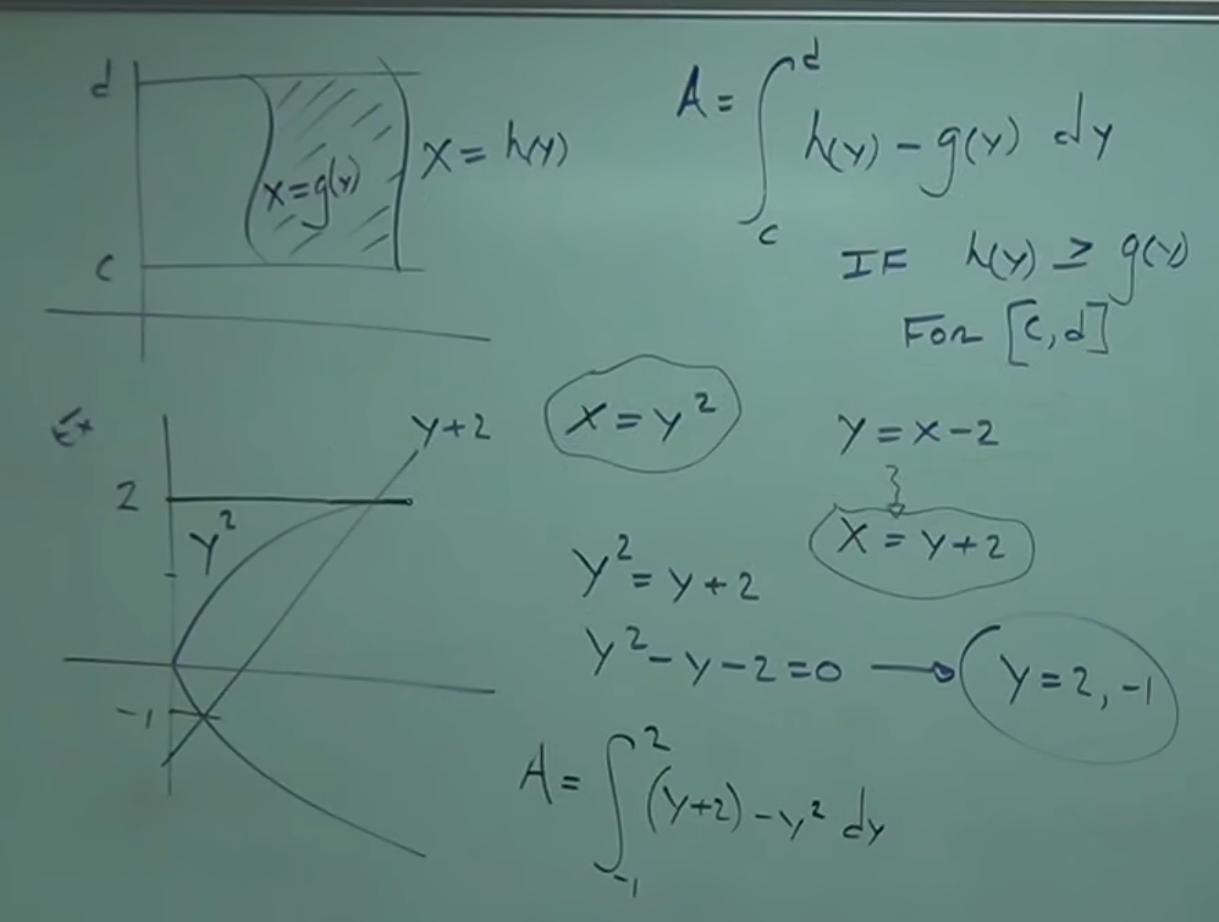
- It is easier to integrate with respect to $𝑦$ because only two functions are involved, and one is always to the right of the other.
- The formula is similar to integrating with respect to $𝒙$, but with $𝒙$
and $𝑦$ reversed along the $𝑦$-axis
- Now we have to go from $𝓒$ to $𝓓$ along the $𝑦$-axis over one interval $[𝓒,𝓓]$
- General idea: A function $𝒇(𝒙)$ is on the right of
another function $𝓰(𝒙)$ over an interval $[𝓒,𝓓]$
- Note that the right function was the above (top) function on interval $[𝓪,𝓫]$ when we integrate with respect to $𝒙$
- Set up the equations in terms of $𝑦$: $𝒙=𝒉(𝑦)$, $𝒙=𝓰(𝑦)$.
- [1:29:10]. The area is $\displaystyle \int_{𝓒}^{𝓓}\big(𝒉(𝑦)-𝓰(𝑦)\big)\,𝒅𝑦$ if $𝒉(𝑦)\ge 𝓰(𝑦)$ for all $𝑦\in[𝓒,𝓓]$
- Use letters: $𝓒=−1$, $𝓓=2$.
- 𝒮𝓉ℯ𝓅 1: Solve for $𝑦$: $𝑦^{2}=𝑦+2$
- Obtaining the values $𝑦=2$ and $𝑦=-1$.
- 𝒮𝓉ℯ𝓅 2: Determine the integration limits (the $𝑦$-values) and which function
is on the right and on the left.
- On the right $𝑦+2$; on the left $𝑦^{2}$
- Justify right − left on the whole interval: $𝑦^{2}\le 𝑦+2 \Leftrightarrow (𝑦−2)(𝑦+1)\le 0$, true for $𝑦\in[−1,2]$ ⇒ no split needed.
- Continuity note: both curves are continuous; the region is closed and bounded → area via definite integrals applies directly.
- Domain note (for $𝑦=±\sqrt{𝒙}$): $𝒙\ge 0$, which explains the vertical left bound $𝒙=0$ and the split at $𝒙=1$.
- On the right $𝑦+2$; on the left $𝑦^{2}$
- 𝒮𝓉ℯ𝓅 3: Set up the integral:
- $\displaystyle \int_{-1}^{2}\big((𝑦+2)-𝑦^{2}\big)\,𝒅𝑦$
- Evaluation: Antiderivative $-\tfrac{𝑦^{3}}{3}+\tfrac{𝑦^{2}}{2}+2𝑦$, so area $=9/2$
- Introduction