Calculus 1 Lecture 5.2
Volume of Solids By Disks and Washers Method
Introduction.
- 01:00.
Understanding the Concept of Volume as “Cross-Sectional Area × Length”
- Visualizing volumes as the sum of many rectangular prisms
- Condition for applying this method: sides perpendicular to the 𝒙-a𝒙is
- The volume is bounded between points 𝓪 and 𝓫, where sides are perpendicular to the
𝒙-axis
1.- Volume of solids by slicing.
- 02:25.
Preparing for the Deduction of the Volume Integral
- [📷image]
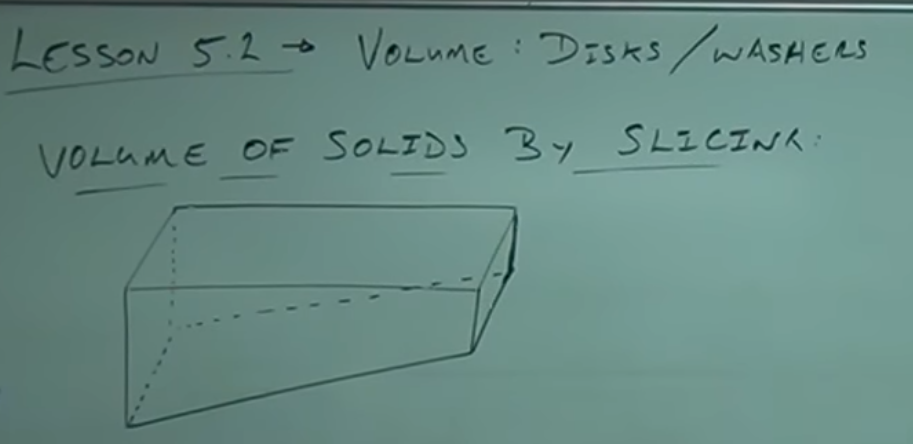
- Drawing as a fundamental tool
- Main idea: slice the solid into “slabs”
- 03:30.
Slicing into “Slabs”
- [📷image]
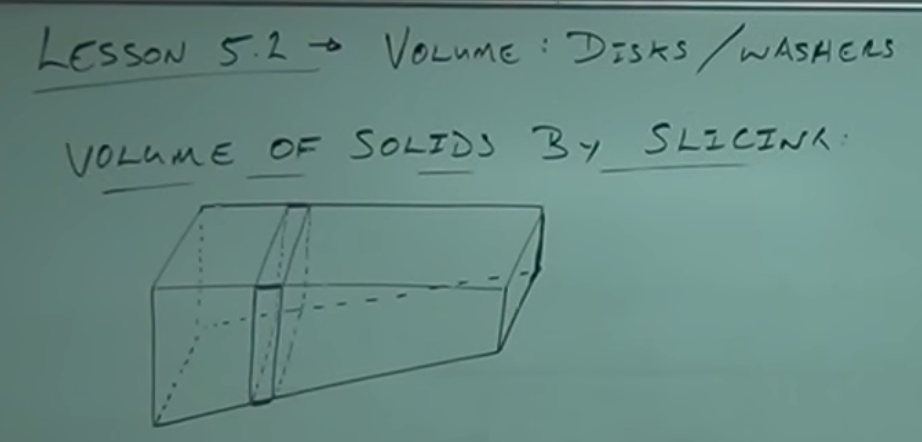
- Using slabs of the same width to simplify the sum
- Representing the width of each slab as $\,\Delta 𝒙\,$
- 03:58.
Expanding a Single Slab
- 05:10.
Main idea –
- [📷image]
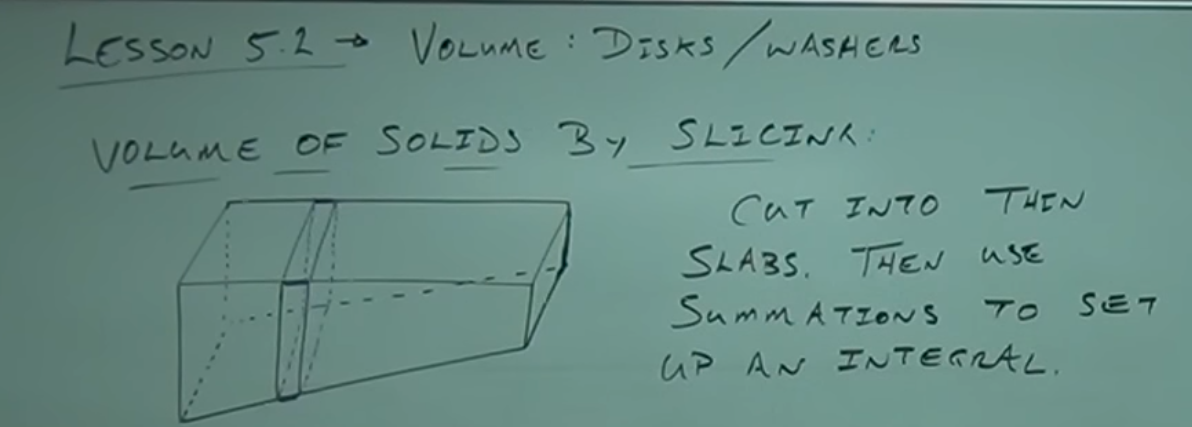
- **Cut into thin slabs; then use Riemann sums to set up an integral.**
- 06:30.
The fundamental idea of calculating volumes using integration. The key points are:
- ① Basic Concept of Volume:
- Volume can generally be understood as surface area times length.
- In this case, it is the **cross-sectional area multiplied by its width**.
- ② Visualization of the Cross-Section:
- Imagine cutting a solid perpendicularly to its main axis.
- If you take out a **"slab"** (a thin slice of the solid) and turn it toward you,
the face you see is the **cross-section**.
- This section has an **area** that we denote as $𝓐(𝒙)$.
- ③ Approximating the Volume:
- Multiplying the cross-sectional area $𝓐(𝒙)$ by the width $\,\Delta 𝒙\,$ gives
an approximation of the volume of that small "slab".
- The thinner the slab (i.e., the smaller $\,\Delta 𝒙$), the more accurate the
volume calculation.
- ④ Parallel with Area Calculation:
- Similar to finding areas under a curve by summing rectangles and then taking
$\Delta 𝒙 \to 0$ to get the exact area.
- Here, 𝗯𝘆 𝘀𝘂𝗺𝗺𝗶𝗻𝗴 𝘁𝗵𝗲 𝘃𝗼𝗹𝘂𝗺𝗲𝘀 𝗼𝗳 𝗶𝗻𝗳𝗶𝗻𝗶𝘁𝗲𝗹𝘆 𝘁𝗵𝗶𝗻
𝗰𝗿𝗼𝘀𝘀-𝘀𝗲𝗰𝘁𝗶𝗼𝗻𝘀 and taking the limit (letting the number of slabs approach infinity
while their width $\Delta 𝒙$ approaches zero), we obtain the **exact** volume.
- ⑤ Conclusion:
- To compute the volume, **the first step is to determine the area of the
cross-section**, as this will be the function we integrate along the solid.
Defining the area of cross-section
- 07:30. To
implement the main idea, we need to define the cross-sectional area.
- [📷image]
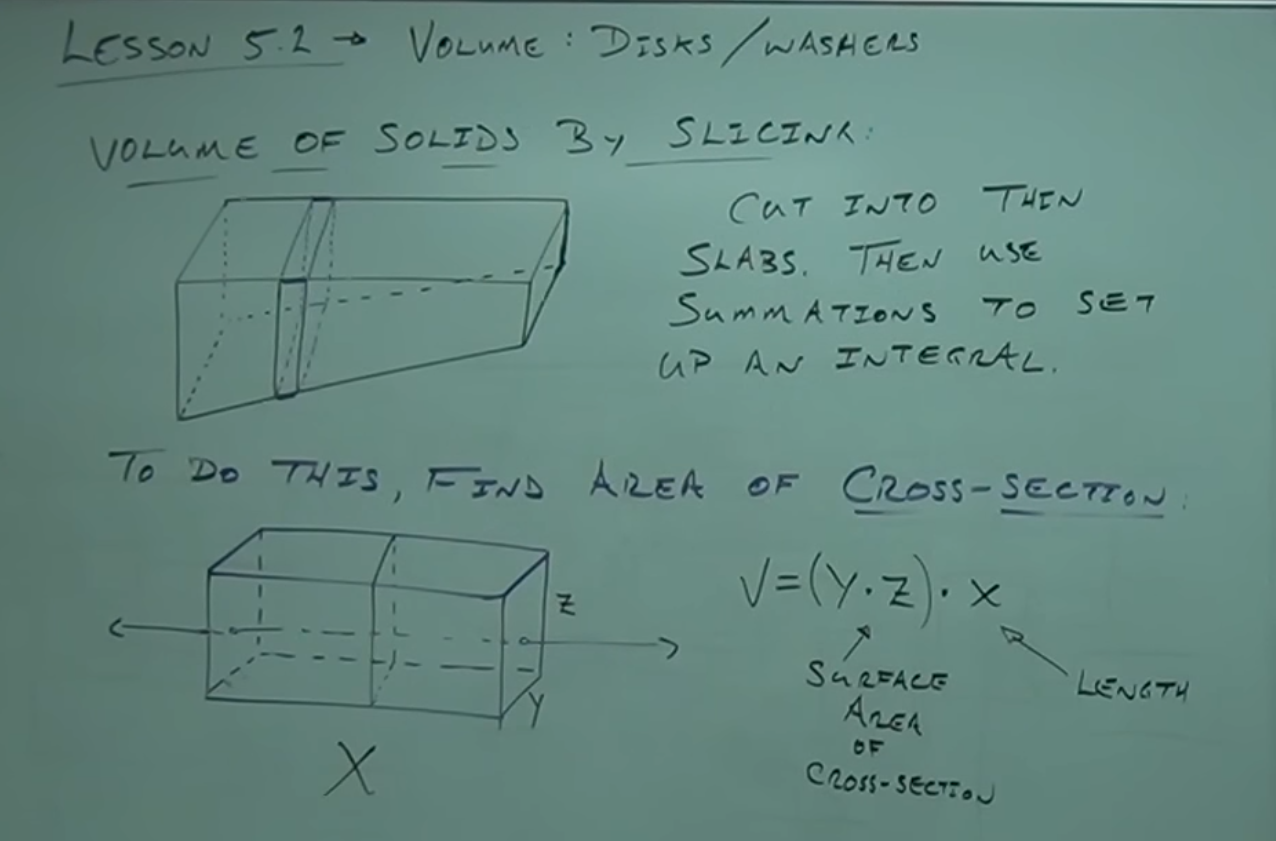
- 09:40.
Find the cross-sectional Volume (𝓥) taking a rectangular prism by example.
- $𝓥=𝒚\cdot 𝒛\cdot 𝒙$ where $𝒚\cdot 𝒛$ is the cross-sectional area and $𝒙$ is the
lenght.
- 11:11.
Understanding Slab Approximation
- The concept involves creating a large number of very thin slices (or "slabs") and summing
their individual volume to determine the total volume of the solid. The key lies in treating each slab as a
simple and small approximation of the solid; by accumulating infinitely many such slabs with infinitesimally
small thickness, we achieve an accurate measurement of the total volume.
- 11:45.
Importance of Perpendicularity.
- If the sides are not aligned with the 𝒙-axis, slabs won't be uniform or consistent in
shape and size.
- Non-perpendicular alignment complicates the approximation since each slice might vary
significantly.
- Simplicity When Aligned.
- When solids are bounded by planes perpendicular to the 𝒙-axis, each slab has a
consistent cross-sectional area that can be easily integrated.
- This consistency allows for straightforward summation (integration) along the 𝒙-axis
from point A to B.
Find the volume of any solid that is bound by perpendicular planes to 𝒙 -axis
at points 𝓪 and 𝓫.
- 12:40.
Introduction
- 15:30. Cut
the solid into slabs so that they're the same width.
- 18:10.
Zoom in on a slab
- 18:40.
Analogy with the Area Problem: Arbitrary Point
- Selecting an arbitrary point $(x_k^*)$ within each sub-interval (along $\Delta 𝒙$)
- Importance of that arbitrary point in taking the limit
- 20:34.
Finding the Cross-Sectional Area
- [📷image-1]
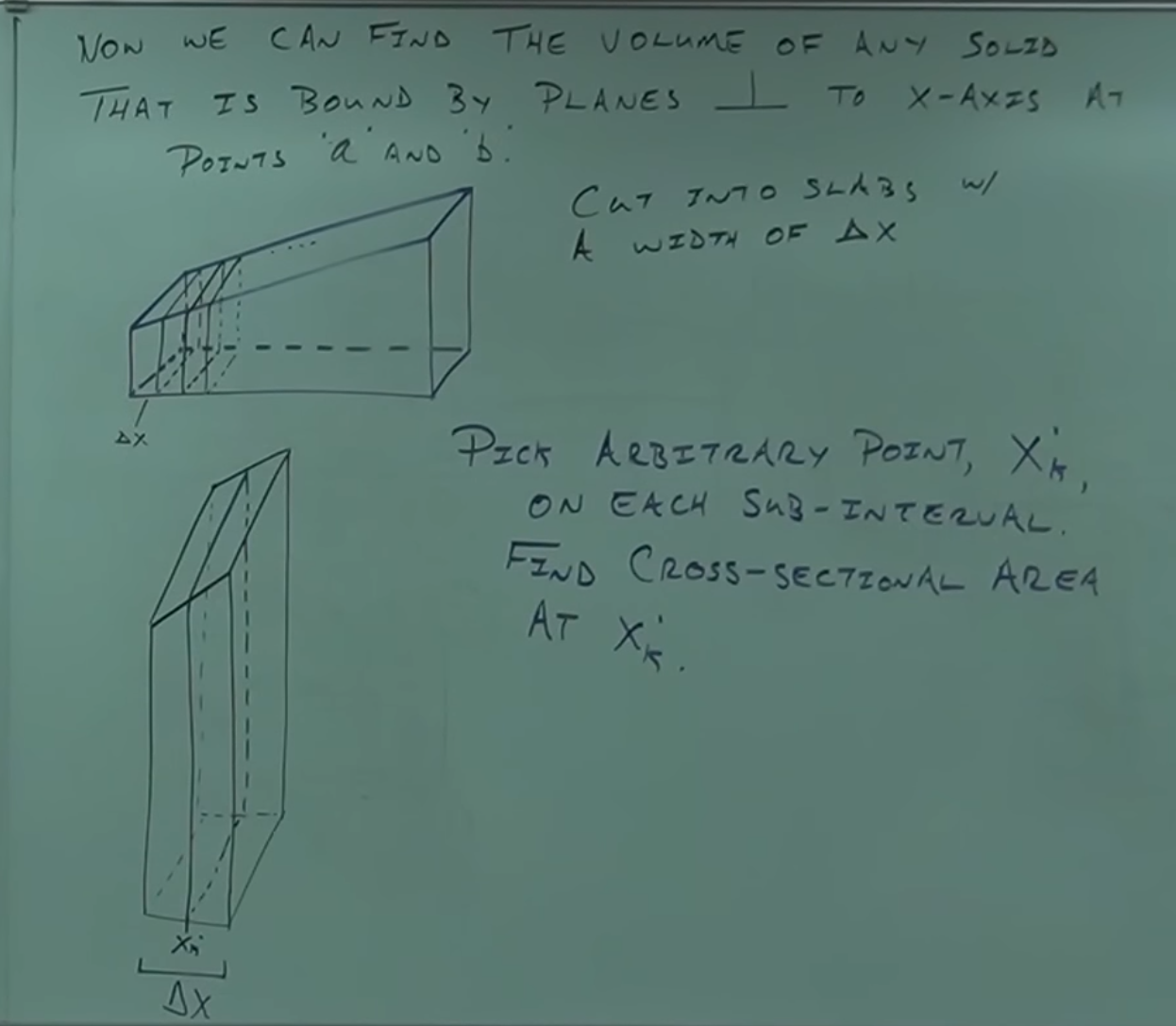
- The slab width ($\Delta 𝒙$) is known
- The height corresponds to $𝒇(x_k^* )$ in the area problem
- Identifying the cross-sectional area as the main objective
- Using the Arbitrary Point $x_{k}^{\ast}$ to Find the Cross-Sectional Area
- $x_{k}^{\ast}$ allows us to find the area of each cross section in each
subinterval
- Visualizing the cut at $x_{k}^{\ast}$ as a surface
- The cross-sectional area at $x_{k}^{\ast}$, multiplied by $\Delta 𝒙$, gives the
volume over that subinterval
- 24:25.
Computing the Volume in an Arbitrary Interval
- [📷image-2]
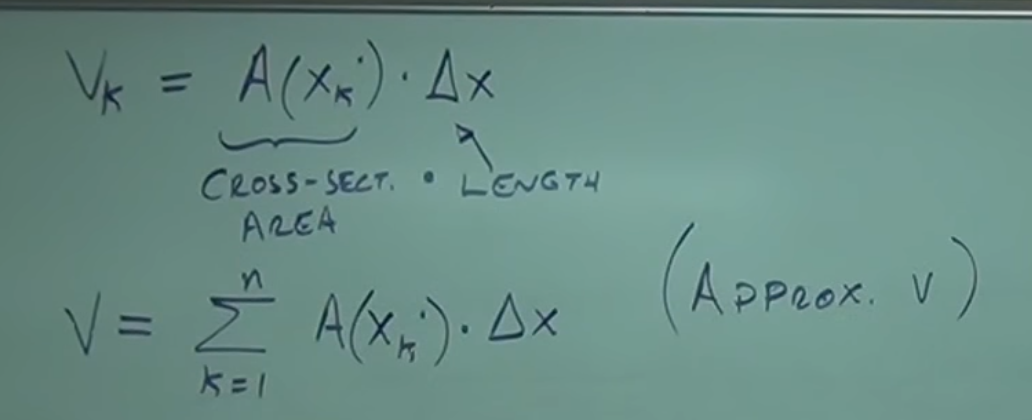
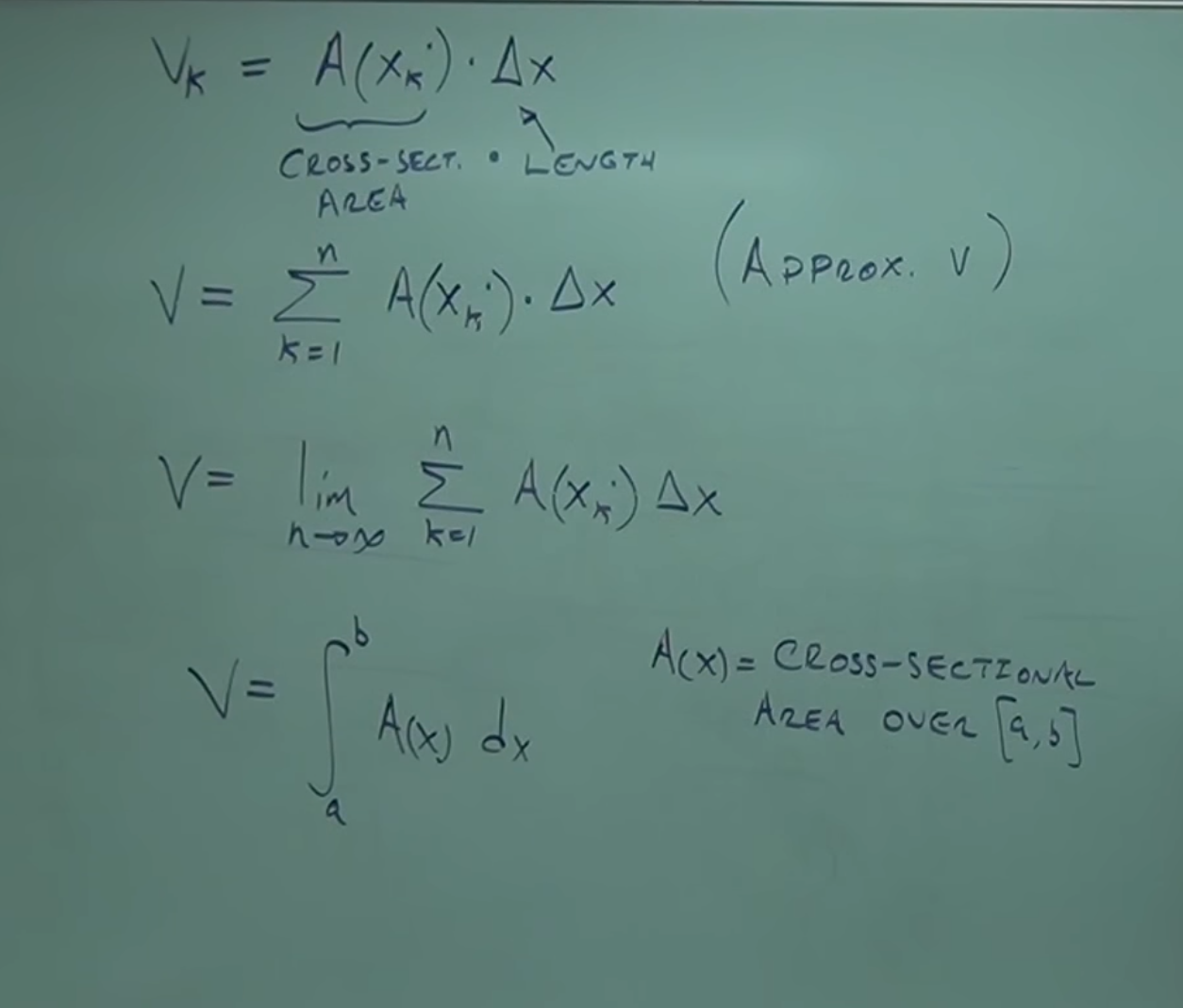
- Defining 𝑽ₖ as the volume of the k-th interval (one slab)
- $𝓥_k=\text{Area}(x_k^* )\cdot \Delta 𝒙$
- cross-sectional area ⇢ $𝓐(x_k^* )$
- Lenght ⇢ $\Delta 𝒙$
- Summation of all slab volumes (aproximate volume)
- $𝓥=\displaystyle \sum_{k=1}^{n} 𝓐(x_k^*)\cdot \Delta 𝒙$ as an appro𝒙imation of
the total volume
- 27:25.
The Limit of the Riemann Sum as the Definite Integral
- [📷image-3]
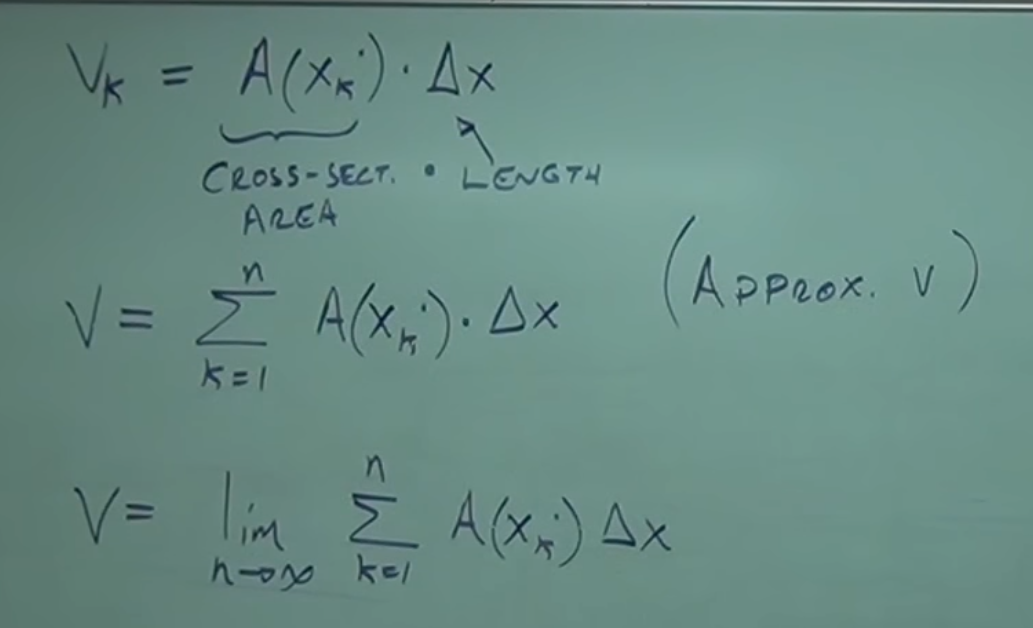
- Applying the limit as $n \to \infty$ to get the e𝒙act volume
- Converting the sum into a definite integral:
- $\displaystyle \lim_{n\to\infty}\sum_{k=1}^{n} 𝓐(x_k^*)\cdot \Delta 𝒙 \;\to\;
𝓥=\displaystyle \int_{𝓪}^{𝓫} 𝓐(𝒙)\,dx$
- Interpreting the integral as summing cross-sectional areas from 𝓪 to 𝓫:
$[𝓪,𝓫]$
- 31:20.
E𝒙tension to integration with respect to 𝑦.
- [📷image-4]
 - [📷image-5]
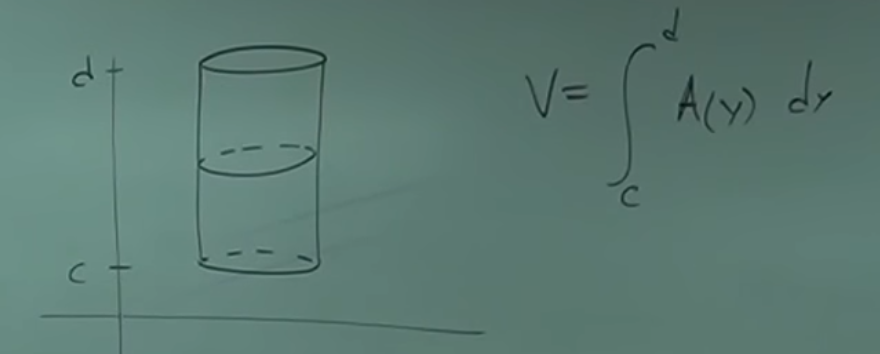
- $𝓥=\displaystyle \int_{𝓬}^{𝓭} 𝓐(𝑦)\,dy$
- 32:40. 🧩
Example – Introduction: Volume of a Cylinder
- [📷image]
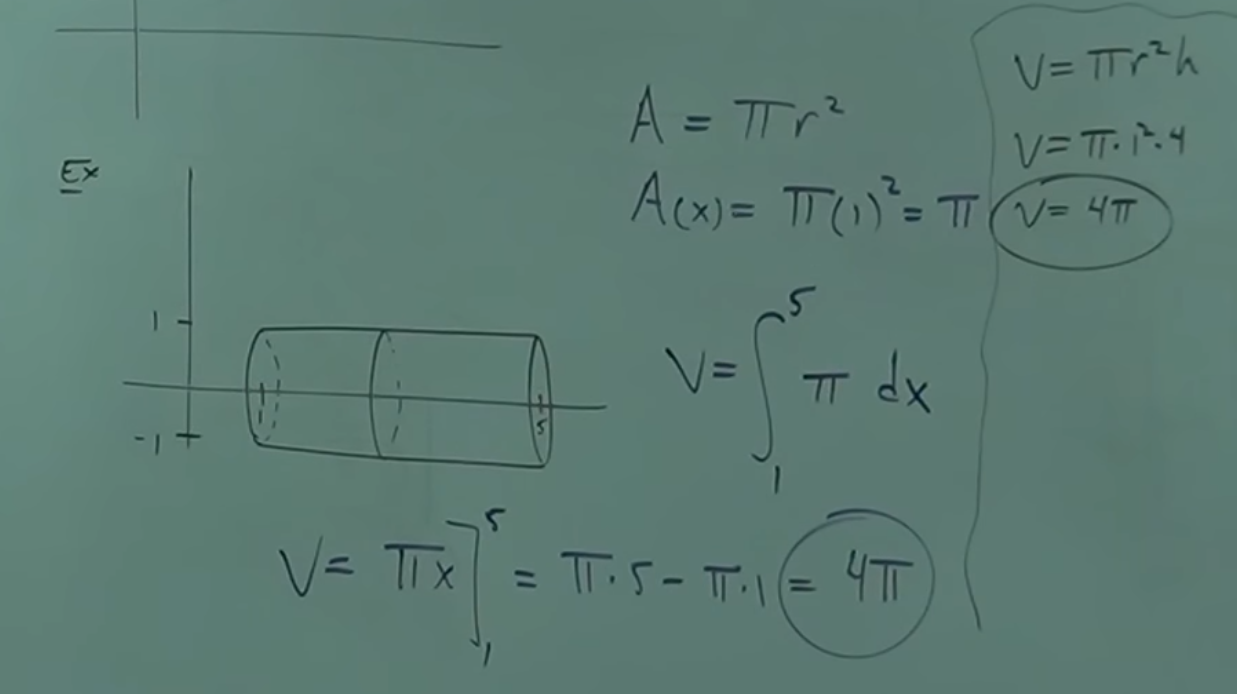
- Find the volume of a right circular cylinder whose central axis lies along the horizontal
axis on [1,5] and extends between [1,−1] along the 𝑦-axis.
- $𝓐=\pi\cdot r^{2}$; $𝓐(𝒙)=\pi\cdot (1)^{2}=\pi$ Then the volume is found by integrating
$𝓐(𝒙)$ over $𝒙$ from 1 to 5:
- $𝓥=\displaystyle \int_{1}^{5}\pi\,dx=\pi[𝒙]\Big|_{1}^{5}=\pi(5-1)=4\pi$
- Verification with the Cylinder Volume Formula
- Cylinder volume = (base area) × (height) = $\pi r^{2}\cdot h$
- Calculation: $\pi(1)^{2}\times (5-1)=4\pi$
2.- Volume of solids of revolution.
- 39:20.
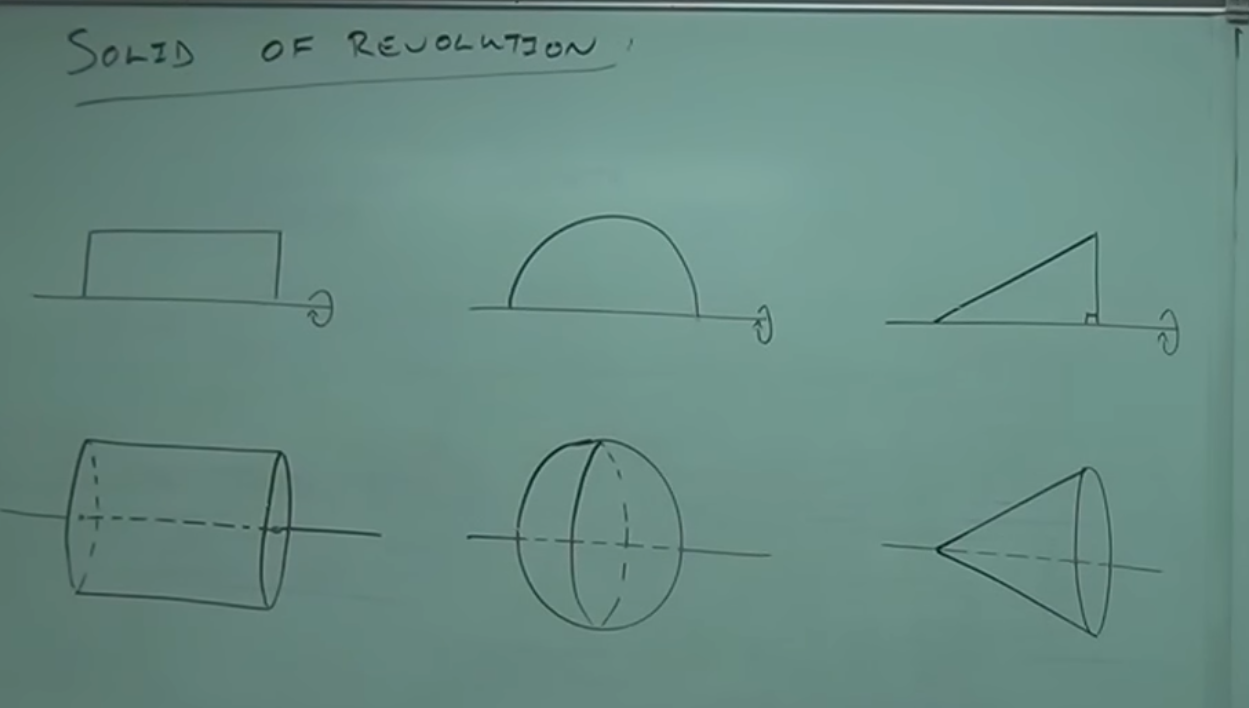
Introduction to Solids of Revolution
- [📷image-1]
 - [📷image-2]
 - [📷image-3]
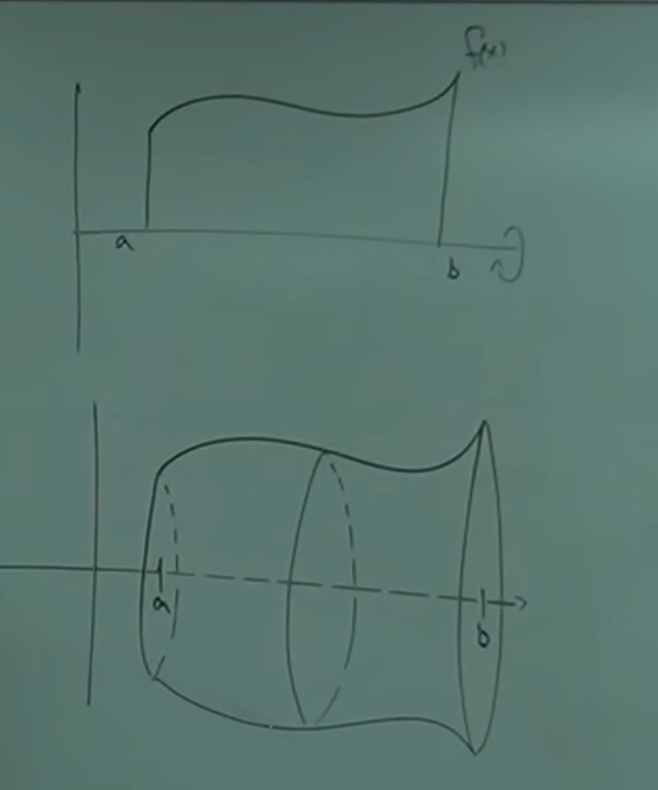
- A solid is formed by rotating a function about an a𝒙is
- E𝒙ample: rotating a rectangle around the 𝒙-a𝒙is creates a cylinder
- E𝒙ample: rotating a semicircle around the 𝒙-a𝒙is creates a sphere
- E𝒙ample: Rotating a right triangle around the 𝒙-axis typically creates a cone.
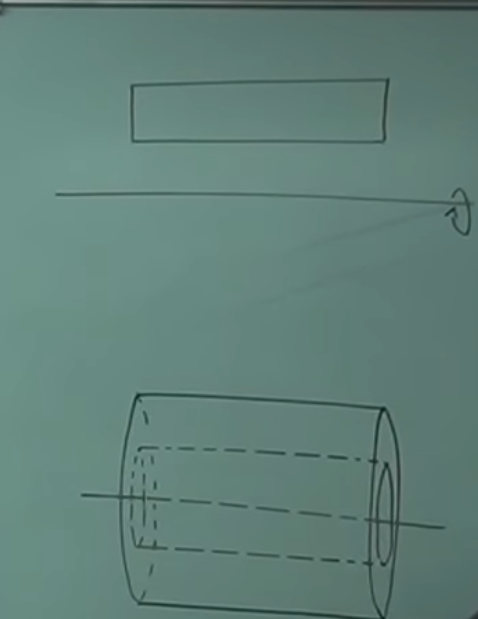
- E𝒙ample: Consider a rectangle (or rectangular strip) that is parallel to the axis of
rotation
and does not include that axis within its boundaries. When this rectangular region
is
rotated, you obtain a tube (or hollow cylinder) whose inner radius is $R_{\text{inner}}$ and
outer
radius is $R_{\text{outer}}$.
Volume of solids of revolution ᎠᏆᏚᏦ ᎷᎬᎢᎻᎾᎠ
- 44:45.
When the function is not regular.
- [📷image]
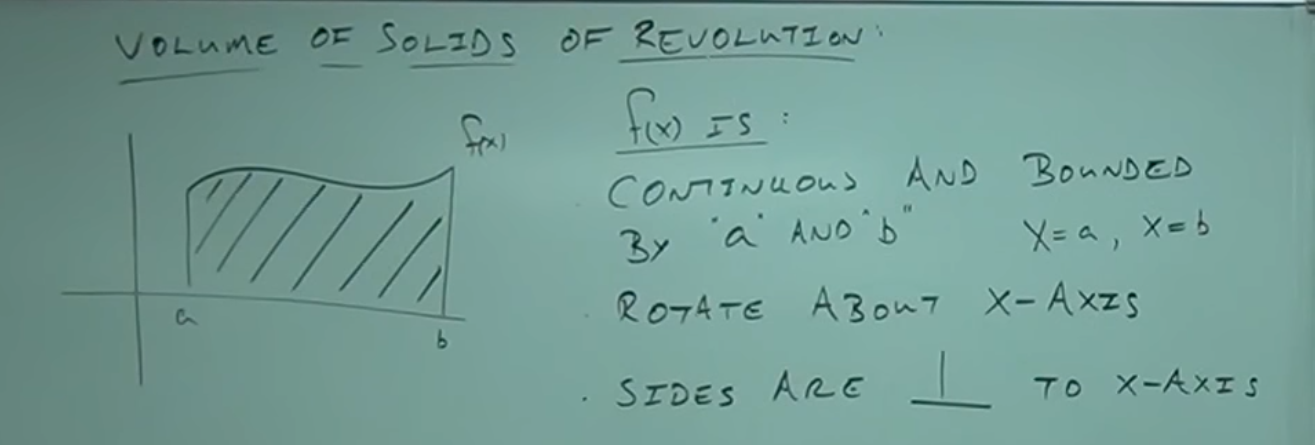
- Conditions for Using the ᎠᏆᏚᏦ ᎷᎬᎢᎻᎾᎠ
- $𝒇(𝒙)$ must be continuous and bounded between 𝓪 and 𝓫 (vertical lines $𝒙=𝓪$ and
$𝒙=𝓫$)
- Rotating around the 𝒙-a𝒙is requires sides perpendicular to the 𝒙-a𝒙is
- 49:00.
The General ᎠᏆᏚᏦ ᎷᎬᎢᎻᎾᎠ for Finding Volume
- Integrate the cross sections perpendicular to the a𝒙is of rotation
- Need a function representing the cross-sectional area
- Summing cross-sectional areas from 𝓪 to 𝓫
- 52:40.
Find the solid Volume by slicing
- [📷image-1]
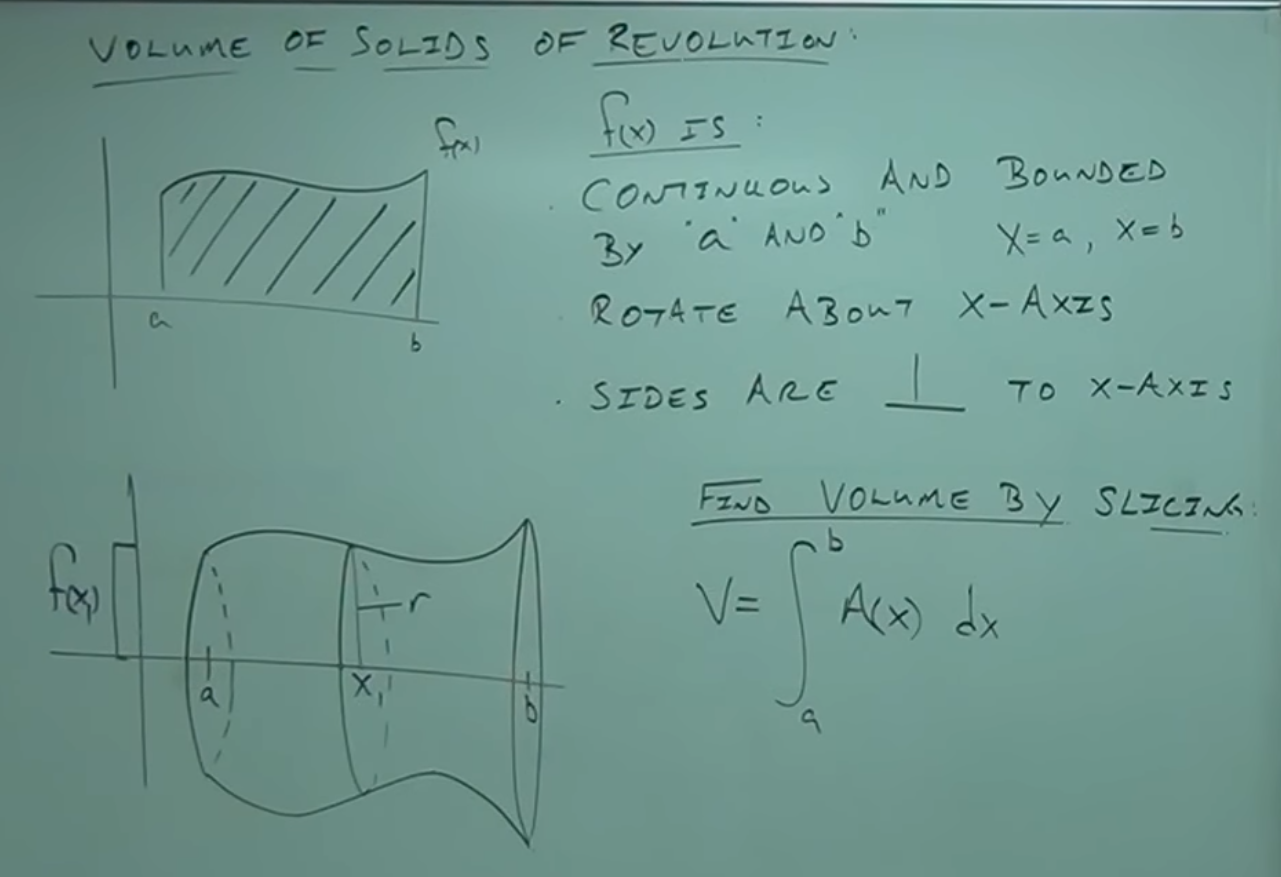 - [📷image-2]
- $𝓥=\displaystyle \int_{𝓪}^{𝓫} 𝓐(𝒙)\,dx$
- 54:20. Specifying the Cross-Sectional Area
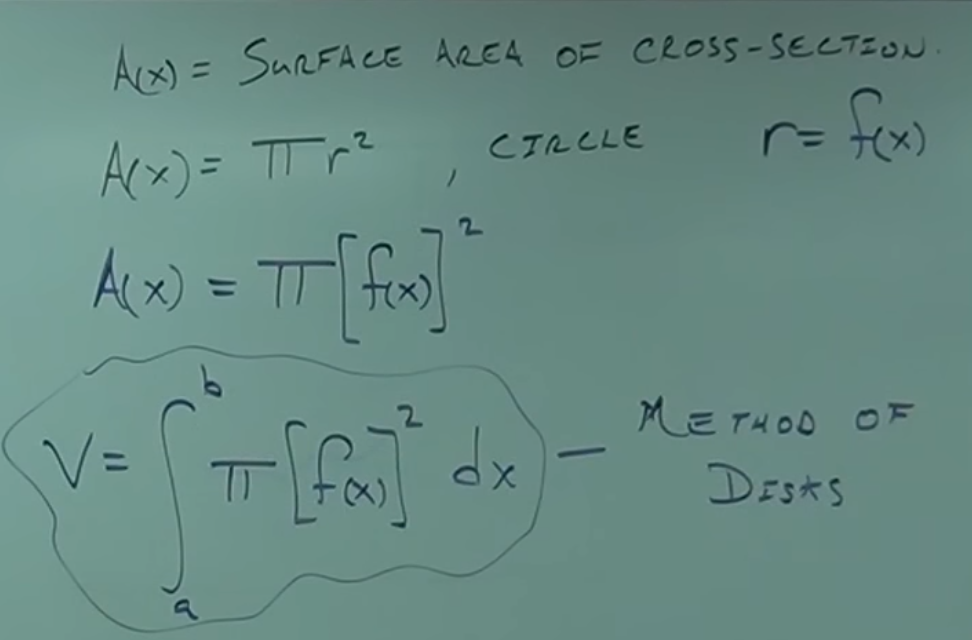
- $𝓐(𝒙)$ represents the area of each cross section
- The cross section is allways a circle: $𝓐(𝒙)=\pi r^{2}$
- $r=𝒇(𝒙)$; The radius $r$ is the height of $𝒇(𝒙)$.
- 57:45. Substituting to Get $𝓐(𝒙)$ in Terms of $𝒙$
- $𝓐(𝒙)=\pi r^{2}\;\Rightarrow\; 𝓐(𝒙)=\pi[𝒇(𝒙)]^{2}$
- 58:30. **The Disk Method Formula**
- $𝓥=\displaystyle \int_{𝓪}^{𝓫} 𝓐(𝒙)\,dx\;\Rightarrow\; \boxed{𝓥=\displaystyle
\int_{𝓪}^{𝓫} \pi[𝒇(𝒙)]^{2}\,dx}$
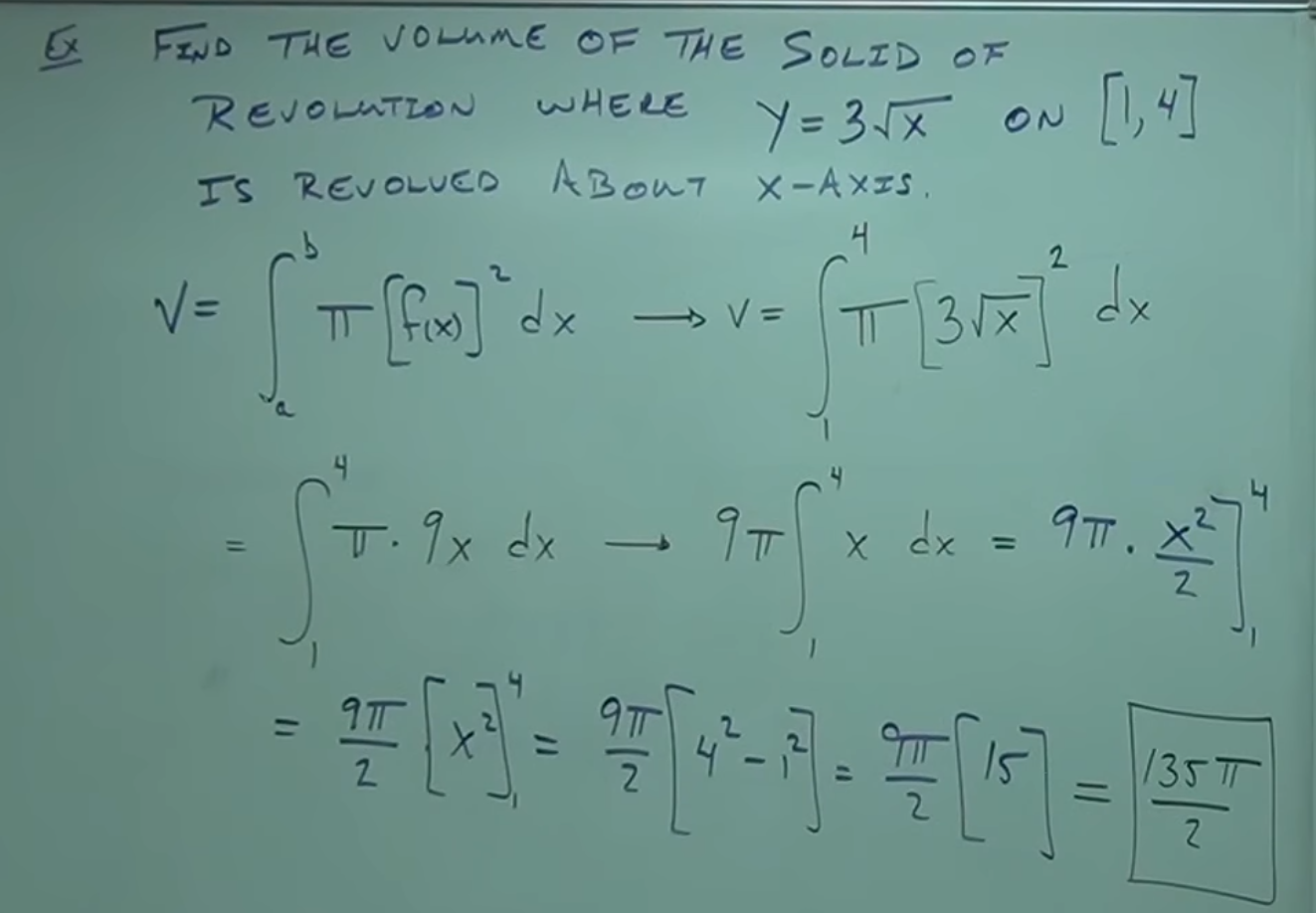
- 1:00:00.🧩 Example – 1: $𝒇(𝒙)=3\sqrt{𝒙}$ on $[1,4]$
- [📷image]
- The problem: find the volume of the solid of revolution
- Conditions: perpendicular sides to form circles
- Alternative wording of the problem
- Setting up the integral: $𝓥=\displaystyle \int_{𝓪}^{𝓫} \pi[𝒇(𝒙)]^{2}\,dx
\;\Rightarrow\; 𝓥=\displaystyle \int_{1}^{4} \pi[3\sqrt{𝒙}]^{2}\,dx$
- 31:53. Simplifying and Evaluating the Integral
- $\pi[3\sqrt{𝒙}]^{2}=9\pi 𝒙$
- $𝓥=\displaystyle \int_{1}^{4} 9\pi 𝒙\,dx$
- Factor out the constant: $9\pi \displaystyle \int_{1}^{4} 𝒙\,dx$
- The integral of $𝒙$ is $\displaystyle \frac{𝒙^{2}}{2}$
- $𝓥=9\pi \big[ \displaystyle \frac{𝒙^{2}}{2}\big]\Big|_{1}^{4}=9\pi
\big[\displaystyle \frac{16}{2}-\frac{1}{2}\big]=9\pi\big(\displaystyle \frac{15}{2}\big)= \displaystyle
\frac{135\pi}{2}$
- 1:09:00.
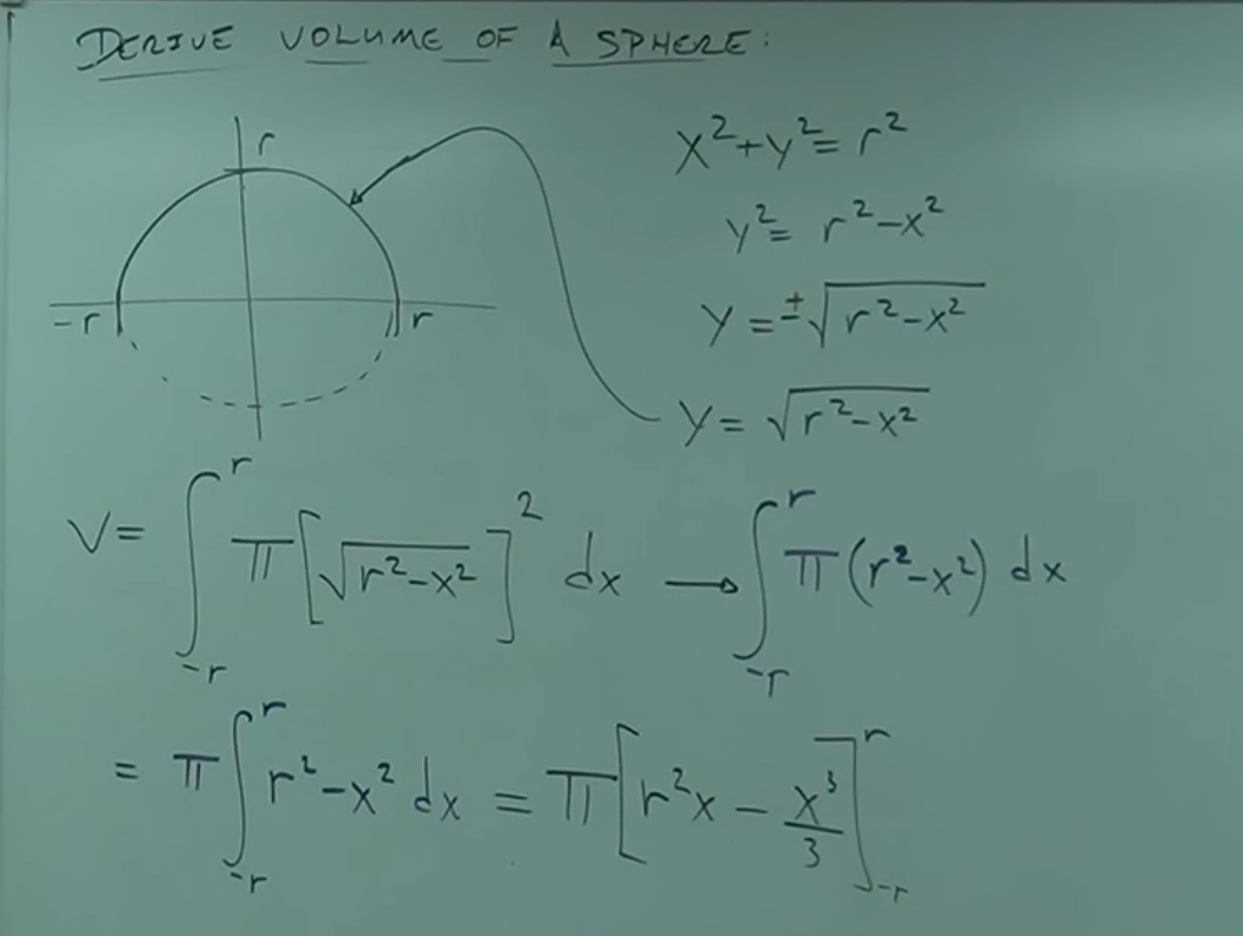
🧩 Example – 2: Finding the Volume of a Sphere
- [📷image-1]
 - [📷image-2]
- Circle equation: $𝒙^{2}+𝑦^{2}=r^{2}$
- Solving for $𝑦$: $𝑦=\pm\sqrt{r^{2}-𝒙^{2}}$
- Using the upper half: $𝒇(𝒙)=\sqrt{r^{2}-𝒙^{2}}$
- Integral setup:
- Volume $=\displaystyle \int_{-r}^{r} \pi\,[\sqrt{r^{2}-𝒙^{2}}]^{2}\,dx$
- 37:05. Simplify:
- Volume $=\displaystyle \int_{-r}^{r} \pi\,(r^{2}-𝒙^{2})\,dx$
- 37:23. Factor out $\pi$:
- Volume $=\pi \displaystyle \int_{-r}^{r} (r^{2}-𝒙^{2})\,dx$
- Integration and Evaluation
- The integral of $r^{2}$ is $r^{2}\cdot 𝒙$
- The integral of $𝒙^{2}$ is $\displaystyle \frac{𝒙^{3}}{3}$
- Volume $=\pi\left[\;r^{2}\cdot 𝒙-\dfrac{𝒙^{3}}{3}\;\right]_{-r}^{r}$
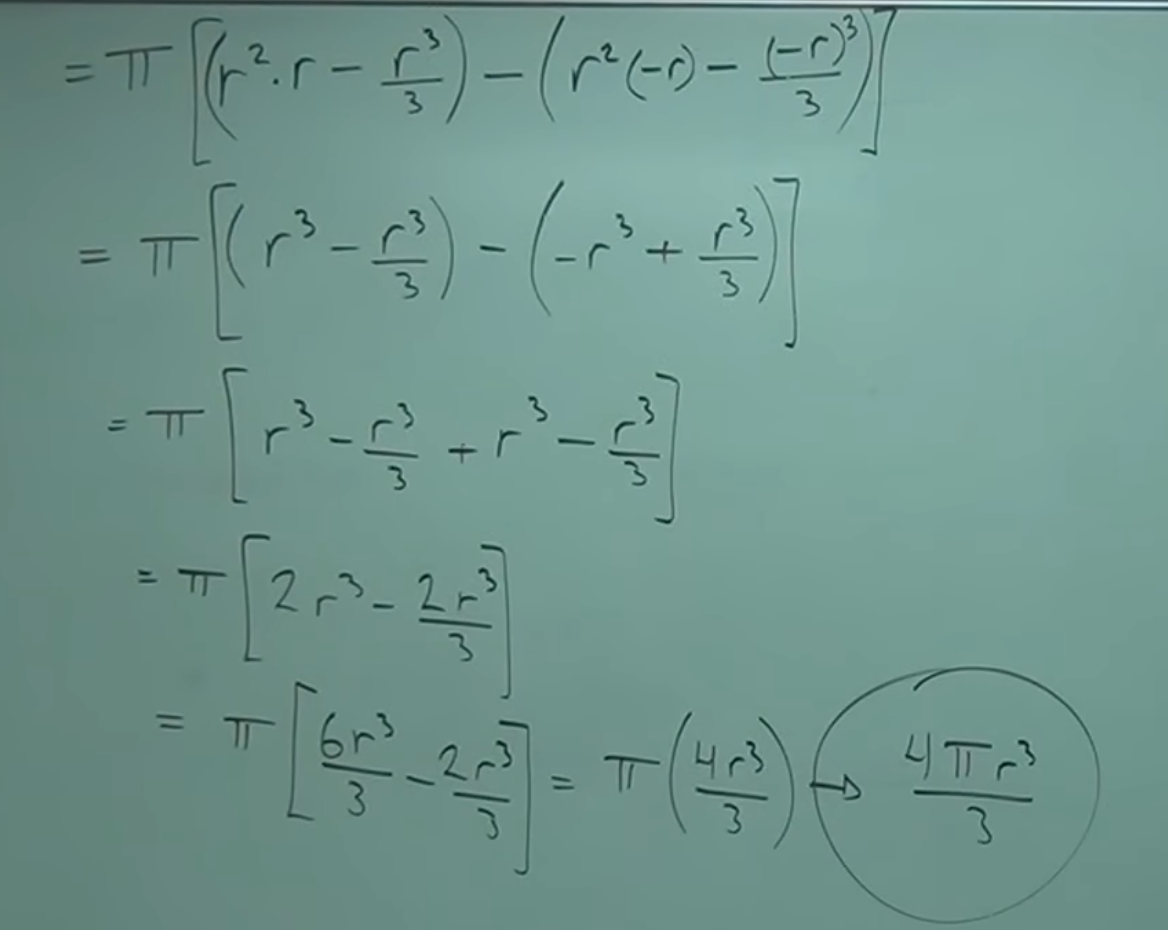
- At $𝒙=r$: $r^{2}\cdot r- \displaystyle \frac{r^{3}}{3}=r^{3}- \displaystyle
\frac{r^{3}}{3}$
- At $𝒙=-r$: $r^{2}\cdot(-r)- \displaystyle \frac{(-r)^{3}}{3}=-r^{3}+ \displaystyle
\frac{r^{3}}{3}$
- Subtracting gives: $\pi\big[(r^{3}- \displaystyle \frac{r^{3}}{3})-(-r^{3}+
\displaystyle \frac{r^{3}}{3})\big]$
- Simplifying: $\pi\big[2r^{3}- \displaystyle \frac{2r^{3}}{3}\big]=\pi\big[
\displaystyle \frac{6r^{3}}{3}- \displaystyle \frac{2r^{3}}{3}\big]=\pi\big[ \displaystyle
\frac{4r^{3}}{3}\big]$
- Sphere volume: $\displaystyle \frac{4}{3}\pi r^{3}$
Volume of solids of revolution ᎳᎪᏚᎻᎬᎡ ᎷᎬᎢᎻᎾᎠ
- 1:22:30.
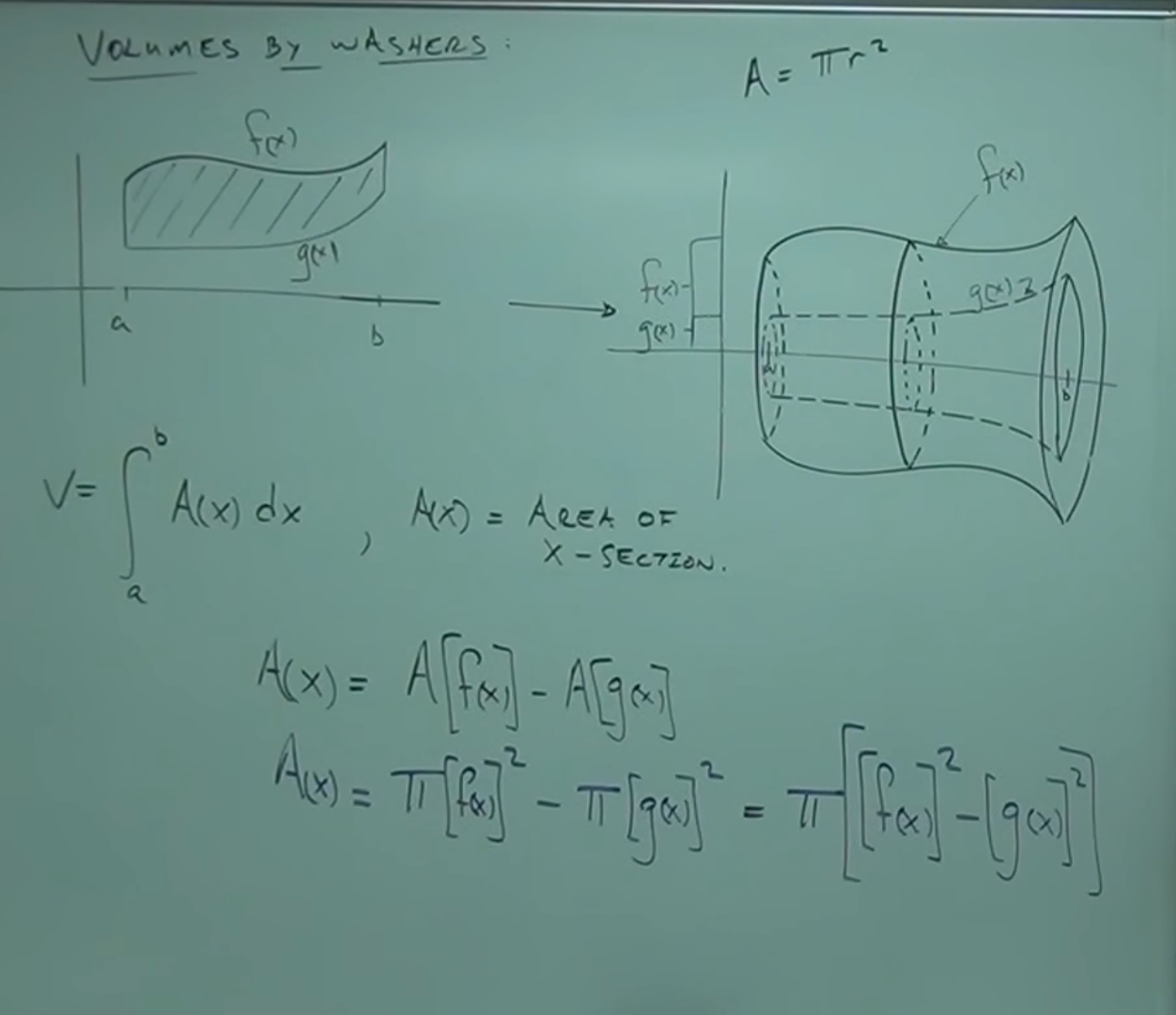
The General ᎳᎪᏚᎻᎬᎡ ᎷᎬᎢᎻᎾᎠ for Finding Volume
- [📷image-1]
 - [📷image-2]
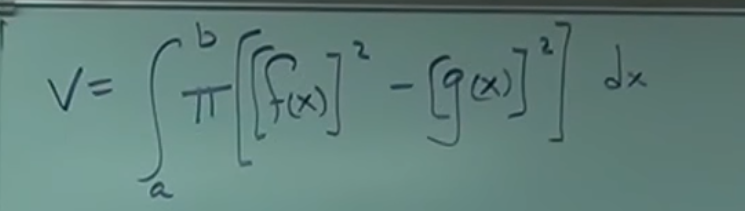
- What if there is another function $𝓰(𝒙)$ between $𝒇(𝒙)$ and the 𝒙-a𝒙is?
- A solid is created with a hollow region in the center
- Visualizing the solid with the hollow part
- 1:26:20.
Deduction of the ᎳᎪᏚᎻᎬᎡ ᎷᎬᎢᎻᎾᎠ Formula
- The volume is still the integral of the cross-sectional area
- $𝓥=\displaystyle \int_{𝓪}^{𝓫} 𝓐(𝒙)\,dx$; $𝓐=$ Cross-sectional area (area of
𝒙-section)
- Cross-sectional $𝓐=\text{Area}(𝒇(𝒙))-\text{Area}(𝓰(𝒙))$
- $\text{Area}(𝒇(𝒙))=\pi[𝒇(𝒙)]^{2}$; $\text{Area}(𝓰(𝒙))=\pi[𝓰(𝒙)]^{2}$
- The radius is the function height
- $𝒇(𝒙)$ is the function high at the point $𝒙$
- $𝓰(𝒙)$ is the function high at the point $𝒙$
- 1:31:10.
Summary and Formalization of the Formula
- Rotating the region between 𝒇(𝒙) and 𝓰(𝒙) around the 𝒙-a𝒙is
- Cross sections remain perpendicular to the 𝒙-a𝒙is
- Volume = $\displaystyle \int_{𝓪}^{𝓫} \text{Area}(𝒙)\,d𝒙$
- $𝓐(𝒙)=\pi[𝒇(𝒙)]^{2}-\pi[𝓰(𝒙)]^{2}$
- $𝓐(𝒙)=\pi\big([𝒇(𝒙)]^{2}-[𝓰(𝒙)]^{2}\big)$
- $\boxed{\displaystyle 𝓥=\int_{𝓪}^{𝓫}\pi\Big([𝒇(𝒙)]^{2}-[𝓰(𝒙)]^{2}\Big)\,d𝒙}$
- Also called “Volume by Washers”
- 1:34:10.
🧩 Example – Find the volume of the solid created: Area between $𝒇(𝒙)=𝒙^{2}+ \tfrac{1}{2}$ and $𝓰(𝒙)=𝒙$ on
$[0,2]$ is rotated about the 𝒙-axis.
- [📷image]
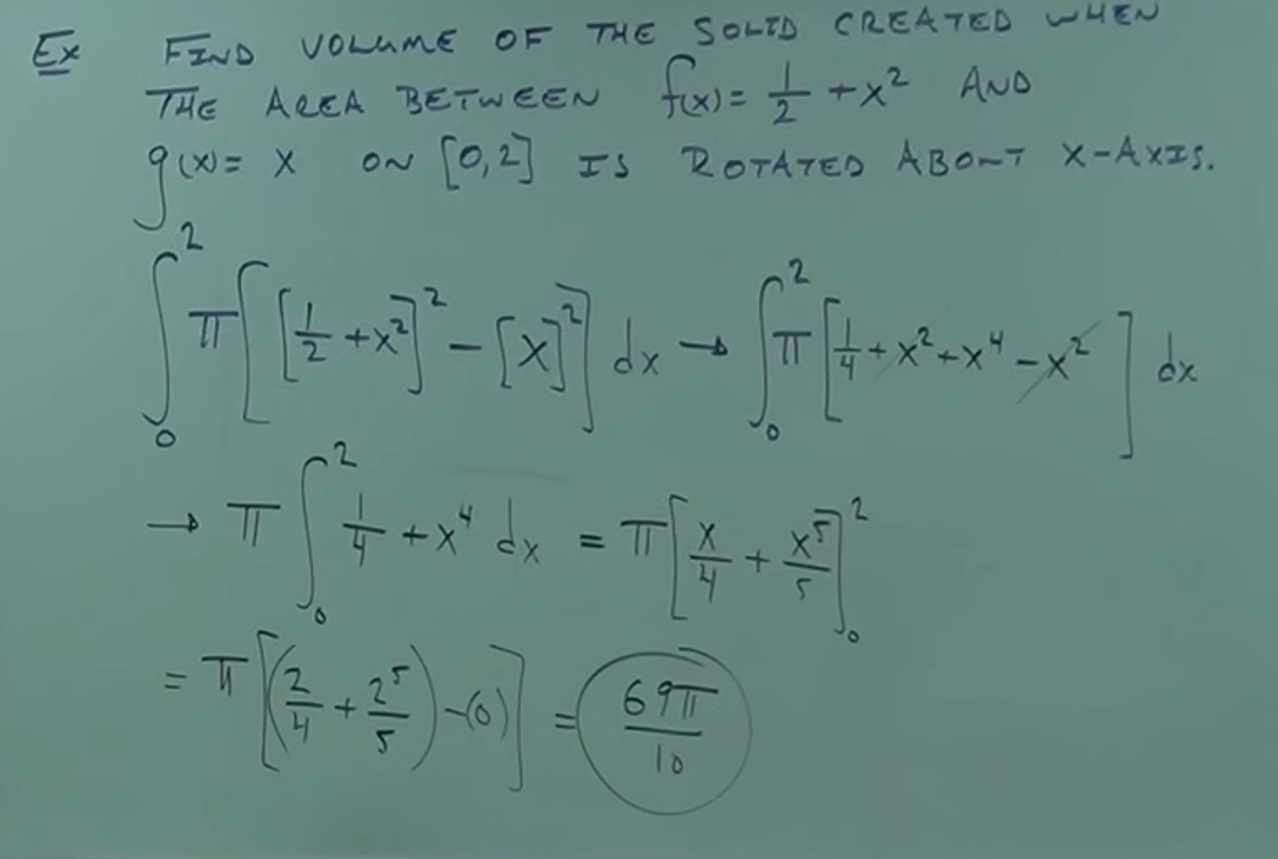
- Identifying the Upper Function
- **Importance of distinguishing which function is on top**
- How to know which function is “above”?
- Correct method: evaluate each function at a point within the interval
- $𝒇(1)=(1)^{2}+\dfrac{1}{2}=\dfrac{3}{2}$, $𝓰(1)=1$
- Conclusion: $𝒇(𝒙)$ is above $𝓰(𝒙)$
- Integral setup:
- $\displaystyle 𝓥=\int_{0}^{2}\pi\big([(𝒙)^{2}+\dfrac{1}{2}]^{2}-[𝒙]^{2}\big)\,d𝒙$
- 1:41:10. E𝒙panding and Simplifying the Integrand
- $[(𝒙)^{2}+\dfrac{1}{2}]^{2}=𝒙^{4}+𝒙^{2}+\dfrac{1}{4}$
- $\displaystyle 𝓥=\int_{0}^{2}\pi\big(𝒙^{4}+𝒙^{2}+\tfrac{1}{4}-𝒙^{2}\big)\,d𝒙$
- Cancel terms: $\displaystyle 𝓥=\int_{0}^{2}\pi\big(𝒙^{4}+\tfrac{1}{4}\big)\,d𝒙$
- Factor out $\pi$: $\displaystyle 𝓥=\pi\int_{0}^{2}\big(𝒙^{4}+\tfrac{1}{4}\big)\,d𝒙$
- Integration and Final Evaluation
- The integral of $𝒙^{4}$ is $\tfrac{𝒙^{5}}{5}$
- The integral of $\tfrac{1}{4}$ is $\tfrac{𝒙}{4}$
- $\displaystyle
𝓥=\pi\left[\dfrac{𝑦^{2}}{2}-\dfrac{𝑦^{5}}{5}\right]_{0}^{2}=\pi\left(\dfrac{1}{2}-\dfrac{1}{5}\right)=\dfrac{3\pi}{10}$
- At $𝒙=2$: $\displaystyle
\pi\left[\dfrac{(2)^{5}}{5}+\dfrac{2}{4}\right]=\pi\left[\dfrac{32}{5}+\dfrac{1}{2}\right]$
- At $𝒙=0$: $0$
- Subtract and simplify: Volume $= \displaystyle
\pi\left[\dfrac{32}{5}+\dfrac{1}{2}\right]=\pi\left[\dfrac{64}{10}+\dfrac{5}{10}\right]=\dfrac{69\pi}{10}$
Volumes where 𝒙-section is perpendicular to 𝒚-axis
- 1:46:23.
Volumes with cross-sections ⟂ to the 𝒚-axis (discs & washers in 𝒅𝒚)
- [📷image]
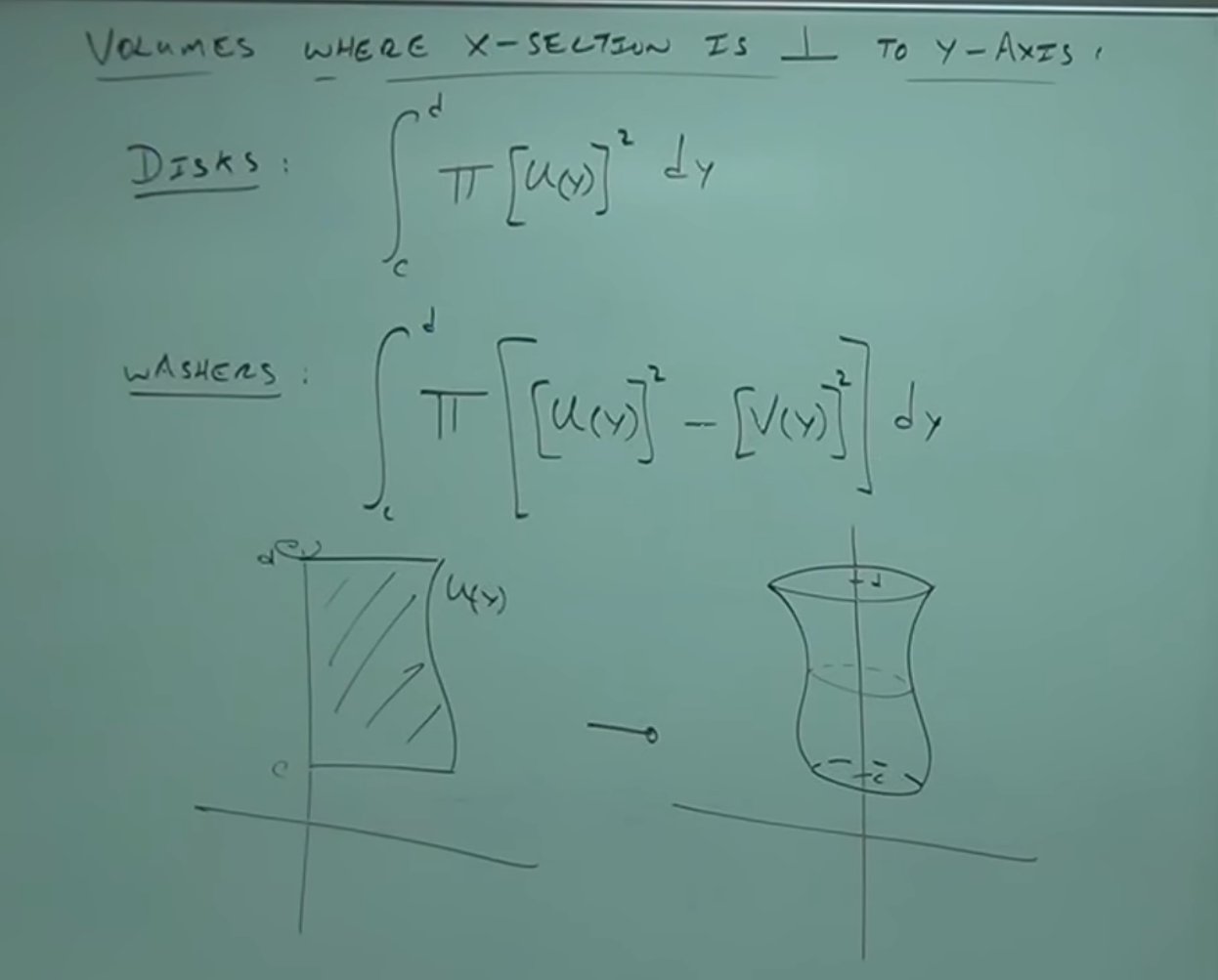
- Setup (compare to the 𝒙-axis case)
- Previously: cross-sections ⟂ to 𝒙 ⇒ integrate 𝒅𝒙 on $[𝓪,𝓫]$
- Now: cross-sections ⟂ to 𝒚 ⇒ integrate 𝒅𝒚 on $[𝓬,𝓭]$
- Discs method in 𝒅𝒚
- $\displaystyle 𝓥=\int_{𝓬}^{𝓭}\pi\,[𝒖(𝑦)]^{2}\,d𝑦$, where $𝒖(𝑦)$ is the radius
(expressed as 𝒙 in terms of 𝑦)
- Functions must be written **in terms of 𝑦** (solve for $𝒙=𝒖(𝑦)$)
- Washers method in 𝒅𝒚
- $\boxed{\displaystyle 𝓥=\int_{𝓬}^{𝓭}\pi\big([𝒖(𝑦)]^{2}-[𝒗(𝑦)]^{2}\big)\,d𝑦}$
- With $𝒖(𝑦)\ge 𝒗(𝑦)$ for all $𝑦\in[𝓬,𝓭]$
- Still 𝒙 as functions of 𝑦: “right (outer) − left (inner)” radii measured
horizontally
- Key note (variable consistency)
- Revolve **around 𝒙-axis** ⇒ write curves as $𝑦=𝒇(𝒙)$, bounds in 𝒙, integrate 𝒅𝒙
- Revolve **around 𝒚-axis** ⇒ write curves as $𝒙=𝒖(𝑦)$, bounds in 𝑦, integrate 𝒅𝑦
1:49:57.
🧩 Example 1 – :Revolve $𝑦=\sqrt{𝒙}$ around the 𝒚-axis, with $𝑦\in[0,2]$ (discs in 𝒅𝒚)
- [📷image]
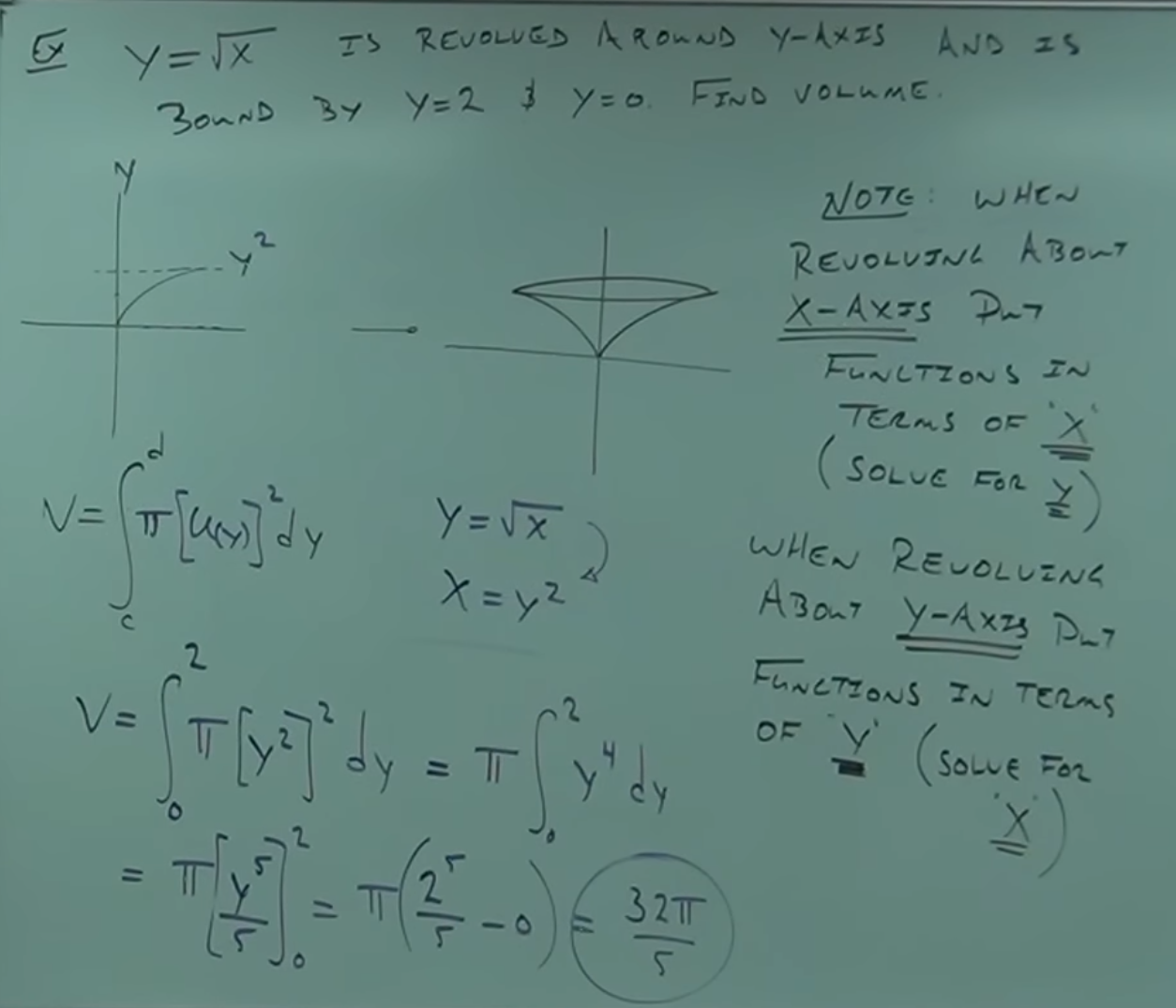
- 1:54:26. Put function in terms of 𝑦
- $𝑦=\sqrt{𝒙}\;\Rightarrow\; 𝒙=𝑦^{2}$ (this is the radius $𝒖(𝑦)$)
- Set up (perpendicular to 𝒚 ⇒ discs)
- $𝓬=0$, $𝓭=2$
- $\displaystyle 𝓥=\int_{0}^{2}\pi\,(𝑦^{2})^{2}\,d𝑦$
- Evaluate
- $\displaystyle
𝓥=\pi\int_{0}^{2}𝑦^{4}\,d𝑦=\pi\left[\dfrac{𝑦^{5}}{5}\right]_{0}^{2}=\dfrac{32\pi}{5}$
- Result: $\displaystyle 𝓥=\dfrac{32\pi}{5}$ (Revolving the **same region** about 𝒙-axis
gives a **different** volume.)
2:00:23.
🧩 Example 1 – Same curve, revolve around 𝒙-axis (discs in 𝒅𝒙)
- [📷image]
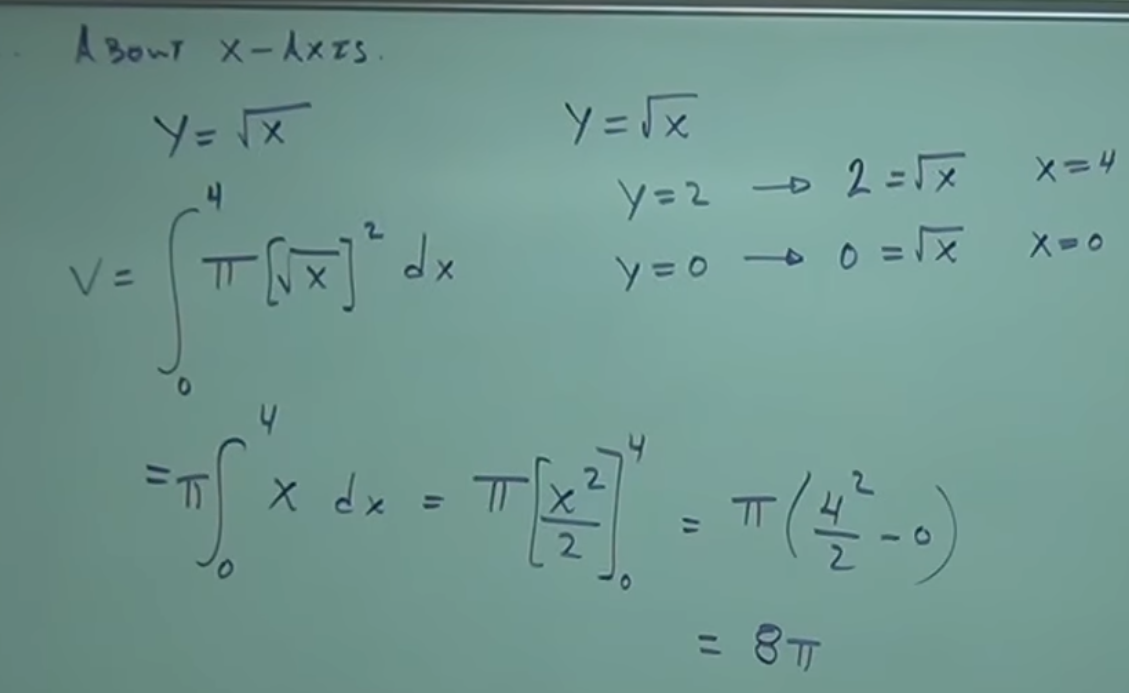
- Bounds conversion
- Given $𝑦=\sqrt{𝒙}$ on $𝑦\in[0,2]$ ⇒ plug $𝑦=0$ and $𝑦=2$ into $𝑦=\sqrt{𝒙}$:
$𝒙\in[0,4]$
- Set up
- $\displaystyle
𝓥=\int_{0}^{4}\pi\,(𝑦(𝒙))^{2}\,d𝒙=\int_{0}^{4}\pi\,(\sqrt{𝒙})^{2}\,d𝒙=\int_{0}^{4}\pi\,𝒙\,d𝒙$
- Evaluate
- $\displaystyle 𝓥=\pi\left[\dfrac{𝒙^{2}}{2}\right]_{0}^{4}=8\pi$
- Conclusion: $\displaystyle \dfrac{32\pi}{5}\neq 8\pi$ (axis of rotation matters).
2:03:44.
🧩 Example – 2:Area between $𝑦=𝒙^{2}$ and $𝑦=𝒙^{3}$, revolved around 𝒙-axis (washers in 𝒅𝒙)
- [📷image]
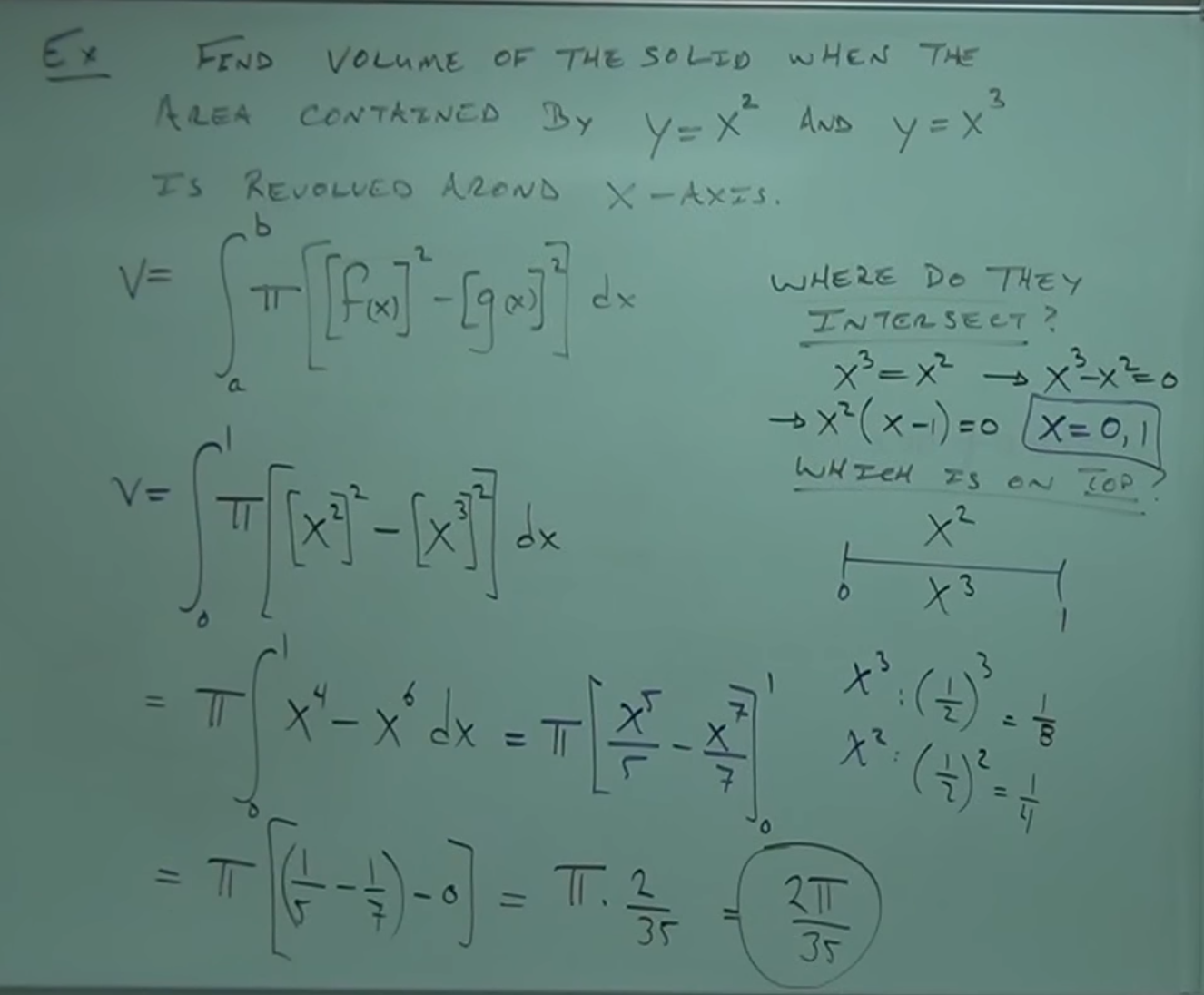
- Goal & method
- $\displaystyle 𝓥=\int_{𝓪}^{𝓫}\pi\big([𝒇(𝒙)]^{2}-[𝓰(𝒙)]^{2}\big)\,d𝒙$
- Cross-sections ⟂ to 𝒙-axis ⇒ **washers** (outer radius − inner radius), integrate
𝒅𝒙
- Radii are vertical distances to the axis $𝑦=0$: $𝒇(𝒙)$ = top, $𝓰(𝒙)$ = bottom
- Intersections & interval in 𝒙
- Set $𝒙^{3}=𝒙^{2}\Rightarrow 𝒙^{2}(𝒙-1)=0\Rightarrow 𝒙=0,1$
- Test on $(0,1)$: at $𝒙=\tfrac{1}{2}$, $𝒙^{2}=\tfrac{1}{4}$, $𝒙^{3}=\tfrac{1}{8}$ ⇒
**top $=𝒙^{2}$**, **bottom $=𝒙^{3}$** on $[0,1]$
- Both curves are $\ge 0$ and continuous on $[0,1]$ ⇒ washer formula applies on one
piece
- Radii (vertical)
- Outer radius $𝒇(𝒙)=𝒙^{2}$ (farther from $𝑦=0$)
- Inner radius $𝓰(𝒙)=𝒙^{3}$ (closer to $𝑦=0$)
- Cross-sectional area:
$𝓐(𝒙)=\pi\big([𝒙^{2}]^{2}-[𝒙^{3}]^{2}\big)=\pi(𝒙^{4}-𝒙^{6})$
- Set up the integral
- $\displaystyle
𝓥=\int_{0}^{1}\pi\big([𝒙^{2}]^{2}-[𝒙^{3}]^{2}\big)\,d𝒙=\pi\int_{0}^{1}(𝒙^{4}-𝒙^{6})\,d𝒙$
- Evaluate
- $\displaystyle
𝓥=\pi\left[\dfrac{𝒙^{5}}{5}-\dfrac{𝒙^{7}}{7}\right]_{0}^{1}=\pi\left(\dfrac{1}{5}-\dfrac{1}{7}\right)=\pi\cdot\dfrac{2}{35}$
- Result: $\displaystyle 𝓥=\dfrac{2\pi}{35}$
2:13:35.
🧩 Example – 3:Revolve between $𝑦=𝒙^{2}$ and $𝒙=𝑦^{2}$, revolved around 𝑦-axis (washers in 𝒅𝑦)
- [📷image]
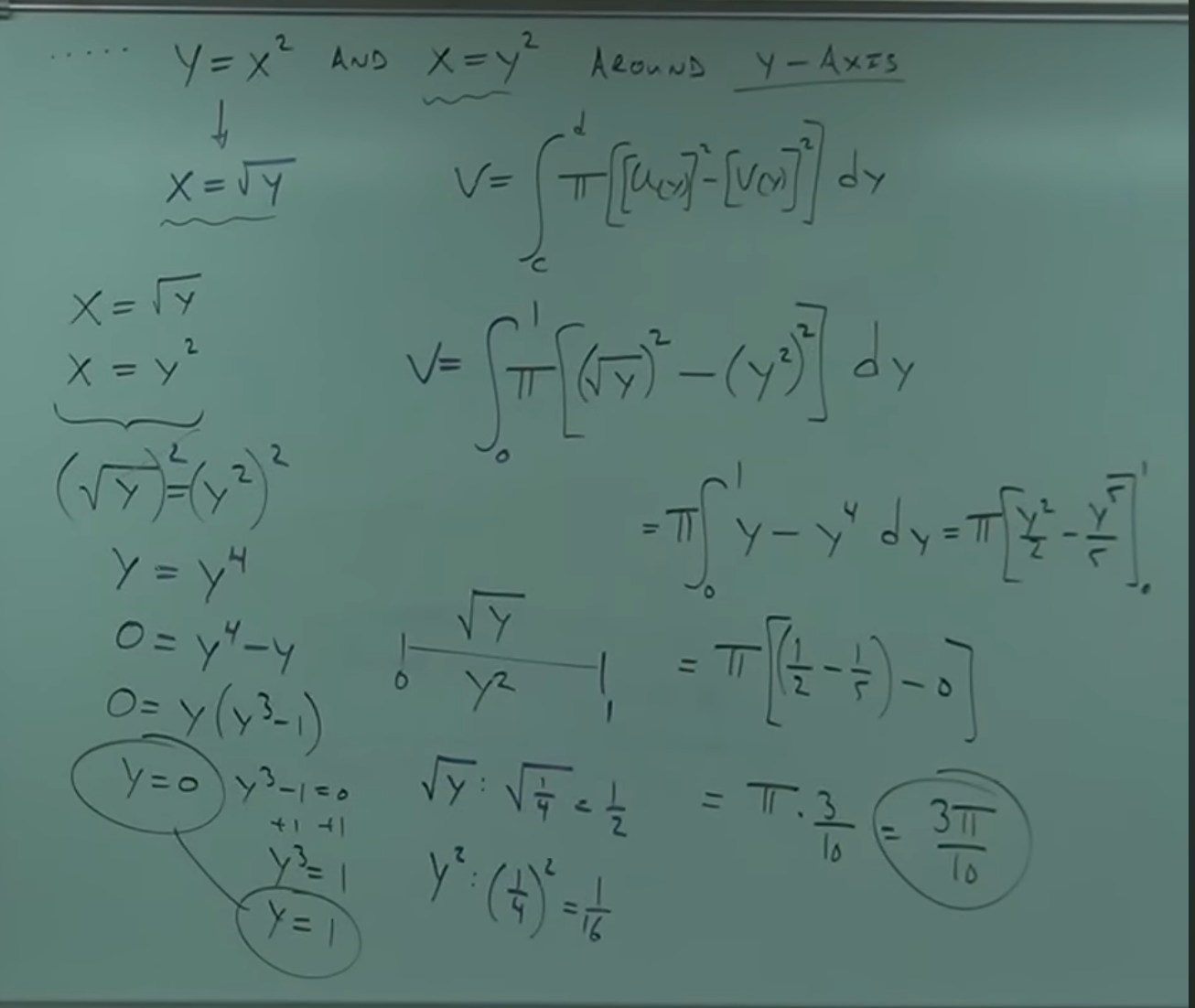
- Goal & method
- $\displaystyle 𝓥=\int_{𝓬}^{𝓭}\pi\big([𝒖(𝑦)]^{2}-[𝒗(𝑦)]^{2}\big)\,d𝑦$
- Cross-sections ⟂ to 𝒚-axis ⇒ **washers** (right/outer − left/inner), integrate 𝒅𝑦
- Write curves **in terms of 𝑦** (solve for $𝒙=\dots$) to measure horizontal radii
- Put functions in terms of 𝑦
- From $𝑦=𝒙^{2}\Rightarrow 𝒙=\sqrt{𝑦}$ (right/outer curve)
- Given $𝒙=𝑦^{2}$ (left/inner curve).
- Whiteboard check: $((\sqrt{𝑦})^{2}=(𝑦^{2})^{2}\Rightarrow 𝑦=𝑦^{4}\Rightarrow
𝑦(𝑦^{3}-1)=0)$
- Intersections: $𝑦=0, 𝑦=1$ ⇒ interval $[𝓬,𝓭]=[0,1]$
- Radii (horizontal, measured from the 𝒚-axis)
- Outer radius $𝒖(𝑦)=𝒙_{\text{right}}=\sqrt{𝑦}$
- Inner radius $𝒗(𝑦)=𝒙_{\text{left}}=𝑦^{2}$
- Cross-sectional area:
$𝓐(𝑦)=\pi\big([\sqrt{𝑦}]^{2}-[𝑦^{2}]^{2}\big)=\pi(𝑦-𝑦^{4})$
- Set up the integral
- $\displaystyle
𝓥=\int_{0}^{1}\pi\big([\sqrt{𝑦}]^{2}-[𝑦^{2}]^{2}\big)\,d𝑦=\pi\int_{0}^{1}(𝑦-𝑦^{4})\,d𝑦$
- Evaluate
- $\displaystyle
𝓥=\pi\left[\dfrac{𝑦^{2}}{2}-\dfrac{𝑦^{5}}{5}\right]_{0}^{1}=\pi\left(\dfrac{1}{2}-\dfrac{1}{5}\right)=\dfrac{3\pi}{10}$
- Result: $\displaystyle 𝓥=\dfrac{3\pi}{10}$
2:25:07.
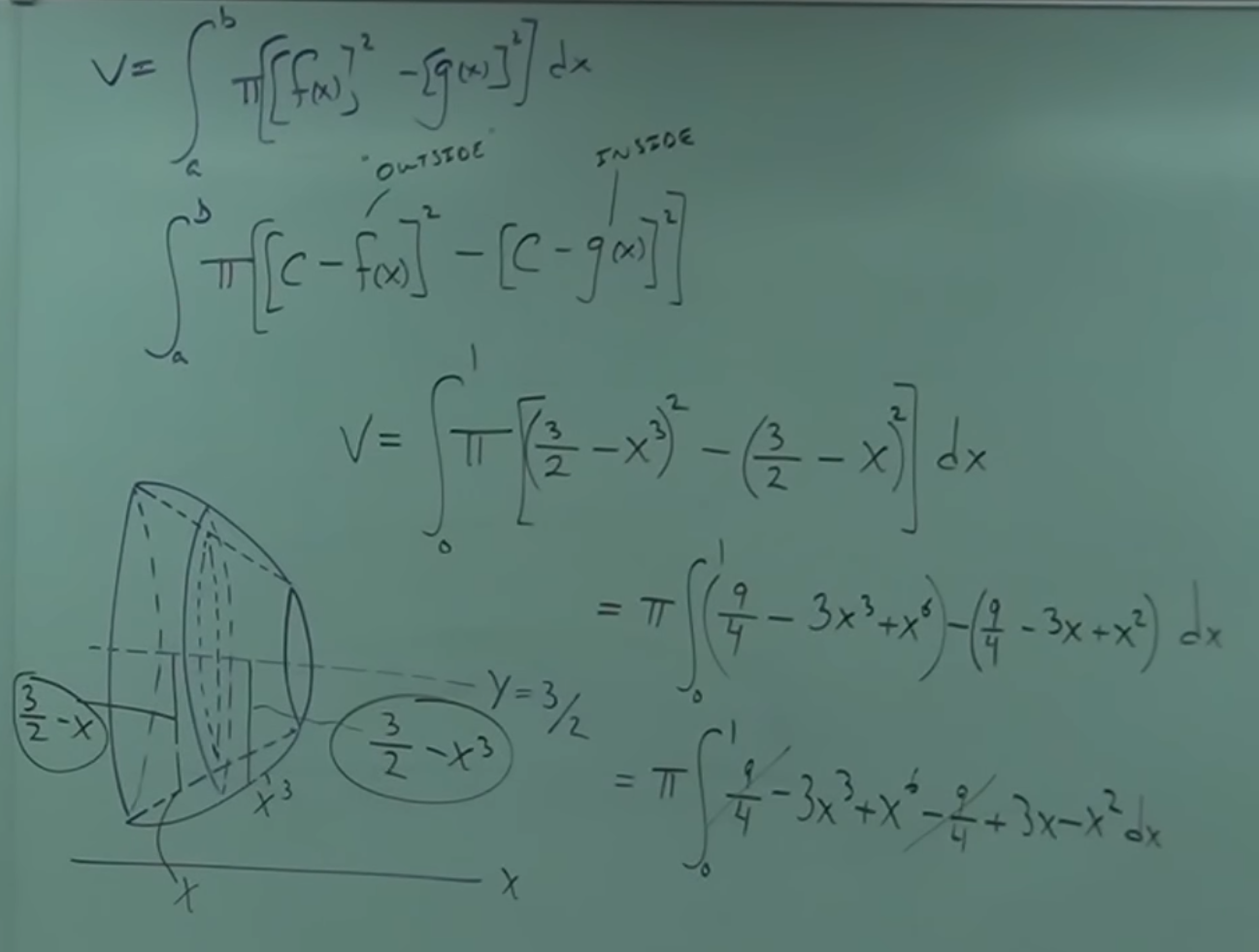
🧩 Example – 4:Revolve between $𝑦=𝒙$ (outside) and $𝑦=𝒙^{3}$ (inside) about $𝑦=\tfrac{3}{2}$ (shifted axis,
washers in 𝒅𝒙)
- [📷image-1]
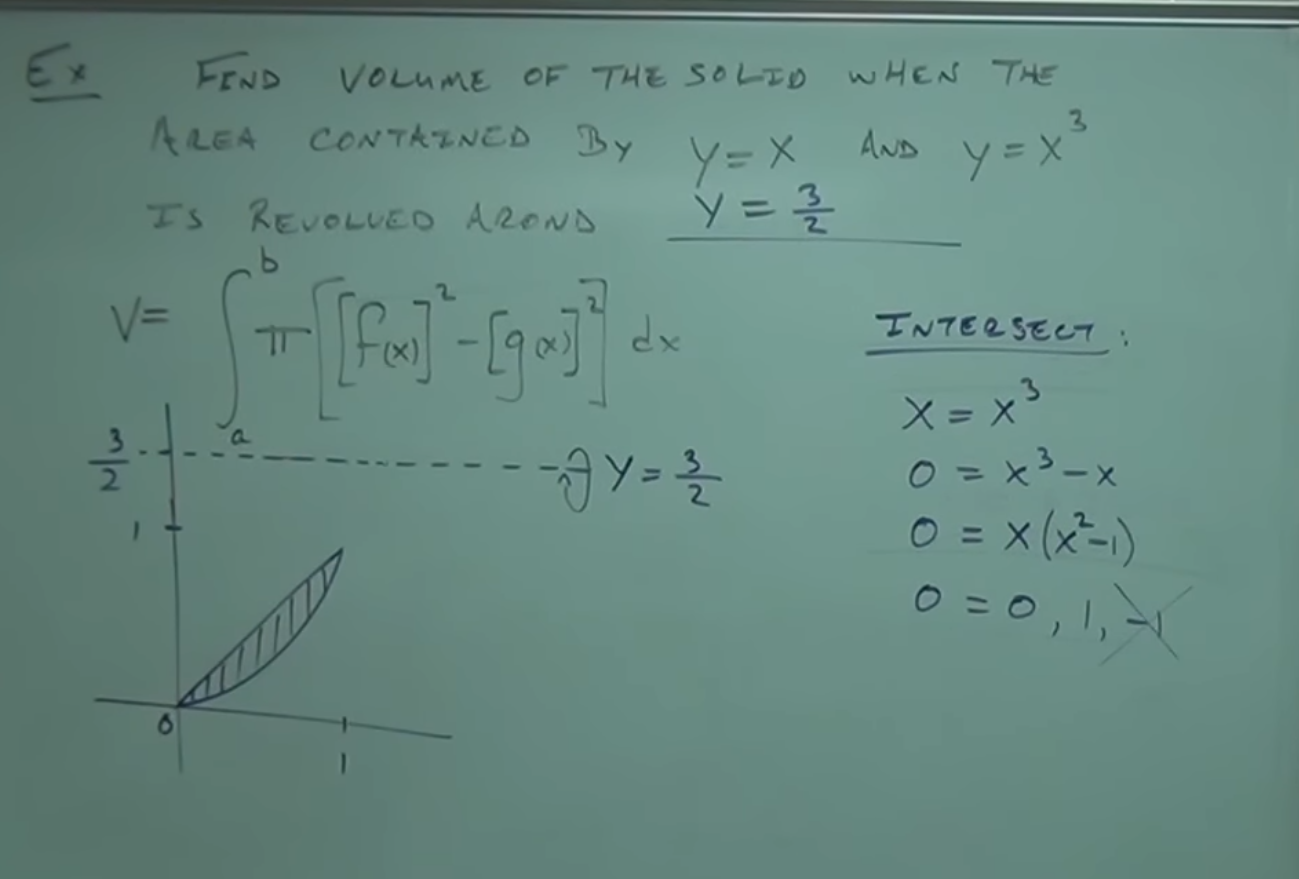 - [📷image-2]
 - [📷image-3]
- Goal & method
- $\displaystyle 𝓥=\int_{𝓪}^{𝓫}\pi\big([𝒇(𝒙)]^{2}-[𝓰(𝒙)]^{2}\big)\,d𝒙$
- Axis of rotation is the horizontal line $𝑦=\tfrac{3}{2}$ ⇒ cross-sections ⟂ to
𝒙-axis ⇒ **washers** in 𝒅𝒙.
- Radii are **vertical distances** from the axis $𝑦=\tfrac{3}{2}$ to each curve (outer
− inner)
- Intersections & interval in 𝒙
- Set $𝑦=𝒙$ and $𝑦=𝒙^{3}$ equal: $𝒙^{3}=𝒙^{2}\Rightarrow 𝒙^{2}(𝒙-1)=0\Rightarrow
𝒙=0,1$
- On $(0,1)$: test $𝒙=\tfrac{1}{2}$ ⇒ $\tfrac{1}{2}>\tfrac{1}{8}$ ⇒ **outer curve** is
$𝑦=𝒙$, **inner curve** is $𝑦=𝒙^{3}$
- Radii with respect to $𝑦=\tfrac{3}{2}$ (vertical distances)
- Outer radius $𝑹_{\text{out}}(𝒙)=\dfrac{3}{2}-𝒙^{3}$ (farther from the axis)
- Inner radius $𝑹_{\text{in}}(𝒙)=\dfrac{3}{2}-𝒙$ (closer to the axis)
- Cross-sectional area: $𝓐(𝒙)=\pi\big(𝑹_{\text{out}}^{2}-𝑹_{\text{in}}^{2}\big)$
- Set up the washer integral
- $\displaystyle
𝓥=\int_{0}^{1}\pi\Big[\big(\dfrac{3}{2}-𝒙^{3}\big)^{2}-\big(\dfrac{3}{2}-𝒙\big)^{2}\Big]\,d𝒙$
- Expand to simplify before integrating
- $\left(\dfrac{3}{2}-𝒙^{3}\right)^{2}=\dfrac{9}{4}-3𝒙^{3}+𝒙^{6};\;
\left(\dfrac{3}{2}-𝒙\right)^{2}=\dfrac{9}{4}-3𝒙+𝒙^{2}$
- Difference: $𝒙^{6}-3𝒙^{3}+3𝒙-𝒙^{2}$
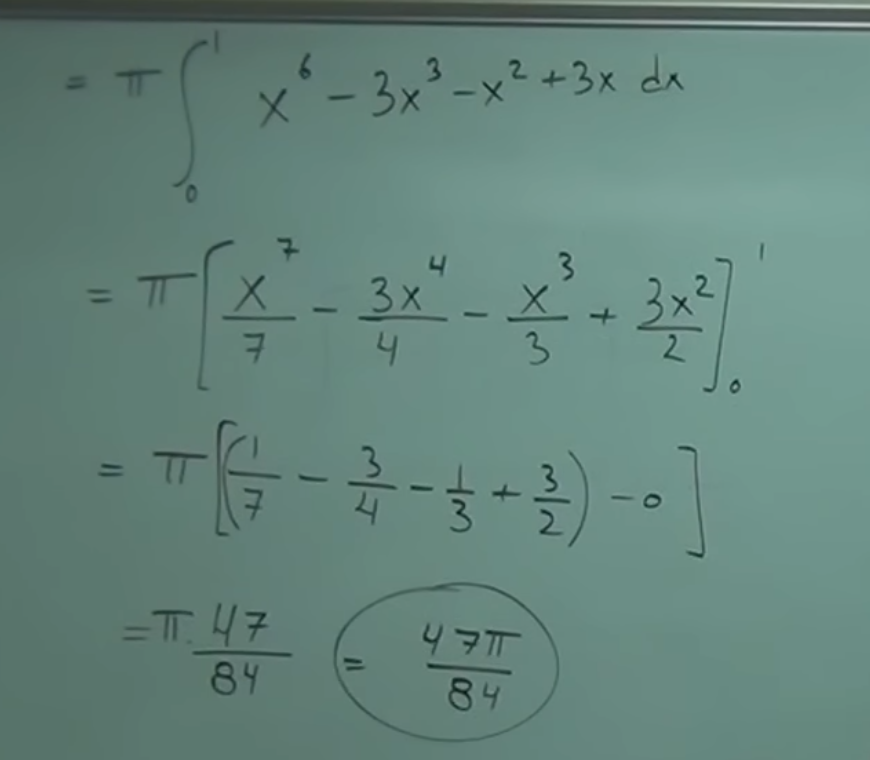
- $\displaystyle 𝓥=\pi\int_{0}^{1}\big(𝒙^{6}-3𝒙^{3}-𝒙^{2}+3𝒙\big)\,d𝒙$
(reordered terms).
Evaluate
- Antiderivative: $\displaystyle
\frac{𝒙^{7}}{7}-\frac{3}{4}𝒙^{4}-\frac{𝒙^{3}}{3}+\frac{3}{2}𝒙^{2}$
- Plug bounds: $\displaystyle
𝓥=\pi\left(\frac{1}{7}-\frac{3}{4}-\frac{1}{3}+\frac{3}{2}\right)=\pi\cdot\frac{47}{84}$
Result: $\displaystyle 𝓥=\frac{47\pi}{84}$