Calculus 1 Lecture 5.3
Volume of Solids By Cylindrical Shells Method
The Cylindrical Shells Method
- 00:01.
Introduction to the Cylindrical Shells Method
- [📷image]
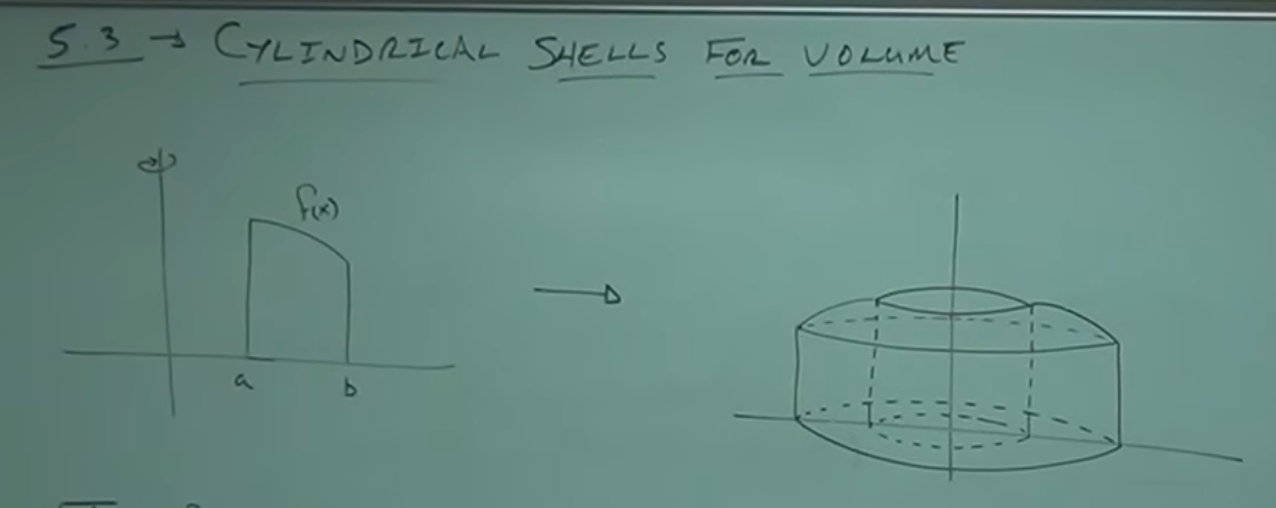
- Main idea: Calculate the volume of a solid of revolution around the 𝑦-axis, bounded by
vertical lines 𝓐 and 𝓑 and a function 𝒇(𝒙)
- Alternative to the disk/washer method: The disk/washer method would require two integrals;
cylindrical shells aim to solve it with a single integral
- Visualization: The region is considered a function of 𝒙 rotated around the 𝑦-axis
- Cake analogy: The method is explained using the analogy of slicing a cake into concentric
cylindrical layers with a "coffee cutter"
- Idea of limits: The thickness of each cylinder tends to be very, very small
- 02:53.
Volume of a Cylinder
- [📷image]
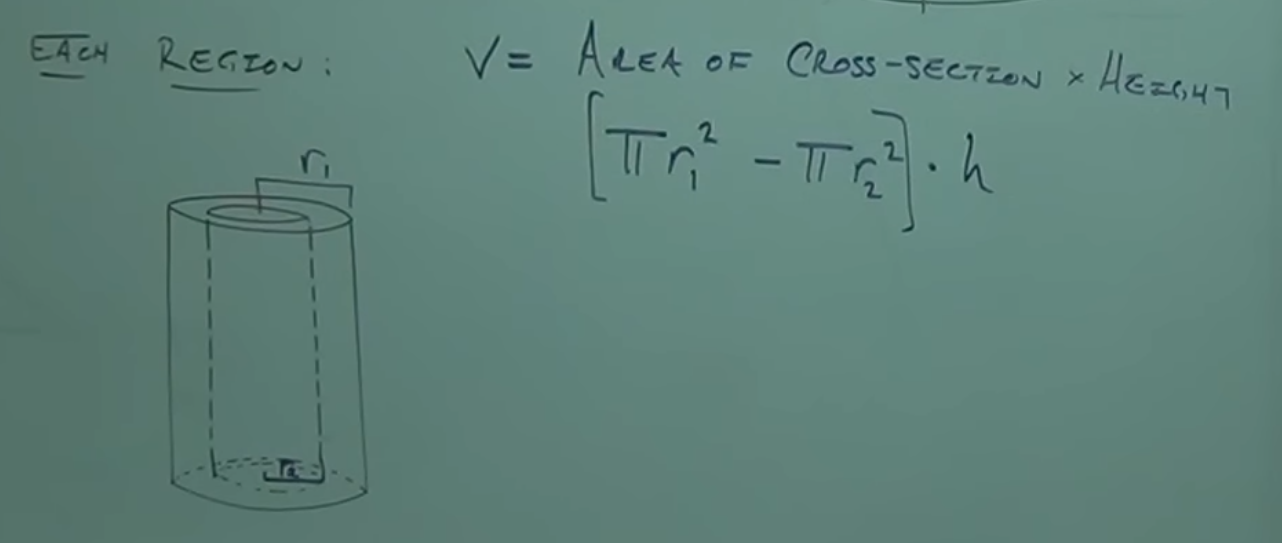
- Volume is the cross-sectional area multiplied by the height
- The cross-section is a circle (or a washer), obtained by subtracting a smaller circle from
a larger one
- Cross-sectional area: $\pi\cdot \mathcal{R}_1^2 - \pi\cdot \mathcal{R}_2^2$, where
$\mathcal{R}_1$ and $\mathcal{R}_2$ are the outer and inner radii
- The height is the function 𝒇(𝒙)
- An arbitrary point is chosen to determine the height
- 06:52.
Mathematical Development of the Formula
- [📷image]
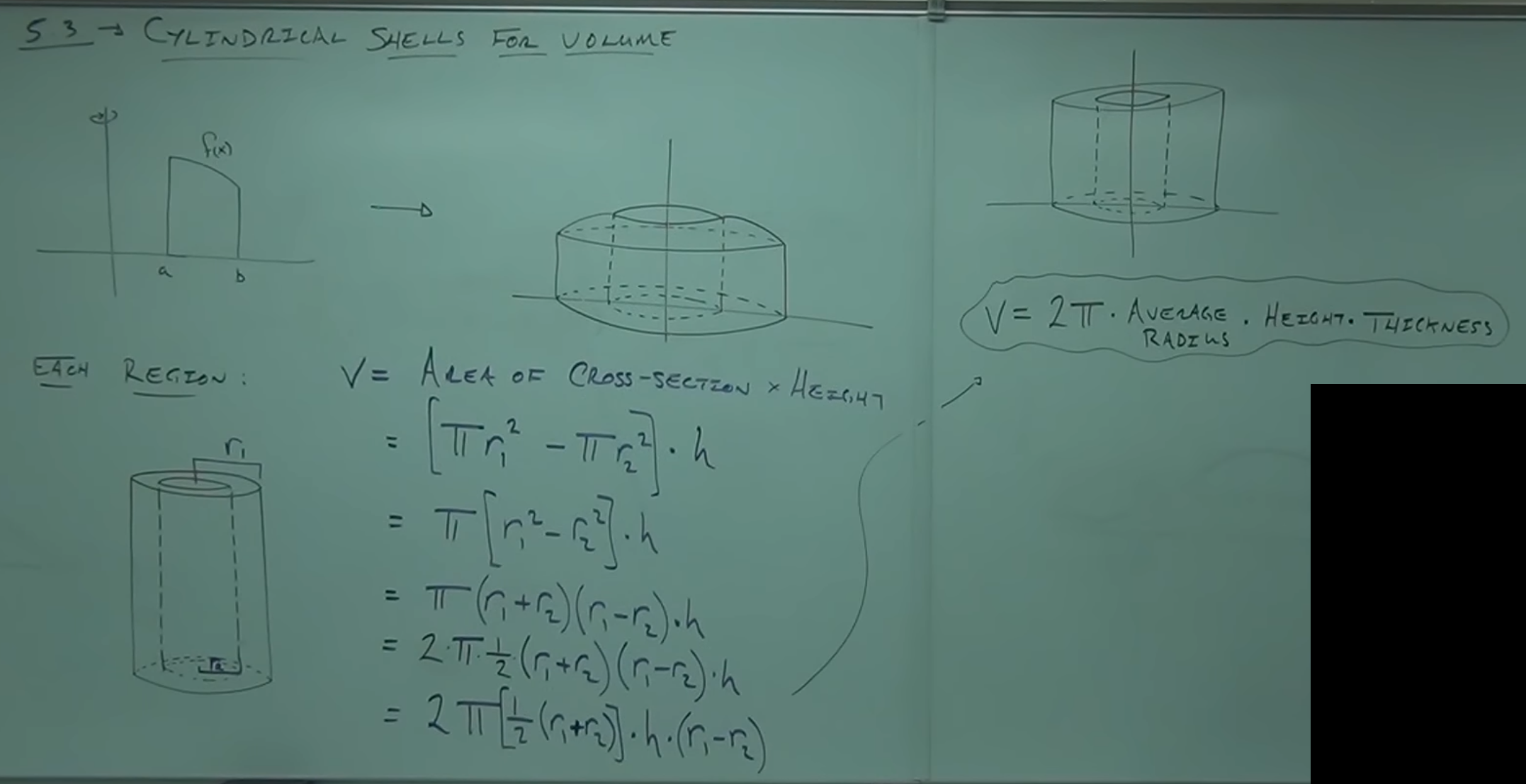
- Volume = Cross-sectional area × height
- Factoring out π: $\pi(\mathcal{R}_1^2-\mathcal{R}_2^2)\cdot \mathcal{h}$
- Difference of squares: $\pi(\mathcal{R}_1+\mathcal{R}_2)(\mathcal{R}_1-\mathcal{R}_2)\cdot
\mathcal{h}$
- Multiplication by $\dfrac{2}{2}$ → $2\cdot\dfrac{1}{2}$:
$2\pi\cdot\dfrac{1}{2}\cdot(\mathcal{R}_1+\mathcal{R}_2)\cdot(\mathcal{R}_1-\mathcal{R}_2)\cdot \mathcal{h}$
- Identification of terms:
- 𝒉 = height
- $\mathcal{R}_1-\mathcal{R}_2$ = thickness of the cylindrical shell
- $\dfrac{1}{2}(\mathcal{R}_1+\mathcal{R}_2)$ = average radius
- 11:40.
General formula:
- **Volume = $2\pi \cdot (\text{average radius}) \cdot (\text{height}) \cdot
(\text{thickness})$**
- 13:00.
Connection with the Function 𝒇(𝒙) and the Differential
- [📷image]
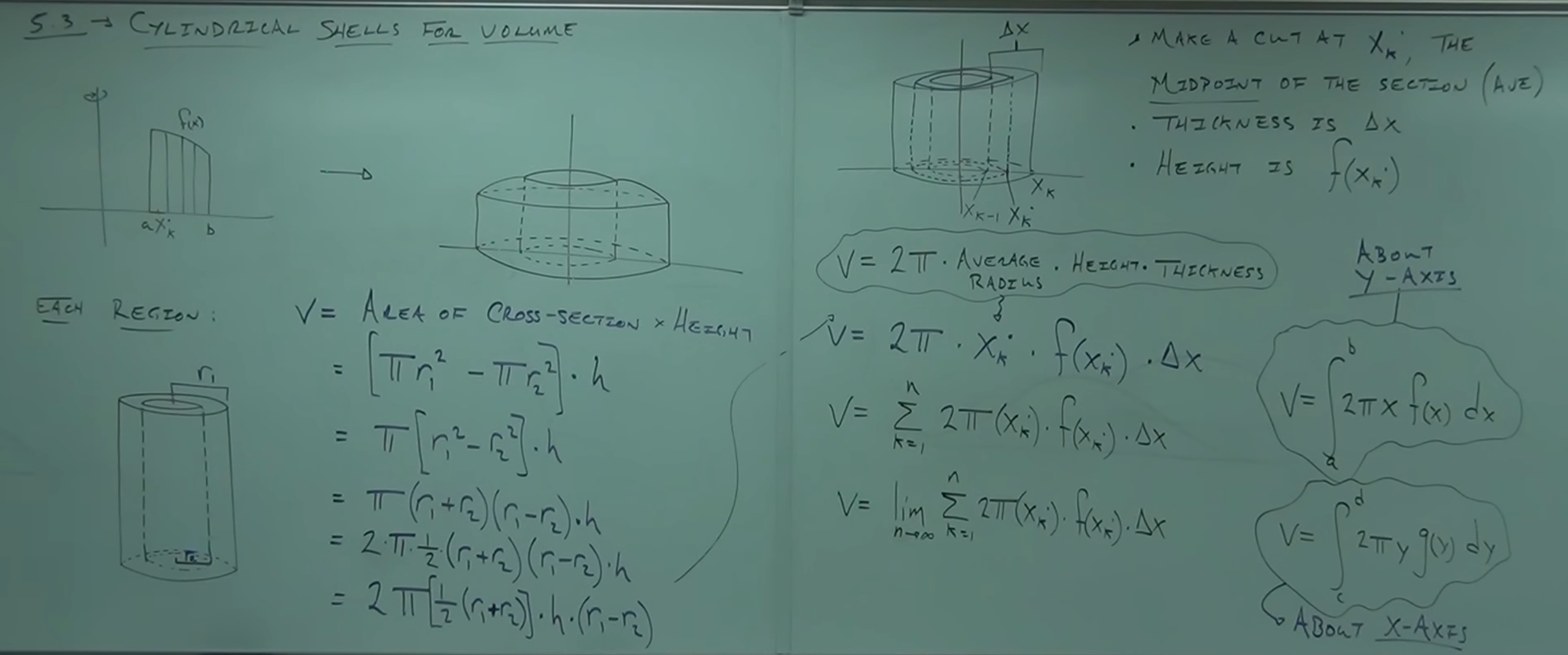
- A cylindrical slice is taken within the shell at an arbitrary point $x_{k}^{\ast}$
- 15:30. $x_{k}^{\ast}$ is chosen as the midpoint of the interval.
- $x_{k}^{\ast}$ is the average point between $x_{k-1}$ and $x_k$
- 16:24.
The thickness of the slice is $\Delta x$ (the difference between the previous and current slices).
- The height at $x_{k}^{\ast}$ is $𝒇(x_k^* )$
- 18:20. Volume of an individual shell: $2\pi\cdot x_{k}^{\ast}\cdot 𝒇(x_k^* )\cdot
\Delta x$
- $2\pi\times(\text{average radius})\times(\text{height})\times(\text{thickness})$
- 20:00. The volumes of all shells are summed to approximate the total volume:
- $\mathcal{V}=\displaystyle \sum_{k=1}^{n} 2\pi\cdot x_{k}^{\ast}\cdot 𝒇(x_k^* )\cdot
\Delta x$
- The limit is taken as the number of shells approaches infinity, converting the sum into an
integral:
- $\mathcal{V}=\displaystyle \lim_{n\to\infty}\sum_{k=1}^{n}2\pi\cdot x_{k}^{\ast}\cdot
𝒇(x_k^* )\cdot\Delta x$
- Final formula:
- $\boxed{\mathcal{V}=\displaystyle \int_{\mathcal{a}}^{\mathcal{b}}2\pi\cdot 𝒙\cdot
𝒇(𝒙)\,d𝒙}$
- Random arbitrary points $x_k^*$ are represented by 𝒙
- Around 𝒚-axis
- NOTE: Axis of revolution: Around the 𝒚-axis, integration is performed with respect to 𝒙
- **Important!** When rotating around the 𝒙-axis, the function must be in terms of 𝒙:
- $\boxed{\mathcal{V}=\displaystyle \int_{\mathcal{c}}^{\mathcal{d}}2\pi\cdot
𝒚\cdot 𝒇(𝒚)\,d𝒚}$
- Around 𝒙-axis
- 24:35. 🧩
Example – Region bounded by 𝒇(𝒙)=√𝒙, 𝒙=1, 𝒙=4, revolved around the 𝒚-axis
- [📷image]
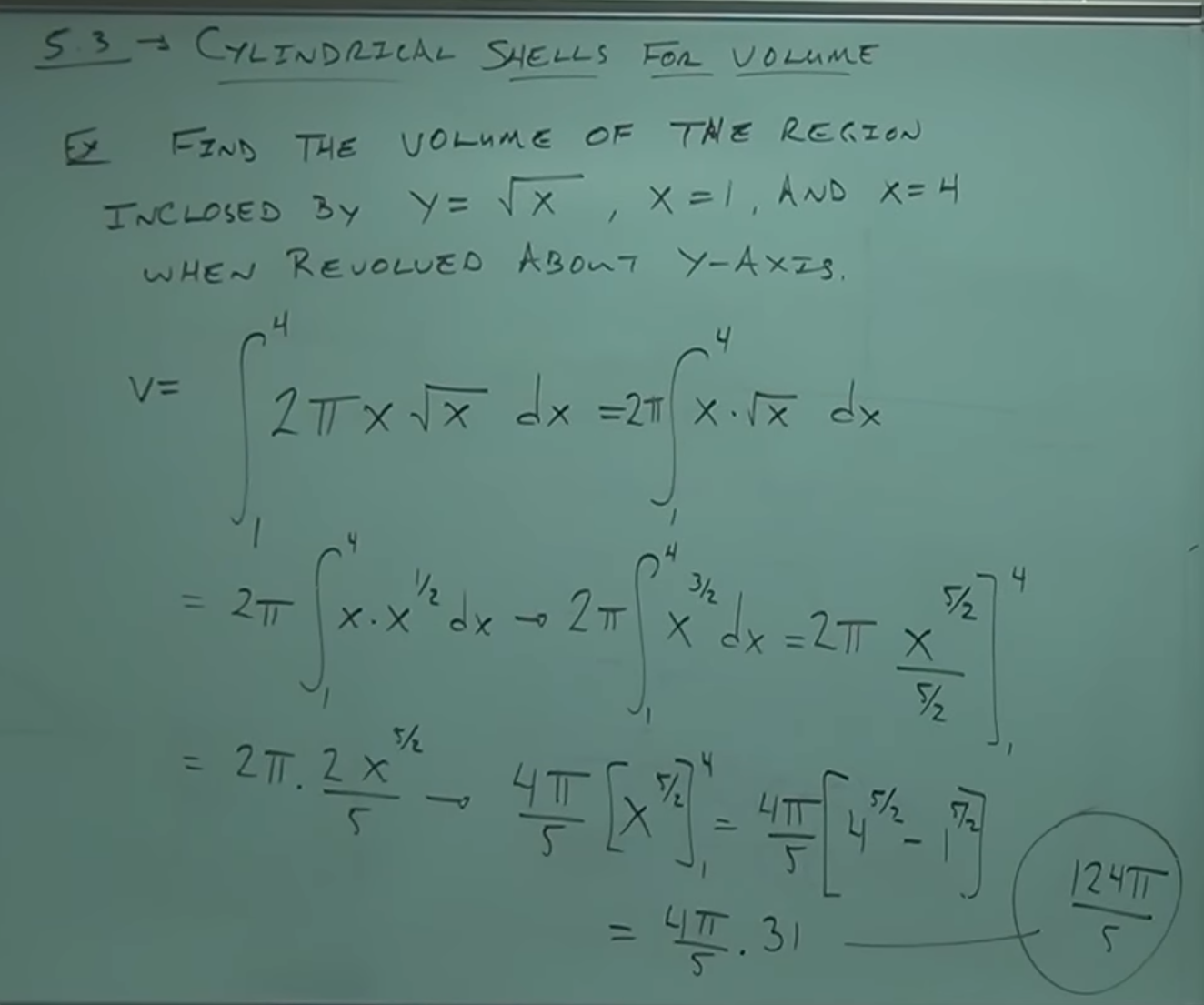
- Confirmation of the function in terms of 𝒙
- Integral setup: $\mathcal{V}=\displaystyle \int_{1}^{4}2\pi\cdot 𝒙\sqrt{𝒙}\,d𝒙$
- Simplification: $2\pi\displaystyle\int_{1}^{4}𝒙^{\dfrac{3}{2}}\,d𝒙$
- Integration: $2\pi\Big[\dfrac{2}{5}𝒙^{\dfrac{5}{2}}\Big]\Big|_{1}^{4}$
- Evaluating limits: $\dfrac{4\pi}{5}\big(4^{\dfrac{5}{2}}-1^{\dfrac{5}{2}}\big)$
- Final result: $\mathcal{V}=\dfrac{124\pi}{5}$
- 29:03.
Comparison with Disks/Washers and Functions Between Curves
- Cylindrical shells method is an alternative to the disk/washer method, with a key
difference:
- Orientation of slices:
- Disks/washers: slices ⟂ to axis of rotation
- Shells: slices ∥ to axis of rotation → thin strips wrap into cylinders
- Wrapping around the 𝒚-axis
- Use vertical strips (width $d𝒙$)
- Radius = 𝒙
- Height = $[𝒇_{\text{upper}}(𝒙)−𝒇_{\text{lower}}(𝒙)]$
- Thickness = $d𝒙$
- Wrapping around the 𝒙-axis
- Use horizontal strips (width $d𝒚$)
- Radius = 𝒚
- Height = $[𝒇_{\text{right}}(𝒚)−𝒇_{\text{left}}(𝒚)]$
- Thickness = $d𝒚$
- Regions bounded by two curves
- Height = upper − lower, similar to areas
- Integration limits (𝓪, 𝓫)
- Determined by intersection points of the two functions in 𝒙
- General cylindrical shell formula:
- $\mathcal{V}=\displaystyle
\int_{\mathcal{a}}^{\mathcal{b}}2\pi\cdot(\text{radius})\cdot(\text{height})\,d𝒙$
- For rotation about the 𝒚-axis: $\boxed{\mathcal{V}=\displaystyle
\int_{\mathcal{a}}^{\mathcal{b}}2\pi\cdot𝒙\cdot[𝒇_{\text{upper}}(𝒙)−𝒇_{\text{lower}}(𝒙)]\,d𝒙}$
- For rotation about the 𝒙-axis: $\boxed{\mathcal{V}=\displaystyle
\int_{\mathcal{a}}^{\mathcal{b}}2\pi\cdot𝒚\cdot[𝒇_{\text{right}}(𝒚)−𝒇_{\text{left}}(𝒚)]\,d𝒚}$
- Identifying the “top” function
- Always check which curve is above (larger 𝑦) in the interval
- 29:50. 🧩
Example – Cylindrical shells method: Region bounded by 𝒇(𝒙)=𝒙 and 𝓰(𝒙)=𝒙², around the 𝒚-axis
- [📷image]
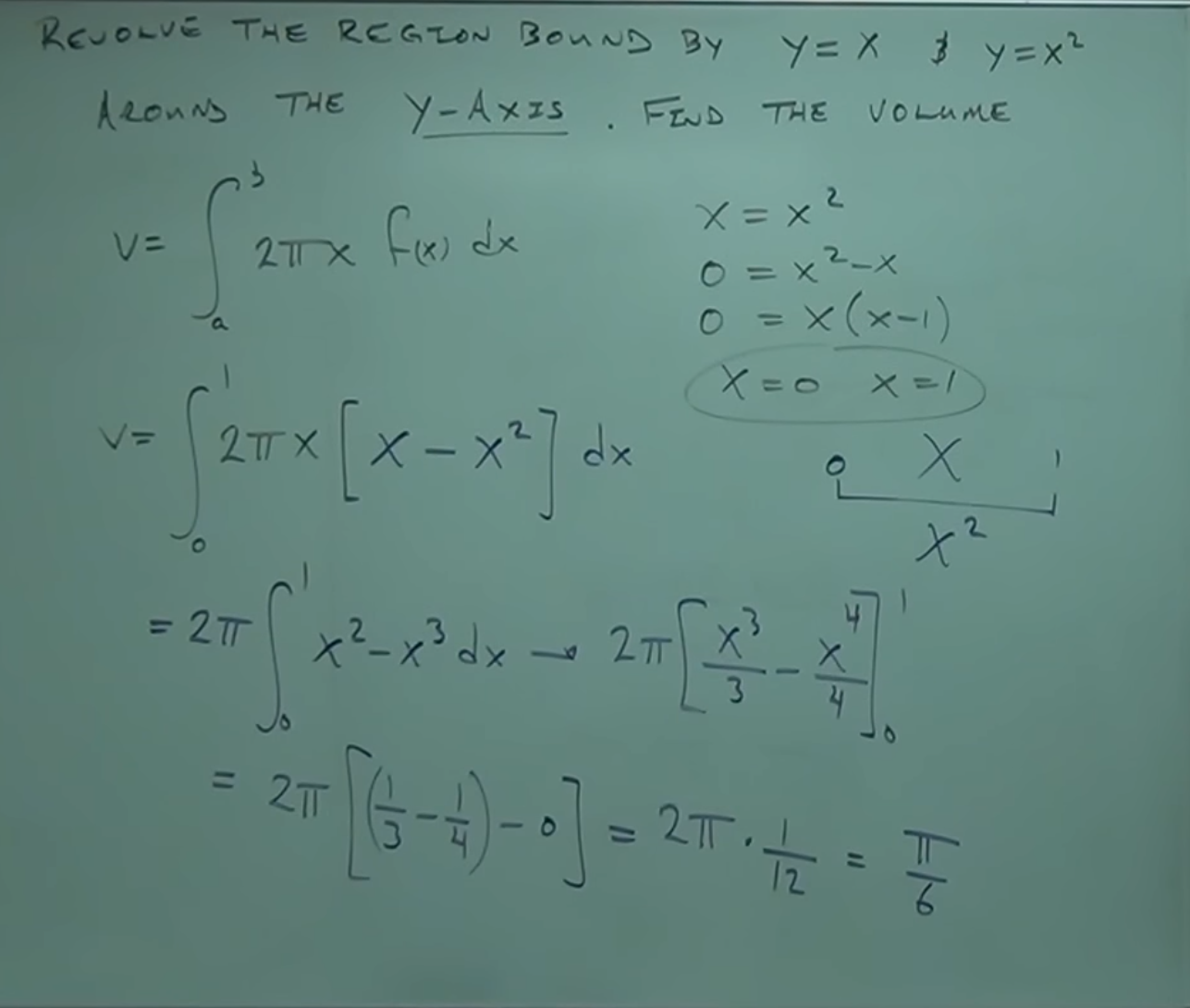
- Problem setup: Volume between two curves around the 𝒚-axis
- $\mathcal{V}=\displaystyle \int_{\mathcal{a}}^{\mathcal{b}}2\pi\cdot
𝒙\cdot[𝒇_{\text{upper}}(𝒙)−𝒇_{\text{lower}}(𝒙)]\,d𝒙$
- Integration limits:
- Identifying the "Top" Function
- For $𝒙\in[0,1]$, $𝒇(𝒙)=𝒙$ is on top
- Integration: $\displaystyle \int_{0}^{1}2\pi\cdot 𝒙(𝒙−𝒙²)\,d𝒙$
- Simplification: $2\pi\displaystyle \int_{0}^{1}(𝒙²−𝒙³)\,d𝒙$
- Integration: $2\pi\Big[\dfrac{𝒙³}{3}−\dfrac{𝒙⁴}{4}\Big]_{0}^{1}$
- Evaluating limits: $2\pi\big(\dfrac{1}{3}−\dfrac{1}{4}\big)$
- Final result: Volume $=\dfrac{\pi}{6}$
- 36:25. 🧩
Example – Region bounded by 𝒇(𝒚)=−𝒚²+6𝒚 and 𝓰(𝒚)=0, around the 𝒙-axis
- [📷image]
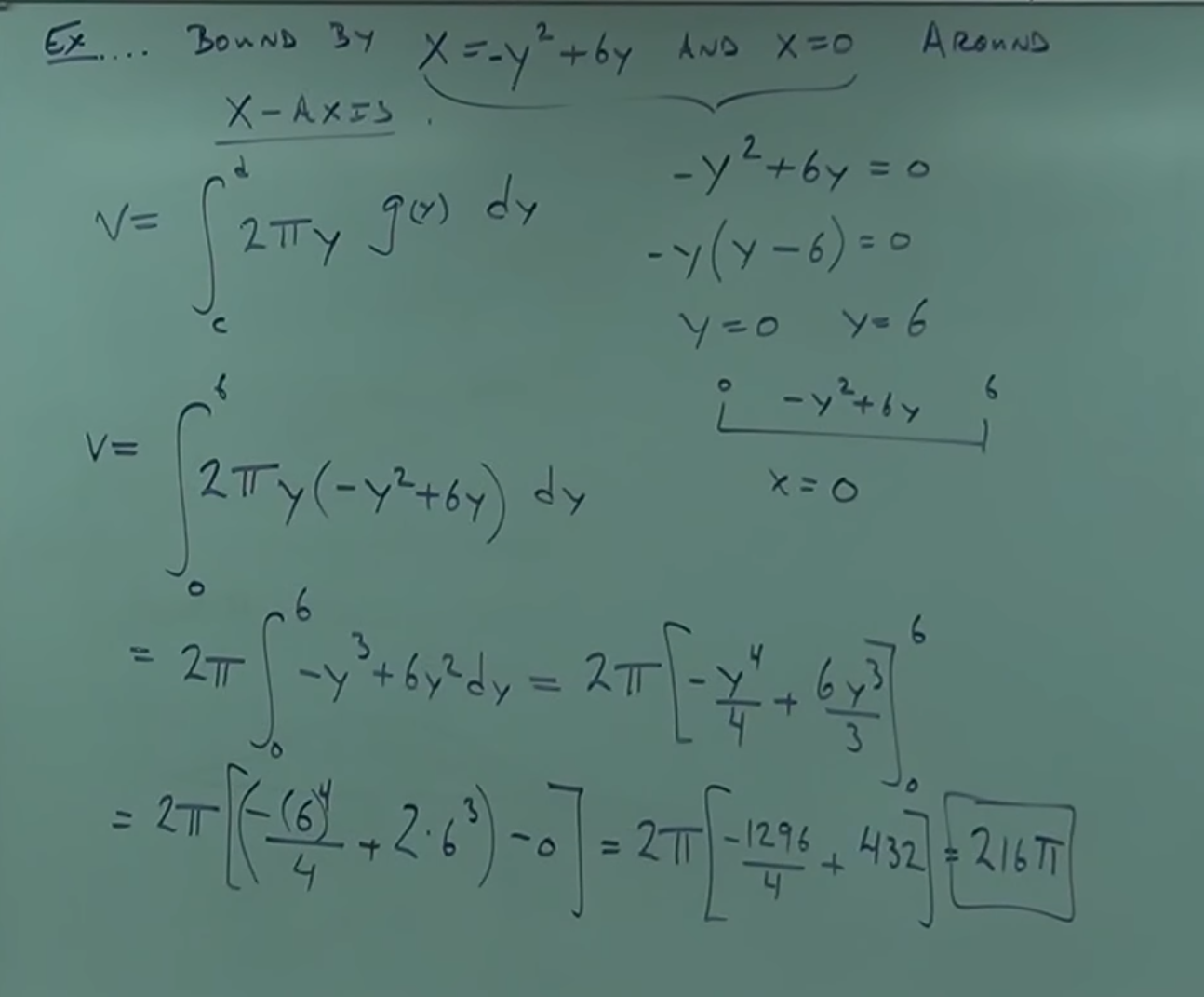
- Problem setup: Volume between two curves around the 𝒙-axis
- $\mathcal{V}=\displaystyle
\int_{\mathcal{a}}^{\mathcal{b}}2\pi\cdot𝒚\cdot[𝒇_{\text{right}}(𝒚)−𝒇_{\text{left}}(𝒚)]\,d𝒚$
- Identifying the "Right" Function
- $𝓰(𝒚)=0$ → $𝒙=0$ ⇢ vertical line at $𝒙=0$
- $𝒇_{\text{right}}(𝒚)=−𝒚²+6𝒚$
- Integration limits:
- $−𝒚²+6𝒚=0$ → $𝒚=0$ and $𝒚=6$
- Integration:
-
$\mathcal{V}=2\pi\displaystyle\int_{0}^{6}𝒚(−𝒚²+6𝒚)\,d𝒚=2\pi\displaystyle\int_{0}^{6}(−𝒚³+6𝒚²)\,d𝒚$
- Evaluating limits:
-
$\mathcal{V}=2\pi\Big[−\dfrac{𝒚⁴}{4}+2𝒚³\Big]_{0}^{6}=2\pi\big(−\dfrac{6⁴}{4}+432\big)=216\pi$
- 45:00. 🧩
Example – Cylindrical shells method: Region bounded by 𝒇(𝒙)=𝒙²+1, 𝓰(𝒙)=−𝒙+1, and 𝒙=1, around the 𝒚-axis
–
- [📷image]
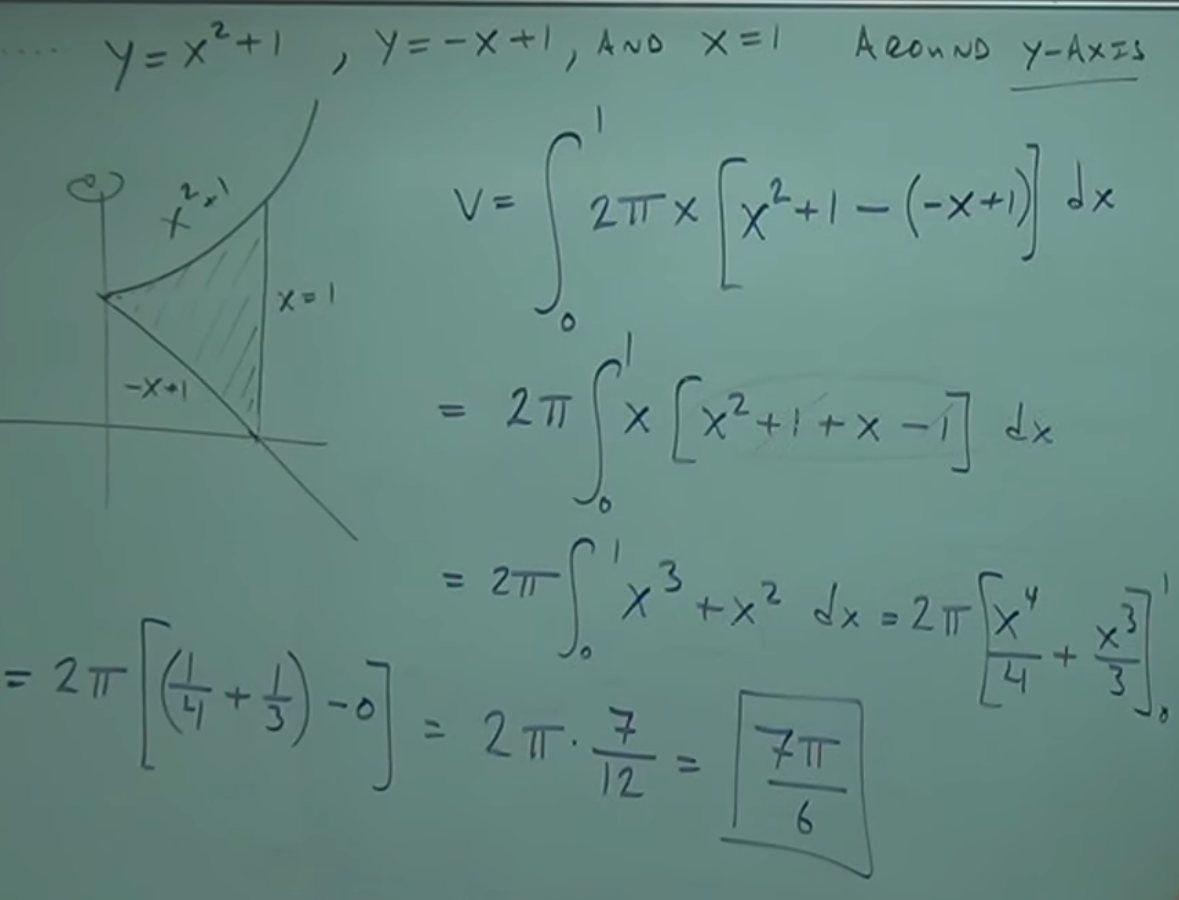
- Problem Definition
- Find the volume generated by rotating the region bounded by three functions around the
𝒚-axis
- Given functions:
- $𝒇(𝒙)=𝒙²+1$ → Parabola shifted up 1 unit
- $𝓰(𝒙)=−𝒙+1$ → Line with positive slope
- $𝒉(𝒙)=1$ → Vertical boundary
- The region lies in the first quadrant
- Cylindrical Shells Method Setup
- General formula:
$\mathcal{V}=\displaystyle\int_{\mathcal{a}}^{\mathcal{b}}2\pi(\text{radius})(\text{height})\,d𝒙$
- Radius: distance from 𝒚-axis → $r=𝒙$
- Height: difference between upper and lower functions → $(𝒙²+1)−(−𝒙+1)$
- Integration from $𝒙=0$ to $𝒙=1$
- $\mathcal{V}=\displaystyle\int_{0}^{1}2\pi\cdot 𝒙\cdot[(𝒙²+1)−(−𝒙+1)]\,d𝒙$
- Simplify:
$\mathcal{V}=2\pi\displaystyle\int_{0}^{1}(𝒙³+𝒙²)\,d𝒙=2\pi\Big[\dfrac{𝒙⁴}{4}+\dfrac{𝒙³}{3}\Big]_{0}^{1}=2\pi\big(\dfrac{1}{4}+\dfrac{1}{3}\big)=\dfrac{7\pi}{6}$
- 45:00. 🧩 Example – Disk/Washer Method: Region bounded by 𝒇(𝒙) = 𝒙² + 1, 𝓰(𝒙) =
-𝒙 + 1 and 𝒙 = 𝒉(𝒚) = 1 , around the 𝒚-axis –
- [📷image]
- Picture & plan
- Axis: 𝒚-axis ⇒ cross-sections ⟂ to 𝒚 ⇒ **washers** in $𝒅𝒚$.
- Horizontal slice at height $𝑦$ spans from a **left boundary**
$𝒙_{\text{left}}(𝑦)$ to the **right wall** $𝒙=1$.
- Express 𝒙 in terms of 𝑦 (for horizontal radii)
- From $𝒇(𝒙)=𝒙^{2}+1$: $𝑦=𝒙^{2}+1 \Rightarrow 𝒙=\pm\sqrt{𝑦-1}$ (take
$+\sqrt{\;\,}$ branch for $𝑦\ge 1$)
- From $𝓰(𝒙)=-𝒙+1$: $𝑦=-𝒙+1 \Rightarrow 𝒙=1-𝑦$
- 𝑦-interval and piecewise left boundary
- Intersections $𝒙^{2}+1=-𝒙+1 \Rightarrow 𝒙(𝒙+1)=0
\;\Rightarrow\;$✳️$(𝒙,𝑦)=(0,1)\text{ and }(-1,2)$
- Intersections with the vertical wall $𝒙=1$:
- With $𝒇(𝒙)=𝒙^{2}+1$: at $𝒙=1 \Rightarrow 𝒚=2$ → point $(1,2)$
- With $𝓰(𝒙)=-𝒙+1$: at $𝒙=1 \Rightarrow 𝒚=0$ → point $(1,0)$
- Therefore, $𝒙=1$ spans vertically from $𝒚=0$ (line) up to $𝒚=2$ (parabola).
- Both curves intersect at ✳️$(0,1)$, which is exactly where the region changes
its left boundary.
- Piecewise left boundary (split at $𝒚=1$):
- For $𝒚\in[0,1]$: left boundary given by the line ⇒
$𝒙_{\text{left}}(𝑦)=1-𝑦$.
- Reason: the parabola $𝒚=𝒙^{2}+1$ starts at $𝒚=1$ (no real $𝒙$ for
$𝒚<1$).
- For $𝒚\in[1,2]$: left boundary given by the parabola ⇒
$𝒙_{\text{left}}(𝑦)=\sqrt{𝑦-1}$.
- Check: at $𝒚=1$ both meet at $(0,1)$; for $𝒚>1$, $1-𝒚<0$ (left of
𝒚-axis) while $\sqrt{𝑦-1}\ge 0$.
- Radii w.r.t. the 𝒚-axis ($𝒙=0$)
- Outer radius $\mathcal{R}(𝑦)=$ distance to $𝒙=1$ ⇒ $\mathcal{R}(𝑦)=1$ (for all
$𝑦$ in the region).
- Inner radius $𝑟(𝑦)=$ distance to $𝒙_{\text{left}}(𝑦)$ ⇒
$𝑟(𝑦)=𝒙_{\text{left}}(𝑦)$.
- $𝑟(𝑦)=1-𝑦$ for $𝑦\in[0,1]$; \;\; $𝑟(𝑦)=\sqrt{𝑦-1}$ for $𝑦\in[1,2]$.
- Set up the washer integrals
- $\displaystyle \mathcal{V}=\pi\int_{0}^{1}\!\big(1-(1-𝑦)^{2}\big)\,𝒅𝑦 \;+\;
\pi\int_{1}^{2}\!\big(1-(\sqrt{𝑦-1})^{2}\big)\,𝒅𝑦$
- First piece: $2𝑦-𝑦^{2}$
- Second piece: $2-𝑦$
- Evaluate
- $I_{1}=\displaystyle
\int_{0}^{1}(2𝑦-𝑦^{2})\,𝒅𝑦=\Big[\,𝑦^{2}-\dfrac{𝑦^{3}}{3}\,\Big]\Big|_{0}^{1}=1-\dfrac{1}{3}=\dfrac{2}{3}$
- $I_{2}=\displaystyle
\int_{1}^{2}(2-𝑦)\,𝒅𝑦=\Big[\,2𝑦-\dfrac{𝑦^{2}}{2}\,\Big]\Big|_{1}^{2}=(4-2)-\Big(2-\dfrac{1}{2}\Big)=\dfrac{1}{2}$
- $\displaystyle
\mathcal{V}=\pi\big(I_{1}+I_{2}\big)=\pi\!\left(\dfrac{2}{3}+\dfrac{1}{2}\right)=\dfrac{7\pi}{6}$