Calculus 1 Lecture 5.4 Finding the Length of a Curve on a Plane
Finding the Length of a Curve on a Plane
- 01:40.
Main idea
- The calculation of distance traveled along a curve is a fundamental problem in mathematics
and physics. Unlike the straight-line distance between two points,
measuring distance along a curve requires a different approach based on the idea of approximating with
straight-line segments.
- Geometric Idea: Approximation with Line Segments:
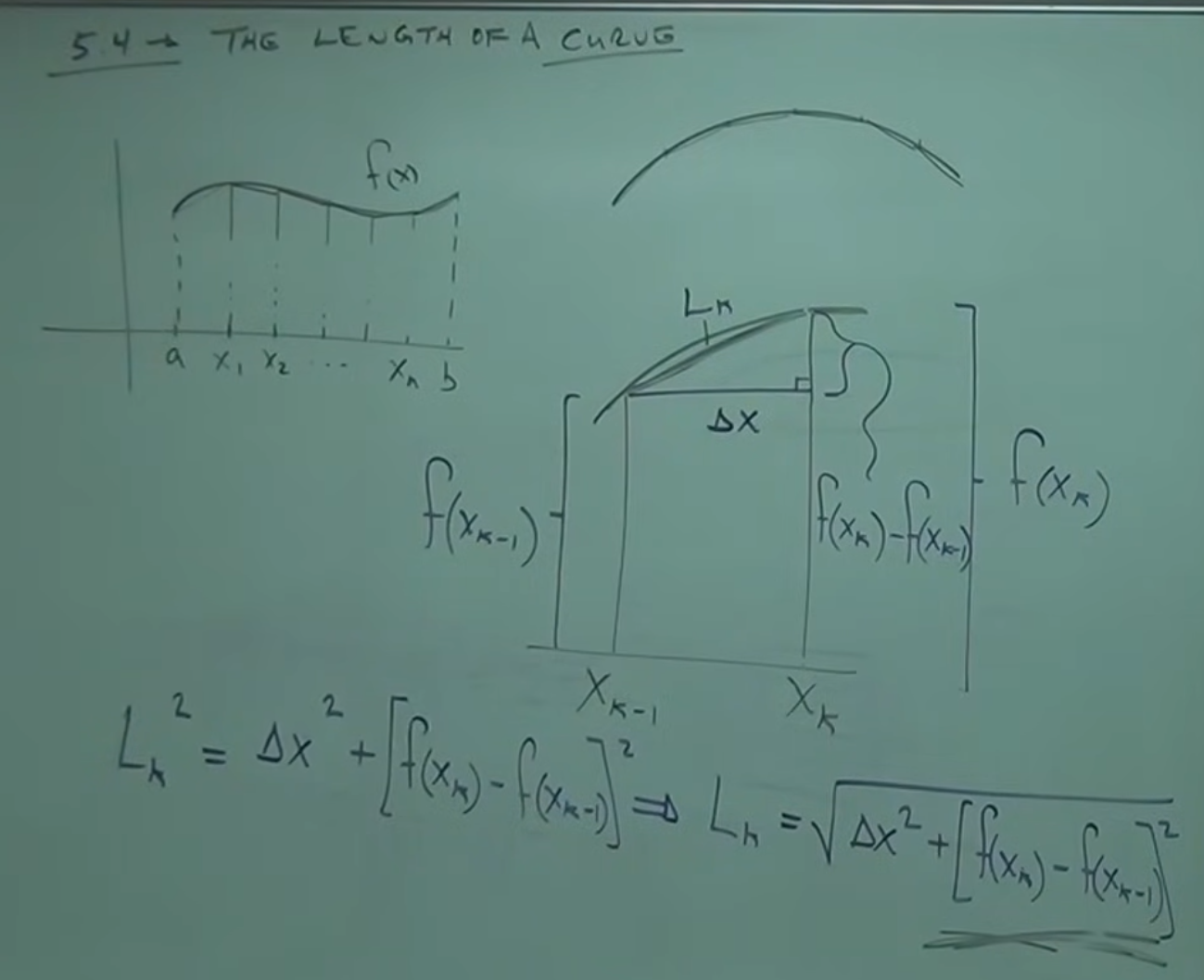
- Consider a curve defined by a function $𝒇(𝒙)$.
- Select several points on the curve and connect them with straight-line segments.
- If we use only a few segments, the approximation is rough, but as we increase the
number of segments, the total distance begins to resemble the actual length of the curve.
- 04:20.
Application of Calculus: The Limit of Approximation
- [📷image-1]
 - [📷image-2]
 - [📷image-3]
- We divide the interval into small subintervals.
- We take one subinterval and calculate its segment distance by creating a straight
rectangle:
- Our segment is the Hypotenuse: $𝐋_{k}$
- $[𝒙_{k-1},𝒙_{k}]$ Extremes of the subinterval
- Base side: $\Delta 𝒙$ is the distance between $𝒙_{k-1}$ and $𝒙_{k}$
- Height: $𝒇(𝒙_{k})-𝒇(𝒙_{k-1})$
- 08:10. $𝐋_{k}^{2}=(\Delta
𝒙)^{2}+\big[\,𝒇(𝒙_{k})-𝒇(𝒙_{k-1})\,\big]^{2}\;\Rightarrow\;𝐋_{k}=\sqrt{(\Delta
𝒙)^{2}+\big[\,𝒇(𝒙_{k})-𝒇(𝒙_{k-1})\,\big]^{2}}$
- 10:10.
Doing calculus
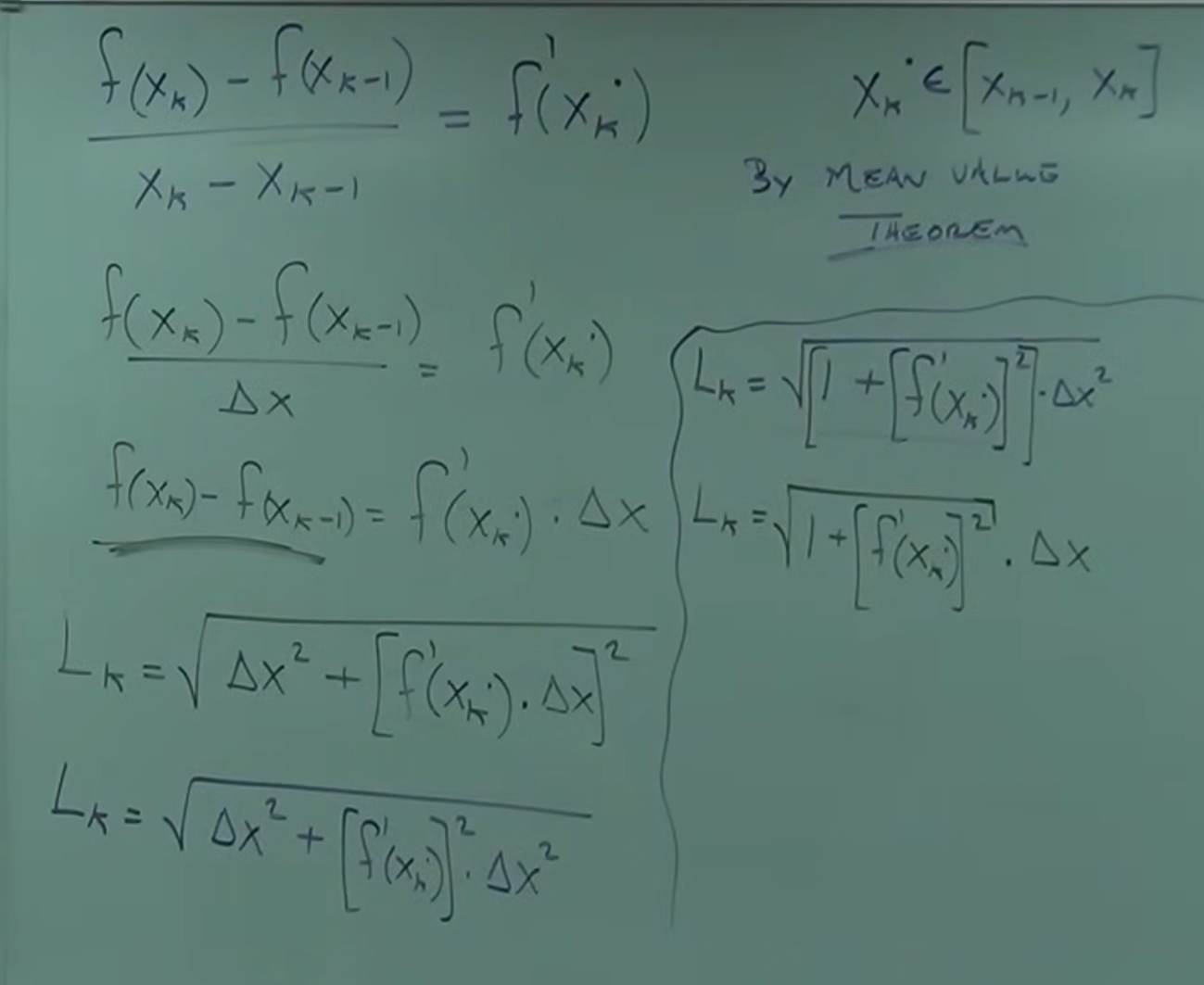
- Use what the Mean Value Theorem says:
- Mean Value Theorem (MVT):
Let $𝒇(𝒙)$ be a function that is continuous on the closed interval $[𝓪,𝓫]$ and differentiable on
the open interval $(𝓪,𝓫)$. Then, there exists at least one point $𝒄$ in $(𝓪,𝓫)$ such that:
- $𝒇'(𝒄)=\dfrac{𝒇(𝓫)-𝒇(𝓪)}{𝓫-𝓪}$
- Intuition: The theorem states that if a function meets these
conditions, there is at least one point where the instantaneous rate of change (derivative) is
equal to the average rate of change over the interval. In other words, the tangent line at
$𝒙=𝒄$ is parallel to the secant line connecting $(𝒂,𝒇(𝒂))$ and $(𝒃,𝒇(𝒃))$.
- Extrapolating to our problem:
- $𝒇'(𝒙_k^* )=\dfrac{𝒇(𝒙_{k})-𝒇(𝒙_{k-1})}{𝒙_{k}-𝒙_{k-1}}$
- $x_{k}^{\ast}\in[𝒙_{k-1},𝒙_{k}]$
- $𝒙_{k}-𝒙_{k-1}$ represents $\Delta 𝒙$
- $𝒇'(𝒙_k^* )=\dfrac{𝒇(𝒙_{k})-𝒇(𝒙_{k-1})}{\Delta 𝒙}\;\Rightarrow\;
𝒇(𝒙_{k})-𝒇(𝒙_{k-1})=𝒇'(𝒙_k^* )\cdot \Delta 𝒙$
- $𝐋_{k}=\sqrt{(\Delta 𝒙)^{2}+\big[𝒇(𝒙_{k})-𝒇(𝒙_{k-1})\big]^{2}}$
- $𝐋_{k}=\sqrt{(\Delta 𝒙)^{2}+\big[\,𝒇'(𝒙_k^* )\cdot \Delta
𝒙\,\big]^{2}}$
- $𝐋_{k}=\sqrt{1+\big(𝒇'(𝒙_k^* )\big)^{2}}\cdot \Delta 𝒙$ (One single
section)
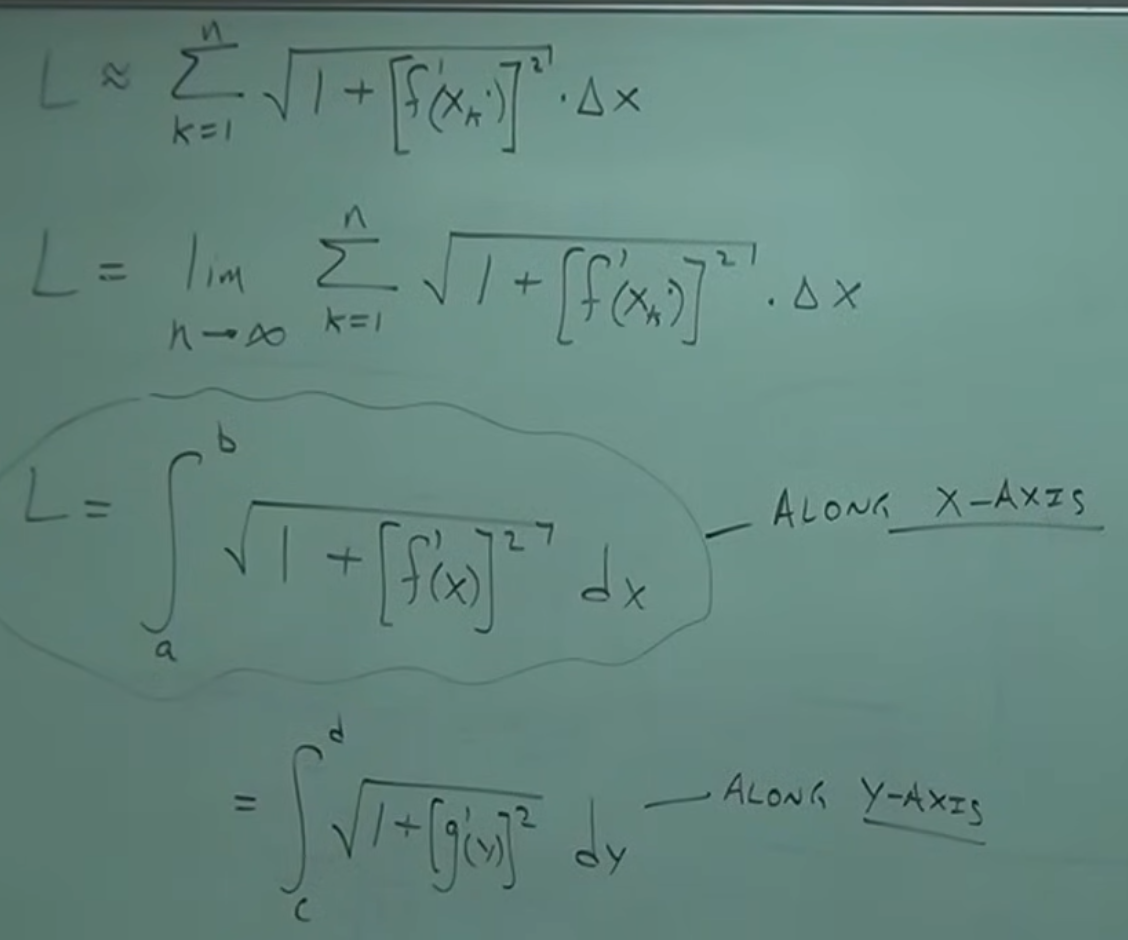
- 18:40. All multiple sections 𝑳
- $𝐋 \approx \displaystyle \sum_{k=1}^{n}\sqrt{1+\big(𝒇'(𝒙_k^* )\big)^{2}}\cdot
\Delta 𝒙$
- $𝐋=\displaystyle
\lim_{n\to\infty}\sum_{k=1}^{n}\sqrt{1+\big(𝒇'(𝒙_k^*)\big)^{2}}\cdot \Delta 𝒙$
- Length of a curve on a plane
- $\boxed{𝐋=\displaystyle \int_{𝓪}^{𝓫}\sqrt{1+\big(𝒇'(𝒙)\big)^{2}}\cdot
\mathrm{d}𝒙}$ along $𝒙$-axis
- $\boxed{𝐋=\displaystyle \int_{𝒸}^{𝒹}\sqrt{1+\big(𝒇'(𝒚)\big)^{2}}\cdot
\mathrm{d}𝒚}$ along $𝒚$-axis
- 23:00. 🧩
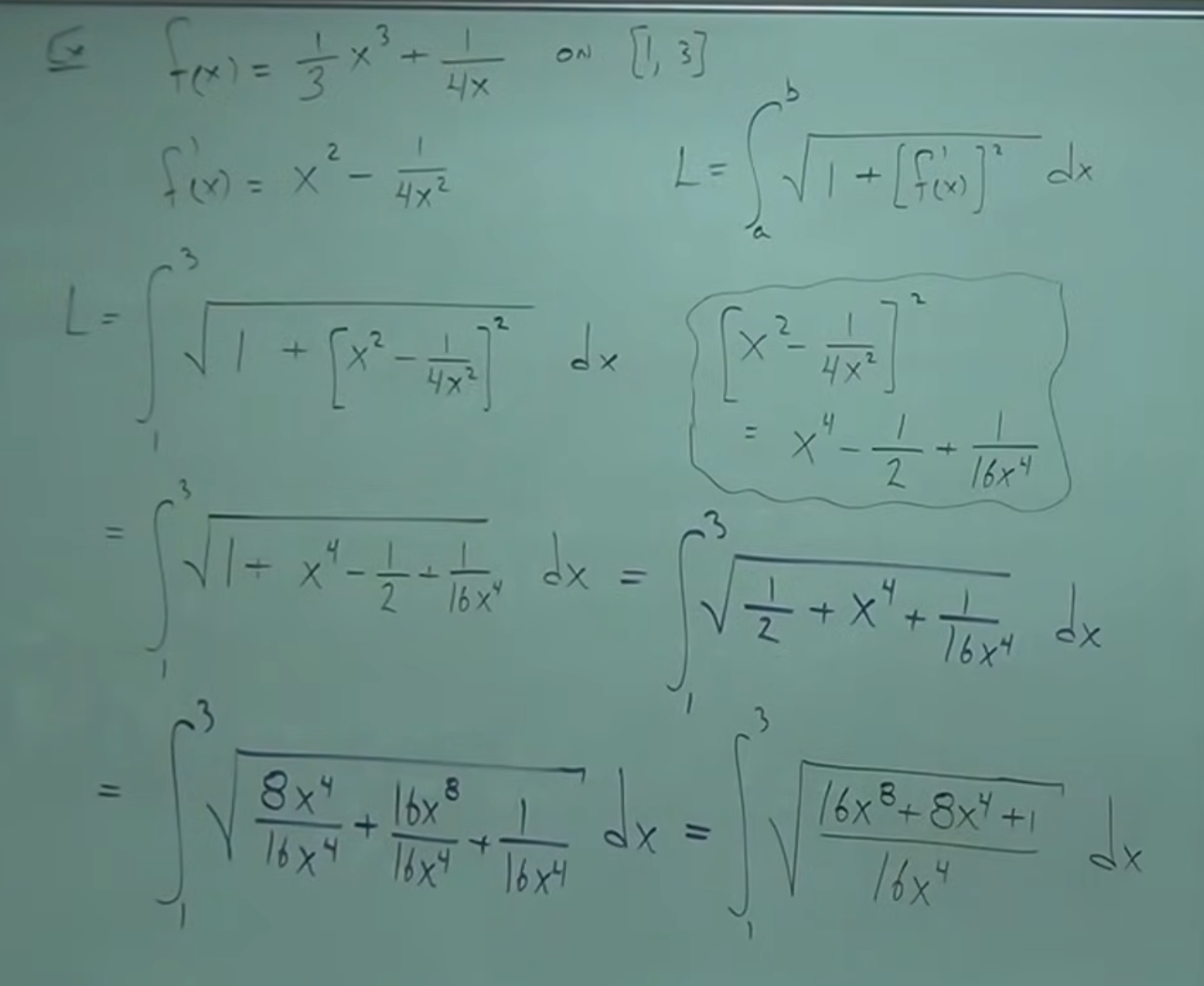
Example – Find the length of a curve: $𝒇(𝒙)=\dfrac{1}{3}𝒙^{3}+\dfrac{1}{4𝒙}$ on $[1,3]$
- [📷image-1]
 - [📷image-2]
- Arc-length formula (variable 𝒙)
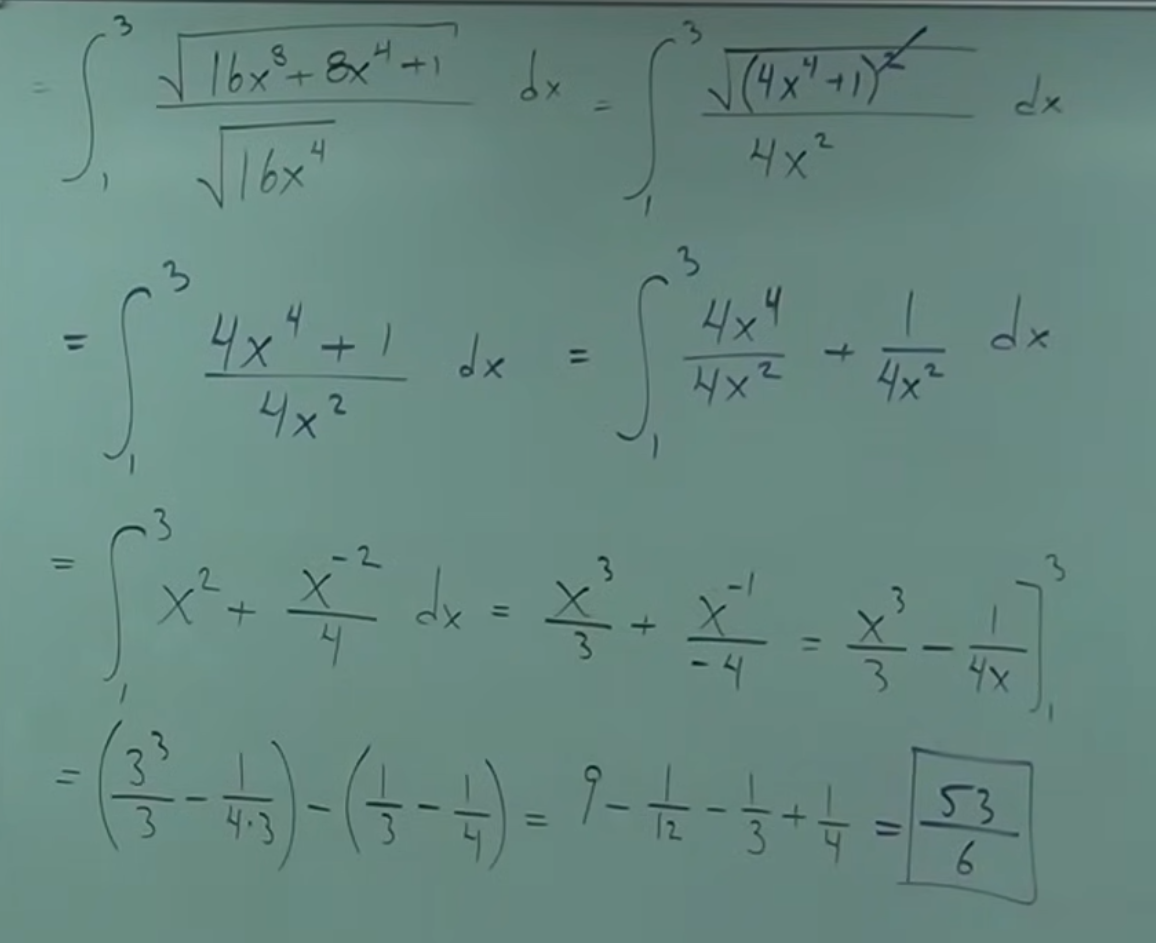
- $𝐋=\displaystyle \int_{1}^{3}\sqrt{1+\big(𝒇'(𝒙)\big)^{2}}\cdot \mathrm{d}𝒙$
- Domain check: $𝒙>0$ (por $1/𝒙$) ⇒ $[1,3]$ válido
- Differentiate and substitute
- $𝒇'(𝒙)=𝒙^{2}-\dfrac{1}{4𝒙^{2}}$
- $𝐋=\displaystyle
\int_{1}^{3}\sqrt{\,1+\big(𝒙^{2}-\dfrac{1}{4𝒙^{2}}\big)^{2}\,}\cdot \mathrm{d}𝒙$
- Simplifying the radical using a perfect square
- $\big(𝒙^{2}-\dfrac{1}{4𝒙^{2}}\big)^{2}=𝒙^{4}-\dfrac{1}{2}+\dfrac{1}{16𝒙^{4}}$
-
$1+\big(𝒙^{2}-\dfrac{1}{4𝒙^{2}}\big)^{2}=\dfrac{1}{2}+𝒙^{4}+\dfrac{1}{16𝒙^{4}}=\dfrac{(4𝒙^{4}+1)^{2}}{(4𝒙^{2})^{2}}$
- $\sqrt{1+\big(𝒇'\big)^{2}}=\dfrac{4𝒙^{4}+1}{4𝒙^{2}}\quad(𝒙>0)$
- Integrate
- $𝐋=\displaystyle \int_{1}^{3}\Big(𝒙^{2}+\dfrac{1}{4}𝒙^{-2}\Big)\,\mathrm{d}𝒙$
-
$𝐋=\Big[\,\dfrac{𝒙^{3}}{3}-\dfrac{1}{4𝒙}\,\Big]_{1}^{3}=\Big(\dfrac{27}{3}-\dfrac{1}{12}\Big)-\Big(\dfrac{1}{3}-\dfrac{1}{4}\Big)=\dfrac{53}{6}$
- 41:10. 🧩
Example – Find the length of a curve: $𝒇(𝒙)=𝒙^{3/2}$ from $(1,1)$ to $\big(2,2\sqrt{2}\big)$
- [📷image-1]
 - [📷image-2]
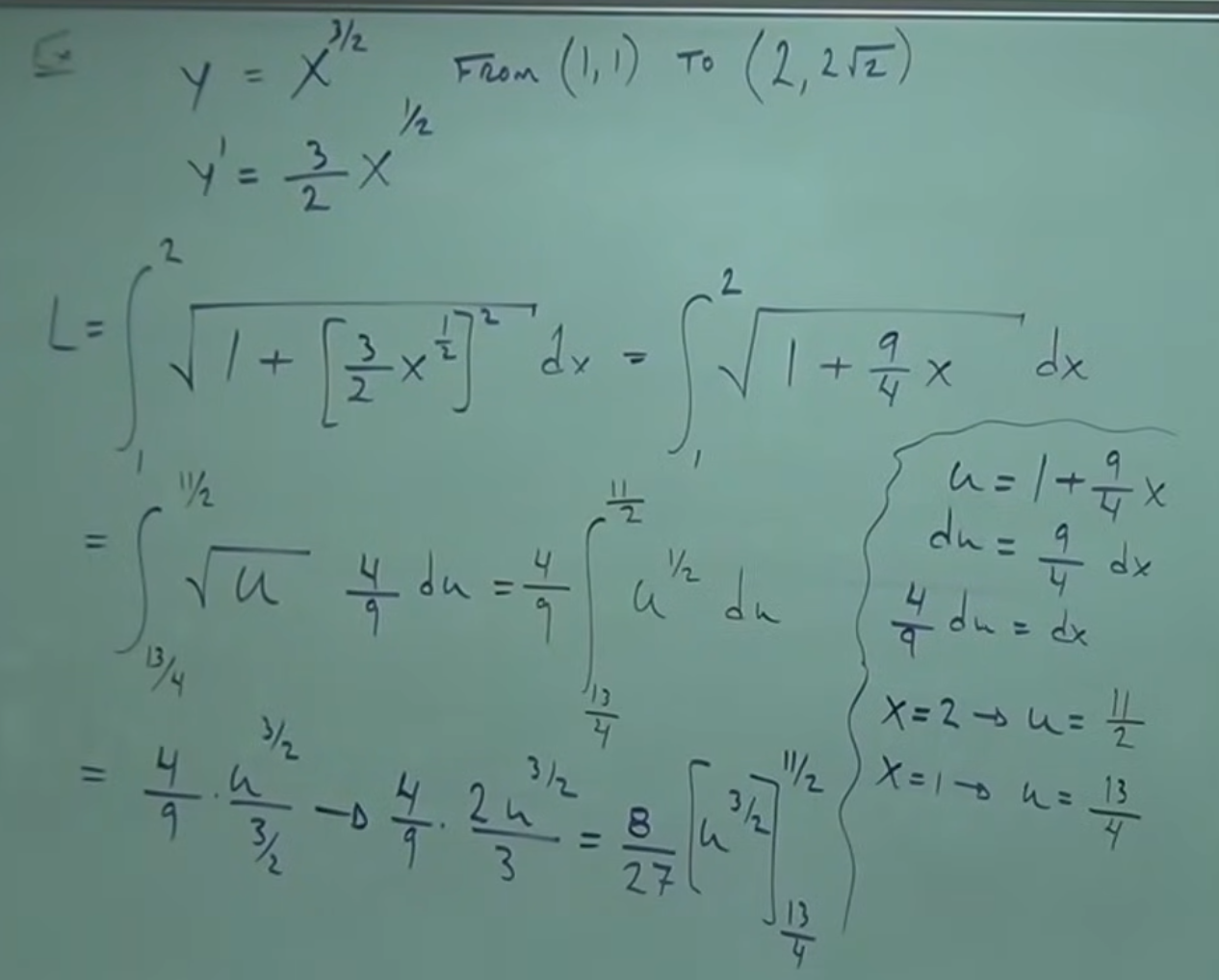
- $𝒇'(𝒙)=\dfrac{3}{2}\cdot 𝒙^{1/2}$
- $𝐿=\displaystyle \int_{1}^{2}\sqrt{\,1+\big(\dfrac{3}{2}\cdot
𝒙^{1/2}\big)^{2}\,}\,\mathrm{d}𝒙=\int_{1}^{2}\sqrt{\,1+\dfrac{9}{4}𝒙\,}\,\mathrm{d}𝒙$
- Substitution:
- $𝒖=1+\dfrac{9}{4}𝒙$
- $\mathrm{d}𝒖=\dfrac{9}{4}\,\mathrm{d}𝒙$
- $\dfrac{4}{9}\,\mathrm{d}𝒖=\mathrm{d}𝒙$
- Limits:
- $𝒙=2 \Rightarrow 𝒖=\dfrac{11}{2}$
- $𝒙=1 \Rightarrow 𝒖=\dfrac{13}{4}$
- Integrating:
- $\displaystyle \int_{13/4}^{11/2}\sqrt{𝒖}\,\mathrm{d}𝒖$
- $\dfrac{4}{9}\displaystyle \int_{13/4}^{11/2} 𝒖^{1/2}\,\mathrm{d}𝒖$
- $\dfrac{4}{9}\cdot \dfrac{2}{3}\,𝒖^{3/2}\,\Big|_{13/4}^{11/2}$
- $\dfrac{8}{27}\Big[\, 𝒖^{3/2}\,\Big]_{13/4}^{11/2}$
- Evaluating:
-
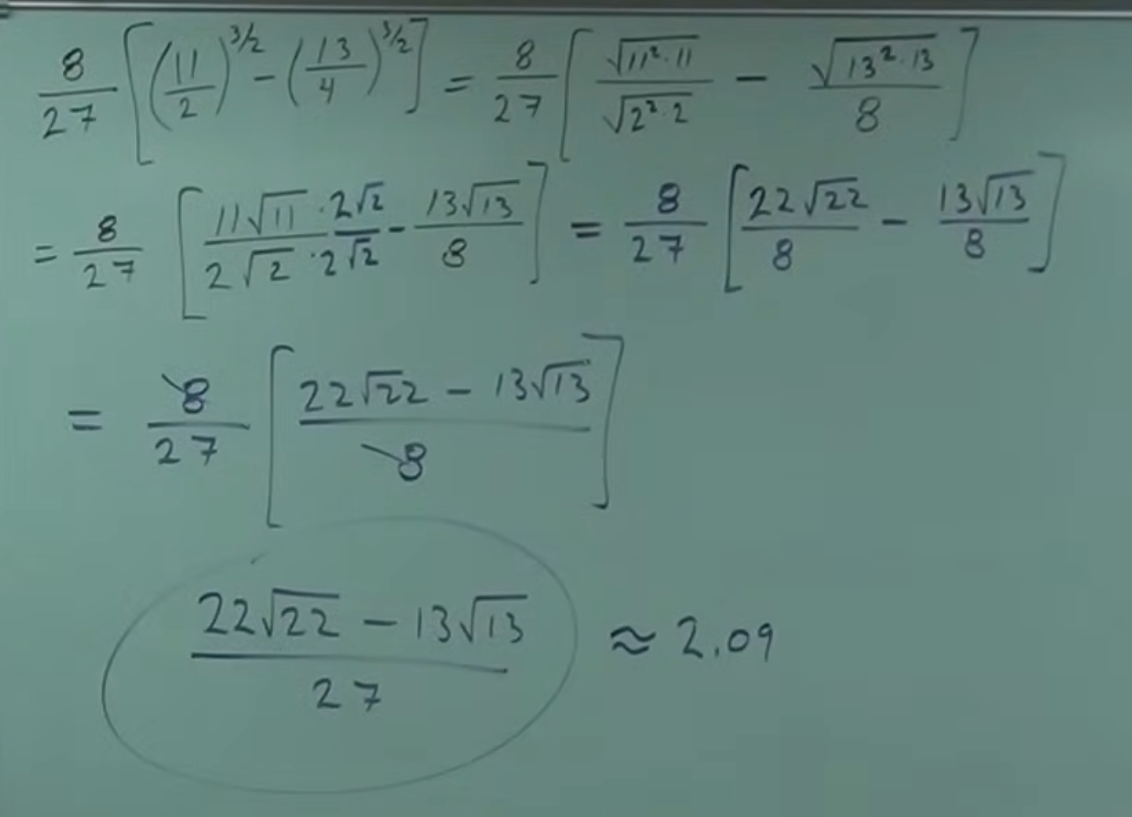
$\dfrac{8}{27}\Big[\,\big(\dfrac{11}{2}\big)^{3/2}-\big(\dfrac{13}{4}\big)^{3/2}\,\Big]$
- $\dfrac{8}{27}\Big[\, \dfrac{\sqrt{11^{2}\cdot 11}}{\sqrt{2^{2}\cdot 2}} -
\dfrac{\sqrt{13^{2}\cdot 13}}{8}\,\Big]$
- $\dfrac{8}{27}\Big[\, \dfrac{11\sqrt{11}}{2\sqrt{2}} - \dfrac{13\sqrt{13}}{8}\,\Big]$
- $\dfrac{8}{27}\cdot \dfrac{1}{8}\Big[\,22\sqrt{22}-13\sqrt{13}\,\Big]$
- Final:
- $\dfrac{22\sqrt{22}-13\sqrt{13}}{27}\approx 2.09$
- 58:10. 🧩
Example – Find the length of a curve: $𝒇(𝒙)=𝒙^{3/2}$ from $(1,1)$ to $\big(2,2\sqrt{2}\big)$ in terms of $𝒚$
- [📷image-1]
 - [📷image-2]
- Formula for length in terms of 𝒚:
- $𝐋=\displaystyle \int_{𝒸}^{𝒹}\sqrt{\,1+\big(𝒇'(𝒚)\big)^{2}\,}\cdot \mathrm{d}𝒚$
- Express 𝒙 as a function of 𝒚:
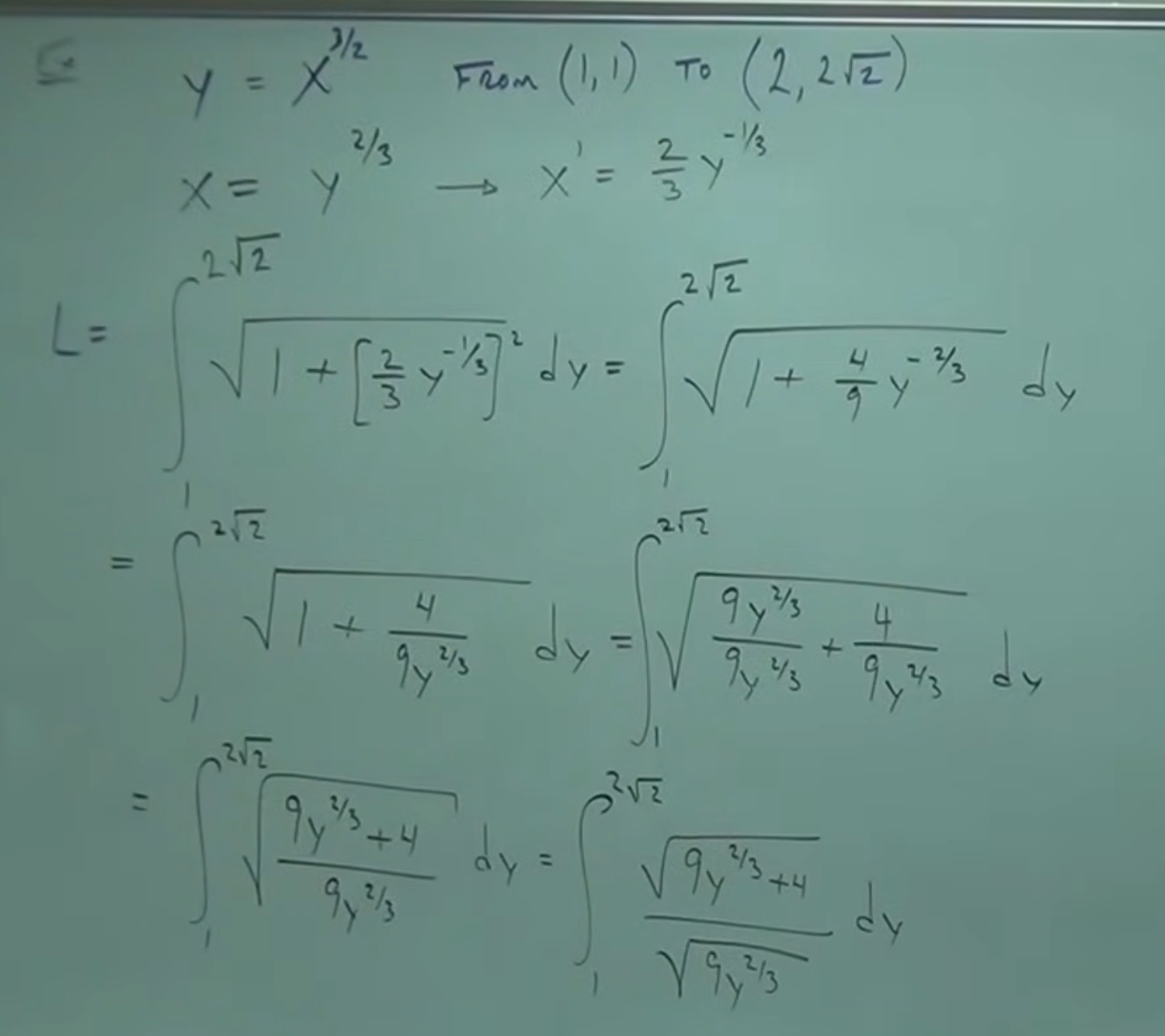
- $𝒚=𝒙^{3/2}\;\Rightarrow\; 𝒙=𝒚^{2/3}$
- $𝒙'=\dfrac{\mathrm{d}𝒙}{\mathrm{d}𝒚}=\dfrac{2}{3}\,𝒚^{-1/3}$
- Substitute into the arc length formula:
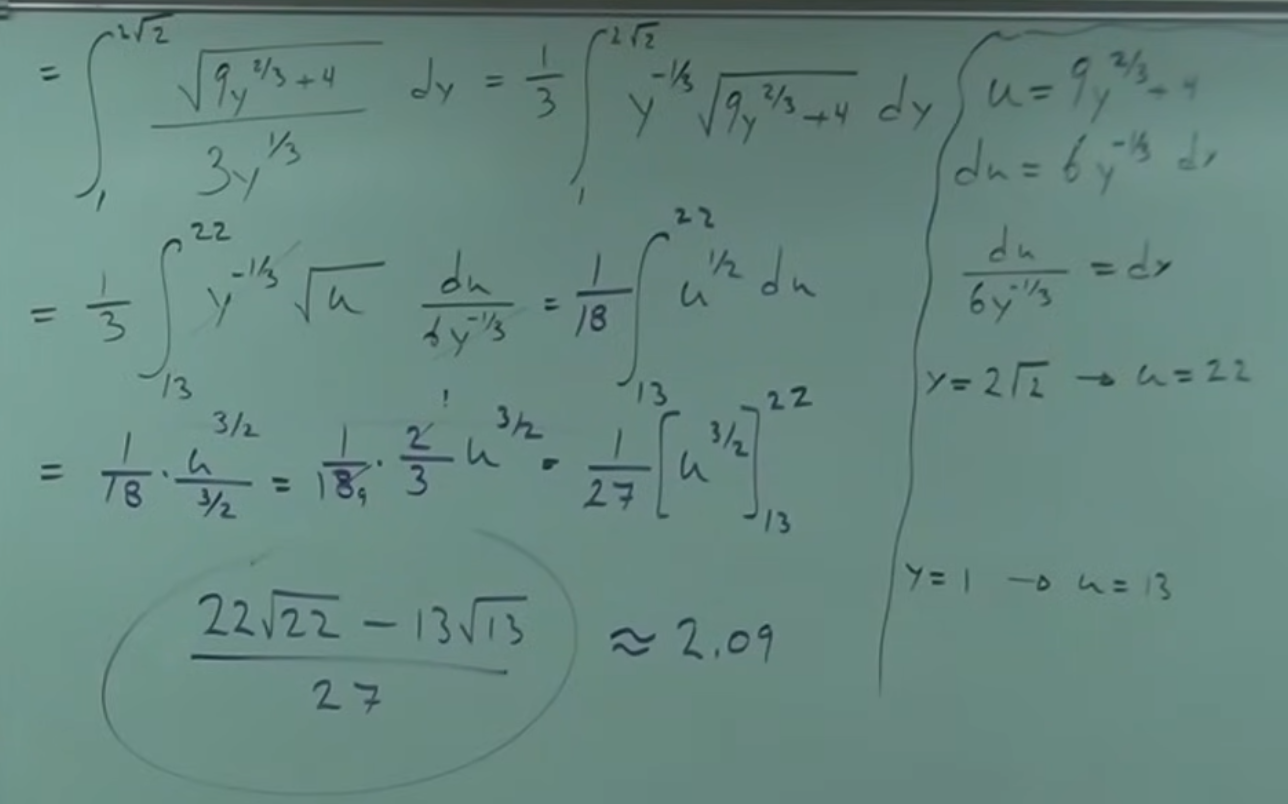
- $𝐋=\displaystyle
\int_{1}^{2\sqrt{2}}\sqrt{\,1+\big(\dfrac{2}{3}𝒚^{-1/3}\big)^{2}\,}\,\mathrm{d}𝒚$
- $=\displaystyle \int_{1}^{2\sqrt{2}}\sqrt{\,1+\dfrac{4}{9}𝒚^{-2/3}\,}\,\mathrm{d}𝒚$
- $=\displaystyle
\int_{1}^{2\sqrt{2}}\sqrt{\,\dfrac{9𝒚^{2/3}+4}{9𝒚^{2/3}}\,}\,\mathrm{d}𝒚$
- $=\displaystyle \int_{1}^{2\sqrt{2}}
\dfrac{\sqrt{\,9𝒚^{2/3}+4\,}}{3\,𝒚^{1/3}}\,\mathrm{d}𝒚$
- Substitution:
- Let $𝒖=9𝒚^{2/3}+4 \;\Rightarrow\; \mathrm{d}𝒖=6\,𝒚^{-1/3}\,\mathrm{d}𝒚
\;\Rightarrow\; \mathrm{d}𝒚=\dfrac{\mathrm{d}𝒖}{6\,𝒚^{-1/3}}$
- Limits: $𝒚=1 \Rightarrow 𝒖=13;\;\; 𝒚=2\sqrt{2} \Rightarrow 𝒖=22$
- Substitute and simplify:
- $𝐋=\dfrac{1}{3}\displaystyle \int_{1}^{2\sqrt{2}}
𝒚^{-1/3}\sqrt{\,9𝒚^{2/3}+4\,}\,\mathrm{d}𝒚$
- $=\dfrac{1}{18}\displaystyle \int_{13}^{22}\sqrt{𝒖}\,\mathrm{d}𝒖$
- $=\dfrac{1}{27}\Big[\,𝒖^{3/2}\,\Big]_{13}^{22}$
- Evaluate:
- $𝐋=\dfrac{1}{27}\Big[\,22^{3/2}-13^{3/2}\,\Big]$
- $=\dfrac{22\sqrt{22}-13\sqrt{13}}{27}\approx 2.09$
Surface area generated by the rotation of a curve
- 1:09:20.
Intro𝒅𝑢ction
- 1:12:50.
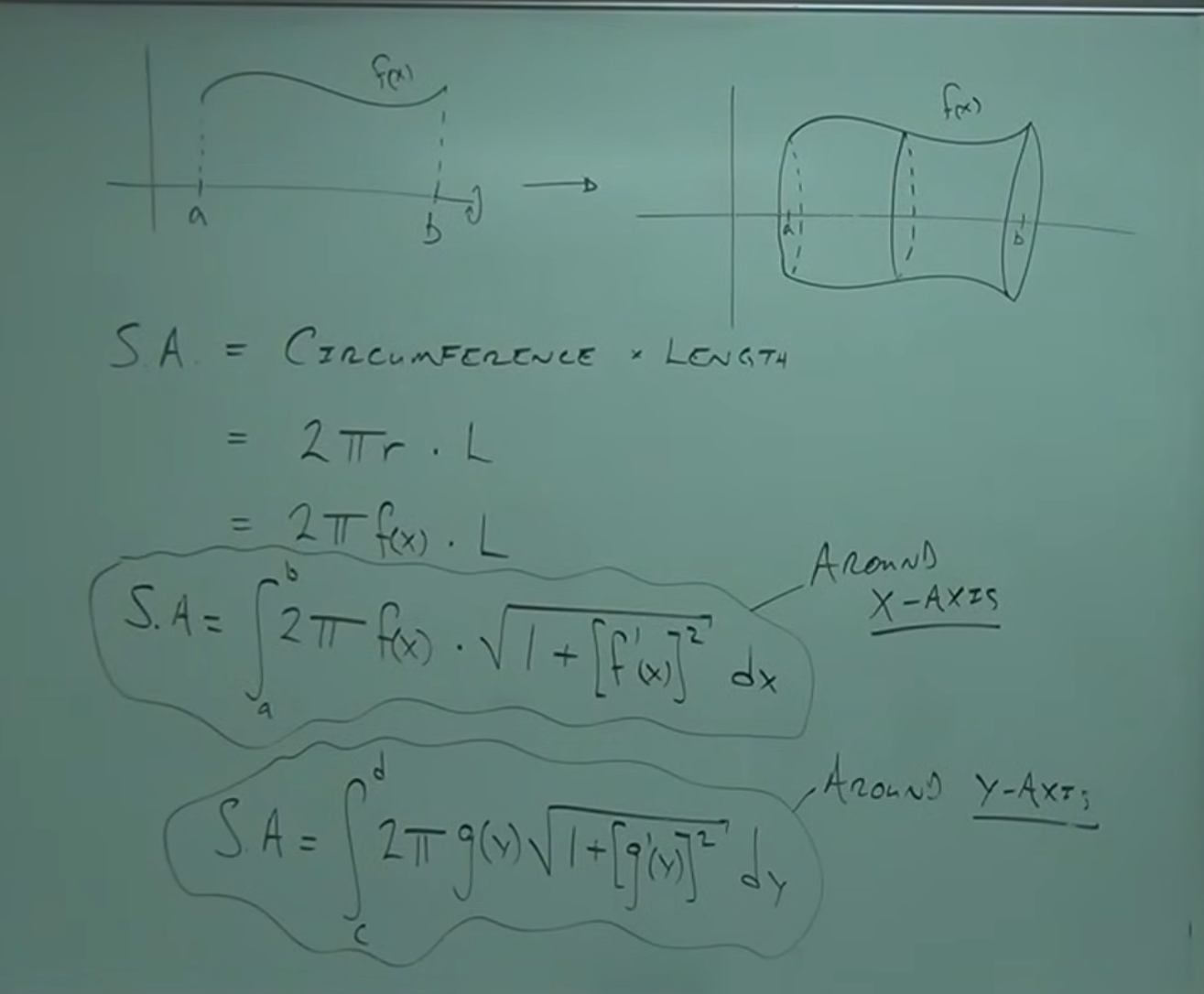
Surface area ($𝓢$) = circumference (cross-section) ∙ length ($𝐿$)
- [📷image]
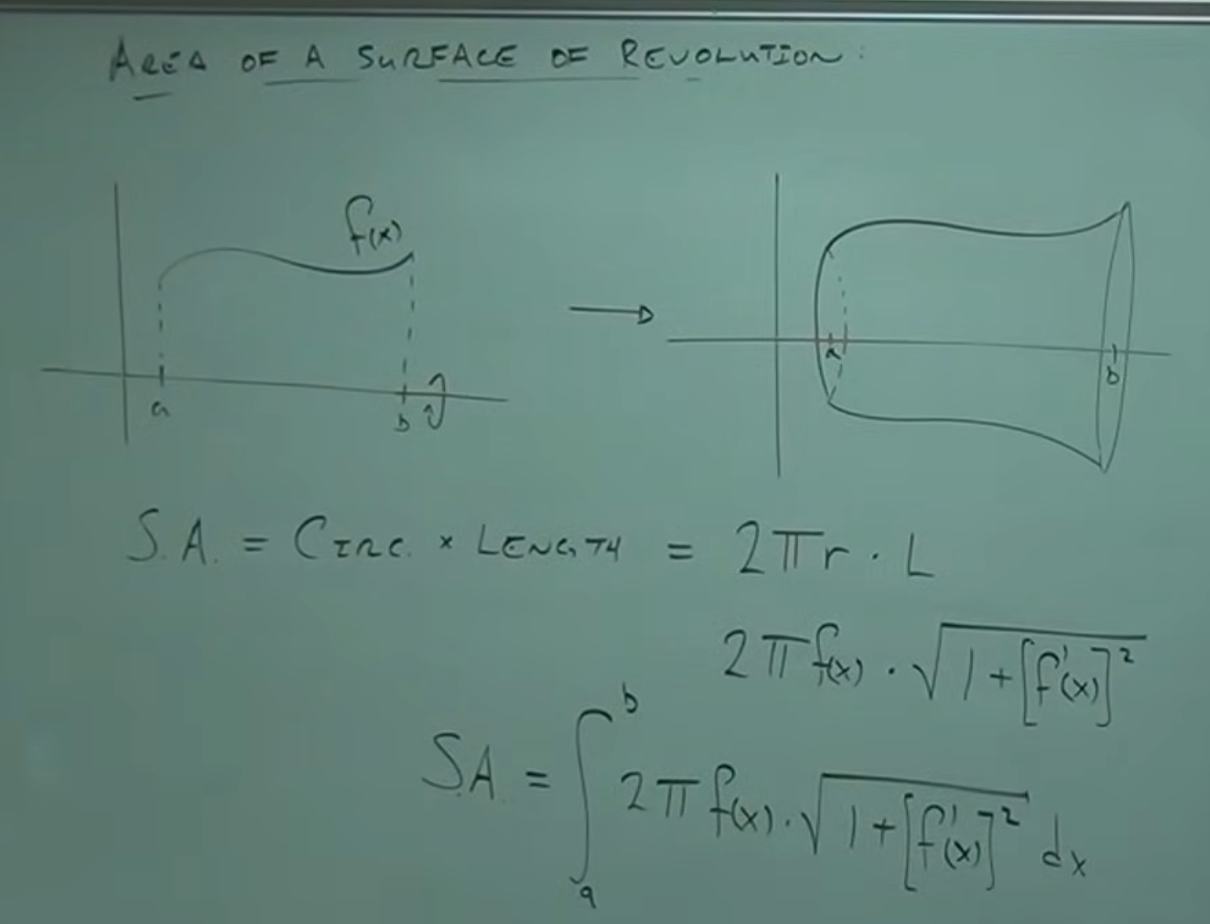
- To find the total surface area of a solid of revolution, we use the concept of surface
area generated by rotating a curve.
- The key steps are:
- Measure the distance traveled by the edge of the shape → This is the arc length of
the generating curve.
- Multiply it by the circumference (cross-section) generated by rotation → This is
the circumference with a radius equal to the distance of the curve from the axis of rotation.
- General formula for surface of revolution:
- If we rotate a function $𝒚=𝒇(𝒙)$ around the $𝒙$-axis, the generated surface
area is computed as:
- $𝓢=\displaystyle \int_{𝒂}^{𝒃} 2\pi\,𝒇(𝒙)\cdot
\sqrt{\,1+\big(𝒇'(𝒙)\big)^{2}\,}\,\mathrm{d}𝒙$
- Where:
- $2\pi\,𝒇(𝒙)$ is the circumference generated when rotating a point
$(𝒙,𝒇(𝒙))$.
- $𝒇(𝒙)$ is the radius at any given point, the distance from $x$-axis to
the function
- $\sqrt{\,1+\big(𝒇'(𝒙)\big)^{2}\,}$ represents the differential arc length
element.
- What we are doing here:
- We take each small segment of the curve.
- Compute its traveled distance (arc length)
$\sqrt{\,1+\big(𝒇'(𝒙)\big)^{2}\,}\,\mathrm{d}𝒙$
- Multiply it by the circumference $2\pi\,𝒇(𝒙)$.
- 1:15:43.
Graphical approach. Full explanation
- [📷image-1]
 - [📷image-2]
 - [📷image-3]
 - [📷image-4]
 - [📷image-5]
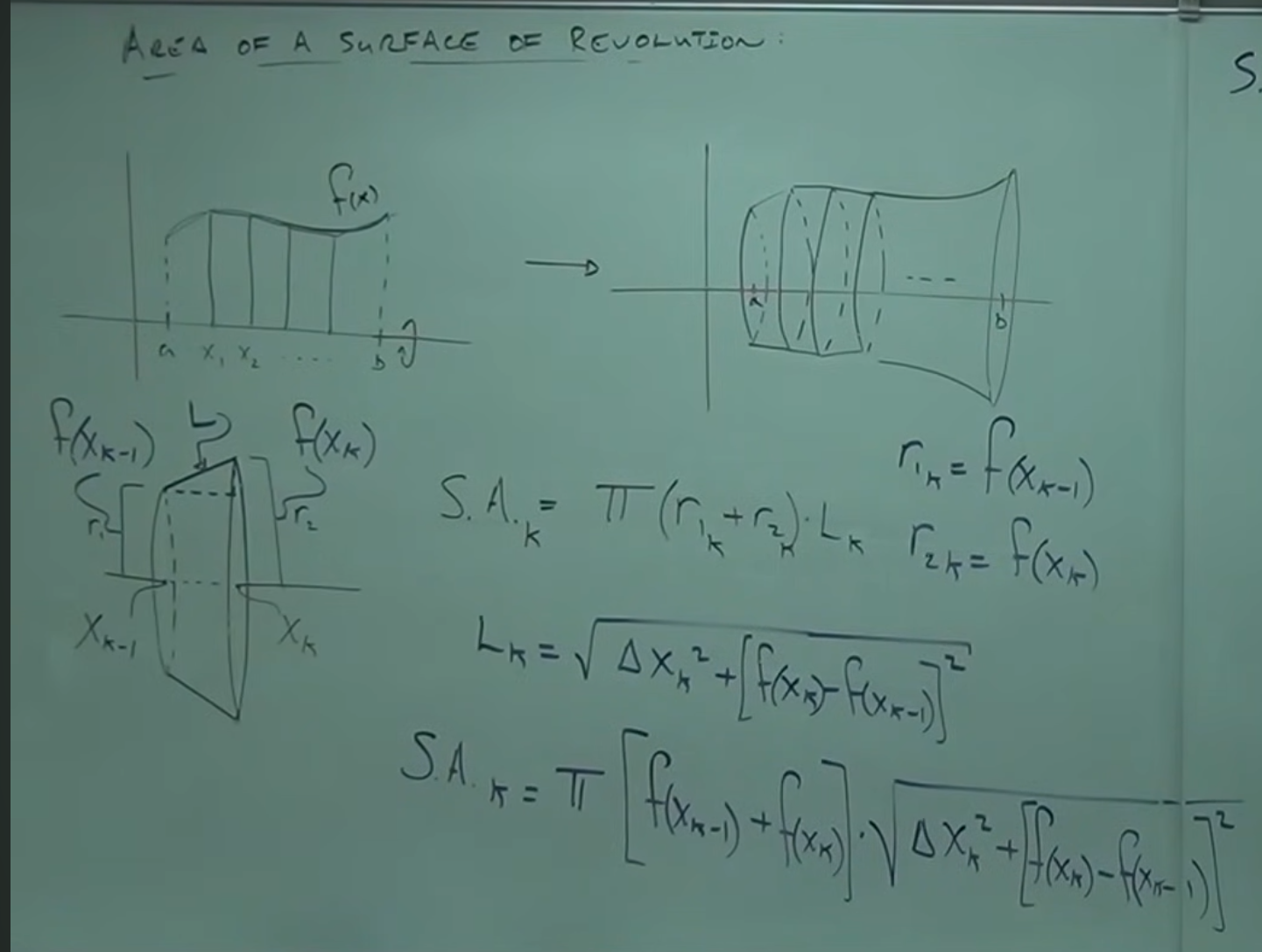
- 1:18:30. Zoom one section of the solid.
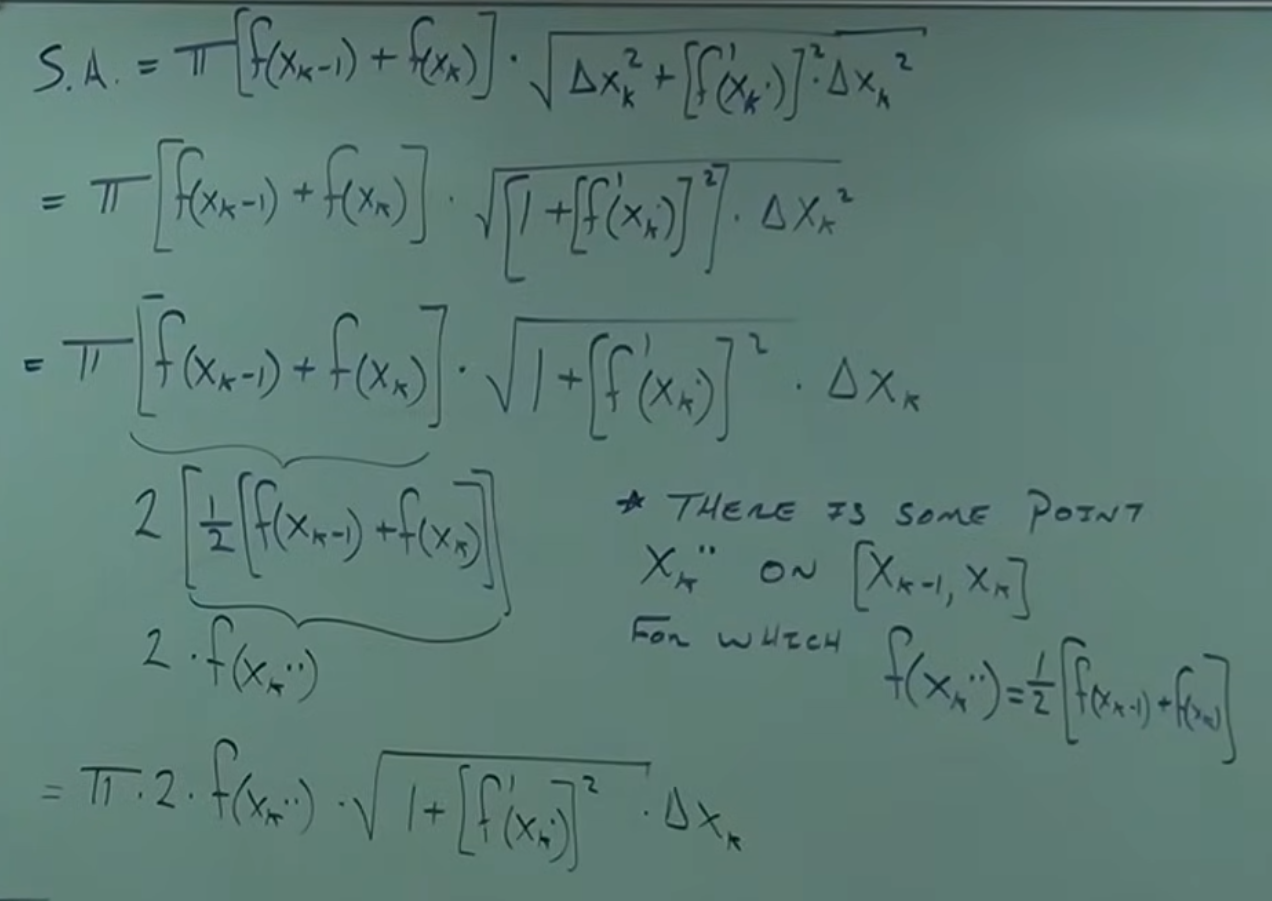
- Each small segment of the solid can be approximated by a truncated cone, where
$𝐿_{k}$ represents the arc length of the generating curve
- We start from the known formula for the lateral surface area of a
truncated cone:
- $𝓢_{k}=\pi\cdot(𝓻_{1k}+𝓻_{2k})\cdot 𝐿_{k}$
- Serves as the foundation for deriving the total surface area of a solid of
revolution
- 1:23:00. $𝓢_{k}=\pi\cdot(𝓻_{1k}+𝓻_{2k})\cdot 𝐿_{k} \;\Rightarrow\;
𝐿_{k}=\sqrt{(\Delta 𝓍_{k})^{2}+\big[\,𝒇(𝓍_{k})-𝒇(𝓍_{k-1})\,\big]^{2}}$
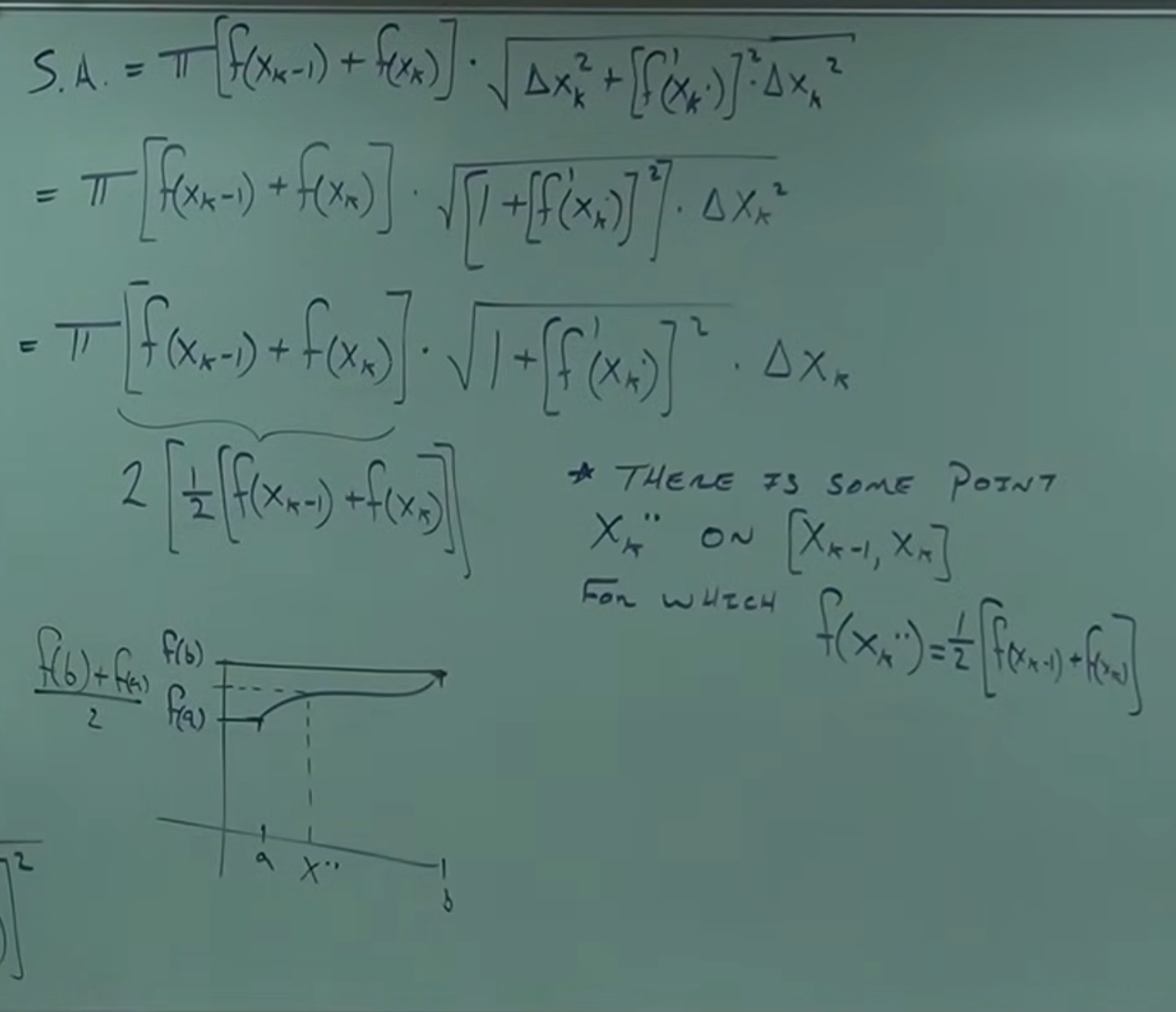
- $𝓢_{k}=\pi\big[\,𝒇(𝓍_{k-1})+𝒇(𝓍_{k})\,\big]\cdot \sqrt{(\Delta
𝓍_{k})^{2}+\big[\,𝒇(𝓍_{k})-𝒇(𝓍_{k-1})\,\big]^{2}}$
- $𝓢_{k}=\pi\big[\,𝒇(𝓍_{k-1})+𝒇(𝓍_{k})\,\big]\cdot \sqrt{(\Delta
𝓍_{k})^{2}+\big[\,𝒇'(𝓍_k^* )\,\Delta 𝓍_{k}\,\big]^{2}}$
- $𝒇(𝓍_{k})-𝒇(𝓍_{k-1})\Rightarrow 𝒇'(𝓍_k^* )\cdot \Delta 𝓍_{k}$ by the mean
value theorem
- $\pi \big[\,𝒇(𝓍_{k-1})+𝒇(𝓍_{k})\,\big]\cdot \sqrt{\,1+\big(𝒇'(𝓍_k^*
)\big)^{2}\,}\cdot \Delta 𝓍_{k}$
- 1:29:05. $𝒇(𝓍_{k-1})+𝒇(𝓍_{k}) \;\Rightarrow\; 2\cdot
\dfrac{𝒇(𝓍_{k-1})+𝒇(𝓍_{k})}{2}=$ average of radii
- There is some point $𝓍_{k}^{**}\in[𝓍_{k-1},𝓍_{k}]$ for which
$𝒇(𝓍_{k}^{**})=\dfrac{𝒇(𝓍_{k-1})+𝒇(𝓍_{k})}{2}=$ average of heights
- 1:34:35. $\pi \big[\,𝒇(𝓍_{k-1})+ 𝒇(𝓍_{k})\,\big]\cdot \sqrt{\,1+\big(𝒇'(𝓍_k^*
)\big)^{2}\,}\cdot \Delta 𝓍_{k} \;\Rightarrow\; \pi \cdot 2 \cdot 𝒇(𝓍_{k}^{**})\cdot
\sqrt{\,1+\big(𝒇'(𝓍_k^* )\big)^{2}\,}\cdot \Delta 𝓍_{k}$
- $𝓢_{k}=2\pi\cdot 𝒇(𝓍_{k}^{** })\cdot \sqrt{\,1+\big(𝒇'(𝓍_k^* )\big)^{2}\,}\cdot
\Delta 𝓍_{k}$
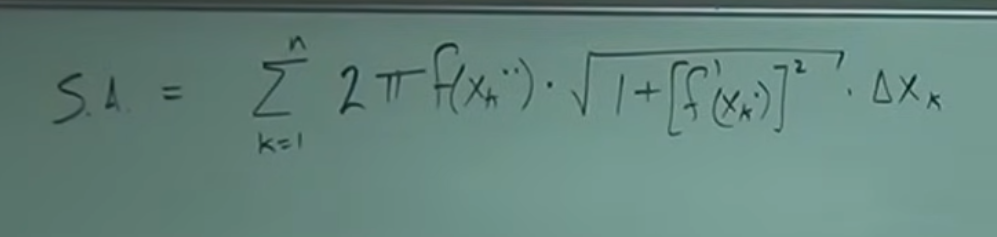
- 1:36:10. Sum up all $𝓢_{k}$
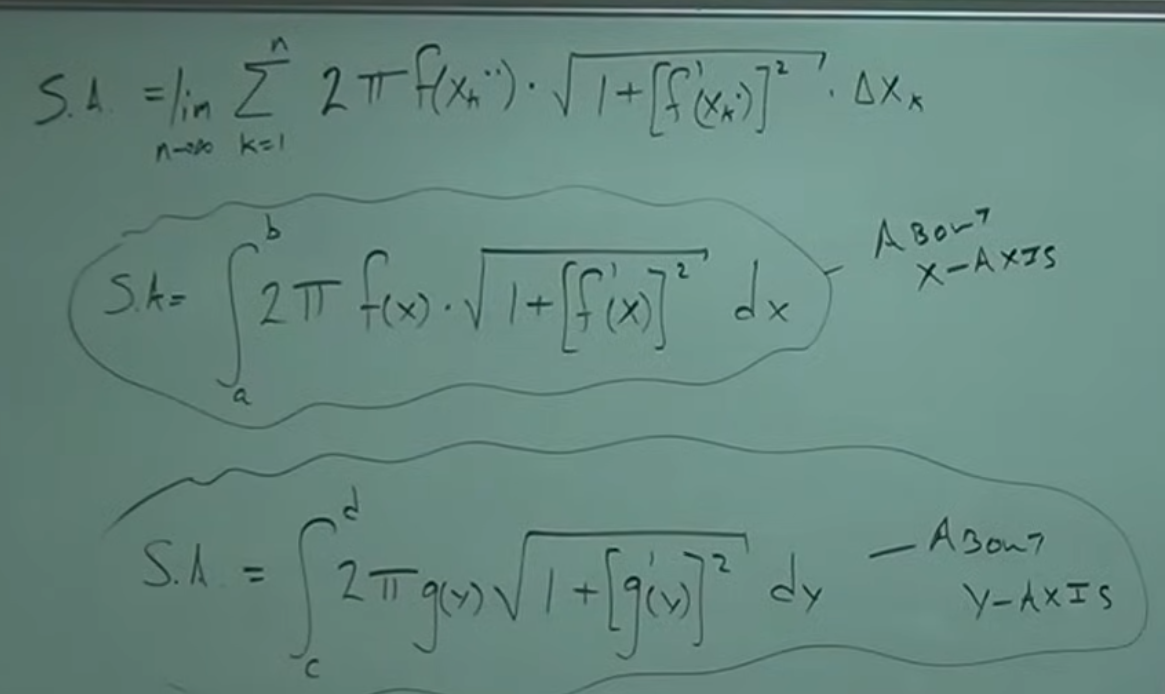
- $𝓢=\displaystyle \lim_{n\to\infty}\sum_{k=1}^{n} 2\pi\, 𝒇(𝓍_{k}^{**})\cdot
\sqrt{\,1+\big(𝒇'(𝓍_{k}^{*})\big)^{2}\,}\cdot \Delta 𝓍_{k}$
- $\boxed{𝓢=\displaystyle \int_{𝓪}^{𝓫} 2\pi\,𝒇(𝓍)\cdot
\sqrt{\,1+\big(𝒇'(𝓍)\big)^{2}\,}\,\mathrm{d}𝒙 \;}$ about $𝓍$-axis
- $\boxed{𝓢=\displaystyle \int_{𝒸}^{𝒹} 2\pi\,𝒈(𝒚)\cdot
\sqrt{\,1+\big(𝒈'(𝒚)\big)^{2}\,}\,\mathrm{d}𝑦 \;\;}$ about $𝒚$-axis
- 1:38:55.
Graphical approach. Simplified version
- [📷image]
- 1:48:15.
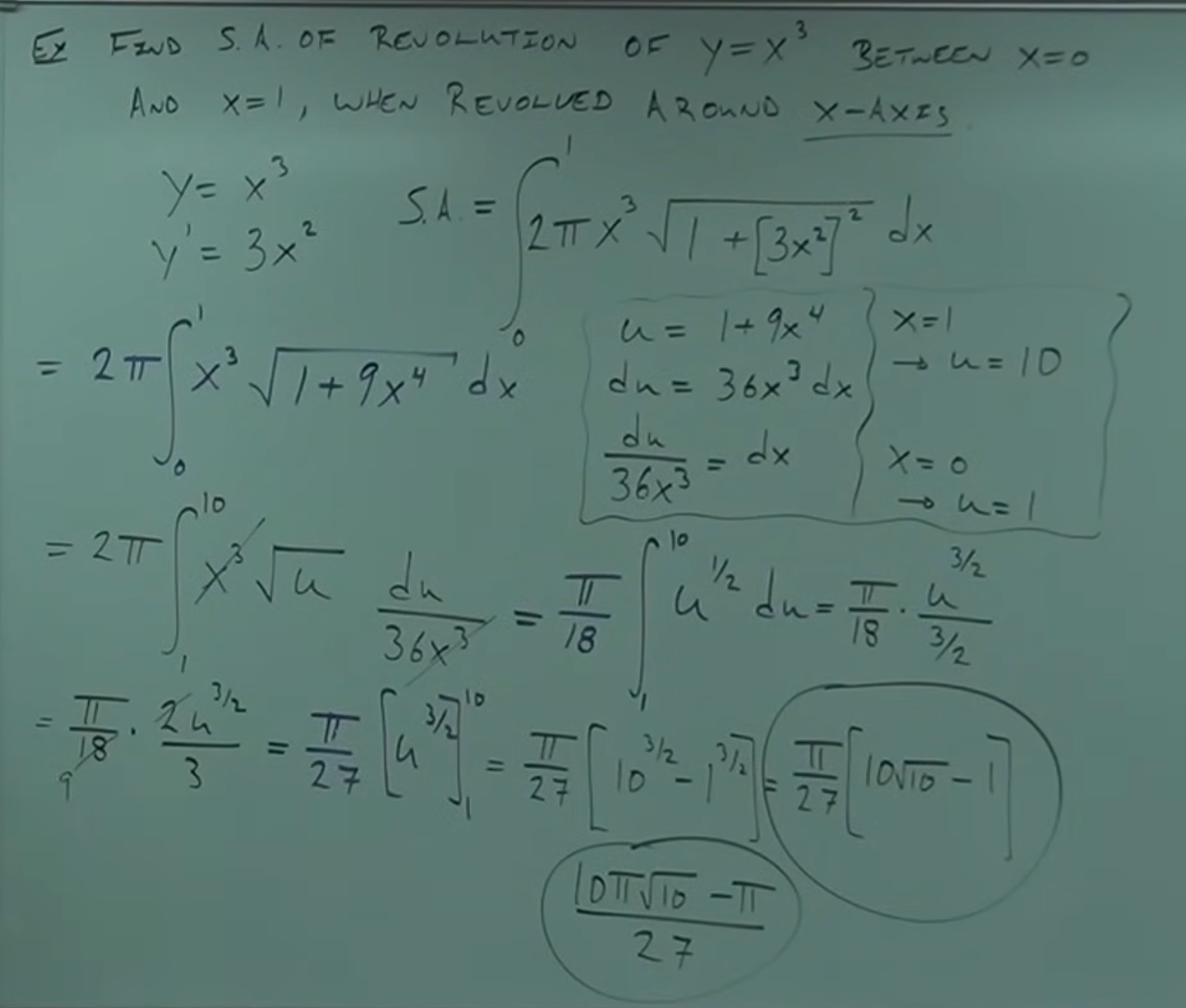
🧩 Example – Find the Surface Area ($𝓢$) of revolution: $𝒚=𝒙^{3}$ between $𝒙=0$ and $𝒙=1$, when revolved
around the $𝒙$-axis –
- [📷image]
- Starting point
- We start from the known formula for the lateral surface area of a
truncated cone:
- $𝓢_{k}=\pi\cdot(𝓻_{1k}+𝓻_{2k})\cdot 𝐿_{k}$
- In the limit as $\Delta 𝒙\to 0$, this leads to the formula for the surface area of a
solid of revolution:
- $𝓢=\displaystyle \int_{𝓪}^{𝓫} 2\pi\cdot 𝒓\cdot
\sqrt{\,1+\big(𝒇'(𝒙)\big)^{2}\,}\,\mathrm{d}𝒙$
- Given data
- Function: $𝒚=𝒙^{3}$
- Derivative: $𝒚'=3𝒙^{2}$
- Formula setup
- Substitute into the formula:
- $𝓢=\displaystyle \int_{0}^{1} 2\pi\cdot 𝒙^{3}\cdot
\sqrt{\,1+\big(3𝒙^{2}\big)^{2}\,}\,\mathrm{d}𝒙$
- Simplify inside the radical:
- Therefore:
- $𝓢=2\pi \displaystyle \int_{0}^{1} 𝒙^{3}\sqrt{\,1+9𝒙^{4}\,}\,\mathrm{d}𝒙$
- Substitution
- Let $𝓾=1+9𝒙^{4}$
- $\mathrm{d}𝓾=36𝒙^{3}\,\mathrm{d}𝒙 \;\Rightarrow\;
\mathrm{d}𝒙=\dfrac{\mathrm{d}𝓾}{36𝒙^{3}}$
- Bounds:
- $𝒙=0 \Rightarrow 𝓾=1$
- $𝒙=1 \Rightarrow 𝓾=10$
- Substitute into the integral:
- $𝓢=2\pi \displaystyle \int_{1}^{10} 𝒙^{3}\cdot \sqrt{𝓾}\cdot
\dfrac{\mathrm{d}𝓾}{36𝒙^{3}}$
- Simplify constants: $𝓢=\dfrac{\pi}{18} \displaystyle \int_{1}^{10}
\sqrt{𝓾}\,\mathrm{d}𝓾$
- Integration
- $\displaystyle \int \sqrt{𝓾}\,\mathrm{d}𝓾=\dfrac{2}{3}\,𝓾^{3/2}$
- Then:
- $𝓢=\dfrac{\pi}{18}\cdot \dfrac{2}{3}\cdot \Big[\,𝓾^{3/2}\,\Big]_{1}^{10}$
- $𝓢=\dfrac{\pi}{27}\big(10^{3/2}-1\big)$
- Final result
- $𝓢=\dfrac{\pi}{27}\big(10\sqrt{10}-1\big)$
- 1:59:40.
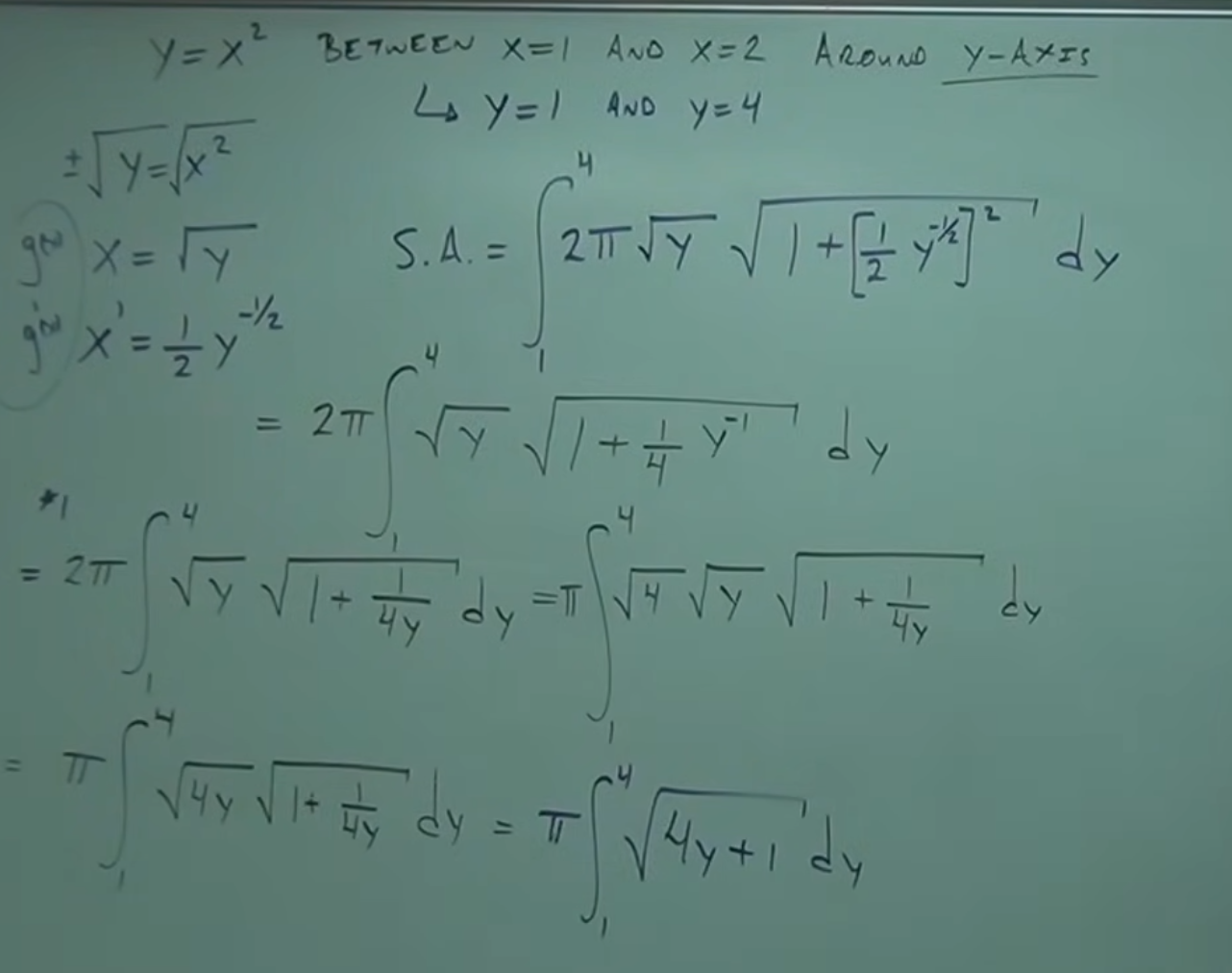
🧩 Example – Find the Surface Area ($𝓢$) of revolution: $𝒚=𝒙^{2}$ between $𝒙=1$ and $𝒙=2$, when revolved
around the $𝒚$-axis
- [📷image-1]
 - [📷image-2]
- Set the problem in 𝒚 (axis is 𝒚)
- For revolution around 𝒚-axis, use $𝓢=\displaystyle \int_{𝒸}^{𝒹} 2\pi\,𝒈(𝒚)\cdot
\sqrt{\,1+\big( 𝒈'(𝒚)\big)^{2}\,}\,\mathrm{d}𝑦$
- From $𝒚=𝒙^{2}\Rightarrow 𝒙=\sqrt{𝒚}$ (take the positive branch on $𝒙\in[1,2]$);
$𝒙'(𝒚)=\dfrac{\mathrm{d}𝒙}{\mathrm{d}𝒚}=\dfrac{1}{2}\cdot 𝒚^{-1/2}$
- Bounds and radii
- $𝒙\in[1,2]\Rightarrow 𝒚\in[1,4]$.
- Radius to the 𝒚-axis: $𝒓(𝒚)=𝒙=\sqrt{𝒚}$
- Set up the integral
- $𝓢=\displaystyle \int_{1}^{4} 2\pi\cdot \sqrt{𝒚}\cdot
\sqrt{\,1+\big(\dfrac{1}{2}\cdot 𝒚^{-1/2}\big)^{2}\,}\,\mathrm{d}𝒚$
- Inside the root: $\big(\dfrac{1}{2}\cdot
𝒚^{-1/2}\big)^{2}=\dfrac{1}{4𝒚}\;\Rightarrow\; \sqrt{\,1+\dfrac{1}{4𝒚}\,}$
- $𝓢=2\pi \displaystyle \int_{1}^{4} \sqrt{𝒚}\cdot
\sqrt{\,1+\dfrac{1}{4𝒚}\,}\,\mathrm{d}𝒚$
- (1*) Board path 1 — “Insert 2 as $\sqrt{4}$ inside the radical”
- Combine radicals as on the board:
- $𝓢=2\pi \displaystyle \int_{1}^{4} \sqrt{𝒚}\cdot
\sqrt{\,1+\dfrac{1}{4𝒚}\,}\,\mathrm{d}𝒚 \;\to$
- $𝓢=\pi \displaystyle \int_{1}^{4} \sqrt{4}\cdot \sqrt{𝒚}\cdot
\sqrt{\,1+\dfrac{1}{4𝒚}\,}\,\mathrm{d}𝒚$
- $𝓢=\pi \displaystyle \int_{1}^{4} \sqrt{4𝒚}\cdot
\sqrt{\,1+\dfrac{1}{4𝒚}\,}\,\mathrm{d}𝒚$
- $𝓢=\pi \displaystyle \int_{1}^{4} \sqrt{\,4𝒚+1\,}\,\mathrm{d}𝒚$
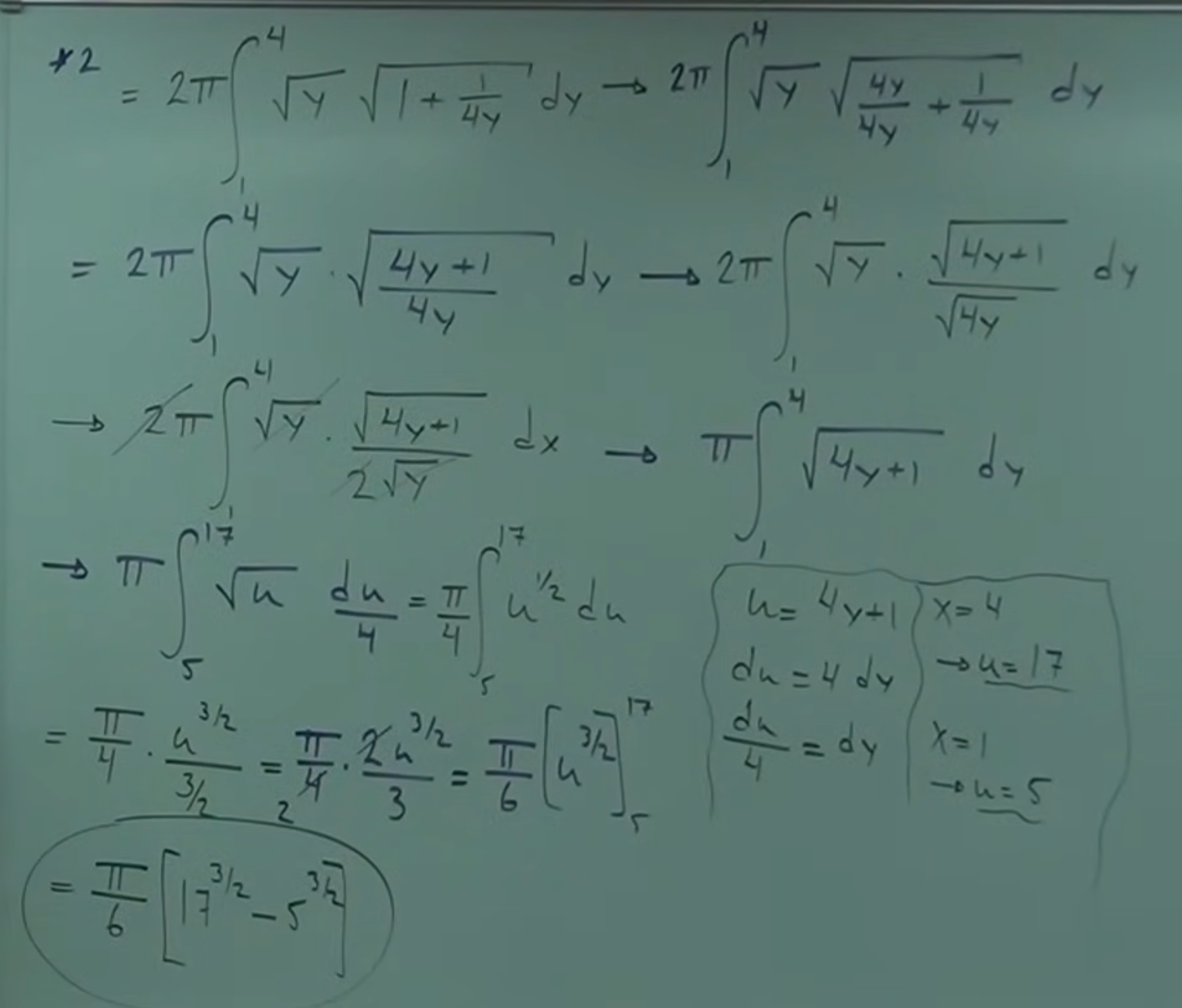
- (2*) Board path 2 — “Explicit cancellation of $\sqrt{𝒚}$ and constants”
- Repeat the starting line and show each cancellation step-by-step:
- $𝓢=2\pi \displaystyle \int_{1}^{4} \sqrt{𝒚}\cdot
\sqrt{\,1+\dfrac{1}{4𝒚}\,}\,\mathrm{d}𝒚$
-
$\sqrt{\,1+\dfrac{1}{4𝒚}\,}=\sqrt{\,\dfrac{4𝒚+1}{4𝒚}\,}=\dfrac{\sqrt{\,4𝒚+1\,}}{2\sqrt{𝒚}}$
- $𝓢=2\pi \displaystyle \int_{1}^{4} \sqrt{𝒚}\cdot
\dfrac{\sqrt{\,4𝒚+1\,}}{2\sqrt{𝒚}}\,\mathrm{d}𝒚=\pi \displaystyle \int_{1}^{4}
\sqrt{\,4𝒚+1\,}\,\mathrm{d}𝒚$
- Substitution and evaluation:
- Let $𝓾=4𝒚+1 \Rightarrow \mathrm{d}𝓾=4\,\mathrm{d}𝒚,\; 𝒚=1 \Rightarrow 𝓾=5,\;
𝒚=4 \Rightarrow 𝓾=17$
- $𝓢=\dfrac{\pi}{4}\displaystyle \int_{5}^{17} 𝓾^{1/2}\,\mathrm{d}𝓾$
- $𝓢=\dfrac{\pi}{4}\cdot \dfrac{2}{3}\cdot 𝓾^{3/2}\,\Big|_{5}^{17}$
- $𝓢=\dfrac{\pi}{6}\big[\,17^{3/2}-5^{3/2}\,\big]$